
Voice search is rapidly reshaping how consumers discover local businesses. In 2025, approximately 20.5% of people worldwide said they used voice search in some form. This shows the obvious growth of spoken queries in today’s search behaviour.


Capturing these local voice searches allows businesses to connect with high-intent customers in real time, making it a necessity to adopt strategies that align with how people speak and search on mobile devices and smart assistants.
Implementing voice search optimisation as part of a local SEO strategy helps your business appear in relevant searches. It can drive more foot traffic and local engagement.
Let’s look at the proper voice search optimisation steps for your business.
Key Takeaways
- Most voice queries include natural, question-based language and often contain “near me” or location-specific intent, so optimising for these phrases is essential.
- Accurate NAP details, categories, photos, business hours and reviews increase your chances of being featured in local voice search results.
- Creating FAQ sections, long-tail question-focused content and mobile-friendly pages helps your site align with how people speak and search.
What is Voice Search?

Image Credit: Seobility
Voice search describes a method of interacting with technology whereby users speak a query, rather than typing it and receive an answer verbally or via an onscreen result. It is enabled by voice‑activated assistants such as Google Assistant, Apple Siri, Amazon Alexa and similar smart‑speaker or mobile device systems.

Imagine you’re commuting on the MRT from Orchard to Marina Bay in Singapore and you suddenly remember you need to pick up a birthday cake. You pull out your smartphone and say: “Hey Google, where’s a good cake shop near Marina Bay that’s open now?”
The query is more conversational, more natural‑language and often shorter in terms of context but richer in phrasing.

As technology advances and voice‑enabled devices proliferate (smart speakers, car assistants, mobile devices), voice search becomes more embedded in everyday behaviour. For businesses, especially with local footprints, failing to optimise for voice means missing out on a growing stream of queries that are high‑intent and local in nature.
Because many voice searches are done on the go (mobile) and often converted into a call, visit or direction, they tend to carry substantial value. Ensuring your content and listings align with how people speak and search is becoming a must.
What Are “Near Me” Queries?
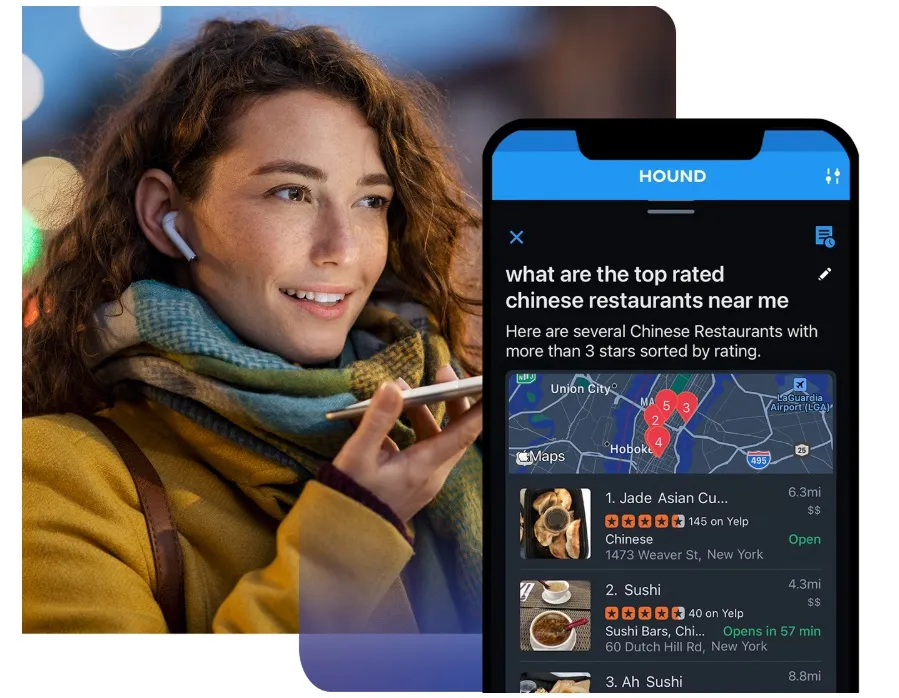
Image Credit: SoundHound AI
“Near me” queries refer to search engine inputs in which a user explicitly adds modifiers such as “near me”, “nearby” or “close to me”, when looking for a product, service or business in very close geographic proximity.
Typical examples include phrases like “coffee shop near me”, “electrician near me open now” or “bookstore near me Singapore”. These searches are a subset of local‑search behaviour and strongly indicate that the user is seeking something available in the immediate area, often with intent to act quickly.
Key Features of “Near Me” Searches
Here are some characteristics that define these queries:
- Location‑focused intent: The user is actively looking for options around them or within a defined radius (for example, 5 km). Searches that include the phrase “near me” rely heavily on device location data (GPS, IP address) or on the user explicitly being in a given place.
- High immediacy: Many of these queries express a readiness to visit, call, purchase or otherwise engage, for example when someone asks “pharmacy open now near me”.
- Mobile dominance: A large proportion of “near me” searches originate on smartphones, tablets or other mobile devices while on the move.
- Conversational tone: Since many of these arise from voice‑search or quick mobile queries, they tend to be more natural‑language (e.g., “Where’s the nearest burger place open near me?”) rather than terse keyword phrases.
- Local business relevance: These searches are especially relevant to businesses that operate in a defined physical location (shops, cafés, service companies) because the query implies proximity and an offline action.
Let’s say you’re in Singapore, near the Bugis Junction area and you need a fast scooter repair. You open your phone and ask: “Scooter repair shop near me Bugis open now”
Your device recognises your location (Bugis, Singapore), interprets the intent (scooter repair, immediate) and the modifier “near me” emphasises proximity. The results returned will favour businesses with accurate location data, business hours, strong reviews and mobile‑friendly websites, giving those businesses a higher chance of being chosen.
How to Capture Local Voice Queries In 8 Steps
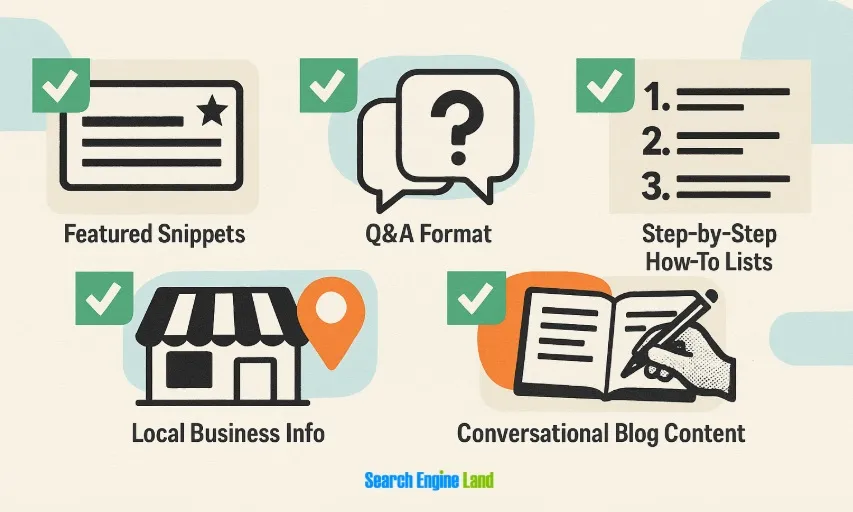
Image Credit: Search Engine Land
Capturing local voice queries requires a combination of local SEO optimisation, conversational content and technical readiness. Follow these steps to ensure your business appears in high‑intent local voice searches.
Step 1: Identify Conversational and Local Keywords
- Focus on natural, question-based phrases people might speak rather than type. Examples include:
- “Where can I find a vegan café near Orchard Road Singapore?”
- “Best plumber near me open now in Marina Bay”
- Use tools such as Google’s People Also Ask, AnswerThePublic and local keyword planners to discover long-tail and local search terms.
- Analyse competitors’ listings to identify gaps and common phrases.
Step 2: Optimise Your Google Business Profile
- Ensure your NAP (Name, Address, Phone number) is accurate, consistent and complete.
- Add categories, services, photos and updated business hours.
- Encourage reviews, as voice assistants prioritise highly rated local businesses.
- Include common questions and answers in your business description or posts, which can appear as featured snippets.
Step 3: Create Conversational Website Content
- Write content in a natural, conversational tone that mirrors how users speak.
- Add an FAQ section addressing questions your local customers frequently ask. For example:
- “Do you deliver in the Marina Bay area?”
- “Are you open on weekends?”
- Optimise blog posts and landing pages with long-tail, question-style keywords.
Step 4: Implement Local Schema Markup
- Use structured data (JSON‑LD) to help search engines understand your business.
- Mark up: address, phone number, opening hours, services, menu items and location.
- A sample schema would look like this:
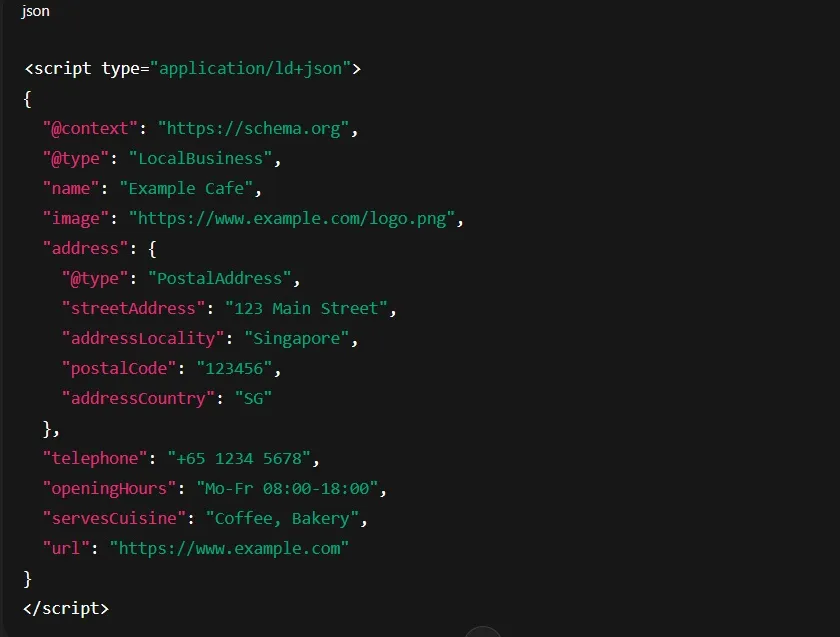
Image Credit: ChatGPT Generated
- Proper schema increases the likelihood of appearing in voice search results and rich snippets.
Step 5: Ensure Mobile-Friendliness and Fast Load Times
- Voice searches are predominantly on mobile devices, so a responsive design is crucial.
- Compress images, enable browser caching and optimise scripts to improve page speed.
- Test your site with tools like Google PageSpeed Insights to confirm performance.
Step 6: Build Local Citations and Backlinks
- List your business consistently across local directories (Yelp, TripAdvisor, Singapore Business Directory).
- Contribute guest posts to local blogs, media and organisations to acquire backlinks.
Local citations improve your visibility and authority, increasing the chance of being returned for voice queries.
Step 7: Monitor Performance and Adjust Strategy
- Track voice search traffic and performance with Google Search Console and analytics tools.
- Monitor rankings for “near me” and question-based queries.
- Update content, listings and FAQs regularly based on data trends.
- Consider testing different conversational keywords to refine your reach.
Step 8: Leverage Local Reviews and Engagement

Image Credit: Social Pilot
- Encourage satisfied customers to leave reviews mentioning location and services, as voice assistants often pull content from reviews.
- Respond to reviews promptly to maintain trust and improve local reputation.
- Use social media posts to highlight local events, promotions and community involvement, reinforcing your local relevance.
Securing Your Local Voice Search Advantage
Identify conversational keywords, maintain an up-to-date Google Business Profile, create mobile-friendly content, and implement structured data to capture more local voice traffic and turn searches into real-world visits.
Regular monitoring and adaptation ensure your strategy keeps pace with evolving user behaviour and voice technology.
Take the next step in dominating local search by partnering with MediaOne. Our team of experts can help optimise your business to ensure you appear in front of local customers exactly when they’re looking for your products or services. Contact us now!
Frequently Asked Questions
How does multilingual search affect local voice queries?
In multilingual regions like Singapore, users may speak queries in English, Mandarin, Malay, Tamil, or even informal Singlish. Optimising content to recognise these variations can improve visibility in voice search results.
Do virtual assistants favour certain types of businesses for voice search?
Voice assistants tend to prioritise businesses with complete listings, high ratings, fast websites and clear answers to FAQs. Service-oriented, location-based businesses often benefit the most.
Can seasonal or temporary changes impact voice search visibility?
Yes. For example, seasonal hours, pop-up locations, or temporary closures can affect whether your business appears in voice results. Keeping listings and content updated is essential.
How does voice search influence paid advertising strategies?
While organic visibility is key, integrating voice-focused keywords into local pay-per-click (PPC) campaigns can capture users who prefer voice commands, especially for “near me” searches.
Is it necessary to optimise for every voice assistant individually?
While Google Assistant dominates search, optimising for multiple platforms like Siri, Alexa and Bixby can expand reach. The fundamentals, accurate listings, conversational content and structured data benefit all assistants.