I once had a client tell me, quite confidently, that his business did not need crisis management planning because he ran a “boring” company. No drama, no controversy, nothing to worry about.

Six weeks later, a disgruntled ex-employee posted a detailed account of their experience on Facebook. By the time the client called me, it had been shared three hundred times and a local news outlet had reached out for comment.
That is the thing about brand crises. They do not announce themselves in advance, and they do not care whether you think your business is interesting enough to be a target.
Brand crisis management is the structured process of detecting, responding to, and recovering from events that damage a brand’s reputation, trust, or commercial relationships. In Singapore, where social media reaches 88.2% of the population and news routinely moves through WhatsApp groups, Telegram channels, and TikTok feeds before it reaches any newsroom, the window for a composed response is genuinely narrow.
Most guides on this subject focus on the mechanics: what to post, when to apologise, and how to handle comments. What they tend to skip over is the strategic layer. Who is watching before something breaks? Who decides what gets said and in what order? Who ensures the brand does not say something that lands badly with the legal team three days later?
That is what this guide covers. It looks at how a social media marketing firm supports crisis management from preparation through to recovery, what good looks like at each stage, and what to ask before you trust an agency with something this consequential.
If you want someone to think through this with you, MediaOne works with Singapore businesses as a social media marketing consultancy that treats crisis readiness as a serious part of the brief.
Key Takeaways
- A social media marketing firm provides structure, speed, and objectivity, which are critical for managing crises effectively.
- Early detection through social listening can prevent minor issues from escalating into full reputational events.
- Delayed or inconsistent responses often worsen crises and damage long-term brand trust.
- Crisis management requires preparation, not just reaction, including frameworks, monitoring, and trained teams.
- Recovery depends on consistent communication, accountability, and sustained trust-building after the crisis.
Understanding Brand Crises in a Social Media-Driven World
Not every reputational problem is a crisis. I think that distinction matters more than most businesses realise.
A negative review is not a crisis. A slow week of poor comments is not a crisis. A crisis is when the volume, velocity, and sentiment of negative attention reach a point where it begins to affect how people perceive the business at scale, and where inaction or a poor response makes the situation materially worse.
Singapore’s social media environment raises the stakes considerably. With 88.2% of the population active on social platforms and 97% of that access happening on mobile devices, a difficult moment can turn into a public conversation before your marketing team has had their morning coffee.
Understanding what a crisis actually looks like, and how it travels, is the starting point for managing one well.
Types of Brand Crises
In my experience, most brand crises fall into one of four broad categories. They are not always clean or distinct. Some overlap. But recognising the type of crisis you are dealing with matters because it shapes how you should respond.
1. PR Backlash
This category covers situations in which a brand publicly says or does something perceived as offensive, tone-deaf, or misaligned with audience values. The trigger is often unintentional. A campaign that reads differently across demographics. A spokesperson’s comment was taken out of context. A social post that lands badly during a sensitive news cycle.
Singapore has seen a number of these in recent years. The CDL boardroom dispute in early 2025 between CEO Sherman Kwek and executive chairman Kwek Leng Beng is a useful reference point. What began as an internal corporate conflict became a public story as details surfaced, stock prices fell, and brand sentiment deteriorated sharply online.
The communications challenge was not just reputational. It was structural because the brand’s credibility was being questioned from within.
PR backlash tends to spread widely and quickly. It attracts commentary from people who have no prior grievance with the brand. Managing it requires a clear, calm public narrative, not defensiveness.
2. Customer Complaints Going Viral
This is the most common crisis type at the SME level, and it is frequently underestimated until it is too late. A single unhappy customer with a detailed post and a credible grievance can generate significant traction, particularly if the brand’s initial response is slow, dismissive, or absent entirely.
What amplifies these situations is not usually the complaint itself. It is the response. When audiences see a brand ignore a legitimate concern, or worse, respond with a generic template, the original complaint becomes secondary. The brand’s behaviour under scrutiny becomes the story.
3. Product or Service Failures
These crises combine an operational problem with a reputational one, and the two need to be managed in parallel. The Chocolate Finance situation in early 2025 is a clear example.
When the brand suspended instant withdrawals on its Chocolate Card following a surge in customer withdrawals triggered by changes to its bill payment rewards programme, customers were frustrated.
But the frustration was compounded by the significant delay in communication and the initial lack of clarity about what was actually happening.
The CEO eventually addressed it publicly on LinkedIn, and his transparency helped somewhat. But by that point, the narrative had already been shaped by speculation and customer anxiety.
The lesson here is not that the operational issue was avoidable. It is that faster, clearer communication would have managed the reputational dimension more effectively, even while the operational fix was still in progress.
4. Internal Scandals
These often land harder than external ones, precisely because they signal something is wrong beneath the surface. Leadership disputes, employee conduct incidents, and ethical controversies all fall into this category. Audiences tend to be less forgiving of internal scandals because they imply a cultural or governance problem rather than just an isolated mistake.
The communication approach for internal scandals is distinct. Audiences are not looking for a polished corporate response. They want evidence that the organisation understands what happened, takes it seriously, and is doing something meaningful about it. Anything that reads as spin or deflection tends to prolong the crisis rather than contain it.
How Crises Spread on Social Platforms
Understanding how crises travel in Singapore specifically is important because the mechanics here differ from those in many other markets.
WhatsApp is the real accelerant. With approximately 90% penetration and widespread use of community groups, forwarded messages, and broadcast lists, a story can circulate privately and at scale before it surfaces on any public platform.
By the time a crisis appears on your Facebook page or in your Instagram comments, it may already be well-established in WhatsApp conversations you have no visibility into. That invisibility is what makes WhatsApp particularly difficult to monitor.
Telegram channels pick up stories early. Many Singaporean consumers, journalists, and community moderators are active on Telegram. Niche channels covering specific industries, neighbourhoods, or consumer interests can amplify a brand story before traditional media becomes aware of it. A negative experience posted in a Telegram group of 10,000 members has real reach.
TikTok’s algorithm is adversarial to brands in crisis. The platform surfaces reactive and commentary content aggressively. A creator who posts a video about a brand’s poor handling of a situation does not need to have a large following.
If the content resonates, the algorithm distributes it broadly, and the brand may not even be tagged. This is the most difficult channel to monitor and respond to because the conversation is effectively invisible until it has already gained traction.
Beyond the platforms themselves, the pace of spread is the critical factor. Reputational crises now unfold in hours, not days. That compression changes the response calculus entirely. Every additional hour without a coherent public position is an hour in which someone else is shaping the narrative.
Real Impact on Trust, Revenue, and Long-Term Brand Equity
I want to be specific here because the impact of an unmanaged crisis is often discussed in vague terms. The actual consequences are concrete and measurable.
- Search visibility is affected. Negative content, whether it is a forum thread, a news article, a viral post screenshotted and reposted, or a string of one-star Google reviews, gets indexed. It sits in search results and shapes the first impression of every new prospect who searches your brand name. For businesses that rely on organic search for lead generation, this is a direct commercial problem, not just a reputational one.
- Customer acquisition costs increase. When negative sentiment is circulating, conversion rates from marketing channels tend to decline. Prospects are doing their due diligence, they find the negative content, and they hesitate. The leads still come in. They just close at a lower rate. That change in conversion efficiency may not be immediately traced back to the crisis, which makes it easy to underestimate.
- Hiring and partnerships are affected. I see this less discussed, but it matters for founders and business leaders. Potential hires research companies before accepting offers. Partners and corporate clients conduct brand due diligence before committing. An unresolved or poorly managed crisis that appears visibly in search results is a friction point in both conversations.
- Long-term brand equity erodes when crises are left unaddressed. Brand equity is essentially accumulated trust. It takes time to build, and it can be damaged faster than most businesses expect. Industry research consistently indicates that intangible assets, of which brand trust is a significant component, represent approximately 90% of enterprise value for many businesses. That figure helps quantify what is actually at stake.
The brands that recover well from crises are generally not the ones that avoid all criticism. They are the ones who responded with clarity and honesty, demonstrated accountability, and managed the post-crisis period deliberately. Recovery is possible. It is just not automatic.
A note on framing: Many businesses treat a brand crisis as a communications problem to be managed with the right words. In reality, it is a business continuity issue. The communications are important, but they only hold if the underlying response is genuine. Audiences, particularly in Singapore, are discerning. They recognise the difference between accountability and the appearance of accountability. That distinction is where most crisis responses succeed or fail.
Why You Need a Social Media Marketing Firm for Crisis Management
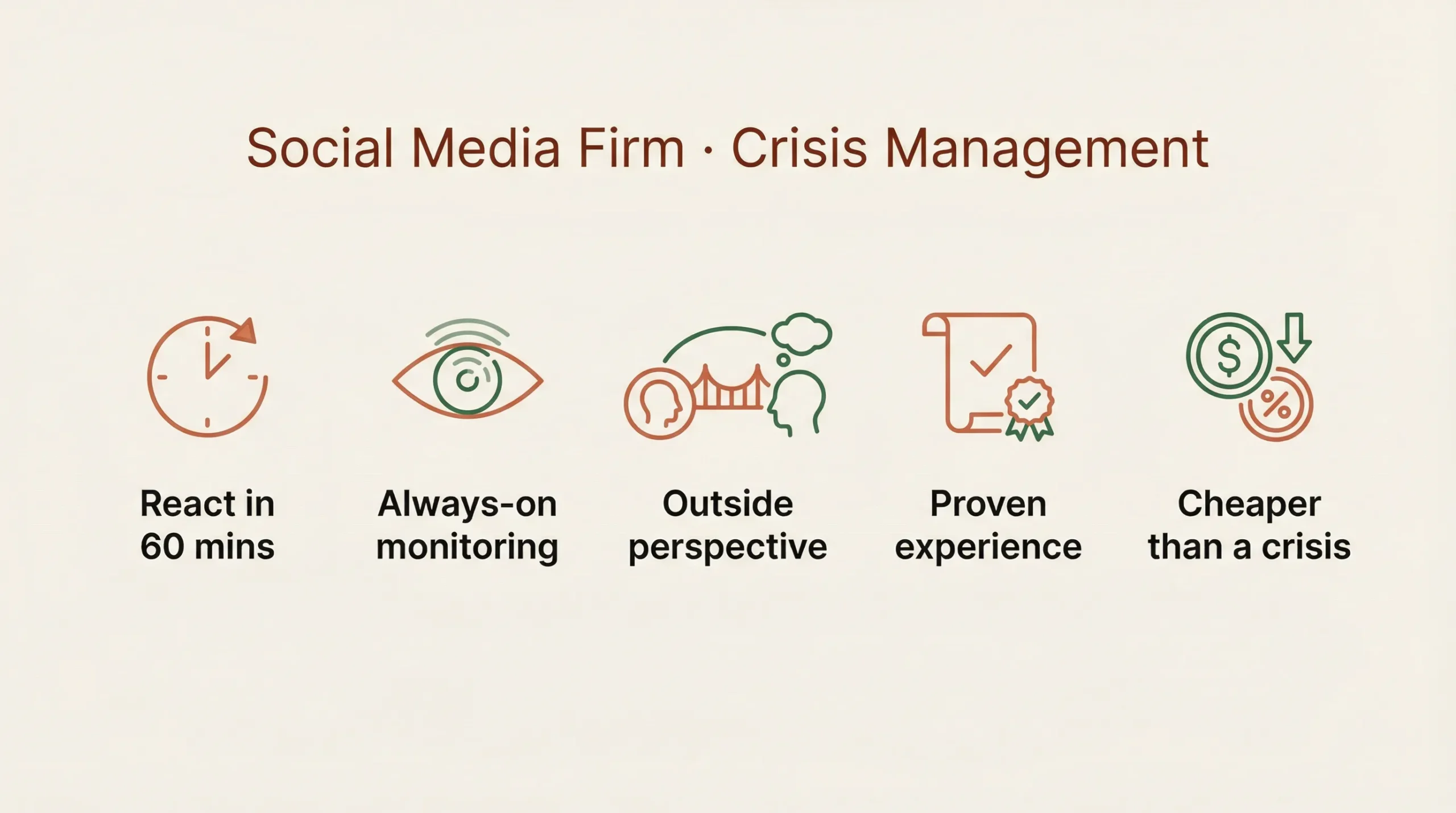
Most business owners I speak with assume their internal team can handle a crisis if one arises. And in some cases, that is true, but only if the team is structured for it, equipped with the right tools, and has done it before.
The reality for most Singapore SMEs is that none of those three conditions is met. When something goes wrong publicly, internal teams are often managing operations, fielding calls, escalating to leadership, and drafting a public response simultaneously. That is a recipe for a delayed, inconsistent, and frequently defensive communication that makes a bad situation worse.
A professional social media marketing firm adds something different to the picture. It is not just execution capacity. It is structure, speed, objectivity, and the kind of operational experience that only comes from having been through it.
Speed and Real-Time Response Capabilities
In a social media crisis, time moves differently than in normal business situations. What might be a manageable complaint at 9 AM can be a trending conversation by 11 AM, picked up by a local community page or a Telegram group by noon, and covered by a media outlet by early afternoon. I have seen this timeline play out more than once in Singapore, and it rarely takes as long as people expect.
The first 60 minutes are the most consequential. This is the window in which a brand can get ahead of the story, acknowledge the situation, and begin shaping how the audience perceives its response.
Miss that window, and you are no longer responding to the conversation. You are reacting to a narrative that has already been set by someone else.
What a social media marketing firm can do in that first hour:
- Identify the source and scope of the issue across platforms
- Assess whether the conversation is localised or spreading
- Draft and issue a holding statement that buys time without making commitments the brand cannot keep
- Brief leadership on what is happening and what needs to be decided
- Begin managing comments and direct messages on the most active channels

Internal teams, unless they are specifically structured for this kind of response, are not set up to move this quickly. There is an approval chain. There is a legal review. There is often a fundamental disagreement about what to say and who should say it.
That process can take four to six hours in a typical SME environment, which, in crisis terms, is not a delay. It is a surrender.
Access to Tools and Monitoring Systems
One of the structural advantages a professional firm brings is access to social media management tools (monitoring and listening infrastructure) that most businesses have no reason to run independently.
Enterprise-grade tools like Brandwatch, Meltwater, Sprout Social, and Brand24 do not just track when a brand is mentioned. They surface sentiment shifts, track the velocity of a conversation, flag influencer activity, and alert teams when a specific keyword or topic is spiking across multiple platforms simultaneously.
This matters in a crisis because the earliest warning signals are rarely obvious. A single complaint on Facebook may not register concern.
But when that same complaint is echoed across four platforms within 30 minutes, and sentiment around the brand name starts shifting from neutral to negative, that is a pattern a monitoring system will catch long before a human scrolling their feed would.
What good monitoring tools track:
- Brand name mentions, including misspellings and abbreviations
- Sentiment classification across positive, neutral, and negative
- Conversation volume and rate of change over time
- Influencer and media mentions
- Competitor and industry-adjacent conversations that might pull the brand in
The practical constraint for most Singapore SMEs is cost. A platform like Brandwatch can run into USD $800 to over $3,000 a month, depending on the plan, and that is before you factor in the time needed to interpret the data meaningfully.
Working with a social media marketing firm gives a business access to that infrastructure as part of a broader retainer, without carrying the full overhead.
I would add one important caveat, though: the tool is only as useful as the person reading it. Raw data without experienced interpretation is just noise. A good firm has analysts who understand what a shift in sentiment actually means for a specific brand in a specific sector, and can translate that into a clear recommendation.
Objective, Third-Party Perspective
There is something that happens inside an organisation when a crisis breaks. Everyone feels it differently. The founder feels exposed. The operations team feels defensive. The marketing team feels responsible. Legal wants to say nothing. PR wants to say something, but carefully. And somewhere in the middle of all of that, a public response needs to be written.
What tends to come out of that process is either too cautious, too corporate, or too loaded with internal emotion to land the way it needs to. This is not a criticism of the people involved. It is simply the reality of being inside a situation where everyone has a stake and a perspective.
An external firm brings none of that. They are not emotionally invested in who is responsible internally. They are not trying to protect a department or manage a relationship. What they can see clearly is what the audience is actually responding to, what tone will resonate and what will backfire, and where the real risk to reputation lies.
This detachment is genuinely valuable, especially when the instinct of internal leadership is to go defensive or to minimise. In my experience, the brands that come through crises well are almost always the ones that found a way to communicate honestly and calmly, even when internally they were anything but calm.
An objective third party helps create that gap between what is felt and what is communicated.
Experience Handling Similar Crises
There is a meaningful difference between a firm that has managed crisis situations and one that has read about crisis management. The difference shows up under pressure, not during the calm conversations before anything has gone wrong.
A firm with genuine crisis experience brings a kind of pattern recognition that is hard to teach. They know that the second statement is often more dangerous than the first, because it tends to come with more specifics that can later be contradicted.
They know when silence reads as indifference and when it reads as restraint. They know the difference between a comment thread that should be engaged and one that is better left to run out of oxygen on its own. These are judgment calls that come from having made mistakes before, or from having helped clients avoid them.
When evaluating a firm’s crisis experience, ask directly:
- Can you walk me through a crisis situation you have handled for a client?
- What did the timeline look like from detection to resolution?
- What went well, and what would you do differently?
- Have you worked with brands in sectors with high reputational sensitivity, such as finance, healthcare, property, or F&B?
The answers will tell you a great deal. A firm that has genuine experience will answer with specifics, context, and honest reflection. A firm that has not will give you theory and generalities.
Risk Mitigation Compared to Reactive Internal Handling
The financial argument for having professional crisis support in place is straightforward, even if it rarely gets framed this way in advance.
When a crisis is handled well and early, the cost to the business is primarily the retainer or engagement fee paid to the firm. When it is handled poorly, or not handled at all, the costs compound in ways that are harder to quantify but very real.
Customer acquisition costs rise as negative reviews suppress conversion. Search results for the brand name surface crisis-related content that is indexed and persistent. Potential business partners encounter that content during due diligence. Talent pipelines thin out when a brand’s public reputation is uncertain.
Consider two scenarios from the Singapore market: A brand with a monthly retainer, including monitoring and a pre-built response framework, encounters a viral customer complaint. The firm responds within 90 minutes, manages the conversation, and contains the situation within 48 hours. The financial cost is minimal beyond the ongoing retainer.
Now take the same incident without preparation. No monitoring means the brand finds out late. No framework means the response takes hours to draft and approve. No prior relationship with the firm means an emergency engagement is needed at a much higher rate, often two to three times the standard retainer cost. And by the time the response goes out, the narrative has already been shaped elsewhere.
The cost of preparation is a retainer. The cost of not preparing is a crisis that lasts longer, costs more to manage, and leaves a longer-lasting reputational damage. I have never had a client tell me, after the fact, that they wish they had spent less on preparation.
How a Social Media Marketing Firm Prepares Your Brand Before a Crisis
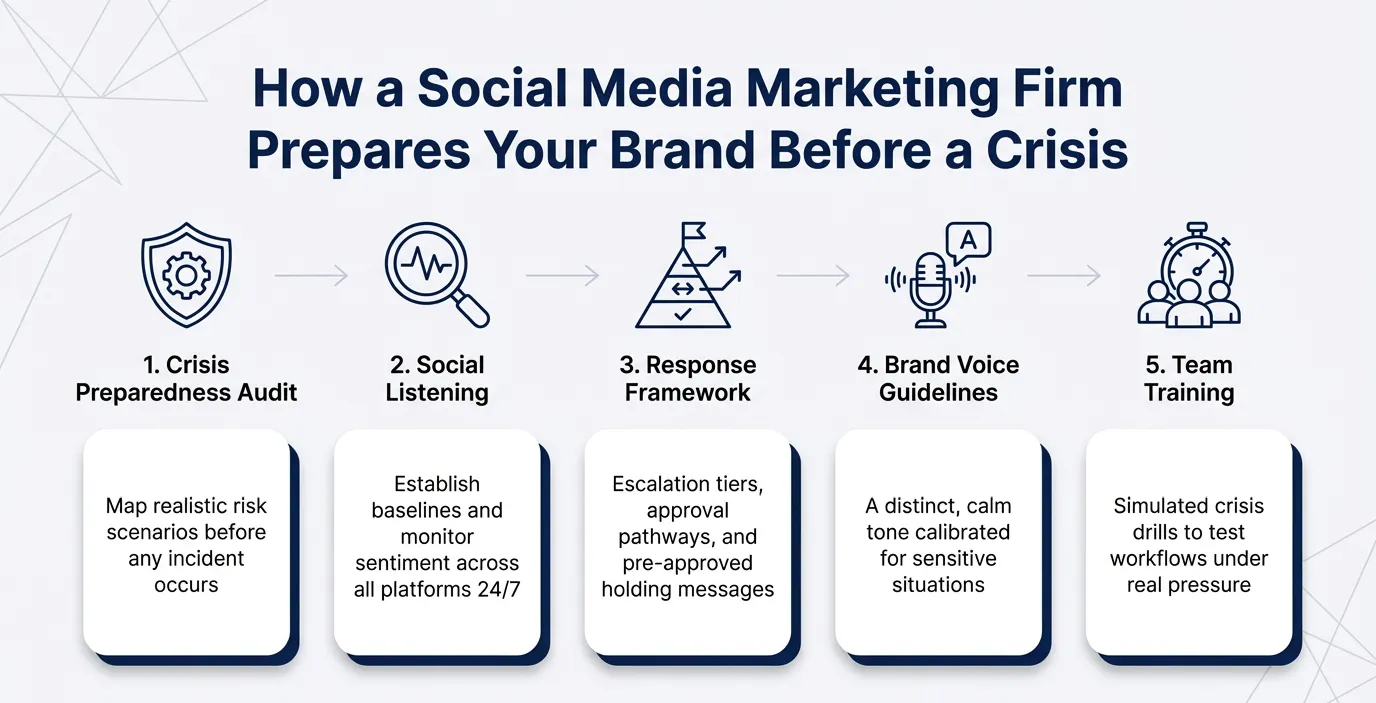
Most brands don’t think about a crisis until they’re already in one. By then, every second feels expensive, and every response feels risky. When I work with clients, I focus on preparation first.
A capable social media marketing firm doesn’t just react. It builds the systems, playbooks, and safeguards that enable your brand to respond with clarity rather than panic.
Crisis Preparedness Planning
Most businesses think about crisis management after something has already gone wrong. That is the wrong order.
A competent social media marketing firm starts with a preparedness audit long before any incident surfaces. This means sitting down with the client, mapping their most realistic risk scenarios, identifying key stakeholders, and building a response structure that can be activated quickly when the pressure is on.
The scenarios worth planning for are usually specific to the business:
- A product defect surfaces publicly before the brand is aware of it
- A senior employee makes a controversial statement in a public forum
- A disgruntled former customer launches a coordinated negative review campaign
- A supplier issue goes viral, and the brand gets pulled into the story by association
- A competitor deliberately seeds negative content about the brand online
The value of working through these scenarios in advance is that the team is not making decisions under stress for the first time. They have already rehearsed the logic. They know what they would say, who needs to be involved, and how fast each type of situation requires a response.
I have found that this process also surfaces internal vulnerabilities that clients were not aware of. Sometimes the biggest risk is not external at all. It is that two senior people have conflicting ideas about what the brand should say in a difficult moment, and nobody has ever resolved that conflict until a crisis forces the issue.
Social Listening Setup and Monitoring Dashboards
Social listening is not something you turn on when things go wrong. By then, you have already lost the early window.
Setting up a listening infrastructure before any incident allows a firm to establish a proper baseline. We know what normal looks like for your brand: typical mention volumes, the usual sentiment ratio, which media outlets or content creators regularly reference you, and how active your comment sections typically are on any given week.
That baseline is what makes anomaly detection meaningful. When volume spikes on a Tuesday afternoon or sentiment shifts negative across three platforms within a short window, the monitoring dashboard flags it immediately. Without a baseline, a spike is just noise. With one, it is actionable intelligence.
A well-configured monitoring setup typically tracks:
- Direct brand mentions across Facebook, Instagram, TikTok, X, and YouTube
- Indirect references in community groups, forums, and long-form review platforms
- Sentiment scoring, broken down by platform and updated in near real time
- Influencer and media mentions, particularly from outlets with significant reach in Singapore
- Competitor activity that might intersect with or escalate your own brand conversation
- Keyword clusters related to your products, services, leadership, or known risk areas
The tools commonly used at the professional level include Brandwatch, Meltwater, Sprout Social, and Brand24, with selection typically depending on account size, budget, and the depth of reporting required.
The tool itself matters less than the analyst interpreting the data and deciding whether something warrants immediate attention.
Creating Response Frameworks and Escalation Workflows
One of the most valuable things a social media marketing firm delivers before a crisis is a documented response framework. This is not a generic template. It is a decision tree built specifically around the brand’s structure, stakeholders, and communication risk profile.
A proper response framework covers:
- Escalation tiers: Which situations can be handled at the community management level, which require a senior communications lead, and which require legal and executive sign-off
- Approval pathways: Who drafts public statements, who reviews them, who has final sign-off, and what the maximum turnaround time is at each stage
- Holding message templates: Pre-approved language that can be deployed immediately to signal that the brand is aware and engaged, before a full statement is ready
- Platform-specific protocols: The response approach for a Facebook comment thread differs from a TikTok video gaining traction, which differs again from managing a Telegram group discussing the brand
- Contact lists and access credentials: Who has login access to which accounts, who is the legal contact, who is the PR lead, and how each of them is reached outside business hours
What I see most often when brands have no framework in place is improvisation under pressure. Someone drafts a response without checking with legal. A senior leader posts something unilaterally that contradicts what the community manager already said.
The tone shifts between platforms because different team members are responding independently. These are not isolated communication failures. They are structural failures that are almost entirely preventable with proper preparation.
The escalation workflow is particularly important because it removes ambiguity from high-stress moments. When everyone knows their role, the response becomes faster and more coherent. Without it, the first thirty minutes of a crisis are consumed by internal confusion rather than external communication.
Brand Voice Guidelines for Sensitive Situations
A brand’s regular communications tone is built for engagement, persuasion, and relationship-building. That tone does not automatically translate into crisis communication, and attempting to use it can create exactly the wrong impression.
Promotional energy reads as callous during an incident. Playful copy sounds flippant when customers are genuinely concerned. Even a brand that normally communicates with warmth and personality needs a distinct register for situations that require gravity, accountability, and measured honesty.

A professional social media marketing firm develops a separate set of voice guidelines specifically for sensitive situations. These typically include:
- Tone calibration: The language should be sincere and calm, without being clinical or distant. It must feel human without being conversational to the point of being flippant.
- Sentence and paragraph length: Shorter and simpler than normal. Crisis audiences are reading quickly and emotionally. Dense copy loses them.
- What to avoid: Jargon, passive constructions that obscure accountability, defensive qualifications, and anything that sounds like it was written by a legal team rather than a person.
- What to include: A clear acknowledgement of the situation, a signal that the brand is taking it seriously, any factual information that can be confirmed at the time of writing, and a next step or commitment.
- Platform-specific tone adjustments: A LinkedIn statement allows for more formality and length. An Instagram story response needs to feel more direct and immediate. A Facebook comment response should be personal and grounded.
The deeper issue here is that without guidelines, people revert to instinct under pressure. And, instinctively, when someone is stressed or defensive, they tend toward self-protection rather than transparency.
Voice guidelines do not eliminate that instinct. They give the team something structured to hold onto when their natural response would not serve the brand well.
Training Internal Teams
Having documentation in place is necessary. Having a team that knows how to use it is the part most brands skip.
The best social media marketing firms run structured crisis simulation exercises with their clients, and these sessions are worth taking seriously. They are not theoretical workshops.
The objective is to test whether the actual workflow holds up under pressure: whether the right people can be reached quickly, whether the approval chain functions at the speed a real crisis demands, and whether the team’s instincts align with the protocols they have agreed to on paper.
A well-run simulation typically includes:
- A realistic scenario is introduced without warning, so the team cannot over-prepare
- A timed response window that mirrors the actual urgency of a real situation
- Real drafting exercises where team members produce holding statements and public responses
- A debrief that surfaces gaps in the workflow, inconsistencies in tone, and delays in the approval chain
What these exercises regularly reveal is that internal teams overestimate their readiness. People assume they know what to do because they have read a document. Doing it under simulated pressure is a different experience entirely.
Training also extends to less formal preparation: ensuring the right people have administrative access to all relevant social media accounts, that out-of-hours contact numbers are up to date, and that every team member understands not just their own role but enough of the broader process to make sound decisions if a more senior contact is unavailable.
The goal is not a perfect response. The goal is a coherent one, delivered at the right speed, by a team that is not making fundamental decisions for the first time when the stakes are real.
Real-Time Crisis Response: How a Social Media Marketing Firm Takes Action
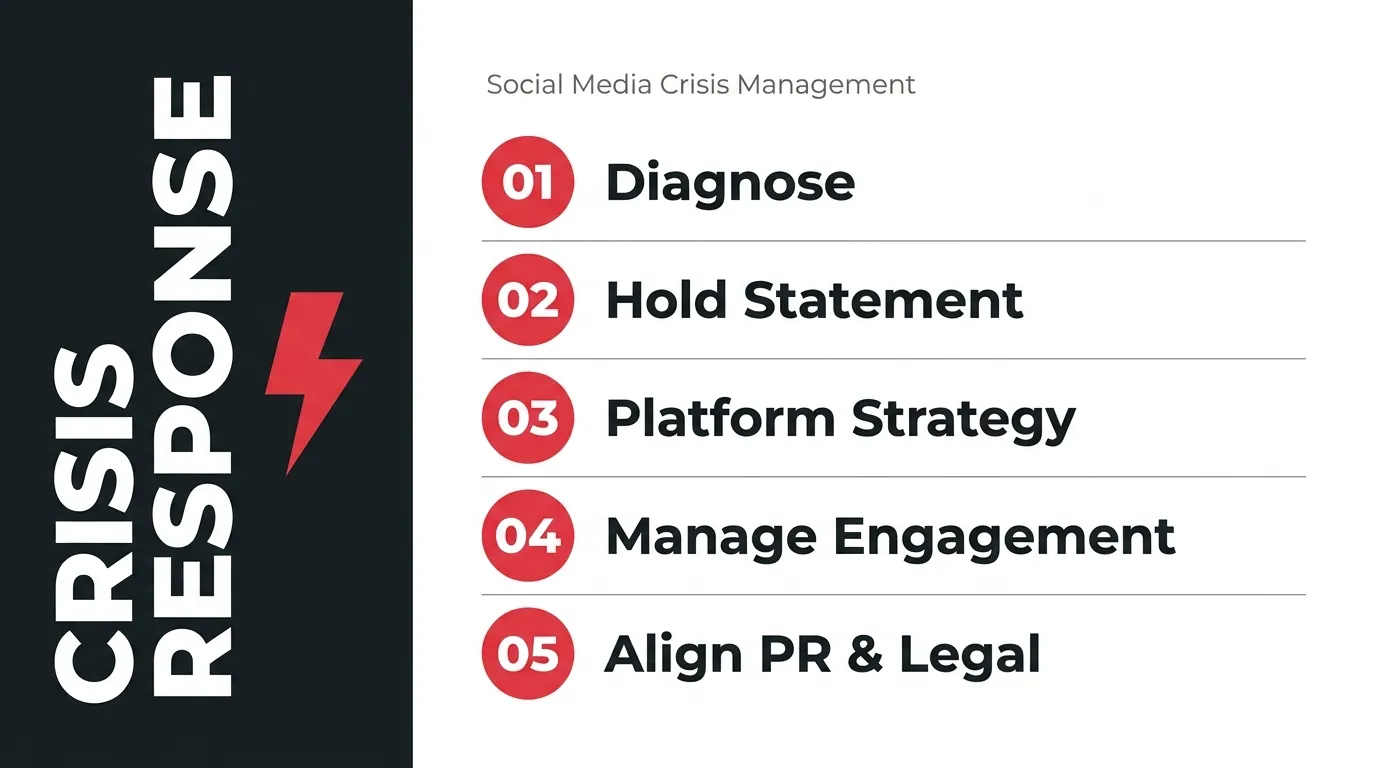
When a crisis hits, speed matters more than perfection. I tell clients this all the time. The first few hours often determine whether the issue dies down or escalates into a full-blown reputational problem. A social media marketing firm is built for this kind of pressure, with systems, processes, and people ready to act immediately.
Immediate Response Protocols
When a crisis breaks, the first step is not to respond publicly. It is to assess. What is the actual situation? How far has it spread? Which platforms are active? Who are the key voices driving the conversation?
A professional firm follows a structured response protocol that begins with diagnosis before communication.

Crafting Timely and Accurate Public Statements
The holding statement is often the most important piece of communication in a crisis. It acknowledges the situation, signals that the brand is aware and engaged, and buys time for a fuller response without saying something that cannot be walked back.
Poor holding statements are vague or defensive. Good ones are honest, specific enough to show the brand understands what is happening, and empathetic enough to show the audience they are being taken seriously.
Platform-Specific Response Strategies
What works on LinkedIn does not translate to TikTok. A LinkedIn response tends to be longer, more formal, and addressed to a professional audience. A TikTok response, if appropriate at all, needs to be direct, human, and brief.
Facebook comment management differs from Instagram DMs, and managing a Telegram group discussing the brand requires a different approach.
A good social media marketing firm handles all of these channels simultaneously, maintaining a consistent message while adapting the tone and format to each platform.
Managing Comment Sections and DMs
During an active crisis, comment sections can become a battlefield. A firm manages this strategically: responding to legitimate concerns promptly and clearly, de-escalating tension without feeding it, and identifying which comments require escalation to direct messaging for more sensitive handling.
Coordinating with PR and Legal Teams
Crisis management does not happen in isolation. A social media marketing firm should be able to work cohesively with legal counsel, PR agencies, and internal leadership. The communication must be legally defensible, strategically sound, and publicly credible simultaneously.
Reputation Management and Damage Control by a Social Media Marketing Firm
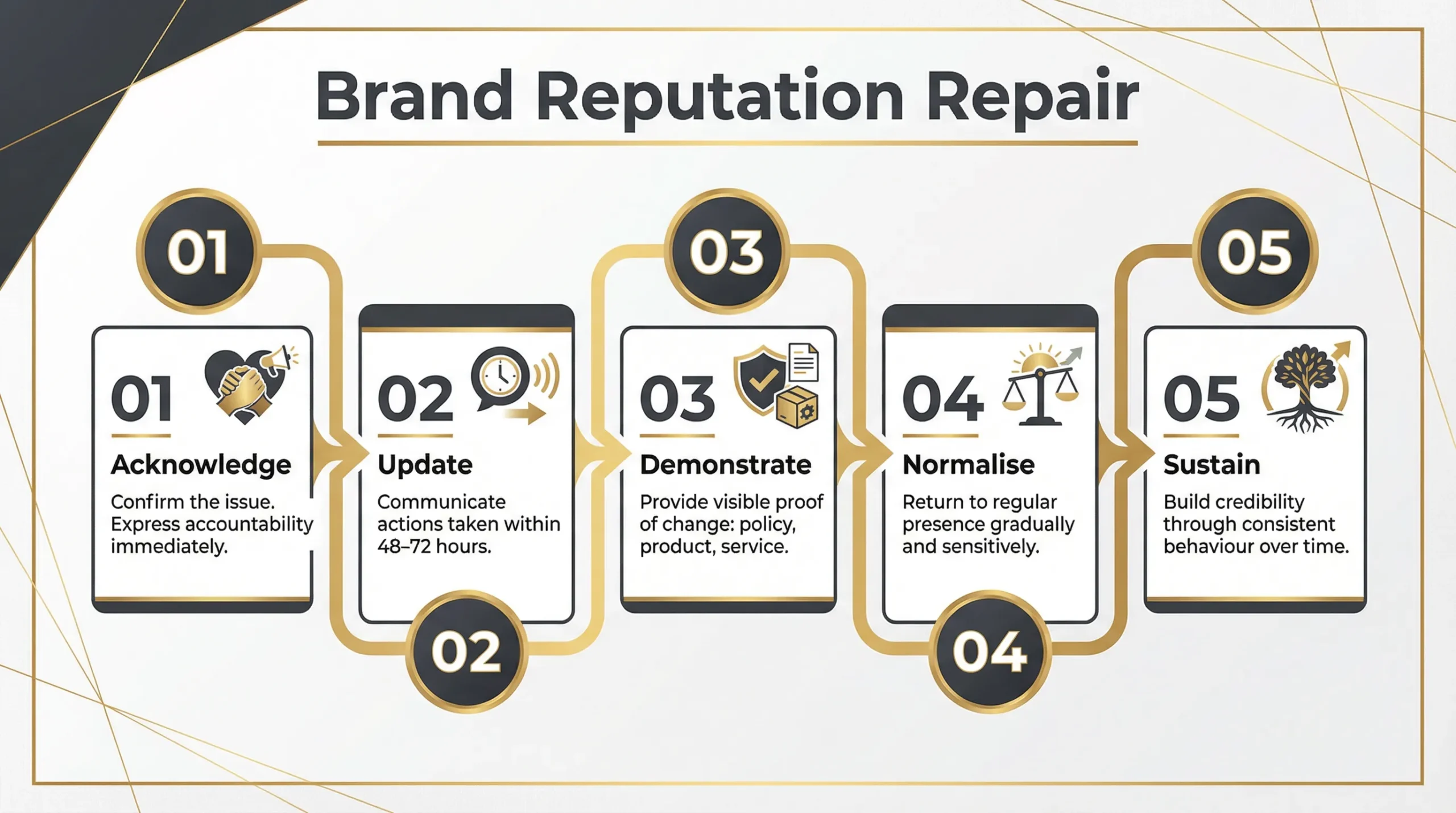
Once the initial wave of a crisis has been contained, the harder work begins. Containing a situation and repairing a reputation are two entirely different phases that require different thinking. Containment is about speed and control. Brand reputation repair is about consistency, credibility, and the slow work of rebuilding what the crisis eroded.
A good social media marketing firm understands this distinction clearly. The tactical decisions made in the days immediately after a crisis, including how to respond to feedback, handle media interest, correct false narratives, and sequence the recovery, will shape how the brand is perceived for months to come.
This section covers each of those dimensions in practical terms.
Addressing Negative Feedback Publicly and Privately
The most important thing I can say here is this: not all negative feedback deserves the same response strategy, and treating it uniformly is one of the most common mistakes brands make under pressure.
A professional social media marketing firm operates a triage system. Before any response is sent, the team assesses the nature of the complaint, the platform’s visibility, the public or private context, and the intent behind it.
That assessment determines whether a response belongs in the public comment thread or in a private direct message.
When a public response is the right call:
A public response is appropriate when the complaint has already attracted visible engagement, when others in the audience are watching how the brand handles it, or when silence would be interpreted as indifference or admission.
In these situations, a well-crafted public reply does more than address one person. It signals to the broader audience that the brand is accountable, present, and able to handle criticism with composure.
The public response does not need to be lengthy. In fact, shorter is usually better. Acknowledge the concern, express genuine care, and invite the person to continue the conversation privately, where more details can be shared.
That transition from public to private is important because it moves the resolution into a space where the brand has more control over the conversation without appearing to suppress it.
When a private response is the right call:
Some complaints carry personal details, financial information, or sensitive context that should never be addressed in a public thread. Health-related complaints, billing disputes, and situations involving personal data all fall into this category.
Responding publicly to these can actually make things worse, both legally and in terms of trust.
There are also situations where a customer is clearly in distress rather than simply dissatisfied. Directing them to a private channel is the more respectful and practical choice, and most reasonable customers will recognise that.
A few practical principles that guide this:
- Respond publicly to acknowledge; resolve privately to protect both parties
- Keep the public acknowledgement warm and specific enough to feel genuine, not templated
- Never argue in a public comment thread, regardless of how unfair the criticism seems
- Follow up publicly, where appropriate, to confirm that the matter has been resolved
What separates a firm that handles this well from one that does not is consistency. Anyone can get a single response right. A professional firm maintains that standard across dozens of interactions, across multiple platforms, under time pressure, and often across different team members handling different channels simultaneously.
Handling Influencers, Media, and Public Figures
When an influencer, journalist, or public figure becomes part of a brand’s crisis story, the situation moves into entirely different territory. The authority they carry means their commentary reaches far beyond a typical comment thread, and their content is often indexed by search engines, giving it a much longer lifespan than an organic social post.
I have seen brands make the mistake of treating an influencer’s critical post the same way they would treat a customer complaint. This is where a professional influencer marketing agency works best in this scenario.
The instinct to respond quickly and directly is understandable, but it often backfires. A poorly worded reply to a verified account with a hundred thousand followers can become a story in its own right.
The first step is an assessment of the person involved and the nature of their criticism: Is this a well-regarded journalist with a track record of fair coverage, or a content creator who is sensationalising for engagement? Is the criticism based on a genuine experience, or is there a motive behind it?
These distinctions matter because the appropriate response varies significantly.

For media and journalists specifically, the firm coordinates with the brand’s PR team or communications director to determine whether a formal media response is warranted.
Social media is rarely the right channel for addressing press enquiries directly, and a careless reply in a comment thread can create a quote that appears in the published story.
For influencers and public figures, the decision framework typically looks like this:
- Genuine criticism with audience resonance: Acknowledge respectfully, offer to connect privately, and ensure the resolution is visible
- Factually inaccurate content: Issue a clear and calm correction, backed by evidence, without being combative
- Content that appears coordinated or motivated: Document it, assess the legal dimension if necessary, and decide whether engagement serves the brand or amplifies the issue
- Opinion-based commentary: In most cases, this does not require a direct response. Engaging with every critical opinion gives it more visibility than it would otherwise receive
The principle I return to consistently is that engagement should be purposeful. A response to a high-profile figure must be approved at the right level, reviewed for legal and reputational risk, and timed appropriately. A social media marketing firm keeps that process structured even when the pressure to respond immediately is intense.
Controlling Misinformation and Rumours
Singapore’s digital environment creates a particular challenge when it comes to misinformation. WhatsApp has a national penetration rate of approximately 90%, and Telegram channels regularly aggregate and amplify unverified claims to audiences of thousands.
The problem with these channels is that they are largely invisible to standard social media monitoring. By the time a false claim has been forwarded extensively through private group chats, a brand may have no idea it is happening.
I have seen false information circulate about brands in Singapore, ranging from fabricated food safety claims to misrepresented customer service incidents, spreading through community WhatsApp groups before reaching Instagram or the local media.
At that point, correcting it is significantly harder because the original source of the misinformation is often untraceable, and the audience that received it never sees the correction.
Active social listening is the foundation. Tools like Brandwatch and Meltwater monitor brand mentions across public channels, picking up spikes in conversation that might indicate a rumour is gaining traction before it reaches a tipping point.
Monitoring keyword variations, common misspellings, and associated terms gives a more complete picture than tracking the brand name alone. When misinformation is identified, the response strategy depends on its scale and source:
- For misinformation confined to a small community or group, a factual public statement on the brand’s own channels is usually sufficient
- For false claims that have reached media outlets or verified accounts, a formal correction coordinated with PR is more appropriate
- For legally problematic misinformation, legal counsel determines whether a notice or takedown request is warranted
What a firm avoids is overcorrecting in a way that amplifies the false claim. The standard guidance is to state the facts clearly without repeating the specific false assertion in detail, because doing so risks spreading the very narrative you are trying to counter.
One thing that is easy to overlook: internal communications matter here too. Staff encountering false claims about the brand need to know what the official position is and how to respond if they are personally asked about it. A good firm helps brands prepare internal briefing notes that align the whole organisation behind a consistent narrative.
Rebuilding Audience Trust in Real Time
Trust does not return because a brand says it has fixed the problem. It returns because the audience sees consistent evidence of that over time.
This is the part of crisis management that most businesses underestimate, partly because it is slower and less dramatic than the initial response, and partly because it requires sustained effort when the pressure to return to normal is strong.
The sequencing matters. In my experience, brands that recover well from public crises follow a broadly similar pattern, not because they read the same playbook, but because this is genuinely how trust works.
A practical recovery sequence looks like this:
- Immediate acknowledgement: The brand has confirmed the issue, expressed accountability, and committed to action. This happens during the active crisis phase.
- The update statement: Within forty-eight to seventy-two hours, the brand communicates what has been done and what is still in progress. This shows follow-through.
- Demonstrated action: Over the following days and weeks, the brand provides evidence that things have actually changed, whether through product improvements, policy updates, service communications, or other visible proof points.
- Normalised engagement: Gradual return to the brand’s regular presence, with sensitivity to tone in the weeks immediately following the crisis.
- Ongoing consistency: Trust accumulates through repeated interactions over time. A brand that continues to behave well after the spotlight has moved builds far stronger credibility than one that managed the optics of a single event.
The content strategy during this phase should be less about promotion and more about value. Educational content, transparent updates, and genuine community engagement all signal that the brand is present for its audience rather than simply selling to them.
A social media marketing firm’s role during recovery is to maintain this sequencing deliberately, to prevent the client from reverting to normal content strategy too soon, and to continue monitoring sentiment so that any residual negative conversations are caught and addressed before they reignite.
What I have noticed in Singapore specifically is that audiences here respond particularly well to accountability that feels personal rather than corporate. A statement from a named leader, delivered in plain language and without legal hedging, tends to land far better than a carefully worded brand statement that reads like it was written by a committee.
The firm’s job is to help the client find that register and sustain it through the recovery period.
Case Examples of Social Media Marketing Firm Crisis Management
Here are some examples of how brands worked through a brand crisis through social media:
I’ve worked with businesses across Singapore long enough to know this. No two crises look the same, but the patterns behind them are predictable. What matters is how quickly and strategically you respond.
In this section, I’ll break down case-style examples of how a social media marketing firm can step in, stabilise the situation, and guide a brand back to solid ground.
Scenario One: A Viral Customer Complaint for a Renovation Business
A mid-sized renovation firm in Singapore received a one-star Google review and a detailed Facebook post from a customer alleging poor workmanship and delayed delivery. The post was shared by a local home improvement community group with over forty thousand members.
The firm’s social media marketing consultancy had monitoring alerts in place and flagged the post within ninety minutes. A holding response was published within two hours, acknowledging the situation, expressing genuine concern, and inviting the customer to resolve it directly.
A direct message was sent to a senior operations contact. The matter was resolved privately within forty-eight hours. A follow-up public comment from the customer confirmed resolution. The post did not reach mainstream media.
What worked: Speed, empathy, and genuine resolution. The public response was brief but visible, shifting the audience’s perception from neglect to accountability.
Scenario Two: A Product Issue Escalated Then Resolved for an F&B Brand
A food and beverage brand received multiple complaints across Instagram and Facebook about a product quality issue. The comments were not coordinated, but they were consistent and accumulating. The brand initially had no monitoring in place and only became aware of the conversation when a staff member happened to see it.
By the time the brand engaged a social media marketing firm on an emergency basis, the issue had been picked up by a food review blog with a substantial readership. The firm advised pausing all scheduled content immediately, drafted a product statement in coordination with the operations team, and managed the comment sections across three platforms while the product was pulled for quality review.
The response took longer than it should have because there was no preparation. The episode resolved without media escalation, but the cost of emergency crisis management significantly exceeded what an ongoing retainer would have been.
What worked: Eventual transparency and decisive action on the product side.
What failed: The brand had no monitoring in place, no response framework, and no pre-established agency relationship. The first hour of the crisis was completely unmanaged.
Key Takeaway from Both Examples
Preparation is not a luxury. The businesses that come through crises intact are almost never the ones that managed it best under pressure. They are the ones who had enough preparation in place to buy themselves time and structure.
Common Mistakes Brands Make Without a Social Media Marketing Firm
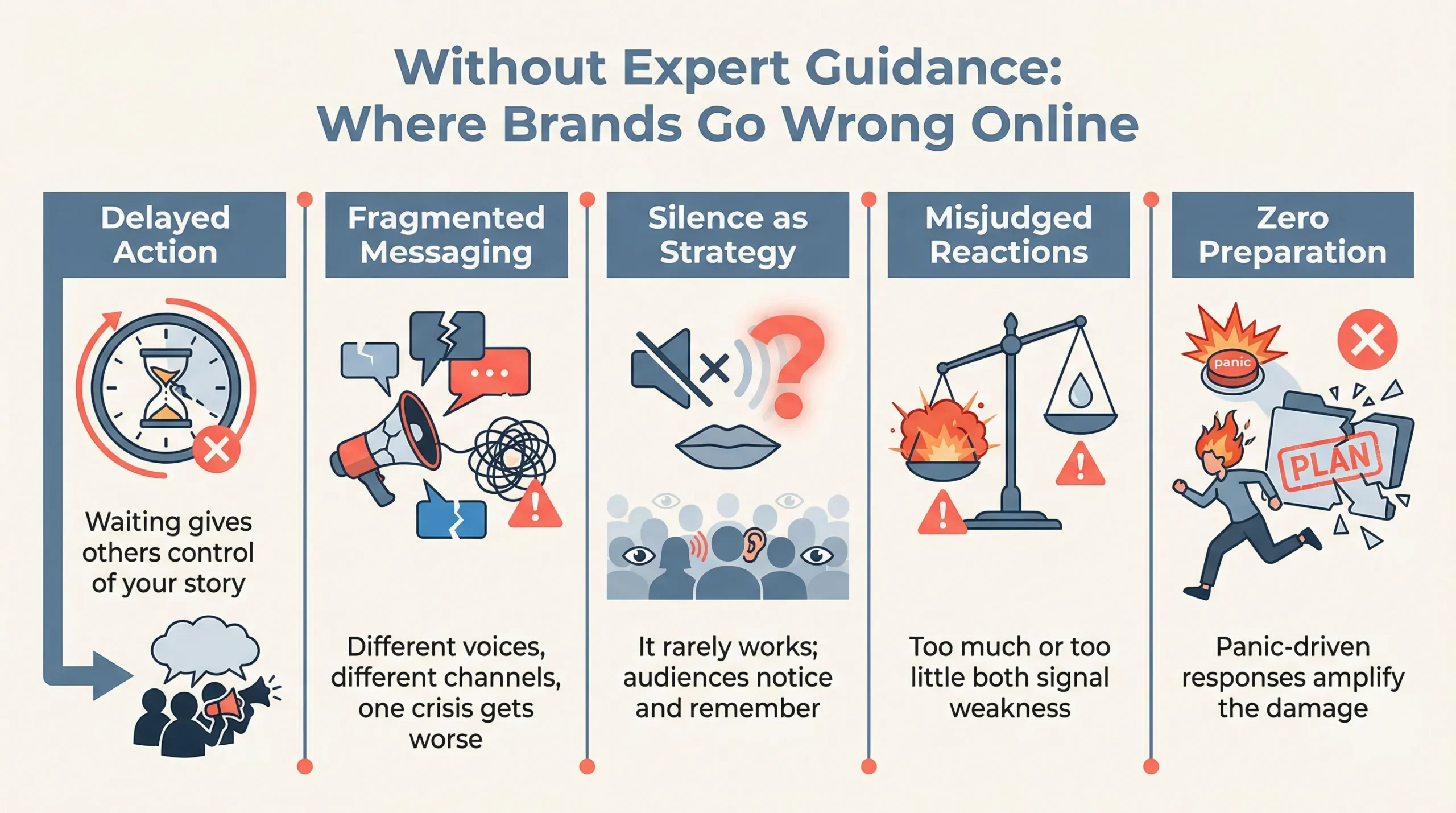
I have seen this play out more times than I can count. A brand faces backlash online, and instead of taking control, they hesitate, react emotionally, or go silent. Without a social media marketing firm, most businesses are simply not equipped to handle the speed and scrutiny of a digital crisis. The mistakes are predictable and often costly.
- Delayed Responses: The single most common mistake is waiting too long. By the time a brand has had two internal meetings and three rounds of edits on a statement, the narrative has already been written by someone else. Speed is a professional capability, not just a preference.
- Inconsistent Messaging: Brands often make the mistake of letting different team members respond across different channels with slightly different messages. The inconsistency gets noticed and screenshotted. It suggests internal disarray, which only makes the situation worse.
- Ignoring Audience Sentiment: Some brands try to wait out a crisis, assuming it will blow over without engagement. This strategy works occasionally for very minor issues. For anything with real traction, silence is interpreted as indifference or guilt. The audience does not forget that the brand chose not to respond.
- Overreacting or Underreacting: Both extremes are problematic. Overreacting to a minor complaint by issuing an elaborate public apology elevates the issue and signals fragility. Underreacting to a serious issue by posting something minimal and business-as-usual signals that the brand does not understand the gravity of the situation.
- Lack of Preparation: This is where most of the above mistakes originate. Brands that are unprepared improvise under pressure, and improvised responses in crisis conditions are almost never the right ones.
What Is a Social Media Marketing Firm and What Do They Do
When clients come to me, they usually think a social media marketing firm is there to grow followers or run ads. That is only one part of the picture. The real value lies in how we shape narratives, respond to public sentiment, and safeguard brand trust when it matters most.
Core Services Offered by a Social Media Marketing Firm
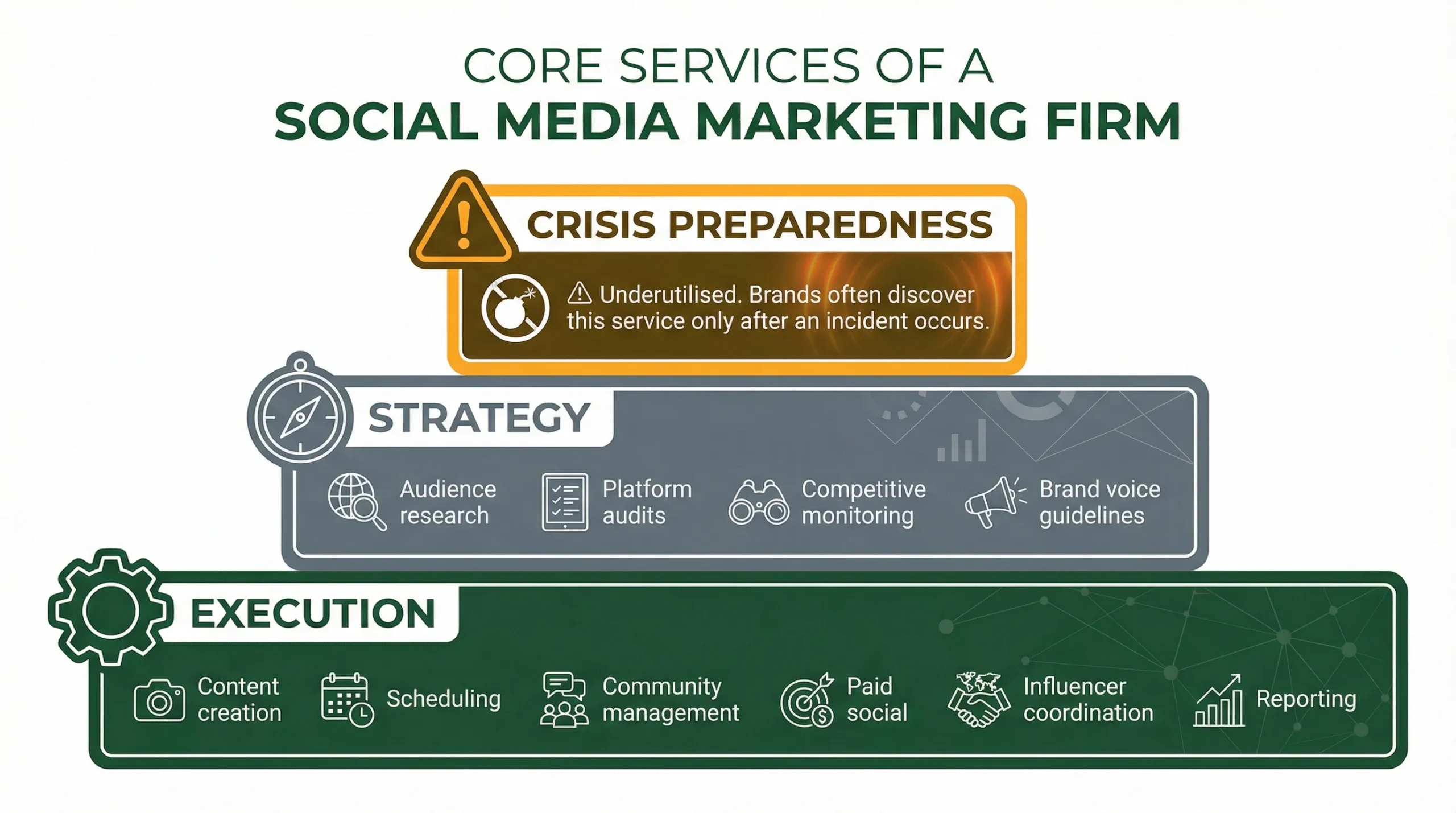
A social media marketing firm manages a brand’s presence, voice, and performance across social platforms. The core scope includes content creation and scheduling, community management, paid social advertising, influencer coordination, and performance reporting.
Beyond the day-to-day execution, experienced firms also provide strategic services: audience research, platform audits, competitive monitoring, brand voice guidelines, and increasingly, crisis preparedness planning.
That last one is still underutilised. Many brands only discover their agency offers crisis support after something has already gone wrong.
The Difference Between In-House Teams and External Agencies
An in-house team knows the brand deeply. That is a genuine advantage. But it comes with limitations. Internal teams are often too close to the situation to communicate calmly under pressure.
They may not have the tools, authority, or detachment to make quick, objective decisions. And when leadership is directly involved in a crisis, having a neutral third party manage the public communication is often the safer call.
A social media marketing firm brings structure, distance, and operational experience. They have done this before, or at least, the better ones have. They carry monitoring tools, pre-built response frameworks, and the ability to act quickly across multiple platforms without waiting for internal approvals to cascade through layers of management.
Why Brands Rely on a Social Media Marketing Firm During High-Risk Situations
The answer is simple: containment requires speed and clarity. A firm with an active monitoring setup can flag an emerging issue before a client even knows about it.
That window of twenty to sixty minutes between a post gaining traction and going truly viral is often the difference between a managed response and a full-blown reputational event.
Key Skills That Matter in Crisis Scenarios
Not all social media skills are equal in a crisis. The competencies that matter most include:
- Real-time sentiment tracking and interpretation
- Rapid copywriting that is accurate, empathetic, and legally defensible
- Platform-specific moderation, including Facebook comments, Instagram DMs, and WhatsApp community groups
- Coordination with PR, legal, and leadership teams under time pressure
- Knowing when to speak, when to wait, and when to hold the line
Working with a Social Media Marketing Firm for Crisis Management
If there is one thing I want to leave with you from this guide, it is this: the best crisis management is the kind you never need to use in full, because you prepared for it.
The brands I have seen handle difficult moments well in Singapore are not necessarily the most well-known or the best-resourced. They are the ones who invested in preparation, who had a firm they trusted already in their corner, and who responded with clarity and honesty when something went wrong.
A capable social media marketing firm is not just a content machine. At its best, it is a strategic communications partner that helps you build equity when things are going well and protects that equity when they are not.
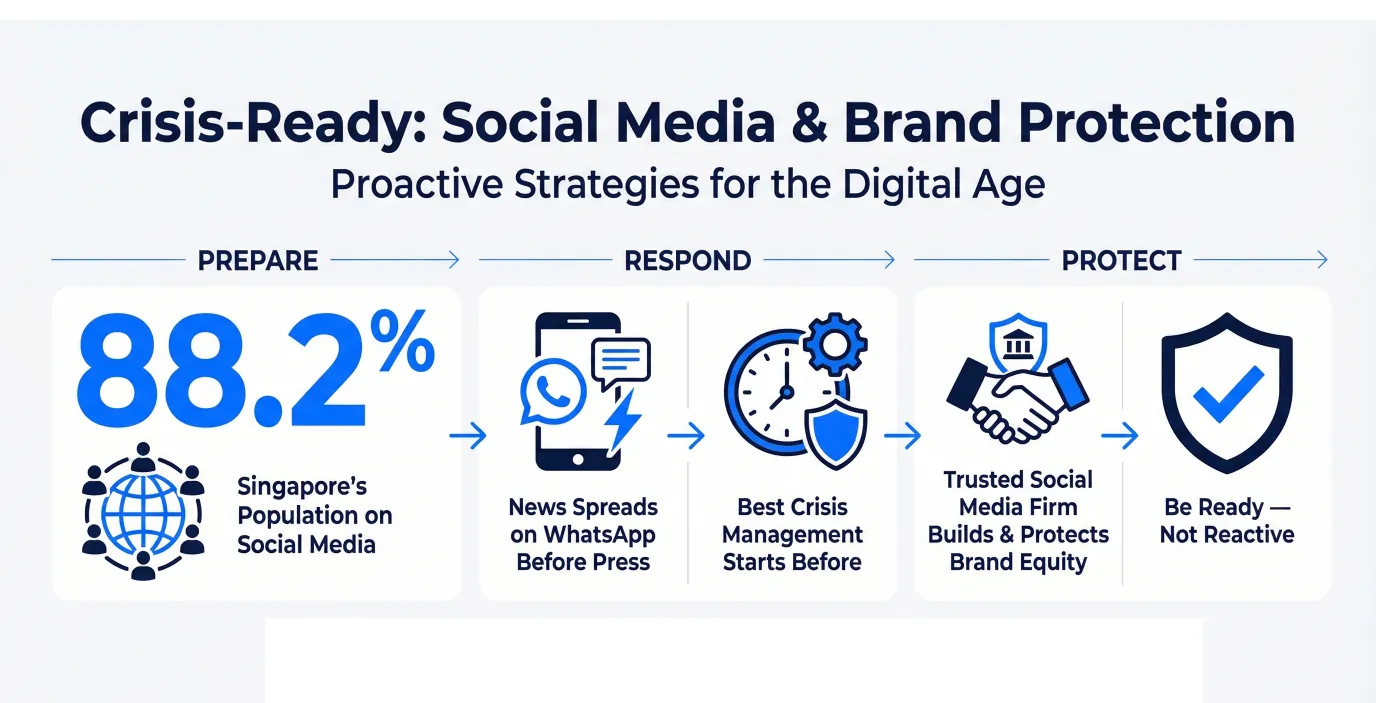
Crises are not exceptional anymore. In a market where 88.2% of the population is on social media, and news spreads through WhatsApp communities before reaching the press, every business with a public profile has some level of exposure. The question is not whether something will eventually challenge your brand’s reputation. The question is whether you will be ready.
If you are thinking seriously about this and want a clearer view of what good crisis preparedness should look like, a conversation with MediaOne would be a sensible starting point.
Frequently Asked Questions
Industries with high public exposure or regulatory sensitivity tend to benefit the most. This includes finance, healthcare, F&B, and property, where trust directly affects revenue. However, any business with an active online presence can face reputational risk. The more visible the brand, the greater the need for structured crisis support.
Yes, and this is where most businesses get the calculation wrong. Reactive crisis management is significantly more expensive and less effective than having preparation in place. A firm that knows your brand, your risk scenarios, and your approval chain before something happens will respond far faster and more effectively than one brought in cold.
Social monitoring tracks direct mentions of a brand name or handle. Social listening captures the broader conversation, including discussions where the brand is referenced but not directly tagged. During a crisis, listening is more valuable because it surfaces early warning signals before they reach the brand’s own pages.
A professional firm can manage the communications dimension while coordinating with legal counsel. They should understand what can and cannot be said publicly for legal reasons and work within those boundaries. The communications and legal strategies need to be aligned, and a good firm will know where that boundary sits.
Recovery timelines vary significantly based on the severity of the crisis, the quality of the response, and the industry. Minor incidents managed well can lead to sentiment recovery within 2 to 4 weeks. More serious crises affecting customer trust or generating media coverage may require three to six months of sustained post-crisis content and community work before sentiment returns to baseline.