

I’ll be honest: I’ve seen too many startups treat socialising like a daily chore instead of a growth system. That’s usually when social media marketing consultancy becomes necessary — not because the team lacks effort, but because they’re posting without a clear strategy, clear positioning, or a repeatable process.

One week they’re chasing trends, the next they’re boosting posts, and by the end of the month, they still can’t explain what social is actually doing for the business.
I’ve worked with founders and lean marketing teams across Singapore who were stuck in that exact cycle. They had ambition, decent ideas, and plenty of activity — but no scalable structure to support them.
The turning point always came when we stopped asking, “What should we post next?” and started asking, “How should social support grow at this stage of the business?”
That’s what this guide is about: building a social strategy that can scale with your startup. And for businesses looking for social media marketing consultancy, my team at MediaOne often helps bring that structure, clarity, and long-term thinking into place.
Key Takeaways
- Start with audience clarity by defining your ideal customer profile, pain points, and decision triggers before choosing platforms or content direction
- Build your strategy around buyer behaviour, not platform popularity, ensuring each channel supports discovery, trust, and conversion
- Develop a clear content system using defined content pillars, format guidelines, and a consistent publishing rhythm to avoid reactive posting
- Apply a funnel-based approach by mapping content to awareness, consideration, and conversion stages to drive real business outcomes
- Use repurposing as a core mechanism to scale efficiently, turning one strong idea into multiple content formats across platforms
- Establish operational systems early, including workflows, approvals, and ownership, so the strategy can scale without relying on individuals
- Focus on commercial metrics, such as conversion rate, qualified traffic, and customer acquisition cost, instead of vanity engagement metrics
- Continuously refine based on feedback loops and performance data, ensuring messaging, formats, and platforms evolve with the market
Why Startups Struggle Without a Structured Strategy
I’ll be honest: I’ve seen too many startups treat socialising like a daily chore instead of a growth system. That’s usually when social media marketing consultancy becomes necessary — not because the team lacks effort, but because they’re posting without a clear strategy, clear positioning, or a repeatable process.
One week they’re chasing trends, the next they’re boosting posts, and by the end of the month, they still can’t explain what social is actually doing for the business.
I’ve worked with founders and lean marketing teams across Singapore who were stuck in that exact cycle. They had ambition, decent ideas, and plenty of activity, but no scalable structure behind it.
The turning point always came when we stopped asking, “What should we post next?” and started asking, “How should social support grow at this stage of the business?”
This distinction matters because most startups do not begin with a full content engine. They usually begin with fragments: one founder who is reasonably comfortable on camera, one marketer who is overstretched, one designer who is already overloaded, a Slack channel full of half-formed ideas, and a lot of urgency without much alignment.
Without a clear strategy, social media quickly becomes reactive. You post because the calendar looks empty. You boost something because a competitor seems to be doing the same. You jump from one platform to another because someone says the platform is falling. At that stage, you are not really marketing. You are improvising.
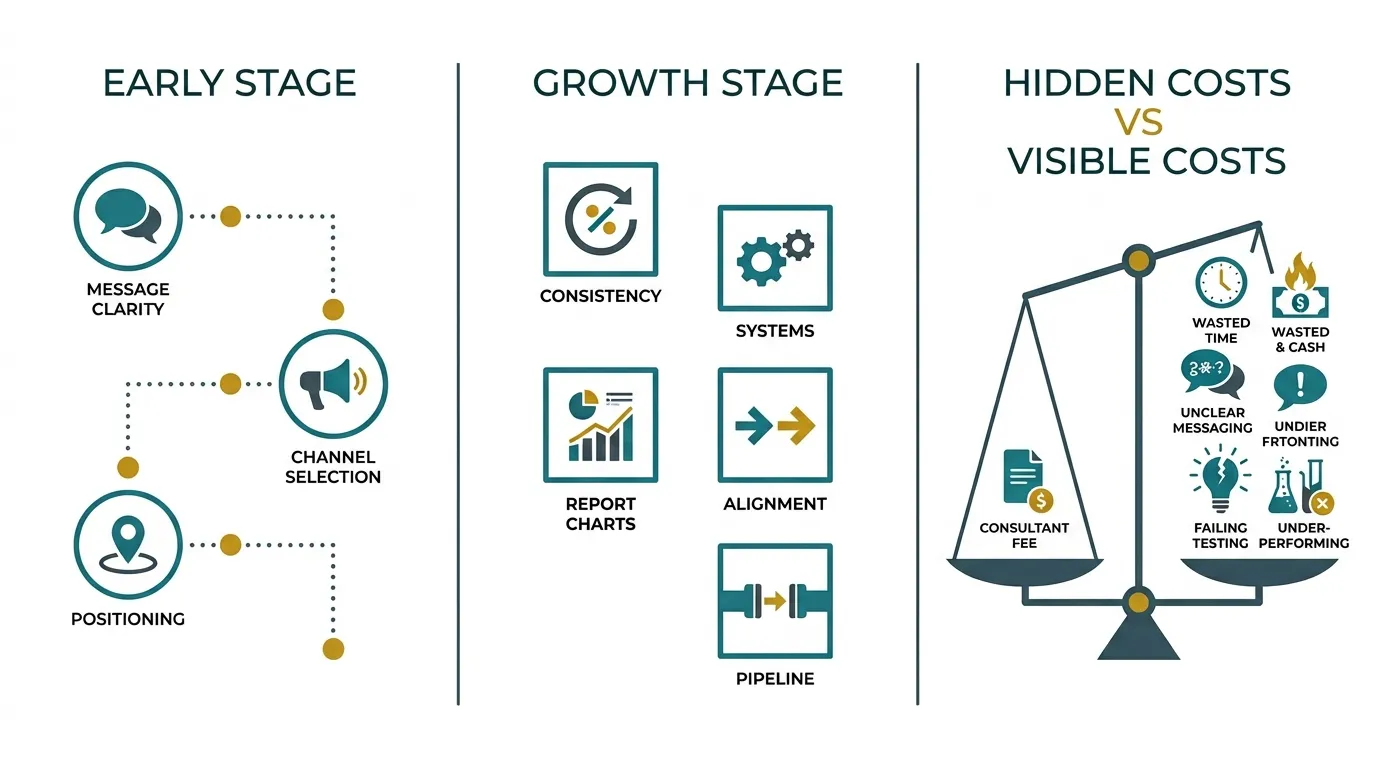
Early-stage startups usually need help with positioning, audience clarity, platform focus, a realistic publishing rhythm, and founder visibility. Growth-stage startups usually need stronger reporting, clearer workflows, better handovers, stronger content operations, and closer alignment between social, sales, and revenue.

In both cases, the deeper challenge is not “how do we create more content?” It is “how do we build a social engine that can grow with the business?” That is where consultancy becomes genuinely useful.
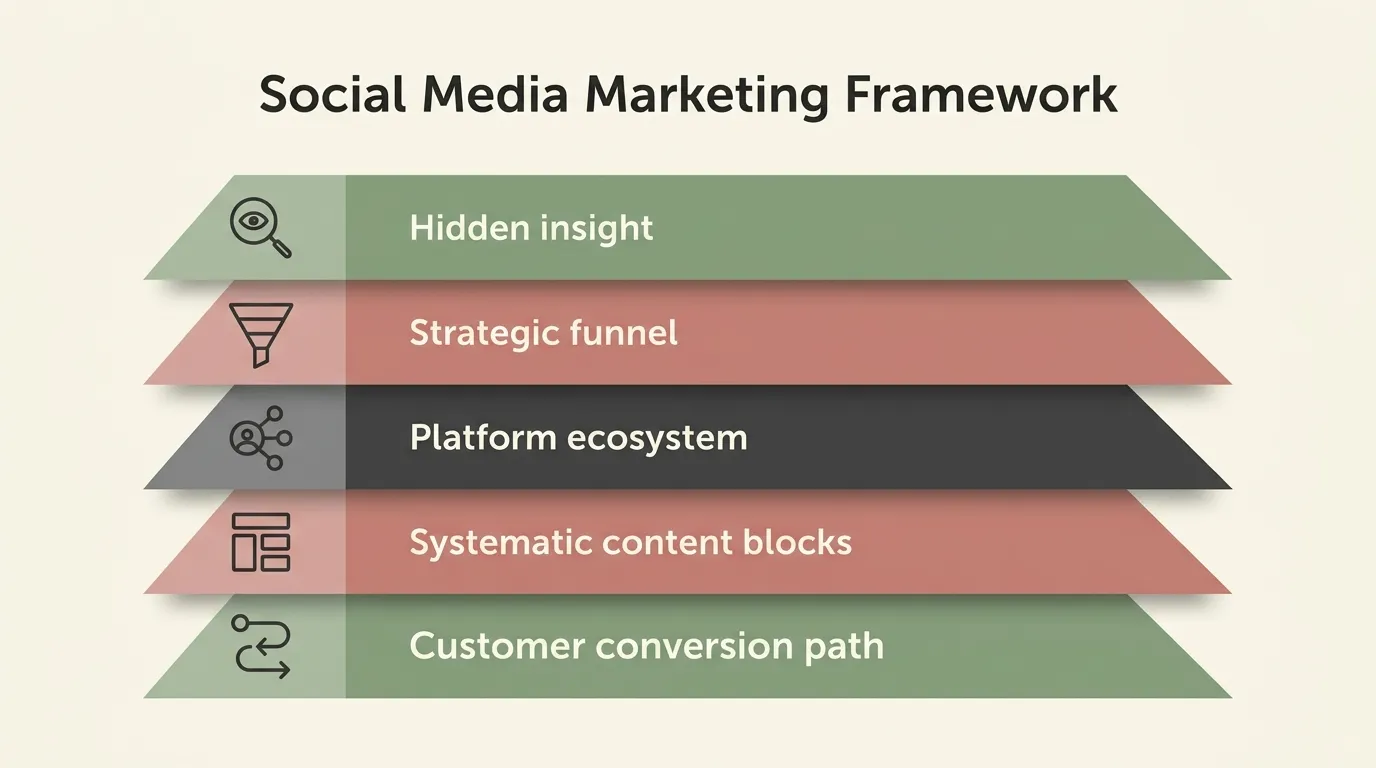
- Step 1: Start with audience clarity: Define your ideal customer profile, pain points, motivations, and buying triggers before making decisions on platforms, messaging, or content. Without a clear understanding of the audience, startups risk building a strategy on assumptions that weaken performance from the start.
- Step 2: Choose platforms based on buyer behaviour: Select social media channels according to where your audience discovers brands, builds trust, and makes purchase decisions; not based on founder preference or what feels most familiar. A strong platform choice should reflect how buyers actually behave throughout the journey.
- Step 3: Build structured content systems early: Create a repeatable system with clear content pillars, format guidelines, repurposing rules, approval workflows, and a consistent publishing rhythm. This helps startups scale social media efficiently and avoid reactive, inconsistent posting.
- Step 4: Map content to the marketing funnel: Make social content commercially effective by aligning it with each stage of the funnel, from awareness and trust-building to consideration, conversion, and retention. This ensures content supports real business growth rather than existing solely for visibility.
- Step 5: Prioritise structure, measurement, and operational discipline: A strong social media strategy needs more than content ideas; it needs clear execution frameworks, accountability, and performance tracking. Whether managed internally or with external support, social should be run as a growth function, not as a reactive content treadmill.
Once the audience definition is sharper, I look at platform behaviour. This is where strategy often improves very quickly.
A founder may say their audience is on Instagram, and that may be true. But being present on a platform is not the same as being ready to discover, compare, trust, or buy on that platform. That distinction matters.
The strongest social strategies are built around platform intent, not just platform presence.
DataReportal found that in 2025, 62.3% of Instagram users, 52.5% of Facebook users, and 51.5% of TikTok users used those platforms to research brands and products. By 2026, that pattern still held, with Instagram leading social brand research and TikTok and Facebook continuing to play major roles.
So the real question is not simply whether your audience uses a platform. It is whether they use it in a way that supports your commercial goal.
For B2B startups, LinkedIn remains highly relevant because it gives access to professional context and decision-makers. But that does not mean every startup should build its entire strategy around LinkedIn. It means platform choice should be shaped by buyer behaviour rather than founder preference.
LinkedIn’s own 2024 B2B benchmark supports that broader view. The report found that 75% of B2B marketers said social media was their most-used marketing channel, while 36% said it was their most effective channel.
That is a useful reminder that platform choice is no longer just a brand-awareness decision. It is increasingly tied to pipeline, trust, and commercial performance.
Platform mix matters too. DataReportal’s 2026 report found that online adults use an average of 6.75 social platforms per month. That is one reason I rarely recommend building a startup strategy around a single channel.
A scalable framework usually needs a primary platform, a secondary platform, and a clear role for each, rather than a vague “we should be everywhere” mindset.
Good Consultants Look for Rewarded Behaviour, Not Just Visible Behaviour
I also pay attention to content consumption patterns because I want to know whether the audience is more likely to:
- Skim short clips
- Save educational carousels
- Respond to founder-led opinion posts
- Click into case-study threads
- Engage in comments
- Revisit brand content later
This is where startup strategy often gets lazy. Teams copy what competitors are posting without asking whether those posts are actually driving movement.
A good consultant does not just look at what the market publishes. They look at what the market rewards.
That difference is clear in the data. So if a startup is choosing between being useful and being interesting, the answer is usually both. Educational content works better when it is packaged with attention, clarity, and personality.
Platform-specific behaviour matters here, too. On LinkedIn, users want brands to show up with educational product information, community engagement, and customer support, and they are most likely to interact with text posts. That is a very different behaviour pattern from TikTok or Instagram, where shorter visual formats dominate.
When consultants ignore those differences, content systems become inconsistent because they are built around internal preference instead of platform-native behaviour.
Authenticity also matters more than many teams think. HubSpot’s 2025 Social Media Trends report says 76% of marketers believe authentic, low-production videos outperform highly produced content. That is a useful correction for startups that assume better strategy means bigger production. Often, a better strategy means clearer relevance.
At the same time, format still matters. HubSpot’s 2026 State of Marketing found that 48.6% of marketers said short-form video delivered the biggest ROI of any media format. That does not mean every startup should become video-first overnight. It means content system design should be tied to what the audience actually consumes and what the business can produce consistently well.
And consistency does not mean volume for its own sake. Even though publishing volume has declined, engagement still increased by nearly 20%. That is one of the clearest signs that content systems should be built around quality, originality, and fit — not just frequency.
Funnel-based Planning is What Makes Social Strategy Commercially Useful
The final part of the framework is funnel-based planning. This is the layer that stops social media from becoming a disconnected content machine.
Many startups treat social media as a visibility channel. They post to stay active, to look credible, or to imitate the brands they admire. But a scalable consultancy framework has to push past visibility and ask a more useful question:
What role is this content playing in the movement?
- Is it building awareness?
- Creating trust?
- Handling objections?
- Generating demand?
- Driving inquiry?
- Supporting conversion?
- Retaining customers?
That matters because social now affects far more than top-of-funnel attention. HubSpot’s 2025 consumer survey found that 1 in 4 social media users bought a product directly through a social media app in the previous three months, and that figure rose to 43% among Gen Z.
Social is no longer just where people discover brands. It is also where they validate, compare, and sometimes purchase.
The same report found that 59% of consumers prefer to gather information themselves when researching a brand or product rather than speak to a human.
That is one reason why educational, proof, and objection-handling content are so important in a startup funnel. If buyers want to self-educate, social strategy has to support self-education.
Influence also shows up across the funnel. In 2025, HubSpot found that 29% of people said they had discovered a product through an influencer on social media.
That does not mean every startup needs an influencer budget. It means trust transfer, creator validation, and third-party credibility are increasingly part of social funnel design.
Search behaviour is moving into this framework, too. More than half of brands already have a social search optimisation strategy in place, and another 43% are experimenting with social search.
If startups want scalable discovery, they need to think not only about what they publish, but also how content titles, phrasing, themes, and keywords help them surface in social-led search behaviour.
And none of this works without measurement. Only 44% of marketing leaders rated their social teams as experts at measuring the business impact of social.
That is exactly why a consultancy framework needs to connect content and platform activity to funnel stages from the start. Otherwise, startups end up with content reports, not decision-making systems.
A Scalable Framework is Not Built on Trends. It is Built on Decisions.
That is why I begin with foundations. Not because formats do not matter. Not because platforms do not matter. Not because content systems do not matter.
But because all of those things only become useful when they are built on the right audience logic.
A startup does not need more content before it understands who it is trying to move, where that audience is willing to trust, what kind of behaviour each platform rewards, and how content connects to the funnel.
That is what makes a social media marketing consultancy framework scalable.
Not more activity. Better decisions.
Platform Selection Strategy in Social Media Marketing Consultancy
If I could eliminate one bad habit from startup marketing, it would be the obsession with being present on every social media platform at once.
You do not need to be everywhere. In fact, for most startups, trying to be everywhere too early is one of the fastest ways to exhaust the team and dilute the brand.
I would almost always rather see a startup own one or two channels properly than perform weakly across six.
The Best Platform is The One Your Team Can Sustain
For B2B startups, that often means starting seriously with LinkedIn, sometimes supported by YouTube, email, or founder-led short-form content.
For B2C startups, the answer may be TikTok, Instagram, creator-led distribution, or community-driven channels, depending on product type and audience maturity.
The key point is this: platform choice is not purely a matter of demographics.
It is operational too.
Before choosing a channel, I usually ask:
- Can the team realistically produce the type of content this platform rewards?
- Can we sustain the pace for several months?
- Can we manage comments and direct messages properly?
- Can we test and improve quickly enough?
- Can this platform realistically support the business goal?
If the answer is no, then the platform may be attractive in theory but unscalable in practice.
Match platform ambition to team capacity– that is one of the earliest lessons I learnt the hard way. The platform’s ambition needs to match the team’s capacity.
Not every startup needs to behave like a media brand. Most need one strong primary channel, one supporting channel, and a system that can expand later.
Content System Design in Social Media Marketing Consultancy
The startups that scale social well are rarely the ones with the most ideas. They are usually the ones with the best content system.
That system should include:
- Clear content pillars
- Message hierarchy
- Format guidance
- Repurposing logic
- Approval flow
- Publishing rhythm
Without that structure, content becomes emotional. Every post turns into a debate. Internal stakeholders react to individual pieces as if each one defines the whole brand.
With a system, content becomes operational.
Start With Three to Five Strong Content Pillars
For most startups, I recommend building around three to five core pillars. A useful mix might include:
- Founder perspective
- Customer pain points
- Product education
- Proof and results
- Industry commentary
That gives the brand enough variety to stay interesting without becoming scattered.
Repurposing Changes the Economics of Startup Content
From there, I look at content formats:
- Short-form content helps with reach and familiarity.
- Long-form content is better for trust and depth.
- Community content builds relationships.
- Social proof content often moves buyers closer to action.
The goal is not to choose one format and ignore the rest. The goal is to create a system where one strong idea can travel well.
That is why I believe so strongly in repurposing. Repurposing is adapting existing content into new formats for different platforms, and one of the key rules in its guide is the 5-to-1 rule: one long-form piece should generate at least 5 smaller social media posts.
That single habit changes the economics of startup content.
A founder webinar can become:
- A blog post
- A LinkedIn post
- A carousel
- A short-form video
- A sales follow-up asset
At that point, social media stops feeling like a weekly reset. It starts behaving like a compounding system.
Funnel-Based Approach in Social Media Marketing Consultancy
One of the most important changes I made in my own work was to stop treating all social content as if it had the same role. It does not.
- Some content is there to create awareness.
- Some content is there to shape consideration.
- Some content is there to remove friction before conversion.
Once you accept that, planning gets much more precise.
Match Content to the Stage of Trust
- At the top of the funnel, content should create relevance and attention.
- In the middle of the funnel, it should educate, differentiate, and build confidence.
- At the bottom of the funnel, it should answer objections, reduce uncertainty, and make the next step feel sensible.
That means the planning question changes, too.
Instead of asking, “What should we post next week?”, the team should ask, “What does our audience need to see and believe at this stage before they are ready to act?”
For startups, this is especially important because they do not have the enormous brand equity to do the work for them.
They need content that earns belief.
I use the word “scalable” carefully because it gets thrown around far too casually in startup circles. When I use it, I mean something specific.
A scalable social strategy is one that can grow without becoming fragile.
- If the founder gets busy, it still runs.
- If a new marketer joins, they can step into it.
- If output increases, quality stays intact.
- If another channel is added, the whole team does not panic.
That is what scale looks like in practice.
Systems are What Make Scale Possible
The difference between a fragile social programme and a scalable one usually comes down to systems. A fragile strategy depends on one talented person remembering everything. A scalable one is documented.
It has:
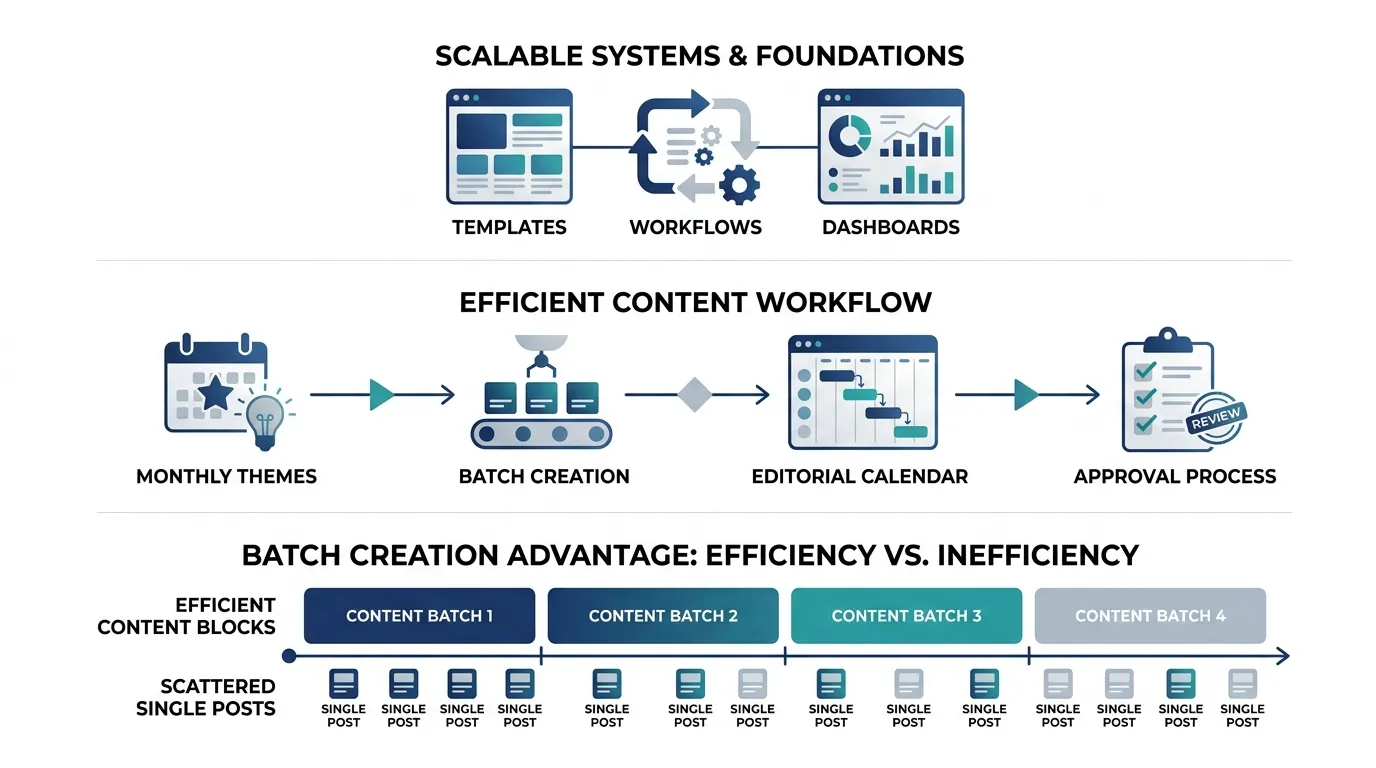
- Templates
- SOPs
- Message libraries
- Workflows
- Approval rules
- Dashboards
- Clear ownership
This is the kind of work startups often avoid because it feels too process-heavy at first. Then growth happens, the pressure increases, and suddenly everyone wants consistency, speed, and visibility all at once.
Systems are what let you have all three.
Creating Repeatable Content Workflows
I am a big fan of boring workflow design because boring workflows make exciting outcomes possible.
The simplest scalable structure I have seen work for startups usually includes:
- Monthly content themes
- Weekly batch creation
- One editorial calendar
- One content owner
- One approval path
- One review rhythm
That is often enough.
You do not need a giant playbook to start. You need enough clarity that the team can move without constant internal friction.
Batch Creation Reduces Wasted Effort
Batching helps because startups lose too much time context-switching.
Writing one post here, editing one reel there, chasing one approval at the end of the day, then jumping into analytics the next morning, may feel productive. In reality, it fragments the team’s energy.
When content is created in batches:
- Tone stays more consistent
- Momentum builds faster
- Approvals are easier
- Decision fatigue drops
- The calendar becomes more realistic
That is when the editorial plan stops being a wishlist and becomes an operating tool.
If there is one area where startups often get misled, it is measurement.
Once teams begin posting consistently, they naturally want proof that something is working. Unfortunately, many end up tracking the easiest social media metrics to screenshot rather than the ones that matter most.
Vanity Metrics Are Not Useless, But They Are Incomplete
Followers, likes, reach, and views can be useful signals. They tell you whether content is being seen. They can indicate whether something has resonated enough to generate surface-level interaction.
What they do not tell you on their own is whether social media is helping the business grow.
I have seen startups celebrate engagement with content that never generated a qualified lead. I have also seen highly educational, low-vanity content outperform flashier assets because it attracted the right audience.
That is why I separate metrics into layers:
- Awareness metrics
- Engagement metrics
- Business metrics
Social media metrics are often grouped into audience growth, customer satisfaction, awareness, customer retention, social media ROI, brand health, engagement, and paid social media metrics. It also highlights conversions, social media referral traffic, click-through rate, cost per click, and return on ad spend as important measures of commercial impact.
For startups, that commercial layer matters most.
Top KPIs in Social Media Marketing Consultancy
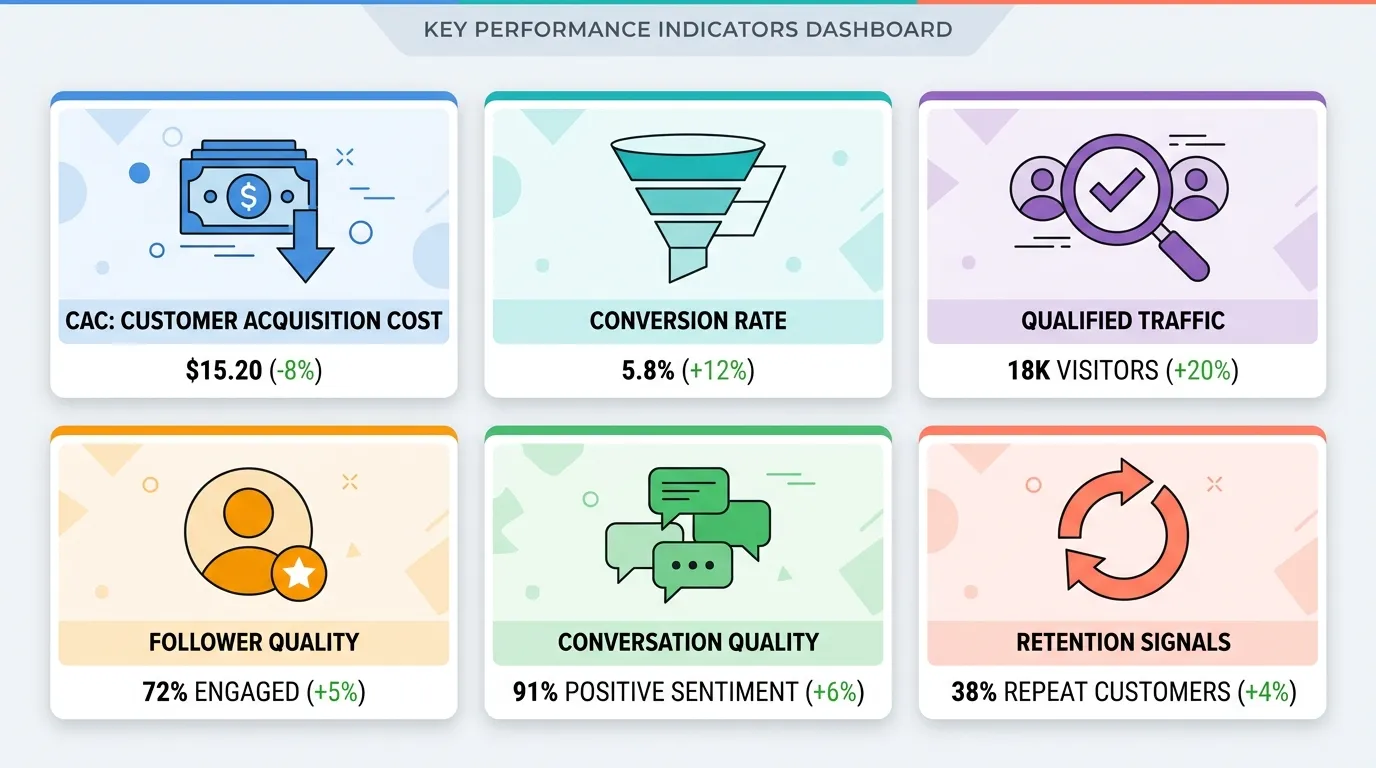
If I am advising a startup, these are the KPIs I usually care about most:
- Customer acquisition cost from social: This should include not only paid social but also the broader impact social has across assisted and direct conversion paths.
- Conversion rate from social content: This shows whether content is turning attention into action.
- Qualified traffic: Not every click is useful. I want visits that match the ICP and behave well once they arrive.
- Follower quality: A smaller audience of relevant decision-makers is often more valuable than a large passive following.
- Reply and conversation quality: Who is responding? Prospects, customers, peers, partners, or irrelevant accounts?
- Retention and community signals: Are people coming back? Recommending the brand? Mentioning it without prompting?
Follower count can still be useful for context. But follower quality usually tells me far more about whether the channel is becoming commercially meaningful.
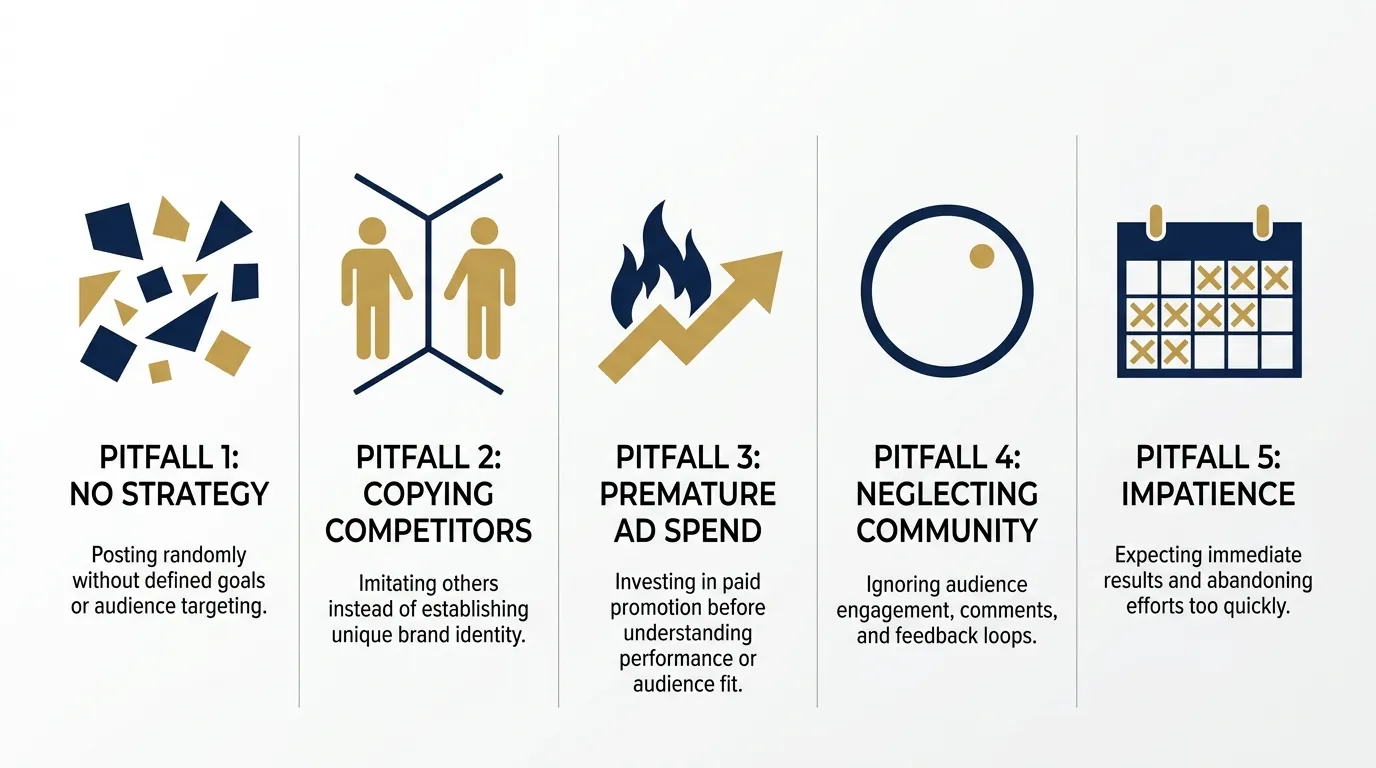
The most expensive mistakes are rarely dramatic. Usually, they are ordinary mistakes repeated often enough to become expensive.
Posting Without a Strategic Point of View
This is the most common one.
The problem is not always bad content. More often, it is a lack of coherence.
One week, the brand sounds playful, the next week it sounds highly technical. Then it becomes stiff and overly formal because someone senior asked for a more “professional tone”.
Over time, that inconsistency makes the brand harder to trust and harder to remember.
Copying Competitors Blindly
I understand why this happens. Competitors are visible, and visibility creates the illusion of certainty.
But copying a competitor’s format, cadence, or voice without understanding their business model, customer base, or strategy usually leads to generic marketing.
You end up borrowing someone else’s surface without understanding the structure underneath it.
Over-investing in Ads Too Early
Paid social is powerful, but it does not fix weak fundamentals.
If the message is unclear, the offer is weak, and the landing page does not convert, then ad spend simply accelerates waste.
Startups often learn this too late because paid reach can create the illusion of traction before the economics tell the truth.
Ignoring Community as a Growth Lever
Community is often treated as a nice-to-have when in reality it can be one of the most important trust signals a startup has.
Community-led growth is the process of leveraging community to impact business outcomes, such as increasing customer acquisition, boosting engagement, and improving retention.
That is precisely why comments, DMs, customer groups, and repeated conversations should not be treated as side tasks. They are part of the growth engine.
Expecting Immediate Proof
Social compounds awkwardly.
For a while, it can feel underwhelming. Then the strategy sharpens, the message lands better, and the audience starts responding more meaningfully.
The startups that understand this tend to focus on learning speed and consistency rather than chasing instant proof.

When I talk about social media marketing consultancy, I am not talking about someone who shows up, audits your feed, and tells you to “be more consistent”.
A proper consultant helps a startup make better decisions. That includes decisions like:
- What to say
- Who to say it to
- Where to say it
- How often to publish
- How to measure performance
- What to stop doing altogether
That, to me, is the real difference between consultancy and chaos.
Consultancy vs Agency vs In-house Support
A social media agency usually focuses on execution. They create assets, publish content, report on results, and, in many cases, manage paid campaigns.
An in-house marketer sits closer to the business, which is useful, but in a startup environment, that person is often doing far too much. They may be handling content, community management, email, paid media, reporting, and internal stakeholder requests simultaneously.
A consultant plays a different role.
The job is more strategic. I see it as creating clarity, building the system, and helping the business avoid expensive mistakes before those mistakes become normal operating behaviour.
| Criteria | Consultancy | Agency | In-house Support |
| Primary role |
|
|
|
| Best for |
|
|
|
| Main focus |
|
|
|
| Typical output |
|
|
|
| Strengths |
|
|
|
| Weaknesses |
|
|
|
| Cost structure |
|
|
|
| Speed of implementation |
|
|
|
| Strategic clarity |
|
|
|
| Execution capacity |
|
|
|
| Flexibility |
|
|
|
| Scalability |
|
|
|
| Brand familiarity |
|
|
|
| Objectivity |
|
|
|
| Best startup stage |
|
|
|
| Biggest risk |
|
|
|
| Ideal use case |
|
|
|
In-House vs Agency vs Social Media Marketing Consultancy: What’s Best for Startups
There is no universal answer here. The right model depends on stage, speed, internal capability, and what the business actually needs next.
When in-house makes sense: In-house support works well when you already have someone capable of owning the channel and enough internal clarity for them to operate effectively.
When agency support makes sense: Agency support is useful when you need execution power, creative production, paid media support, or specialist capability quickly.
When consultancy makes the most sense: Consultancy is strongest when the business needs:
- Strategic clarity
- Channel focus
- Stronger systems
- Better decision-making
- A more scalable operating model
Why a hybrid model often works best: In many startup situations, the most sensible answer is hybrid.
- A consultant shapes the strategy
- An in-house marketer owns the day-to-day execution
- An agency or specialist supports where deeper execution is needed
That model gives the business flexibility without locking it into heavy overheads too early.
Long-term scalability depends less on who does the work and more on whether the work is systemised well enough to grow.
My honest answer is earlier than most founders think, though not necessarily with a huge monthly retainer.
Pre-launch: Where Consultancy Creates Clarity
Before launch, startups often need help with:
- Message-market fit
- Channel prioritisation
- Founder positioning
- Launch narrative
- Early audience clarity
At this stage, consultancy helps the business avoid building its social presence on vague assumptions.
Post-launch: Where Consultancy Improves Performance
After launch, the need changes. Now the business needs:
- Consistency
- Repurposing systems
- Clearer reporting
- Stronger paid and organic alignment
- Better links between social activity and pipeline
The signs that consultancy is needed are often obvious once you know what to look for.
Signs Your Startup May Need a Consultant:
- You are posting regularly, but seeing little business impact
- The founder is carrying the brand presence through personal effort alone
- Ad spend is rising without stronger results
- Internal stakeholders keep changing direction
- Nobody can explain why each platform matters
- Reporting exists, but it is not driving decisions
Budget is Not The Only Cost to Think About
Yes, budget matters. But I think founders should frame the decision more honestly.
The cost of a consultant is visible.
The cost of six months of unclear messaging, wasted creative effort, poor ad testing, and confused brand signals is usually invisible.
Because it is invisible, it is often underestimated.
If I were making this decision for a startup today, I would not begin by asking who can post the most content or promise the fastest growth. I would start with fit.
The right partner should understand your business model, growth stage, audience, and the operational realities of a lean team. More importantly, they should be able to turn social media from a noisy activity into a structured system that supports positioning, demand, and long-term brand trust.
That is why the best choice is rarely the loudest provider or the cheapest quote. It is the team that can help you make better decisions, build repeatable workflows, and connect content to commercial outcomes.
If your startup needs that kind of strategic support backed by execution, MediaOne is worth considering as a social media marketing agency.
For a sharper conversation about channel fit, growth priorities, and whether a proper social media marketing consultancy approach is right for your business, call MediaOne for more information.
Frequently Asked Questions
What is the difference between a social media marketing consultancy and a social media agency?
A social media marketing consultancy typically emphasises diagnosis, strategy, planning, and operating models, while a social media agency typically emphasises campaign execution, content production, and ongoing channel management.
How much does a social media marketing consultancy cost?
Costs vary widely by scope, market, and seniority. Industry guides commonly place outsourced social media management at $500–$5,000 per month, with freelancer or consultant work often priced hourly, by project, or on retainer. For startups, it is also worth comparing whether the engagement covers strategy, measurement, workflow design, and platform recommendations.
When should a startup hire a social media marketing consultancy?
A startup may benefit from a social media marketing consultancy when it lacks a clear social strategy, channel priorities, messaging framework, or measurement system—especially if its posting is inconsistent, its audience fit is unclear, or its social activity is not tied to business goals.
Should startups manage social media in-house or outsource it?
In-house social media management tends to work best when a startup needs close brand integration, internal content ownership, and steady day-to-day support, while outsourcing tends to make more sense when the business needs specialist expertise, flexible capacity, or campaign execution; some startups use a hybrid model that keeps strategy close to the business while outsourcing production or channel management.
How long does it take to see results from a social media marketing consultancy?
Results depend on the goal and channel mix: early indicators such as reach, engagement, and clicks may improve within weeks or the first 30–90 days, while more reliable lead flow, conversion gains, and revenue impact often take roughly 3–6 months of consistent work, with paid campaigns generally moving faster than organic efforts.