
Social media is no longer a channel where brands can rely on casual posting and expect meaningful traction. In 2026, audiences are seeing more content, more AI-assisted creative, and more brands competing for the same attention.
At the same time, consumers still want content that feels useful, original, and human, which means brands need more than a content calendar to stand out.
That is where a well-planned social media marketing campaign comes in. A strong campaign gives structure to your content, aligns activity with business goals, and creates a clear path from visibility to engagement to conversion.
For brands seeking sharper execution, faster testing, and clearer accountability, partnering with a social media agency can make that process far more effective. With this context in mind, it’s essential to define what constitutes a social media marketing campaign in today’s environment.
Key Takeaways
- A successful social media marketing campaign starts with one clear objective, a defined audience, and the right platform mix. Without that foundation, even strong creatives can struggle to deliver meaningful results.
- Agencies execute campaigns more effectively by combining strategy, content planning, paid support, and performance tracking into a coordinated process. This helps brands launch with more clarity, test faster, and optimise based on real data.
- Different campaign types serve different goals, from brand awareness and lead generation to product launches, UGC, and seasonal promotions.
- High-performing campaigns in 2026 need to balance speed with relevance. Audiences respond better to platform-native, useful, and authentic content than generic posts that feel overly polished or disconnected from how people actually use social media.
A social media marketing campaign is a coordinated series of posts, ads, creative assets, and audience actions, built around a single clear objective within a defined timeframe. It is different from day-to-day posting because it is designed to drive a specific outcome, such as awareness, leads, sales, event registrations, or customer retention.
At its core, a campaign should include one primary goal, a defined audience, a consistent message, creative assets tailored to each platform, a publishing schedule, and a way to track results. That structure is consistent with how leading campaign guides define social media campaigns today.
Many brands still treat campaigns as random posts, publishing a few visuals, boosting the best, and hoping for results. This rarely works since there’s no cohesive strategy connecting content, targeting, timing, and measurement.
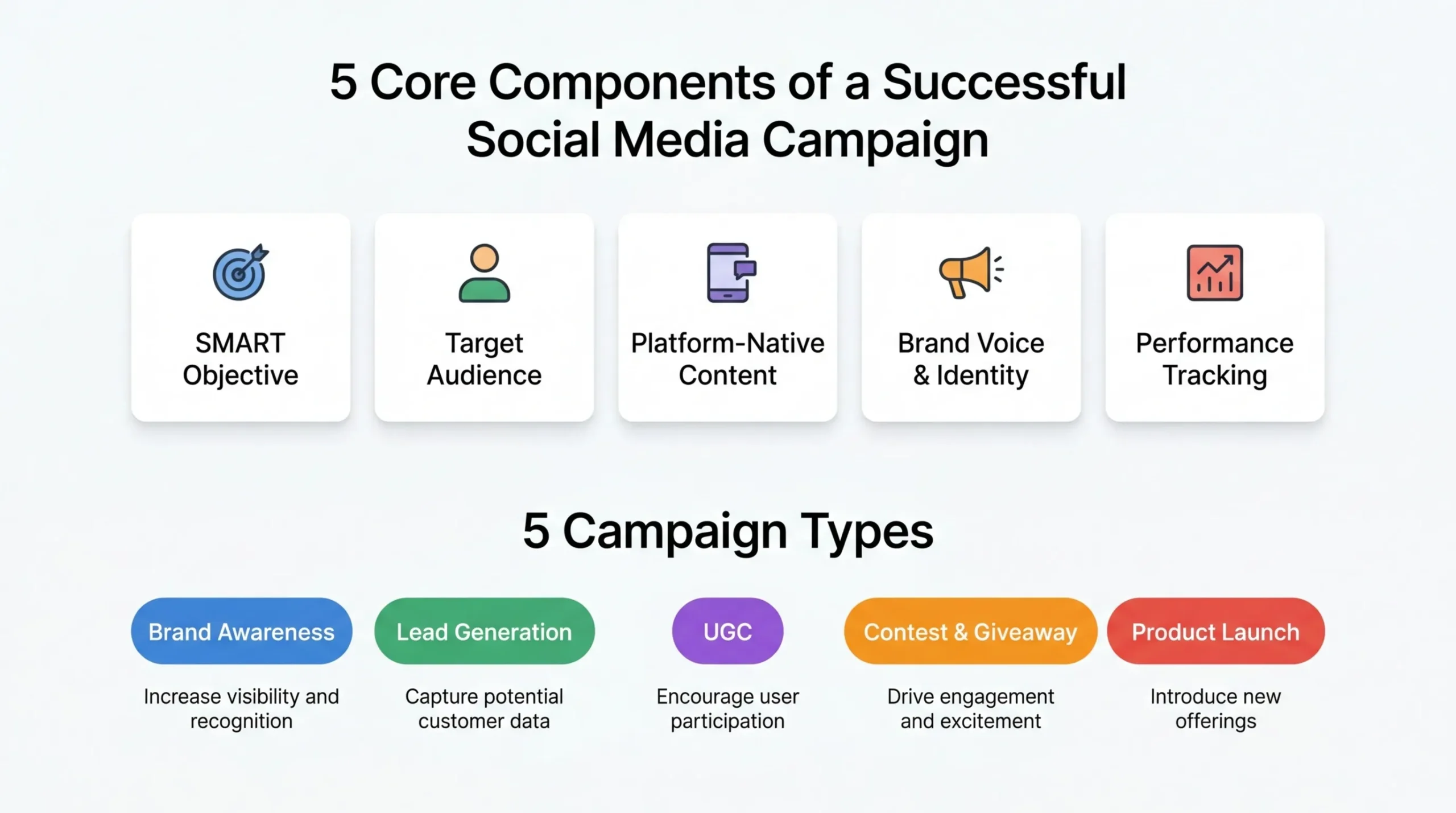
Every high-performing social media campaign shares five foundational elements, regardless of industry, budget, or platform:
- A SMART objective: Specific, Measurable, Achievable, Relevant, and Time-bound
- A defined target audience: Persona-level specificity, not broad demographics
- Platform-native content: Built for each channel, not repurposed across all of them
- A consistent brand voice and visual identity: Recognition builds trust over time
- A real-time performance tracking framework: KPIs agreed before launch, not after
Miss any one of these and the campaign will underdeliver, regardless of how large the budget or how creative the content.
Before you create content or spend on ads, it’s important to determine the type of campaign you are running. This matters because each campaign type has a different goal, content approach, and definition of success. A clear distinction among types ensures that messaging, targeting, and results are aligned.
1. Brand Awareness Campaigns
Brand awareness campaigns work best when the creative is memorable, emotionally clear, and easy to associate with the brand. The aim is not to push for an immediate sale, but to make sure more people know who you are and what you stand for.
- Primary goal: Introduce your brand to new audiences and improve recall and recognition.
- Best formats: Video ads, influencer partnerships, paid reach campaigns, YouTube pre-rolls
- KPIs to track: Reach, impressions, brand lift, share of voice
Example: Nike’s Move to Zero campaign used platforms like Instagram and YouTube to build a strong emotional connection around sustainability, helping the brand reach large audiences beyond existing customers.
2. Lead Generation Campaigns
Lead generation campaigns are designed to move users from interest to action. To work well, they need a strong offer, low-friction forms, and a clear follow-up process. If the form is too long or the value exchange is weak, lead quality and conversion rate usually suffer.
- Primary goal: Capture qualified contact details, such as email addresses, phone numbers, and registrations, from potential customers.
- Best formats: Meta Lead Ads, LinkedIn Lead Gen Forms, gated content such as ebooks, templates, webinars, or consultations
- KPIs to track: Cost per lead, lead volume, form completion rate, lead quality score
Best platforms: LinkedIn for B2B, Facebook and Instagram for B2C
Or you can engage a lead generation agency to get more details and support in creating effective lead generation campaigns for your business.
3. User-Generated Content Campaigns
UGC campaigns tend to perform well because the content feels more credible than standard brand advertising. They also help brands build a stronger sense of community while extending campaign reach without relying entirely on in-house production.
- Primary goal: Encourage customers to create and share content about your brand, helping you build trust and social proof at scale.
- Best formats: Branded hashtag challenges, review prompts, photo contests, testimonial campaigns
- KPIs to track: UGC volume, branded hashtag reach, earned media value, sentiment
Example: Apple’s #ShotOniPhone campaign turned customers into creators, generating a huge volume of authentic content while reinforcing product quality through real user experiences.
4. Contest and Giveaway Campaigns
These campaigns can generate fast traction, but the quality of that traction matters. If the prize is unrelated to the brand, you may attract low-intent participants who disappear once the giveaway ends.
- Primary goal: Drive quick bursts of engagement, follower growth, or list-building through incentive-based participation.
- Best formats: Tag-to-enter posts, share-to-win mechanics, Story participation, comment-based entries
- KPIs to track: Entry volume, follower growth rate, cost per new follower, engagement retention after the campaign
Example: Moonfruit’s well-known Twitter contest generated massive brand visibility by encouraging users to post with its branded hashtag, turning a simple contest mechanic into a viral result.
5. Product Launch Campaigns
Product launch campaigns are most effective when they build momentum in stages. Rather than revealing everything at once, agencies often sequence the campaign so curiosity, trust, and urgency build over time.
- Primary goal: Build anticipation before launch and drive strong interest or sales once the product goes live.
- Best formats: Teaser posts, countdowns, behind-the-scenes content, influencer seeding, launch-day ads
- KPIs to track: Launch-day traffic, conversion rate, share of voice, and return on ad spend in the first week.
Agency tip: Start building anticipation at least three to four weeks before launch. Warm audiences are far more likely to convert than completely cold ones on launch day.
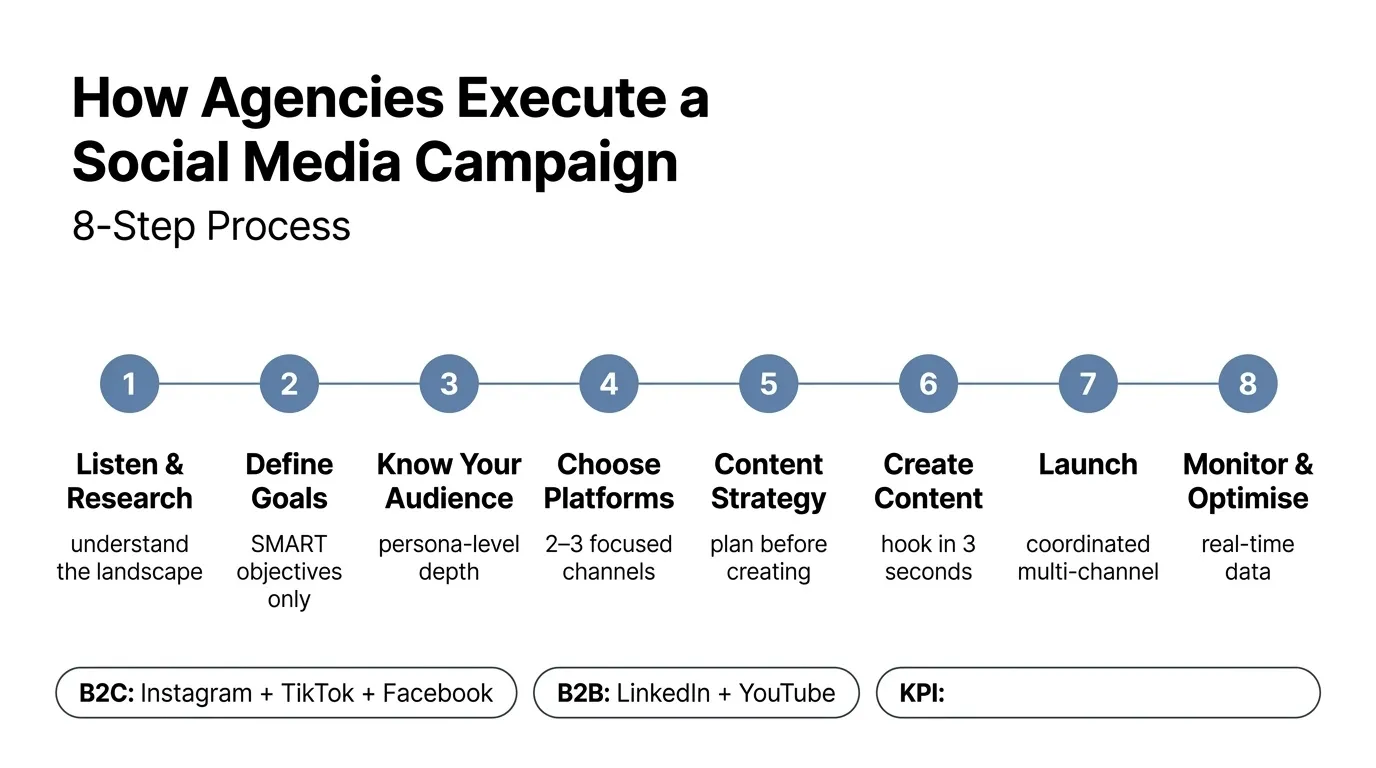
Executing a social media marketing campaign takes more than publishing content and watching the numbers roll in. Agencies follow a structured process that connects every part of the campaign and works toward the same goal.
This is what allows them to launch with clarity, optimise quickly, and turn social activity into measurable business results.
Step 1: Listen and Research Before You Build Anything
The single most expensive mistake brands make is jumping straight to content creation without first understanding the landscape. Professional agencies never skip the social listening phase. It is the intelligence layer that makes every subsequent decision sharper, faster, and more cost-effective.
What social listening reveals before your campaign launches:
- The exact language your target audience uses to describe their problems, so your campaign copy resonates immediately.
- Which content formats are earning the highest engagement in your category right now
- What your closest competitors are doing, and more importantly, what they are missing
- The current sentiment around your brand, product, or industry
- Which creators and voices already carry authority with your target audience
Pre-campaign research toolkit:
| Tool | What It Does | Cost |
| Google Trends | Identifies rising and falling search interest around your topic | Free |
| Meta Audience Insights | Reveals demographic and interest data for your Facebook/Instagram audience | Free |
| LinkedIn Analytics | Shows what content your followers engage with most | Free |
| Brandwatch / Mention | Tracks brand mentions, keywords, and hashtags across all platforms | Paid |
| SparkToro | Discovers where your target audience spends time online | Paid |
| BuzzSumo | Identifies the highest-performing content in your industry | Paid |
Competitive intelligence checklist:
Before briefing any creative, every agency runs through these questions:
- What campaigns are your top 3 competitors running right now?
- What is their posting frequency and content mix, video vs static vs stories?
- Which posts earned the highest engagement in the last 90 days?
- What do audience comments reveal about unmet needs or frustrations?
- What content themes or hashtags do they own, and which ones are unclaimed territory?
The answers to these questions shape the entire campaign brief that follows.
Step 2: Define Your Campaign Goals
A social media campaign without a defined goal is just content with a deadline. Before a single creative asset is produced, agencies lock in a SMART campaign objective, and every subsequent decision is filtered through it.
The SMART goal framework applied to social media campaigns:
| Principle | What It Means | Example |
| Specific | Define exactly what you want to achieve | “Generate leads from Singapore SME decision-makers aged 30–50” |
| Measurable | Attach a number to the goal | “Generate 200 qualified leads” |
| Achievable | Grounded in historical benchmarks | Based on the previous campaign CPL data |
| Relevant | Tied directly to a business outcome | Feeds the Q4 sales pipeline |
| Time-bound | Has a firm deadline | “Within 45 days” |
Campaign objective types and their business purpose:
- Brand awareness → Entering new markets, repositioning, or reaching new customer segments.
- Lead generation → Building a sales pipeline with contact-qualified prospects.
- Website traffic → Increasing product page visits and reducing reliance on paid search
- Conversions and sales → Direct revenue attribution from social media channels
- Community growth → Building long-term loyalty, retention, and brand advocacy
- Event promotion → Maximising registrations, footfall, or ticket sales
- App installs → Driving downloads through targeted mobile-first campaigns.
The critical rule agencies never break: every campaign goal must be paired with a business metric, not just a social metric.
Getting 10,000 likes means nothing if it generates zero leads, zero sales, and zero pipeline. Stakeholders measure business outcomes, so build your goals accordingly.
Step 3: Identify and Deeply Understand Your Target Audience
You cannot create compelling campaign content for “everyone.” The brands that consistently outperform on social media have one defining trait in common: they know their audience at a personal level. not just demographics, but motivations, platform behaviours, content preferences, and purchasing triggers.
Understanding that different target audiences have different needs and wants is key. For instance, there is a noticeable difference between B2B and B2C audiences. B2B audiences are typically focused on professional goals and long-term value, while B2C audiences are often driven by emotional connection and instant gratification.
To dive deeper into the nuances between these two, you can explore how social media marketing for B2B vs B2C differs in strategy and approach here.
Why audience research determines campaign ROI:
A product with mass-market appeal can still fail if it’s targeting the wrong segment, platform, or message. Conversely, a niche brand with a precisely defined audience can achieve exceptional results on a modest budget, purely through surgical targeting and relevant messaging.
Data sources agencies use to build audience personas:
| Source | Insights Gained |
| CRM and sales data | Demographics, purchase frequency, average order value, and location |
| Platform-native analytics | Age, device, location, peak activity times, content preferences |
| Social listening tools | Language patterns, recurring complaints, and emotional triggers |
| Customer interviews | Decision-making process, perceived alternatives, real motivations |
| Competitor follower analysis | Who engages with competitor content and why |
| Google Analytics audience reports | Interests, in-market segments, affinity categories |
What a complete campaign audience persona includes:
- Name, age range, occupation, income bracket, and location
- Primary social platforms used, and how they use them (consume vs. create vs. shop)
- Core goals and aspirations relevant to your product or service category
- Primary pain points your campaign messaging can directly address
- Content formats they respond to most (short video, carousels, long-form, UGC)
- Specific triggers that move them from passive interest to active purchase consideration
Agencies typically build two to three personas per campaign to serve different audience segments without fragmenting the budget or diluting the core message.
Step 4: Select the Right Social Media Platforms
Attempting to maintain a strong presence across every platform with a single campaign budget is a resource trap that produces mediocrity everywhere.
The most effective social media campaign strategies concentrate creative energy and ad spend on the two to three platforms where the target audience is most active and most receptive.
Platform overview for campaign planning:
| Platform | Best Campaign Use | Top Content Format | Core Audience | Ad ROI |
| Retargeting, community, broad B2C reach | Video, carousel, lead forms | 25–54, all demographics | ★★★★★ | |
| Visual products, influencer campaigns, lifestyle brands | Reels, Stories, carousel | 18–34, lifestyle, fashion, food | ★★★★★ | |
| TikTok | Brand awareness, viral content, Gen Z reach | Short-form video, challenges | 13–34, entertainment-first | ★★★★☆ |
| B2B lead generation, thought leadership, HR/recruitment | Articles, video, lead gen forms | Professionals 25–54 | ★★★★☆ | |
| YouTube | Brand storytelling, tutorials, long-form education | Long and short videos | All age groups | ★★★★☆ |
| X (Twitter) | Real-time PR, community, customer service | Text, images, threads | 25–44, news and tech | ★★★☆☆ |
| Evergreen discovery, high purchase intent | Infographics, product pins | Women 25–44, home, food, fashion | ★★★☆☆ |
The four questions that drive platform selection:
- Where does my target audience actually spend their time? Platform demographics outweigh platform popularity. A platform with 3 billion users is irrelevant if your audience isn’t on it.
- What content format does my campaign require? Video-first campaigns anchor on TikTok and YouTube. Document and authority content anchors on LinkedIn. Visual product campaigns anchor on Instagram.
- What is my realistic budget per platform? LinkedIn advertising costs significantly more per click than Meta advertising, but it generates higher-quality B2B leads. Factor in the cost-per-outcome, not cost-per-click, when making your platform decision.
- What does my specific campaign objective demand? Brand awareness favours TikTok (algorithmic viral reach) and YouTube (video completion and retention). Lead generation favours LinkedIn Lead Gen Forms and Meta lead ads. Direct conversions favour Instagram Shopping and Facebook Dynamic Product Ads.
Agency rule of thumb: For B2C brands, start with Instagram, TikTok, and Facebook. For B2B brands, start with LinkedIn + YouTube. Prove ROI on two platforms before expanding the budget to a third.
Step 5: Develop a Content Strategy That Serves the Campaign
A social media content strategy is the operational blueprint for your campaign. It answers every question before execution begins: what will be created, for which audience, in which format, on which platform, when, and with what message.
Agencies invest heavily in this stage because every hour spent here saves three hours of execution time.
Content format performance by platform (2025):
| Format | Best Platform | Key Metric | Ideal Length |
| Short-form video | TikTok, Instagram Reels, YouTube Shorts | Completion rate, shares | 15–60 seconds |
| Carousel / multi-slide | Instagram, LinkedIn | Saves, swipe-throughs | 5–10 slides |
| User-generated content | Instagram, TikTok | Comments, reshares | Native/organic |
| Long-form video | YouTube, LinkedIn | Watch time, subscriber growth | 5–15 minutes |
| Static image posts | Instagram, Facebook | Saves, shares | Single frame |
| Text / thought leadership posts | Reactions, reposts, comments | 150–300 words | |
| Stories / ephemeral content | Instagram, Facebook | Link taps, direct replies | 15 seconds |
| Interactive polls and quizzes | Instagram, LinkedIn, X | Poll votes, engagement rate | One clear question |
Structuring content around four campaign pillars:
Rather than producing ad hoc posts, agencies build campaigns around four content pillars that serve the campaign objective from different angles:
- Educational content: Teach the audience something genuinely valuable about your product category or industry
- Entertaining content: Create content people want to watch, share, and return to because it’s surprising, funny, or emotionally resonant
- Inspirational content: Show real outcomes, customer transformations, and brand success stories
- Promotional content: Direct product features, offers, and conversion-focused posts (cap this at 20–30% of total campaign content)
Building the campaign content calendar:
A content calendar is your team’s operational command centre throughout the campaign. Each entry specifies:
- Publication date and optimal posting time (based on audience activity data)
- Platform and content format
- Full caption copy including primary keyword and CTA
- Creative asset reference (file name or Figma/Canva link)
- Hashtag set (a mix of broad, mid-tier, and niche hashtags)
- Paid amplification: yes/no, target audience, and daily budget
Step 6: Create Content That Stops the Scroll
The most strategically sound social media marketing campaign will fail if the creative doesn’t arrest attention in the first three seconds. In a feed where every post is competing for milliseconds of awareness, content quality is not a differentiator; it is a table stake.
The Three-Second Rule
Every piece of campaign content must deliver its opening hook within the first three seconds. If the scroll continues, the algorithm registers a negative signal and progressively reduces that content’s reach. The hook is everything.
Hook formats that consistently perform:
- A bold, counterintuitive statement: “Your content calendar is probably hurting your engagement.”
- A direct question that creates immediate self-identification: “Still boosting posts and calling it a strategy?”
- A striking visual contrast or unexpected pairing that creates visual disruption
- A specific, surprising number: “We ran one campaign for 30 days. Here’s what ₹50,000 actually bought us.”
Step 7: Launch Your Campaign With Coordination
A campaign launch is not just hitting the “publish” or “go live” button. Professional agencies treat launch day as a precisely coordinated moment that requires preparation across creative, paid media, community management, and analytics teams, all aligned to the same clock.
Pre-launch checklist agencies use:
- All creative assets were reviewed, approved, and uploaded to the scheduling tool.
- Ad accounts funded, and audience targeting parameters configured and reviewed.
- UTM tracking parameters are appended to every link in every post and ad
- Conversion pixels verified and firing correctly on all landing pages.
- Community management team briefed on tone, FAQs, and escalation protocols.
- Influencer and partner posts are confirmed, scheduled, or published simultaneously.
- Email marketing launch aligned to amplify the campaign’s opening push.
- Analytics dashboards are built and live before the first post goes out.
Timing and coordination best practices:
- Launch on Tuesday, Wednesday, or Thursday. These days consistently yield the highest organic engagement rates across most B2B and B2C platforms.
- Avoid launching during major competing news cycles, as they can suppress your content’s visibility.
- Synchronise your social launch with email, blog, PR, and paid search simultaneously. This coordinated multi-channel push generates a compounding awareness effect in the first 48 hours.
- For paid campaigns, launch with 10–20% of your total budget as a test allocation in the first 48 hours. Gather data on which creative and audience performs best before scaling the full spend.
Step 8: Monitor Performance and Optimise in Real Time
The most effective social media campaigns are not set-and-forget operations. They are living systems that evolve in real time based on performance data. Agencies set up dashboards and monitoring protocols before launch specifically so they can act on signals within hours, not weeks.
Key performance indicators (KPIs) to track by campaign type:
| Campaign Objective | Primary KPIs | Secondary KPIs |
| Brand Awareness | Reach, impressions, share of voice | Video completion rate, follower growth |
| Lead Generation | CPL, lead volume, form completion rate | CTR, landing page conversion rate |
| Website Traffic | Sessions from social, CTR | Bounce rate, pages per session |
| Conversions / Sales | ROAS, revenue, conversion rate | CPC, add-to-cart rate |
| Engagement / Community | Engagement rate, saves, shares | Comments, DM volume, sentiment |
How agencies approach campaign optimisation:
Week 1: Establish baseline: Gather initial data without making major changes. Identify which creatives and audience segments are performing above and below expectations.
Week 2: Test and adjust: Pause underperforming ad sets. Scale budget toward the top-performing creative variants. Adjust targeting parameters based on audience response data.
Week 3 onwards: Scale and refine: Double down on proven formats and audiences. Introduce new creative variants to combat ad fatigue. Maintain a daily monitoring cadence for paid and a weekly cadence for organic.
Tools for real-time campaign monitoring:
- Meta Business Suite: Facebook and Instagram paid performance, audience breakdowns, and ad delivery
- LinkedIn Campaign Manager: B2B campaign analytics, including company-level engagement data
- Google Analytics 4: Post-click behaviour, social traffic attribution, and conversion path analysis
- TikTok Ads Manager: Video performance, audience insights, and creative analytics
- Sprout Social / Hootsuite: Cross-platform organic performance monitoring and social inbox management
Optimisation rule: If a paid ad set has spent enough budget to register 50+ meaningful actions (clicks, leads, or purchases) and is still underperforming against KPI benchmarks, pause it. Do not let sentiment override data.
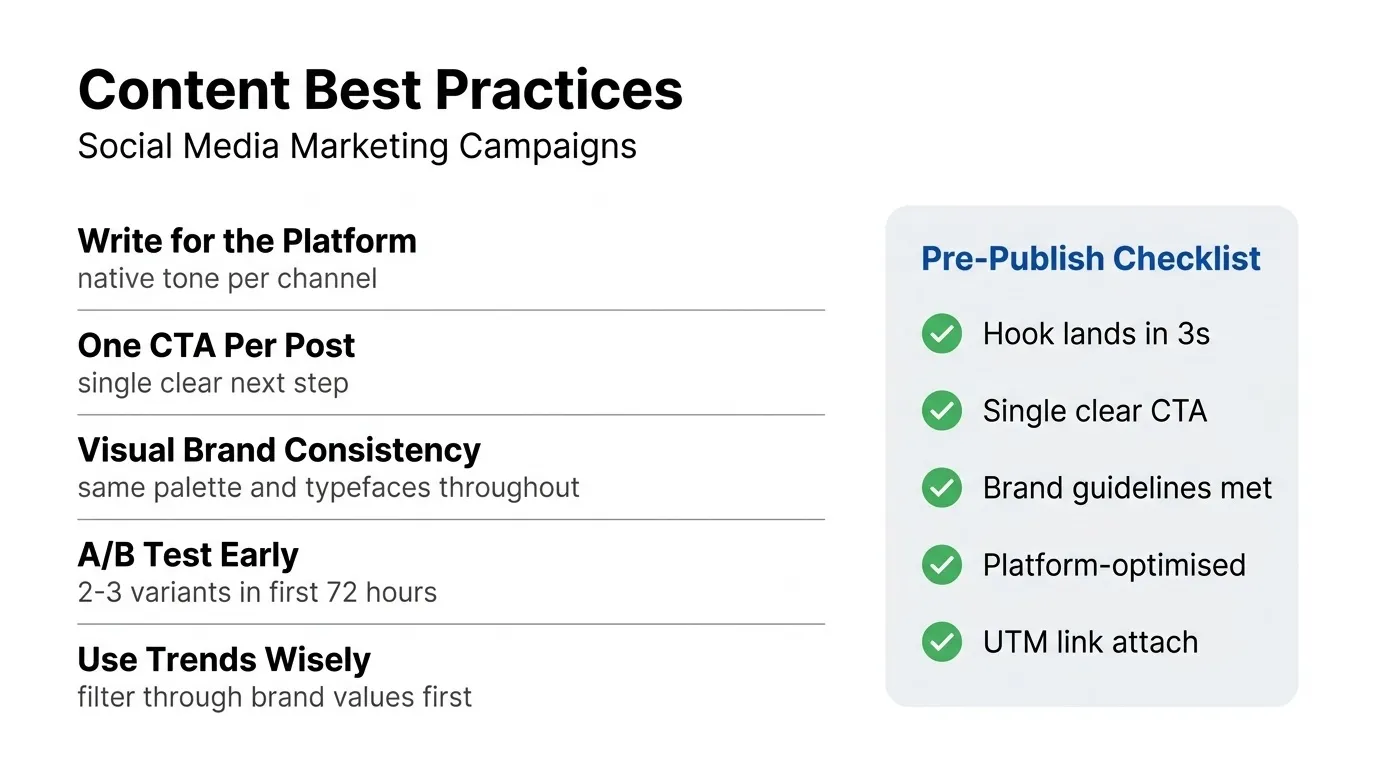
Write for the platform, not the brand. The tone, length, and format that perform on LinkedIn, professional, data-driven, long-form content will fall completely flat on TikTok. Build platform-native versions of each campaign asset. Never repurpose verbatim.
One post, one call to action. Every piece of content should direct the audience to exactly one next step: “Shop now,” “Save this post,” “Drop a comment below,” “Click the link in bio.” Multiple CTAs in one post dilute conversion intent and reduce click-through rates.
Maintain visual brand consistency. Use the same colour palette, typefaces, and logo placement across all platforms and formats throughout the campaign duration. Consistent visual identity builds recognition, and recognition builds trust.
A/B test early and scale fast. In the first 72 hours of a paid campaign, run two to three creative variants; different hooks, different visual formats, different CTAs. Double down on the top performer with the majority of the budget before the campaign loses momentum.
Leverage trending formats without losing brand identity. Participating in trending audio, meme formats, or viral challenges can dramatically amplify organic reach, but always pass trends through your brand’s values filter before activating them. Relevance without authenticity reads as opportunistic.
Agency checklist before publishing any campaign asset:
- Does the opening hook land within 3 seconds? ✓
- Is the CTA singular and clear? ✓
- Is the visual identity consistent with brand guidelines? ✓
- Has this been optimised specifically for this platform? ✓
- Is there a UTM tracking link attached (for paid content)? ✓
The right tools determine how efficiently your campaign scales and how precisely it can be monitored. Agencies organise their technology stack across three functional layers.
Layer 1: Social Media Management and Scheduling Tools
These platforms are the operational backbone of campaign execution, handling scheduling, multi-account management, team collaboration, and content approval workflows.
| Tool | Best For | Key Features | Starting Price |
| Hootsuite | Enterprise teams, multi-client management | Full scheduling suite, analytics, and team workflows | ~$99/month |
| Buffer | Small teams, simplicity-first scheduling | Clean UI, affordable, basic analytics | Free tier available |
| Sprout Social | Premium analytics, customer care, social listening | Advanced reporting, smart inbox, listening | ~$249/month |
| Later | Instagram and TikTok visual planning | Visual calendar, link in bio tool, media library | From $18/month |
| SocialPilot | Agencies managing multiple brands | Client management, white-label reports | From $30/month |
Key features to prioritise when choosing a management tool:
- Multi-platform support across all channels you use
- Content calendar with drag-and-drop scheduling
- Team collaboration, approvals, and role-based access
- Built-in analytics with exportable reports
- Social inbox to manage comments and DMs in one place
Layer 2: Analytics and Performance Reporting Tools
Without analytics, campaign optimisation is guesswork. These tools provide the data layer that tells you precisely what is working, what isn’t, and where to reallocate resources.
| Tool | Best For | What It Measures |
| Google Analytics 4 | Post-click website behaviour | Traffic source, conversions, and user journeys |
| Meta Business Suite | Facebook and Instagram campaigns | Ad delivery, reach, ROAS, audience breakdown |
| LinkedIn Campaign Manager | B2B paid campaigns | Leads, CTR, company-level engagement |
| TikTok Analytics | Organic and paid TikTok content | Video views, completion rate, follower demographics |
| Brandwatch | Brand sentiment and social listening | Mention volume, sentiment score, share of voice |
What to look for in campaign analytics tools:
- Automated weekly and monthly performance report generation
- Attribution modelling across multiple touchpoints (not just last-click)
- Audience segmentation breakdowns for ad performance
- Sentiment analysis to detect early signs of negative response
- Integration with your CRM to connect social leads to revenue outcomes
Layer 3: Design and Content Creation Tools
Visual content is the currency of social media. Professional-grade design is no longer a barrier that requires a full creative team; the following tools put broadcast-quality creative production within reach of any brand.
Canva is the most widely adopted design tool for social media marketers. Canva offers thousands of platform-specific templates, a brand kit feature for maintaining visual consistency, a background remover, video editing, and team collaboration, all in a browser-based environment. Canva Pro unlocks the full feature set.
- Best for: Non-designers who need professional output quickly; teams managing high content volumes
- Pricing: Free tier available; Canva Pro from $15/month
Adobe Express: Adobe’s entry-level design platform with pre-designed motion templates for animations, a built-in social media scheduler, real-time team collaboration, and direct integration with Photoshop and Illustrator files. Particularly strong for brands already in the Adobe ecosystem.
- Best for: Teams that work across Adobe Creative Suite; campaigns requiring animated content
- Pricing: Free tier available; Adobe Express Premium from $9.99/month
CapCut is purpose-built for short-form video editing with TikTok and Reels-native templates, automatic subtitle generation, trending sound integration, and AI-powered editing features. Available as both a mobile app and a desktop editor.
- Best for: TikTok and Instagram Reels content production at speed; social media teams without dedicated video editors
Together, Canva and Adobe Express serve over 150 million users worldwide, reflecting how central design tools have become in modern campaign workflows.
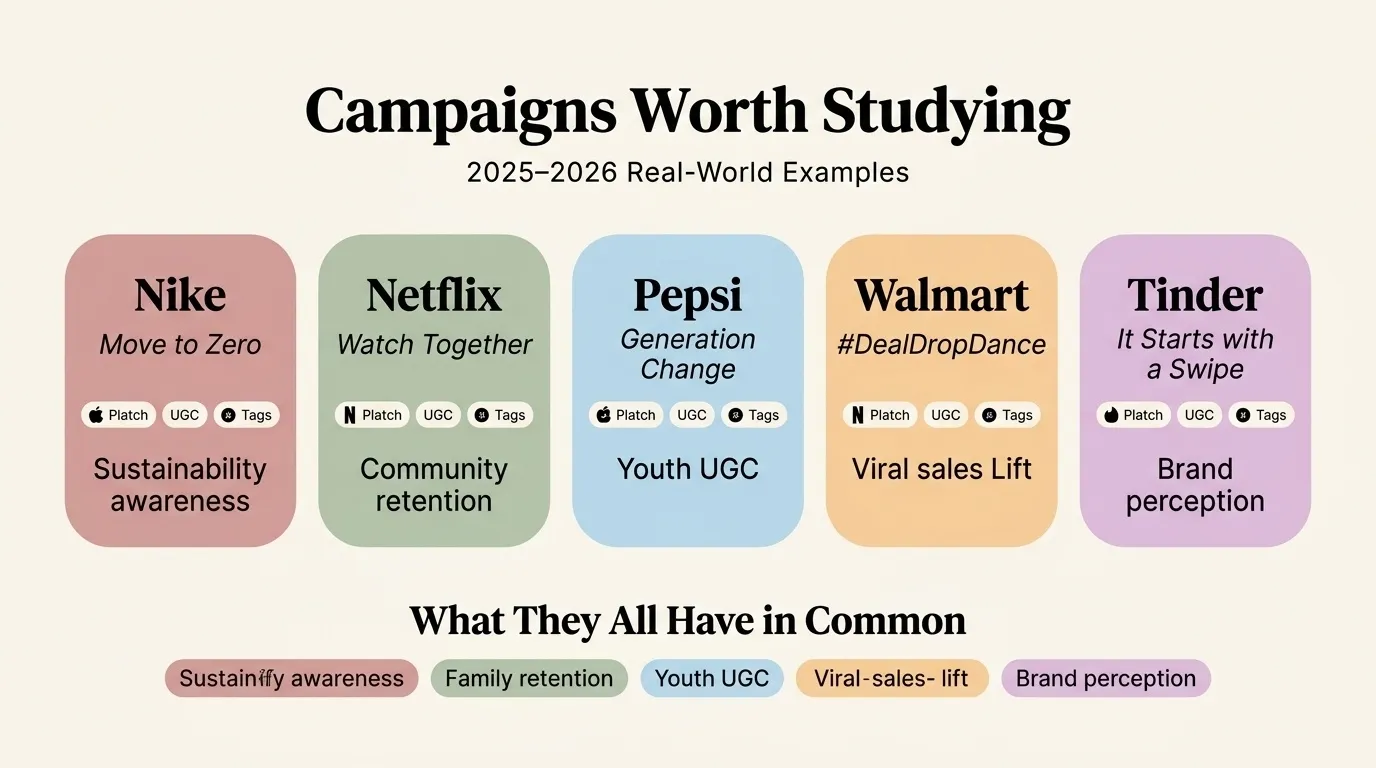
The campaigns that resonate most share a common trait: they are built around a clearly defined audience insight, executed with creative precision, and measured against honest business metrics.
| Brand | Campaign Name | Goal | Platform | Results |
| Nike | Move to Zero | Brand awareness, sustainability values | Instagram, YouTube, TikTok | Global awareness lift; strong emotional brand association with environmental causes |
| Netflix | Watch Together: Teleparty | Community building, viewer retention | Instagram, X, YouTube | Fostered shared viewing culture; significant engagement spike and platform stickiness increase |
| Pepsi | Generation Change | Youth engagement, social advocacy | TikTok, Instagram | Millions of youth-generated submissions; dominant share of voice in target demographic |
| Walmart | #DealDropDance | Product promotion, viral reach | TikTok | Millions of challenge participations; measurable sales lift during promotional window |
| Tinder | It Starts with a Swipe | Brand repositioning, user acquisition | Instagram, TikTok, OOH | Significant cultural conversation; measurable brand perception improvement among the 18–25 demographic |
What every successful campaign in this table has in common:
- A single, clearly defined primary objective
- Precise audience targeting (not broad demographic guessing)
- Platform-native creative that fits the channel’s culture
- Real-time data monitoring with willingness to pivot
- A measurable business outcome is the definition of success.
One of the most common questions brands ask agencies is: “How much should we spend?” There is no single correct answer, but there is a reliable framework that prevents both underspending (which starves the campaign of reach) and overspending before proof of ROI is established.
The Three-Bucket Budget Framework
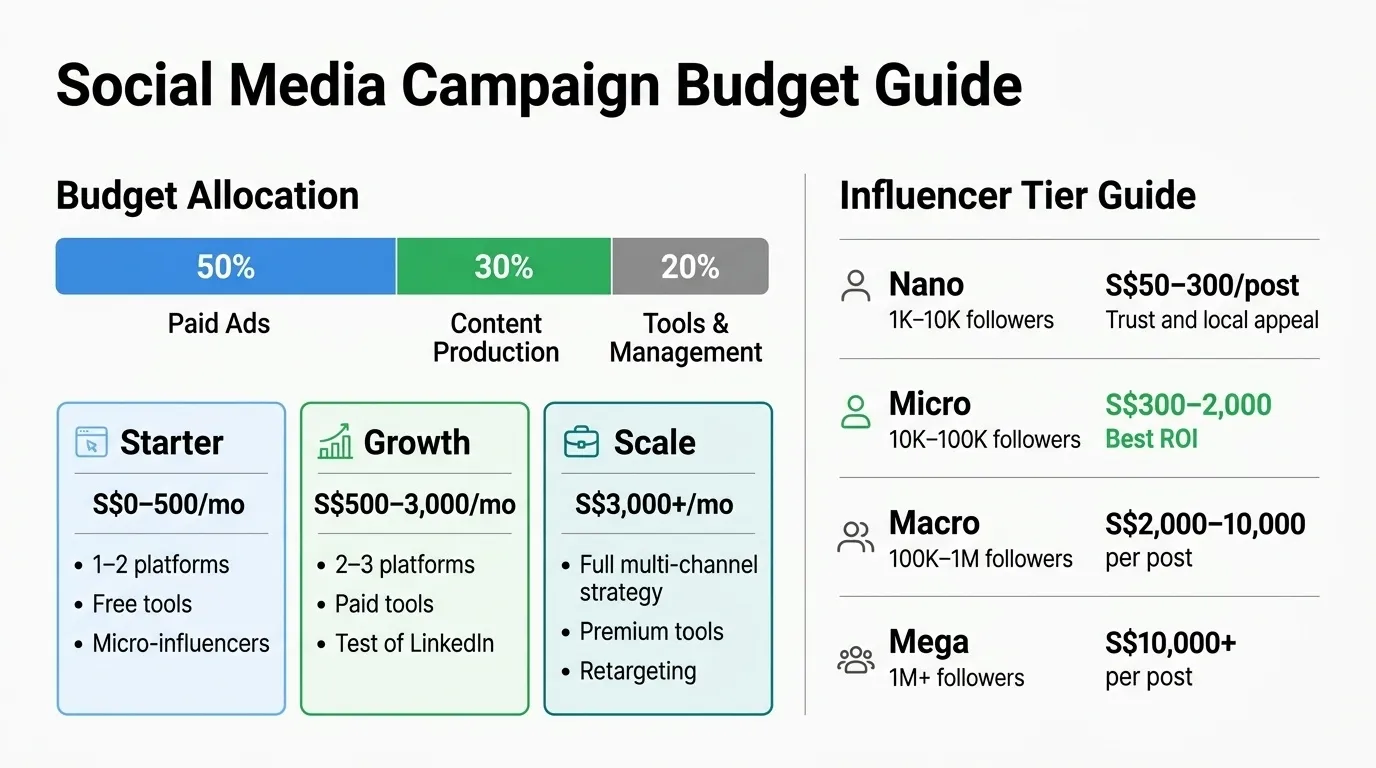
Allocate your total campaign budget across three core areas before production begins:
| Budget Bucket | Allocation | What It Covers |
| Content Production | 30% | Creative asset creation; video production, design, copywriting, influencer fees |
| Paid Amplification | 50% | Ad spend across Facebook, Instagram, TikTok, LinkedIn, and YouTube |
| Tools and Management | 20% | Scheduling software, analytics tools, and agency management fees |
Starter Budget (Under S$500/month):
- Focus exclusively on one to two platforms.
- Allocate S$150–S$300/month to targeted Meta ads (Facebook and Instagram)
- Use free tools: Canva for design, Buffer’s free tier for scheduling, and Google Analytics.
- Partner with micro-influencers, rates often start at S$100–S$300 per post
- A S$150/month Facebook and Instagram campaign reaches thousands of targeted local users, at a fraction of the cost of a single printed magazine advertisement.
Growth Budget (S$500–S$3,000/month):
- Run coordinated paid campaigns across two to three platforms simultaneously.
- Invest in a mid-tier management tool (Later, SocialPilot, or Buffer Pro)
- Allocate 60% to paid ads, 40% to content production, and influencer fees
- Test LinkedIn InMail or LinkedIn Lead Gen Forms for B2B campaigns
Scale Budget (S$3,000+/month):
- Full multi-channel campaigns with dedicated ad budgets per platform
- Invest in premium tools (Sprout Social, Brandwatch) and agency-grade reporting.
- Commission professional video content and ongoing influencer partnerships
- Implement retargeting campaigns to recapture high-intent website visitors.
B2C vs. B2B Budget Allocation
For B2C brands: Prioritise Instagram, Facebook, and TikTok. Run visually driven campaigns with conversion-optimised ad sets and retargeting audiences. Influencer partnerships deliver strong ROI, particularly micro-influencers in your specific niche.
For B2B brands: Prioritise LinkedIn. Showcase thought leadership content, share original data and insights, and run LinkedIn Lead Gen Form campaigns targeting decision-maker job titles. Expect higher CPL than in B2C, but qualify leads based on revenue potential, not raw cost.
Influencer and Partnership Strategy
Influencer marketing has become one of the highest-ROI channels in the modern campaign toolkit. In 2025, 86% of US marketers partnered with influencers, and brands reported earning an average of $5.78 for every $1 spent on influencer campaigns. Top-performing campaigns achieve $18–$20 in return per dollar invested.
The average influencer marketing CPM dropped 53% year-over-year in 2025, making this channel more cost-efficient than at any point in its history.
Types of Influencer Partnerships and When to Use Each
| Tier | Follower Range | Best Use Case | Cost Range |
| Nano-influencers | 1,000–10,000 | Hyper-local campaigns, community trust, and authentic reviews | S$50–S$300/post |
| Micro-influencers | 10,000–100,000 | Niche category authority, high engagement, strong conversion | S$300–S$2,000/post |
| Macro-influencers | 100,000–1M | Broad reach within a defined niche, brand association | S$2,000–S$15,000/post |
| Mega-influencers | 1M+ | National brand awareness, major product launches | S$15,000+/post |
The agency insight most brands miss: Micro-influencers (10K–100K followers) consistently deliver better campaign ROI than mega-influencers.
Their audiences are more tightly defined, their engagement rates are significantly higher (typically 3–6% vs. under 1% for mega-influencers), and they are more willing to create genuinely authentic content because the brand relationship feels more collaborative.
How to Identify the Right Influencer Partners
- Start with your audience, not the influencer’s follower count. The question is not “who has the most followers?” but “who already has the trust of my exact target audience?”
- Audit engagement quality, not just quantity. Check that comments are genuine conversations, not generic emoji replies that signal bot activity or an inactive audience.
- Review content-brand alignment. Does the influencer’s existing content style and values align with your brand? Forced brand partnerships are immediately recognisable and damage both parties’ credibility.
- Use data to evaluate past performance. Ask for media kits and historical campaign data, engagement rate per post, average story views, and previous brand collaboration performance metrics.
- Start with a test collaboration. Run a single post or story before committing to a longer campaign. Evaluate reach, engagement quality, and conversion data before scaling the relationship.
Setting Up Influencer Partnerships for Accountability
- Define deliverables in writing: number of posts, story frames, video formats, posting timeline, and exclusivity period.
- Provide a clear campaign brief with talking points, mandatory disclosures (#ad, #sponsored), and brand guidelines.
- Use dedicated UTM tracking links for each influencer to accurately attribute traffic and conversions.
- Negotiate rights to repurpose influencer content as paid dark posts — this allows you to run their authentic content as targeted ads to amplify reach far beyond their organic audience.
Before launch, every campaign produced by a professional social media agency passes through this complete pre-flight checklist. Use it as your own quality gate.
Research and Strategy
- Social listening completed; audience language, competitor analysis, and trending formats documented.
- SMART campaign objective defined and approved by all stakeholders
- Two to three audience personas built with platform behaviour data
- Platform selection finalised with rationale documented.
- Competitor campaign audit completed, gaps and opportunities identified.
Content and Creative
- Content pillars defined (educational, entertaining, inspirational, promotional)
- Content calendar built for the full campaign duration across all platforms.
- All creative assets are produced in platform-native formats and dimensions.
- Brand guidelines are applied consistently across all assets.
- A/B test variants prepared for all paid ad creatives (minimum two variants per ad set)
Technical Setup
- UTM tracking parameters appended to all links
- Conversion pixels verified on all landing pages.
- Ad accounts funded and targeting parameters reviewed.
- Analytics dashboards built and tested before launch
- Community management protocol was briefed to the response team.
Post-Launch
- Daily KPI monitoring for the first two weeks
- Weekly performance review with budget reallocation based on data
- Monthly full campaign report with insights and recommendations for the next campaign
- Post-campaign debrief: what worked, what didn’t, what to do differently.
A well-executed social media marketing campaign is one of the most powerful, measurable, and scalable growth tools available to any brand, regardless of size or budget. But the operative condition is well-executed.
The brands that consistently win are not the ones with the largest budgets or the most posts. They are the ones with the clearest strategy, the most precise understanding of their audience, and the discipline to monitor data and optimise without hesitation.
The roadmap is clear and repeatable:
Listen before you build. Define goals before you create. Know your audience before you target. Choose platforms with intention. Create content that is native to each channel. Launch with full team coordination. Measure everything from day one. Optimise without attachment to original assumptions.
Whether this is your first campaign or your fiftieth, these principles apply equally. Social media has fundamentally levelled the competitive playing field. The question is no longer whether you can compete; it is whether your strategy is precise enough to win.
If you’re looking to fine-tune your paid media approach and optimise your campaigns for maximum impact, we offer free paid media consultations to help you craft a targeted strategy.
Ready to build a campaign that delivers real results? Talk to MediaOne’s social media team to get started today.
Frequently Asked Questions
What are the key elements of a successful social media marketing campaign?
A successful social media marketing campaign requires six elements: a SMART objective tied to a business goal, a well-defined target audience persona, platform selection aligned with that audience, platform-native content in multiple formats, a consistent brand voice and visual identity, and a KPI tracking framework in place before launch day.
How do I measure the effectiveness of my social media campaign?
Measure effectiveness based on your goal. For awareness, track reach and impressions. For engagement, track engagement rate and save. For conversions, track CTR, CPL, ROAS, and revenue. Use Google Analytics 4 for post-click behaviour and Meta Business Suite or LinkedIn Campaign Manager for paid ad performance data.
What budget should I allocate for a social media marketing campaign?
Allocate 5–15% of your total marketing budget to social media. Divide it across three buckets: 30% content production, 50% paid amplification, and 20% tools and management. Small businesses can start effectively with S$300–S$500/month in paid ads and scale as ROI data supports increased investment.
Can small businesses benefit from social media marketing?
Yes, and often more dramatically than large brands. Hyper-local targeting, authentic founder-led content, and micro-influencer partnerships allow small businesses to outperform their size.
A dental practice running S$2,000/month in geo-targeted Facebook and Instagram ads achieved a 400% ROI. Budget size matters far less than strategic precision.\\
What common mistakes should I avoid in a social media campaign?
The six most costly mistakes are launching without clear KPIs, targeting an audience that is too broad, using the same content across every platform without adapting it, ignoring performance data after launch, posting inconsistently, and focusing on vanity metrics like likes rather than business outcomes like leads and conversions.
How do I handle negative feedback on social media during a campaign?
Respond promptly and acknowledge the concern publicly without being defensive. Move detailed resolution to direct messages. Never delete legitimate negative comments — this typically escalates the situation and signals evasiveness to your broader audience. Brands that respond with transparency and genuine care consistently build stronger audience trust than before the incident.