Definition and Overview
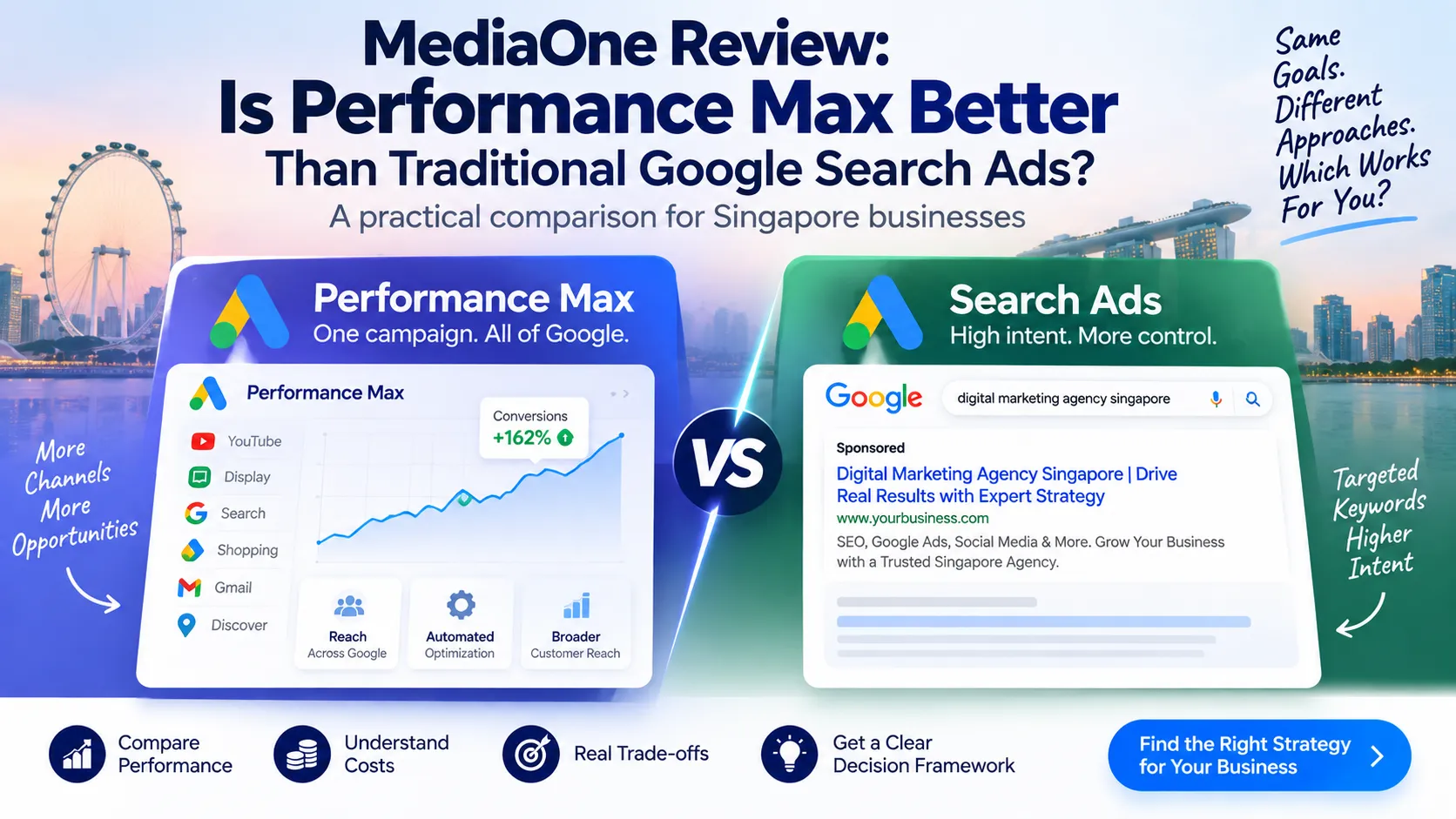
Google Ads offers two primary campaign structures for driving conversions and sales: Performance Max and search ads. Understanding their differences helps you allocate your budget effectively and match your campaign type to your business maturity and goals.

Performance Max is Google’s automated, AI-driven campaign type. It uses machine learning to optimize placements across Google’s entire network, including Search, Display, Shopping, YouTube, and Gmail. You provide creative assets and conversion data. Google’s algorithm then decides where and how to spend your budget.


Search ads are text-based advertisements that appear when someone searches for a keyword you’ve bid on. You control the keywords, bid amounts, and ad copy. Placements are limited to Google Search results.
Key differences include:
- Control level: Search ads offer granular control over keywords and bids; Performance Max relies on algorithmic optimization
- Budget flexibility: Search ads let you pause or adjust spend daily; Performance Max scales within your daily budget
- Data requirements: Performance Max requires consistent conversion tracking; search ads work with or without conversion data
- Transparency: Search ads show which keywords triggered impressions; Performance Max shows aggregate channel data only
- Learning time: Performance Max typically requires 2-4 weeks to optimize; search ads can generate performance data immediately
How Each Campaign Type Works
Performance Max
Performance Max automates campaign setup and optimization. You provide assets (images, videos, headlines, descriptions) and specify conversion goals. Google’s system learns which combinations perform best across channels and adjusts bids and placements in real time.
The learning phase typically lasts 2 to 4 weeks. During this period, Google tests different creative combinations and audience signals to identify high-performing segments. Once learning completes, the campaign scales with greater efficiency.
Performance Max works best when you have clean, centralized conversion data. If your conversion tracking is incomplete or fragmented across multiple platforms, Performance Max cannot optimize effectively. This gap often reflects incomplete setup, not channel failure.
Search Ads
Search ads operate on a keyword-bidding model. You select keywords related to your product or service, set a maximum cost per click (CPC), and write ad copy. When someone searches that keyword, your ad competes in an auction. The highest-bidding, best-quality ad typically appears first.
You control the daily budget and can pause campaigns, adjust bids, or change targeting at any time. Results appear quickly because intent is explicit: someone has already searched for your product.
Search ads require ongoing optimization. You must monitor which keywords drive conversions, pause underperforming keywords, refine bids, and test different ad copy. This manual work is your responsibility or your agency’s responsibility.
Campaign Types and Variants
Performance Max Variants
Standard Performance Max runs across all available Google channels. Budget distribution is entirely automated.
Performance Max for lead generation emphasizes lead form submissions. Google optimizes for completed forms rather than website conversions.
Performance Max for shopping prioritizes product feed data. Performance depends on feed quality, product descriptions, and inventory accuracy.
Search Ads Variants
Search ads (branded keywords) target your company or product name. These typically have high conversion rates and low cost per click because intent is already aligned with your brand.
Search ads (non-branded keywords) target generic terms (e.g., “running shoes,” “plumbing services”). Volumes are higher, but cost per click and competition are typically higher as well.
Search ads (long-tail keywords) target specific, multi-word phrases (e.g., “waterproof running shoes for women”). Volumes are lower, but intent is highly specific.
Performance Max vs Search Ads: Comparison Table
| Metric | Performance Max | Search Ads |
|---|---|---|
| Control over placement | Algorithm decides across all channels | You choose keywords and bids |
| Budget scaling | Automated within daily limit | You set daily cap; manual adjustments possible |
| Learning timeline | 2-4 weeks typical learning phase | Immediate performance data |
| Data maturity required | Requires 200+ conversions monthly for optimal results | Works with or without conversion data |
| Transparency | Channel-level reporting; keyword-level data unavailable | Keyword-level performance visible |
| Cost per conversion (typical range) | Often lower after learning phase; varies by vertical | Predictable; correlates directly to bid strategy |
| Reach expansion | Extends across multiple channels automatically | Limited to search results |
| Manual optimization burden | Minimal after setup | Ongoing keyword, bid, and copy testing required |
How to Choose: Decision Framework
Answer these questions in order to determine which approach fits your situation.
1. How much monthly conversion data do you generate?
If you generate 200+ conversions per month with clean tracking, Performance Max can leverage that signal effectively. If you generate fewer than 50 conversions monthly, search ads may be more transparent and easier to optimize manually. Between 50-200 conversions, either approach works, but Performance Max’s advantage increases as volume grows.
2. How much direct control do you need?
If you must know which keywords, placements, or audience segments drive results, search ads provide keyword-level transparency. Performance Max shows only channel-level performance (Search, Display, Shopping channels appear as aggregated metrics). If you prioritize reporting simplicity and trust algorithmic optimization, Performance Max reduces manual management overhead.
3. What is your monthly Google Ads budget?
Budgets below SGD 2,000 per month often suit search ads better. Smaller budgets generate fewer conversions, which limits Performance Max’s learning signal. Search ads’ keyword-level control helps you focus spend on highest-intent terms. Budgets above SGD 5,000 per month often benefit from Performance Max because the volume of conversions provides stronger learning signals and the algorithm can allocate spend across channels more effectively.
4. How mature is your conversion tracking?
Performance Max requires accurate, comprehensive conversion tracking. If you track only some conversions (e.g., online sales but not phone calls), Performance Max optimizes incompletely. If your tracking is fragmented across Google Ads, Google Analytics, CRM, and offline systems, consolidate it first. Search ads work with basic or partial tracking because you control keyword targeting and can evaluate performance manually.
5. How much time can you dedicate to optimization?
Search ads require ongoing management: keyword analysis, bid adjustments, ad copy testing, and pausing underperforming keywords. Allocate 4-8 hours per week for a mature search account. Performance Max requires setup and weekly monitoring, but day-to-day optimization is minimal. If your team has limited capacity, Performance Max reduces the workload.
6. What is your conversion value range?
If conversions vary widely in value (e.g., one sale = SGD 500, another = SGD 5,000), search ads’ keyword-level control lets you adjust bids to prioritize high-value keywords. Performance Max uses conversion value in its optimization, but you cannot manually weight specific keyword segments.
Selection Reference Table: Which Approach Matches Your Situation
| Your Situation | Better Fit | Why |
|---|---|---|
| Budget under SGD 2,000/month, <50 conversions/month, no conversion tracking | Search Ads | Keyword-level control maximizes efficiency on small spend |
| Budget SGD 2,000-5,000/month, 50-200 conversions/month, tracking in place | Either; test both | Search Ads for immediate transparency; Performance Max if willing to run 4-week test |
| Budget over SGD 5,000/month, 200+ conversions/month, consolidated tracking | Performance Max | Learning phase is cost-effective; algorithmic scaling across channels is more efficient |
| Must report ROI by keyword or audience segment to leadership | Search Ads | Performance Max reporting is channel-level only |
| High conversion variance (values range 2-5x); need to weight high-value segments | Search Ads | Bid control lets you favor high-value keywords |
| Lead generation focus; form submissions tracked | Performance Max for lead generation | Optimizes for form completion across channels |
| E-commerce with product feed | Performance Max for Shopping | Optimization relies on product feed data and feed quality |
| Brand-protection focus; prevent competitor ad clicks | Search Ads | You control exact match keywords and can exclude competitor terms |
Setup and Optimization Guide
Setting Up Performance Max
1. Audit your conversion tracking. Log into Google Analytics and your Google Ads account. Verify that conversions are being recorded in both systems. Check that all revenue is attributed (not just web sales if you also have phone or offline sales). Add conversion adjustments if offline data exists.
2. Gather creative assets. Collect at least three images (1200x628px minimum), three videos (15-30 seconds each), five headlines (30 characters max each), and five long headlines (90 characters max each). Performance Max tests combinations, so variety helps the algorithm learn.
3. Create the campaign. Go to Google Ads, select “Performance Max,” and choose your conversion goal. Set a daily budget that allows at least SGD 15-20 per day. Lower budgets slow learning.
4. Monitor the learning phase. For 2-4 weeks, avoid major bid or budget changes. The algorithm needs consistent data to establish patterns. Check weekly that conversions are still being tracked.
5. Post-learning optimization. After 2-4 weeks, review which channels (Search, Display, Shopping, YouTube, Gmail) drive the best return on ad spend. Pause underperforming channels if your account supports channel exclusions. Refresh creative assets monthly to prevent learning plateau.
Setting Up Search Ads
1. Conduct keyword research. Use Google Keyword Planner or Semrush to identify keywords your audience searches. Start with 20-30 keywords grouped by theme (e.g., “branded,” “product features,” “competitor comparisons”).
2. Set up conversion tracking. Add the Google Ads conversion tracking tag to your website. Test it by completing a purchase or lead submission, then verify in Google Ads that the conversion recorded.
3. Create ad groups. Group related keywords (e.g., “running shoes women,” “women’s running sneakers,” “athletic shoes for women”) into a single ad group. Write two to three ad variants per group, each highlighting a different benefit.
4. Set bids strategically. Start with a manual bid strategy. Set your maximum CPC based on your conversion value. For example, if an average customer is worth SGD 300 and your target return is 3:1, set your max CPC to SGD 100. Adjust after your first 50 conversions.
5. Monitor and refine. Each week, check which keywords generated conversions and which generated only clicks without conversion. Increase bids on converting keywords. Pause keywords with high click volume but zero conversions. Test new ad copy variants monthly.
Common Issues and Troubleshooting
| Common Issue | Why It Happens | Recommended Action |
|---|---|---|
| Performance Max: High cost per conversion in weeks 1-3 | Learning phase. Algorithm is testing combinations before optimizing. | Continue spending. Do not pause or reduce budget. Cost per conversion typically improves after week 3-4. |
| Performance Max: Conversion tracking shows zero conversions | Tracking code not installed or firing on wrong event. | Audit Google Ads conversion tag. Test manually by completing a purchase or form submission. Check that Google Analytics matches Google Ads conversion count. |
| Performance Max: One channel (e.g., Display) shows much higher cost per conversion | Channel audience or placements less aligned with your offer. | If your account supports channel-level adjustments, reduce budget allocation to underperforming channels. Do not pause entirely; low volume may skew early data. |
| Search Ads: High cost per click but zero conversions from specific keyword | Keyword intent does not match your offer. | Pause the keyword. Add it to negative keywords in other ad groups to prevent future wasting. |
| Search Ads: Click-through rate (CTR) is 1% or lower | Ad copy is not compelling or not matching search intent. | Rewrite headlines to include the search keyword. Add specificity (e.g., “Free shipping” or “Money-back guarantee”). Test new variants. |
| Search Ads: Conversion rate is 1% or lower despite good traffic | Landing page does not align with ad promise. | Test a different landing page. Ensure the page loads quickly (under 3 seconds). Add a clear call-to-action button above the fold. |
| Both: Budget exhausted before month end despite low conversions | Bids set too high relative to conversion volume. | Lower your maximum CPC by 15-20%. Tighten keyword targeting (add negative keywords, increase match type specificity). |
| Both: Quality Score is low (below 6/10) | Ad copy, landing page, or keyword relevance is poor. | Improve ad copy to include the keyword. Improve landing page speed and mobile experience. Test more specific keywords with higher intent. |
Data Privacy and Compliance
Ensure all conversion tracking and audience targeting comply with Singapore’s Personal Data Protection Act (PDPA) requirements. If you collect names, email addresses, or phone numbers for lead generation, document user consent and keep records available for audit. When using Performance Max, Google handles audience data on your behalf, but you remain responsible for disclosing data practices in your privacy policy.
FAQ
What does “learning phase” mean, and why does it matter?
The learning phase is the period when Performance Max’s algorithm is identifying which creative combinations, audiences, and placements perform best. Google typically completes this phase within 2-4 weeks. During learning, your cost per conversion may be higher than normal. Do not pause or significantly reduce budget during learning, as this restarts the phase and delays optimization.
How much does it cost to run a Performance Max or search ads campaign?
Campaign costs depend on your bids, not the campaign type. If you set a daily budget of SGD 50, your monthly spend is approximately SGD 1,500 (assuming 30 days). Typical agency service fees for Google Ads management in Singapore range from SGD 800 to SGD 2,000 per month. Agency fees vary significantly by provider; confirm pricing with your provider before engagement.
Is Performance Max suitable if my budget is under SGD 2,000 per month?
Performance Max works with smaller budgets, but learning becomes slower. If your monthly budget is SGD 1,000 and your average order value is SGD 50, you may generate only 15-20 conversions monthly. This volume is below the 200+ conversions that enable fast learning. Search ads may deliver faster results at smaller budgets because keyword-level control lets you focus spend on highest-intent terms.
I have conversion tracking set up, but it’s incomplete. Should I still use Performance Max?
Incomplete tracking is one of the most common reasons Performance Max underperforms. If you track online conversions but not phone inquiries or in-store purchases, Performance Max optimizes based on partial data. Fix tracking first. Add offline conversion imports or call tracking integration. Once tracking is consolidated, Performance Max learning is significantly more efficient.
Does Performance Max really expand reach compared to search ads alone?
Performance Max typically expands reach across additional channels compared to search-only approaches because it automatically places ads on Display, YouTube, Shopping, and Gmail in addition to Search. The extent of reach expansion varies by vertical and feed quality. E-commerce brands often see broader reach; service businesses may see smaller increments because performance depends on fit with Display and YouTube audiences.
How long does it take to see results from a new campaign?
Search ads generate initial performance data within 1-2 weeks. Performance Max requires 2-4 weeks of learning before optimization stabilizes. “Results” means actionable data, not necessarily profit. If your campaign generates 30 clicks but zero conversions in week one, you have enough data to analyze intent fit, but not enough to measure return on investment. Plan to run campaigns for at least 4 weeks before evaluating success.
What is a common misconception about Performance Max vs search ads?
Many businesses believe Performance Max delivers better results immediately. In reality, Performance Max requires setup time and consistent conversion data to perform well. If your conversion tracking is weak or your budget is very small (under SGD 2,000 monthly), search ads often deliver better short-term results. Performance Max’s advantage grows as your budget and conversion volume increase.
If I switch from search ads to Performance Max, will my results drop?
Not necessarily. However, during the switch, you may experience a dip in performance for 1-2 weeks while Performance Max enters its learning phase. To minimize disruption, run both campaign types in parallel for 2-4 weeks. Once Performance Max stabilizes, gradually reduce search ads spend if Performance Max metrics justify it. This overlap ensures continuity and gives you data to compare both approaches.
How do I know if my agency is managing my account well?
For Performance Max: Check that conversion tracking is complete, that the learning phase lasted 2-4 weeks without interruption, and that cost per conversion improved month-over-month after learning. For search ads: Check that underperforming keywords were paused, that ad copy was tested and refreshed monthly, and that bids were adjusted based on keyword performance. Ask your agency to explain keyword selection, bid strategy, and monthly optimization actions.
What happens if I pause a Performance Max campaign and restart it?
Restarting pauses the campaign’s historical learning. When you relaunch, the algorithm begins a new learning phase, typically 2-4 weeks, even if it has previously learned from months of data. This can increase cost per conversion temporarily. Avoid pausing unless necessary. If you must pause, make it brief (under a week if possible).
Can I run Performance Max and search ads at the same time?

Yes. In fact, running both in parallel for 4-6 weeks is recommended when testing Performance Max for the first time. This overlap lets you compare results directly. Each campaign type attracts slightly different audience segments and generates different data. Once you have 4 weeks of data from both, you can make a more confident decision about which to scale.
Does converting from broad match keywords to exact match reduce traffic?
Yes, typically by 20-40%, but it often improves conversion rate and lowers cost per conversion because intent alignment is tighter. Most businesses optimize toward volume rather than value without proper conversion tracking. If you shift to exact match and conversion tracking is in place, you can calculate whether the lower volume is offset by improved conversion rates and lower cost per acquisition.
What if my product feed quality is poor and I use Performance Max for Shopping?
Poor feed quality limits Performance Max’s ability to show relevant products. Performance Max relies on product titles, descriptions, images, and availability data to match ads to searcher intent. If your feed contains incomplete information, low-quality images, or outdated inventory, Performance Max cannot optimize effectively. Audit your product feed first. Ensure all required fields are filled, images are high-resolution, and inventory is current. Improving feed quality often delivers better results than changing campaign settings.
Is there a minimum monthly budget required to run either campaign type?
No hard minimum, but smaller budgets generate slower learning and fewer actionable insights. Budgets under SGD 500 per month may generate fewer than 10 conversions weekly, which is below the threshold for reliable performance trends. Budgets between SGD 500-2,000 monthly are viable for testing but may show high variability. Budgets above SGD 2,000 monthly typically provide stable performance and clear optimization signals.
How do agencies optimize the learning phase, and does it really compress the timeline?
Experienced agencies may help streamline setup by ensuring clean tracking, high-quality assets, and conservative initial bids. These actions reduce wasted spend during learning, but they do not eliminate the phase. Learning requires Google’s algorithm to gather sufficient conversion data. An agency cannot compress a 2-4 week learning phase into 1 week without sacrificing data quality. Avoid any claim that an agency can accelerate learning beyond this natural timeline.