
I still remember the first time we ran an influencer campaign that completely flopped.
We had the budget.
We had the creators.
We had what looked like “great reach.”
And yet, nothing moved. No meaningful traffic, no conversions, no measurable lift in brand awareness.
That experience forced us to rethink our influencer outreach strategies. It became clear that success had very little to do with how many creators we contacted, and everything to do with how intentional, structured, and data-driven the process was.
In practical terms, influencer outreach strategies are not just about sending messages or offering free products. They are systems designed to identify the right creators, build genuine relationships, and align campaigns with specific business outcomes.
This is where most brands struggle.
They treat outreach as a one-off activity. A quick campaign push. A numbers game. Professional agencies approach it differently. Outreach is built into a repeatable framework that connects discovery, qualification, messaging, negotiation, and long-term relationship management.
The shift over the past few years has been significant. One-off collaborations are becoming less effective. The real value now comes from sustained creator partnerships that compound over time, build trust with audiences, and generate consistent results.
If you are exploring influencer outreach services in Singapore influencer marketing agency support, this is exactly where structured execution makes the difference between wasted budget and scalable growth.
In this guide, I will break down how agencies actually build and execute influencer outreach strategies, including the parts that most surface-level articles leave out.
Key Takeaways
- Influencer outreach strategies work best when built as structured systems rather than one-off campaigns.
- Agencies prioritise data, creator fit, and long-term partnerships over vanity metrics.
- Personalisation and multi-channel outreach significantly improve response and conversion rates.
- Compliance, contracts, and brand safety are essential for sustainable campaign success.
What Are Influencer Outreach Strategies? A Clear, Practical Definition
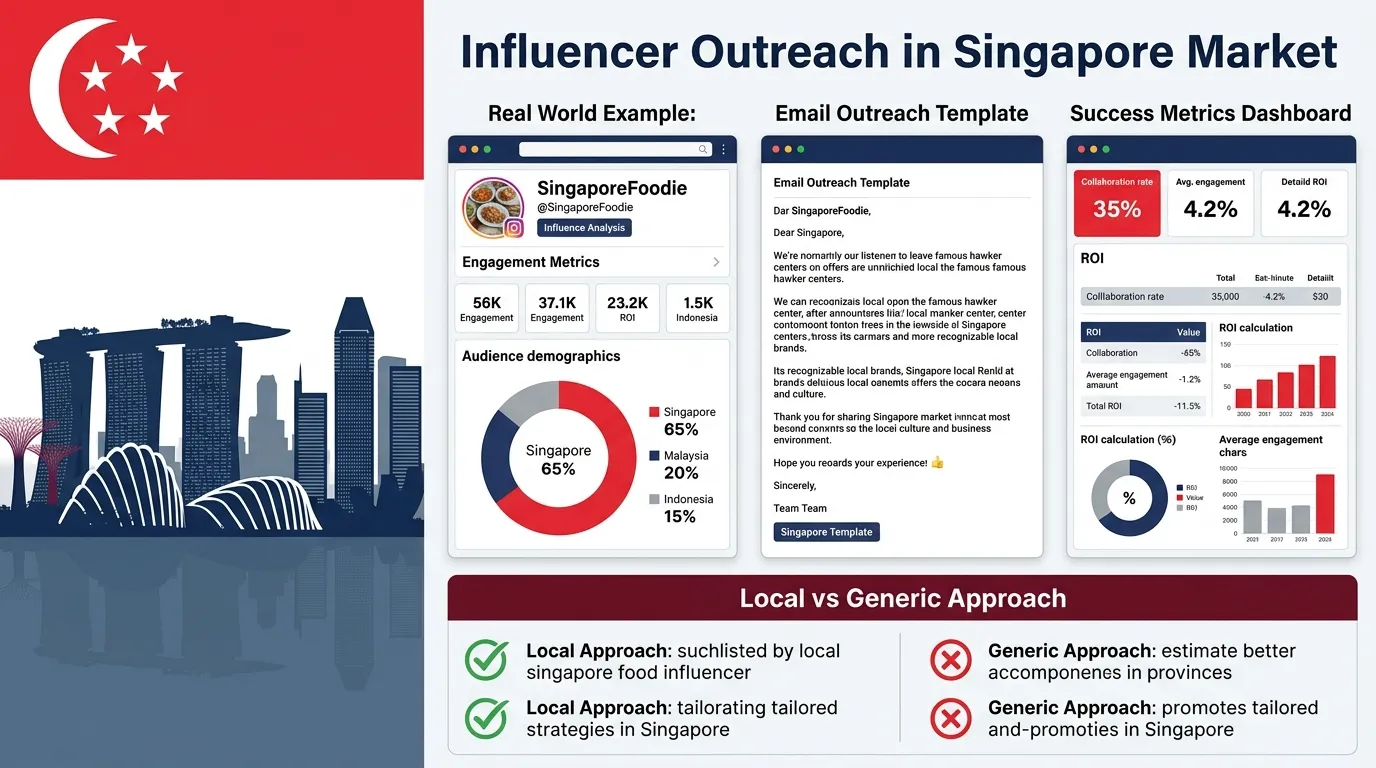
When I first started working on influencer campaigns, I made the same mistake most brands still make today. I thought outreach was about sending a message and waiting for a reply.
It is not.
Influencer outreach strategies are not messages. They are systems. If you strip everything down, you are really building a repeatable process that determines who you work with, how you approach them, and what kinds of outcomes you can expect.
How I Define Influencer Outreach in Practice
In real-world execution, influencer outreach is the structured process of identifying, evaluating, contacting, and developing relationships with creators who can help achieve a specific marketing objective.
That process usually includes several moving parts working together:
- Creator discovery and research: Finding potential influencers based on relevance, audience fit, and platform behaviour, not just visibility.
- Qualification and vetting: Assessing whether a creator is actually worth working with by analysing engagement quality, audience authenticity, and past collaborations.
- Personalised communication: Reaching out in a way that feels intentional and specific to the creator, not copied and pasted across 50 inboxes.
- Negotiation and deal structuring: Aligning on deliverables, pricing models, timelines, and usage rights in a way that supports campaign goals.
- Relationship management: Maintaining the connection beyond the first campaign so you don’t have to start from scratch every time.
If any one of these breaks down, the entire outreach effort becomes inefficient. That is usually where brands struggle. They focus heavily on the message, but ignore everything that happens before and after it.
Influencer Outreach vs Influencer Marketing: Why the Distinction Matters
One of the biggest sources of confusion I see, even among experienced marketers, is treating outreach and influencer marketing as interchangeable.
They are not.
Here is how I explain it to clients:
- Influencer marketing is the broader strategy. It includes campaigns, content, distribution, and performance tracking
- Creator partnerships are the long-term relationships you build with selected influencers over time
- Influencer outreach is the entry point. It is the mechanism that determines who enters your ecosystem in the first place
If your outreach is weak, everything that follows becomes harder. You end up working with the wrong creators, negotiating from a weak position, or chasing results that were never realistic to begin with.
Where Influencer Outreach Fits in the Marketing Funnel
Outreach does not neatly fit into a single stage of the funnel. It operates across multiple layers.
At the top of the funnel, it shapes awareness by determining which creators represent your brand.
In the middle, it influences consideration, because the credibility of those creators affects how audiences perceive your offer.
And in many cases, especially with performance-driven campaigns, outreach directly impacts conversion, since the right creator can drive action while the wrong one generates noise.
This is why I treat outreach as a strategic function, not an administrative task.
The Difference Between Basic and Advanced Outreach Strategies
Most brands operate at a very basic level without realising it. A simple approach often looks like this:
- Search for influencers using hashtags
- Shortlist based on follower count
- Send a generic DM offering a collaboration
It feels productive, but it is largely guesswork.
A more advanced, agency-level approach looks very different:
- Creators are scored based on multiple factors, including audience quality, engagement patterns, and brand alignment
- Outreach is sequenced across channels, such as email first, then social follow-ups
- Messaging is contextual and informed by research, not templated
- Relationships are warmed up before pitching, especially for high-value creators
There is also a shift in mindset.
Instead of asking, “How do we get this influencer to say yes?” the better question is, “Is this the right creator to begin with, and how do we build a relationship that compounds over time?”
That shift alone changes the quality of your results.
A Simple Way to Think About It
If you want a practical mental model, think of influencer outreach strategies as a pipeline.
- At the top, you have a large pool of potential creators.
- As you move down, that pool becomes more refined through qualification, communication, and negotiation.
- At the bottom, you end up with a small group of high-quality partners who can actually drive results.
Most brands focus only on the middle, the message. Agencies focus on the entire pipeline. That is where the difference shows.
How Professional Agencies Build Influencer Outreach Strategies That Scale
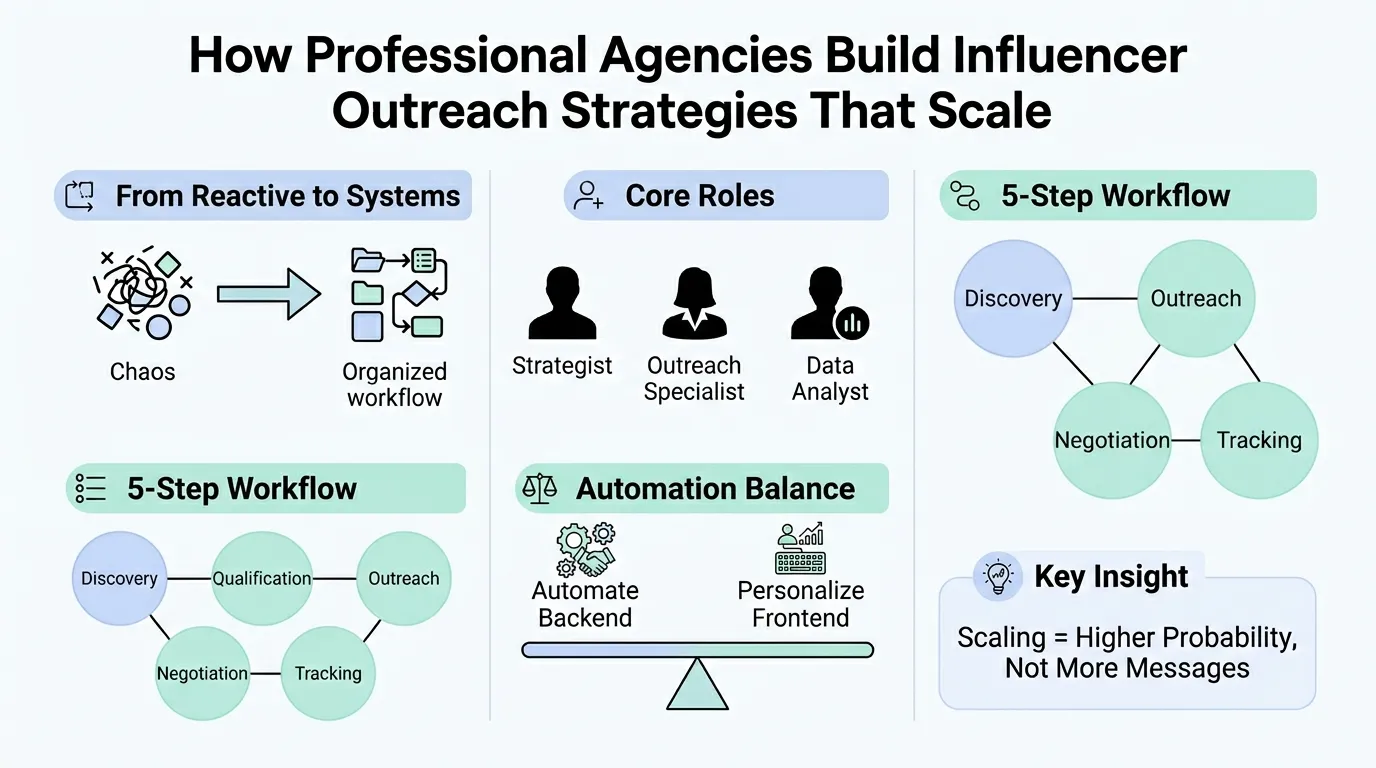
When I first started running influencer campaigns at MediaOne, I made the same mistake I see most brands make today. We treated outreach as a task to complete, not a system to build.
A campaign would come in, we would scramble to find creators, send a batch of messages, negotiate on the fly, and hope something stuck. It worked occasionally, but inconsistently. Worse, it was not scalable.
That changed when we stopped thinking in terms of campaigns and started thinking in terms of workflows.
From Reactive Outreach to Repeatable Systems
Most brands approach influencer outreach like this:
- “We need creators for this campaign”
- Search, shortlist, message, repeat
It feels productive, but it resets every time.
At an agency level, that approach breaks down quickly. You cannot scale results if every campaign starts from zero.
So we build systems that:
- Continuously source and qualify creators
- Maintain structured pipelines
- Track every interaction and outcome
Instead of asking, “Who should we reach out to today?”
We ask, “How does this campaign plug into the system we’ve already built?”
That shift alone changes the consistency of results.
The Core Roles Behind a Scalable Outreach Engine
A common misconception is that influencer outreach is handled by one person. In reality, high-performing campaigns result from coordinated roles, each focused on a specific part of the process.
Here is how we typically structure it:
1. Campaign Strategists
- Define campaign objectives. Awareness, conversions, or authority
- Identify target audience segments
- Set creator selection criteria based on business goals
They answer the question: What are we trying to achieve, and who can realistically help us get there?
2. Outreach Specialists
- Craft and send personalised messages
- Manage follow-ups and negotiations
- Build relationships with creators over time
They are not just sending emails or DMs. They are managing perception. A well-handled conversation can turn a one-time collaboration into a long-term partnership.
3. Data Analysts and Performance Leads
- Track campaign metrics across platforms
- Evaluate creator performance beyond surface-level numbers
- Feed insights back into future selection and outreach
They close the loop. Without this layer, outreach becomes guesswork.
Campaign Planning vs Ad Hoc Execution
One of the clearest differences between brands and agencies is how campaigns are planned. Brands often move quickly. There is pressure to launch, so outreach begins before the strategy is fully defined.
We take a different approach. Before a single message is sent, we map out:
- Campaign goals and success metrics
- Target creator profiles
- Budget allocation across tiers of influencers
- Messaging angles and value propositions
This does not slow things down. It prevents wasted effort.
Campaigns that skip this stage often end up overpaying the wrong creators or attracting responses that do not convert into meaningful results.
The Workflow That Makes Scaling Possible
At MediaOne, we rely on structured workflows that look roughly like this:
- Discovery and Initial Filtering
- Pull creators based on niche, audience, and platform
- Apply baseline filters such as engagement rate and content relevance
- Deep Qualification
- Analyse audience authenticity and demographics
- Review past brand collaborations
- Score creators against campaign goals
- Outreach Sequencing
- Send a personalised initial message
- Schedule follow-ups across different channels if needed
- Track response rates and adjust messaging
- Negotiation and Onboarding
- Align on deliverables, pricing, and timelines
- Formalise agreements and expectations
- Performance Tracking and Feedback
- Monitor campaign results in real time
- Document insights for future campaigns
Each step feeds into the next. Nothing is isolated.
Where Automation Helps, and Where It Hurts
Automation is often misunderstood.
Used correctly, it reduces manual work in areas like:
- Creator discovery
- Data aggregation
- Pipeline tracking
Used incorrectly, it damages response rates and brand perception.
I have seen brands automate outreach messages entirely. The result is predictable. Creators ignore them because they feel generic.
The balance we aim for is simple:
- Automate the backend
- Personalise the front end
For example:
- Use tools to shortlist creators quickly
- Manually craft the first message with specific references to their content
That small detail can be the difference between being ignored and getting a reply.
Why Most Brands Struggle With This Balance
The challenge is not access to tools or talent. It is a mindset.
Brands tend to prioritise speed:
- “How many creators can we reach this week?”
Agencies prioritise precision:
- “How many of the right creators can we engage meaningfully?”
Scaling outreach is not about sending more messages. It is about building a system where each message has a higher probability of success.
That requires:
- Clear workflows
- Defined roles
- Consistent feedback loops
Once those are in place, outreach stops feeling like a scramble. It becomes predictable, measurable, and far more effective over time.
Influencer Outreach Strategies for Finding the Right Creators
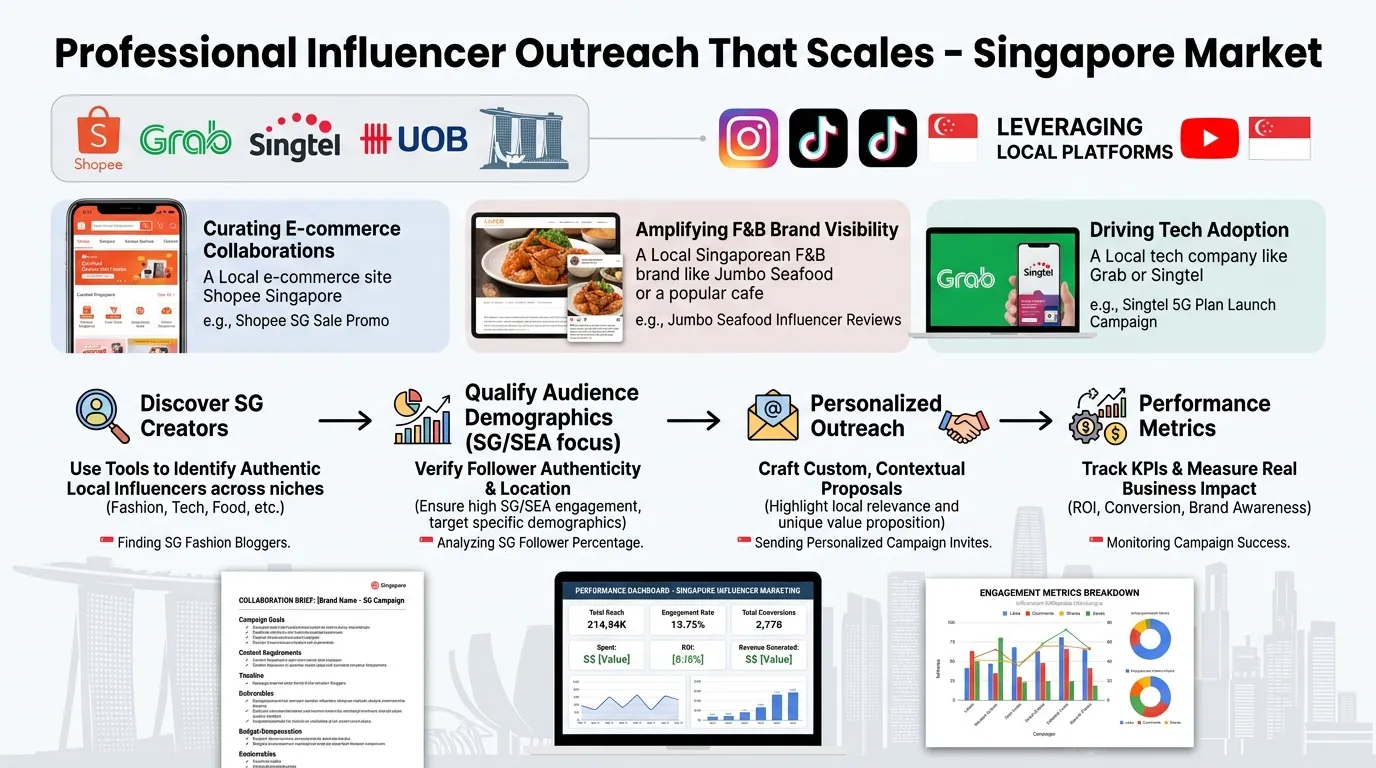
I learned this the hard way early on at MediaOne. You can find hundreds of influencers in a single afternoon, but most of them will not move the needle for your campaign.
Finding creators is easy. Finding the right ones, the ones who actually drive results, is where the real work begins.
Over time, we stopped treating influencer discovery as a sourcing task. We started treating it as a filtering system. That shift alone improved campaign performance more than any outreach template ever did.
What Agencies Actually Look For (Beyond Follower Count)
Follower count is often the first thing brands look at. It is also one of the least reliable indicators of performance.
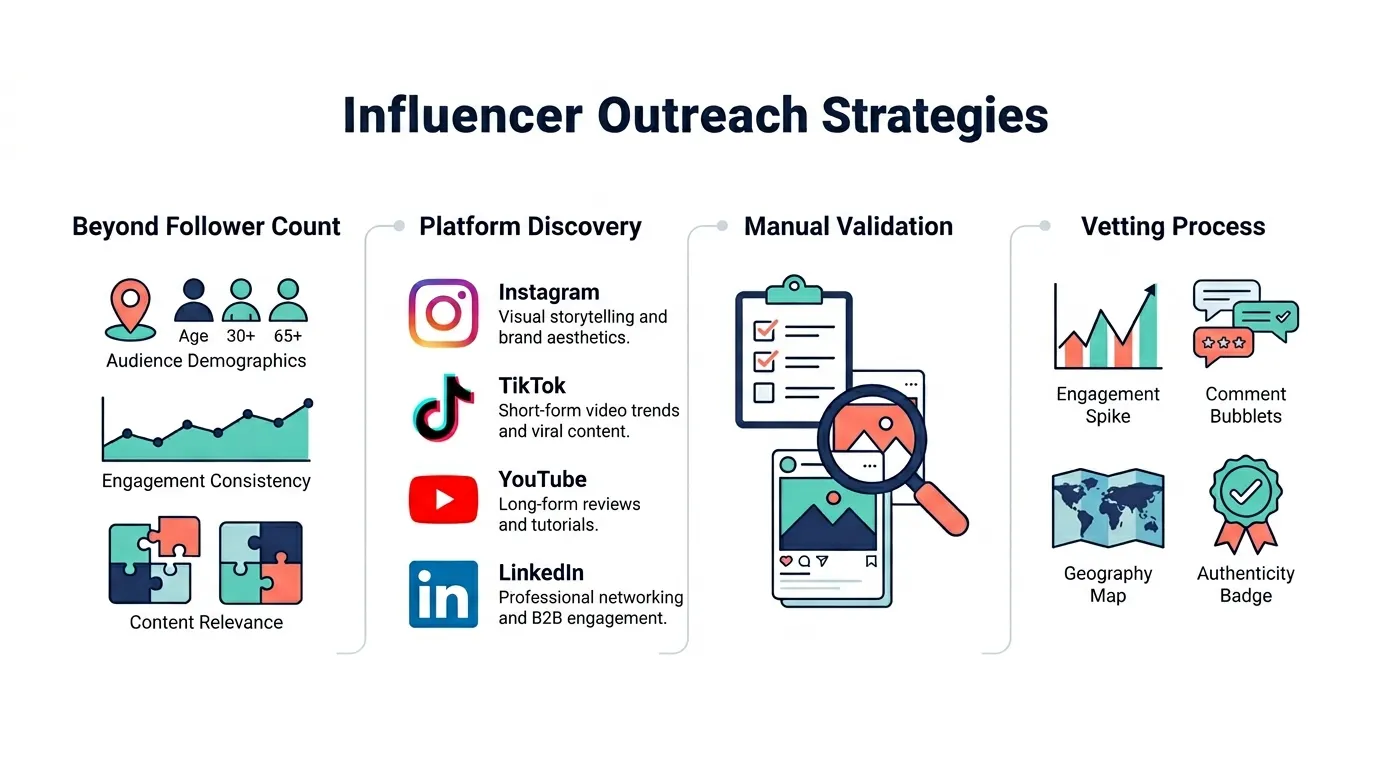
When we evaluate creators, we prioritise three core signals:
- Audience demographics: Who is actually watching, not who appears to be watching. We look at location, age groups, and interests. A creator with 50,000 followers in the wrong market is less valuable than one with 10,000 in the right one.
- Engagement consistency: Not just average likes, but patterns over time. Does engagement fluctuate wildly, or is it stable across posts? Consistency often signals a real, loyal audience.
- Content relevance: This goes beyond niche. It is about alignment. Does the creator already produce content that naturally fits your brand, or will the collaboration feel forced?
A creator might look impressive on paper, but if these three areas do not align, we move on quickly.
Platform-Specific Discovery Methods We Use
Each platform requires a different approach. What works on TikTok will not translate directly to LinkedIn.
Here is how we typically break it down:
- Instagram and TikTok: We start with hashtags, but we do not stop there. Competitor analysis is far more revealing. We look at who is already working with brands in the same space and then map out adjacent creators.
- YouTube: Discovery here is driven by search behaviour. We use keyword research and content categories to identify creators who rank consistently within a niche. This often surfaces more credible, long-form content creators.
- LinkedIn: This is less about “influencers” and more about authority figures. We look for professionals who drive conversations, not just impressions. Engagement quality matters more than volume on this platform.
Tools can speed up this process, but they rarely replace judgment. They give you a list. They do not tell you who actually fits.
Why Manual Validation Still Matters
This is where most campaigns go wrong. A tool might flag a creator as “high engagement,” but without context, that number means very little. We always validate manually before moving forward.
That includes:
- Reviewing recent posts one by one
- Looking at how the audience interacts, not just how often
- Checking whether brand collaborations feel natural or transactional
Manual validation takes time, but it prevents expensive mistakes.
How We Vet Influencers Properly
Vetting is not a single step. It is a layered process.
Here are some of the checks we run:
- Engagement spikes: Sudden jumps in likes or followers can indicate paid growth or bot activity. We compare post-performance over time to spot anomalies.
- Comment quality: A high comment count is meaningless if the comments are generic. We look for real conversations, questions, and reactions that show genuine interest.
- Audience geography: This is often overlooked. If your target market is Singapore and most of the audience is elsewhere, performance will suffer regardless of reach.
- Content authenticity: Does the creator sound like themselves, or do all sponsored posts feel scripted? Authenticity is difficult to measure, but easy to recognise when you see it.
Building a Qualified Influencer Shortlist
One of the biggest misconceptions is that more options lead to better campaigns. In reality, the opposite is true.
By the time we finish filtering, a list of 100 potential creators often becomes 10 to 15 strong candidates. That is not a limitation. That is a sign the process is working.
A qualified shortlist should feel selective. Every name on that list should make sense for the campaign without forcing the fit.
Your Takeaway
If you take one thing from this, let it be this: Influencer discovery is not about finding people who can promote your brand. It is about identifying people who already speak to the audience you want to reach.
Once you start thinking this way, your outreach becomes sharper, your messaging becomes more natural, and your campaigns start to perform the way they should.
Data-Driven Influencer Outreach Strategies Agencies Use to Qualify Influencers
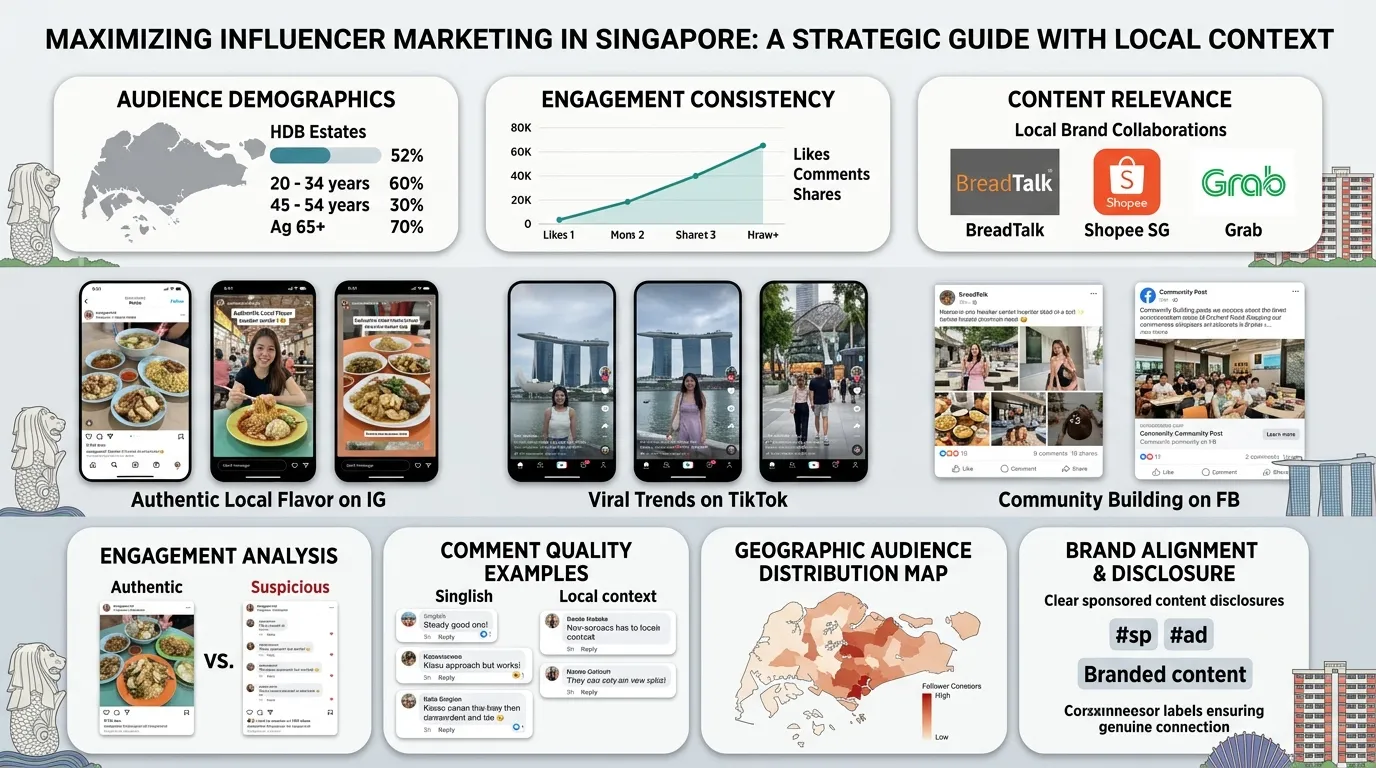
Over time, I learned that the difference between a campaign that looks good on paper and one that actually drives results comes down to how you qualify influencers. Not just who you pick, but how rigorously you evaluate them before outreach even begins.
Agencies do not rely on gut feel. We rely on benchmarks, patterns, and a structured way of filtering signal from noise.
Why Data Beats Instinct Every Time
There is nothing wrong with intuition. It helps you spot creative fit and brand alignment. But intuition alone is inconsistent. Data gives you consistency.
At scale, when you are evaluating dozens or even hundreds of creators, you need a system that allows you to compare them on the same playing field. That is where most in-house teams struggle. They evaluate influencers individually rather than using a framework.
What we do instead is layer multiple data points, then look for alignment across them.
The Core Metrics We Actually Care About
Let me walk you through what we look at before a creator even makes it onto a shortlist:
1. Engagement Rate Relative to Follower Size
A 2 percent engagement rate might be strong for a creator with a million followers, but weak for someone with ten thousand. Context matters.
We benchmark engagement differently depending on:
- Platform: TikTok tends to have higher engagement than Instagram
- Creator size: Micro influencers often outperform larger accounts
- Content format: Video, carousel, and static posts behave differently
We are not just asking, “Is this good?”
We are asking, “Is this good for this specific type of creator?”
2. Audience Authenticity
This is where many campaigns quietly fail. On the surface, an account might look impressive. But once you dig into the audience, the story can change quickly.
We analyse:
- Follower growth patterns over time
- Audience location distribution
- Comment quality and relevance
If a Singapore-based brand is working with a creator whose audience is mostly outside the region, that mismatch alone can kill performance.
Tools can flag suspicious patterns, but manual review is still necessary because fake engagement is getting harder to detect automatically.
3. Past Campaign Performance
This is one of the most underused filters. Whenever possible, we look at:
- Previous brand collaborations
- Content performance on sponsored posts versus organic posts
- Consistency of results across campaigns
Some creators perform well organically but struggle with branded content. Others know how to integrate products naturally and maintain engagement.
That distinction matters more than most people realise.
How We Score Brand Alignment Internally
Data alone is not enough. You also need structured judgment. At MediaOne, we often assign an internal score for brand alignment based on:
- Tone of voice
- Content style and storytelling approach
- Audience fit with the client’s target market
For example, a creator might have excellent engagement, but if their content style feels transactional or overly promotional, it can dilute a premium brand’s positioning.
Alignment is not about liking the creator. It is about whether their content naturally supports the brand’s message.
Red Flags We Never Ignore
Over the years, certain patterns have become easy to spot. When I see these, I pause immediately.
- Sudden spikes in follower growth without a clear reason, such as a viral post
- High impressions paired with unusually low interaction
- Comments that feel generic, repetitive, or disconnected from the content
These signals do not always mean fraud, but they do require deeper investigation.
It is better to eliminate a questionable creator early than to discover issues after the campaign has already gone live.
Why Surface Metrics Can Mislead You
One of the biggest misconceptions in influencer outreach is that visibility equals impact. It does not.
A creator can generate impressive reach while driving very little meaningful action. On the other hand, a smaller creator with a highly engaged and relevant audience can outperform them significantly.
This is why depth matters more than surface-level metrics. We look at:
- How audiences respond, not just how many people see the content
- Whether engagement translates into interest or intent
- How consistently a creator delivers results over time
The Real Shift: From Vanity Metrics to Decision Frameworks
If there is one shift I would recommend to any brand, it is this: Stop evaluating influencers individually. Start evaluating them systematically.
When you build a qualification framework:
- You reduce bias
- You make better decisions faster
- You create repeatable results
That is ultimately what separates agency-level execution from ad hoc outreach.
At the end of the day, influencer outreach strategies only work if the foundation is solid. And that foundation is built long before the first message is ever sent.
Personalised Influencer Outreach Strategies That Get Responses
Most outreach fails for a simple reason. It sounds like it was written for everyone.
Creators can tell within seconds whether a message was written specifically for them or pulled from a template. Agencies that consistently get replies do not rely solely on clever wording. They build a system that makes personalisation repeatable without making it mechanical.
Let me walk you through how we approach this at MediaOne.
What “Personalisation” Actually Means in Practice
Personalisation is not adding someone’s name or referencing their latest post in a superficial way. That is basic hygiene.
Real personalisation answers one question clearly: Why this creator, for this campaign, right now?
A strong outreach message reflects three layers of relevance:
- Content fit: Does the creator already talk about topics aligned with your brand?
- Audience alignment: Are their followers the people you want to reach, not just in demographics but in intent?
- Campaign context: Does your offer make sense within the creator’s current content direction?
When these align, the message feels natural instead of transactional.
Anatomy of a High-Converting Outreach Message
We follow a structure, but we adapt the tone to the creator. A strong message typically includes:
- A specific opening: Mention a piece of content and explain why it stood out. Avoid generic compliments.
- A clear reason for reaching out: Make it obvious why they were selected, not just that they are “a great fit.”
- A simple, relevant offer: Do not overload the message with details. Focus on what matters to them.
- A low-friction next step: Make it easy to reply. A simple question works better than a long brief.
Here is the difference in approach:
Weak outreach
- “We love your content and would like to collaborate”
Strong outreach
- “Your recent post on [specific topic] stood out because of how you explained [specific insight]. We are working on a campaign that focuses on the same audience, and I think there is a natural fit here.”
The second version shows intent. It signals that the message was written with care.
How We Scale Personalisation Without Losing Quality
This is where most brands get stuck. They either:
- Personalise deeply but cannot scale, or
- Scale aggressively and lose authenticity
We treat personalisation as a research problem, not a writing problem.
Before outreach begins, we structure creator data into a usable format:
- Content themes
- Audience signals
- Past brand collaborations
- Engagement patterns
This allows us to quickly identify angles.
Instead of writing from scratch each time, we build message frameworks tied to creator profiles, then customise key sections:
- Opening line
- Relevance statement
- Offer positioning
The result is consistent quality without sounding automated.
Timing and Follow-Up Strategy
Even strong messages get missed. Timing plays a bigger role than most people expect.
Our typical sequence looks like this:
- Initial message: Sent at a time aligned with the creator’s activity patterns
- First follow-up (3 to 5 days later): Short, polite, and referencing the original message
- Final follow-up: A light check-in that keeps the door open without pressure
The tone of follow-ups matters. You are not chasing. You are reminding.
Creators often revisit messages when they have availability or when a campaign becomes relevant to them. A well-timed follow-up can surface your message at the right moment.
Email vs DM: Choosing the Right Channel
Channel choice affects response rates more than most people realise.
- Email
- Works better for mid-tier to large creators
- Signals professionalism
- Suitable for detailed collaborations
- Direct Messages (Instagram, TikTok, LinkedIn)
- More effective for micro and nano influencers
- Faster and more conversational
- Lower barrier to response
In many campaigns, we use both.
For example:
- Start with email for structure
- Follow up with a DM referencing the email
This multi-touch approach increases visibility without being intrusive.
Why Some Messages Convert While Others Don’t
After running hundreds of campaigns, a pattern becomes clear.
Messages that convert tend to:
- Show clear intent
- Respect the creator’s time
- Align with the creator’s content and audience
Messages that get ignored usually:
- Feel mass-produced
- Focus too much on the brand
- Lacks a clear reason for collaboration
The difference is not subtle. It is immediately visible to the recipient.
A Practical Framework You Can Apply
If you want to improve response rates, start here:
- Research before writing
- Identify why the creator is relevant
- Look beyond surface-level metrics
- Anchor your message in something specific
- A post, a theme, or an insight
- Keep your offer simple and relevant
- Avoid overloading with details
- Make replying easy
- Ask one clear question
- Follow up with intention
- Not too soon, not too late
At MediaOne, we do not treat outreach as a volume game. We treat it as a positioning exercise.
When the message reflects real alignment, responses follow naturally. Not because the wording is clever, but because the intent is clear.
Cold vs Warm Influencer Outreach Strategies: What Agencies Do Differently
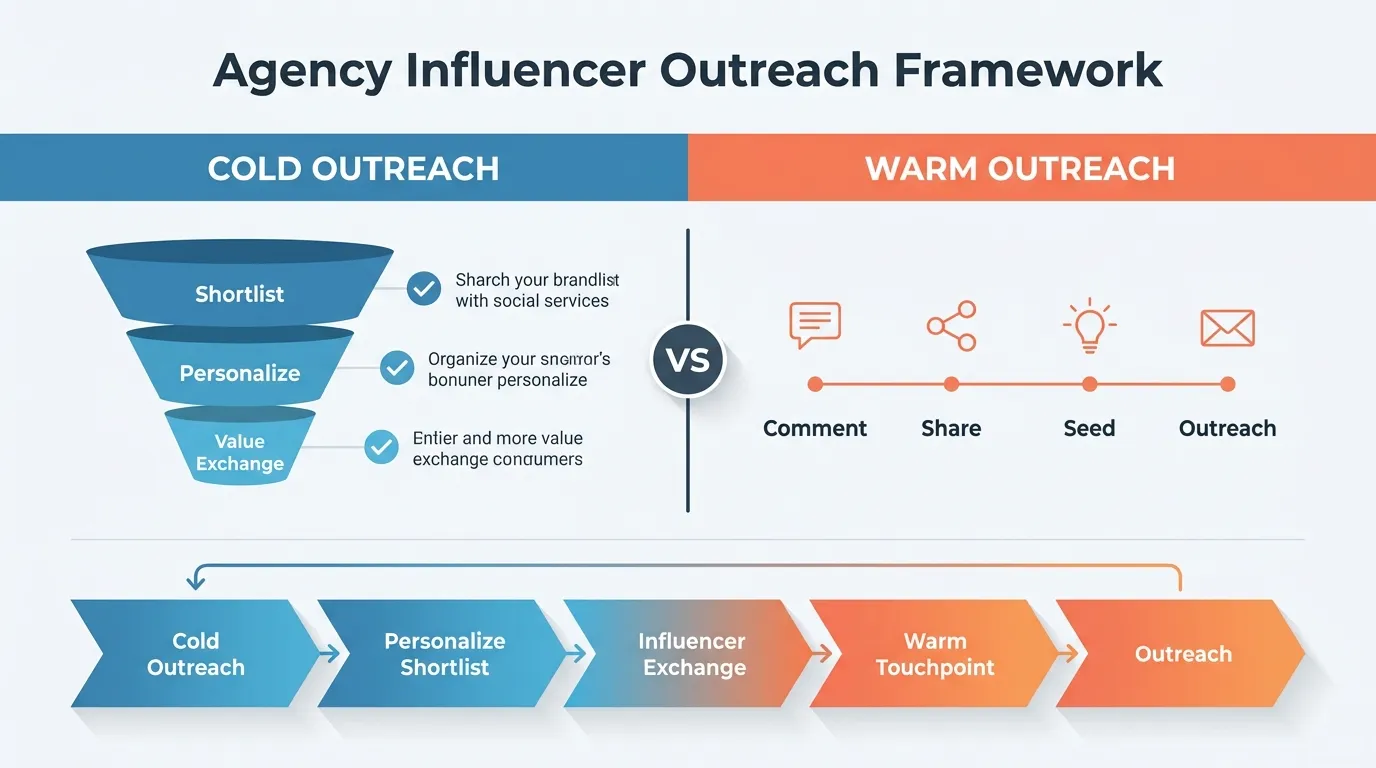
When brands talk about influencer outreach strategies, they usually focus on the message itself. In reality, the outcome is often decided before the first message is even sent. The real difference lies in how familiar the creator is with your brand at the point of contact.
Cold outreach and warm outreach are not just tactics; they are strategies. They represent two very different starting points in the relationship.
What Cold Outreach Actually Looks Like in Practice
Cold outreach is contacting a creator with no prior interaction or relationship. It is fast, scalable, and useful when you need to:
- Launch campaigns quickly
- Test multiple creators at once
- Enter new markets or niches
In agency environments, cold outreach is rarely random. We still apply multiple layers of qualification before reaching out, which significantly improves response rates.
A well-executed cold outreach approach includes:
- A tightly defined creator shortlist based on audience fit
- Personalised messaging that references specific content
- A clear and relevant value exchange
Cold outreach works best when:
- The offer is strong and aligned with the creator’s audience
- The creator is already open to brand collaborations
- The message demonstrates clear intent, not mass outreach
That said, even well-crafted cold outreach tends to have lower response and conversion rates compared to warmer approaches.
What Warm Outreach Means and Why It Performs Better
Warm outreach is built on familiarity. Instead of introducing your brand from scratch, you create multiple touchpoints before making an ask. This shifts the interaction from a transactional to a relational one.
In practice, this often involves:
- Engaging consistently with a creator’s content over time
- Leaving thoughtful comments that add to the conversation
- Sharing or amplifying their posts through your brand channels
- Sending products or experiences without immediate expectations
These actions signal genuine interest rather than opportunism. By the time outreach happens, the creator already recognises your brand. That alone increases the likelihood of a response.
The Psychology Behind Warm Outreach
Creators receive a high volume of pitches. Most of them feel interchangeable. Warm outreach stands out because it does not feel like a pitch.
It feels like:
- A continuation of an existing interaction
- A collaboration rather than a transaction
- A brand that understands its content and audience
This subtle shift changes how creators evaluate the opportunity.
Instead of asking, “Is this worth my time?”, they are more likely to think, “This makes sense for what I already do.”
Seeding Strategies Agencies Use Before Outreach
One of the most effective warm-up methods is product seeding. Instead of leading with a proposal, agencies send products with no obligation attached.
The goal is simple:
- Let the creator experience the product organically
- Observe whether they engage with it naturally
- Build goodwill before introducing a collaboration
When done correctly, this creates:
- More authentic content
- Higher trust between brand and creator
- Stronger long-term partnerships
Seeding is not about giving away free products. It is about identifying creators who are genuinely aligned and giving them a reason to care.
Community Engagement as a Pre-Outreach Strategy
Another overlooked layer is community interaction. Before reaching out, agencies often:
- Engage with the creator’s audience through comments
- Participate in conversations happening in their content
- Show up consistently, not just once
This builds visibility in a way that feels organic. When the outreach message eventually arrives, it does not feel like it came from a stranger.
Retargeting Creators Who Already Show Interest
Agencies also pay attention to signals that most brands ignore.
If a creator:
- Likes your posts
- Comments on your content
- Shares your brand organically
They are already halfway into the funnel. Instead of treating them as cold prospects, we treat them as warm leads.
Retargeting these creators with outreach typically results in:
- Higher response rates
- Faster deal closure
- Better campaign alignment
This is one of the simplest ways to improve outreach performance without increasing effort.
When to Use Cold vs Warm Outreach
Both approaches have their place. The decision depends on your campaign goals and timelines.
Use cold outreach when:
- You need to scale quickly
- You are testing new audiences
- You have a strong, clear offer
Use warm outreach when:
- You are building long-term partnerships
- Brand alignment matters more than reach
- You want higher conversion and content quality
In most agency campaigns, we use both.
- Cold outreach fills the top of the pipeline.
- Warm outreach drives the highest-value collaborations.
How Agencies Combine Both for Better Results
The strongest influencer outreach strategies are not purely cold or purely warm. They are layered.
A typical flow might look like:
- Identify and qualify creators
- Begin light engagement with top-tier targets
- Run cold outreach for broader coverage
- Prioritise warm leads for deeper partnerships
This approach balances efficiency with effectiveness. It allows you to move fast without sacrificing relationship quality.
The Real Advantage: Moving From Transactions to Relationships
Most brands treat influencer outreach as a one-time interaction. Agencies treat it as the start of a relationship. That shift changes everything.
When creators feel like partners rather than placements, you see:
- Better content
- Stronger audience trust
- More consistent results over time
And that is where influencer outreach strategies stop being a marketing tactic and start becoming a long-term growth channel.
Influencer Outreach Strategies for Different Campaign Goals
One of the biggest mistakes I see, even among experienced marketing teams, is treating influencer outreach as a one-size-fits-all process. It is not.
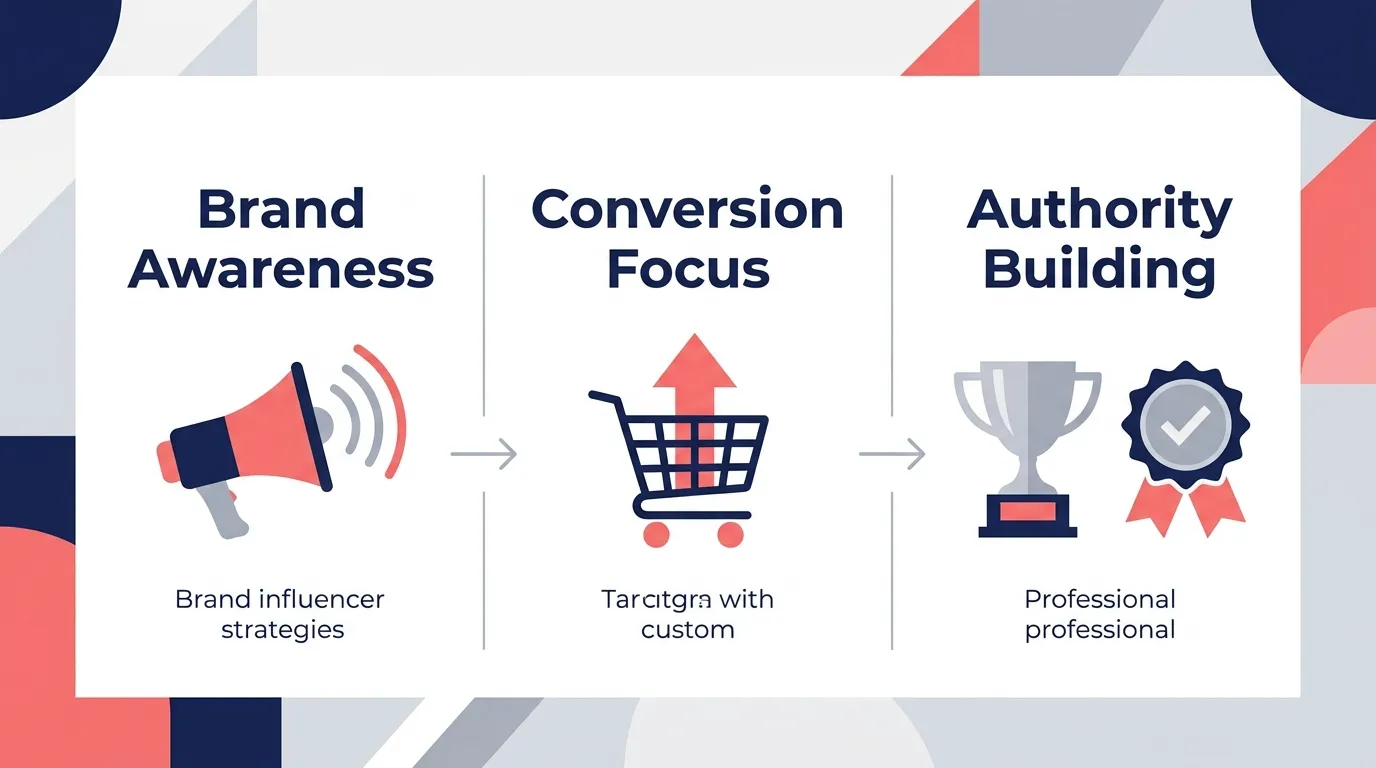
The way you approach creators should change depending on what you are trying to achieve. Reach, conversions, and authority each require a different mindset, a different shortlist of influencers, and often a different deal structure.
When we plan campaigns at MediaOne, we start with the end goal and work backwards. That single decision shapes everything. Who do we reach out to? How we approach them. What we ask for. Even though we measure success.
Here is how I break it down in practice:
Brand Awareness Campaigns
If the goal is visibility, then scale matters more than precision.
In these campaigns, we prioritise creators who can put the brand in front of as many relevant people as possible, within a short period of time.
What we focus on:
- High-reach creators with strong impressions, not just follower count
- Content formats that are easily shareable, such as short-form video
- Consistent posting frequency to maintain momentum
How outreach differs:
- Messaging is broader and more brand-led
- We emphasise storytelling and creative freedom
- Turnaround times are usually tighter
There is also a trade-off here. High-reach creators tend to have lower engagement rates than their audience size would suggest. That is expected.
What matters is whether the content creates enough visibility to justify the cost.
A practical example: For a regional campaign in Singapore, we worked with a mix of mid-tier and macro influencers on TikTok and Instagram. Instead of over-optimising for engagement, we focused on content volume and timing. The goal was to dominate attention within a specific window.
Conversion-Focused Campaigns
This is where most brands get it wrong. They assume that popular influencers will automatically drive sales. That is rarely the case.
Conversion-driven campaigns require a completely different type of creator. You are looking for people who influence decisions, not just attention.
What we focus on:
- Creators with a track record of driving clicks or purchases
- Audiences that trust recommendations, often in niche categories
- Content that feels native and personal rather than polished
Outreach strategy shifts:
- We introduce performance-based incentives, such as affiliate commissions
- Messaging becomes more direct about outcomes and expectations
- We prioritise long-form or review-style content where persuasion can happen
User-generated content plays a significant role here. It tends to feel more authentic and performs better in retargeting campaigns.
Key insight: A smaller creator with a highly engaged audience often outperforms a larger influencer when the goal is conversion. This is not a theory. It is something we consistently observe across campaigns.
Niche Authority Campaigns
These are often overlooked, but they can be incredibly powerful. When a brand needs credibility rather than reach or immediate sales, we focus on authority.
This is especially relevant for:
- B2B brands
- Professional services
- High-consideration products
What we prioritise:
- Micro and nano influencers with deep expertise
- Creators who are respected within specific communities
- Content that educates rather than entertains
How outreach changes:
- The tone becomes more collaborative and less transactional
- We position the opportunity as a partnership, not a campaign
- Deliverables often include thought leadership content, not just posts
These creators may not have massive audiences, but their influence runs deeper. Their recommendations carry weight because they are seen as credible voices, not just content producers.
A simple way to think about it:
- Awareness campaigns borrow attention
- Conversion campaigns capture intent
- Authority campaigns build trust
Matching Strategy to Outcome
Before reaching out to a single influencer, I always ask one question. What does success actually look like?
If that is not clearly defined, outreach becomes reactive. You end up chasing creators instead of building a system.
Once the goal is clear, everything else becomes easier:
- The right creators stand out
- Messaging becomes more natural
- Performance becomes easier to evaluate
This is the difference between running influencer campaigns and building a scalable, repeatable outreach strategy.
Influencer Outreach Strategies for Negotiation and Deal Structuring
Negotiation is the point where a campaign either becomes scalable or quietly starts leaking budget.
Most brands focus heavily on finding the right influencers and crafting outreach messages. That matters, but what happens after a creator says “yes” is just as important.
This is where agencies tend to outperform. We do not approach negotiation as a one-off conversation. We treat it as part of a broader system designed to protect margins, extend content value, and improve long-term returns.
Understanding the Real Objective Behind Negotiation
It is tempting to think negotiation is about getting a lower price. That is only one part of it.
The real objective is to structure a deal that:
- Aligns incentives between brand and creator
- Extracts maximum value from each piece of content
- Creates flexibility for future campaigns
A slightly higher upfront fee can still be a better deal if it includes broader usage rights or stronger upside in performance.
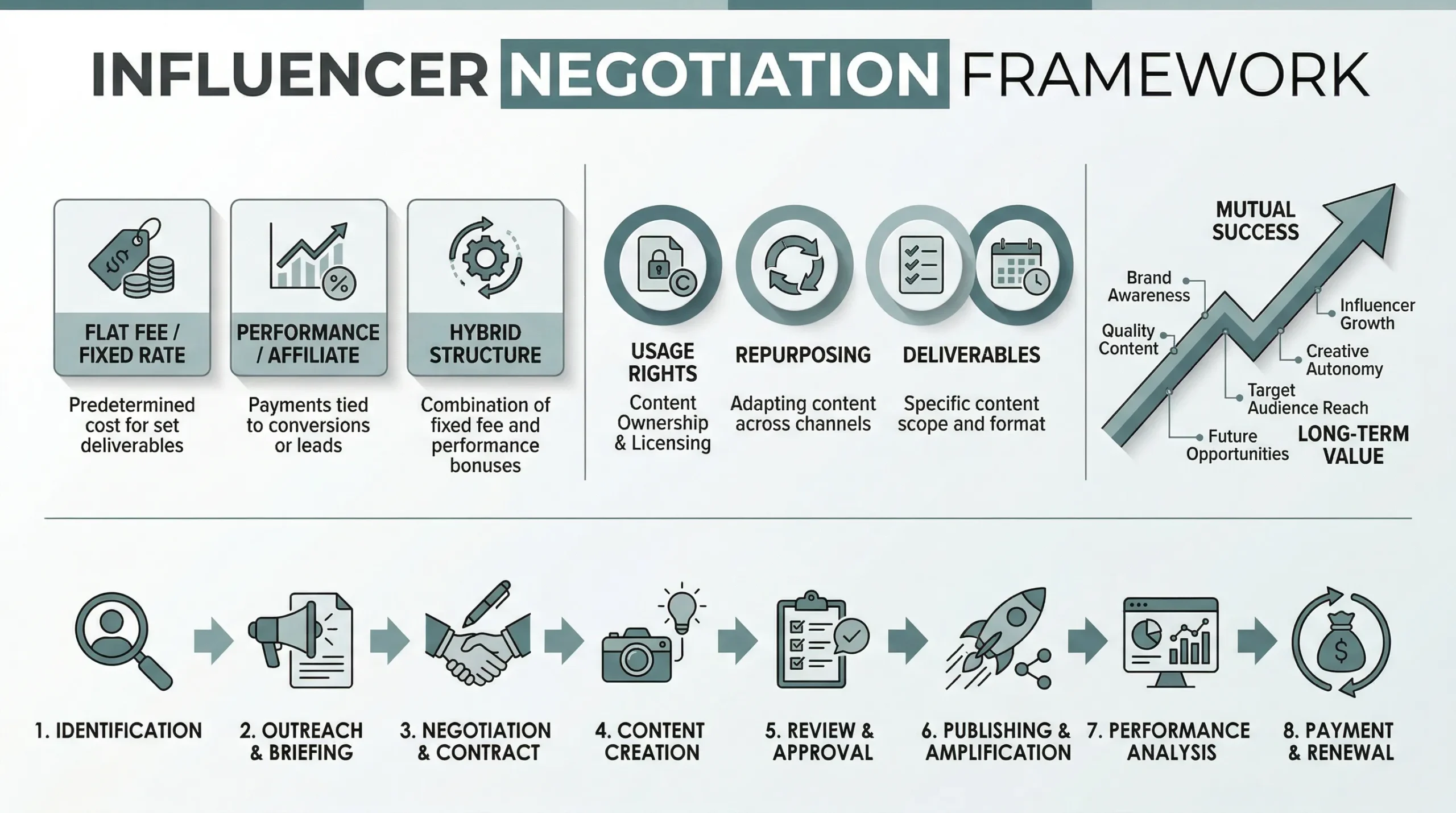
Common Pricing Models Agencies Use
There is no single “best” pricing model. The structure depends on campaign goals, creator profile, and risk tolerance.
- Flat Fee
- A fixed payment for defined deliverables
- Works well for brand awareness campaigns
- Predictable, but not always tied to performance
- Affiliate or Performance-Based
- Creator earns a commission per sale or lead
- Strong alignment with conversion-focused campaigns
- Lower upfront risk, but requires proper tracking
- Hybrid Models
- Combination of flat fee + performance incentives
- Increasingly common in mature campaigns
- Balances risk while motivating creators to perform
In practice, we often lean towards hybrid structures because they allow both parties to benefit when a campaign performs well.
What Agencies Actually Negotiate Beyond Price
Price is only one lever. The more important variables are often hidden in the details.
Usage Rights
- Can the brand reuse the content in ads
- Can it be published on owned channels
- How long can the content be used
This is critical. A single influencer video can become a high-performing ad asset. Without proper rights, that opportunity disappears.
Content Repurposing
- Breaking one deliverable into multiple assets
- Adapting content across platforms
- Using creator content in email or landing pages
We often negotiate with repurposing in mind from the start. It increases the lifespan of each piece of content.
Deliverables and Scope
- Number of posts, stories, or videos
- Platform-specific formats
- Revision allowances
Clarity here prevents misalignment later. Vague agreements almost always lead to friction.
Timelines
- Content deadlines
- Review and approval windows
- Campaign launch alignment
Delays can affect the entire campaign pipeline, especially when multiple creators are involved.
Negotiation Tactics That Improve ROI
Over time, we have found that effective negotiation is less about pressure and more about positioning.
- Present clear campaign goals so creators understand the bigger picture
- Offer long-term collaboration opportunities instead of one-off deals
- Bundle deliverables where it makes sense to improve cost efficiency
- Anchor discussions around value, not just cost
Creators are more flexible when they see potential for ongoing work. This is one of the most overlooked advantages agencies bring to the table.
Structuring Deals for Long-Term Value
Short-term campaigns can work, but long-term partnerships tend to outperform them.
When negotiating, we often include:
- Options for future collaborations at pre-agreed rates
- First access to new campaigns
- Performance-based bonuses tied to results
This creates continuity. Instead of restarting the outreach process every time, you build a reliable network of creators who already understand your brand.
If you are building your own influencer outreach strategy, this is a simple way to approach negotiation:
- Define your campaign objective clearly before discussing price
- Choose a pricing model that aligns with that objective
- Prioritise usage rights and content flexibility
- Be explicit about deliverables and timelines
- Look for ways to extend the relationship beyond one campaign
Negotiation is not a separate step. It is where strategy becomes tangible.
When structured properly, each deal does more than deliver content. It builds assets, relationships, and data you can reuse across future campaigns.
Influencer Outreach Strategies for Long-Term Partnerships
Most brands approach influencer outreach as a transaction. A brief. A post. A payment. Then they move on.
That model still exists, but it rarely produces meaningful compounding results.
In my experience running campaigns at MediaOne, the real leverage comes from shifting from one-off collaborations to structured, long-term partnerships. The difference is not subtle.
It changes how creators talk about your brand, how audiences respond, and how efficiently your budget performs over time.
Why Long-Term Partnerships Outperform One-Off Campaigns
A creator who works with you once is testing the waters. A creator who works with you repeatedly starts to integrate your brand into their narrative.
That distinction matters because audiences are highly attuned to authenticity. When a product appears once, it feels like an ad. When it appears consistently, it begins to feel like a genuine preference.
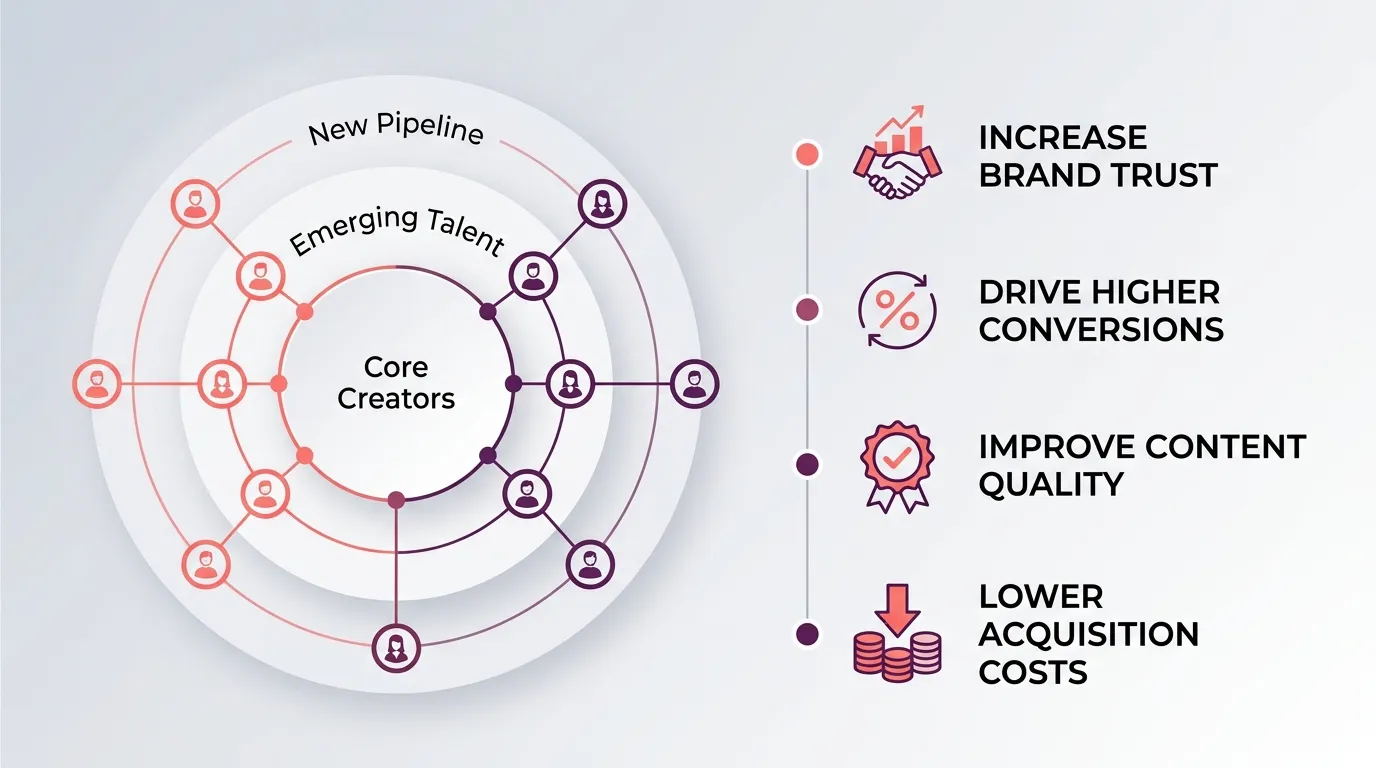
From a performance standpoint, long-term partnerships tend to deliver:
- Higher trust and credibility with the audience
- Improved conversion rates over time
- More consistent content quality
- Lower acquisition costs per campaign
There is also an operational benefit. You spend less time sourcing and onboarding new creators, and more time optimising relationships that already work.
How Agencies Turn Creators into Long-Term Partners
This does not happen by accident. Agencies build systems around retention, just as they do for acquisition.
At MediaOne, we typically segment creators into tiers based on performance and alignment. From there, we actively develop those relationships rather than waiting for the next campaign cycle.
Here are the most common partnership paths:
- Brand Ambassadors: Creators who consistently represent the brand across multiple campaigns and formats. They are often given early access to products, deeper brand context, and more creative freedom.
- Repeat Collaborators: Creators who may not be exclusive but are brought back regularly because they perform well and understand the brand voice.
- Content Partners: Creators who produce assets not just for their own audience, but also for paid ads, landing pages, and social media use.
Each tier requires a slightly different approach, but the underlying principle is the same. You are building a relationship, not managing a transaction.
Retention Strategies That Actually Work
Retention is where most brands fall short. They assume that paying on time is enough. It is not. Strong creator relationships are maintained through deliberate, ongoing effort.
- Consistent Communication: Creators should not only hear from you when you need something. Share updates, campaign results, and even future plans. This keeps them invested in your growth.
- Performance Feedback That Adds Value: Instead of generic praise, provide insights. Let them know which content performed best and why. This helps them improve, and positions you as a partner rather than just a client.
- Exclusive Opportunities: Offer selected creators early access to campaigns, higher-budget collaborations, or experimental formats. This signals that they are part of a smaller, trusted group.
- Creative Freedom with Guardrails: Over-directing creators often leads to weaker content. Give clear objectives, but allow room for their style to come through. That is what their audience responds to.
- Fair and Evolving Compensation: If a creator consistently performs, their compensation should reflect that. Long-term partnerships break down quickly when creators feel undervalued.
Building a Creator Ecosystem Around Your Brand
When done correctly, you do not just have a list of influencers. You have an ecosystem. This ecosystem typically includes:
- A core group of high-performing creators
- A secondary layer of emerging collaborators
- A pipeline of new creators is being tested
The goal is to create continuity. New creators bring fresh reach, while established partners deliver consistent results.
Over time, this structure allows you to:
- Launch campaigns faster
- Maintain a steady content pipeline
- Reduce reliance on paid acquisition channels
Brands that invest in this kind of ecosystem often see more stable performance across campaigns, even when platform algorithms shift.
A Practical Way to Start
If you are currently running one-off campaigns, the transition need not be complicated.
Start by identifying:
- The top 10 to 20 percent of creators who delivered the best results
- Those who showed strong brand alignment, not just high metrics
Then:
- Re-engage them with a longer-term proposal
- Offer a structured collaboration plan instead of a single deliverable
- Build a simple system to track performance and communication
You do not need a large roster. You need a reliable one.
The Real Advantage
Long-term influencer outreach strategies are not just about efficiency. They are about depth. When creators understand your brand, believe in what you are building, and see a future in the partnership, their content reflects that.
That is when influencer marketing stops feeling like advertising and becomes a genuine extension of your brand voice. And that is where the strongest results tend to come from.
Influencer Outreach Strategies for Compliance and Brand Safety
When people talk about influencer outreach strategies, they usually focus on discovery, messaging, and conversion. Compliance and brand safety are often treated as afterthoughts, which is where most campaigns quietly fall apart.
From where I sit at MediaOne, this is not a side consideration. It is part of the strategy from day one. If you get this wrong, it does not matter how strong your outreach is. You risk legal exposure, reputational damage, and wasted budget.
Let’s break down how agencies approach this properly:
Compliance Is Built Into the Process, Not Added Later
A common mistake I see is brands thinking compliance only comes in at the posting stage. By then, it is already too late.
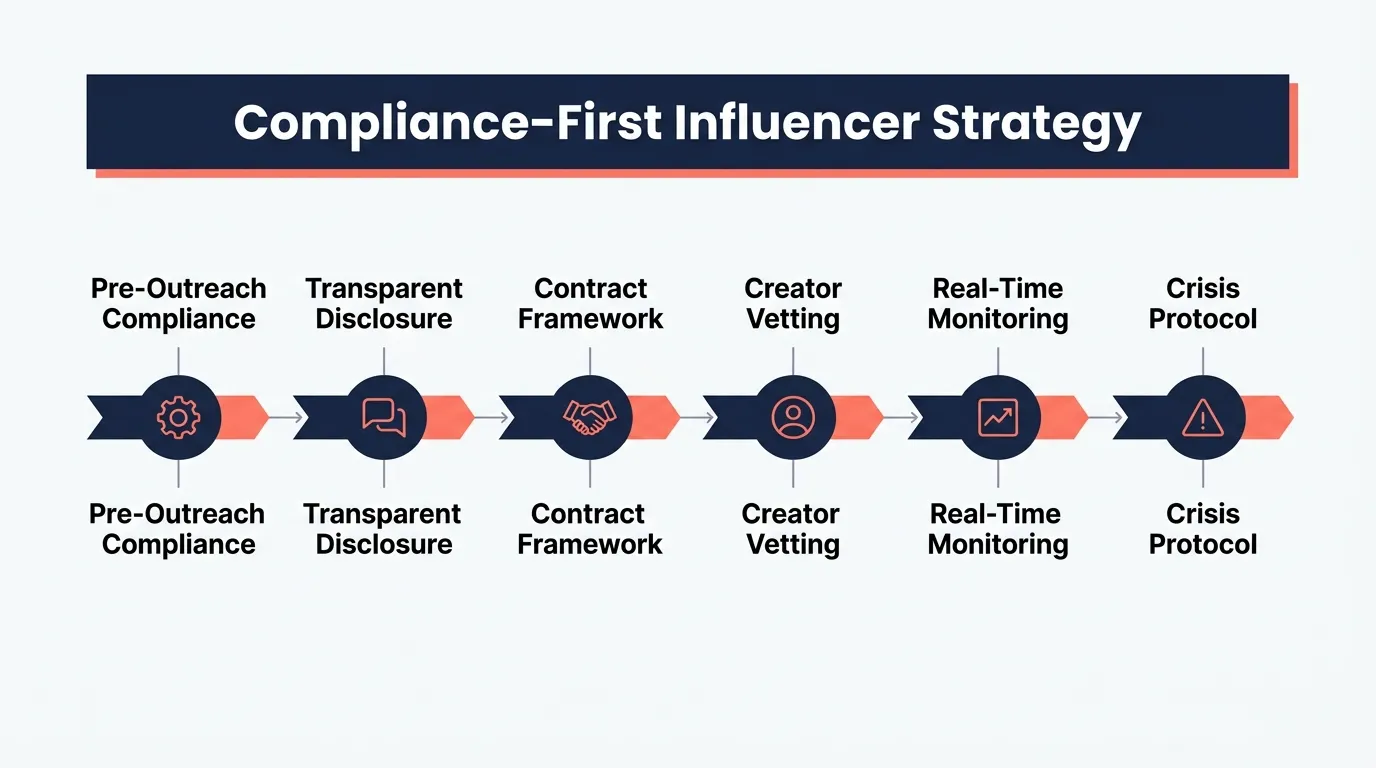
In a structured outreach strategy, compliance is introduced at three points:
- Before outreach: Define requirements and non-negotiables
- During negotiation: Align expectations and document them clearly
- Before publishing: Review content against agreed standards
This prevents last-minute issues and avoids awkward back-and-forth with creators.
Disclosure Is Not Just a Hashtag. It Is a Trust Signal
Most people reduce compliance to adding #ad or #sponsored. That is only part of it.
A well-executed campaign ensures:
- Disclosure is visible and unambiguous, not hidden in a block of hashtags
- The tone of the content still feels natural, not forced or overly scripted
- The creator understands why disclosure matters, not just that it is required
In markets like Singapore, where we operate heavily, regulators expect transparency. Even when enforcement is inconsistent, audiences are not. They can tell when something feels off.
Contracts Are Where Most Risk Is Managed
If there is one area brands tend to underinvest in, it is contracts.
A proper influencer agreement should clearly outline:
- Deliverables
- Number of posts
- Format (Reels, Stories, YouTube videos, etc.)
- Deadlines
- Usage rights
- Can you reuse the content for ads
- Duration of usage
- Platforms where it can appear
- Disclosure requirements
- Exact wording or guidelines
- Placement within captions or videos
- Exclusivity clauses
- Whether the creator can work with competitors
- Duration of exclusivity
- Approval workflows
- Whether the content needs to be reviewed before posting
- Turnaround times for feedback
This is not about being overly rigid. It is about removing ambiguity so both sides can execute confidently.
Brand Safety Starts With Creator Selection
You cannot fix brand safety issues after you have chosen the wrong creator. This is why agencies invest heavily in vetting before outreach even begins.
We look at:
- Content history
- Past posts, tone, and recurring themes
- Any controversial or polarising content
- Audience behaviour
- Comment sentiment
- Types of discussions happening in the community
- Brand alignment
- Does the creator’s voice match the brand’s positioning
- Are there any value conflicts
It is not about avoiding personality. It is about understanding the full context of who you are partnering with.
Active Monitoring During Campaigns Is Non-Negotiable
Even with the right contracts and creators, things can shift quickly once content goes live.
Agencies monitor campaigns in real time:
- Track how posts are performing
- Watch for negative sentiment or unexpected reactions
- Check that disclosures are correctly implemented
If something goes off track, response time matters.
This could mean:
- Requesting edits
- Clarifying messaging in comments
- Adjusting future content in the same campaign
A passive approach here can lead to small issues becoming larger ones.
Crisis Preparedness Is Part of Professional Outreach
Not every campaign will face issues, but every serious agency plans for them. A basic crisis framework includes:
- Clear escalation paths
- Who handles issues internally
- Who communicates with the creator
- Pre-agreed actions
- Content removal or edits
- Public clarification if needed
- Documentation
- Keeping records of agreements and approvals
This does not need to be complicated. It just needs to exist before you need it.
Where Most Brands Get It Wrong
From what I have seen, the gaps are consistent:
- Treating compliance as a legal checkbox instead of a strategic layer
- Relying on informal agreements or message threads instead of contracts
- Skipping proper vetting because a creator “looks right”
- Not monitoring campaigns after content goes live
Each of these seems small on its own. Together, they create unnecessary risk.
If you are building your own influencer outreach strategy, keep it simple but structured:
- Define your compliance requirements upfront
- Vet creators beyond surface metrics
- Use clear, written agreements
- Review content before it goes live
- Monitor performance and sentiment actively
That alone will put you ahead of most campaigns running today. At MediaOne, we do not separate outreach performance from brand safety. They are part of the same system.
The strongest campaigns are not just the ones that perform well. They are the ones that protect the brand while they scale.
Turning Influencer Outreach Strategies Into a Competitive Advantage
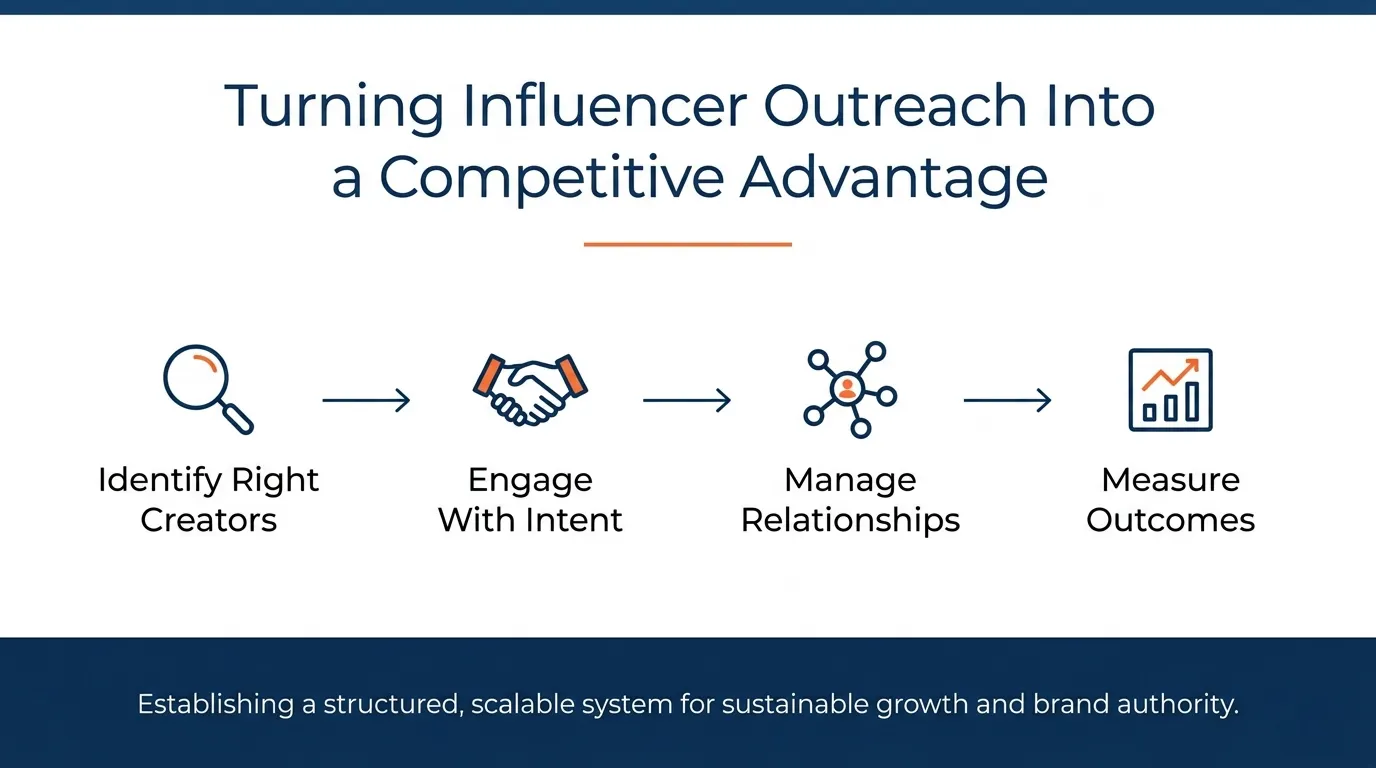
Most brands do not struggle with finding influencers. They struggle with building a system that consistently delivers results.
What separates high-performing campaigns from forgettable ones is structure. The ability to identify the right creators, engage them with intent, manage relationships properly, and measure outcomes with clarity.
When these pieces come together, outreach stops being a one-off activity and starts becoming a repeatable growth channel.
From my experience at MediaOne, the real advantage comes from treating influencer work as part of a broader marketing engine. It should align with your SEO, paid media, and content strategy so each campaign compounds rather than resets.
If you are looking to refine how your campaigns are planned and executed, it may be worth reviewing the structure of your current influencer outreach strategies. For brands operating in Singapore or targeting this market, we work closely with teams that want a more disciplined, performance-led approach.
You can reach out to our MediaOne team to explore how to improve and align your current influencer outreach strategies with long-term growth.
Frequently Asked Questions
How long does it take to see results from influencer outreach strategies?
Results depend on campaign goals and execution quality. Awareness campaigns may show engagement within days, while conversion-focused campaigns often take several weeks to optimise. Consistency and repeated collaborations usually improve performance over time. Brands that track and refine campaigns tend to see stronger long-term outcomes.
How many influencers should be included in a single outreach campaign?
There is no fixed number, as it depends on budget, goals, and audience size. Smaller campaigns may focus on a handful of high-quality creators, while larger campaigns can involve dozens or more. The key is balancing reach with relevance rather than simply increasing volume. A smaller, well-aligned group often performs better than a large, mismatched one.
What budget is needed for effective influencer outreach strategies?
Budgets vary widely depending on the platform, creator tier, and campaign scope. Micro influencers may require modest fees or product exchanges, while larger creators command higher rates. It is more effective to allocate budget based on expected outcomes rather than solely on follower size. Testing different tiers can help identify the most cost-efficient mix.
Can small businesses compete with larger brands using influencer outreach strategies?
Yes, small businesses can compete by focusing on niche creators and highly targeted audiences. Micro and nano influencers often have stronger engagement and closer relationships with their followers. A well-defined message and authentic collaboration can outperform larger campaigns with broader reach. Precision often matters more than scale.
What industries benefit most from influencer outreach strategies?
Industries with strong visual or lifestyle appeal tend to benefit the most, such as fashion, beauty, fitness, and travel. However, B2B sectors can also see results through niche creators and thought leaders. The effectiveness depends on how well the strategy aligns with audience behaviour and the chosen platform. With the right approach, most industries can leverage influencer outreach effectively.