Influencer marketing has become a serious part of the marketing mix in Singapore. DataReportal reported that Singapore had 5.16 million social media user identities in January 2025, equivalent to 88.2% of the population.

We Are Social also reported that influencer ad spend in Singapore reached US$106 million, up 13.6% year on year. That makes one thing clear: creator partnerships are no longer treated as side experiments.
Brands are investing in them as a serious channel for reach, engagement, and commercial growth.
That is why influencer marketing case studies matter. They show how real campaigns were built, why certain creators were chosen, how the message was shaped, and what other brands can learn from the result.
For businesses looking to build a more structured creator strategy, working with a leading influencer marketing agency in Singapore can also help bring clearer direction, stronger execution, and more measurable outcomes.
In this article, we will look at several Singapore-relevant campaign examples, identify the patterns behind stronger influencer work, and outline what brands should consider before launching their own creator campaigns.
Key Takeaways
- The best influencer marketing case studies are built around one specific goal, whether that is driving awareness, promoting a sales event, increasing participation, or reshaping brand perception.
- A large audience may look attractive on paper, but it does not automatically make a creator the best fit for a campaign. The strongest Singapore examples show that local familiarity, audience alignment, and trust often matter more than reach by itself.
- Content tends to perform better when it feels native to the channel it appears on, rather than being adapted awkwardly from another format.
- Likes and views can be useful signals, but they should not be the only way a campaign is judged. Brands need to align their reporting with the campaign’s real purpose, whether that means tracking awareness, clicks, leads, conversions, or changes in brand perception.
- Influencer marketing should not be treated as separate from advertising standards just because it appears on social media.
Why Influencer Marketing Case Studies Matter for Brands
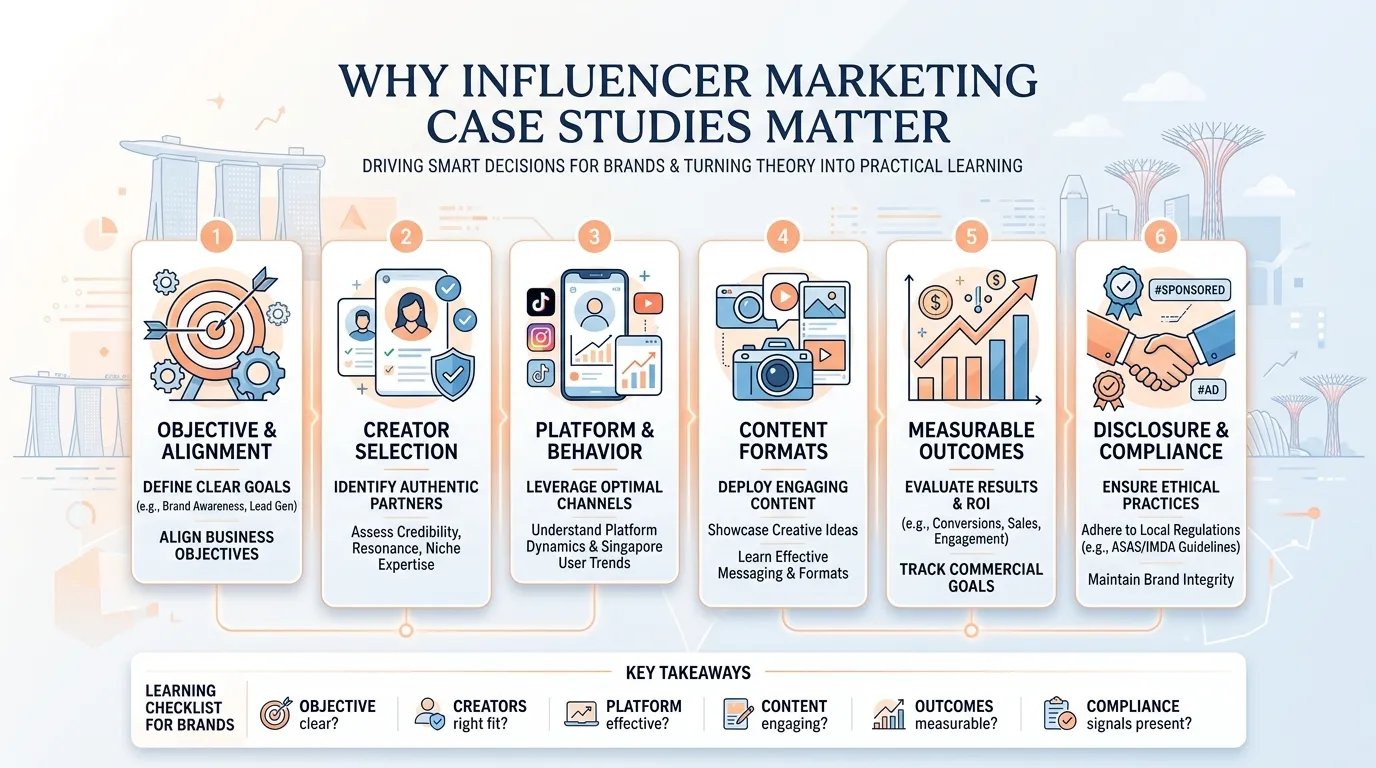

A case study is useful because it makes marketing theory practical. Instead of telling a brand to “choose the right influencer” or “track performance properly”, it shows how those decisions worked in an actual campaign.

That matters in Singapore, where brands often need to balance:
- local cultural relevance
- platform behaviour
- creator credibility
- commercial objectives
- disclosure and compliance expectations
A strong case study should not just show that a post looked good. It should explain the campaign logic clearly enough for another brand to learn from it.
What a strong influencer marketing case study should show
| Element | Why it matters |
| Campaign objective | Shows what the brand was trying to achieve |
| Creator choice | Explains why the influencer or creator was selected |
| Platform | Shows whether the campaign matched audience behaviour |
| Content format | Helps readers understand what was actually produced |
| Outcome | Makes the example commercially useful |
| Compliance signals | Indicates whether the campaign was handled credibly |
Quick checklist for evaluating a case study
A useful influencer case study should answer these questions:
- What was the brand trying to achieve?
- Why were those creators chosen?
- Which platform was used, and why?
- What type of content was created?
- Was there any measurable outcome or reported impact?
- Did the campaign appear credible and transparent?
If those basics are missing, the case study may still be interesting, but it is much less useful for decision-making.
What Successful Influencer Campaigns Usually Have in Common
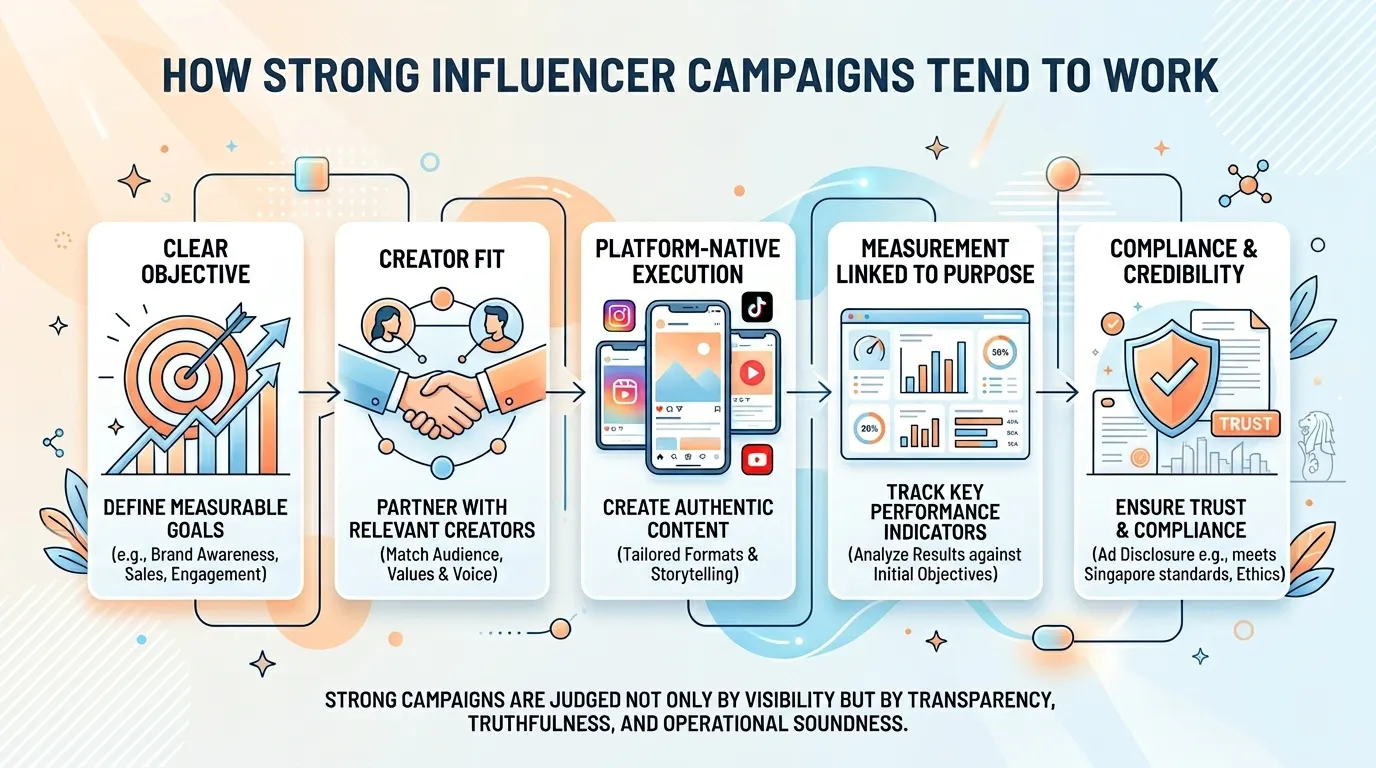
When you compare stronger influencer campaigns, a few recurring patterns appear. These patterns do not guarantee success, but they do show what better campaigns tend to get right.
- Clear objective: The best campaigns usually have one clear job. That job might be to promote a sales event, refresh brand perception, drive participation, or support product discovery. Campaigns become weaker when the brand expects the same creator content to do everything at once.
- Strong creator fit: A creator does not need to be the biggest name to be the right fit. What matters more is whether the creator makes sense for the audience, tone, and message. Local familiarity, trust, relevance, and niche authority often matter more than raw follower count.
- Platform native execution: The content should feel natural on the platform where it appears. What works on TikTok will not always work on Instagram, and what works in a livestream environment will not necessarily translate to static content.
- Measurement tied to purpose: The campaign should be judged according to its original goal. Awareness campaigns need different KPIs from conversion campaigns. Repositioning campaigns may also need broader indicators such as engagement quality or sentiment.
- Compliance as part of campaign quality: In Singapore, influencer content is not outside the rules simply because it appears on social platforms. ASAS’ Guidelines on Interactive Marketing Communication and Social Media make clear that the guidance applies to advertising and marketing communication using social media to promote goods and services or influence consumer behaviour. For financial institutions, MAS’ Guidelines on Standards of Conduct for Digital Advertising Activities are relevant where financial products and services are advertised through digital and social channels. That means a campaign should be assessed not only by its visibility, but also by whether it is transparent, truthful, and operationally sound.
Influencer Marketing Case Study 1: Shopee’s 9.9 Campaign With Xiaxue and Mayiduo

Image Credit: MARKETING INTERACTIVE
Shopee’s 9.9 campaign is a useful influencer marketing case study for brands looking at event-led retail promotions.
Public reporting confirms that Shopee worked with local influencers Xiaxue and Mayiduo to promote its 9.9 Super Shopping Day campaign in Singapore, and that the campaign also aligned with Shopee Live activities during the same promotional period.
- Campaign objective: The campaign’s purpose appears clear: drive attention to a major shopping event and build top-of-mind recall around a time-sensitive sales push. This was not framed as a long brand-building story. It was built around visibility, promotional urgency, and participation during a key retail moment.
- Platform(s): Social media, ad creative, and Shopee Live
- Content format: Campaign creative, promotional content, and livestream-linked activation
- What is publicly confirmed: According to MARKETING-INTERACTIVE, Shopee engaged Xiaxue and Mayiduo to promote 9.9 in Singapore. The article also quotes Shopee describing the campaign as part of a hyper-localised approach and says the two creators were engaged to run exclusive shopping deals and live product demonstrations on Shopee Live.
- Shopee’s own LinkedIn post separately confirms that Xiaxue and Mayiduo were featured in its latest TV commercial for the 9.9 Super Shopping Day.
- Execution: Based on the available reporting, the execution combined recognisable local creator talent, simple promotional messaging, and cross-format support spanning ad creative and livestream-related activation. That makes this example most useful as a lesson in retail-event campaign structure and local creator fit.
- What was reported about the results: No clear public performance figures were disclosed in the sources used here. That means this influencer marketing case study is more useful for understanding campaign setup and creator selection than for benchmarking ROI or conversion performance.
- Main lesson: For event-led retail campaigns, recognisable local creators and clear calls to action can do more work than overcomplicated storytelling. When the campaign moment is already strong, the clearer priority is usually reach, recall, and participation.
Influencer Marketing Case Study 2: MILO Van Goes Digital
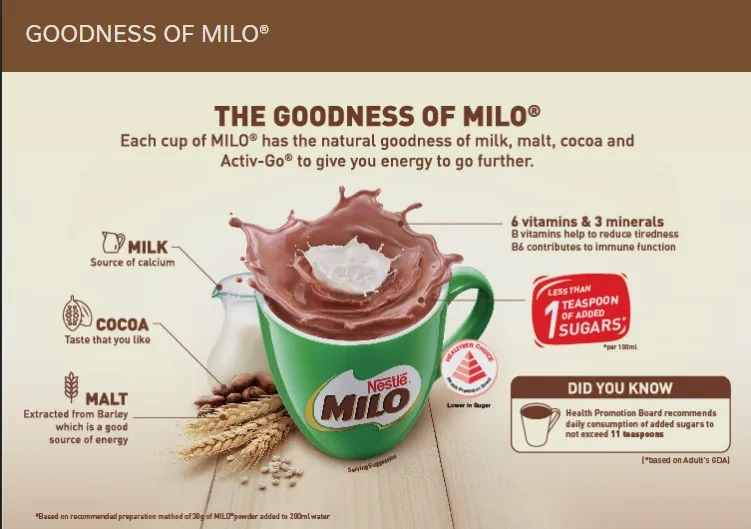
Image Credit: Milo
MILO‘s digital van campaign shows how influencer marketing can help a heritage brand modernise nostalgia. MARKETING-INTERACTIVE reported that the campaign featured five influencers who served as both on-screen talent and distribution drivers, helping push content through paid and earned channels.
- Campaign objective: This campaign was designed to revive affection for the iconic MILO van in a more digital, socially shareable way. Rather than relying solely on nostalgia, the brand turned that familiarity into a modern engagement mechanic. The campaign specifically aimed to accelerate MILO consumption and drive purchases of promotional packs tied to MILO toy van collectables.
- Platform(s): Facebook, Instagram, YouTube, and supporting digital channels
- Content format: Creator-led challenge content, episodic social content, and supporting promotional assets
- Why the influencer role mattered: The influencers were not just there for endorsement. They were part of the campaign system. According to MARKETING-INTERACTIVE’s case study, the five influencers helped attract attention, drive viewership and voting, and support the brand’s broader promotional assets, making the creator role more integrated and commercially useful.
- Execution: The campaign combined:
- influencer content
- paid amplification
- earned reach from creator audiences
- a participation element linked to the MILO van concept
- promotional product support
- This made the influencer’s work feel part of a wider campaign, rather than a one-off sponsorship. The execution included a teaser phase, a two-episode MILO Van Recipe Showdown, and creator-led content designed to build excitement and drive engagement.
- What was reported about the results:
- This is where the example is stronger. PROTOCOL reports that the campaign reached almost 1.6 million views across Facebook, Instagram, and YouTube, generated 3x more views exceeding the 1-minute mark, 2x more engagement, and 3x the average view time compared with other posts during the same period.
- It also reports +209% improvement in ad retention, +225% in social reach, and +127% in social volume versus baseline. These figures appear to be reported by the agency behind the campaign rather than an independent platform audit, so they should be read as campaign-reported results.
- Main lesson:
- Influencers can do more than appear in branded content. They can act as both creative talent and distribution partners, which makes the campaign more integrated and often more effective.
- A small accuracy note: the source names four competing influencers from SGAG and Night Owl Cinematics, plus Munah Bagharib as host, which is why the article refers to five influencers in total.
Influencer Marketing Case Study 3: Eu Yan Sang’s Millennial Repositioning Campaign
Eu Yan Sang is a useful influencer marketing case study because it shows how a heritage brand can use experience-led activation and influencer amplification to feel more relevant to younger audiences. In this case study, the campaign is framed around making traditional Chinese medicine feel more relatable to a younger, more modern audience.
- Campaign objective: Introduce TCM to millennials in a more relatable way and position Eu Yan Sang as a brand with stronger contemporary relevance. The source explains that both Eu Yan Sang and TCM were seen as too traditional and less connected to younger lifestyles, which gave the campaign a clear repositioning job.
- Platform(s): Social media, lifestyle media coverage, and experience-led amplification.
- Content format: Influencer and media attendance, pop-up activation coverage, and social amplification around the experience.
- What is publicly confirmed: According to MARKETING-INTERACTIVE, Eu Yan Sang partnered with speakeasy cocktail bar The Library to create a six-month herbmixology pop-up campaign. The concept used TCM herbs in cocktails and placed the experience in a stylish, contemporary setting to create more modern associations around the brand. The same report states that Eu Yan Sang also hosted a press preview, inviting lifestyle influencers and traditional media guests to experience the space and cocktails.
- Execution:
- What makes this example stronger than a simple influencer mention is that the influencer and media element supported a broader brand experience rather than acting as a standalone sponsored post.
- The execution combined physical experience, cultural reframing, and social amplification. That is a useful lesson for brands trying to shift perception, because repositioning often works better when creators help amplify a new brand context rather than simply repeat a marketing message.
- What was reported about the results:
- The public source used here is much clearer on campaign objectives and execution than on measurable performance data.
- The case study confirms the repositioning logic, the pop-up format, and the involvement of lifestyle influencers and media, but it does not provide clear public metrics that make this a performance-led benchmark.
- That means this influencer marketing case study is more useful for understanding repositioning strategy and campaign design than for benchmarking ROI.
- Main lesson: Eu Yan Sang shows that influencer marketing can support more than short-term promotion. It can also help a legacy brand reframe itself for a younger audience when the creator activity is tied to a broader experience and a clearer cultural repositioning strategy.
Influencer Marketing Case Study 4: vivo Smartphone’s Micro-Influencer Campaign
Vivo’s X50 campaign is a useful influencer marketing case study because it shows how a brand can use micro-influencers to drive reach and engagement without relying on celebrity scale. As reported in this case study, the campaign was positioned as a targeted effort to build awareness and engagement for the vivo X50 among a specific audience on Instagram.
- Campaign objective: Build awareness and engagement for the vivo X50 in Singapore while keeping spending efficient and audience targeting focused. That gave the campaign a more performance-conscious role than a broad mass-awareness push.
- Platform(s): Instagram
- Content format: Micro-influencer social content and campaign-led audience targeting.
- What is publicly confirmed: According to MARKETING-INTERACTIVE, Vivo used micro-influencers as part of the X50 campaign, and the work went on to win bronze for Most Effective Use – Specific Audience at the MARKies Awards 2021. That makes this example particularly useful for brands considering whether smaller creators can still deliver meaningful campaign value when matched to the right audience and format.
- Execution: What makes this campaign relevant is the strategic role of the creator tier. Rather than treating reach as the only success factor, the campaign appears to have prioritised audience relevance, platform fit, and stronger engagement potential through micro-influencer selection. That is an important contrast to campaigns built mainly around headline creator names.
- What was reported about the results: The public source reports that the campaign exceeded its targeted engagements by more than 120%, generated over 1,000 comments, and delivered a reach rate of more than 90% among its intended audience. That makes this example stronger as a results-backed addition to the article than campaigns where only the setup is publicly discussed.
- Main lesson: Vivo shows that influencer marketing case studies do not always need celebrity creators to be commercially useful. A focused micro-influencer strategy can work well when the objective, platform, and audience are tightly aligned.
Comparison Table: What These Influencer Marketing Case Studies Show
Looking at case studies side by side makes it easier to spot what strong influencer campaigns have in common. The table below summarises the key differences and lessons from each campaign in a more practical, scan-friendly format.
| Brand | Objective | Influencer role | Format used | Main lesson |
| Shopee | Promote a major shopping event | Recognisable local personalities driving awareness and live commerce participation | Ad creative and livestream support | Clear promotional moments benefit from familiar creators and simple calls to action |
| MILO | Refresh nostalgia and drive engagement | Influencers as talent and distribution drivers | Social content, paid support, participation mechanics | Creators can amplify both message and campaign reach |
| Eu Yan Sang | Reposition a legacy brand for younger audiences | Influencers and media helping reshape perception | Experience-led campaign with social amplification | Influencer marketing can support brand repositioning, not just promotion |
Each campaign had a distinct purpose. Shopee focused on an event, MILO on engagement around nostalgia, and Eu Yan Sang on perception shift. That clarity helped shape everything else.
- Creator relevance matters more than generic popularity: The campaigns worked because the creator or amplification partner made sense for the audience and the message. The fit was strategic, not random.
- Influencer work performs better when connected to wider campaign mechanics: The strongest examples did not rely on a single sponsored post. They tied creator content to livestreams, earned media, participation, product hooks, or experience-led amplification.
- Good campaigns are also credible campaigns: Because influencer content falls within Singapore’s advertising and social media guidance, transparency and truthful communication still matter. Compliance does not replace creativity, but it does affect campaign quality and trust.
MediaOne Perspective: What Structured Influencer Campaign Management Looks Like
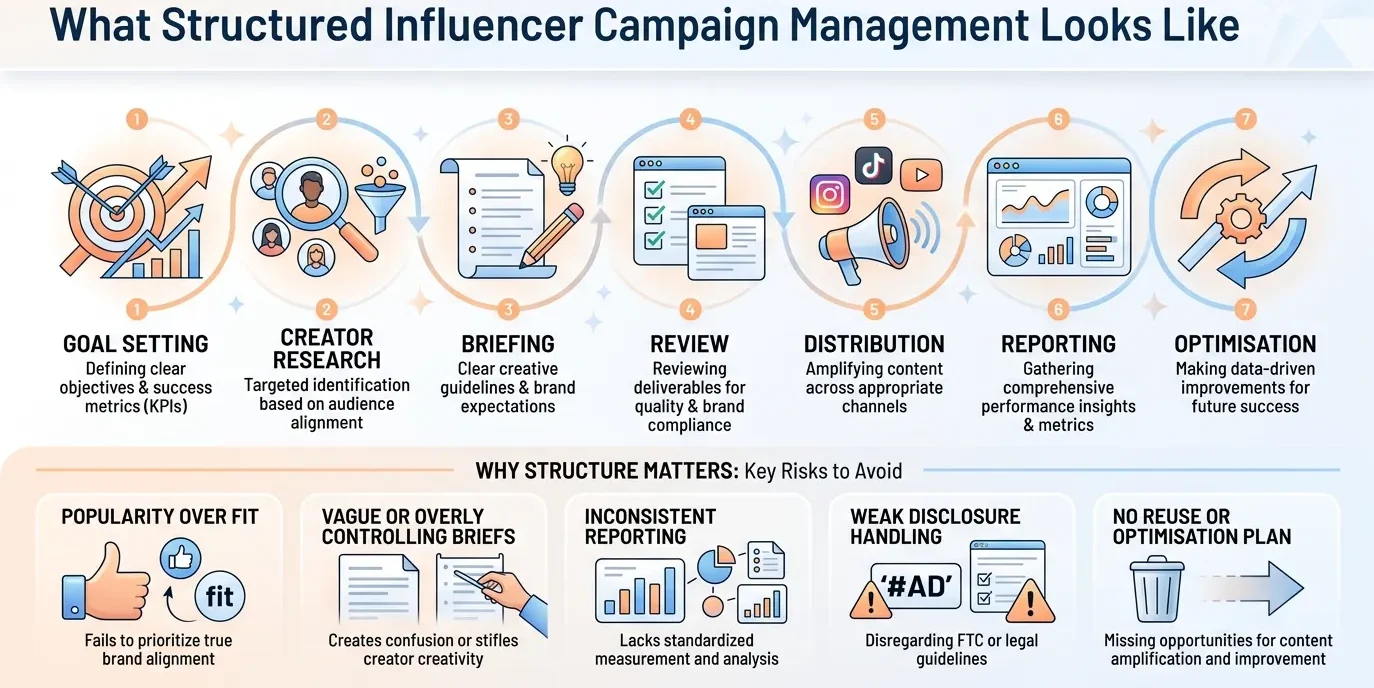
The case studies above may differ in category, format, and creator type, but they point to a similar pattern. Stronger influencer campaigns are usually built on a clear objective, deliberate creator selection, platform-appropriate execution, and reporting that matches the campaign’s actual purpose.
That structure matters because influencer campaigns often fail before the content even goes live. Common issues include unclear goals, weak creator fit, over-scripted briefs, inconsistent disclosure handling, and reporting that does not reflect what the campaign was meant to achieve.
A more disciplined process usually includes the following stages:
| Campaign stage | What should happen |
| Goal setting | Define the business objective and KPI framework |
| Creator research | Assess audience fit, relevance, and credibility |
| Briefing | Align message, deliverables, and disclosure expectations |
| Review | Check content quality, claims, and brand suitability |
| Distribution | Plan organic support, paid support, or repurposing |
| Reporting | Measure results against the original goal |
| Optimisation | Capture learnings for the next campaign |
This kind of structure does not make a campaign less creative. It makes the work easier to manage, measure, and improve over time.
What Brands Can Learn Before Launching Their Own Influencer Campaign
Studying case studies is useful, but the value lies in properly applying the lessons. Before launching a campaign, brands should focus on execution discipline.
Define success before outreach begins
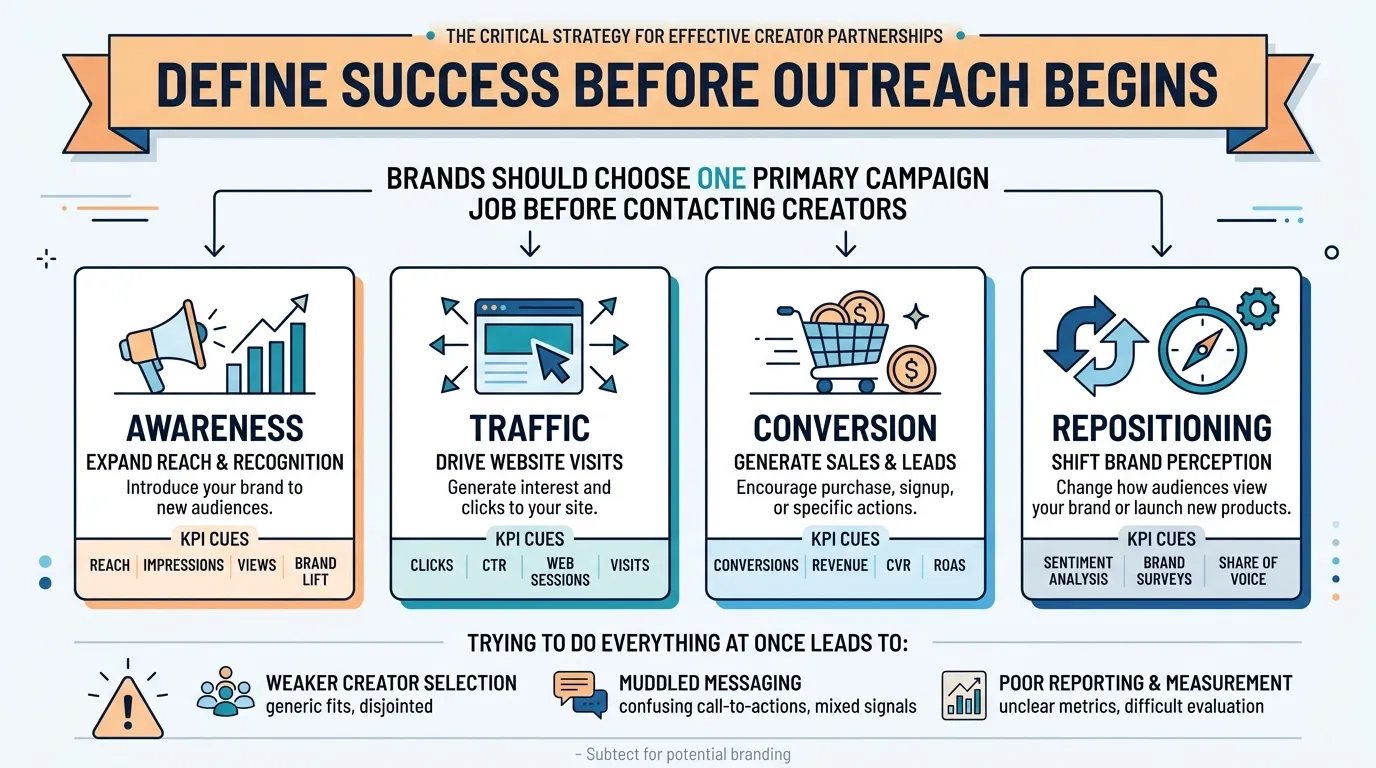
Before contacting any creator, the brand should be clear about the campaign’s primary job. Is the campaign meant to increase awareness, drive engagement, generate website traffic, support lead generation, lift sales, or reposition the brand in the market?
If the answer is all of those at once, the campaign is probably still too broad, which usually leads to weaker creator selection, muddled messaging, and poor reporting.
A practical way to tighten the brief is to match each main objective to a single main KPI family. For example:
- Awareness campaigns should focus on reach, impressions, video views, and recall-oriented engagement
- Traffic campaigns should focus on clicks, CTR, landing page visits, and session quality
- Conversion campaigns should focus on sign-ups, leads, purchases, promo code use, or assisted revenue
- Repositioning campaigns may need softer indicators such as engagement quality, sentiment, branded search lift, or earned amplification
That approach makes the campaign easier to brief, report on, and optimise once content starts going live.
Choose creators for fit, not just for fame
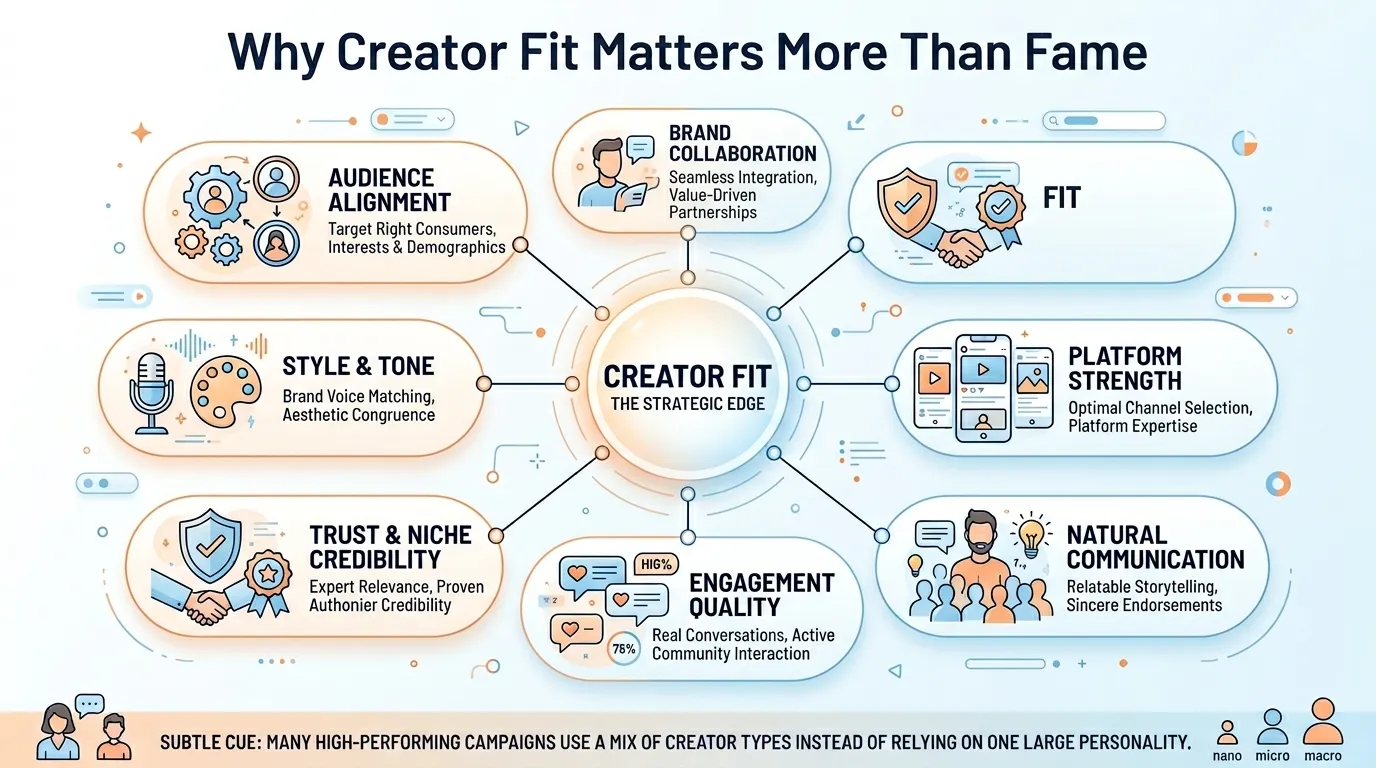
Creator selection should be treated as a relevance decision, not a popularity contest. A large following can boost visibility, but it does not automatically make the creator the right choice for the brand. In practice, brands should assess creators across several dimensions:
- audience relevance
- content style and tone
- trust and credibility within the niche
- platform strength
- consistency of engagement
- previous brand collaboration fit
- ability to communicate naturally without sounding forced
A smaller creator with stronger audience alignment can often outperform a bigger name with weaker relevance, especially in trust-led categories or campaigns targeting a specific community.
That is one reason many high-performing campaigns use a mix of creator types rather than relying on a single large personality.
Brief for authenticity, not script reading
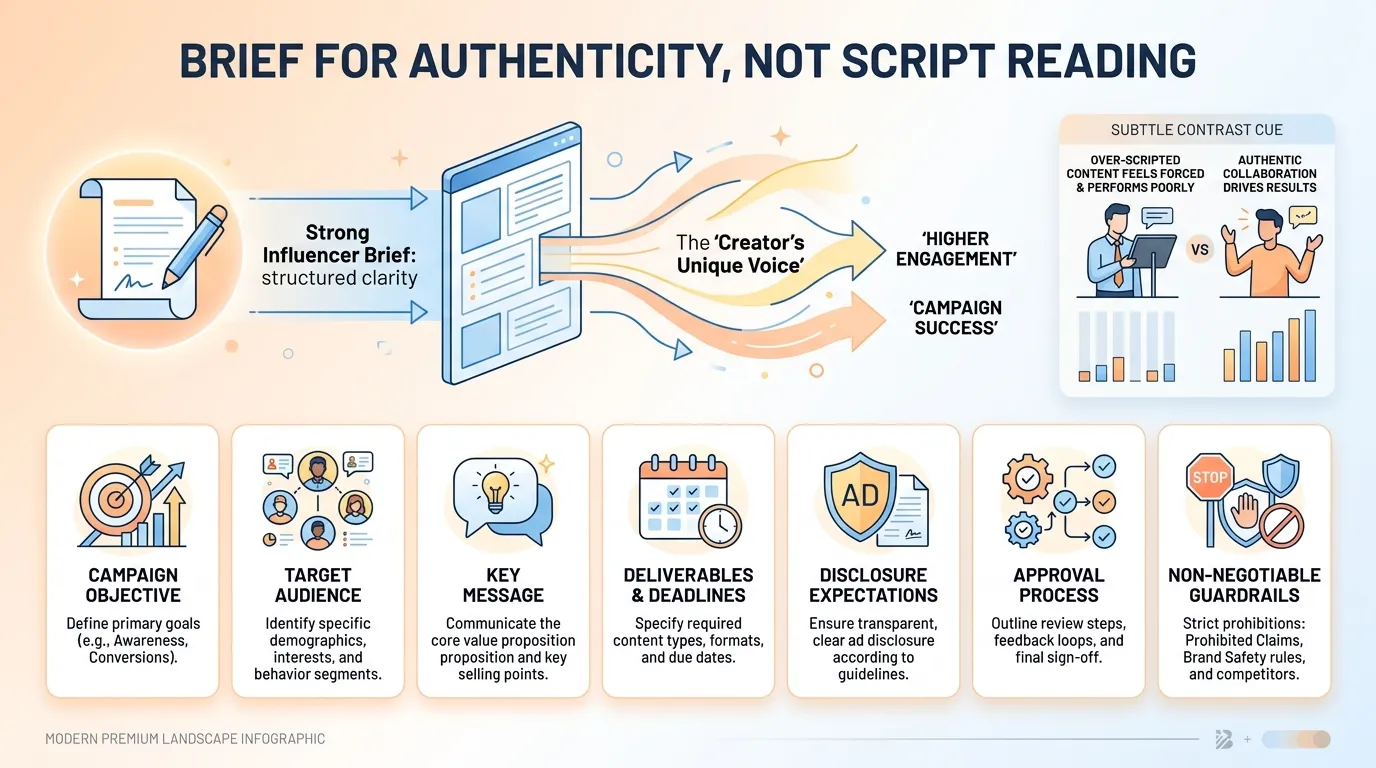
A strong influencer brief should create clarity without flattening the creator’s voice. At a minimum, the brief should cover:
- campaign objective
- target audience
- key message
- deliverables and posting deadlines
- disclosure expectations
- content approval process
- non-negotiable guardrails, such as prohibited claims or brand safety requirements
What it should not do is turn the creator into a spokesperson reading corporate copy. Over-scripted content tends to perform poorly because it no longer feels native to the platform or believable to the audience.
The best briefs give creators enough context to understand the business goal, while still leaving room for platform-native execution.
Pre-launch checklist
| Area | What to confirm before launch |
| Objective | We know the main business goal |
| Audience | We know who we want to reach |
| Creator fit | The creator is relevant to the category and audience |
| Brief | Deliverables and expectations are clear |
| Compliance | Disclosure, claims, and data handling have been reviewed |
| KPI tracking | Success metrics are defined in advance |
| Repurposing | We know whether strong content can be reused |
When to Work With a Leading Influencer Marketing Agency in Singapore
Some brands can run smaller creator campaigns in-house. But as complexity grows, the pressure points become clearer.
Signs a brand may need agency support
- Creator sourcing is taking too much time
- The team struggles to compare creators properly
- Reporting is shallow or inconsistent
- Campaigns involve multiple creators or platforms
- Compliance review is becoming harder to manage
- Influencer spend is not tied clearly enough to outcomes
If your team wants a more structured way to manage creator selection, campaign execution, compliance, and reporting, partnering with a leading influencer marketing agency in Singapore can help turn influencer activity into clearer business outcomes.
Learn From Influencer Marketing Case Studies for Brands in Singapore
The real value of influencer marketing case studies is not just in showing what a brand did. It is in revealing the strategic choices behind the outcome, from creator selection and campaign structure to platform fit, measurement, and execution quality.
For brands in Singapore, case studies are far more useful than surface-level trend commentary. Shopee shows how familiar local personalities can strengthen a major promotional moment.
MILO shows that creators can play a bigger role than just simple endorsement, helping drive both content and distribution. Eu Yan Sang shows that influencer-led amplification can also support repositioning, helping an established brand feel more relevant to a younger audience.
Taken together, these examples make one point clear: stronger influencer campaigns are rarely accidental. They are built on a clear objective, the right creator fit, platform-native execution, and a process that is structured enough to support both credibility and commercial results.
Brands that approach influencer marketing with that level of discipline are far more likely to turn creator collaborations into meaningful business outcomes, rather than short-lived social activity.
If your business is looking to plan smarter creator partnerships, improve campaign structure, or turn influencer activity into more measurable results, MediaOne can help.
Reach out to us today or check out our branding services for more information.
Frequently Asked Questions
How do I choose the right influencer for my campaign in Singapore?
Start by looking at audience fit, not just follower count. The right creator should align with your target audience, brand tone, and campaign objective. Review their content style, engagement quality, past brand collaborations, and whether their audience is likely to care about your offer. A smaller creator with stronger relevance can often outperform a larger one with weaker alignment.
Should I work with micro-influencers or macro-influencers?
It depends on what you want the campaign to achieve. Macro-influencers are often useful for broader visibility, while micro-influencers can be stronger for niche relevance, trust, and higher-quality engagement. The better question is which type of creator best fits your audience and budget. Choose based on campaign purpose rather than popularity alone.
What KPIs should I track for an influencer marketing campaign?
Your KPIs should align with the campaign’s job. If the goal is awareness, look at reach, impressions, video views, and engagement. If the goal is conversion, focus on clicks, leads, sign-ups, sales, or promo code usage. Tracking the wrong KPI can make a good campaign look weak, or a weak campaign look better than it really is.
How much should a brand budget for influencer marketing in Singapore?
The budget depends on creator tier, content format, campaign length, usage rights, and whether paid amplification is involved. A simple campaign with a few micro-influencers will cost far less than a multi-platform campaign using larger creators and repurposed content. Brands should also budget for strategy, coordination, reporting, and, if applicable, boosting. The smartest approach is to set the budget around the business goal rather than just the number of influencers.
What should be included in an influencer brief?
A strong influencer brief should cover the campaign objective, target audience, key message, deliverables, deadlines, and non-negotiable brand guardrails. It should also state any disclosure requirements, approval steps, and content usage rights. At the same time, it should leave enough room for the creator’s own voice. Overly scripted briefs often lead to content that feels unnatural.

Do I need to disclose sponsored influencer content in Singapore?
Yes, sponsored influencer content should be handled transparently. If there is a paid relationship, free product arrangement, or another commercial agreement, the promotional nature of the content should be clear enough to the audience. This protects trust and helps brands avoid weak campaign practices. Disclosure should be treated as part of campaign planning, not an afterthought.
Can influencer content be reused for ads or other marketing channels?
Yes, but only if the usage rights are clearly agreed in advance. Brands should confirm whether creator content can be repurposed for paid ads, landing pages, websites, email marketing, or other channels. This should be covered in the agreement before the campaign begins. Without clear usage rights, repurposing can become a legal and operational problem.
How long should an influencer campaign run before I judge results?
That depends on the type of campaign and the result you want. A short promotional push may show clear results within days, while brand-building or repositioning campaigns can take longer to assess properly. It is usually better to review early signals first, then measure final performance against the original objective. Judging too quickly can lead to poor decisions about scaling or stopping.
When should a business hire an influencer marketing agency?
A business should consider agency support when creator sourcing, coordination, approvals, reporting, and optimisation start becoming difficult to manage internally. This is especially true for campaigns involving multiple creators, multiple platforms, or stricter compliance needs. An agency can help build a more structured process and improve accountability. That becomes more important as campaign complexity increases.
What mistakes should brands avoid in influencer marketing?
The biggest mistakes are choosing creators based only on follower count, setting vague campaign goals, over-scripting content, and failing to define KPIs before launch. Brands also run into trouble when they ignore disclosure, usage rights, or data-handling considerations. A campaign can look polished on the surface, yet still perform poorly if the underlying strategy is weak. Strong planning usually prevents most of these problems.