
LinkedIn is no longer just a networking platform, but an engine for business growth and lead generation. In fact, 89% of B2B marketers use LinkedIn for lead generation, making it one of the most relied-on channels in modern marketing.
Simply having a LinkedIn presence is not enough. Brands need a strategy that integrates LinkedIn with overall marketing and aligns content with business goals, audience needs, and measurable outcomes.
This guide will walk you through how to use both company pages and personal profiles effectively so you can build authority, foster engagement, and drive better results from LinkedIn. For expert guidance in developing your LinkedIn strategy, check out the social media marketing services.
Key Takeaways
- LinkedIn is most effective when integrated with a larger marketing system. Its strengths are trust, authority, and the ability to foster long-term business relationships.
- Company pages build brand credibility and consistency. Personal profiles boost engagement and visibility. Use both together for the best results.
- Set specific goals for LinkedIn. Align each post with objectives like brand awareness, thought leadership, or lead generation.
What Is a Social Media Marketing Strategy?
A social media marketing strategy is a structured plan that defines how a business will use social platforms to support marketing and business goals. It helps brands decide where to show up, what to say, who to target, and how to measure performance.
Without a strategy, many businesses fall into the habit of posting simply to stay active. That often leads to inconsistent messaging, weak engagement, and little connection between content and commercial outcomes.
A proper strategy usually includes:
- clear business and marketing goals
- a defined audience
- the right platform mix
- content pillars or themes
- a posting and distribution plan
- measurement criteria
Each platform should serve a different purpose. Instagram may support visual storytelling. TikTok may help with reach and discovery.
Facebook may work for community engagement and remarketing. LinkedIn adds something different. It helps brands build trust, share expertise, and stay visible to people who influence or make decisions.
Why LinkedIn Matters in a Modern Social Media Marketing Strategy

LinkedIn is important because many business decisions require repeated exposure before prospects trust a brand enough to take action.
This is where LinkedIn stands out. It gives brands a space to show what they know, not just what they sell. That distinction matters because authority and trust are often what move buyers forward.
LinkedIn is especially valuable because it helps businesses:
- reach professionals in a business mindset
- communicate expertise in a natural way
- support longer consideration cycles
- stay visible through useful, trust-building content
- combine brand visibility with personal thought leadership
Unlike more entertainment-driven channels, LinkedIn is often less about chasing fast reach and more about building a strong perception over time. For many businesses, that makes it one of the most commercially valuable parts of a modern social media marketing strategy.
Key Benefits of Using LinkedIn for Marketing

LinkedIn’s biggest strength is audience quality. Other platforms might get you more views, but LinkedIn puts you in front of buyers, managers, partners, and niche professionals who matter.
Its benefits usually show up in a few clear ways:
- Stronger credibility: Useful posts, insights, and case studies help a business look informed and trustworthy.
- Higher quality visibility: The people seeing your content are more likely to be relevant to your offer or industry.
- Better nurturing potential: LinkedIn helps you stay in front of prospects over time rather than depending on one-off conversion moments.
- Support for wider marketing activity: Blog content, webinars, case studies, and even SEO-led content can be repurposed and amplified through LinkedIn.
- Greater founder and team visibility: Businesses can strengthen both brand authority and personal authority at the same time.
In practical terms, LinkedIn is often not the best platform for cheap attention. It is one of the better platforms for trusted visibility and relationship-led marketing.
How to Get Started With LinkedIn as Part of Your Social Media Marketing Strategy
Start with a clear, actionable plan. Whether your goal is to build brand awareness or nurture prospects, a step-by-step approach keeps you focused. Follow these steps to integrate LinkedIn into your strategy.
Step 1: Define Your Objective for LinkedIn

The first step is to define what you want LinkedIn to achieve for your business. Is it:
- Brand awareness (getting your name out there)?
- Website traffic (driving visitors to your site)?
- Lead generation (capturing potential customers)?
- Authority and thought leadership (building your brand as a trusted resource)?
- Employee visibility (boosting founder or team member profiles)?
Actionable Tip: Clearly write your top 1–2 objectives for LinkedIn, such as “Increase brand awareness by 20% in six months” or “Generate 50 qualified leads quarterly.” Keep your objectives measurable and use them to shape the content you create.
Step 2: Clarify Your Audience

Knowing exactly who you want to reach is key to creating relevant content. Take a moment to think about your ideal audience:
- What job roles (e.g., marketing managers, HR professionals, decision-makers) do they hold?
- Which industries are they in (e.g., beauty, tech, education)?
- What are their pain points? What solutions does your brand provide them?
- What’s their intent? Are they in the research phase or closer to purchasing?
Actionable Tip: Create a buyer persona by listing concrete details, such as job titles (e.g., “Marketing Manager”), specific pain points, and key needs. Reference this persona each time you draft content to ensure it targets your audience directly.
Step 3: Build 3 to 5 Content Pillars
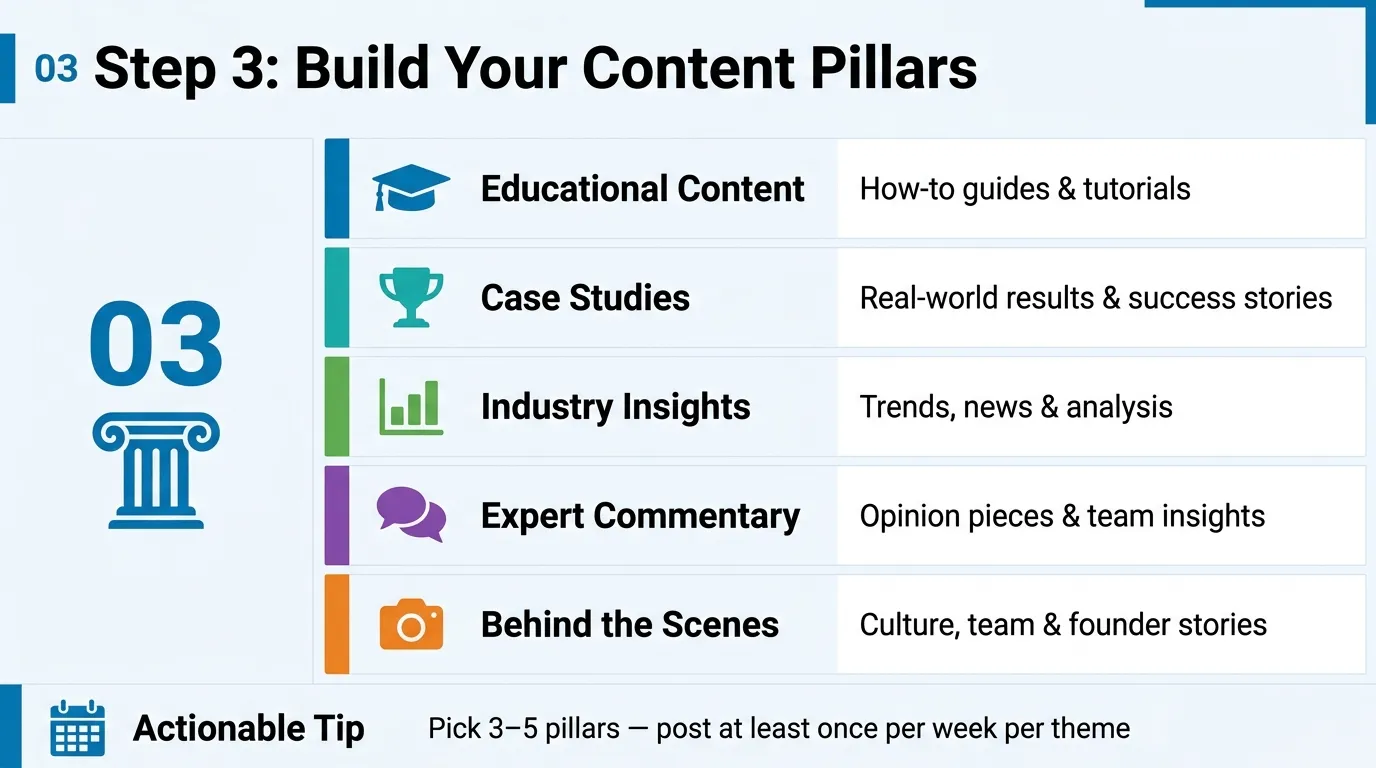
Your content needs to align with both your audience’s interests and your business goals. Content pillars are recurring themes or topics that define your brand’s voice. These might include:
- Educational content (e.g., how-to guides, tutorials)
- Case studies and success stories (e.g., showing real-world results)
- Industry insights (e.g., trends, news, and analysis)
- Expert commentary (e.g., opinion pieces or personal insights from your team)
- Behind-the-scenes content (e.g., company culture, employee features)
Actionable Tip: Select 3 to 5 main topics that align with your audience and business goals. For example, if you’re in beauty, choose themes like “Makeup tutorials” and “Product reviews,” and plan to post at least once per week for each pillar.
- Makeup tutorials
- Skincare routines
- Product reviews
- Beauty trends
- Team or founder expertise
These will keep your content varied but focused.
Step 4: Optimise Your LinkedIn Presence
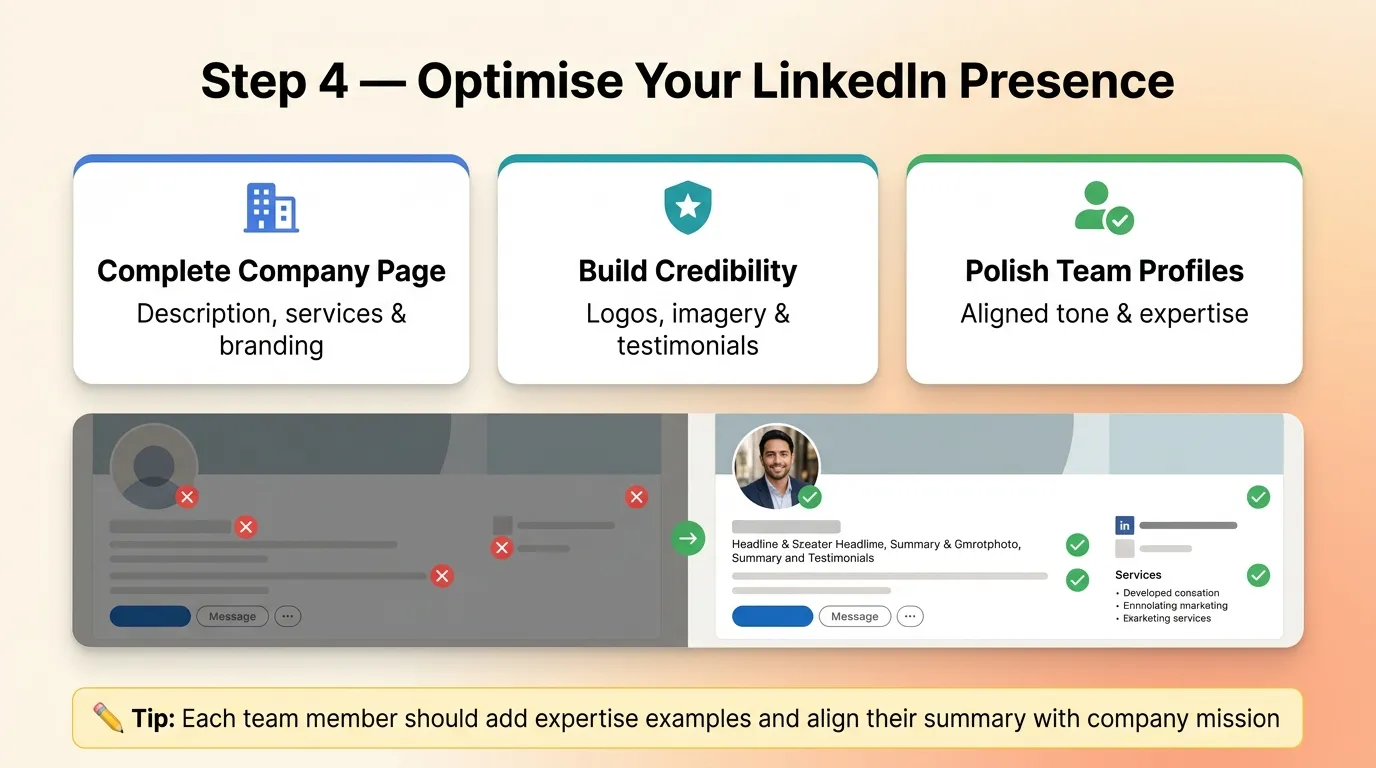
Before posting, ensure both your company page and key personal profiles are optimised and aligned with your brand. Here’s how:
- Complete your company page: Ensure it includes a clear, compelling description, a list of services, and up-to-date branding.
- Credibility matters: Include logos, relevant imagery, and testimonials to boost trust.
- Personal profiles: If your team members will be posting, ensure their profiles are polished and aligned with your brand’s messaging.
Actionable Tip: Ask each team member to update their LinkedIn profile by adding specific examples of their expertise and contributions at the company, and by reviewing their summaries to ensure alignment with the company’s tone and mission.
Step 5: Set a Realistic Posting Cadence

Consistency is key on LinkedIn, but you don’t need to post every day. Instead, aim for 2-3 high-quality posts per week. Focus on creating impactful content that provides value. Quality beats quantity.
- Mix in various content formats, such as articles, short posts, images, and videos.
- Engage with your audience in the comments to build relationships.
Actionable Tip: Set up a content calendar using a tool like Google Calendar or Trello. List each planned post with topic, format, and posting time based on your audience’s peak activity (review LinkedIn analytics for timing). Review the calendar weekly to confirm posts are scheduled and ready.
Step 6: Track Key Metrics (Not Just Vanity Metrics)

Tracking performance is essential for understanding whether your efforts are working. Don’t just focus on likes and follower count. Look at these more meaningful metrics:
- Engagement quality: Are your posts generating meaningful interactions, such as comments, shares, and discussions?
- Website traffic: Are your posts driving traffic to your website or landing pages?
- Lead generation: Are you getting inquiries or conversions from LinkedIn?
Actionable Tip: Use LinkedIn’s analytics and Google Analytics weekly. Check how many visitors LinkedIn sends to your website, and track conversions such as contact form completions or downloads. Adjust your posts based on what drives the most conversions.
Step 7: Adjust and Improve Your Strategy
As with any strategy, regular reviews and adjustments are necessary to improve results. Based on your tracked metrics, adjust your approach. For example:
- Adjust your content: If you find certain topics or content types are getting more engagement, focus on them.
- Try different post formats: test carousel posts, native video content, or LinkedIn articles to see which works better for your audience.
Actionable Tip: Track your LinkedIn impressions, engagement rates, and follower growth each month. Identify which posts received the highest engagement and note any trends in content, posting times, or formats.
Based on these findings, adjust your upcoming content strategy. Try at least one new approach monthly to see which techniques most engage your audience.
Best Types of LinkedIn Content for a Social Media Marketing Strategy

Not all LinkedIn content performs equally well. The strongest content usually teaches, proves, or shows a clear point of view.
A useful LinkedIn content mix includes the following:
- Educational posts: These explain a concept, share a framework, clarify a common mistake, or give practical advice. They are useful for awareness and credibility.
- Thought leadership posts: These share informed opinions on trends, industry shifts, or lessons from experience. They help the brand sound distinctive and knowledgeable.
- Case studies and proof-led posts: These demonstrate how a problem was solved and what results were achieved. They help build trust with mid-funnel audiences.
- Short videos: Short videos are useful for direct commentary, event recaps, and quick insights from founders or experts.
- Carousel or document posts: These work well for step-by-step guidance, comparisons, checklists, and process-led explanations.
- Founder or employee-led content: These posts often feel more natural and human, which can improve reach and engagement.
The goal is not to use every format equally. It is to create a balanced mix. A practical content ratio could look like this:
- 40% educational content
- 20% thought leadership
- 20% proof and case studies
- 10% brand or culture content
- 10% call-to-action or conversion-led content
This keeps the brand informative without becoming repetitive or overly promotional.
Company Page vs Personal Profiles: Which Should You Focus On?
Many businesses assume their LinkedIn company page should be the main engine of their presence because it is the official brand account. While that page is important, it is rarely enough on its own.
People on LinkedIn engage more with individuals than with brands, making company pages best for credibility and personal profiles better for reach, trust, and conversation.
The Role of a Company Page

A company page gives your business a formal presence on LinkedIn. It helps visitors quickly understand who you are, what you do, and whether your brand is active. It also creates a central place to:
- Publish updates
- Showcase services, expertise, and positioning
- Feature achievements and case studies
- Build a content library tied to the business
When someone hears about your company and looks you up, the company page often shapes that first impression. A company page is especially useful for:
- Building formal brand credibility
- Providing a consistent brand message
- Publishing official business updates
- Supporting employer branding and company visibility
Company pages can appear polished but often lack the personal touch. Users are more likely to engage with authentic voices, such as founders or strategists, because personal profiles feel more direct, human, and trustworthy.
The Role of Personal Profiles

Personal profiles are powerful because they create a sense of proximity. A person can share lessons from experience, comment on industry changes, offer a clear point of view, or tell a story in a way that feels more natural than a brand voice. This makes personal profiles especially valuable for thought leadership and trust-building.
Personal profiles are often better for:
- Generating reach and engagement
- Building trust through personal perspective
- Sharing thought leadership
- Starting conversations with prospects and peers
- Humanising the company behind the brand
This is particularly important for service-based businesses and B2B companies. Buyers in these industries are not only evaluating the company but also the people behind it.
They want to know whether the team sounds credible, informed, and commercially aware. A well-managed personal profile can help reduce that trust gap long before a sales conversation happens.
Company Page vs Personal Profiles: A Practical Comparison
Instead of asking which one matters more, it is better to ask what role each one should play within your wider strategy. A simple way to think about it is this:
| Aspect | Company Page | Personal Profiles |
| Best For | Formal brand presence | Reach, trust, and conversation |
| Main Strength | Builds brand credibility and consistency | Humanises the brand, strengthens trust, and fosters engagement |
| Content Type | Official updates, service information, and company achievements | Thought leadership, personal insights, industry commentary |
| Engagement Potential | Less likely to spark strong organic engagement without personal profiles | More likely to generate conversation, engagement, and interactions |
| Role in Strategy | Acts as the brand hub for formal messaging | Acts as a trust and distribution channel for more authentic engagement |
| Audience Connection | Provides structure and consistency, but can feel distant | More relatable and human, builds familiarity with prospects |
| Effectiveness for Lead Generation | Limited, unless combined with personal profiles | Highly effective, especially when backed by personal visibility and authenticity |
Understanding the differences between Company Pages and Personal Profiles on LinkedIn is essential for creating a balanced strategy.
The company page builds brand credibility and provides structure, while personal profiles humanise the brand and help build trust with the audience.
How the Two Should Work Together
For example, a company page might publish:
- A client case study
- A campaign result
- A service announcement
- A webinar or event invite
- A new blog article
Then, a founder, director, or team member can expand on that with personal posts such as:
- The lesson behind the case study
- What most brands get wrong about the topic
- A personal observation from working with clients
- A short takeaway from the webinar
- An opinion on the industry issue discussed in the blog
This creates depth rather than repetition. The company page provides the official version, while personal profiles make the message more relatable and more likely to spark engagement.
Company Page vs Personal Profiles: Key Differences

Here’s a quick comparison of when to use each:
- Company page
- Best for formal brand presence
- Strengthens credibility and consistency
- Useful for official updates and service messaging
- Less likely to spark strong organic engagement on its own
- Personal profiles
- Best for reach, trust, and conversation
- Stronger for thought leadership
- More effective for building familiarity with prospects
- Depends on active participation from real people in the business
The Balanced Approach: Coordinating Both Channels
The strongest LinkedIn strategies usually combine both company pages and personal profiles, but with different expectations. The company page should serve as the foundation, while personal profiles serve as amplifiers.
A practical structure could look like this:
- The company page publishes core brand content each week.
- Founders or team leads repost selectively, adding insight.
- Subject-matter experts publish original posts tied to their expertise.
- All content supports a few clear themes or content pillars.
- Brand and personal visibility reinforce each other over time.
This balance matters because relying only on the company page often limits reach, while relying only on personal profiles can weaken brand consistency.
If a company page is inactive, the brand may look less established. If personal profiles are inactive, the brand may feel distant or overly corporate.
Common Mistakes Brands Make on LinkedIn

LinkedIn can be a strong platform for building trust, visibility, and authority, but many brands underperform because they use it without a clear strategy.
Instead of creating content that informs or builds credibility, they often fall into habits that make their presence feel generic, overly promotional, or inconsistent.
- Posting without a clear goal: Many brands publish content just to stay active, without deciding what each post is meant to achieve. When there is no clear purpose, content tends to feel random and disconnected from business outcomes. Every post should support a goal such as awareness, engagement, authority, traffic, or lead generation.
- Being too promotional: Some brands use LinkedIn like a sales board, filling their feed with service pushes, announcements, and self-congratulatory updates. This usually turns audiences off because people are more likely to engage with useful insights than with constant selling. A stronger mix includes educational posts and proof-led content alongside promotional content.
- Relying only on the company page: A company page is important for brand credibility, but it is rarely enough on its own. Personal profiles often generate better reach, stronger engagement, and more authentic conversations because people connect more naturally with people than with logos. Brands that ignore founder, leadership, or team visibility often miss a major part of LinkedIn’s value.
- Posting inconsistently: Some businesses post heavily for a short period and then disappear for weeks. This weakens momentum and makes LinkedIn feel like an afterthought rather than an active part of the marketing mix. A steady, consistent posting rhythm is usually far more effective than bursts of unsustainable activity.
- Using vague and generic messaging: LinkedIn is full of posts that sound polished but say very little. When content relies on empty phrases and broad claims, it becomes forgettable and hard to distinguish from competitor content. Stronger posts are specific, relevant, and grounded in real expertise or experience.
Avoiding these mistakes can make LinkedIn far more effective within a broader social media marketing strategy.
When brands combine clear goals and a more human approach, LinkedIn becomes a much stronger channel for authority, trust, and long-term business growth.
Leverage LinkedIn for a Winning Social Media Marketing Strategy
LinkedIn, when used strategically, is a powerhouse for establishing brand authority, fostering professional connections, and nurturing long-term business relationships.
The platform enables businesses to build trust, engage with relevant audiences, and generate high-quality leads over time. The key to LinkedIn success lies in consistency and strategic content planning.
To truly harness LinkedIn’s power, it’s important to recognise the unique strengths of company pages and personal profiles. The company page gives your business a formal, credible presence, while personal profiles enable a more human, authentic connection with your audience.
If you’re ready to elevate your LinkedIn strategy and ensure it works effectively alongside other channels in your marketing mix, MediaOne’s social media marketing services are here to guide you through every step of the process.
Let’s help you transform LinkedIn into a powerful asset that drives business results, enhances visibility, and builds lasting relationships with your target audience. Contact us today!
Frequently Asked Questions
How long does it take to see results from LinkedIn marketing?
LinkedIn is usually a long-term channel rather than one that delivers instant results. Businesses often see early signs in improved engagement, profile views, and content reach, while stronger outcomes, such as leads and brand authority, typically build over time with consistent effort.
Is paid advertising necessary to succeed on LinkedIn?
No, paid advertising is not always necessary. Organic content can still help build visibility, trust, and thought leadership, especially when a business has strong expertise and active personal profiles. Paid campaigns can be useful when the goal is a faster reach.
What is the best time to post on LinkedIn for business audiences?
The best time depends on your target audience, industry, and location. In general, weekday business hours tend to perform better because users are already in a professional mindset. The best approach is to test different posting times and monitor when your audience engages most.
Should businesses use LinkedIn to promote blogs and website content?
Yes, LinkedIn can be a strong channel for amplifying blog articles, case studies, webinars, and other website content. Instead of simply dropping a link, it is usually more effective to lead with a useful insight or takeaway that gives people a reason to click through.
How can a small business stand out on LinkedIn against larger competitors?
Small businesses can stand out by being more specific, more human, and more consistent in their communication. Large brands may have larger budgets, but smaller businesses often have an advantage in personal expertise, direct founder visibility, and more authentic content.