I still remember the look on the founder’s face when he told me he’d already hired an SEO consultant, yet had no real idea what he was paying for.

Every month, he received a tidy report, a few ranking updates, and the usual talk about “ongoing optimisation”. But leads were flat, organic traffic was unpredictable, and no one could explain what was actually driving the business forward.
That conversation has stayed with me because it happens more often than most people realise, especially in Singapore.
A business owner knows search matters. They know their competitors are showing up on Google. They know they probably need help.
But when it comes to choosing the right person, the whole process feels murky. Everyone sounds credible. Everyone promises growth. Very few explain SEO in a way that feels honest, commercial, and grounded in reality.
That is the real challenge.
It’s not whether SEO works. It’s about hiring someone who understands your market, your margins, your audience, and the difference between activity and actual progress.
If you’re looking for an SEO consultant in Singapore, this guide will help you make the decision more clearly. And for businesses that want a more strategic, practical hand through the process, my team at MediaOne often helps companies here cut through the noise and make better SEO decisions from the start.
Key Takeaways
- Hiring the right SEO consultant is less about rankings alone and more about finding someone who can improve lead quality, visibility, and commercial performance.
- In Singapore, the best SEO consultant is usually the one who understands your market, explains strategy clearly, and links SEO work to business outcomes.
- Businesses should look closely at experience, reporting quality, technical understanding, and whether the consultant asks smart questions before making recommendations.
- Cheap SEO can become expensive if the work is vague, templated, or built on risky tactics that damage long-term performance.
- The strongest hiring decisions come from comparing fit, transparency, and judgment rather than choosing the loudest pitch or the lowest price.
- Singapore SMEs may be eligible for up to 50% subsidy on qualifying SEO services through the Productivity Solutions Grant (PSG).
Step 1: Understand The Role of an SEO Consultant in Singapore
The difference between a good SEO consultant and a poor one rarely shows up in the pitch. It shows up six months later.
One leaves you with better visibility, stronger commercial pages, cleaner technical foundations, clearer reporting, and a sharper understanding of what your audience is actually searching for.
The other leaves you with vague deliverables, a few token ranking wins, and a lot of explanations that sound clever but go nowhere.
That difference matters more in Singapore than many people realise.
This is a compact, competitive, digitally mature market. With 95.8% internet penetration and Google holding 92.8% of the search market share, the stakes for getting SEO right are unusually high. Buyers compare quickly. Search intent is often high-value.
In sectors like healthcare, legal, property, education, renovation, finance, and B2B services, the gap between ranking well and ranking poorly is not just traffic. It can be pipeline, enquiries, and revenue.
Local pricing also varies widely. Singapore SEO engagements can range from a few hundred dollars a month for basic freelance support to S$3,000 or more for broader retainers, depending on scope, competition, website complexity, and provider experience.
That is why this hiring decision should not be treated like a commodity purchase.
You are not just choosing someone to “do SEO”. You are choosing whose judgment to embed in your website.
What Does an SEO Consultant Actually Do?
This sounds like a basic question, but it is where many hiring mistakes begin.
Many business owners still view SEO as keywords, blog posts, and backlinks. That is understandable. Those are the visible bits.
Yet a proper SEO consultant works much more broadly than that. The job is to improve how your website is discovered, understood, trusted, and chosen in search. That requires a blend of analysis, technical judgment, content direction, and commercial understanding.
Good SEO Consultant vs Poor SEO Consultant
| Criteria | Good SEO Consultant | Poor SEO Consultant |
| First Meeting | Asks detailed questions about your business model, customers, competitors, and goals before making any recommendations | Jumps straight to packages and pricing with little interest in how your business actually works |
| Strategy Approach | Builds a custom strategy based on your industry, site condition, competitive landscape, and commercial priorities | Applies a one-size-fits-all template regardless of your sector, site size, or goals |
| Guarantees | Sets realistic expectations with honest timelines; explains what influences results and what they cannot control | Guarantees page-one rankings or specific traffic numbers upfront with no caveats |
| Methods and Tactics | Explains every recommendation clearly; works within Google’s quality guidelines; avoids shortcuts | Vague about what they actually do; may reference PBNs, link farms, or other tactics that carry long-term risk |
| Technical SEO | Audits crawlability, indexation, Core Web Vitals, site architecture, and redirects as part of a structured process | Focuses only on surface-level fixes or skips technical review entirely |
| Content Strategy | Knows when to improve existing pages, when to create new ones, and when more content is the wrong move | Defaults to publishing more blog posts regardless of whether existing content is underperforming |
| Keyword and Intent Research | Maps keywords to buying intent and commercial value; prioritises queries that drive leads, not just traffic | Targets high-volume keywords without assessing whether they attract buyers or just browsers |
| Local and Singapore SEO | Understands multilingual search behaviour, hyperlocal targeting by district, Google Business Profile, and mobile-first indexing | Treats Singapore as a single market; overlooks Mandarin, Malay, and Tamil search behaviour |
| AI Search (GEO & AEO) | Has a clear approach to appearing in Google AI Overviews, structures content for featured snippets, and builds topical authority clusters | Unfamiliar with GEO and AEO; still optimising purely for traditional keyword rankings |
| Reporting | Delivers monthly reports that tell a commercial story — what changed, why it changed, and what it means for leads and revenue | Sends ranking screenshots and traffic graphs with little interpretation or commercial context |
| KPIs They Track | Tracks organic sessions, conversion rate, lead quality, cost per acquisition, and AI Overview appearances | Reports on total impressions, page views, and keyword positions without connecting them to business outcomes |
| Communication | Explains strategy in plain language; is reachable, consistent, and proactive about sharing updates or concerns | Uses jargon to avoid difficult questions; goes quiet when progress stalls |
| Questions They Ask You | Wants to understand your margins, sales cycle, best customers, lead sources, and internal constraints | Asks for your website URL, runs a surface-level check, and sends a proposal |
| Timeline Honesty | Explains that meaningful results typically take 4 to 12 months and describes the factors that affect timing | Promises visible results within weeks to win the deal |
| Data Access | Insists you own all accounts and credentials; sets up access under your Google Search Console and GA4 | Controls the primary account login or withholds access to your own analytics |
| Contract Terms | Offers a clear scope of work, a 30-day exit clause, and full ownership of all content and assets created | Uses long lock-in periods, vague deliverables, and retains ownership of content or backlinks built |
| Accountability | Takes responsibility for strategy; explains underperformance honestly and adjusts the approach | Blames Google algorithm changes or external factors whenever results disappoint |
| Pricing Transparency | Explains what the fee covers, how the scope is defined, and what would change the cost | Bundles services into opaque packages with no breakdown of what is actually included |
| PSG / Grant Awareness | Aware of Singapore’s Productivity Solutions Grant and can advise on eligibility where relevant | Unaware of or indifferent to available subsidies that could reduce cost for Singapore SMEs |
| Post-Engagement Handover | Provides a clear transition document covering completed work, ongoing tasks, and next priorities if the engagement ends | Leaves without documentation; access, content, and strategy notes stay with them |
Google lists common SEO services as reviewing site content and structure, advising on website development, conducting keyword research, developing content, providing SEO training, and providing expertise in specific markets or geographies. Ahrefs also describes the role as covering keyword research, on-page SEO, technical SEO, link building, reporting, and local SEO.
In real life, the role is more practical. A good SEO consultant should be able to tell you what your audience is searching for, why your current pages are underperforming, which technical issues matter first, and what changes are most likely to improve business outcomes.
When SEO is done well, it compounds quietly. In business terms, that often means:
- More qualified organic traffic
- Stronger visibility for non-branded keywords
- Better-performing landing pages
- Improved lead quality
- Less reliance on paid media over time
- Clearer insight into how prospects search before they enquire
That is the strategic upside. It is not instant, but it is durable.
Core Services an SEO Consultant Should Offer
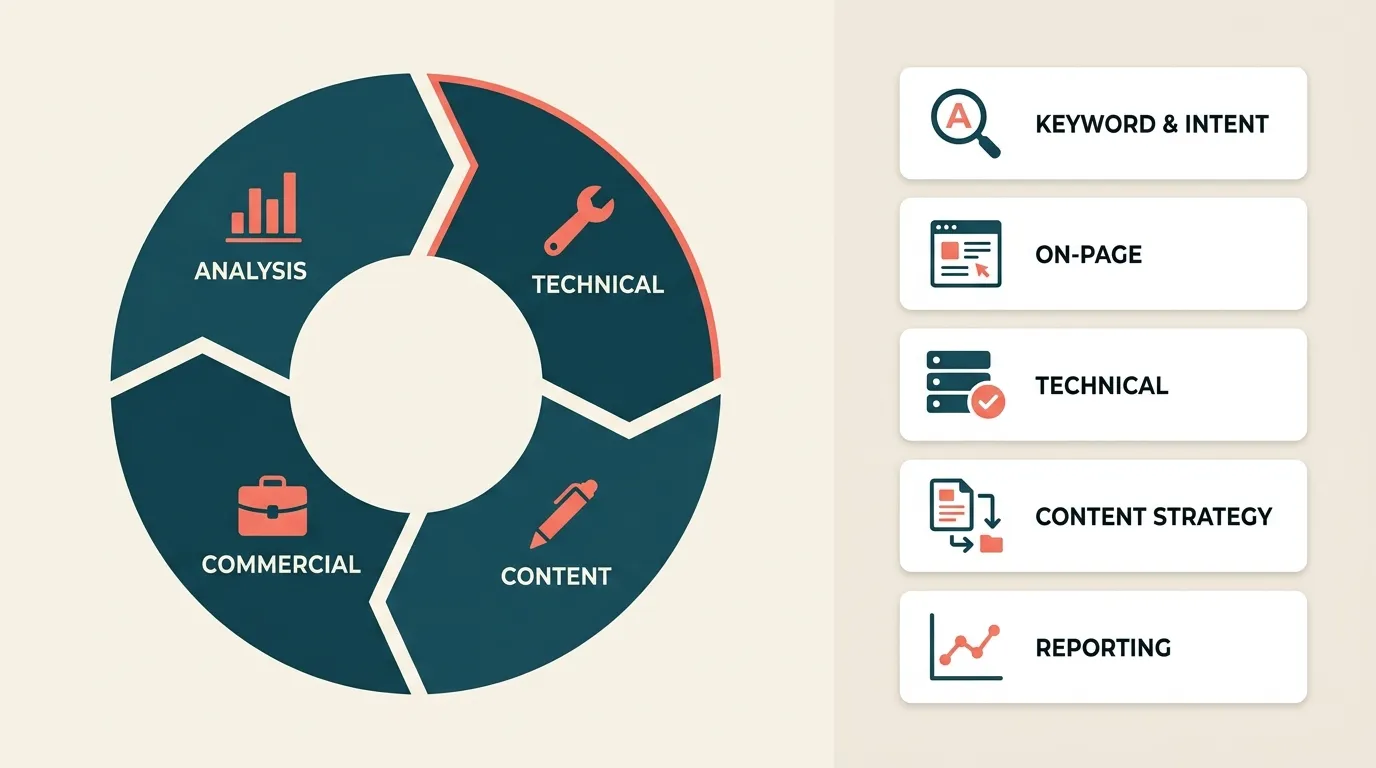
At a minimum, a credible SEO consultant should be competent across five core areas:
- Keyword and intent research: Not just collecting search terms, but understanding how different queries map to different stages of awareness and buying intent.
- On-page SEO: This includes page targeting, title tags, meta descriptions, headings, internal links, page structure, and improving how clearly a page answers the searcher’s question.
- Technical SEO: This covers indexability, crawlability, redirects, site architecture, canonical issues, duplicate pages, Core Web Vitals, structured data, and the kinds of invisible technical problems that stop good pages from performing.
- Content strategy: A proper consultant should know when to improve existing pages, when to create new ones, and when publishing more content is simply the wrong move.
- Reporting and prioritisation: A dashboard is not enough. You want someone who can interpret what is happening, explain why it matters, and tell you what should happen next.
That is the difference between an operator and an advisor.
Technical SEO, On-Page SEO, Content, and Local SEO
If you want a simple way to understand SEO, think of it as four interconnected systems:
- Technical SEO ensures search engines can crawl, index, and understand your site properly.
- On-page SEO helps each page send clearer relevance signals.
- Content SEO ensures your pages align with user intent and are worth ranking.
- Local SEO helps you win visibility where geography influences choice — which is especially relevant for service businesses in Singapore.
The point is not to split these into neat silos but to understand that weakness in one area limits the others. A website can have strong content and still underperform if technical issues stop pages from being indexed correctly. A site can be technically clean and still struggle because the content is thin, misaligned, or written for internal stakeholders instead of real searchers.
Singapore’s Local SEO Landscape Specifically
Singapore’s digital landscape shapes how SEO is done here. Any consultant working in this market should understand them.
Singapore had 10.5 million mobile connections as of early 2025, up 6.3% year on year. Smartphone penetration sits at 97%, one of the highest in Asia. That means mobile-first indexing is not a technical checkbox. It is the baseline expectation for every page.
Beyond mobile, there are four dimensions of Singapore SEO that separate strong consultants from generic ones:
- Multilingual search behaviour: Singapore has four official languages: English, Mandarin, Malay, and Tamil. In categories like healthcare, legal advice, renovation, and financial services, a significant share of search queries are in languages other than English. A consultant who does not address this is leaving visibility on the table.
- Hyperlocal targeting: Effective SEO in Singapore often means optimising by district rather than just city-wide. Orchard, Jurong East, Tampines, Bugis, and Toa Payoh are not interchangeable. Buyers searching for a service often include a district or MRT station in their query. A consultant who treats Singapore as one homogeneous location will underperform.
- Google Business Profile: For any business with a physical presence, GBP is not optional. Map pack visibility in Singapore is competitive, particularly in food, healthcare, legal, and home services. A capable consultant will know how to optimise the profile, manage reviews, and integrate GBP signals with the broader SEO strategy.
- Voice search opportunity: Only 13% of marketers currently include voice search in their SEO strategy, despite its growing prevalence on mobile. That gap represents a real competitive advantage for businesses whose consultants understand how to structure content for conversational queries.
A consultant does not need to be Singaporean to understand the market. But they do need to understand the reality of competing here.
Step 2: Understand The Differences Between The Roles of SEO Consultant, SEO Agency, and In-House
Singapore businesses are often choosing between a freelance SEO consultant, a boutique digital agency, a larger performance agency, or even an overseas provider. On paper, all of them may claim to offer the same thing. But in practice, the depth of thinking varies enormously.
Here is a direct comparison to help frame the decision:
| Criteria | Freelance Consultant | Agency | In-House SEO |
| Monthly Cost (SGD) | S$200–S$3,000 | S$700–S$10,000+ | S$4,000–S$8,000 salary |
| Scalability | Limited | High | Medium |
| Specialisation | Deep niche expertise | Broad team coverage | Company-specific |
| Accountability | Single point of contact | Account manager | Direct line manager |
| Best For | SMEs, niche projects | Fast-growth, multi-channel | Enterprise with ongoing needs |
A freelance SEO consultant may be the better fit if you need senior thinking, learner engagement, and direct access to the person doing the work. An SEO agency in Singapore may be a better fit if you need a more comprehensive team for technical implementation, content production, design, outreach, analytics, and project management.
In-house tends to make sense when SEO is a core, ongoing strategic function and the company has enough volume of work to justify the salary and benefits overhead.
What matters is not the label. What matters is whether the person or team can solve the problem in front of you.
Signs Your Business Needs an SEO Consultant

Businesses often start looking for an SEO consultant when growth stalls, traffic drops, technical issues become difficult to diagnose, or important keywords underperform. They start looking when something feels off.
Traffic dips. Lead volume softens. Competitors become more visible. A new site launches and underperforms. Pages that should rank never really move.
The in-house team publishes content, but nothing seems to gain traction. Someone in management asks why the company is spending so much on paid ads when search demand already exists.
Here are the signals to pay attention to most:
- Your organic traffic has declined, and nobody can explain why.
- Your website has been redesigned, but rankings have slipped.
- You rank for terms that bring curiosity, not conversions.
- Your competitors consistently outrank you in key categories.
- Your site has content, but very few pages generate meaningful visits or leads.
- You rely heavily on paid search and need a stronger organic acquisition channel.
- Your team knows SEO matters, but no one owns the end-to-end strategy.
When these patterns appear, the issue is not always a lack of activity. In many cases, the bigger problem is poor prioritisation.
When an In-house Team Still Needs an SEO Consultant
Hiring an SEO consultant does not mean your internal team has failed. In many cases, the opposite is true.
A capable content team may need help with technical SEO. A good performance marketer may understand paid search deeply, but needs a stronger organic strategy. A marketing manager may need an experienced sounding board before they make structural changes to the site.
An internal team can be excellent and still benefit from an outside perspective that challenges assumptions and surfaces missed priorities. They kept publishing the wrong content. They expanded the wrong pages. They solved the easy problems instead of the ones that mattered most.
A consultant may help shorten that cycle by providing specialised technical, strategic, or market-specific expertise.
When Should a Singapore SME Choose a Consultant Over an Agency?
For a smaller business, including an SME in Singapore, a consultant may be a good fit when the company needs senior strategic guidance or an audit before investing in a larger delivery setup.
That often happens when:
- The website is relatively small
- Budgets are tighter
- The company wants senior input, not a large delivery team
- The business needs an audit and roadmap first
- The internal team can implement some of the work once priorities are clear
In that situation, a consultant may be a sensible first step. Sometimes the most valuable thing an expert can do is not to “do everything”. It is to help you stop doing the wrong things.
Step 3: Understand The Price of an SEO Consultant in Singapore
This is usually the first question businesses ask, even when it should not be the only one. Still, it is a fair question. SEO pricing in Singapore varies because the work itself varies. A small brochure-style site in a low-competition niche is a different challenge from a large service site with technical debt, content gaps, and aggressive competitors.
Local pricing also varies widely. Singapore SEO engagements can range from a few hundred dollars a month for basic freelance support to S$3,000 or more for broader retainers, depending on scope, competition, website complexity, and provider experience.
That is why this hiring decision should not be treated like a commodity purchase. You are not just choosing someone to “do SEO”. You are choosing whose judgment to embed in your website.
How Much Does an SEO Consultant Cost in Singapore?
SEO pricing in Singapore varies because the work itself varies. The sections below break down what you should realistically expect to pay depending on the type of provider and the scope of engagement.
Singapore SEO Consultant Pricing Table
| Provider Type | Monthly Cost (SGD) | Best For |
| Freelance / Solo Consultant | S$200 – S$400 | Tight budgets, short-term tasks |
| Basic Agency Package | S$400 – S$700 | SMEs starting out |
| Advanced Agency Package | S$700 – S$3,000+ | Competitive industries, growth-stage |
| Hourly Consultant Rate | S$70 – S$270/hr | Project-based audits, one-off reviews |
| Enterprise / Custom | S$3,000 – S$10,000+ | Large sites, multi-location campaigns |
What Affects SEO Consultant Pricing in Singapore?
Several factors drive pricing differences that are not always visible at the proposal stage:
- Industry competition: Ranking in legal, property, or finance is significantly harder than ranking in a niche B2B service category.
- Volume of target keywords: A broader keyword footprint requires more content, more technical groundwork, and more ongoing management.
- Amount of content production required: If the consultant is writing as well as strategising, the scope (and cost) increases accordingly.
- Current technical condition of the site: The website is technically damaged and requires more front-loaded remediation work.
- Domain age and authority: A newer domain faces steeper challenges in the early stages.
- Local versus international targeting: Regional campaigns involve additional keyword research, content localisation, and link acquisition.
- Urgency of timeline: Compressed timelines require more concentrated resource investment.
That is why price comparisons without context are rarely useful.
Freelance SEO Consultant vs Agency Pricing in Singapore
Freelancers may be more cost-efficient if you want senior expertise and a lean setup. Agencies may justify higher fees if you need broader delivery support.
Neither is automatically better.
Experienced senior consultants have outperformed large teams simply because they understood the commercial problem more clearly. Agencies have also outperformed consultants when execution required several disciplines working together.
Fit matters more than format. If the package looks identical for a dentist, a B2B software company, and a renovation firm, it probably is not a strategy. It is a template.
Can You Get an SEO Subsidy in Singapore? The PSG Grant Explained
This is a question many Singapore SMEs do not think to ask, but it can make a significant difference to the economics of hiring.
The Productivity Solutions Grant (PSG), administered by Enterprise Singapore, provides qualifying businesses with up to 50% subsidy on pre-approved digital marketing and SEO-related solutions.
To be eligible, your business must be:
- Registered and operating in Singapore
- In possession of at least 30% local shareholding
- Using the solution for Singapore-based business activities
The grant covers pre-approved vendors and solution categories. MediaOne is a PSG-approved vendor, which means qualifying clients can access our SEO services at a significantly reduced net cost.
If you are an SME evaluating SEO investment and have not explored PSG eligibility, it is worth a conversation before you sign any engagement. The subsidy can materially change the cost-benefit calculation, particularly for earlier-stage businesses where budget is a genuine constraint.
Step 4: Ask Questions To Your SEO Consultant
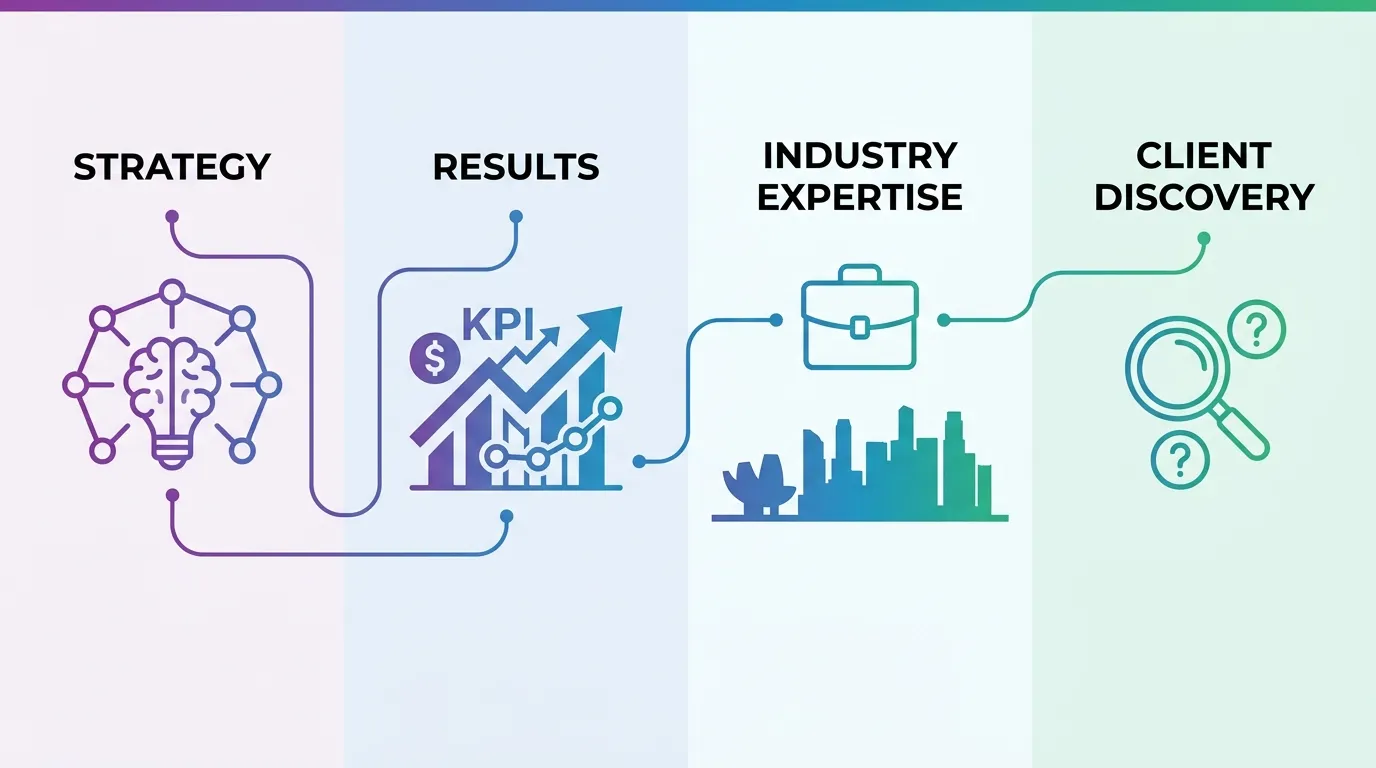
When I advise businesses on this, I tell them to stop trying to be impressed and start trying to reduce risk. You are not interviewing for charisma. You are looking for signs of strategic depth, honesty, and commercial understanding.
Google Search Central lists these as useful questions to ask an SEO, including examples of previous work, expected results and timeframe, industry/country-city/international experience, important SEO techniques, and how communication and recommendations will work.
It also notes that a good SEO should ask you questions about your business, audience, competitors, and revenue model.
Questions to Ask an SEO Consultant About Strategy
Start with the questions that reveal how they think:
- How would you approach SEO for a business like mine?
- What do you think is holding this site back right now?
- What would you prioritise in the first 90 days?
- How do you balance technical fixes, content improvements, and authority building?
- What does success depend on in our category?
- What does your first 30-day onboarding plan look like?
Listen carefully to how they answer. You are not looking for theatrical certainty. You are looking for a logical thought process.
Questions to Ask an SEO Consultant About Results and Reporting
This is where vague providers tend to wobble. Ask:
- What results should we realistically expect after three, six, and twelve months?
- Which KPIs do you track?
- How do you report progress?
- How do you connect SEO work to leads, enquiries, or revenue?
- What access or data will you need from us?
- Can I see a live reporting dashboard from a current client?
- What metrics beyond keyword rankings will you track?
SEO consultants advise looking beyond vanity metrics like organic traffic, page views, impressions, or clicks, and working with someone who can tie SEO results to revenue metrics, such as leads generated. That is a useful litmus test.
Questions to Ask an SEO Consultant About Your Industry and Singapore SEO
Then get more specific:
- Have you worked with similar businesses or similar sales cycles?
- What do you know about the Singapore market in our sector?
- Which competitors would you study first?
- How would you approach local SEO if we serve specific locations?
- Do you see content, technical issues, or site structure as the bigger opportunity here?
- How do you handle multilingual SEO for Singapore’s English-, Mandarin-, Malay-, and Tamil-speaking audiences?
- How do you approach Google Business Profile and hyperlocal SEO in Singapore?
The answers do not need to be perfect on the spot. But the follow-up questions should be sharp.
Questions a Good SEO Consultant Should Ask You
This part matters just as much. A serious consultant should want to understand:
- What makes your business different
- Who your best customers are
- How you make money
- Which services are most profitable
- What your current lead sources look like
- Who your real competitors are
- What constraints exist internally
If someone barely asks about the business and jumps straight to packages, that tells you all you need to know. Serious SEO begins with diagnosis, not pitching.
What to Ask About AI Search: GEO & AEO Skills

This is the section most businesses forget to ask about, and it may be the most important one to get right in 2025 and 2026.
The AI search landscape has shifted faster than most companies have had time to process. As of early 2026, AI Overviews appear on approximately 30–60% of all Google queries, depending on the data source and region. Click-through rates drop by 34.5% to 61% when an AI Overview appears, depending on query type and study methodology.

But here is the important counterpoint. AI search visitors convert at significantly higher rates than standard organic traffic; studies show a range of 4x to 23x, depending on industry, with the best available cross-industry average around 5x higher. That means visibility in AI-generated answers is not just a branding exercise. It is increasingly a high-intent acquisition channel.
Any SEO consultant you hire today should have a clear answer to how they approach this:
- GEO (Generative Engine Optimisation) refers to the practice of creating content that gets cited by AI systems when they generate their answers. This requires original data, expert authorship, clear, structured information, and topical authority rather than just individual keyword rankings.
- AEO (Answer Engine Optimisation) refers to structuring content so that it provides direct, clear answers that can be extracted and surfaced in featured snippets, voice responses, and AI summaries. This typically means placing a concise answer within the first 100 to 150 words of a page, using clean heading hierarchies, and building content that anticipates follow-up questions.
- Topical authority clusters are another essential piece. A consultant who understands modern SEO builds pillar pages supported by tightly related cluster content, creating a structure that signals depth and comprehensiveness to both Google and AI systems.
Original data and research increasingly influence whether content gets cited in AI answers. A consultant who helps you commission a small survey, publish proprietary findings, or produce a unique dataset is creating assets that AI systems are more likely to reference.
The questions to ask a prospective consultant are simple and revealing:
- Do you have experience with GEO and AEO for Google AI Overviews?
- Can you show me a page you have structured specifically to appear in AI Overviews or featured snippets?
- How do you think topical authority affects AI citation eligibility?
If the answer is blank or vague, that is a meaningful signal about how current their thinking actually is.
Step 5: Analyse The SEO Consultant’s Expertise
Once you have asked the right questions, the next step is to evaluate how they respond—and watch for the patterns that separate credible consultants from those who are likely to disappoint.

SEO Consultant Red Flags to Avoid
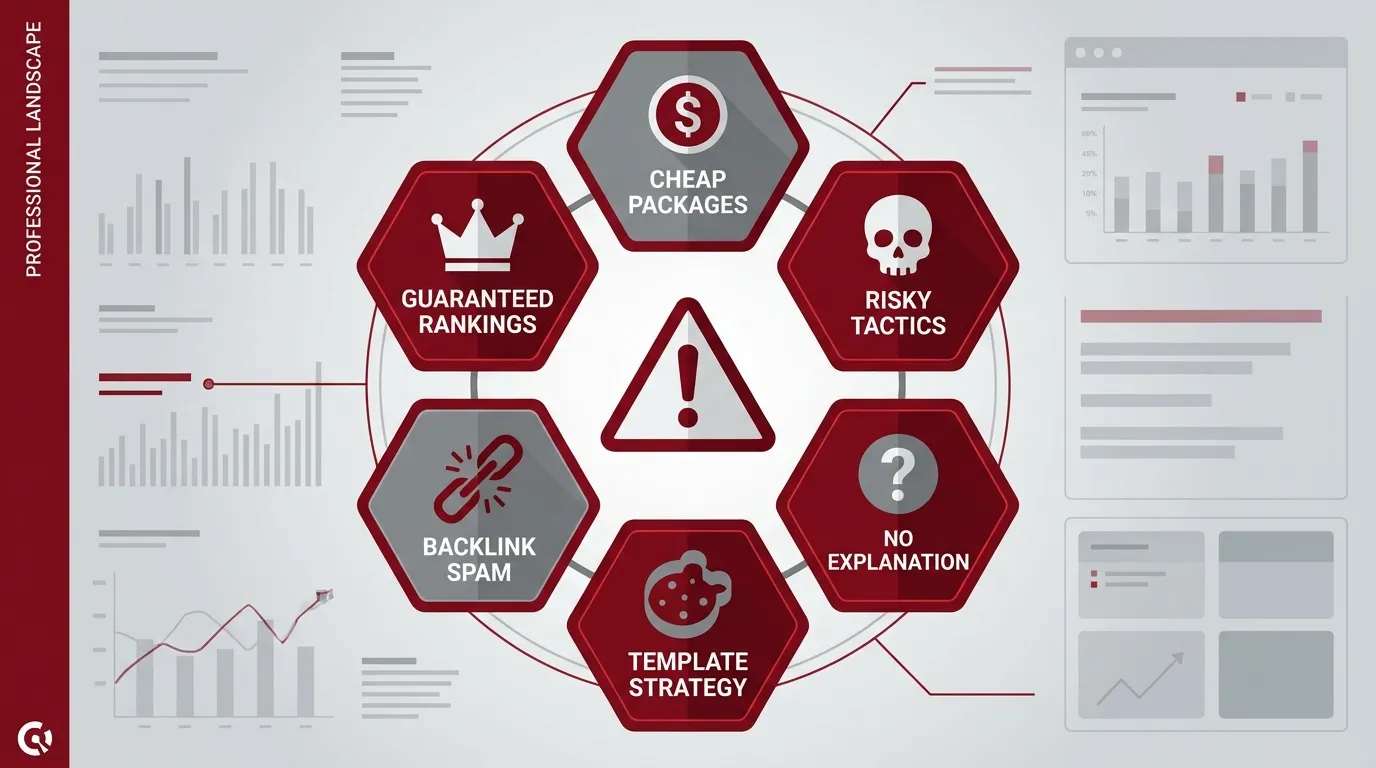
Red flags in SEO are dangerous because they often arrive dressed as confidence. The consultant sounds certain. The process sounds streamlined. The deliverables sound impressive.
There is a monthly package, maybe a proprietary framework, maybe a lot of talk about page-one rankings. And then six months later, nothing that matters has moved.
Google explicitly warns businesses to be wary of unsolicited spam outreach, ranking guarantees, claims of special relationships with Google, secrecy around methods, and practices such as shadow domains or doorway pages.
Red Flag 1: Guaranteed Rankings
Nobody credible can guarantee a number one ranking on Google. A consultant can influence relevance, quality, crawlability, internal linking, content depth, and technical health. They cannot control Google, your competitors, or the timing of algorithmic shifts.
SEO can improve a site’s technical setup and content, but Google says no one can guarantee a number one ranking. Guaranteed rankings usually hide one of three problems: the keyword target is commercially meaningless, the consultant is overpromising to win the deal, or the strategy relies on manipulative tactics that may not age well.
Red Flag 2: Refusal to Explain Methods
If a consultant cannot or will not explain what they are doing and why, that is not confidence. It is a warning. You should understand what is being changed on your website at every stage of the engagement. Transparency is not optional.
Red Flag 3: No Contract Exit Clause
Any consultant who insists on a long lock-in period with no clear termination terms should give you pause. A reasonable engagement allows a 30-day notice period. If the work is good, clients do not leave. If the work is poor, you should be able to exit cleanly without penalty.
Red Flag 4: Withholding GA4 or Search Console Access
Your analytics data belongs to you. A consultant who is unwilling to share access to Google Analytics 4, Google Search Console, or any platform built around your website is prioritising their own leverage over your interests. This should be a firm boundary.
Red Flag 5: Focus on Vanity Metrics
Reporting on page views, social followers, total impressions, or raw keyword rankings without connecting them to leads and revenue is not a strategy. It is performative. If the monthly report does not tell a commercial story, ask why.
Red Flag 6: Cookie-Cutter Packages
If a consultant asks no discovery questions and offers the same package structure to every client, regardless of sector, site size, or competitive landscape, you are not buying a strategy. You are buying a template. A renovation company, a B2B SaaS business, and a specialist healthcare provider need completely different SEO approaches.
Red Flag 7: Mention of PBNs or Link Farms
Private blog networks and link farms are tactics that Google has specifically targeted for years. Any consultant who mentions them approvingly or cannot clearly explain where the links they build are coming from is taking a risk with your domain. The short-term gain is rarely worth the long-term exposure.
Red Flag 8: Blurring SEO and Paid Search
Some consultants count paid traffic improvements as SEO wins or attribute ranking changes to their work when paid campaigns are running simultaneously. These are different channels. A credible consultant keeps the attribution clean and does not take credit for work they did not do.
Check Whether the SEO Consultant Follows Google Search Essentials
You do not need someone to quote Google policy documents at every meeting. You do need someone whose methods align with Google’s quality standards.
Google warns businesses to be cautious of SEO firms that are secretive, guarantee rankings, claim a special relationship with Google, or use deceptive practices like doorway pages, shadow domains, or manipulative tactics that are not clearly explained.
That guidance is not theoretical. It reflects the exact behaviours that often create long-term problems. If a consultant’s strategy depends on volume, shortcuts, or ambiguity, you should ask harder questions.
Make Sure the SEO Consultant Explains the Strategy Clearly
One of the simplest tests is this: Can the person explain the strategy in language a founder or marketing manager can understand without feeling patronised?

You should be able to ask:
- Why are these keywords a priority?
- Why does this page matter?
- Why are we changing the structure?
- Why are we creating this content?
- Why will this likely take six months, not six weeks?
If the explanation is fuzzy, overly jargon-heavy, or evasive, something is off. Clarity is not a luxury in SEO. It is a sign of competence.
Why Communication and Reporting Matter When Hiring an SEO Consultant
The longer you work in this field, the more it becomes clear that reporting is where trust lives or dies. Bad reporting hides behind dashboards, ranking screenshots, and lists of actions with no interpretation.
Good reporting tells a story. It shows what changed, why it changed, what it means commercially, and what needs attention next. It makes progress understandable. It also makes problems visible early, which is just as important.
You are not hiring someone to send you more files. You are hiring someone to reduce uncertainty.
Step 6: Choose The Right SEO Consultant
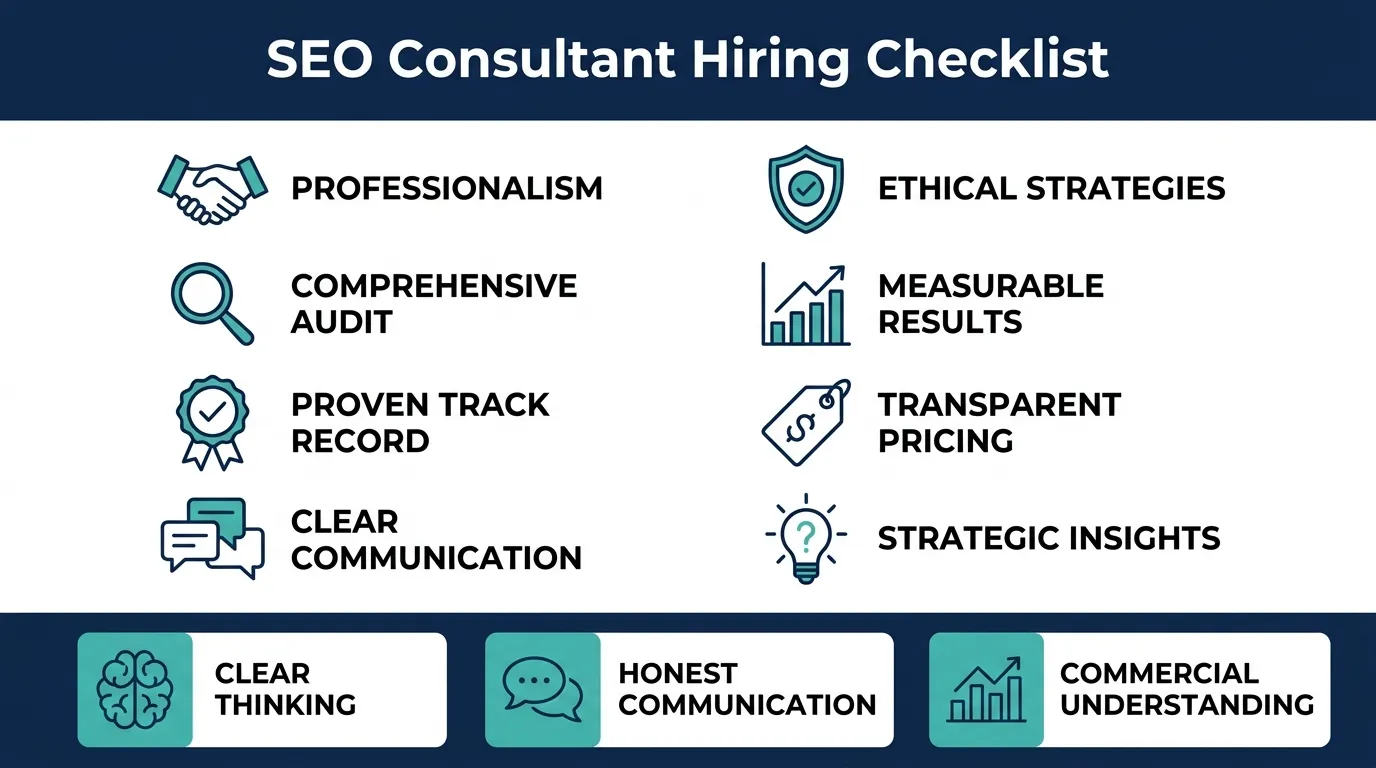
If there is one rule that applies to the entire hiring process, it is this: Do not hire the person who sounds the most certain. Hire the person who understands your business the fastest.
Weak consultants often start with tactics. Strong ones start with context. They want to understand how you make money, which services matter most, who your best customers are, what the sales cycle looks like, where current leads come from, what has already been tried, and which commercial pages genuinely move the needle.
Google recommends interviewing prospective SEO providers, checking references, and asking for a technical and search audit before deciding whether to hire. It also stresses the importance of understanding what changes will be made and why.
Look for Proven SEO Consultant Experience and Case Studies
What matters less is shiny case studies. What matters more is the depth behind them. A decent consultant can show a graph. A strong consultant can explain the decisions behind the graph.
When reviewing previous work, look for signs that the consultant understands:
- Business context, not just SEO mechanics
- The difference between traffic growth and revenue growth
- Page-level optimisation, not just site-wide clichés
- How to diagnose bottlenecks before prescribing solutions
- What realistic progress looks like over time
Ask for examples of similar businesses, similar growth constraints, or similar technical challenges. You are not looking for perfect overlap. You are looking for evidence that they can transfer thinking across situations.
Real-World Examples: What Good SEO Looks Like in Practice
Numbers without context are easy to fabricate. But patterns across real engagements reveal what competent SEO actually produces.
Example A: A Singapore-based home renovation company engaged a specialist consultant at S$1,200 per month. Rather than publishing generic content, the consultant mapped search intent by district, built hyperlocal landing pages for high-density residential areas, and resolved a series of indexation issues that had suppressed visibility for over a year.
Within six months, organic sessions increased by 140%, and the proportion of leads arriving through organic search doubled.
Example B: A B2B technology services company with an established blog had strong traffic but poor commercial conversion. The consultant identified that most content was targeting informational queries with no commercial intent, while the product and service pages had almost no organic visibility.
A combination of on-page restructuring and content prioritisation shifted the acquisition mix significantly. Qualified enquiries from organic traffic increased by over 60% within nine months without any increase in content volume.
Neither of these results came from more activity. They came from better diagnosis and clearer commercial thinking.
Final Checklist Before You Hire an SEO Consultant in Singapore
If you have made it this far, you probably do not need another pitch. You need a decision filter.
Your SEO Consultant Hiring Checklist
Before you sign, make sure you can answer yes to most of these:
- Do they understand how your business makes money?
- Can they clearly explain the likely constraints on your site?
- Have they shown relevant experience or credible thinking?
- Do they communicate in a way your team can actually work with?
- Are their methods transparent and aligned with Google’s guidance?
- Do their KPIs reflect business outcomes rather than just vanity metrics?
- Does the scope match the fee?
- Do they ask smart questions before recommending solutions?
- Can they explain their approach to AI Overviews, GEO, and AEO?
- Does the contract include a clear exit clause and client ownership of all assets?
- Have you confirmed whether PSG funding can be used to reduce the net cost?
If too many of those answers are no, keep looking.
How to Make the Final SEO Consultant Decision
In the end, choose the SEO consultant who combines three things well:
- They think clearly.
- They communicate honestly.
- They understand the commercial reality behind the rankings.
That tends to matter more than polish. More than confidence. More than the most sophisticated deck in the room.
The work that delivers the most value sits with founders, SMEs, and marketing teams who want search to support sustainable growth rather than vanity wins. The strongest SEO relationships are the ones built on clarity, not hype. That is especially true in Singapore, where the businesses that win organically are often the ones that make smarter decisions earlier.
What Should Your SEO Contract Include?
The contract rarely gets enough attention during the hiring process. People focus on the pitch and the price, then sign something without reading it carefully. That is a mistake.
A well-structured SEO contract protects both sides. Here is what it should include at a minimum:
- Scope of work: Specific deliverables per month, not vague commitments like “ongoing optimisation”.
- Ownership of accounts, logins, content, and backlinks: Everything built during the engagement should belong to the client, not the consultant.
- Clear exit and termination clause: A 30-day notice period is reasonable; anything requiring 90 days or more of notice without cause is worth questioning.
- Reporting frequency and format: Monthly at minimum, with a clear structure that connects work to outcomes.
- No penalty guarantee for black-hat tactics: The contract should make clear that the consultant is responsible for the methods used on your domain.
- IP and content ownership assigned to the client: Any content, creative assets, or structured data created during the engagement should remain with the business.
If a consultant is reluctant to include any of these terms, ask why. The discomfort around fair contract terms is often a signal in itself.
Step 7: Post-Hiring: What To Do After You Sign
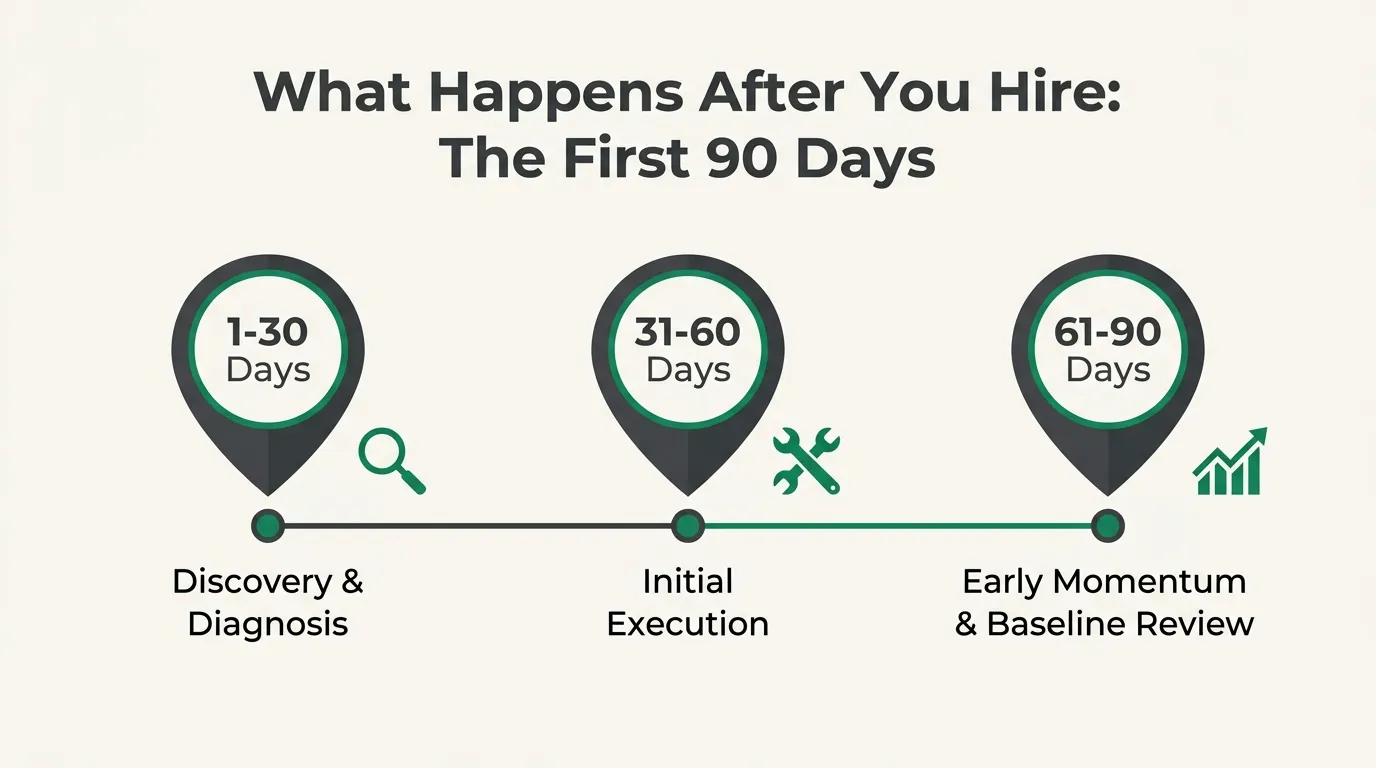
Most articles end at the hiring decision. But what happens next is where the real risk lies.
A vague onboarding sets the tone for a vague engagement. A structured 90-day plan, by contrast, gives you clear milestones against which to measure early progress and hold the consultant accountable.
What Happens After You Hire: The First 90 Days
Here is what a well-run SEO engagement typically looks like across the first three months:
Days 1–30: Discovery and Diagnosis
This phase is about establishing a clear baseline before touching anything.
A competent consultant will conduct a thorough site audit covering technical health, crawl issues, indexation gaps, Core Web Vitals, site architecture, and internal linking. They will also establish baseline KPIs using Google Search Console, GA4, and a rank-tracking tool, and complete a competitive analysis to identify gaps and opportunities.
Keyword mapping (the process of matching target queries to specific pages based on intent) should be completed in this phase, not improvised later.
The output of this phase should be a written prioritisation document, not just a verbal briefing. If a consultant cannot produce a clear roadmap after 30 days, that is an early warning sign.
Days 31–60: Initial Execution
With priorities established, the work shifts to implementation.
This typically includes on-page fixes to underperforming commercial pages, resolution of critical technical issues, content gap corrections on high-priority pages, and Google Business Profile optimisation where relevant.
The consultant should also provide clear communication to your development team or CMS manager about what changes are needed and why. If they cannot explain the work in language your team can act on, execution will stall.
Days 61–90: Early Momentum and Baseline Review
By the end of the third month, you should start to see measurable signals, even if not dramatic results.
This phase typically involves the first ranking movement report, early organic traffic changes, a review of whether the original keyword and page priorities were correct, and the beginning of content calendar activation for longer-term authority building.
The consultant should also produce an honest assessment of what is working, what needs adjustment, and what the next 90 days should focus on. This is the moment when a good consultant earns long-term trust — by being direct about what the data is saying, including the parts that are disappointing.
What Results Should You Expect From an SEO Consultant?
One of the biggest problems in this industry is that too many businesses come into SEO expecting it to behave like paid media. It does not.
SEO is slower, messier, and more compounding than that. Google’s guidance and experienced SEO practitioners alike stress that rankings cannot be guaranteed and that results should be judged over time against meaningful business outcomes.
That is worth repeating because unrealistic expectations make good SEO look disappointing, while bad SEO looks persuasive.
How Long SEO Consultant Work Usually Takes
Early improvements can appear when obvious technical or on-page issues are fixed. That might mean better indexation, stronger page targeting, or improved internal linking. Those changes can create movement relatively quickly.
But deeper gains tend to take longer. If your site needs stronger authority, better commercial content, or a more coherent architecture, then the timeline stretches.
A reasonable expectation for initial ranking movement is 4 to 6 months. Sustained ROI (where SEO is a reliable organic acquisition channel) typically takes 9 to 12 months or longer, depending on the category and starting point.
A good consultant should be honest about that timeline from the outset.
KPIs to Track After Hiring an SEO Consultant
Focus on KPIs that reflect useful progress, not just search engine activity.
| KPI | What It Measures | Tool |
| Organic Sessions | Raw traffic from search | GA4 |
| Keyword Rankings | Position for target terms | Search Console / Ahrefs |
| Click-Through Rate (CTR) | SERP visibility quality | Search Console |
| Conversion Rate | Leads / sales from organic | GA4 Goals |
| Cost Per Acquisition (CPA) | Efficiency of SEO spend | GA4 + CRM |
| Domain Rating / Authority | Link equity growth | Ahrefs / Moz |
| Core Web Vitals | Technical health | PageSpeed Insights |
| AI Overview Appearances | Brand visibility in AI search | Manual / Ahrefs |
The right KPIs depend on the business model, but they should tell a commercial story, not just a reporting story.
Why Leads and Revenue Matter More Than Rankings Alone
Rankings are useful, but they are not the finish line.
A page can rank and still fail commercially. It can attract traffic that never converts. It can bring in the wrong audience. It can look good in a monthly report and quietly do nothing for the business.
That is why the consultants who deliver the most value think in terms of lead quality, revenue contribution, and page-level business outcomes. Rankings matter because they can create opportunity. The opportunity only matters if it leads somewhere useful.

How to Make the Final SEO Consultant Decision
In the end, I would choose the SEO consultant who combines three things well.
- They think clearly.
- They communicate honestly.
- They understand the commercial reality behind the rankings.
That tends to matter more than polish. More than confidence. More than the most sophisticated deck in the room.
These days, the work I value most sits with founders, SMEs, and marketing teams who want search to support sustainable growth rather than vanity wins. The strongest SEO relationships, in my experience, are the ones built on clarity, not hype.
That is especially true in Singapore, where the businesses that win organically are often the ones that make smarter decisions earlier. Give us a call at MediaOne to talk about how we can help with your business’ SEO goals.
Frequently Asked Questions
Do SEO consultants need certifications?
No formal licence or governing body exists for SEO, so certifications are not a requirement in the same way they might be in law, finance, or accountancy. Useful courses from providers such as Semrush or HubSpot can show initiative and ongoing learning, but they do not replace real experience on live websites. The best way to treat certifications is as a supporting signal rather than a deciding factor.
How do I know if my SEO consultant is delivering real value rather than just vanity metrics?
Ask them to show you how their work connects to enquiries, leads, or revenue rather than just traffic and rankings. A consultant who can only point to impression volume or ranking improvements without explaining commercial impact is probably optimising for the report, not the business.
Request a direct line between their work and the number of qualified leads your site generates from organic search.
Is the PSG Grant applicable to SEO services in Singapore?
Yes, qualifying Singapore SMEs can access up to 50% subsidy on pre-approved digital marketing and SEO solutions through the Productivity Solutions Grant administered by Enterprise Singapore. Eligibility requires Singapore registration and at least 30% local shareholding. MediaOne is a PSG-approved vendor. Speak to us directly to confirm whether your business qualifies and which services fall under the grant.
How long will it take to see SEO results in Singapore?
Initial ranking movement typically appears within 4 to 6 months when technical and on-page foundations are addressed correctly. Sustained ROI (where organic search becomes a reliable, compounding acquisition channel) generally takes 9 to 12 months or longer, depending on your starting authority, the competitiveness of your category, and whether content and link building are progressing in parallel.
A consultant who promises faster timelines without clear justification should be pressed for specifics.
What happens to my SEO if the consultant leaves or the engagement ends?
If the engagement is structured correctly, the business retains full ownership of all accounts, content, backlinks, and technical work. Before any engagement begins, confirm that all access credentials, Google Search Console, GA4, GBP, and CMS ownership remain with the business.
A good consultant should hand over a clear transition document covering what has been done, what is in progress, and what should happen next. Avoid any arrangement where the consultant controls the primary account access.
Should you give an SEO consultant admin access?
You should give access based on the work required, not by default. For an initial review, an SEO consultant can often assess a lot from the front end, but ongoing SEO usually benefits from access to Google Search Console, Google Analytics, and some CMS permissions. The safest approach is to grant only the minimum required through role-based access rather than handing over your main admin login.