Introduction
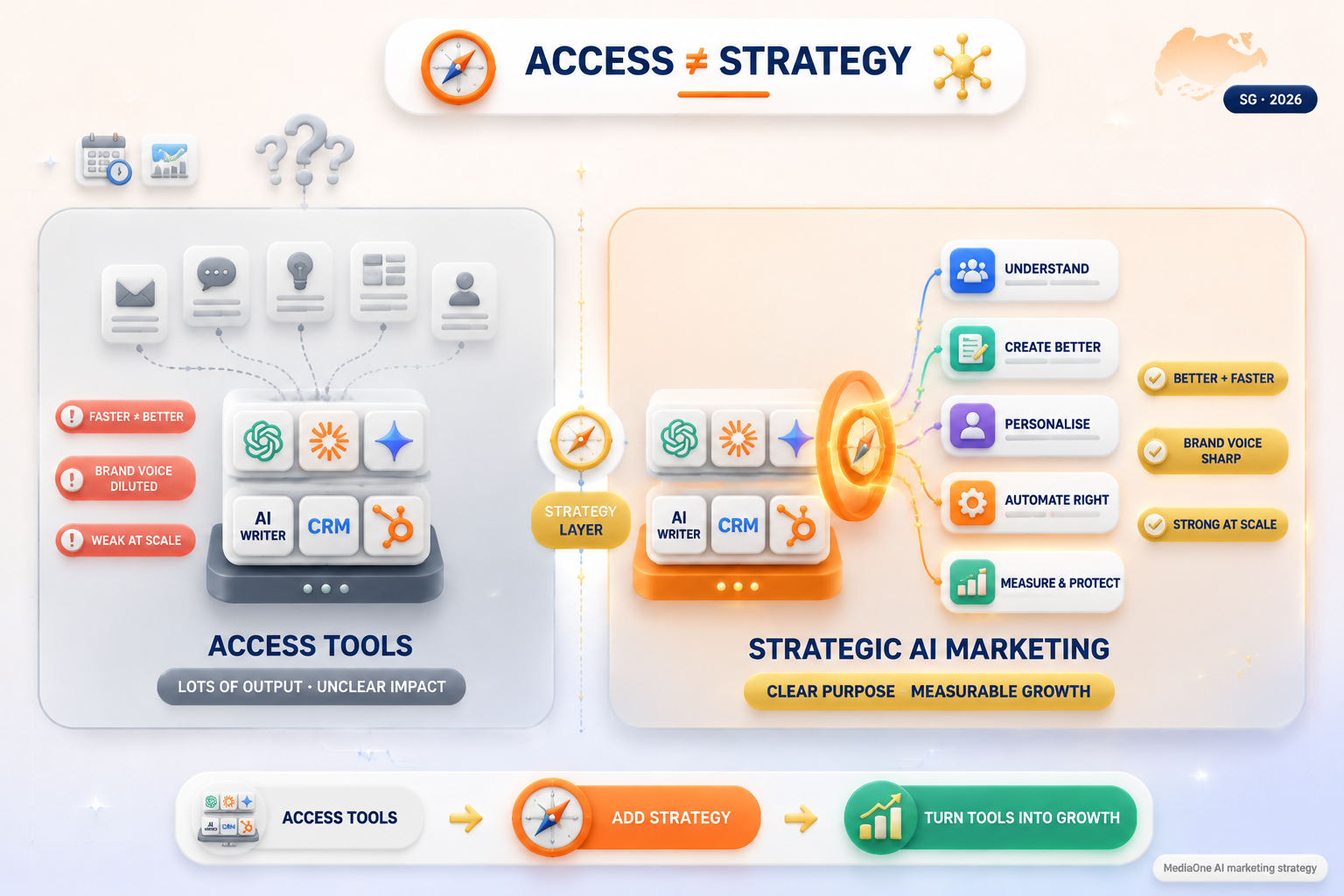
Most companies do not struggle with AI marketing because they lack tools. They struggle because they mistake access for strategy.

A team adopts ChatGPT, Claude, Gemini, an AI writing assistant, a CRM feature, or a new automation platform. Suddenly, emails, social captions, campaign ideas, ad variations, and customer summaries move faster. The content calendar fills up. Meetings feel more productive. Everyone can say the business is using AI.
Then the harder questions arrive. Is the content better, or just faster? Are leads improving? Is the brand voice sharper, or starting to sound like everyone else using the same tools?
That is where a proper AI marketing strategy matters. It is a practical plan for using AI to understand audiences, create better content, personalise campaigns, automate the right work, measure performance, and protect brand trust.
Used well, AI helps marketers move faster without becoming careless. Used poorly, it makes weak marketing easier to scale.
What an AI Marketing Strategy Should Do
- AI tools are not an AI strategy. They only become strategic when tied to a measurable business problem.
- Start with workflow gaps, customer intent, data quality, and commercial goals before choosing tools.
- Use AI for speed, pattern recognition, research support, and repeatable workflows; keep humans responsible for judgment, brand voice, accuracy, and risk.
- Optimise for both traditional search and AI discovery by creating useful, specific, well-structured, non-commodity content.
- Measure business improvement, not content volume or tool adoption.
What Is an AI Marketing Strategy?
An AI marketing strategy is a structured way of applying AI across marketing to support clear business goals. It can cover customer research, SEO planning, segmentation, email workflows, lead scoring, chatbot support, creative testing, reporting, and sales enablement.
The keyword is strategy. AI becomes useful when it is tied to a specific problem, such as producing better content faster, improving lead quality from search, strengthening nurture journeys, or speeding up reporting without losing strategic interpretation.
Without that clarity, AI becomes scattered activity: blog outlines, LinkedIn posts, landing page rewrites, and campaign drafts that save time but do not necessarily improve visibility, conversion, or revenue.
A strong AI marketing strategy answers five questions:
- What problem are we solving?
- Which workflows can AI improve?
- What data does it need?
- Where must humans intervene?
- How will success be measured?
Without those answers, the company has AI activity, not AI strategy.
Why AI Marketing Strategy Matters Now
AI is now part of normal marketing work. HubSpot’s 2026 update on AI in content marketing shows marketers using AI for content creation, research, chatbots, media generation, and data analysis, while also noting that only a small minority publish AI content without revision. That reinforces the point that AI may speed up production, but human editing still protects quality.
McKinsey’s 2025 State of AI research also shows that marketing and sales remain among the functions where organisations commonly apply AI. The direction is clear: AI is no longer a side experiment.
But widespread adoption raises the bar. When every business can generate a blog post, email sequence, or ad variant quickly, speed alone stops being impressive. The advantage shifts to sharper positioning, cleaner data, stronger editing, original insight, and trust.
This is especially important for SEO. Google’s 2026 guidance on generative AI features in Search says traditional SEO still matters for AI Overviews and AI Mode, but visibility also depends on unique, valuable, people-first content. AI makes weak marketing faster. It also makes strong marketing stronger. The difference is the strategy behind it.
The Core Elements of a Strong AI Marketing Strategy
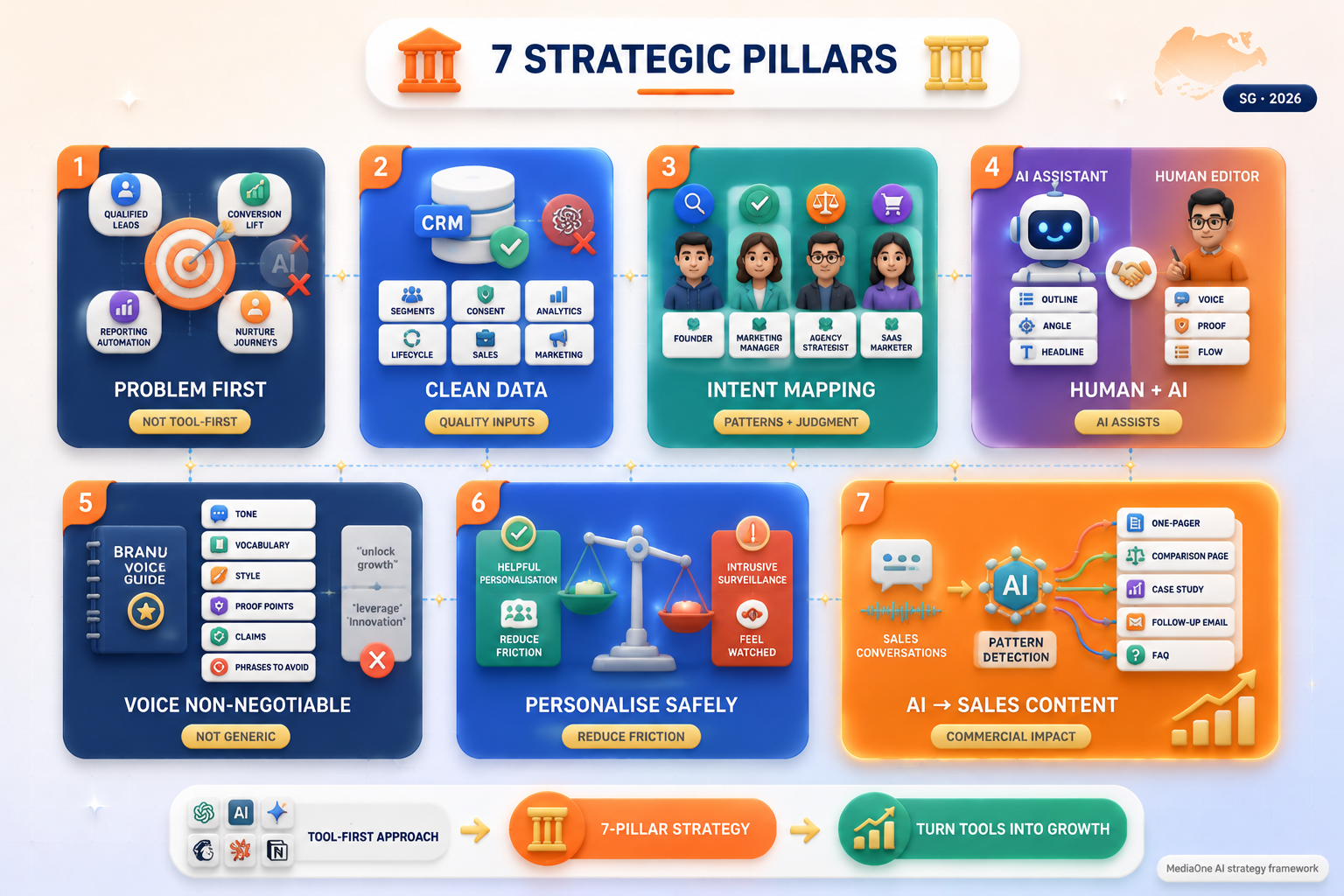
1. Start With a Business Problem, Not a Tool
Weak AI marketing plans begin with a tool. Strong ones begin with a problem.
A vague goal like “use more AI in marketing” does not define the audience, workflow, expected result, or commercial value. A stronger objective is specific: increase qualified leads from organic search, improve landing page conversions, reduce manual reporting, build better nurture journeys, or turn recurring sales objections into useful enablement content.
2. Build on Clean, Useful Data
AI depends on the quality of its inputs. If customer data is incomplete, outdated, duplicated, or scattered across disconnected systems, AI will not fix the problem. It may simply make poor decisions look more sophisticated.
Messy CRM data can lead to irrelevant personalisation, weak segmentation, and missed sales opportunities. A useful AI marketing strategy needs clean CRM records, accurate segments, clear consent practices, reliable analytics, defined lifecycle stages, and connected sales and marketing data.
3. Understand Search Intent and Buyer Intent
AI can help analyse keywords, customer questions, competitor pages, reviews, support tickets, sales notes, and website behaviour. But the goal is not more information. The goal is better intent.
Take the keyword “ai marketing strategy.” A founder may want a simple roadmap. A marketing manager may need a framework for leadership. An agency strategist may be researching client recommendations. A SaaS marketer may want to connect AI with lead generation, onboarding, or retention.
Those users should not receive the same generic answer. AI can identify patterns, but marketers decide what those patterns mean.
4. Use AI to Support Content, Not Replace Thinking
Content creation is one of the most common uses of AI in marketing. It can help with outlines, angles, headlines, research summaries, repurposing, and first drafts. But that does not mean the final content should feel AI-generated.
Strong AI-assisted content still needs human direction. A marketer defines the audience, angle, purpose, structure, voice, proof points, and next step. An editor checks facts, removes generic phrasing, sharpens the flow, and makes sure the piece sounds like the brand, not the tool.
5. Make Brand Voice Non-Negotiable
Lazy AI content is easy to spot because it sounds like it could belong to anyone. The sentences are clean but vague, the tone is polished but forgettable, and the structure is logical but predictable. Phrases like “unlock growth,” “leverage innovation,” “seamless solutions,” and “game-changing results” often appear without saying anything specific.
A strong AI marketing strategy needs clear brand voice rules for tone, vocabulary, sentence style, customer language, proof points, claims, and phrases to avoid. AI can follow a voice guide, but only if one exists.
6. Personalise Without Making Customers Uncomfortable
AI makes it easier to personalise marketing across email, landing pages, product recommendations, and chatbots.
Done well, this feels useful. Done poorly, it feels intrusive. Use AI personalisation to reduce friction, not to make customers feel watched.
7. Connect AI to Sales Enablement
AI marketing strategy should not stop at awareness and content production. Sales teams hear objections, questions, hesitations, and buying signals every day, but those insights often stay buried in calls, notes, emails, or CRM fields.
AI can help identify patterns across those conversations. If prospects often ask about implementation time, pricing, data security, integrations, or ROI, marketing can turn those questions into one-pagers, comparison pages, case studies, follow-up emails, or FAQs.
That is where AI becomes commercially useful. It helps create content that answers real buyer concerns and supports revenue conversations.
AI Marketing With and Without Strategy
| Area | AI Without Strategy | AI With Strategy |
| Content creation | More output, but often generic | Faster production with stronger editorial direction |
| SEO/GEO | Keyword-heavy content with weak substance | Search-intent-led, evidence-backed content that can be retrieved and cited |
| Brand voice | Inconsistent tone across channels | Clear voice rules supported by review workflows |
| Personalisation | Random, intrusive, or poorly timed | Relevant, consent-aware, and customer-focused |
| Reporting | Automated dashboards with little interpretation | Actionable insights tied to business goals |
| Sales support | More content, but not always useful | Assets built around real objections and buyer needs |
| Governance | Higher risk of errors and weak claims | Human review, fact-checking, and approval standards |
What Is Changing in AI Marketing in 2026?
A useful AI marketing strategy also has to reflect how quickly search, content, and measurement are changing.
AI Search and GEO Are Becoming Boardroom Issues
Google’s 2026 guidance explains that AI Overviews and AI Mode use techniques such as retrieval-augmented generation and query fan-out. Marketers now need content that is easy to retrieve, specific enough to be cited, and strong enough to satisfy related follow-up questions.
The takeaway is not to chase gimmicky AEO or GEO hacks. Foundational SEO still matters. So does non-commodity content with original analysis, clear structure, expert input, useful visuals, and evidence at the point of claim.
AI Agents Are Moving Closer to the Customer Journey
AI agents are beginning to move beyond answering questions into helping users complete tasks. Nike’s 2026 announcement about AI-powered shopping on Google is a useful signal: the brand described a shopping experience where users can discover and buy Nike products through Gemini and AI Mode, reducing the steps between inspiration and checkout.
For marketers, this means content, product data, feeds, landing pages, and conversion paths must be ready for both human visitors and AI-assisted journeys.
Measurement Is Getting Harder and More Important
The IAB’s 2026 State of Data report focuses on AI’s impact on attribution, incrementality, and marketing mix modelling. This reinforces a key point that AI strategy is also about understanding performance when signals are fragmented.
AI can help marketers summarise data, model campaign impact, and identify performance patterns, but the strategic question remains the same: which activity actually improved the business?
Real-World AI Marketing Examples Worth Learning From
The strongest AI marketing examples are not just about faster content production. They show how AI can improve discovery, customer experience, creative governance, and commercial decision-making when there is a clear strategy behind it.
L’Oréal: Brand Voice, Creative Governance, and Agentic AI
L’Oréal shows why AI marketing needs both ambition and boundaries. Its Beauty Genius assistant uses generative AI, augmented reality, computer vision, and colour science to provide personalised beauty guidance, while its CreAItech platform helps marketing teams produce images, videos, sound, and 3D digital assets at scale.
More importantly, L’Oréal has paired creative acceleration with responsible AI rules, including a stated position that it does not use AI-generated lifelike faces, bodies, hair, or skin to support or enhance product benefits.
The lesson for marketers is that AI can support creative scale, but brand trust still depends on human standards, ethical boundaries, and a clear view of what the technology should not do.
Amazon Rufus and Alexa for Shopping: AI Search, GEO, and Product Discovery
Amazon shows how product discovery is shifting from keyword search to guided conversation. Rufus began as Amazon’s generative AI shopping assistant, but it was renamed Alexa for Shopping on May 13, 2026, bringing the experience closer to how people already use Alexa.

Alexa for Shopping can answer questions, compare products, suggest personalised recommendations, track prices, find deals, and add items to a cart for review. Customers may increasingly discover brands by asking AI assistants for recommendations, comparisons, or next steps. Content, product data, reviews, FAQs, and authority signals need to be structured well enough for AI systems to retrieve, understand, and cite.
Klarna: Sales Enablement, Customer Conversations, and Measurable Impact
Klarna shows how AI can turn customer conversations into operational and marketing intelligence. In its 2025 annual report, Klarna said its AI assistant handled 80% of customer service chats during the year ended December 31, 2025. The company had previously reported that the assistant delivered approximately US$39 million in cost savings in 2024.
For marketing teams, the lesson is not only cost reduction. Chat logs, support tickets, and sales notes can reveal recurring objections, buying questions, product confusion, and customer friction. Those insights can inform FAQs, landing pages, nurture emails, comparison content, sales one-pagers, and case studies. This is where AI becomes commercially useful. It helps marketing respond to what customers and prospects are already asking.
How to Build an AI Marketing Strategy Step by Step
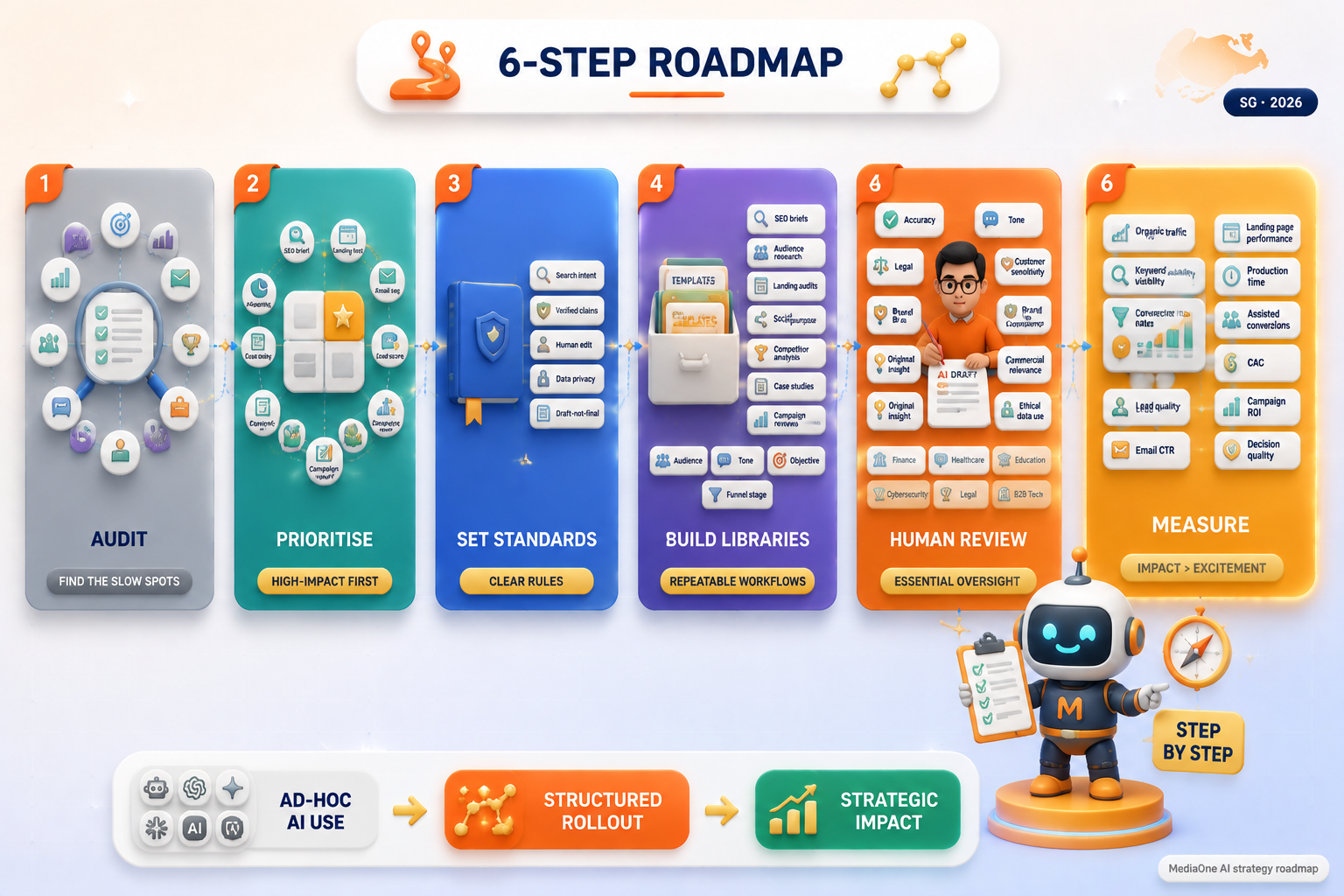
Step 1: Audit Your Current Marketing Workflow
Start by identifying where the team is slow, stretched, or underperforming. Look at content planning, SEO research, campaign reporting, email workflows, paid media testing, lead scoring, social media production, customer research, and sales enablement. Which tasks are repetitive? Which campaigns lack insight? Which content attracts traffic but fails to convert? Which sales questions keep coming up?
Step 2: Prioritise High-Impact Use Cases
Not every workflow needs AI immediately. For a B2B SaaS company, useful use cases may include SEO content briefs, landing page testing, email nurture segmentation, lead scoring support, sales objection analysis, case study drafting, content refresh recommendations, and campaign reporting. For ecommerce, AI might support product recommendations, review analysis, abandoned cart campaigns, personalised offers, or dynamic ad variations.
Step 3: Create AI Content Standards
If AI is used for content, the team needs clear standards. Every article should match search intent. Important claims should be verified. Every draft should be edited by a human. Confidential customer or company data should not be entered into unapproved tools. AI output should be treated as a draft, not a final answer.
Step 4: Build Prompt and Workflow Libraries
Prompts are more useful when they are part of a repeatable workflow. A good library may include templates for SEO briefs, audience research, landing page audits, social repurposing, competitor analysis, case study summaries, and campaign reviews. The best prompts include context: audience, product, tone, objective, funnel stage, proof points, objections, and desired output.
Step 5: Keep Humans in the Review Loop
AI can draft, summarise, classify, and suggest. It cannot fully own brand risk. Human review is still essential for accuracy, tone, legal or compliance concerns, customer sensitivity, brand fit, commercial relevance, original insight, and ethical use of data. This is especially important in industries where trust matters, such as finance, healthcare, education, cybersecurity, legal services, and B2B technology.
Step 6: Measure What Actually Matters
AI should be measured by impact, not excitement. Useful metrics may include organic traffic, keyword visibility, conversion rates, cost per lead, lead quality, email click-through rates, landing page performance, content production time, assisted conversions, customer acquisition cost, and campaign ROI. A mature strategy asks whether AI helped the team make better decisions, create better experiences, or improve business results.
AI Governance Workflow
| Stage | Owner | AI Role | Human Check |
| 1. Generation | Content lead or marketer | Draft, summarise, cluster, repurpose | Check brief, context, and audience fit |
| 2. Editorial review | Editor or brand owner | Suggest alternatives and simplifications | Review tone, brand voice, originality |
| 3. Accuracy review | SME, legal, or senior marketer | Flag claims and source gaps | Verify facts, claims, compliance, and risk |
| 4. Approval | Named owner | Track versions and notes | Sign off before publication |
| 5. Audit log | Marketing operations | Record tool use and workflow steps | Record reviewer, date, and what changed |
Common Mistakes to Avoid
Mistake 1: Treating AI as the Strategy
AI is a capability that supports strategy. If the audience, offer, positioning, or funnel is unclear, AI will only help the team execute a weak plan faster.
Mistake 2: Publishing Without Human Editing
AI can sound confident even when it is wrong, vague, or off-brand. Every important piece of content should be reviewed by someone who understands the audience, subject, and brand.
Mistake 3: Chasing Volume Instead of Value
Publishing more content does not automatically create growth. A company can produce dozens of AI-assisted articles and still fail if the content does not answer real questions, target valuable searches, or support conversion.
Mistake 4: Ignoring AI Search Visibility
Traditional SEO still matters, but AI discovery changes how users find and evaluate information. Content should be structured for humans first, while also being clear enough for retrieval, citation, and follow-up questions in AI search environments.
Conclusion
A strong AI marketing strategy helps marketers spend less time on repetitive work and more time on decisions that move the business forward.
AI can support research, drafting, segmentation, reporting, automation, and optimisation. It can surface patterns teams might miss. But customer trust, brand voice, ethical judgment, and strategic direction still belong to people.

The brands that get AI right will not be the ones publishing the most content or adopting the most tools. They will be the ones connecting AI to business goals, clean data, useful content, responsible governance, AI-search visibility, and human review.
For teams ready to move from AI activity to AI strategy, the next step is a clear audit of where AI can improve visibility, content quality, campaign performance, and revenue impact without weakening brand trust. MediaOne helps businesses bring that structure to SEO, performance marketing, content, and AI-driven campaigns, turning scattered AI use into a smarter growth strategy.
If your team needs help turning AI experiments into a measurable SEO and performance marketing strategy, speak with MediaOne’s team about where AI can create the strongest commercial impact.
Frequently Asked Questions
What is an AI marketing strategy?
An AI marketing strategy is a practical plan for using artificial intelligence to improve research, content creation, SEO, campaign planning, personalisation, automation, reporting, and customer experience.
Why is AI important in marketing?
AI helps marketers work faster, analyse data, personalise campaigns, generate ideas, automate repetitive work, and identify performance opportunities. Its value is strongest when it supports clear business goals.
Can AI replace marketers?
AI can automate parts of marketing, but it cannot replace human strategy, creativity, judgment, ethics, and brand understanding. The best results usually come from combining AI efficiency with human expertise.
How can AI improve SEO and GEO?
AI can support keyword research, search intent analysis, content briefs, competitor reviews, internal linking suggestions, metadata drafts, and content refresh recommendations. For AI search visibility, content also needs clear structure, original insight, credible sourcing, and useful answers that can be retrieved and cited.
Is AI-generated content bad for SEO?
AI-generated content is not automatically bad for SEO. The problem is low-quality content created mainly to manipulate rankings or fill pages. Content should still be helpful, original, and accurate.