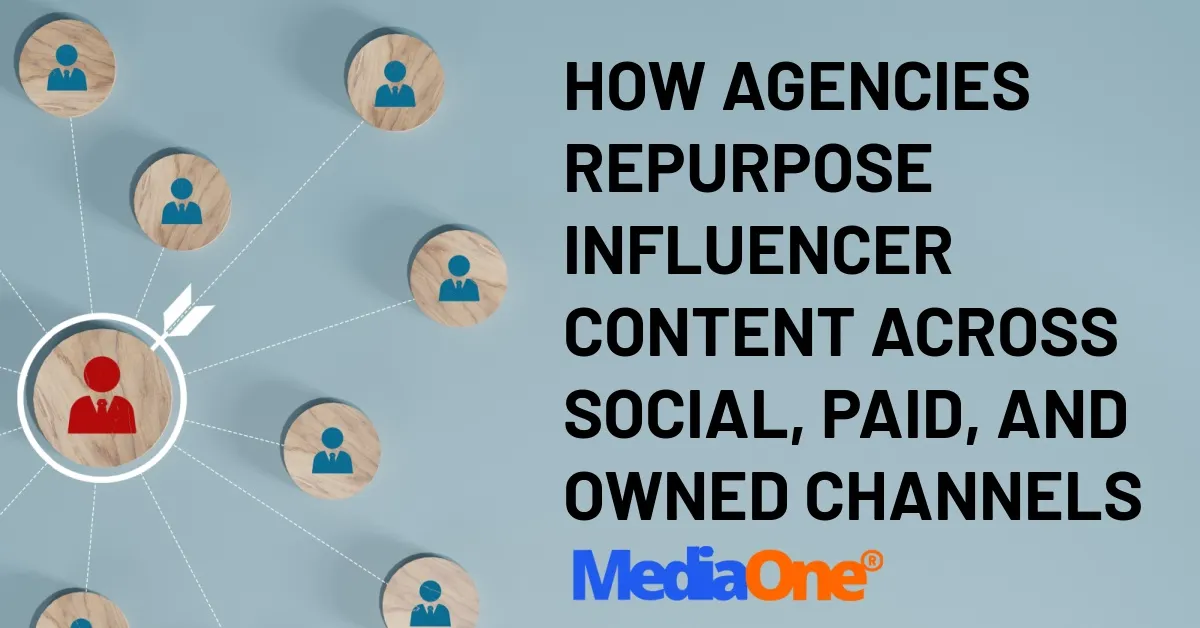
Agencies get the most value from influencer collaborations by planning upfront to reuse creator content across organic social, paid media, and owned channels.

That matters even more in a market like Singapore, where DataReportal reported 5.16 million active social media user identities in January 2025, equal to 88.2% of the population.
In other words, social is already a daily discovery environment, so strong creator assets should keep working long after the original post goes live.
For brands, the goal is not simply to post more. It is to make each asset travel farther with the right edits, permissions, and use case. That is why we treat repurposing as part of a broader influencer marketing agency in Singapore approach and a wider content strategy, not as a last-minute recycling exercise.
Key Takeaways
- We repurpose influencer content to extend asset lifespan, improve return on creator spend, and support a more efficient multi-channel campaign.
- The best assets for reuse are usually tutorials, product demos, testimonials, unboxings, and short-form videos.
- Repurposing is not the same as reposting. We adapt the hook, pacing, format, caption, and CTA for each platform.
- Compliance matters. In Singapore, influencer content still needs clear disclosure and must align with the Singapore Code of Advertising Practice and ASAS social media guidance. Platform-level disclosure tools also matter.
- We measure repurposed influencer content across organic, paid, and owned media, not just likes and views.
What Repurposing Influencer Content Actually Means
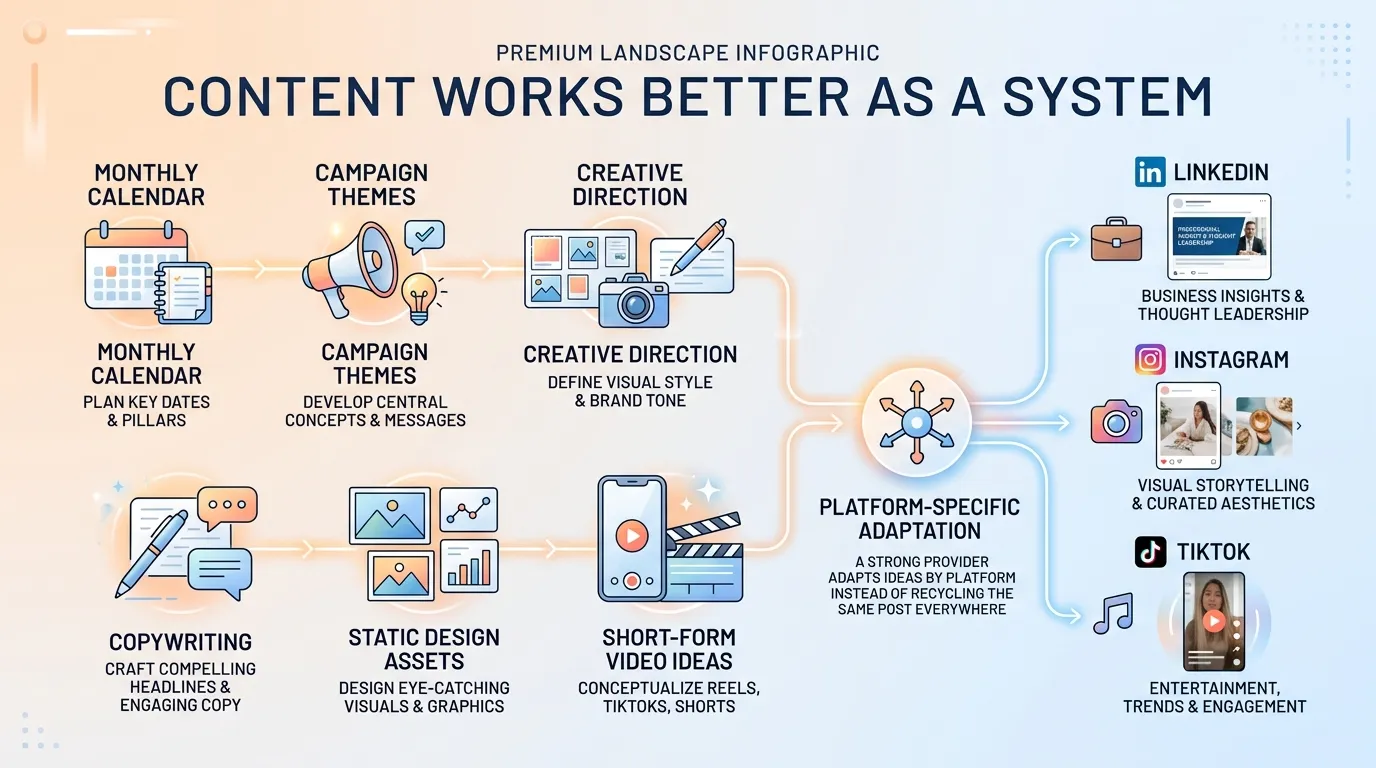
Repurposing influencer content means adapting an existing creator asset for a new platform, audience, or objective. We may shorten a TikTok video, turn the strongest quote into a static graphic for Facebook, or place a testimonial clip on a landing page to support conversions.
The creative idea stays intact, but the execution changes. That is the difference between a strategic content workflow and lazy duplication.
Many brands still confuse repurposing with reposting. They are not the same thing.
| Approach | What it involves | Typical outcome |
| Reposting | Publishing the same asset again with little or no change | Faster fatigue and weaker platform fit |
| Repurposing | Editing the asset for a different channel, format, or objective | Better relevance, stronger efficiency, longer asset life |
This distinction matters because people do not use all platforms the same way. Social media use is shaped by diverse motivations and behaviours, not a single universal pattern. That is exactly why the same creator asset should not be copied and pasted everywhere.
How MediaOne Repurposes Influencer Content Workflow
Repurposing influencer content works best when it follows a clear workflow rather than an ad hoc editing process. In agency practice, the goal is not just to reuse creator assets, but to decide systematically what is worth adapting, where it should be deployed, and how it should be measured.
This is the workflow we typically use to turn creator content into a repeatable multi-channel asset pipeline.
- Identify top-performing creator assets: We begin by reviewing the original influencer content to find assets that have already shown strong potential. This usually includes content with strong watch time, saves, shares, click interest, engagement quality, or conversion signals. At this stage, we are not simply looking for the most polished content. We are looking for assets that already demonstrate audience attention, clear messaging, and commercial value.
- Check licensing and permissions: Before any reuse happens, we confirm what the brand is actually allowed to do with the content. That includes checking whether the asset can be reposted, edited, used in paid media, embedded on owned channels, or repurposed for different formats and markets. This step matters because repurposing influencer content without clear rights can create unnecessary legal, commercial, and relationship issues with creators.
- Score assets by channel fit: Not every creator asset should be sent to every channel. We assess each piece of content based on how well it fits different channel environments, such as TikTok, Instagram, Facebook, LinkedIn, landing pages, product pages, or email. The strongest candidates are usually the assets that combine good performance signals with flexible editing potential and a clear role in the funnel.
- Re-edit by use case: Once the best assets are selected, we adapt them for the job they need to do. A creator testimonial may be edited one way for a retargeting ad, another way for a landing page, and another way for an Instagram Reel. This is where repurposing influencer content goes beyond reposting. The hook, pacing, framing, CTA, format, and surrounding copy should all reflect the use case.
- Route assets to paid, organic, and owned teams: After editing, route the content to the appropriate internal teams or stakeholders. Paid media teams may need creator-led ad variants, social teams may need platform-native posts, and web or CRM teams may need assets for landing pages, product pages, or email campaigns. This step helps ensure that repurposed influencer content is deployed intentionally rather than sitting unused after editing.
- Launch A/B tests: Where relevant, we test creator-led variations against other formats. For example, a creator testimonial clip may be tested against a polished brand ad, or two different hooks may be tested on the same platform to see which version drives stronger click or conversion performance. Testing matters because repurposing influencer content should not rely on assumptions. It should be validated against actual business outcomes.
- Measure by objective: We then assess performance according to the role each asset is meant to play. Awareness assets may be measured by reach, views, and completion rate. Engagement-led assets may be judged by saves, shares, and comments. Conversion-led assets should be measured through CTR, CPA, ROAS, assisted conversions, or other commercial signals. This gives the workflow more discipline and makes it easier to identify what types of repurposed influencer content are actually worth scaling.
- Archive assets in a content library: Once results are clear, the best-performing assets should be archived properly in a structured content library. That library should ideally include the creator name, campaign, usage rights, best-performing channels, approved formats, performance notes, and any restrictions on reuse. This makes future repurposing faster and more scalable. Instead of starting from scratch each time, teams can build from a library of proven creator assets with known value.
Rights and Usage Matrix for Repurposing Influencer Content
One of the most important parts of repurposing influencer content is confirming exactly where and how the asset can be reused. Many brands assume that once creator content is delivered, it can be used freely across all channels. In practice, that is rarely safe to assume.
Usage rights should be defined upfront, ideally before content is produced. This helps avoid internal delays, creator disputes, compliance issues, and unnecessary renegotiation later. It also makes it easier for paid, organic, and owned media teams to know what they can actually deploy.
The more structured approach is to map repurposing use cases to the permissions and contract terms required for each.
| Use case | Needs explicit permission? | Typical contract language to define |
| Organic brand social | Yes | platform scope, duration, and reposting rights |
| Paid ads | Yes | whitelisting, partnership ads, paid usage term, ad account access if needed |
| Website/landing pages | Yes | owned-channel rights, on-site display rights, duration |
| Yes | CRM use, owned media rights, distribution scope | |
| Editing/cutdowns | Yes | derivative works, resizing, subtitles, copy edits, format changes |
What Brands Should Clarify in Creator Agreements
When planning repurposing influencer content, brands should aim to define the practical terms that affect reuse, not just whether the content can be used in general.
That usually includes:
- which platforms the content can appear on
- whether the brand can repost the content on its own channels
- whether paid media use is included
- whether the content can be used on landing pages, product pages, or websites
- whether the asset can be used in email or CRM campaigns
- whether edits, cutdowns, subtitles, or reformats are allowed
- how long the brand may continue using the asset
- whether the rights apply only to one market or multiple markets
- whether additional creator approval is needed before reuse
These details matter because repurposing influencer content often expands beyond the original campaign plan.
A creator video that starts as an Instagram post may later become a paid ad, a landing page testimonial, an email asset, or a retargeting creative. If the agreement only covers the initial post, the brand may not have the rights to make that shift.
Why Agencies Focus on Repurposing Influencer Content
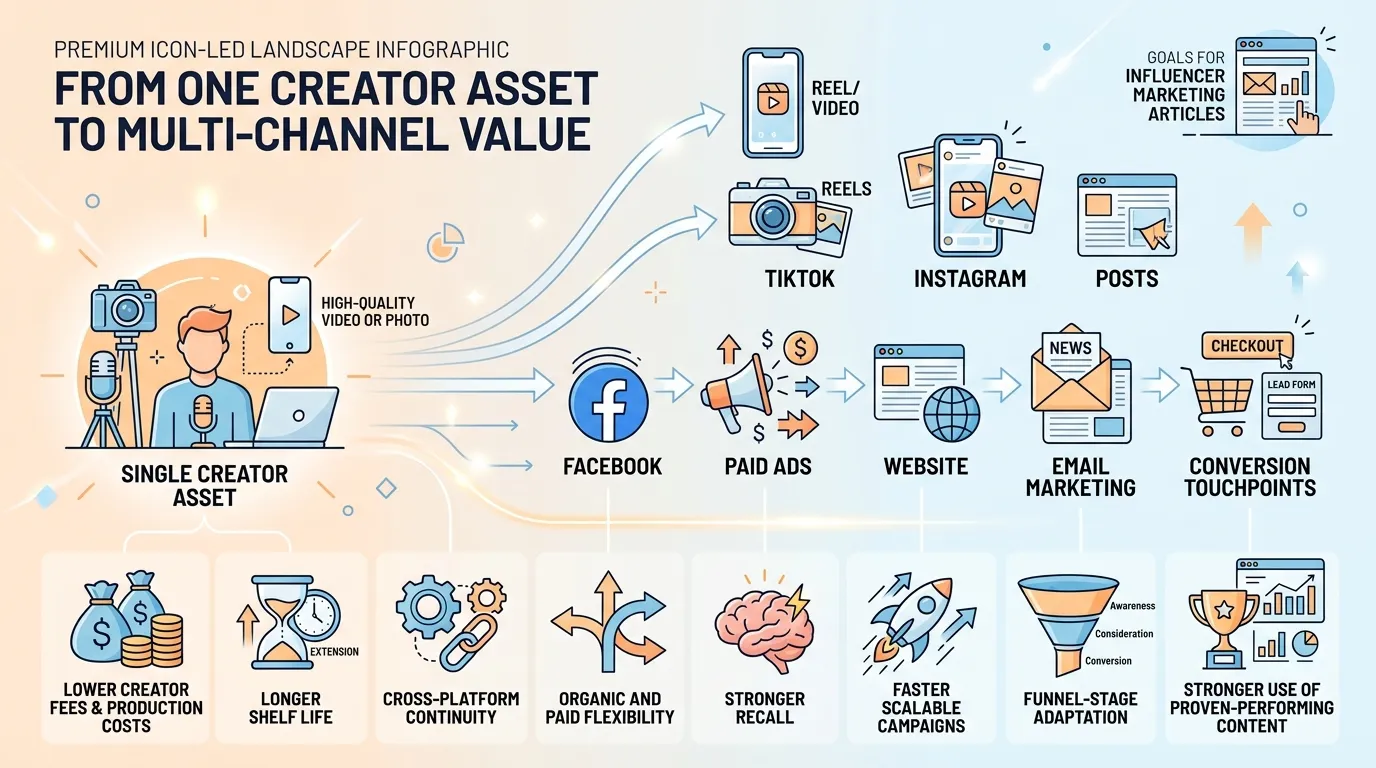
Agencies repurpose influencer content because one strong creator asset should not stop working after a single post. A useful creator collaboration can support organic reach, paid performance, landing page trust, email engagement, and remarketing when it is adapted properly.
Repurposing helps brands get more value from creator fees, production time, and approvals. It also makes campaigns more efficient by turning a single collaboration into multiple usable assets, rather than restarting content production for every channel.
It also improves channel coverage. A customer may first discover a product on TikTok, revisit it on Instagram, click through from Facebook, and convert on a landing page. Repurposing helps brands stay visible across those touchpoints while keeping the message more consistent.
Most importantly, repurposing supports different business goals. A short creator clip may work for awareness, a tutorial for consideration, and a testimonial for conversion.
That is why repurposing influencer content is not just a content tactic. It is a practical way to make creator partnerships contribute more across the full campaign.
What Types of Influencer Content Are Best for Repurposing
Not every asset deserves a second life. We usually prioritise content that is both structurally flexible and commercially useful.
The strongest candidates are:
- short form videos with a strong opening hook
- product demos and tutorials
- review or testimonial style clips
- unboxings and first impressions
- FAQ style explainers
- lifestyle visuals that show the product in use
What we avoid repurposing too aggressively is content that depends on a niche trend, weak storytelling, or a platform joke that does not travel well.
| Content Type | Why it works for repurposing | Best channels | Funnel role |
| Short-form video | Easy to cut into multiple lengths and formats | Instagram, TikTok, YouTube Shorts | Awareness |
| Tutorial | Useful, evergreen, and savable | TikTok, Reels, website | Consideration |
| Testimonial | Strong trust signal | Facebook ads, landing pages, and email | Conversion |
| Unboxing | Builds curiosity and discovery | TikTok, Instagram | Awareness |
| FAQ clip | Answers objections quickly | Reels, Stories, product pages | Consideration |
When we decide what to reuse first, we look at practical signals. Watch time matters. Saves and shares matter. Clear product storytelling matters. Rights availability matters too.
A polished asset with weak retention is often less valuable than a less polished creator clip that holds attention and drives clicks.
How We Decide Which Influencer Content to Repurpose First
Not every creator asset should be repurposed immediately. Some content may look polished but have weak retention. Other assets may feel less refined but carry stronger trust, clearer product communication, or better performance potential across multiple channels.
That is why repurposing influencer content works better when teams use a structured selection rubric rather than relying on instinct.
When reviewing creator assets, we typically prioritise the content most likely to deliver value across paid, organic, and owned environments. The goal is to identify which pieces are strong enough to justify the time, effort, and budget for editing, licensing, and deployment.
Content selection rubric for repurposing influencer content
| Scoring category | What we assess | Why it matters |
| Hook strength | Whether the opening captures attention quickly | Strong hooks improve performance on short-form and paid placements |
| Watch retention | Whether viewers stay engaged with the content | High retention often signals stronger reuse potential |
| Product clarity | Whether the product, service, or key message is easy to understand | Clear messaging makes adaptation more effective across channels |
| Trust signal | Whether the content feels believable, authentic, and persuasive | Trust-led assets often work well for consideration and conversion |
| Evergreen value | Whether the asset can remain relevant beyond a short trend window | Evergreen content is easier to reuse over time |
| Channel flexibility | Whether the asset can be resized, cut down, reframed, or reformatted | Flexible content supports broader deployment |
| Licensing status | Whether rights for reuse, editing, paid media, and owned media are confirmed | Strong content cannot be repurposed safely without the right permissions |
| Paid-media suitability | Whether the asset is strong enough for ad testing and performance use | Not every organic asset is suitable for paid deployment |
A Practical Way to Score Influencer Content
You can turn this into a simple scoring model by rating each asset on a scale of 1 to 5 for every category.
For example:
- 1 = weak
- 3 = usable
- 5 = strong repurposing potential
This gives teams a clearer way to objectively compare assets. A creator video with a strong hook, high retention, strong trust signals, and confirmed licensing may move to the front of the queue, even if it is less polished than another asset.
Example scoring table
| Asset | Hook strength | Watch retention | Product clarity | Trust signal | Evergreen value | Channel flexibility | Licensing status | Paid-media suitability | Total |
| Creator product demo | 4 | 5 | 5 | 4 | 4 | 5 | 5 | 4 | 36 |
| Creator lifestyle clip | 3 | 3 | 2 | 4 | 3 | 4 | 5 | 2 | 26 |
| Testimonial video | 4 | 4 | 5 | 5 | 4 | 4 | 5 | 5 | 36 |
In practice, this helps teams avoid choosing content based only on aesthetics. A highly polished asset may still rank lower if the product message is unclear or if it is too trend-dependent to reuse effectively.

What to Prioritise First
If a team needs to move quickly, the best assets to repurpose first are usually the ones that meet most of these conditions:
- strong opening hook
- above-average watch retention
- clear product or service story
- believable trust signal
- useful beyond a short-term trend
- flexible enough for multiple placements
- confirmed rights for editing and reuse
- realistic potential for paid or owned deployment
That gives the team a more commercially useful starting point than simply picking the most visually appealing creator content.
Repurposing Influencer Content by Funnel Stage
Repurposing influencer content works better when each asset is matched to a specific funnel stage. Not all creator content should do the same job. Some assets are better at stopping attention, while others are better at building trust, answering objections, or supporting repeat engagement.

A practical repurposing framework should therefore connect the creator asset type, the repurposed format, and the final destination to the business objective it is meant to support.
| Funnel stage | Best creator asset | Best repurposed version | Best destination | Main goal |
| Awareness | Unboxing, short UGC clip | 6 to 10 second cutdown | Reels, TikTok, Shorts | Stop attention and increase reach |
| Consideration | Tutorial, FAQ, demo | Carousel, landing page embed | Instagram, website | Build understanding and reduce hesitation |
| Conversion | Testimonial, review | Paid social creative, PDP clip | Meta Ads, product page | Strengthen trust and drive action |
| Retention | Creator usage tips, community content | Email content, loyalty content | CRM, remarketing | Encourage repeat engagement and loyalty |
This structure helps teams avoid a common repurposing mistake: using the same type of creator content for every objective.
An unboxing video may work well as a short awareness cut because it quickly sparks curiosity, but it may not be the strongest conversion asset.
A testimonial or review clip is usually better suited to paid performance creative or product page support, as it provides stronger proof and trust. Likewise, a tutorial or FAQ-style creator asset often works best during consideration, where the audience needs more clarity before acting.
By mapping repurposed influencer content to the funnel stage, brands can make better decisions about what to edit, where to place it, and how to measure success.

How Influencer Content Is Adapted for Different Social Media Channels
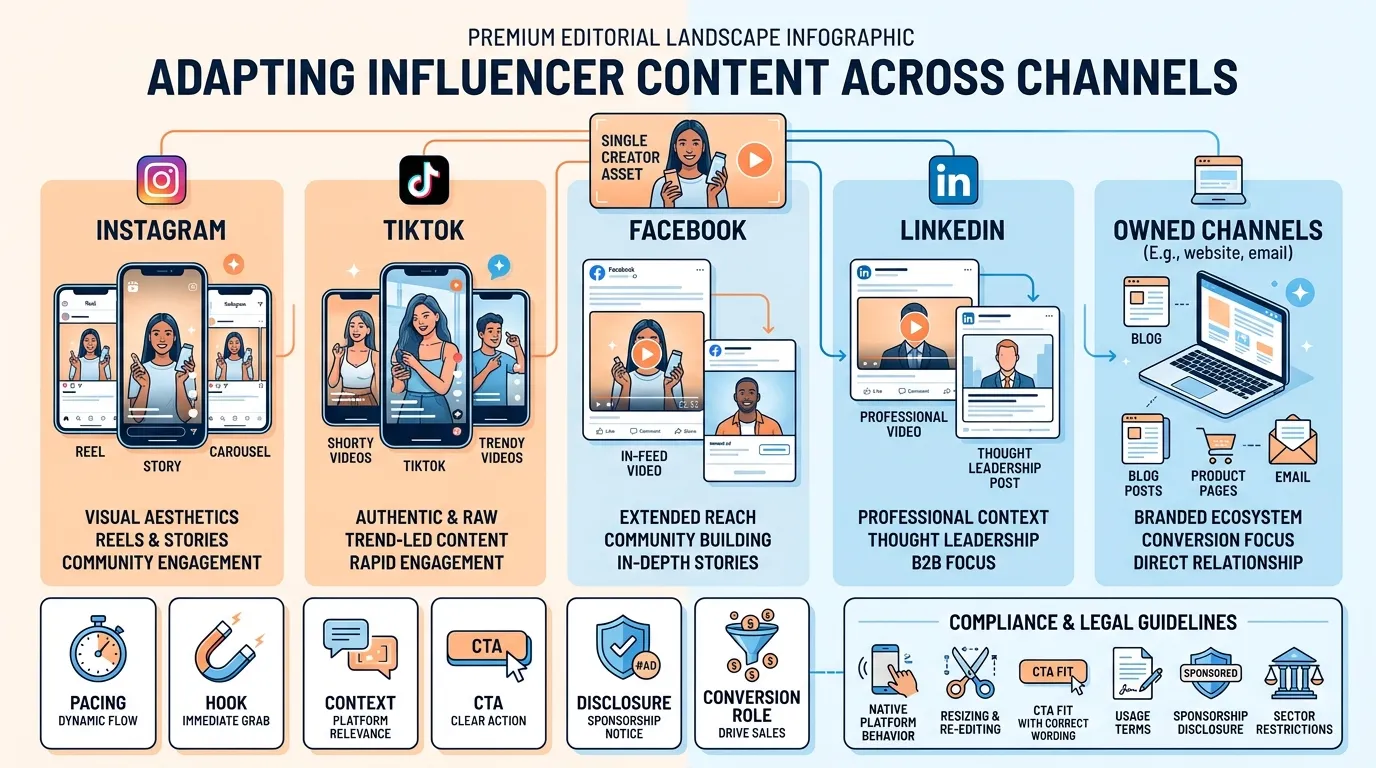
This is where many brands get it wrong. They assume one good asset should work everywhere. In reality, the same asset often requires different creative logic for each channel.
On Instagram, we often tighten the narrative and improve visual structure. Reels may need a cleaner arc, while Stories work better with sharper cuts and direct CTAs. Carousels can also work well when we turn a creator video into quote cards, product steps, or mini explainers.
On TikTok, the bar for native feel is much higher. The hook usually needs to land faster, the pacing can be looser, and the content cannot feel over-branded.
TikTok’s own help guidance requires creators to turn on the commercial content disclosure setting when posting content that promotes a brand, product, or service, reinforcing the importance of native execution and transparent disclosure on the platform.
On Facebook, we often add more context. This is where testimonial edits, stronger captions, and trust-led messaging tend to help. In many campaigns, Facebook also serves as a practical platform for boosting creator-led assets to warmer audiences.
On LinkedIn, we use influencer content more selectively. It makes sense for founder-led brands, B2B voices, employer branding, and campaign learnings. It usually makes less sense for purely lifestyle creator content unless there is a very clear business angle.
On owned channels, creator content often becomes even more commercially useful. We can embed testimonials on product pages, use UGC-style clips on landing pages, or add creator visuals to email flows.
Repurposed content tends to perform best here when it answers objections or reduces uncertainty near the point of conversion.
Owned channels
On websites, landing pages, and email, creator assets should reduce friction and support decisions. Testimonial clips, product walkthroughs, and realistic product visuals often work well here.
| Channel adaptation check | What to review |
| Aspect ratio and length | Resize and recut for the placement |
| Hook | Refine the first seconds for platform behaviour |
| Supporting copy | Rewrite caption or framing to suit channel context |
| CTA | Match the desired action for that platform |
| Creator voice | Preserve credibility and authenticity |
| Disclosure | Confirm sponsorship and promotional transparency rules still apply where needed |
Paid, Organic, and Owned Deployment Rules
A strong operational playbook should define how repurposing influencer content is deployed across media types.
- Organic deployment: For organic social, the focus is usually on reach, engagement, and content continuity. The asset should feel native to the platform and aligned with audience expectations.
- Paid deployment: For paid media, the focus is on commercial performance. This may require stronger hooks, shorter edits, clearer offer framing, and structured testing. Paid reuse also depends heavily on whether the rights explicitly allow ad usage.
- Owned deployment: For owned channels, the goal is often trust, reassurance, and support for conversion. Repurposed creator content should be placed where it helps users move forward, not where it distracts from the page objective.
| Media type | Main purpose | Operational priority |
| Organic | Reach and engagement | Platform fit and audience relevance |
| Paid | Clicks, leads, sales | Rights, testing, and conversion intent |
| Owned | Trust and conversion support | Placement, message clarity, and credibility |
What brands need to check before adapting content for another channel
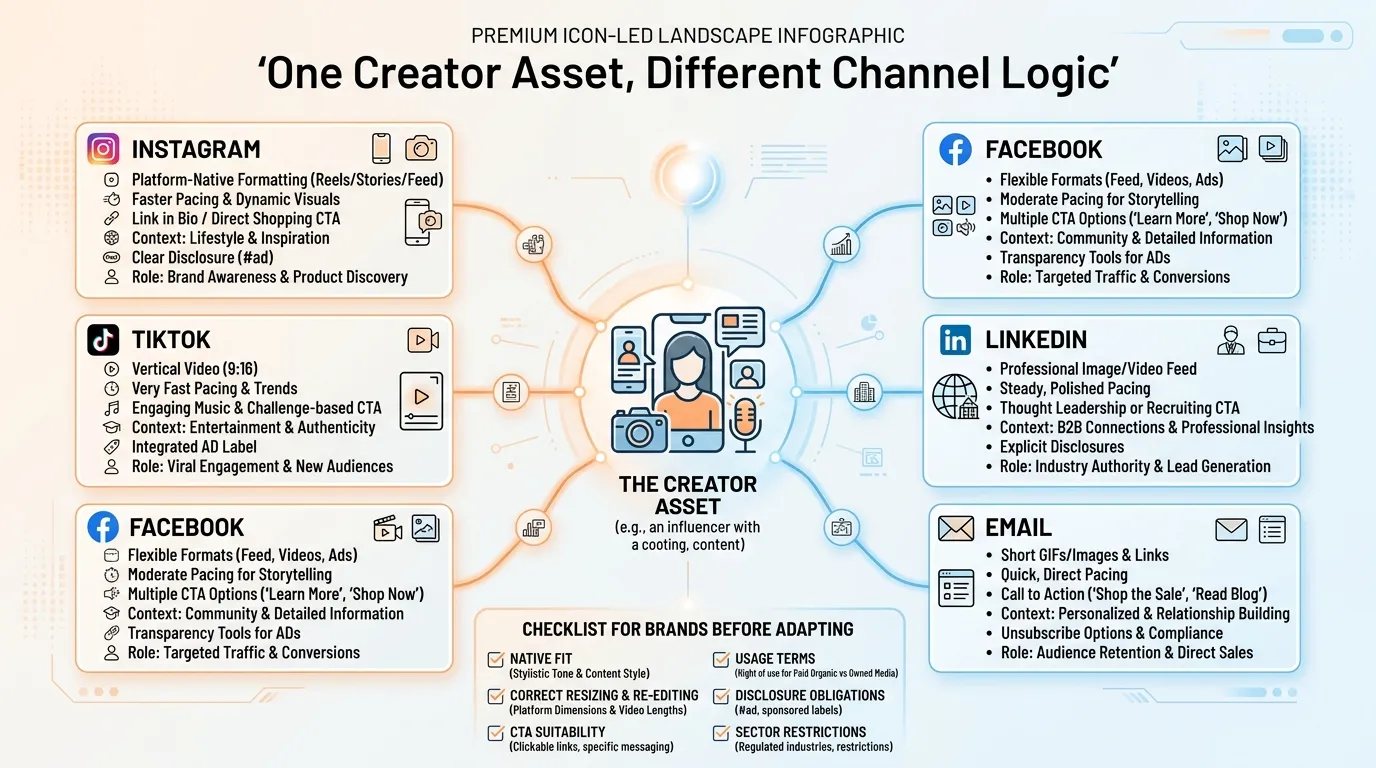
Before we reuse anything, we check the basics:
- Does the content align with the platform’s native behaviour?
- Has the format been resized and re-edited properly?
- Is the CTA appropriate for that channel?
- Do we have the right usage terms for paid, organic, and owned media?
- Does sponsorship disclosure still apply?
- Are there sector-specific restrictions to consider?
This is not just an internal process. In Singapore, the ASAS guidance, as set out in the Singapore Code of Advertising Practice, applies to interactive marketing communication and social media.
The principle is straightforward: ads should be legal, decent, honest, truthful, and clearly recognisable as marketing communication. Meta, TikTok, and YouTube also each maintain their own branded content or paid promotion disclosure systems.
For regulated sectors, the compliance bar is higher. In financial services, for example, MAS issued Guidelines on Standards of Conduct for Digital Advertising Activities in September 2025, with effect from 25 March 2026. If a brand operates in a regulated category, repurposing cannot be treated as a purely creative decision.
Common Ways Agencies Repurpose Influencer Content
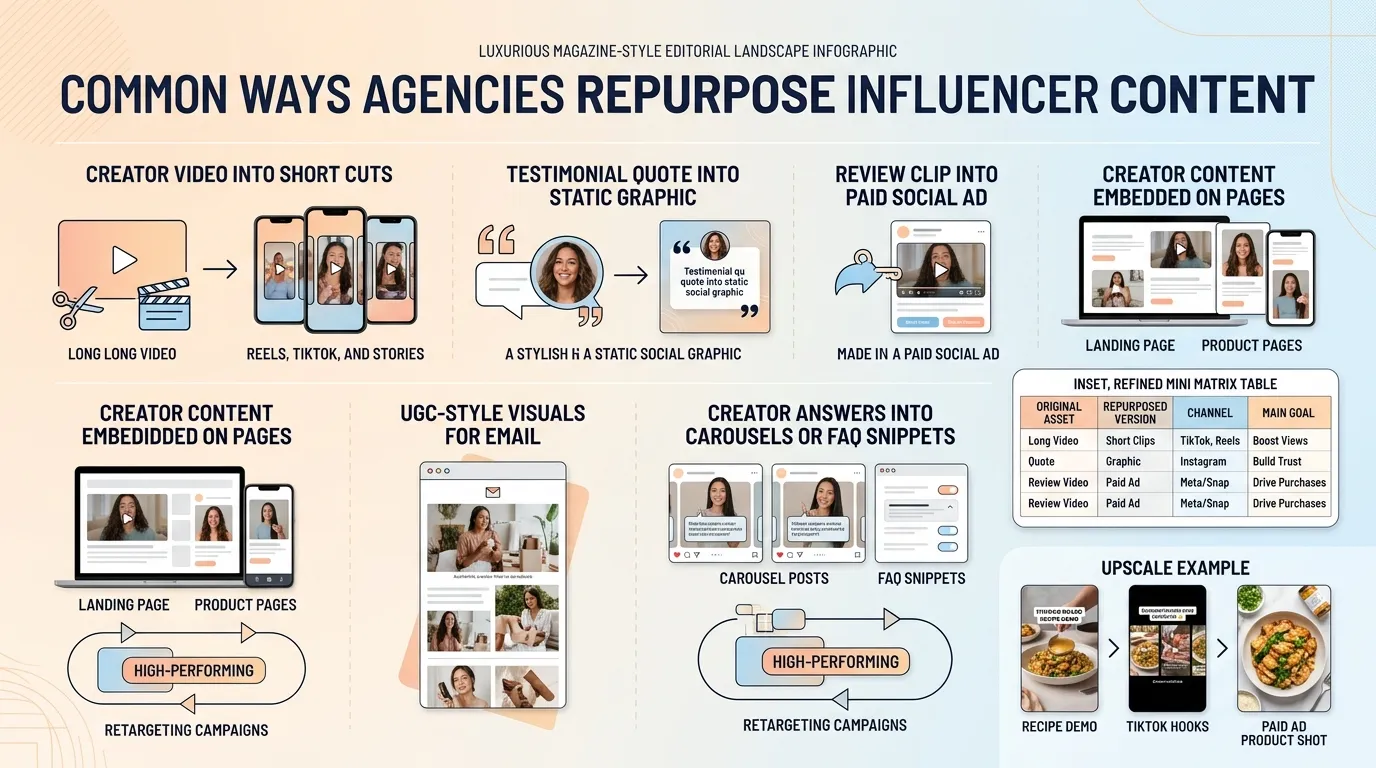
In day-to-day campaign work, these are the most common repurposing moves we make:
- Turn one creator video into multiple short cuts for Reels, TikTok, and Stories.
- Pull the strongest testimonial line into a static social graphic.
- Reuse review style clips in paid social ads.
- Embed creator content on landing pages and product pages
- Use UGC style visuals in email campaigns.
- Turn creator answers into carousel posts or FAQ snippets.
- Bring older high-performing assets back into retargeting campaigns.
| Original Asset | Repurposed Version | Channel | Main Goal |
| Tutorial video | 15-second cutdown | TikTok | Awareness |
| Review clip | Creator-led ad creative | Meta Ads | Conversion |
| Creator photo | Product page visual | Website | Trust |
| FAQ video | Carousel summary | Education |
Example scenario: A food brand partners with one creator for a recipe demo. We cut the full video into short TikTok hooks, use the clearest product shot in a paid ad, turn one quote into a Facebook creative, and place the finished dish visual in an email. One collaboration now supports four separate campaign jobs.
Common Mistakes Brands Make When Repurposing Influencer Content
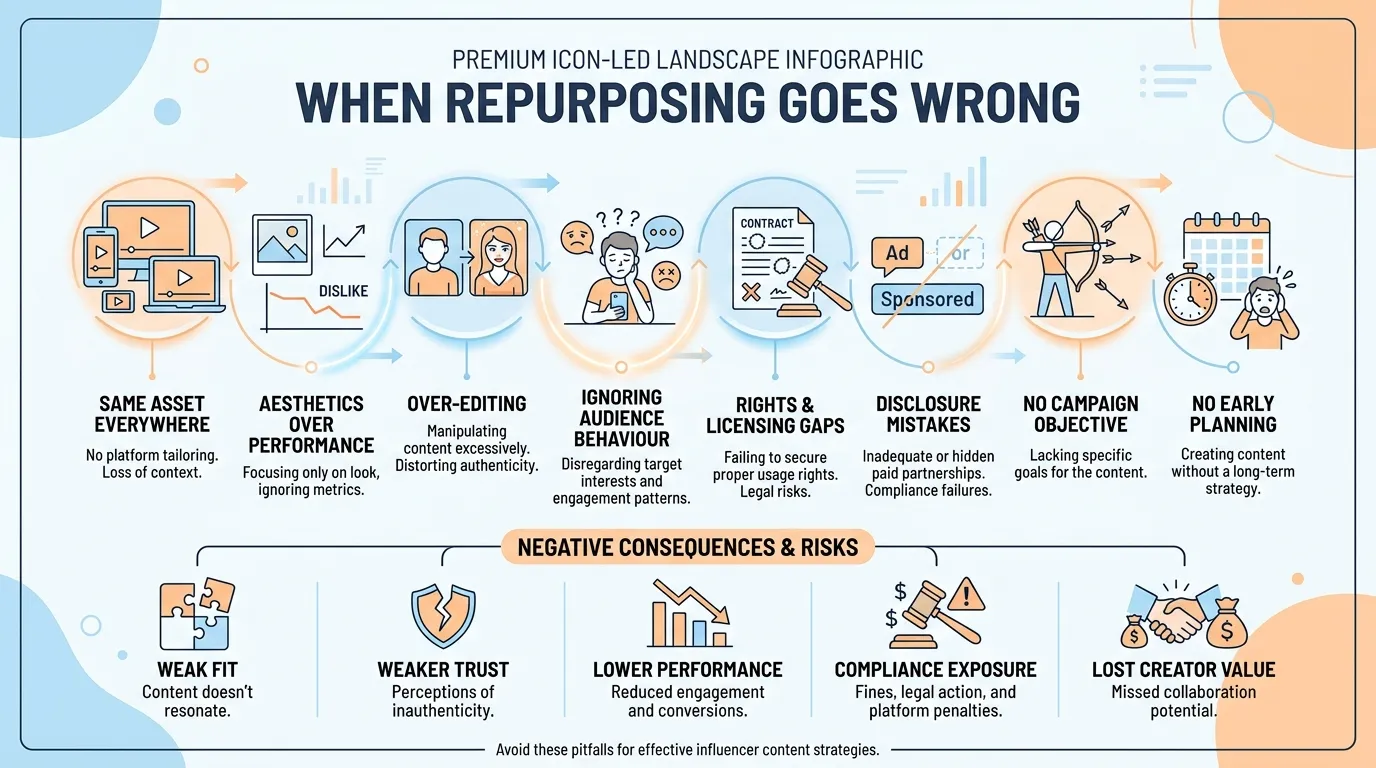
The biggest repurposing mistakes usually come from a weak process rather than weak content.
- Reusing the same asset everywhere without adapting it: A creator asset that works on one platform will not automatically work on another. Each channel has different content norms, audience expectations, and formatting needs.
- Choosing content based on polish instead of performance: The most visually refined asset is not always the most reusable. Stronger candidates usually have better retention, clearer messaging, and stronger trust signals.
- Over-editing until the creator’s voice disappears: Repurposing should improve platform fit without stripping away the authenticity that made the original content persuasive.
- Forgetting usage rights and editing permissions: Brands often assume they can reuse creator content freely across paid, owned, and organic channels. Without clear rights, this can create commercial and legal problems.
- Ignoring the business role of the asset: Repurposed influencer content should have a clear purpose, whether that is awareness, engagement, trust, traffic, or conversion. Without that, content may be reused without creating meaningful value.
The best workflows are planned early. When teams only think about reuse after the original post is live, they often discover too late that they lack the right footage, cutdowns, or permissions.
How to Measure the Performance of Repurposed Influencer Content
This section is where many brands default to vanity metrics. We prefer to separate performance by objective.
| Objective | Metrics to track | What it may indicate |
| Awareness | Reach, impressions, video views | Visibility and creative resonance |
| Engagement | Likes, comments, saves, shares | Relevance and audience interest |
| Traffic | CTR, landing page visits | Click intent |
| Conversion | Leads, sales, CPA, ROAS | Commercial effectiveness |
| Support | Assisted conversions, page engagement | Multi-touch contribution |
For organic performance, we look at watch time, completion rate, shares, saves, comments, and profile actions. These tell us whether the creator asset is genuinely earning attention.
For paid performance, we focus more on click-through rate, cost per click, cost per acquisition, conversion rate, and return on ad spend. Creator-led assets often perform well here because they feel more native than polished studio creatives, but we still test them against brand-produced ads rather than assuming they will always win.
For owned media, we look at time on page, product page engagement, scroll depth, assisted conversions, and email click performance. Repurposed creator content often shines in these environments because it reduces doubt at the point where a user is deciding whether to act.
Example scenario: In one typical test structure, we run a polished brand ad against a creator-led testimonial clip.
The polished ad may win on visual control, but the creator clip often wins on click quality or cost efficiency because it feels less interruptive and more believable. That is why we judge repurposing by business outcome, not by surface-level aesthetics.
Repurposing Influencer Content Checklist
Use this as a quick pre-launch check before reusing any creator asset:
- confirm reposting, editing, paid, and owned-media rights
- check whether partnership ads or whitelisting approval is needed
- score the asset for hook strength, clarity, trust, and flexibility
- match the asset to the right funnel stage
- re-edit it for the channel and objective
- confirm disclosure and compliance requirements
- route the final asset to paid, organic, or owned teams
- measure performance by use case
- archive winning versions in the content library
Use this checklist before you repurpose any creator asset. It helps make sure the content is approved, matched to the right channel, and ready to support the campaign objective.
Make Influencer Content Work Harder Across Every Channel
Repurposing influencer content is not about recycling old assets for convenience. It is about using creator content more strategically to support multiple platforms, campaign objectives, and stages of the customer journey.
When done well, it helps brands get more value from every collaboration, build greater consistency across channels, and turn strong creator assets into content that keeps working long after the original post.
The key is to approach repurposing with intention. That means choosing the right assets, adapting them to fit each platform, checking usage rights and disclosure requirements, and measuring performance against clear business goals. Agencies add value here because we do not just reuse content.
We reshape it to work harder, travel further, and contribute more meaningfully to the overall campaign. When influencer content is treated as a long-term asset rather than a one-time deliverable, it becomes far more powerful within a wider content strategy.
If you want to turn creator partnerships into content that drives stronger reach, sharper performance, and more lasting value across every channel, MediaOne can help.
As an influencer marketing agency in Singapore, we help brands plan, adapt, and scale influencer content more strategically so each collaboration works harder across your wider marketing ecosystem. Contact us to discuss your strategy.
Frequently Asked Questions
How can brands tell if influencer content is worth repurposing?
Brands should assess whether the content has already shown strong performance signals such as watch time, saves, shares, click-throughs, or conversions. We also look at whether the asset is sufficiently evergreen to remain relevant, whether it clearly communicates the product, and whether the usage rights allow broader deployment. Repurposing only makes sense when the content can support a clear business objective beyond the original post.
What should brands include in influencer contracts if they plan to repurpose the content?
If repurposing is part of the plan, the contract should clearly define usage rights, licensing duration, approved platforms, paid media permissions, website or email use, editing permissions, and any exclusivity terms. Without these details, brands may face delays, added costs, or restrictions later when trying to reuse the content. Clear terms upfront make repurposing smoother and more scalable.
Can repurposed influencer content be used in paid ads?
Yes, but only if the brand has secured the proper rights to do so. Paid usage often requires separate approval from the creator, especially if the content will be used in whitelisting, partnership ads, retargeting, or long-term ad campaigns. Before launching any paid campaign, brands should confirm that the agreement explicitly covers ad use.
Which types of influencer content usually perform best for conversions?
Content that addresses trust and product understanding tends to perform best for conversion-focused use. This often includes testimonials, product demos, review clips, before-and-after content, objection-handling videos, and FAQ-style creator content. These formats work well because they help move the audience from interest to action.
How should brands prioritise which influencer assets to repurpose first?
Brands should start with assets that combine strong performance with practical flexibility. In most cases, we would prioritise content that has already performed well organically, can be adapted across multiple formats, and fits multiple stages of the funnel. This approach is more effective than simply choosing the most polished asset.
When is it better to repurpose influencer content rather than create new content from scratch?
Repurposing is usually the better option when the existing asset is still relevant, has strong engagement or conversion potential, and can be adapted to a new channel or objective without losing quality. Creating fresh content makes more sense when the campaign message has changed, the previous content feels outdated, or the audience has already seen the asset too often. The decision should be based on performance, relevance, and content fatigue.
How can brands use repurposed influencer content on landing pages and product pages?
Brands can use creator testimonials, review clips, product demos, lifestyle imagery, or short explanation videos to increase trust and reduce hesitation on owned channels. This works especially well when the creator’s content answers common objections or shows the product in a realistic setting. The key is to place the content where it supports decision-making rather than distracts from conversion.
What metrics should brands track to know if repurposed influencer content is driving ROI?

Brands should track metrics based on the intended objective of the reused content. For awareness, that may include reach, views, and engagement. For performance campaigns, the stronger indicators are usually click-through rate, cost per acquisition, conversion rate, return on ad spend, and assisted conversions. ROI should be judged by commercial impact, not just by surface-level engagement.
What compliance checks should brands make before reusing influencer content across channels?
Before repurposing influencer content, brands should confirm that they have the right usage permissions, that any required disclosures remain clear, that edits do not distort product or service claims, and that the content still aligns with sector-specific advertising requirements where relevant. These checks become even more important when content moves into paid ads, lead generation, or regulated industries.