If you had asked me a few years ago whether SEO alone was enough to win local search in Singapore, I would have said yes.
Today, I would not.
I have spent years helping Singapore brands earn visibility in Google Search, Google Maps, and local pack results. That still matters. A lot. But the search journey has changed. People are no longer relying only on blue links. They are asking full questions. Google is generating summaries. AI tools are recommending brands before a user ever clicks a website.
That is why the GEO vs SEO conversation matters now.
For most businesses in Singapore, this is not a choice between one strategy and the other. The question is how to use both well.
But if I had to answer the title directly, my view is this: for most Singapore businesses, SEO matters more first, and GEO matters more next.
SEO is what gets you into the local search conversation in the first place. GEO is what helps you stay visible as search becomes more answer-led, summary-led, and recommendation-led.
Key Takeaways
- For most local businesses in Singapore, SEO should be prioritised first because it drives visibility in Google Search, Google Maps, and local pack results.
- GEO vs SEO is not a choice between two strategies; SEO builds visibility in search results, while GEO ensures brands are cited and recommended in AI-generated answers.
- SEO remains the foundation for local visibility in Singapore, driven by technical optimisation, content quality, and trust signals.
- GEO expands visibility by making content easier for AI systems to interpret, extract, and include in summaries and recommendations.
- Businesses can rank well on Google yet miss AI-driven exposure if their content lacks clarity, structure, and authority signals.
- The most effective strategy combines SEO fundamentals with structured, high-quality content that performs across both traditional search and AI-driven environments.
Quick Answer: GEO vs SEO Agency?

An SEO agency in Singapore helps your website rank in search engine results and local map listings.
On the other hand, a GEO agency in Singapore helps your brand get cited, summarised, and recommended in AI-generated answers.
SEO is still how you earn visibility in traditional Google results. GEO is how you stay visible when search engines and AI systems answer the question for the user.
If SEO helps you get found, GEO helps you get mentioned.
That difference is now shaping how local businesses win trust, clicks, leads, and mindshare in Singapore.
If you want the shortest possible answer to the title, here it is:
SEO matters more when you are trying to win rankings, Maps exposure, and local pack visibility. GEO matters more when users are researching, comparing, and relying on AI summaries before they ever click.
For most SMEs, the practical sequence is SEO first, GEO second, then both together.
GEO vs SEO at a Glance
| Factor | SEO | GEO |
| Main goal | Rank higher in search results | Get cited or referenced in AI-generated answers |
| Primary output | Blue links, local pack, Maps results | AI summaries, answer boxes, conversational responses |
| User behaviour | Clicks through to your site | May never click, but still sees your brand |
| Content focus | Keywords, on-page relevance, backlinks | entity clarity, semantic depth, structured answers |
| Technical focus | Crawlability, page speed, internal linking, schema | extractability, schema, clear formatting, trusted signals |
| Success metrics | Rankings, CTR, traffic, leads | Mentions, citations, branded search lift, assisted conversions |
| Best for | Search demand capture | AI visibility and recommendation influence |
That table is useful, but the key practical distinction is this: SEO helps you win discoverability. GEO helps you win interpretability. In other words, SEO helps search engines find you, while GEO helps AI systems understand what you do, why you are credible, and when you deserve to be included in an answer.
Why This Matters for Singapore Businesses
I see this shift clearly in Singapore.
A user in Orchard searching for a dentist, a parent in Bukit Timah looking for tuition, or a founder in Raffles Place comparing digital agencies may never browse ten results the way they used to. They may see a local pack, an AI Overview, a shortlist, or a direct recommendation.
Google has already confirmed that local results are influenced by relevance, distance, and prominence. At the same time, Google’s move into AI-generated search experiences has made brand interpretation and source selection more important than ever.
For Singapore businesses, that means this:
- You can rank well and still miss the recommendation layer.
- You can also be mentioned in an AI answer even if you are not in position one.
That is why I no longer look at local visibility through a pure SEO lens. I look at whether a business is visible across both the ranking layer and the AI interpretation layer.
This matters especially in Singapore because many local searches are split into two very different behaviours. Some are immediate-action searches such as “dentist near me”, “24-hour plumber”, or “tuition centre bukit timah”.
Others are research-heavy searches such as “best renovation contractor in Singapore”, “how to choose a corporate lawyer”, or “SEO agency vs GEO agency”.
The first group is still strongly shaped by local SEO fundamentals. The second group is where GEO starts to have much more influence over who gets summarised, compared, remembered, and shortlisted.
My View as an SEO Strategist: SEO Still Runs the Foundation
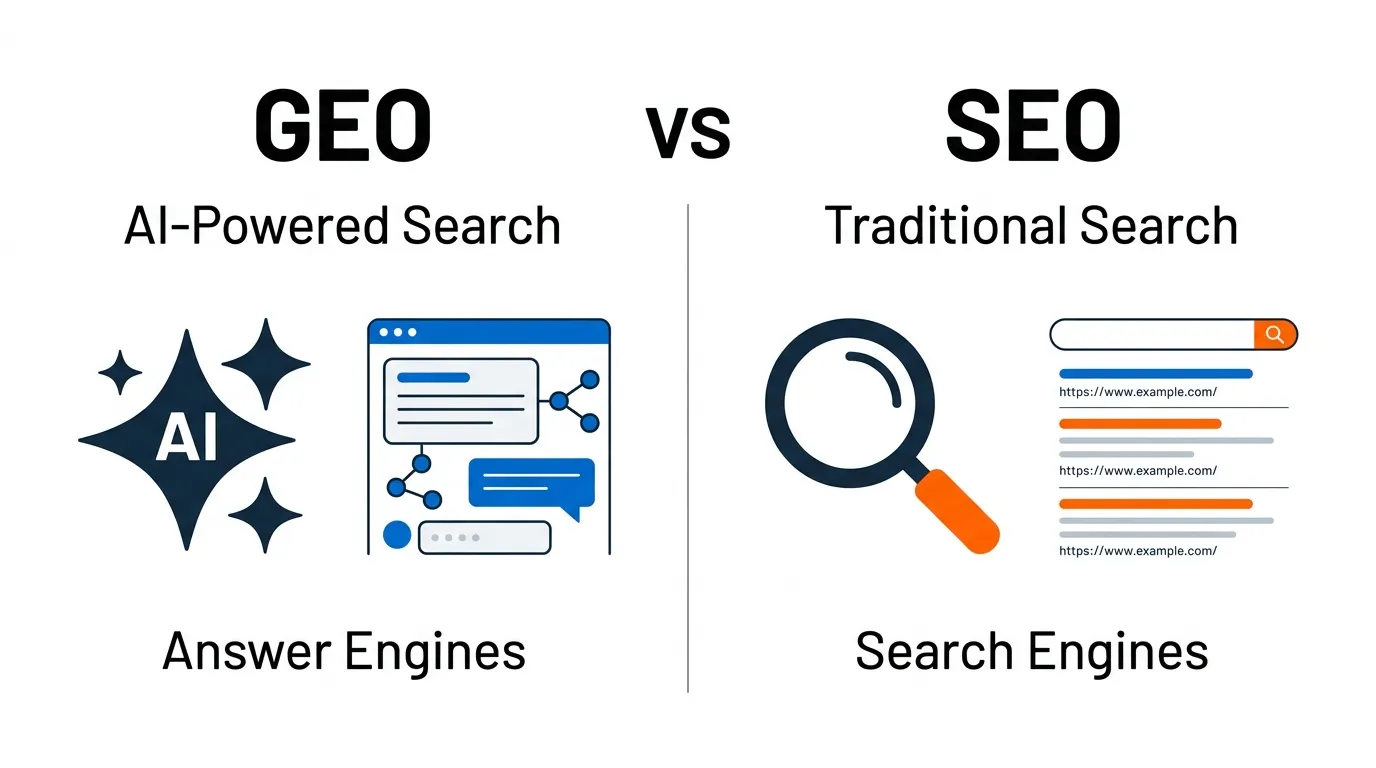
Let me be clear. SEO is not dead. It is still the foundation.
If you want to show up in Google Search, Google Maps, and local pack results, you still need solid SEO fundamentals:
- Technically sound pages
- Clear service and location relevance
- Strong internal linking
- Fast mobile performance
- Quality backlinks
- Accurate business information
- Consistent reviews and citations
In Singapore, these fundamentals still decide who gets into the local consideration set.
If I am working with a clinic in Novena, a law firm in Raffles Place, or a renovation company targeting Tampines and Punggol, I still care about:
- Google Business Profile optimisation
- Review quality and review velocity
- Service-location page depth
- NAP consistency
- Page experience
- Trust signals on the site
Google’s own guidance still emphasises relevance, distance, and prominence for local results.
So when people ask me whether GEO is replacing SEO, my answer is simple:
No. GEO does not replace SEO. It builds on it.
That point is worth making more explicitly. If your business is weak on the signals Google already uses for local ranking, GEO will not rescue you.
If your Business Profile is incomplete, your location pages are thin, your reviews are poor, and your business details are inconsistent, you have not yet built the base layer. SEO matters more at that stage because you are still trying to earn relevance, distance alignment, and prominence.
What SEO Still Controls in Local Search
To make the distinction clearer, here is what SEO still controls most directly in local search visibility:
- Google Business Profile strength: Your categories, business details, reviews, photos, and completeness all affect how clearly Google understands your business and when it should be shown.
- Relevance to service and location intent: If your pages do not clearly connect services to the places you serve, it becomes harder to rank for local intent.
- Distance and geographic fit: No amount of clever content changes the fact that local search is partly constrained by geography. For some queries, proximity still matters a lot.
- Prominence signals: Reviews, backlinks, directory mentions, press coverage, and brand recognition still influence how established your business appears.
- Technical accessibility: If your site is slow, hard to crawl, poorly structured, or confusing on mobile, you weaken both your rankings and your usability.
That is why I would still tell a Singapore SME with limited resources to fix SEO before worrying too much about GEO. If your basics are weak, that is the highest-leverage place to start.
Where GEO Changes the Game

What has changed is how search engines and AI systems surface information.
Google’s AI search experience is designed to synthesise information across multiple sources, not just reward one ranking page. That changes how users discover businesses, especially for informational and research-heavy queries.
This is where GEO matters.
GEO, or Generative Engine Optimisation, is about making your content easy for AI systems to understand, trust, and reuse.
That means your content needs to be:
- Factually clear
- Well structured
- Semantically rich
- Easy to extract
- Supported by strong brand and authority signals
In practical terms, GEO improves your chance of being included when users ask questions like:
- “What is the difference between GEO and SEO?”
- “Which SEO agency in Singapore understands AI search?”
- “How should a local business optimise for AI Overviews?”
In those moments, the AI engine is not just ranking pages. It is interpreting who deserves to be included in the answer.
That is the real shift. SEO is still about earning placement. GEO is increasingly about earning inclusion.
What GEO Adds That SEO Alone Does Not
To make this less abstract, here is what GEO adds that SEO alone does not fully solve:
| What GEO Adds | What It Means |
| Summary-friendly content structure | AI systems respond better to pages with direct definitions, clean headings, comparison tables, FAQs, and concise explanations. |
| Entity clarity | A brand is easier to cite when the page makes it obvious who the company is, what it does, where it operates, and who is behind the advice. |
| Authorship and trust visibility | Author pages, About pages, credentials, case studies, and references help an AI system see the content as more trustworthy. |
| Extractability | A long page can rank, but if its best points are buried in vague paragraphs, it is harder for AI systems to quote or summarise accurately. |
| Recommendation readiness | Some pages attract traffic but never become memorable sources. GEO improves the chance that your brand appears in comparative, advisory, and research-led responses. |
GEO vs SEO for Local Search in Singapore
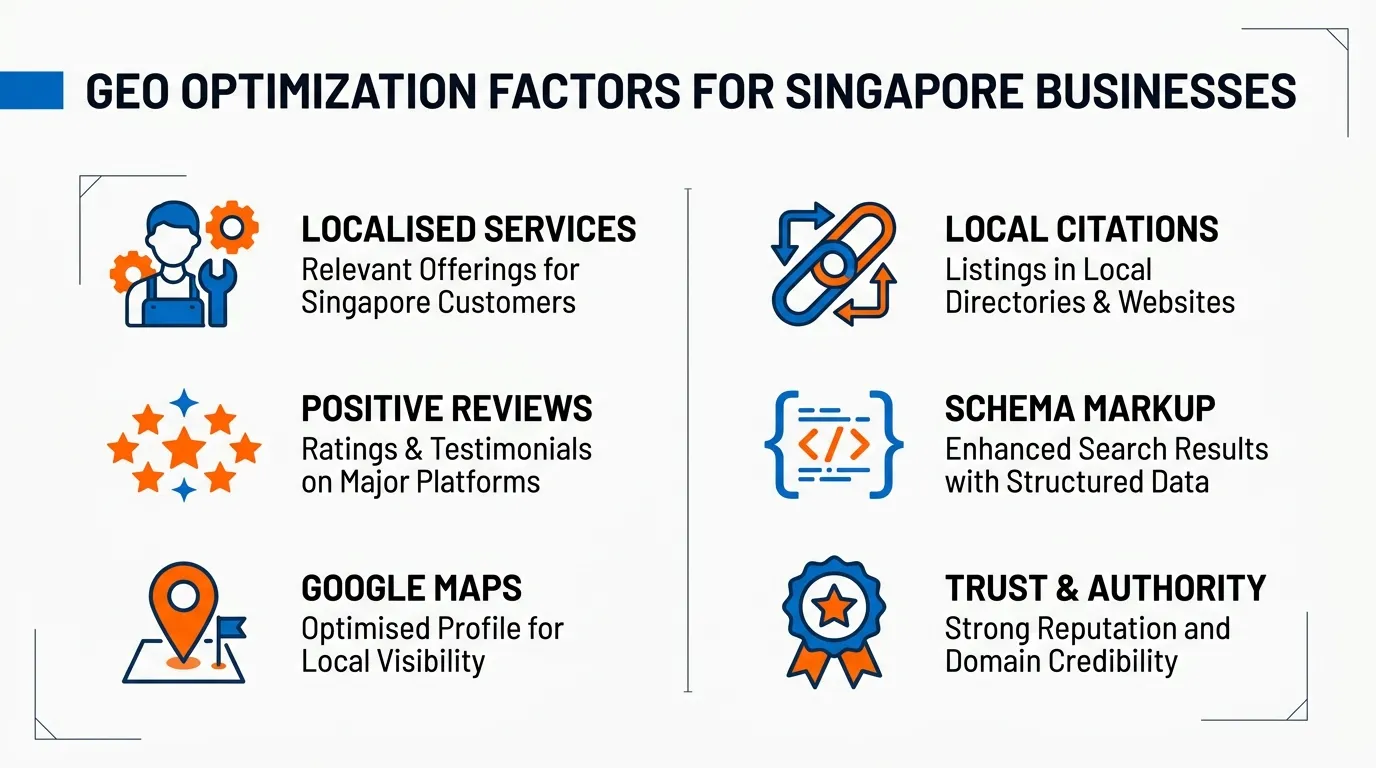
This matters even more in local search.
Traditional local SEO helps you compete in map listings and location-based search results. GEO helps you become a credible source when AI tools summarise who is relevant, trustworthy, or worth considering.
I think of it this way:
- SEO helps you enter the room
- GEO helps you get introduced
For Singapore businesses, that difference is huge.
A restaurant, tuition centre, legal practice, or dental clinic may already rank locally. But if its information is thin, generic, or hard for machines to parse, it is less likely to appear in AI-led recommendations.
On the other hand, a brand with:
- Strong service explanations
- Credible reviews
- Clear local relevance
- Trusted mentions across the web
- Structured data
- Expert-led content
is far easier for an AI system to understand and recommend.
That is why I now advise clients to optimise not only for the click, but also for the citation.
In practical terms, a “dentist near me” query in Singapore may still be dominated by proximity, profile quality, and reviews. But a query like “how to choose a dentist for Invisalign in Singapore” or “best tuition centre for PSLE English” creates a very different search environment.
That is where structure, clarity, expertise, and summary-worthy content start to matter more. One query is primarily local-pack driven. The other is far more likely to involve AI-led comparison and interpretation.
What Matters More by Business Scenario in Singapore
To answer the title more directly, here is the framework I would use.
- If you are not visible in Maps or the local pack yet, SEO matters more: If your business is struggling to appear for obvious local-intent searches, the priority is not GEO. It is local SEO. That usually means improving your Google Business Profile, strengthening your reviews, tightening NAP consistency, and building stronger service-plus-location pages.
- If you already rank reasonably well but want to expand influence, GEO matters more next: Once your baseline visibility exists, the next challenge is becoming the business that gets mentioned, summarised, and remembered. This is where GEO starts to matter more because it influences how your brand shows up in AI-generated research journeys.
- For “near me” and urgent-intent queries, SEO usually matters more: Examples include emergency dental, locksmith, urgent repair, same-day courier, or nearby enrichment classes. These searches are still heavily shaped by local pack signals, proximity, reviews, and Business Profile quality.
- For high-consideration or comparison-heavy services, GEO matters more earlier: Examples include law firms, renovation companies, B2B agencies, financial advisory, specialist clinics, accounting firms, and premium education providers. In these categories, people often research before they contact. That means AI summaries, comparison-style content, and trust-rich pages can shape the shortlist before a click happens.
- For SMEs with limited resources, the order should usually be SEO first, GEO second: If budget is limited, I would not split effort evenly from day one. I would fix the SEO foundation first, then improve content so it performs in both traditional search and AI-led environments. That is the most practical path for most Singapore SMEs.
What Google’s Quality Signals Still Tell Us
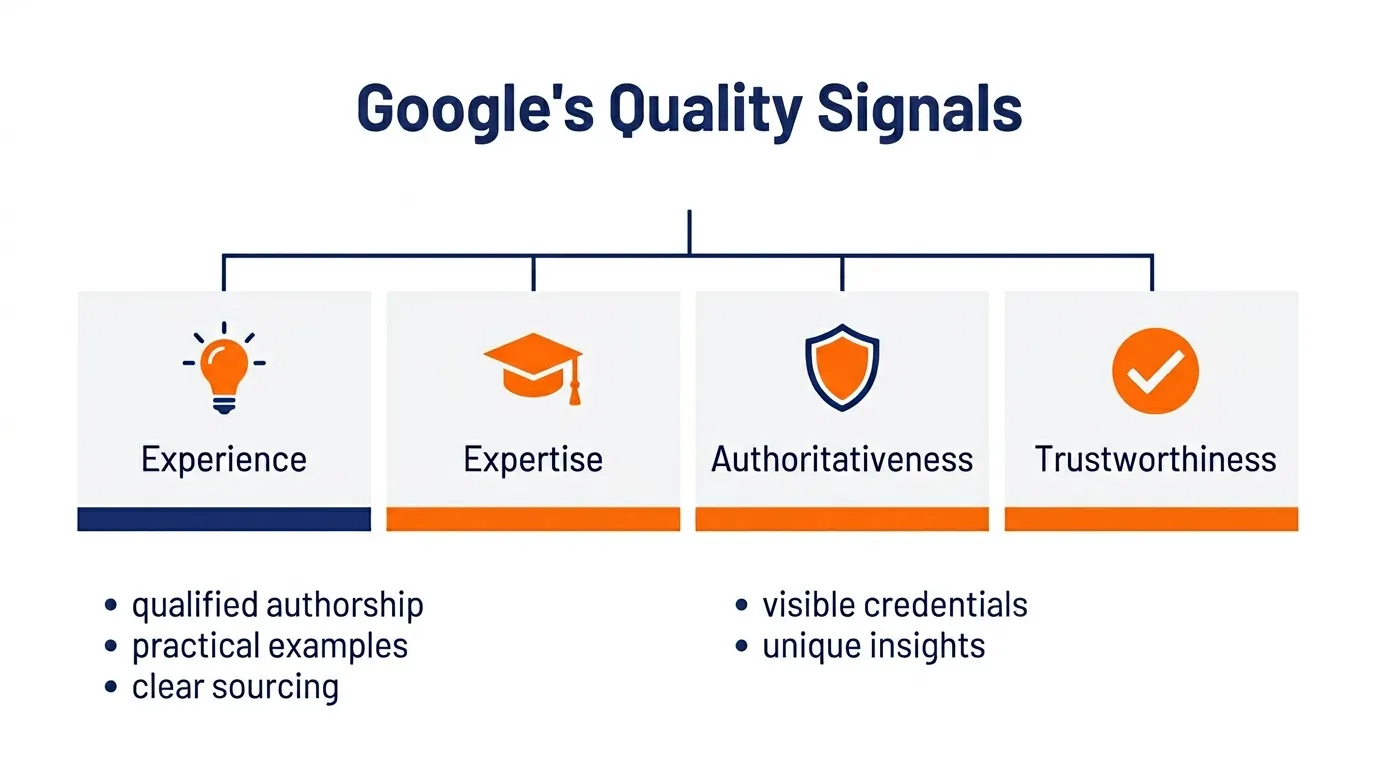
When I audit content today, I still keep Google’s quality principles in mind.
Google’s Search Quality Evaluator Guidelines emphasise E-E-A-T: Experience, Expertise, Authoritativeness, and Trustworthiness
That matters for both SEO and GEO.
If your content looks polished but lacks real expertise, real examples, clear sourcing, or visible authorship, it becomes harder to trust. And when trust is weak, both rankings and AI citation potential suffer.
For a topic like GEO vs SEO, that means I want an article to show:
- Who is writing it
- Why are they qualified
- What they have seen in practice
- What trusted sources support the argument
- What unique insight does the page add
This is one reason I prefer writing from experience.
I do not want a generic article that simply repeats what every other marketing blog says. I want a page that reflects what I have seen in the field, how local search is changing in Singapore, and what businesses actually need to do about it.
Google’s people-first guidance is especially relevant here because GEO can easily become a buzzword trap. If brands start mass-producing shallow “AI-optimised” pages that add no real insight, they may make their sites more extractable, but not more useful.
That is the wrong direction. The best GEO content is still helpful content. It is just better structured, clearer, and easier for both humans and machines to use.
SEO and GEO Overlap More Than Most People Realise
Many marketers frame this as a battle.
I do not.
The best SEO pages already do many things GEO needs:
- They answer intent well
- They structure information clearly
- They use strong headings
- They build topical authority
- They earn links and mentions
- They demonstrate trust
That is why I tell clients not to split SEO and GEO into separate silos too early.
In most cases, the smarter move is to create content that performs in both environments.
That means building pages that are:
- Useful to humans
- Clear to crawlers
- Easy for AI systems to extract
- Strong enough to earn trust beyond your own website
SEO Mechanics vs GEO Mechanics
One reason this topic gets muddled is that people often blur the mechanics. I prefer separating them clearly.
| SEO for Local Search Visibility | GEO for AI-Led Visibility |
| Google Business Profile optimisation | Clear definitions near the top of the page |
| Review quality and review velocity | Concise answer blocks |
| NAP consistency | Comparison tables and FAQ structures |
| Service-area relevance | Visible authorship and expert positioning |
| Service-location pages | Robust About, author, and business pages |
| Internal linking | Entity consistency across the web |
| Core Web Vitals and mobile usability | Extractable formatting and semantic clarity |
| Backlinks and local citations | Off-site mentions that reinforce credibility |
When I explain it this way to business owners, the distinction becomes much easier to act on. SEO improves your ability to rank. GEO improves your ability to be summarised, quoted, and recommended.
How I Optimise for GEO and SEO Together
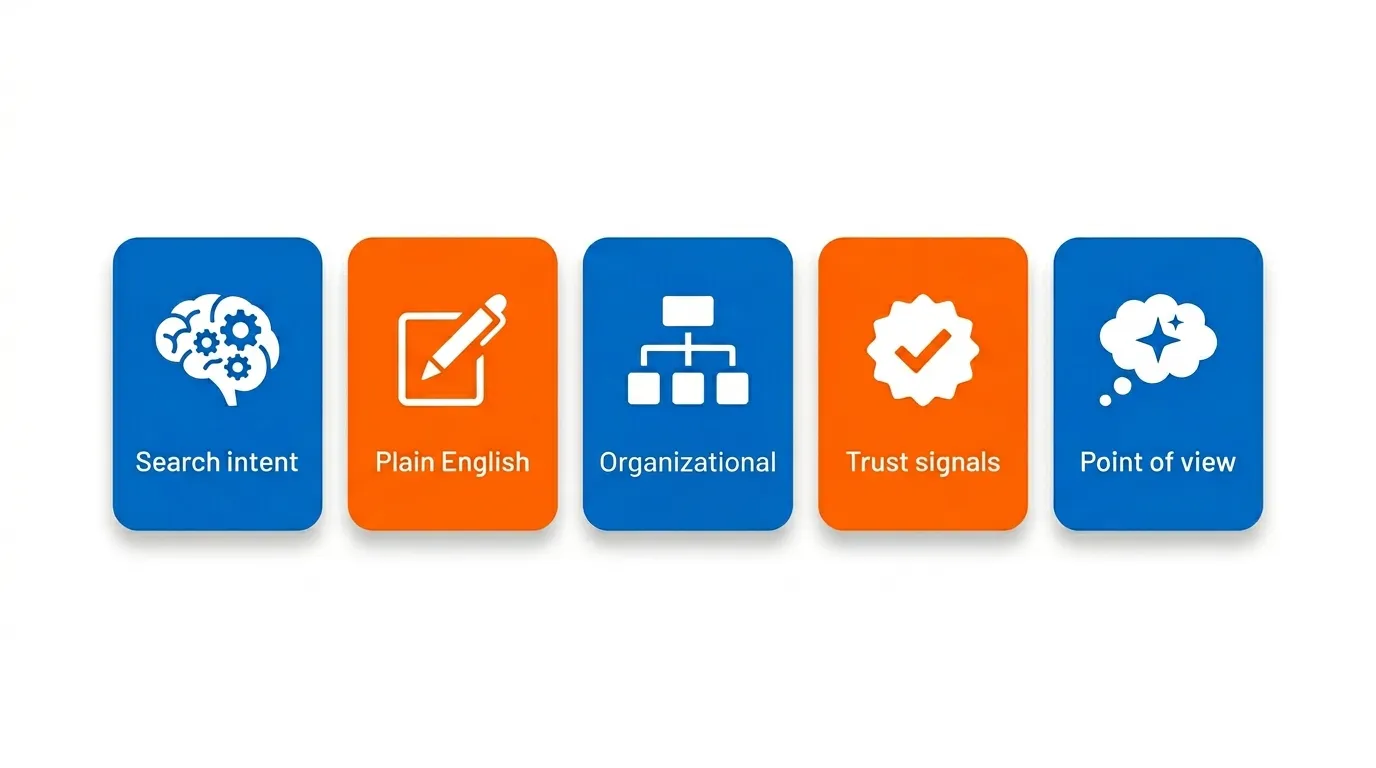
When I build a content strategy today, I use a hybrid approach.
Here is what that looks like.
1. I start with search intent, not just keywords
For a query like “GEO vs SEO”, I know the user usually wants four things:
- a clear definition
- the difference between the two
- whether both matter
- what to do next
That means I do not bury the answer.
I give the definition early. I use a comparison table. I explain the business impact quickly. Then I go deeper.
2. I write in plain English
AI systems prefer clear, direct language. So do busy decision-makers.
That is why I keep paragraphs shorter, remove filler, and avoid saying the same thing three different ways. This also improves readability, which matters for engagement and comprehension.
3. I structure for extraction
If I want a page to perform in AI-led environments, I make it easy to quote and summarise.
That means using:
- Clear H2s and H3s
- Concise definitions
- Bullets and tables
- FAQ-style sections
- Strong topic hierarchy
- Obvious takeaways
4. I strengthen entity and trust signals
A brand is easier to recommend when it is consistent across the web.
So I look at:
- About page quality
- Author credibility
- Case studies
- Reviews
- Directory consistency
- External mentions
- Schema and business details
5. I publish content with a real point of view
This is where most brands fall short.
If your article says exactly what everyone else says, you become replaceable.
If your article adds original observations, local context, practical frameworks, or first-hand experience, you become more useful.
That is what I want from a page targeting GEO vs SEO.
6. I separate “ranking content” from “citation content”
Not every page has to do the same job. Some pages are designed to capture clear local intent, such as service pages, location pages, and Google Business Profile traffic.
Other pages are better positioned to earn AI inclusion, such as explainers, comparisons, buyer guides, and decision-stage FAQs. The strongest strategy connects both.
7. I design pages to answer the obvious follow-up questions
If someone lands on a page about GEO vs SEO, they usually also want to know which matters first, what applies to their type of business, what to measure, and what to fix next.
Pages that answer these follow-up questions tend to perform better for users and are also easier for AI systems to reuse because the content is self-contained and logically complete.
What an AI-Friendly Local Page Looks Like
This is where the GEO conversation becomes practical.
An AI-friendly local page usually has:
- A direct explanation of the service
- A clear description of who it is for
- Specific references to Singapore locations or service areas
- Useful FAQs
- Trust markers such as reviews, credentials, case studies, or author context
- Clean headings that make each section easy to summarise
- Simple language that avoids generic filler
By contrast, an AI-unfriendly page often looks like this:
- It is stuffed with city names
- It repeats vague claims like “we are the leading provider”
- It explains little about the actual service
- It hides important details inside large blocks of text
- It gives no clear evidence of expertise
- It offers no concise answer that an AI system can extract cleanly
I often see thin local pages that were built mainly to rank for combinations like “service + location”. Some of them can still appear somewhere in search because the domain has enough authority or the competition is weak.
But they are poor candidates for citation because they say very little in a trustworthy, structured, quotable way.
What I See in Real Content Audits
One pattern I keep seeing is this: pages that rank are not always deserving of a summary.
In content audits, I often find Singapore service pages with enough SEO signals to appear in search results, but not enough clarity to become strong AI source candidates. They are usually too generic, too padded, or too similar to competitor pages.
I also see the opposite. Some businesses publish excellent expert content, but it is buried inside weak site architecture, poor internal linking, or unoptimised local pages. In those cases, the content may deserve trust, but the SEO foundation is not strong enough.

The businesses that perform best tend to combine both. Their pages are locally relevant, technically solid, and structurally easy to summarise. They explain real services clearly. They show who is behind the advice. And they reinforce that trust across the rest of the web.
The Rise of Zero-Click Search Makes GEO Harder to Ignore
One of the clearest signals of change is zero-click behaviour. SparkToro’s analysis found that a large share of Google searches end without a click.
That does not mean search is less important.
It means influence is moving earlier in the journey.
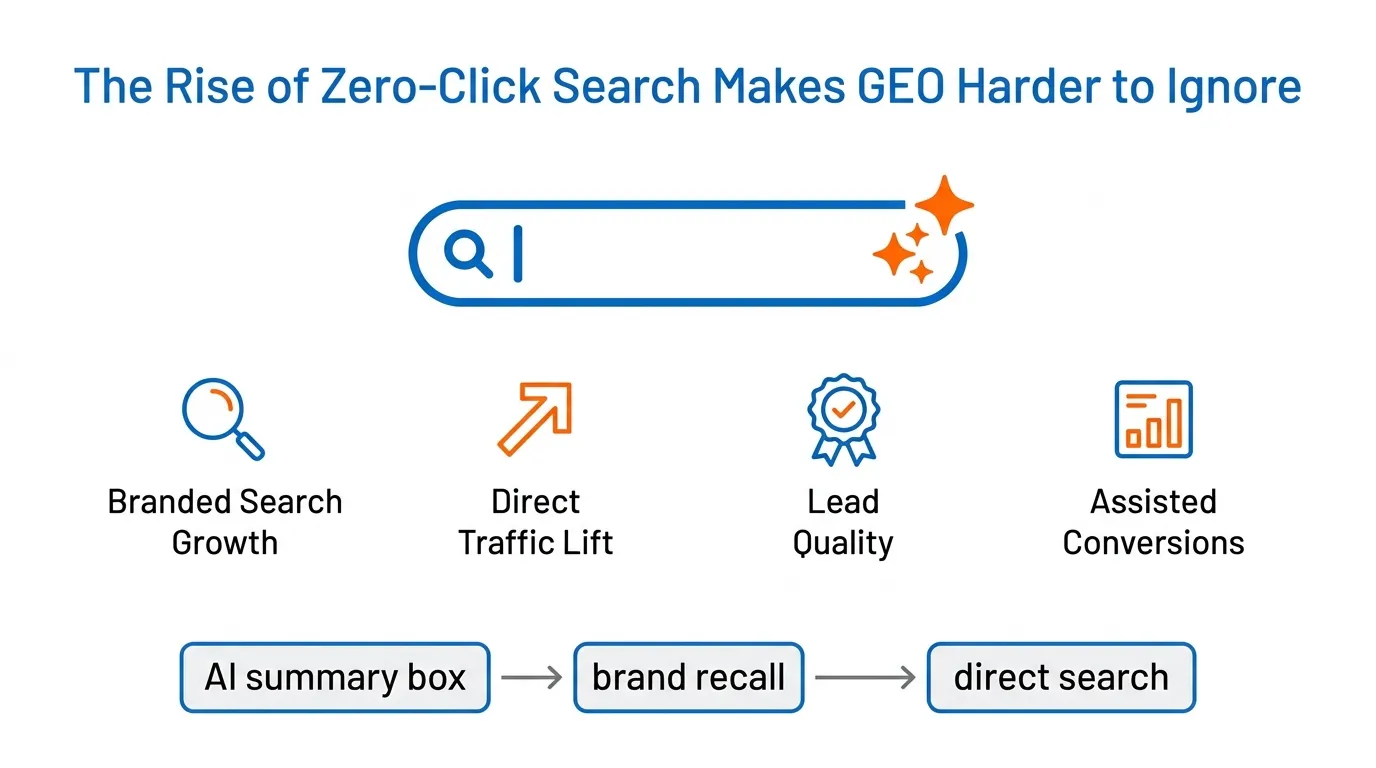
If a user sees your brand inside an AI summary, remembers your name, and later searches for you directly, the click still happened. It just happened later.

I have seen this pattern more often in high-consideration services. Users may not click the first informational result. But they remember the brands that appear repeatedly in trusted places.
So if you only measure SEO by raw organic traffic, you may miss the wider visibility effect.
Today, I also watch for:
- Branded search growth
- Direct traffic lift
- Lead quality
- Assisted conversion patterns
- Presence in AI summaries and answer surfaces
That is why I think it is useful to separate the four layers of visibility now:
- Ranking visibility: Where you appear in organic search and Maps
- SERP-surface visibility: Whether you appear in local packs, snippets, or other search features
- AI summary inclusion: Whether your brand or content is being incorporated into AI-led answers
- Brand recall without click: Whether users later search for you directly because they encountered you earlier in the journey
When businesses only measure the first layer, they can underestimate the impact of the other three.
What a Singapore Business Should Prioritise First
If you run a business in Singapore and want to improve local visibility, here is the order I would prioritise.
- First, fix your SEO foundation: Make sure your site is crawlable, fast, mobile-friendly, and organised around clear services and locations.
- Second, improve your content quality: Write pages that answer real questions in plain English. Add service detail, pricing context where relevant, FAQs, and strong proof.
- Third, tighten your trust signals: Show who wrote the content. Explain your experience. Add real business details, credentials, testimonials, and references.
- Fourth, make your content easier for AI systems to use: Use headings, tables, FAQs, schema, and clear definitions. Avoid vague fluff.
- Fifth, build authority beyond your own website: If nobody else mentions your brand, you are harder to trust. Reviews, directories, local press, partnerships, and industry mentions all help.
If I had to simplify this for an SME owner, I would say:
Phase 1: Be rankable
Fix your site, profile, pages, reviews, and citations.
Phase 2: Be understandable
Make your content easy to parse, quote, and summarise.
Phase 3: Be recommendable
Strengthen the trust signals that make your brand worth mentioning.
What to Measure Now
If search visibility now spans rankings, summaries, and recommendation surfaces, your reporting should evolve too.
At a minimum, I would track:
- Local pack and Maps visibility
- Organic rankings for service and location queries
- Organic traffic by page type
- Branded search growth
- Lead quality by landing page
- Pages that attract assisted conversions
- Mentions or recurring inclusion in AI summaries where observable
- Growth in high-trust signals such as reviews, links, citations, and brand mentions
This matters because a page that loses some clicks may still be doing strategic work if it improves brand recall, drives later branded searches, or influences shortlist formation. That is one of the big reporting shifts I think more Singapore businesses will need to make.
My Thoughts on GEO vs SEO
If you ask me whether GEO vs SEO is the future of local search, I would say this:
It is already here.
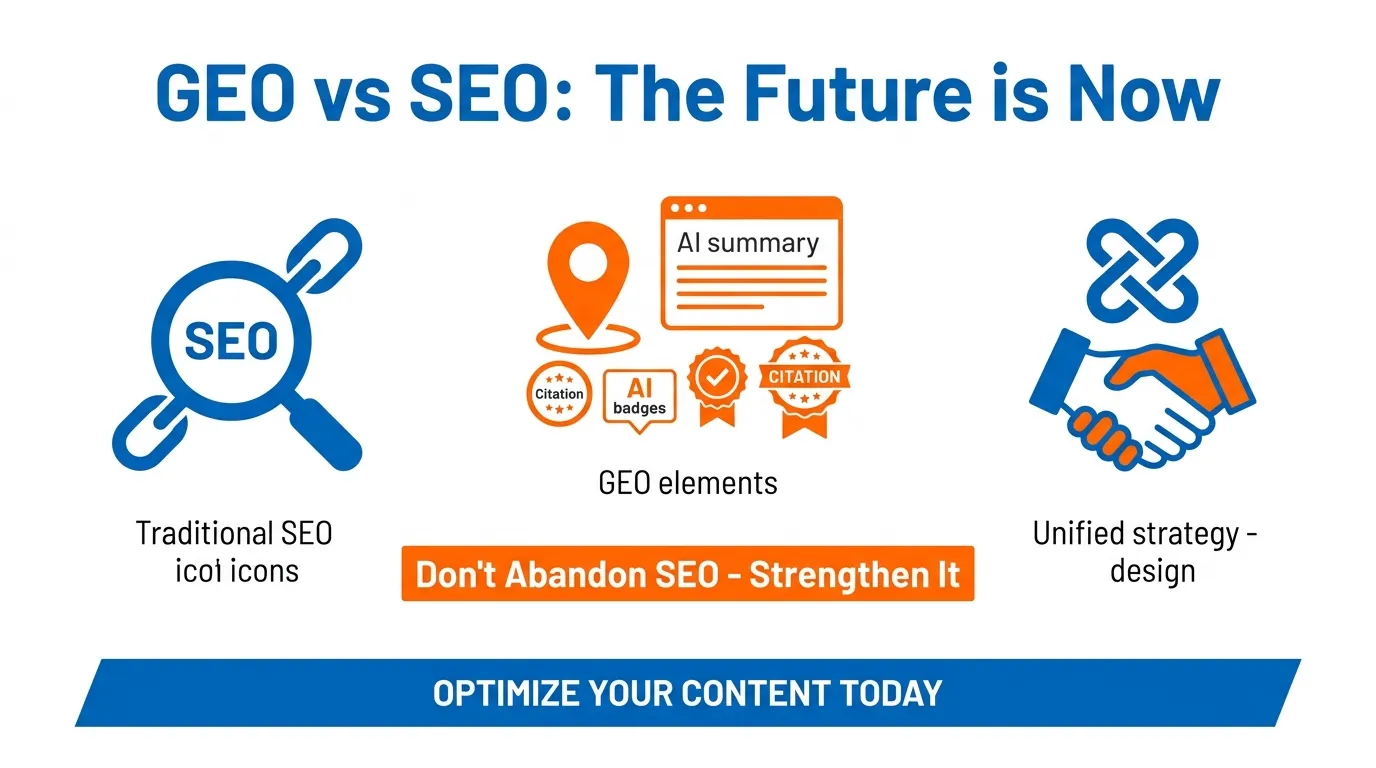
In Singapore, I still see too many businesses treating SEO as a race for blue links alone. That is outdated thinking. Search now includes rankings, maps, summaries, citations, and recommendations. If your strategy only covers one layer, your visibility is incomplete.
My advice is simple.
Do not abandon SEO. Strengthen it.
Then build content and brand signals that make your business easy to understand, easy to trust, and easy to recommend.
That is how you win local visibility now.
And that is how I would approach search if I wanted a Singapore business to stay relevant for the next few years, not just the next few months.
If you want the clearest answer to the title, here it is again: SEO matters more first. GEO matters more once the SEO foundation is in place and the goal shifts from merely being visible to being meaningfully included in AI-led discovery.
The businesses that will do best are the ones that stop treating those as competing ideas and start treating them as sequential layers of modern search visibility.
If you are a Singapore business owner, the useful question is no longer “SEO or GEO?” It is “Are we visible in both the ranking layer and the recommendation layer?” That is the audit I would run first. And that is the strategy I would build from there.
Make sure you call our MediaOne team to learn how we handle the GEO vs SEO debate.
Frequently Asked Questions
Is GEO replacing SEO?
GEO is not replacing SEO. SEO remains the foundation for ranking in search results, especially for local visibility in Singapore. GEO builds on that by improving how content is interpreted and cited by AI systems. The two work together rather than competing.
Does GEO matter for local businesses in Singapore?
Yes, GEO matters increasingly for local businesses in Singapore. Users are relying more on AI summaries and recommendations rather than browsing multiple results. This means being mentioned in AI-generated answers can influence decisions even without a click. Businesses that optimise for both layers gain stronger visibility.
What matters more today, GEO or SEO?
Neither is more important on its own. SEO still drives discoverability through rankings and local search results, while GEO influences how brands appear in AI-driven experiences. Focusing on only one creates gaps in visibility. A combined approach delivers better outcomes.
Can I rank on Google and still miss AI visibility?
Yes, this is already happening. A page can rank well but still be excluded from AI summaries if it lacks clarity, structure, or trust signals. AI systems prioritise content that is easy to extract and verify. Ranking alone does not guarantee inclusion in AI-generated answers.
What type of content works best for both GEO and SEO?
Content that is clear, structured, and aligned with search intent performs best for both GEO and SEO. This includes well-organised pages with strong headings, concise explanations, and credible information. Adding real expertise and local context also improves trust. Content should be useful for users and easy for machines to interpret.