
Early on, we ran a travel campaign that looked perfect on the surface. At the time, we believed we had a strong grasp of travel influencer marketing. The strategy seemed straightforward: Partner with visually compelling creators, showcase a premium destination, and let the content do the work.
A luxury property came on board. We lined up several influencers with strong followings across different regions. The content was polished. The locations were stunning. Within the first week, engagement numbers came in strong. Likes, shares, and comments all pointed in the right direction.
But when we moved past surface metrics and looked at booking data from international markets, the lift was minimal.
That was the moment the gap became obvious.
We had created content that people admired. Not content, that moved them to travel.
It forced us to re-evaluate how travel decisions actually happen. People do not book because a destination looks good. They book when they can imagine themselves there, when the experience feels real, and when the content answers questions they did not even realise they had.
That experience reshaped how we approach travel influencer marketing, especially for brands trying to reach beyond their home market. It shifted our focus from aesthetics to intent, from reach to resonance, and from one-off campaigns to structured storytelling that builds momentum across platforms.
For brands looking to scale globally, this shift is not optional. It is the difference between visibility and actual demand. For those exploring how to approach this more strategically, working with a travel influencer marketing agency in Singapore can help bridge that gap with the right combination of creators, content, and campaign structure.
Key Takeaways
- Travel influencer marketing is most effective when built on storytelling that creates familiarity and trust before booking decisions
- Audience intent, creator alignment, and platform strategy matter more than follower count alone
- Multi-platform and multi-creator campaigns improve reach and consistency across global markets
- Structured strategies outperform one-off campaigns in driving both engagement and conversions
Why Travel Influencer Marketing Matters for Global Reach in 2026

I used to think travel marketing started with search. We would optimise for keywords, build landing pages, and assume travellers would follow a logical path from research to booking.
For a while, that worked. Then behaviour started to shift, and the change was subtle enough that many brands did not notice it immediately.
Travel discovery no longer begins with intent. It begins with exposure.
In Singapore, 70% of travellers now say they seek travel inspiration from social media. At the same time, Singapore had 5.16 million social media user identities in January 2025, equivalent to 88.2% of the population.
That matters because it means discovery is happening inside feeds and video platforms long before a search query is typed.
A few years ago, someone planning a trip would type “best places to visit in Bali” or “top hotels in Tokyo” and compare options across articles and booking platforms. Today, that same journey often starts passively.
A person scrolling through their feed comes across a sunrise hike in Lombok. Another watches a hotel walkthrough in Kyoto without actively seeking it out. Someone else follows a creator documenting a week-long itinerary in Switzerland, not because they planned to go, but because the content pulled them in.
That pattern is now visible in the data. Across the Asia-Pacific markets surveyed by Trip.com Group, more than half of travellers said they are likely to book a trip based on what they have seen on social media.
In Singapore specifically, social-driven discovery is already translating into destination interest, with Tokyo, Bali, and Kyoto among the places most influenced by social content.
I have seen this sequence repeat across campaigns, and recent data supports why it works:
- Exposure creates curiosity.
- Curiosity builds familiarity.
- Familiarity reduces hesitation.
- Only then does intent begin to form.
Globally, half of consumers say they have wanted to book a trip they saw on their social feeds. Among Millennials and Gen Z, 80% say they like the convenience of using travel-planning apps or social media to plan their trips. By the time someone searches, the decision is often already being shaped.
This is where many traditional strategies fall short. They focus on capturing demand rather than creating it.
Creator-led content in Singapore is especially effective in the consideration stage. AnyMind’s 2025 Singapore Digital Landscape report found that Singaporean audiences are 62% more likely to respond to sponsored influencer content and 49% more likely to engage with influencer-led short videos.
If discovery now happens earlier and more passively, then creator content is no longer an add-on to the funnel; it is part of how the funnel begins.
What the data also shows is that familiarity and authenticity matter more than polished promotion. 70% of travellers say they are likely to book accommodation based on access to unique local experiences, 92% rank exploring local and traditional food and beverage as important, and 84% want to connect with the local community and better understand a destination’s history and heritage.
In other words, audiences respond more strongly to lived experience than to generic claims.
That same pattern holds across Asia. Hilton’s 2024 Asia-Pacific research found that 77% of travellers in the region are seeking to better understand their own heritage through travel, while 88% rank local and traditional food and beverage as a top travel consideration.
This helps explain why narrative-driven creator content outperforms static destination marketing: people are not only looking for places to stay, they are looking for meaning, identity and context.
I have worked on campaigns where two properties had similar offerings: The one that invested in narrative-driven creator content saw stronger engagement and more consistent booking patterns over time. The difference was not the product. It was how the experience was communicated.
That is why travel influencer marketing has become central to global reach.
- It introduces destinations to audiences who were not actively searching.
- It builds trust through lived experiences rather than brand claims.
- It uses platform algorithms to distribute content beyond geographic boundaries.
And the scale of that opportunity is real. Singapore recorded 16.5 million international visitor arrivals in 2024, up 21% year on year, while Changi Airport’s international seat capacity rose to more than 41 million, recovering to 98% of 2019 levels.
The market for international travel is already active; influencer marketing works because it shapes preference before high-intent channels capture conversion.
What makes this powerful is not just the scale, but the sequencing. Travel influencer marketing meets people earlier in the decision process, often before they realise they are making one.
Once you understand that shift, the strategy becomes clearer: You are no longer just marketing a destination. You are shaping how that destination is imagined, trusted, and desired before the trip even begins.
What Is Travel Influencer Marketing and How Does It Work?


When I first started working on travel campaigns, I thought the mechanics were straightforward: Bring creators to a destination, capture beautiful content, publish across platforms, and let the audience do the rest.
It sounded logical. It also turned out to be incomplete.
Over time, I realised that travel influencer marketing is not just about showcasing a place. It is about translating an experience into something people can see, understand, and eventually act on.
At its core, travel influencer marketing is a structured collaboration between brands and creators. The goal is not simply visibility. It is to communicate what it feels like to be there.
That distinction changes how campaigns are built.
What These Collaborations Actually Look Like
In practice, these partnerships can take several forms, and each serves a different purpose depending on the campaign objective.
Sponsored Trips
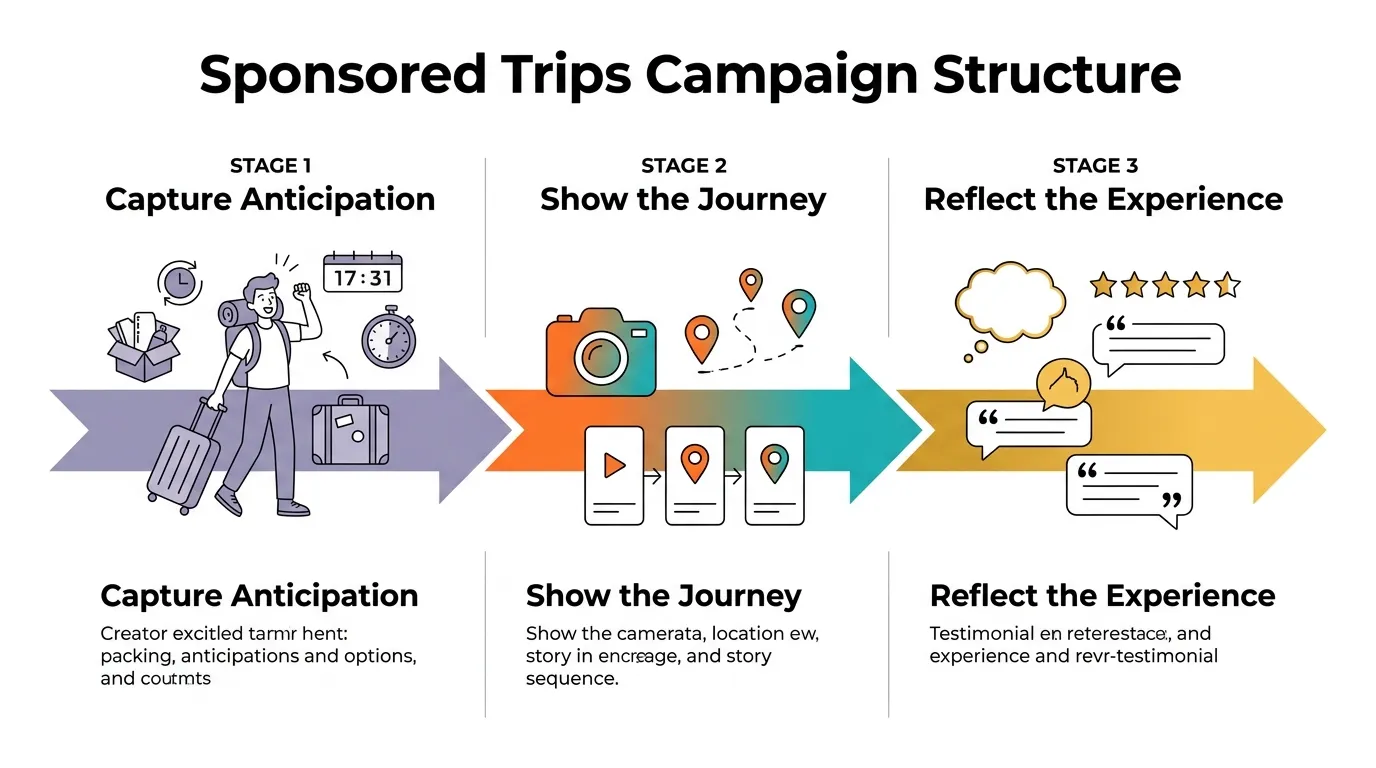
This is the most recognisable format. Creators are invited to experience a destination, hotel, or itinerary, and they document their journey in real time. What matters here is not just the visuals, but the sequence of the experience.
Strong campaigns:
- Capture anticipation before the trip
- Show the journey as it unfolds
- Reflect on the experience after it ends
This creates a narrative that audiences can follow, rather than a single moment they scroll past.
Content Partnerships
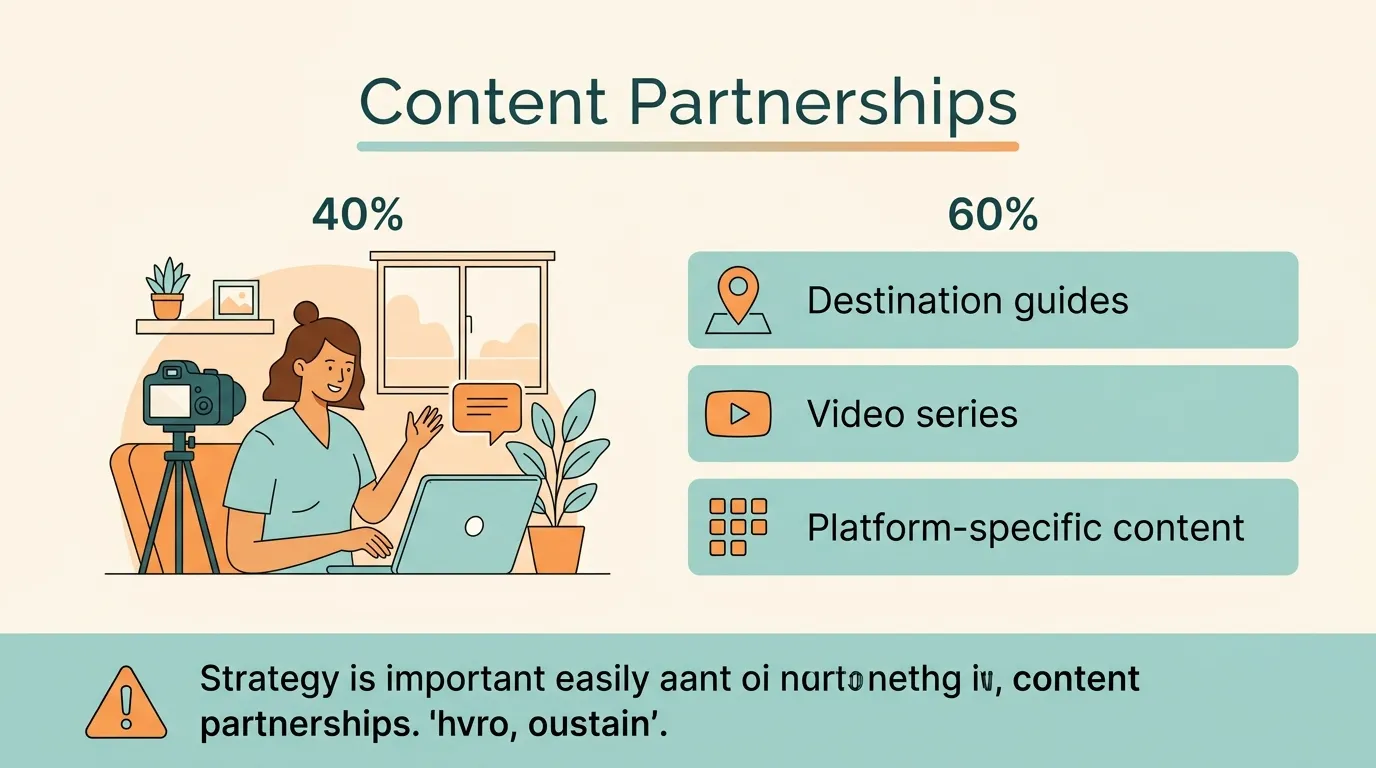
Not every campaign requires travel.
In some cases, brands collaborate with creators to produce specific content pieces based on existing experiences or curated itineraries.
This may include:
- Destination guides
- Themed travel series
- Platform-specific content, such as short-form videos or long-form vlogs
These partnerships work well when there is a clear content strategy behind them. Without that, they tend to feel disconnected.
Multi-Platform Campaigns
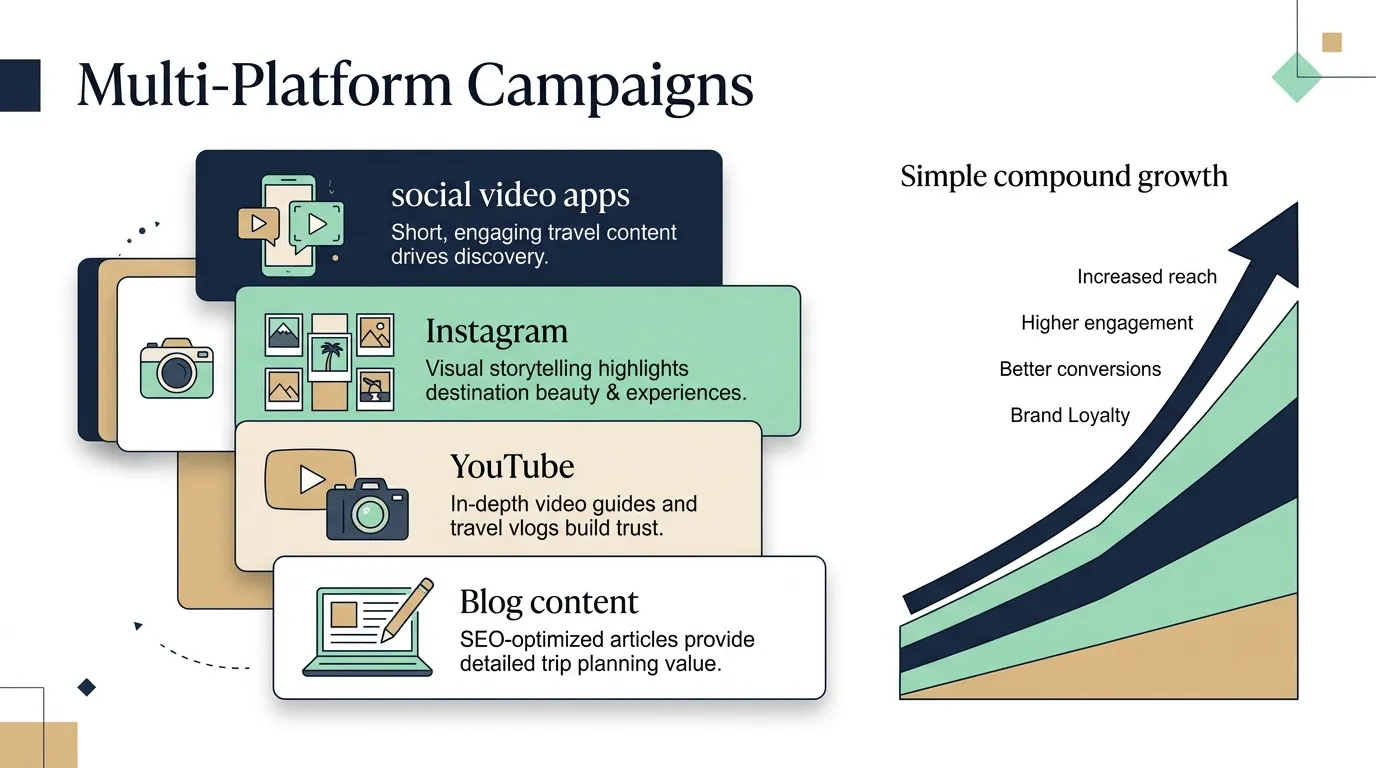
One of the biggest shifts I have seen is the move away from single-platform execution.
Travel decisions are rarely influenced by a single piece of content on a single platform. They are shaped by repeated exposure across different formats.
A typical campaign today might include:
- Short-form videos for discovery
- Instagram posts for visual storytelling
- YouTube content for deeper engagement
- Supporting content, such as blogs or guides, for search visibility
Each platform plays a role. When they work together, the impact compounds.
Why Storytelling Matters More Than Exposure
This is where most campaigns either succeed or fall short. It is easy to generate exposure in travel. A scenic view or a luxury property will almost always attract attention.
What is harder is creating content that makes someone pause and think, “I want to experience this myself.”
That only happens when the content feels real.
From experience, the campaigns that perform best are those where:
- The creator’s perspective feels authentic
- The journey unfolds naturally
- The audience can imagine themselves in the experience
When content feels staged, audiences admire it. When it feels lived, they respond to it.
That difference is subtle, but it is where most of the impact comes from.
The Practical Takeaway
If there is one thing I have learned, it is this: Travel influencer marketing is not about placing a brand inside content. It is about placing the audience inside the experience.
Once you approach it that way, decisions around creators, content formats, and platforms become much clearer.
And, more importantly, the results are starting to reflect it.
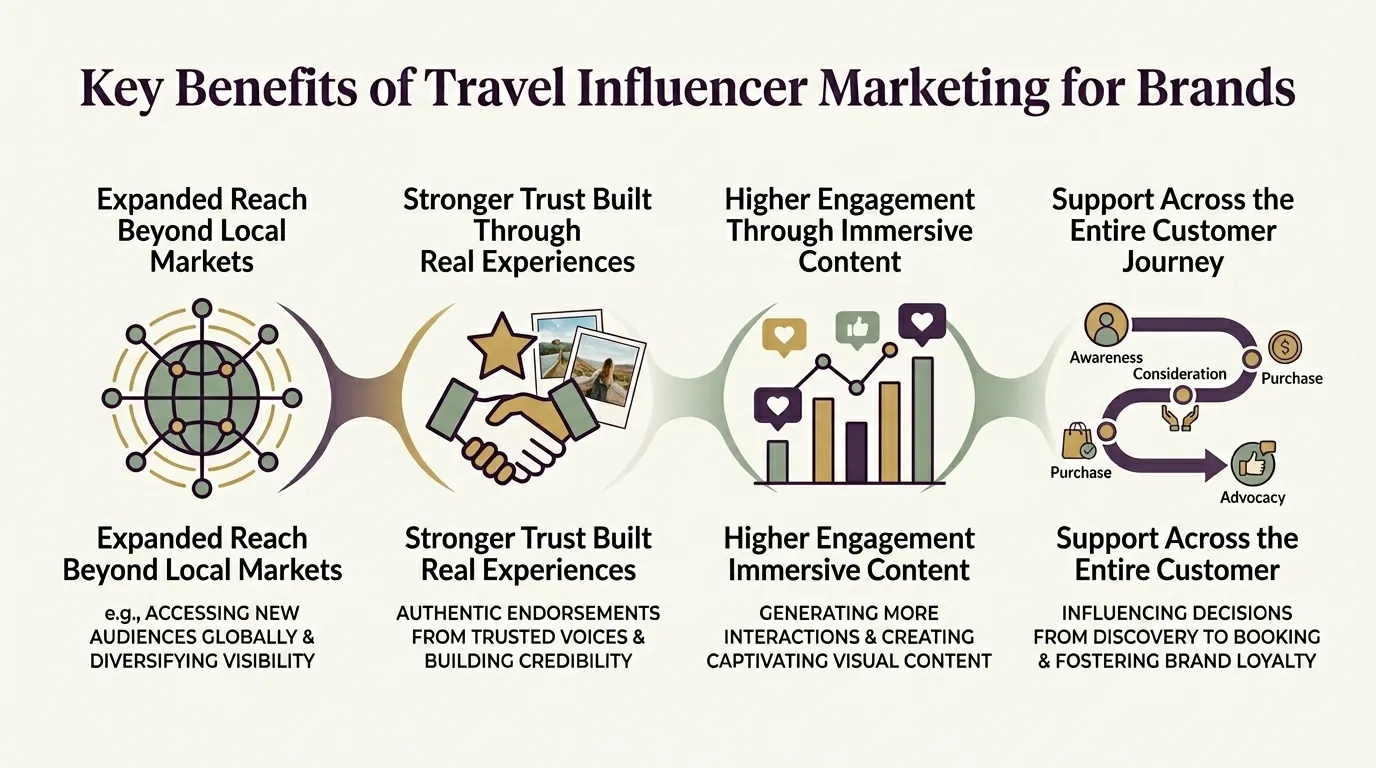
Key Benefits of Travel Influencer Marketing for Brands
Over time, I stopped viewing travel influencer marketing as a content play and began seeing it as a decision-making tool.
Most travellers do not act immediately. They move through a quiet process of discovery, comparison, and validation.
Expedia Group’s path-to-purchase research says travelers viewed an average of 141 pages of travel content in the 45 days before booking, and 59% were undecided on a destination or considered multiple destinations when they first decided to take a trip. It also says resource use spikes during the research and planning phase as travelers compare options.
Along the way, they collect signals that help them decide whether a destination, hotel, or experience is worth committing to.
What travel influencer marketing does, when executed properly, is accelerate that process.
Instead of leaving people to piece together information on their own, it gives them a clearer, more tangible sense of what to expect. That shift changes how quickly interest turns into action.
From working on campaigns across different travel segments, a few benefits consistently stand out:
Benefit #1: Expanded Reach Beyond Local Markets
Travel content rarely stays within borders.
A single piece of content can surface across multiple regions, especially when it taps into universal appeal such as scenery, culture, or unique experiences.
This creates an advantage.
Rather than investing heavily in separate campaigns for each market, brands can build narratives that resonate globally while still feeling relevant locally.
The key is to ensure the content:
- Feels accessible to international audiences
- Highlights elements that are culturally distinctive
- Provides enough context for viewers unfamiliar with the destination
When these elements are in place, reach expands naturally.
Benefit #2: Stronger Trust Built Through Real Experiences
Travel decisions involve some risk.
People are committing to something they cannot fully experience beforehand. That is why trust plays such a central role.
What I have observed is that audiences respond differently to lived experiences compared to polished promotions.
When creators document:
- Small inconveniences as well as highlights
- Real interactions with local environments
- Personal perspectives rather than scripted messaging
The content feels more credible.
That credibility reduces hesitation, which is often the main barrier to conversion.
Benefit #3: Higher Engagement Through Immersive Content
Travel content invites people to imagine themselves in the experience. That is what drives deeper engagement.
Instead of passive scrolling, audiences tend to:
- Save content for future planning
- Share it with travel companions
- Revisit it when making decisions
This behaviour is more valuable than surface-level interactions. It signals intent.
From what I have seen, campaigns that use structured storytelling rather than isolated posts tend to sustain attention longer and generate more meaningful engagement.
Benefit #4: Support Across the Entire Customer Journey
One of the more important shifts in how I approach campaigns is recognising that travel influencer marketing is not limited to awareness.
It can support the entire journey.
- At the discovery stage, short-form content introduces destinations in a way that feels organic
- During consideration, longer content provides depth and answers practical questions
- Closer to booking, detailed experiences help remove uncertainty
When these layers are connected, the campaign becomes more effective without relying heavily on paid amplification.
Why Multi-Creator, Multi-Platform Campaigns Perform Better
A pattern becomes clear after running multiple campaigns. A single creator can generate strong engagement within their audience, but reach tends to plateau.
Introducing multiple creators changes that dynamic. Each creator brings:
- A different audience segment
- A unique storytelling style
- A new perspective on the same destination
When combined with distribution across multiple platforms, the campaign gains both depth and reach.
Campaigns that use multiple creators and platforms may broaden reach by exposing the destination to different audience segments, but the results depend heavily on creator fit, distribution, and execution.
What This Means in Practice
The takeaway is not to produce more content, but to produce more connected content. Each piece should:
- Add a layer of understanding
- Reinforce the overall narrative
- Move the audience closer to a decision
When travel influencer marketing is structured this way, it does more than generate interest. It creates momentum that carries through to actual bookings and long-term brand recognition.
Types of Travel Influencer Marketing Campaigns That Attract Global Audiences
When I first started structuring travel influencer campaigns, I treated every brief the same way: Find the right creators, showcase the destination, and publish content across platforms.
It worked, to a point.
But over time, patterns started to emerge. Different types of travel brands require different storytelling approaches. What worked for a tourism board did not always translate for a hotel. What worked for an airline rarely worked for a local experience provider.
That is when I stopped thinking in terms of “campaigns” and started thinking in terms of formats. Each format has its own strengths, and more importantly, its own role in attracting travelers.
That shift is increasingly supported by travel marketing research: Expedia Group’s 2025 Science of Wanderlust study found that 71% of travelers said video influenced their travel decisions, compared with 24% for static images, while 66% of Gen Z and 65% of Millennials said they turn to social influencers and platforms for inspiration.
Format #1: Destination Marketing Campaigns

Destination campaigns are often the most ambitious.
I have worked on projects where the goal was not just to promote a location, but to reposition it in the minds of international travellers. That requires more than visuals. It requires narrative.
Tourism boards and cities tend to benefit most when they move away from listing attractions and instead focus on creating a journey.
The campaigns that perform best usually:
- Highlight elements that feel unique and cannot be replicated elsewhere
- Connect multiple locations into a single, cohesive storyline
- Feature creators whose audiences already span different regions
For example, instead of showing ten separate landmarks, a stronger approach is to follow a creator through a multi-day itinerary. Viewers begin to understand not just what exists, but how it feels to experience it.
That shift from information to immersion is what drives interest across borders.
A useful example is Visit Salt Lake, which used creator-led trips rather than a single polished brand shoot. By sending multiple creators through different parts of the city and letting them document real experiences, the campaign generated more than 10 million impressions, more than 3 million views, a 4.94% engagement rate, and over 80 pieces of creator content.
The result was not only awareness, but a reusable content library that could continue performing across owned and creator channels.
Format #2: Hotel and Resort Campaigns
Hotels operate in a more competitive and often more saturated space.
I have seen many campaigns fall into the same pattern. Beautiful room shots, wide-angle pool views, and standard amenity walkthroughs. Visually appealing, but often interchangeable.
What tends to work better is content that moves beyond the property itself and into the experience of staying there.
Effective hotel campaigns usually focus on:
- How a guest moves through the space over time
- The small details that influence comfort and convenience
- Moments that feel personal rather than staged
Content might include:
- A morning routine with a view that sets the tone for the day
- An evening sequence that captures ambience rather than just lighting
- Interactions with staff or services that add a human element
This approach is particularly effective for premium and boutique properties, where differentiation often comes from experience rather than scale.
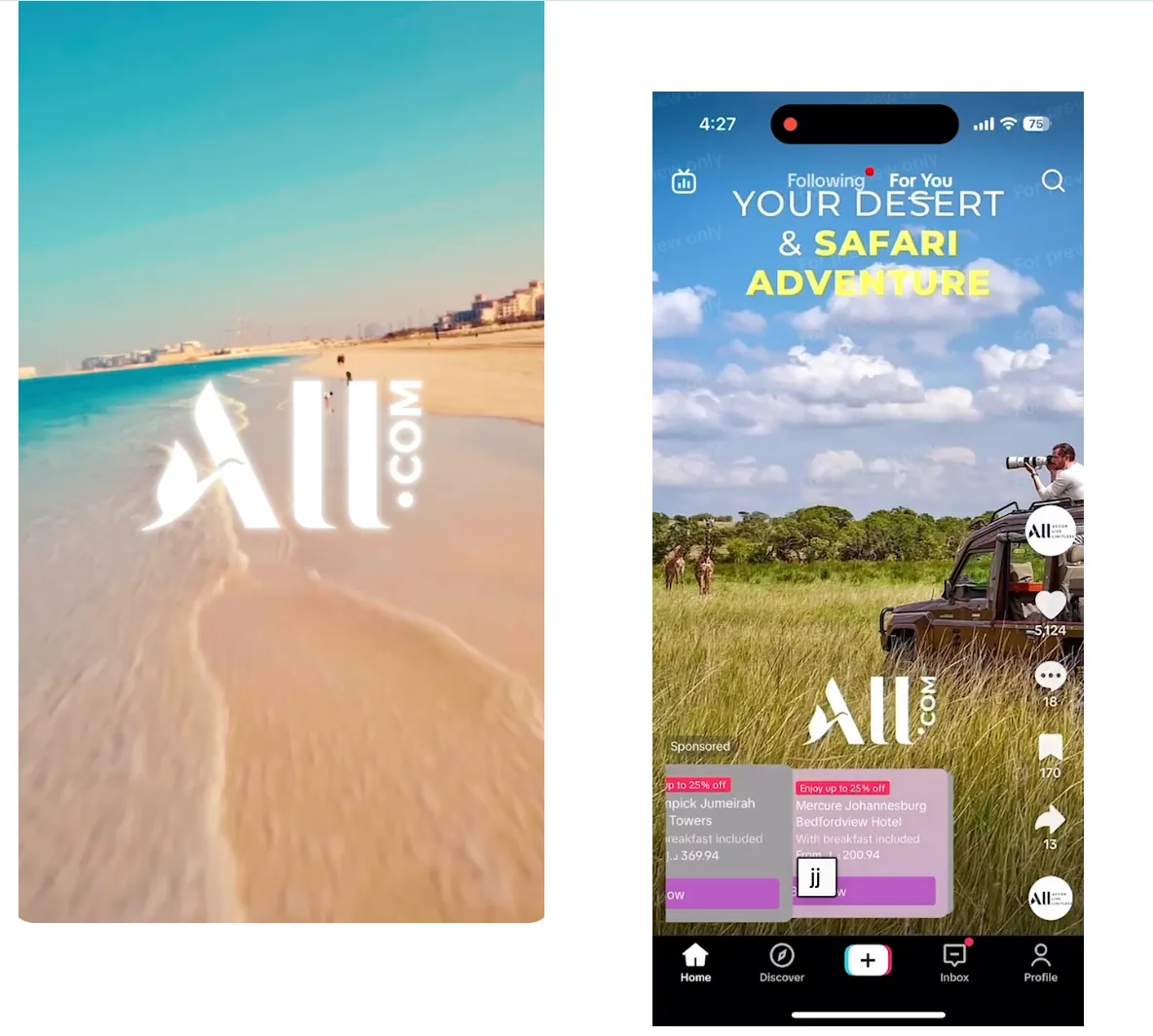
The performance data support that shift. In an Accor campaign using TikTok Dynamic Travel Ads linked to travel-intent signals and property-specific selling points from its global catalog, the brand achieved a 46% reduction in cost per hotel booking, a 1.8x increase in bookings, and a 2.3x increase in return on ad spend.
The lesson is clear: hotel content works better when it helps travellers imagine the stay, not just admire the property.
Format #3: Airline and Transport Campaigns
Transport brands are often treated as functional, but they have more storytelling potential than most people realise.
In earlier campaigns, I noticed that simply highlighting seats, meals, or schedules rarely generated strong engagement. Those details matter, but they do not create interest on their own. What changed performance was reframing the journey as part of the experience.
Airline and transport campaigns tend to perform better when they:
- Show how the journey fits into the overall travel narrative
- Highlight comfort in context rather than isolation
- Offer perspectives that travellers do not usually see
This can include:
- Behind-the-scenes glimpses of operations
- In-transit moments that feel relatable
- Transitions between destinations that create continuity
These campaigns act as a bridge. They connect the anticipation of travel with the experience itself.
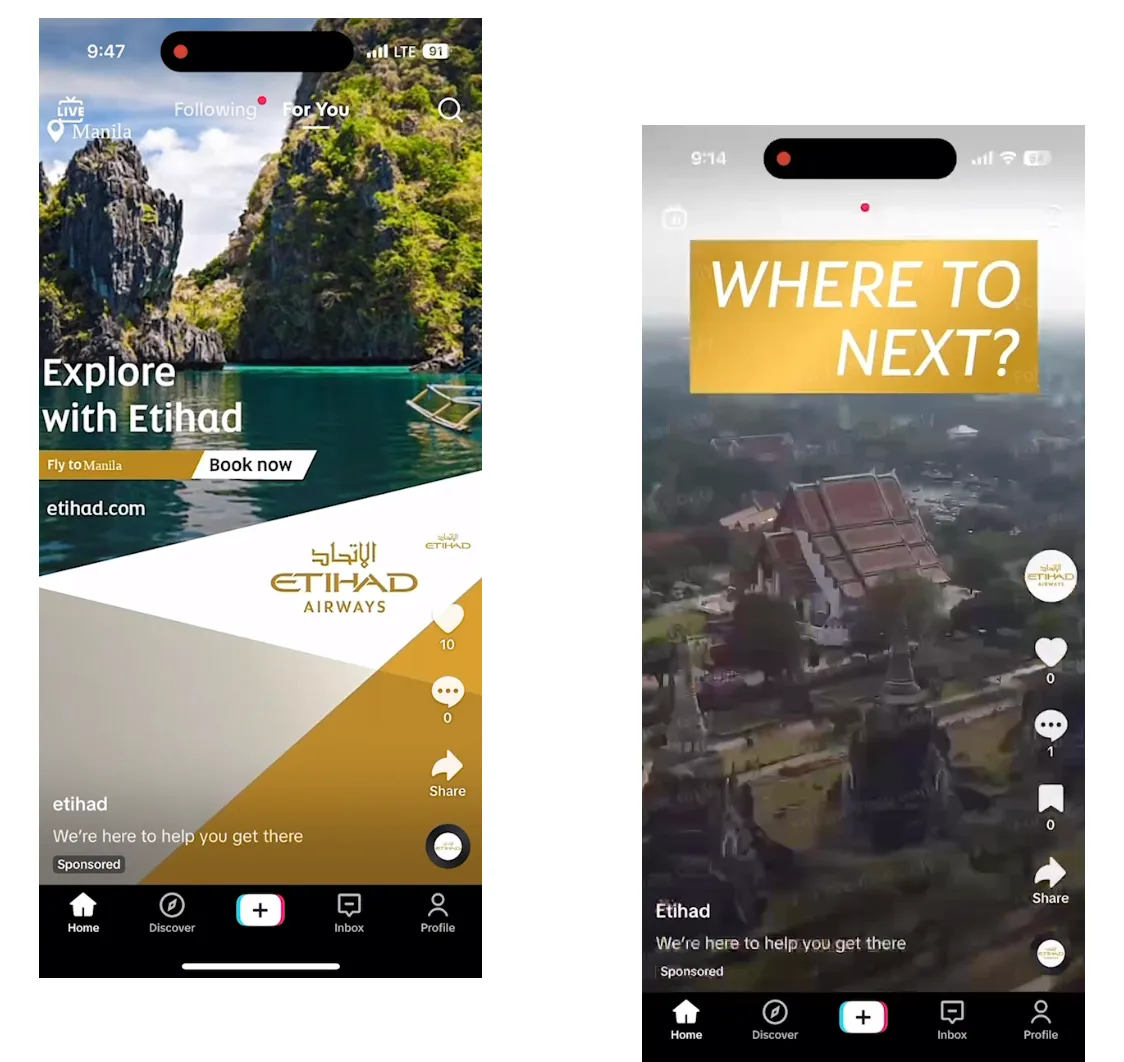
A strong example is Etihad Airways, which built TikTok-first creative around destination discovery and personalised travel intent rather than treating flights as a purely functional purchase.
Running across four key markets, the campaign delivered a 7% lift in flight searches, a 17% increase in flight bookings, and a 232% incremental ROAS. That kind of outcome only happens when the journey is framed as part of the story, not just the logistics that get you there.
Format #4: Experience-Based Campaigns
If there is one format that consistently drives engagement, it is experience-based campaigns.
Activities, tours, and local adventures naturally lend themselves to storytelling. They give creators something to react to, participate in, and document over time.
What I have seen work repeatedly is the use of progression.
Instead of a single post, the content unfolds:
- A build-up before the activity
- The experience itself
- A reflection afterwards
This structure allows creators to:
- Build narratives that feel complete
- Capture authentic interactions with people and places
- Create moments that audiences want to share or revisit
Experience-based campaigns also tend to feel less promotional.
They focus on what happens, not what is being sold. That is exactly what made Pigeon Forge’s extreme adventure campaign so effective.
Pigeon Forge partnered with creators whose audiences were genuinely interested in extreme adventures and theme parks, and built a carefully curated itinerary around high-energy attractions; the campaign generated 20.1 million completed views, 1.2 million total engagements, a 14.9% average engagement rate, and $2.79 million in earned media value
When audiences can follow a real sequence of experiences, engagement tends to rise because the content feels participatory rather than promotional.
Bringing It Together
Each campaign type serves a different purpose, but they are not mutually exclusive.
In many of the more effective travel influencer marketing strategies I have worked on, these formats are combined.
A destination campaign might include:
- A hotel stay that adds depth
- An airline journey that creates continuity
- Local experiences that bring authenticity
When these elements are connected, the campaign feels less like a series of posts and more like a complete travel story.
That is usually when global audiences start paying attention.
How to Build a Travel Influencer Marketing Strategy That Scales Globally
I used to think scaling a travel campaign was about doing more of what already worked. If one influencer delivered strong results, we added five more. If one platform performed well, we expanded to three. The assumption was simple. Growth comes from repetition and expansion.
It did not take long to realise that this approach creates noise, not scale.
In one campaign, we increased the number of creators and platforms without changing the underlying structure. Content volume went up. Reach expanded. Engagement looked healthy.
But consistency dropped. Messaging became fragmented. Performance varied across markets in ways we could not easily explain. That experience forced a different way of thinking.
Scaling is not about multiplying activity. It is about building a system that holds together as it grows.
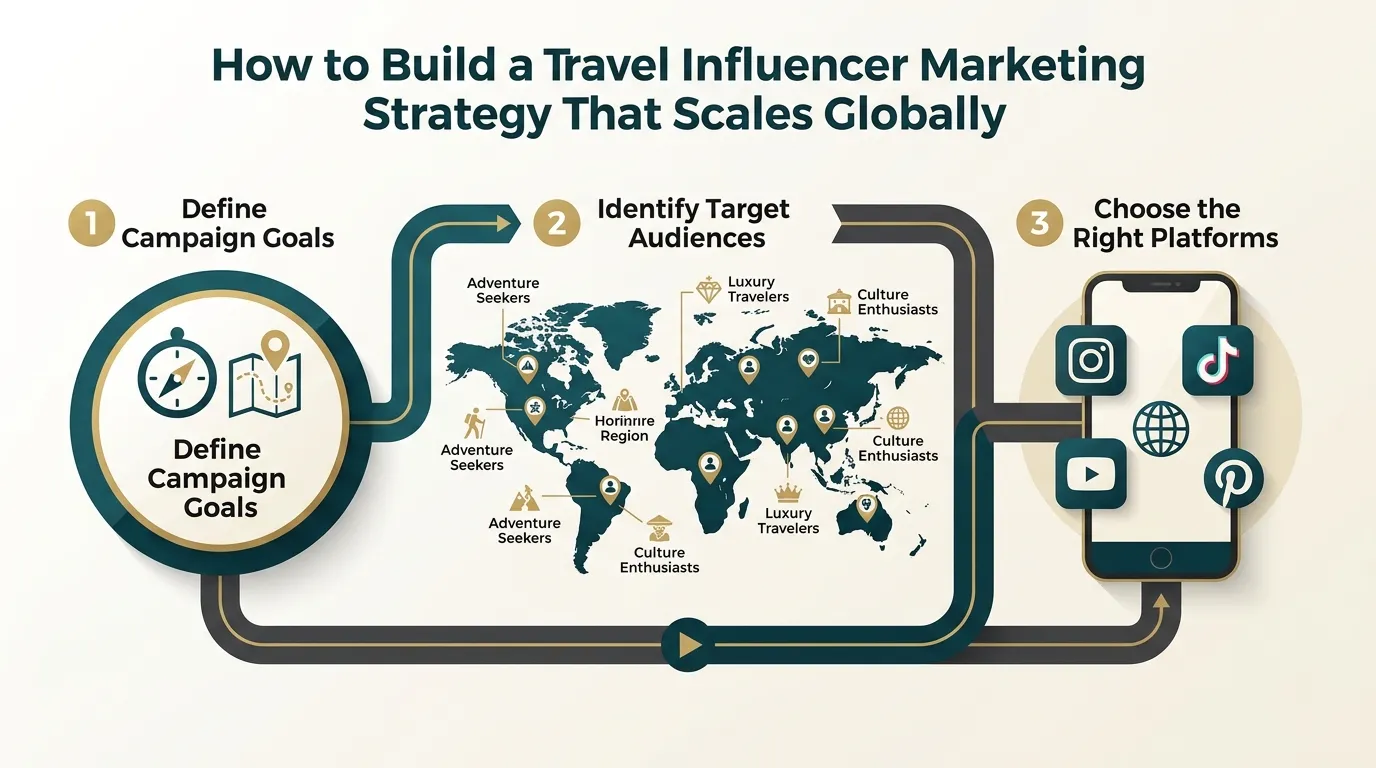
In travel influencer marketing, that system depends on three things. Clear goals, defined audiences, and deliberate platform choices. Without these, campaigns expand outward but lose impact.
Step 1: Define Campaign Goals
Clarity at the start does more than keep teams aligned. It shapes every decision that follows.
Early on, I made the mistake of treating all campaigns the same. The expectation was simple. Generate awareness and bookings simultaneously. That rarely works.
Now, I define the primary objective before anything else.
- If the goal is awareness, the focus is on reach and discovery. Content should be visually striking and easy to consume.
- If the goal is engagement, the emphasis shifts to storytelling and interaction. The audience needs a reason to stay, not just scroll past.
- If the goal is conversions, content must reduce friction. It should answer questions, show practical details, and build confidence in the decision.
Each objective influences:
- The type of creators we work with
- The content formats we prioritise
- The platforms we invest in
When this is unclear, campaigns tend to underperform because they try to do too much at once.
Step 2: Identify Target Audiences
Global reach can be misleading. It is easy to assume that travel content appeals to everyone. In practice, different audiences respond to different signals.
I learned this when a campaign that performed well in Southeast Asia struggled to gain traction in European markets. The visuals were the same, but the expectations were not.
Now, audience definition is more deliberate.
We look at:
- Travel preferences: Are they looking for luxury, adventure, or budget-friendly options?
- Behaviour patterns: Do they plan trips months in advance, or do they decide spontaneously?
- Geographic focus: Are we targeting regional travellers or long-haul visitors?
- Budget and intent: Are they exploring options or ready to book?
This level of clarity influences everything from creator selection to content tone. It also helps avoid a common mistake.
Trying to appeal to everyone often results in content that resonates with no one in particular.
Step 3: Choose the Right Platforms
Not all platforms contribute equally to a travel campaign. One of the biggest shifts in my approach was recognising that each platform plays a distinct role in the journey.
- Instagram is where aspiration lives. It is ideal for polished visuals and lifestyle positioning.
- TikTok is where discovery happens. Content spreads quickly, often beyond existing audiences.
- YouTube is where decisions take shape. Longer content provides depth, context, and reassurance.
Each platform supports a different stage of the journey. What matters is not just presence, but purpose.
Emerging platforms can extend reach, but they should not be added by default.
They need to answer a specific question: Does this platform reach an audience we are not currently engaging, and does it support the type of content we want to produce?
If the answer is unclear, it is usually better to refine existing channels first.
A scalable strategy does not rely on volume. It relies on alignment.
- Goals define direction
- Audiences shape messaging
- Platforms determine distribution
When these elements work together, campaigns become easier to expand without losing effectiveness. From experience, the difference between a campaign that scales and one that stalls is rarely budget.
It is how clearly the strategy is structured from the beginning.
How to Choose Influencers for Travel Influencer Marketing Campaigns
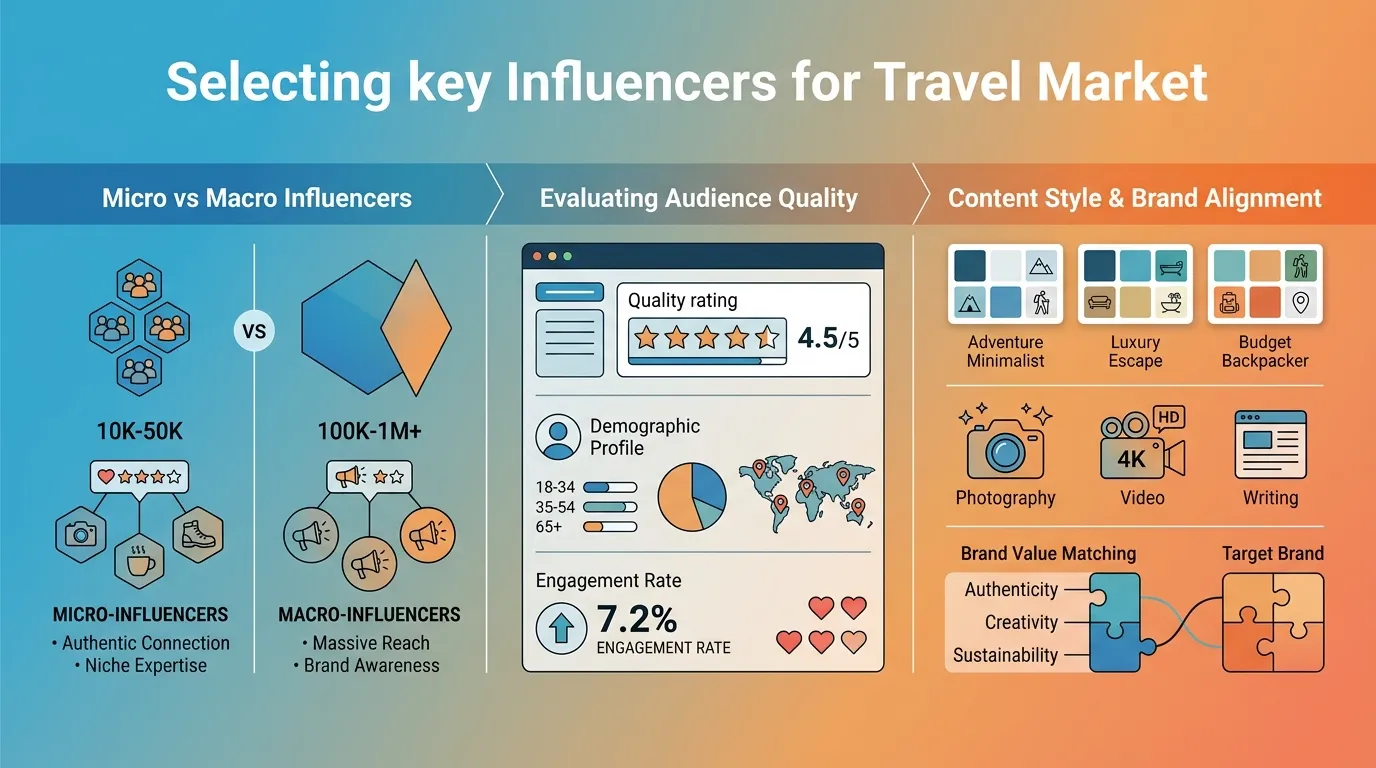
Choosing the right influencers is where most travel campaigns either gain momentum or quietly fall apart. Early on, I made decisions based on what looked impressive. Large followings, polished feeds, high engagement rates. On paper, everything pointed to success.
But once campaigns went live, the results were inconsistent.
Some creators delivered strong reach but little action. Others had smaller audiences yet drove meaningful interest and enquiries. That contrast forced me to look deeper into what actually drives performance in travel influencer marketing.
Over time, the selection process became less about appearance and more about alignment.
Micro vs Macro Influencers
At first glance, the micro vs macro influencer distinction seems straightforward. Macro influencers give you scale. Micro influencers give you engagement.
In practice, the difference is more nuanced.
Macro influencers are useful when the goal is visibility across multiple markets. They can quickly introduce a destination or brand to a large audience. This works well for:
- New market entry
- Broad awareness campaigns
- High-impact launches
However, reach alone does not always translate into action.
Micro influencers tend to operate within more defined niches. Their audiences are often more focused and more responsive. This makes them particularly effective for:
- Building trust around specific experiences
- Driving deeper engagement
- Influencing decision-making at the consideration stage
What I have found to be most effective is not choosing one over the other, but structuring a mix.
- Macro influencers create initial exposure
- Micro influencers reinforce credibility and relatability
Campaigns that combine both tiers often show stronger overall performance than those that rely on a single influencer type. The balance depends on the campaign objective and audience.
Evaluating Audience Quality
This is where most selection processes fall short.
Follower count is visible. Audience quality is not, unless you look closely.
I learned this the hard way after working with a creator whose numbers looked strong but whose audience was largely irrelevant to the campaign. Engagement was present, but it did not translate into meaningful interest.
Now, I treat audience evaluation as a non-negotiable step.
Key signals I look for include:
- Audience location: If the goal is to attract international travellers, the audience must reflect that. A strong local following may not support a global campaign.
- Engagement patterns: Consistent interaction matters more than spikes. Are people asking questions, saving content, or sharing it with others.
- Comment quality: Comments reveal intent. Generic reactions suggest passive interest, while detailed questions often indicate genuine consideration.
These signals provide a clearer picture of whether the audience is likely to move beyond viewing content.
Content Style and Brand Alignment
Even when audience and reach are aligned, campaigns can still underperform if the content does not feel cohesive.
I have seen campaigns where the visuals were impressive but disconnected from the brand’s positioning. The result was content that looked good in isolation but did not strengthen the overall narrative.
That is why content style matters. The creator’s approach to storytelling should complement the brand’s identity.
This includes:
- How they structure their content
- The tone they use when sharing experiences
- The level of detail they provide
Consistency plays a bigger role than aesthetics alone. A creator who consistently documents their journey in a way that feels authentic will often outperform one who produces visually appealing but inconsistent content.
What This Looks Like in Practice
When selecting influencers today, I look at three layers together.
- Does the creator reach the right audience?
- Does their content build trust and context?
- Does their style align with the brand’s positioning?
If all three align, the campaign has a much stronger foundation. If even one is missing, performance tends to drop, regardless of how strong the other metrics appear.
That shift in approach has made influencer selection less about chasing numbers and more about building the right combinations of reach, trust, and storytelling.
Working With a Travel Influencer Marketing Agency
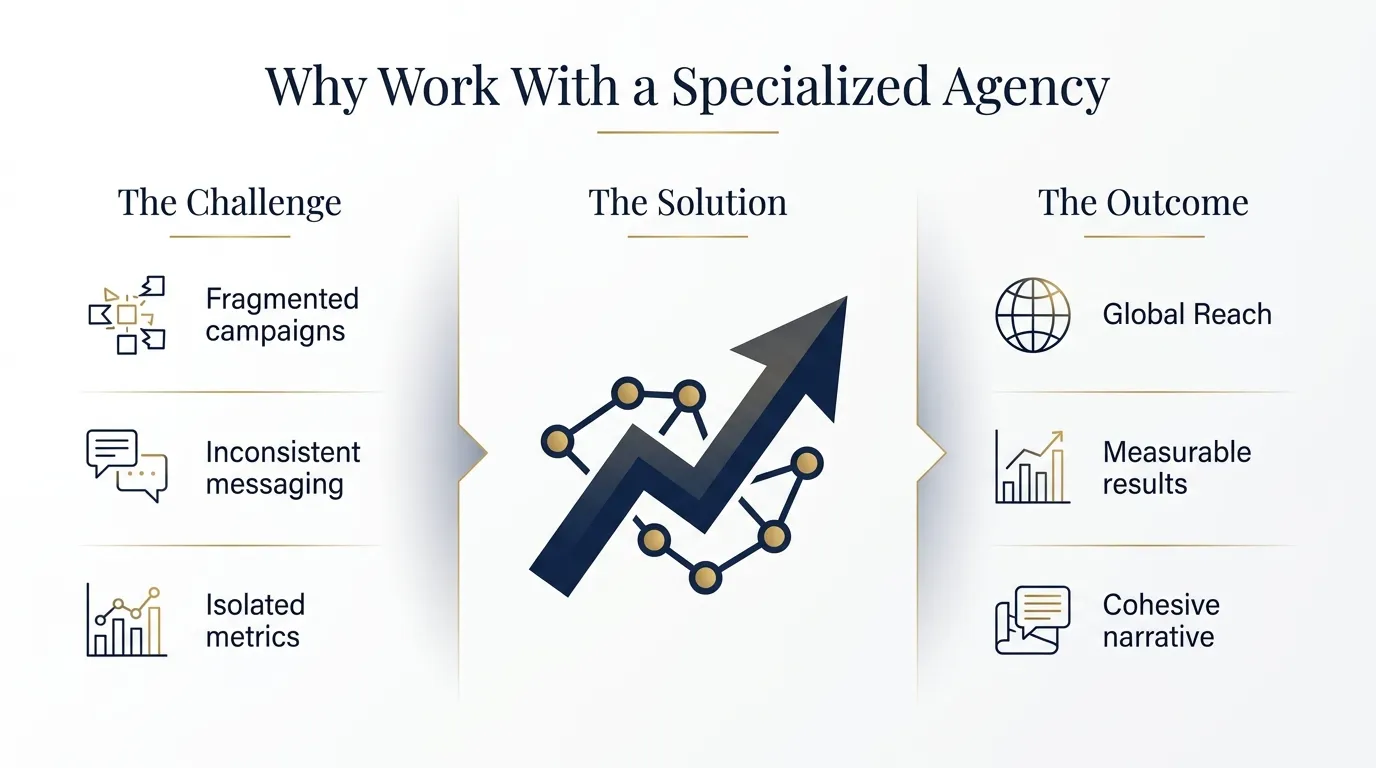
At some point, most brands realise that running travel campaigns internally becomes harder to sustain as they scale.
It is not just about finding creators or producing content. It is about coordinating across multiple markets, aligning messaging across platforms, and ensuring every piece of content contributes to a larger narrative.
I have seen campaigns lose momentum not because the idea was weak, but because execution became fragmented. Different creators told different stories. Content lacked continuity. Performance was measured in isolation rather than within a system.
This is where working with a specialised agency starts to make sense.
A structured approach brings clarity to:
- Creator selection across regions
- Content planning that builds over time
- Platform distribution that supports both reach and conversion
- Measurement frameworks that go beyond surface metrics
For brands operating in or targeting Singapore, local market understanding adds another layer. Audience behaviour, platform preferences, and regional nuances all influence how campaigns perform.
From experience, the most effective campaigns come from a combination of creative direction and strategic oversight. One without the other tends to fall short.
At MediaOne, we work with travel and lifestyle brands to plan and execute campaigns that connect with international audiences while staying grounded in measurable outcomes. For companies evaluating their next steps in travel influencer marketing, it may be useful to have a structured discussion about how their current efforts align with their goals.
You can contact us directly to explore how to refine your travel influencer marketing strategy for a stronger global impact.
Frequently Asked Questions
How long does it take to see results from travel influencer marketing?
Results can vary depending on campaign structure and objectives. Awareness campaigns may show engagement within days, while bookings and conversions often take longer as travellers plan ahead. Travel decisions usually involve multiple touchpoints, so results tend to build over time rather than immediately. Consistency and content sequencing play an important role in accelerating outcomes.
Can travel influencer marketing work for smaller destinations or boutique brands?
Yes, smaller destinations and boutique brands can benefit significantly from travel influencer marketing. These campaigns allow them to showcase unique experiences that larger destinations may not offer. Niche storytelling often attracts more engaged audiences seeking something different. Success depends on choosing creators whose audiences align with the brand’s positioning.
What type of content performs best in travel influencer marketing campaigns?
Content that combines storytelling with practical value tends to perform best. This includes itinerary-based videos, experience walkthroughs, and behind-the-scenes moments. Audiences respond well to content that helps them imagine the full journey rather than isolated highlights. Formats that balance inspiration and information often lead to stronger engagement.
How do travel brands manage influencer content across multiple markets?
Managing content across markets requires a structured approach to planning and distribution. Brands often work with multiple creators while maintaining a consistent narrative across campaigns. Localisation is important to ensure content resonates with different audiences. Centralised tracking and coordination help maintain quality and performance across regions.
Is travel influencer marketing suitable for year-round campaigns or seasonal only?
Travel influencer marketing can be effective both seasonally and year-round. Seasonal campaigns are useful for promoting peak travel periods or specific events. Year-round campaigns help maintain visibility and build long-term interest in a destination or brand. A combination of both approaches often delivers the most balanced results.