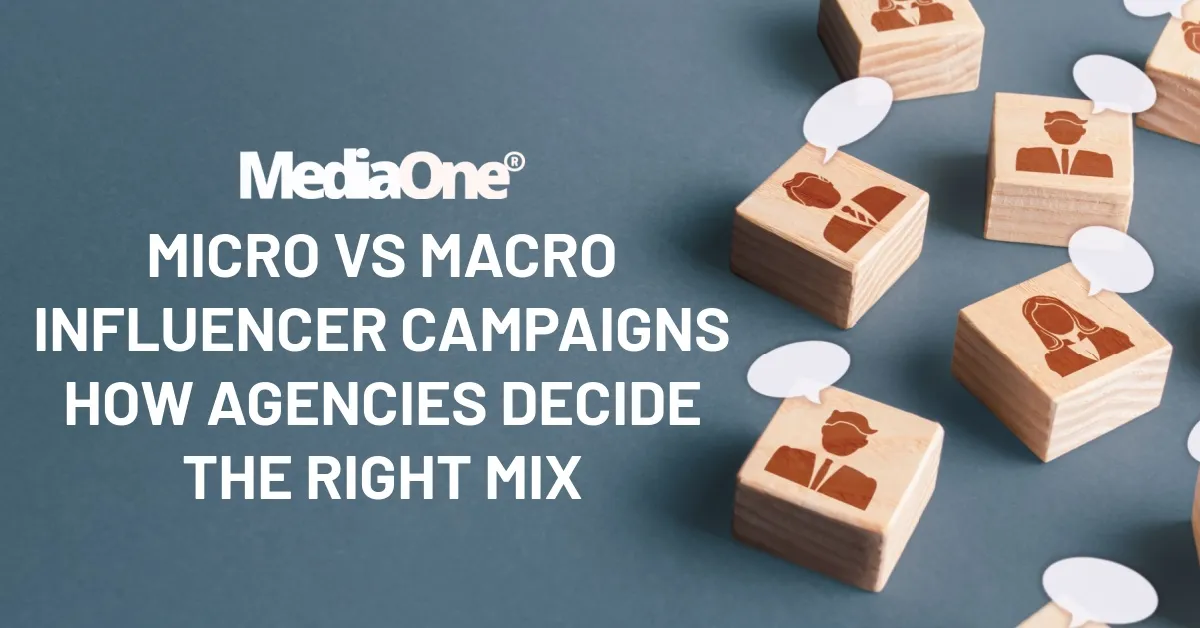
When brands plan an influencer campaign today, one of the first strategic questions agencies ask is: What’s the difference between micro and macro influencers? Both types of creators play a major role in digital marketing, but they serve different purposes depending on campaign goals, audience targeting, and budget.

Choosing between influencer types is not just about follower counts. It is about understanding how reach, engagement, credibility, and conversion potential affect marketing outcomes.
As influencer marketing becomes a core channel for brand growth, agencies increasingly rely on data to determine the right balance between micro vs macro influencers. A campaign designed for awareness may prioritise large creators with millions of followers. Meanwhile, a campaign designed to build trust or drive niche conversions may rely on smaller creators with highly engaged communities.
For businesses seeking expert guidance, working with professionals can make the decision-making process easier. Companies seeking an influencer marketing agency in Singapore campaign strategy often look for teams that can evaluate audience data, select the right creators, and build campaigns that combine reach with measurable results.
This guide explains how agencies approach influencer types and how brands can choose the right mix for their marketing goals.
Key Takeaways
- Micro vs macro influencers differ mainly in reach, engagement style, and audience targeting, which means the right choice depends on campaign objectives rather than follower counts alone.
- Micro influencers often build stronger audience trust and engagement within niche communities, while macro influencers deliver wider visibility and faster brand awareness.
- Agencies evaluate metrics such as engagement rate, audience relevance, cost efficiency, and conversion potential when deciding between micro vs macro influencers.
- Many successful campaigns combine both influencer tiers, using macro influencers for awareness and micro influencers to drive deeper engagement and conversions.
What Are Micro vs Macro Influencers?
Understanding the difference between micro vs macro influencers starts with knowing how influencer tiers are typically classified. Influencers are often grouped by audience size, but agencies also consider engagement rates, audience quality, and content style when categorising creators.
Defining Micro Influencers
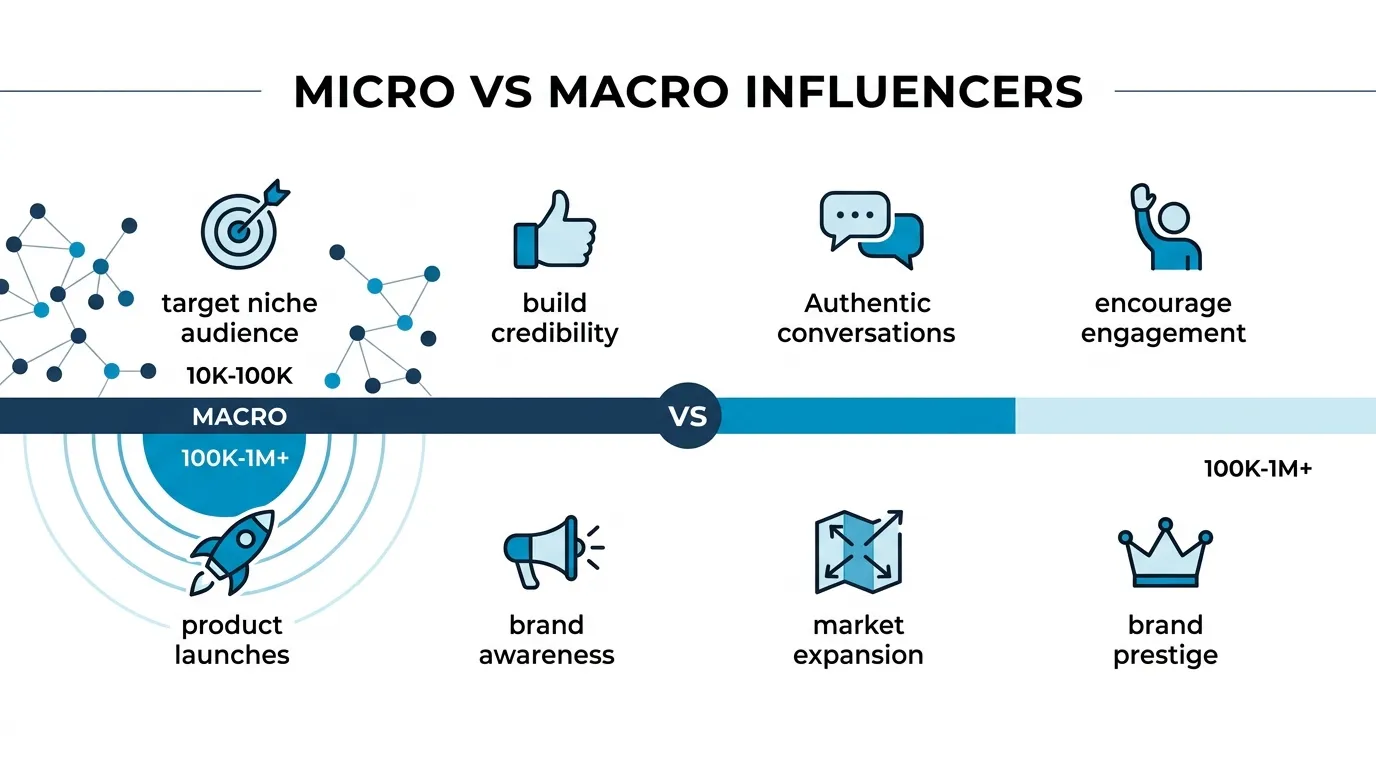
Micro influencers usually have between 10,000 and 100,000 followers on a social platform. These creators often focus on a specific niche such as beauty, fitness, gaming, technology, or parenting. Because their audiences tend to share similar interests, micro influencers often build stronger community relationships with followers.
One reason agencies frequently favour micro influencers is the level of trust they build with their audience. Their content typically feels more personal and less commercial. Followers may see them as relatable individuals rather than celebrities.
For brands evaluating micro vs macro influencers, micro influencers can be particularly effective when the goal is to:
- Target a specific niche audience
- Build credibility around a product
- Generate authentic conversations around a brand
- Encourage engagement and discussion
Micro influencers are commonly active on platforms such as Instagram, TikTok, YouTube, and niche online communities.
Defining Macro Influencers
Macro influencers generally have 100,000 to over 1 million followers. Some may also be public figures, professional creators, or industry personalities who have built large audiences through years of content creation.
When agencies evaluate micro vs macro influencers, macro creators are often selected for campaigns that require large-scale reach. Their large follower base allows brands to generate immediate visibility.
Macro influencers also tend to produce highly polished content. Many work with professional production teams, which allows brands to obtain high-quality visuals and videos that can also be repurposed for advertising campaigns.
Macro influencers are often used for:
- Major product launches
- Large brand awareness campaigns
- Expanding visibility across multiple markets
- Strengthening brand prestige and positioning
Why the Micro vs Macro Influencers Debate Matters for Brands
The discussion around micro vs macro influencers matters because each influencer tier delivers different types of value.
Macro influencers can rapidly increase brand visibility. Micro influencers can deepen trust and drive engagement within specific communities. Agencies, therefore, look beyond simple follower numbers when planning campaigns.
Instead of choosing only one type of creator, many agencies analyse campaign goals, audience demographics, and performance data to determine how both influencer tiers can work together.
4 Key Differences Between Micro vs Macro Influencers

When agencies plan influencer campaigns, one of the first strategic decisions is choosing between micro and macro influencers. The decision typically involves evaluating four key factors: audience size, engagement, content style, and cost. Each factor can significantly impact campaign performance and return on investment.
1. Audience Size and Reach
The most obvious distinction between micro and macro influencers is the size of their audience.
- Macro Influencers: These creators have large followings, often in the hundreds of thousands or millions. A single post can generate significant visibility within a short period, making it ideal for campaigns focused on broad awareness and brand recognition.
- Micro Influencers: These creators have smaller audiences, typically 1,000-100,000 followers. While their reach is narrower, their audiences are niche-specific and highly targeted. For brands aiming to engage specialised communities, micro influencers can deliver higher-quality engagement than macro influencers with general audiences.
Agencies consider both absolute reach and audience relevance when deciding which influencer tier to leverage for a particular campaign.
2. Engagement Rates
Engagement is a crucial factor when evaluating micro vs macro influencers.
- Micro Influencers: Tend to have higher engagement rates per their audience. Followers often feel a stronger connection to these creators, making them more likely to comment, ask questions, and interact meaningfully with content.
- Macro Influencers: Typically see lower engagement rates, though total engagement numbers may still be high due to their massive follower base.
Agencies analyse both engagement rate (as a percentage) and total engagement volume to balance audience interaction with reach. Higher engagement percentages often translate into stronger trust and influence among followers.
3. Content Style and Authenticity
The way influencers create content also differs between micro and macro tiers.
- Micro Influencers: Their content tends to feel authentic, casual, and relatable. Posts often resemble personal recommendations rather than polished advertisements, thereby enhancing credibility and trust among their followers.
- Macro Influencers: Produce higher-production content that is often professional in style, with polished visuals, edited videos, and carefully curated messaging. While this can lend prestige and quality to a campaign, it may feel less personal to audiences.
The choice depends on campaign objectives—brands seeking relatable endorsements may favour micro influencers, while those requiring professional content assets may choose macro creators.
4. Cost and Budget Considerations
Cost is a practical factor that often guides the micro vs macro decision.
- Micro Influencers: Charge lower fees per collaboration, allowing agencies to partner with multiple creators within the same budget. This strategy can extend reach across niche audiences and diversify messaging.
- Macro Influencers: Command higher fees due to their large followings and established reputation. While more expensive, a single macro influencer can provide substantial visibility that multiple micro influencers would not.
Agencies typically evaluate cost-efficiency metrics such as cost per thousand impressions (CPM) and cost per engagement (CPE) to determine which option delivers the best return on investment for the campaign.
When Agencies Choose Micro Influencers Over Macro Influencers

While macro influencers offer broad reach, there are several scenarios where agencies strategically prioritise micro influencers. Their smaller, niche-focused audiences and authentic engagement make them especially valuable for campaigns that require precision, trust, and cost efficiency.
Niche Targeting and Community Engagement
Micro influencers excel at reaching highly specific interest groups. Their followers often share common passions or demographics, making them ideal for brands with specialised products or services.
-
Example: A skincare brand might collaborate with several micro influencers who focus on dermatology, skincare routines, or beauty education. Each influencer reaches a distinct but relevant segment, increasing the likelihood of meaningful engagement and conversions.
By leveraging multiple niche creators, agencies can cover a variety of sub-communities while maintaining relevance and resonance.
Higher Trust and Authentic Recommendations
Micro influencers are often perceived as peers or trusted advisors rather than distant celebrities. Their recommendations can feel more genuine, which strengthens audience trust and loyalty.
- Followers tend to value authentic experiences and personal stories, making them more likely to consider or purchase products endorsed by micro influencers.
- This credibility factor can be especially important for categories where trust is critical, such as health, wellness, or financial products.
Agencies often select micro influencers when the goal is to drive engagement, product trials, or long-term brand affinity rather than sheer visibility.
Cost-Effective Campaign Scaling
One of the strongest advantages of micro influencers is cost efficiency. Collaborating with several micro-influencers can cost roughly the same as partnering with a single macro-influencer.
- This allows agencies to diversify campaigns across different communities, reducing risk if one influencer underperforms.
- It also enables testing across multiple messaging approaches, content formats, and audience segments without exceeding the budget.
- In many cases, this strategy results in higher overall engagement and better ROI than relying solely on a macro influencer.
Testing New Markets or Products
Micro influencers are well-suited for experimental campaigns or market-entry initiatives. Their audiences can provide early insights and feedback on products, messaging, and creative approaches.
- For instance, a brand launching a new tech gadget in a regional market could work with micro influencers to gauge interest and identify potential customer pain points.
- These insights can inform broader campaigns, helping brands refine messaging and positioning before investing in large-scale promotions.
When Agencies Choose Macro Influencers Instead of Micro Influencers

While micro influencers excel at niche targeting and high engagement, macro influencers remain a key strategic choice in many campaigns. Their broad reach, professional content, and media influence make them particularly effective for large-scale or premium campaigns.
Large-Scale Brand Awareness Campaigns
When the primary objective is to maximise visibility, macro influencers are often the preferred choice.
- Reasoning: Their large follower base enables brands to quickly generate significant exposure.
- Example: A new product launch aiming to reach millions of potential customers can benefit from a single macro influencer post, rather than coordinating multiple micro influencers to achieve similar reach.
Macro influencers are especially useful for campaigns targeting mass-market awareness rather than niche communities.
Premium Brand Positioning
Luxury and lifestyle brands frequently partner with macro influencers to reinforce prestige and credibility.
- Perceived Value: High-profile creators carry social clout, elevating a brand’s image in the eyes of audiences.
- Strategic Use: Brands seeking aspirational positioning or to signal premium quality may prioritise macro influencers over micro influencers.
This approach is common in fashion, automotive, travel, and beauty sectors, where association with well-known creators strengthens brand perception.
Professional Production and Content Quality
Macro influencers often invest in higher-quality content production, including professional photography, videography, and editing.
- Benefit: Brands can repurpose influencer content across multiple marketing channels, including social media ads, websites, and email campaigns.
- Example: A macro influencer’s campaign visuals may serve as high-quality marketing assets, reducing the need for additional production resources.
This content consistency is particularly valuable for brands seeking polished campaigns that align with corporate aesthetics.
Media Amplification Opportunities
High-profile influencers often attract media coverage and online discussion beyond their direct follower base.
- Benefit: Press mentions, blog features, and shares from secondary audiences can significantly amplify campaign reach.
- Example: Collaborating with a celebrity influencer on a campaign launch can generate news articles, trending hashtags, and viral content, extending the campaign’s impact beyond the influencer’s own platform.
Micro vs Macro Influencers: How Agencies Calculate ROI

When planning influencer campaigns, agencies carefully evaluate the return on investment (ROI) of micro vs macro influencers. This analysis helps determine which influencer tier delivers the best results relative to cost, audience relevance, and campaign objectives.
Engagement Metrics
Agencies start by examining audience interactions with influencer content, including:
- Likes
- Comments
- Shares
- Saves
These engagement indicators reveal how well the content resonates with the target audience. Micro influencers often achieve higher engagement rates (the percentage of followers who interact), while macro influencers may generate higher total engagement due to their larger audience.
Agencies assess both absolute engagement numbers and engagement rates to compare efficiency across influencer tiers.
Conversion and Sales Attribution
To measure direct campaign impact, agencies track conversions using:
- Affiliate or referral links
- Discount codes
- Trackable URLs or UTM parameters
These tools allow agencies to attribute sales, leads, or sign-ups to specific influencer posts, providing a clear picture of which creators drive measurable business outcomes.
- Micro Influencers: May generate smaller absolute conversions but a higher conversion rate per follower due to a highly targeted audience.
- Macro Influencers: Can deliver larger volumes of conversions, though the conversion rate may be lower proportionally.
Cost-Per-Engagement (CPE) and Cost-Per-Acquisition (CPA)
Two critical efficiency metrics are:
- Cost-Per-Engagement (CPE): Measures how much the brand spends to generate each like, comment, share, or save.
- Cost-Per-Acquisition (CPA): Measures how much the brand spends to acquire a sale, lead, or other desired action.
Agencies use CPE and CPA to objectively compare micro vs. macro influencers. While micro influencers may have higher engagement rates, macro influencers’ reach can sometimes justify a higher cost per engagement if it delivers mass visibility.
Long-Term Brand Value
ROI is not only about immediate metrics. Agencies also consider long-term brand impact:
- Brand Awareness: How much the campaign increases recognition and recall over time
- Brand Perception: How influencer partnerships affect audience perception and credibility
- Audience Growth: Whether campaigns attract followers who remain engaged after the campaign
Micro influencers often foster deeper audience trust and niche community loyalty, while macro influencers can rapidly scale brand awareness.
Micro vs Macro Influencer ROI Metrics
| Metric | Micro Influencers | Macro Influencers | Notes |
|---|---|---|---|
| Engagement Rate | High (%) | Lower (%) | Micro influencers often have a closer, more interactive audience |
| Total Engagement | Moderate | High | Macro influencers reach large audiences quickly |
| Conversions | Targeted, higher per follower | Larger volume, lower per follower | Depends on campaign goals and audience relevance |
| CPE / CPA | Usually lower due to cost efficiency | Can be higher, justified by reach | Agencies evaluate cost-efficiency relative to results |
| Long-Term Brand Value | Strong trust, niche loyalty | High awareness and prestige | Influencer choice affects brand perception and recall |
By analysing these metrics, agencies can make data-driven decisions when selecting between micro and macro influencers. The right mix balances reach, engagement, cost, and long-term brand impact, ensuring campaigns achieve both immediate results and sustained audience growth.
Why Many Agencies Use a Hybrid Strategy of Micro vs Macro Influencers

Rather than committing exclusively to either micro or macro influencers, many agencies adopt a hybrid approach. By combining the strengths of both tiers, campaigns can achieve broad visibility while maintaining authentic engagement with niche communities.
Combining Reach With Authentic Engagement
Macro influencers provide large-scale awareness, delivering campaigns to hundreds of thousands—or even millions—of followers in a single post. This reach is essential for brand recognition and establishing a presence in competitive markets.
Micro influencers, on the other hand, offer higher engagement rates and stronger audience trust. Their content often sparks genuine conversations, fosters community interaction, and drives meaningful actions.
-
Strategic Advantage: Using both tiers allows brands to achieve mass exposure while sustaining engagement and building loyalty among smaller, more targeted audiences.
Supporting Multi-Stage Campaign Funnels
A hybrid strategy enables agencies to map influencers to different stages of the marketing funnel:
| Funnel Stage | Influencer Tier | Purpose |
|---|---|---|
| Awareness | Macro Influencers | Maximise visibility and introduce the brand to large audiences |
| Consideration | Micro Influencers | Engage audiences with detailed content, reviews, and authentic messaging |
| Conversion | Niche Creators / Micro-Influencers | Target highly relevant communities with specific calls-to-action or offers |
This layered approach ensures that the influencer marketing campaign not only reaches people at scale but also nurtures them through meaningful interactions that drive purchase decisions.
Expanding Audience Segments
A hybrid approach allows brands to simultaneously engage multiple audience segments:
- Macro influencers reach broad, general audiences, ideal for mass-market campaigns.
- Micro influencers reach specialised communities with higher purchase intent and loyalty.
By combining these tiers, campaigns can capture both quantity (reach) and quality (engagement and conversions), creating a more balanced and effective marketing strategy.
Cost and ROI Optimization
Working with a mix of micro and macro influencers can also improve cost efficiency:
- Agencies can allocate budget across a few high-reach macro influencers for brand awareness.
- The remaining budget can fund multiple micro influencers to drive engagement and conversions at a lower cost per acquisition.
This balance allows campaigns to achieve scale without sacrificing authenticity or audience relevance.
A hybrid micro-macro strategy is increasingly common because it leverages the strengths of both influencer types. It maximises reach, nurtures engagement, supports the full marketing funnel, and optimises budget allocation, making it a highly effective approach for modern influencer campaigns.
How Agencies Decide the Right Mix of Micro vs Macro Influencers

Agencies use a structured decision-making process to determine the optimal balance between micro- and macro-influencers for each campaign. The goal is to align influencer selection with campaign objectives, audience characteristics, platform dynamics, budget constraints, and past performance insights.
Campaign Goals
The primary objective of a campaign heavily influences influencer selection:
- Awareness Campaigns: Prioritise macro influencers to quickly reach large audiences and generate visibility.
- Engagement or Conversion Campaigns: Rely more on micro influencers, who drive authentic interactions, product trials, and niche audience engagement.
By linking influencer tier to specific campaign goals, agencies can maximise both reach and impact.
Target Audience Demographics
Agencies analyse audience characteristics to ensure influencer alignment:
- Age groups
- Geographic location
- Interests and hobbies
- Purchasing behaviour
Micro influencers are often chosen when campaigns target highly specific or niche audiences, while macro influencers are more effective for mass-market demographics. Audience alignment ensures that content resonates and drives meaningful engagement or conversions.
Platform Strategy
Different social platforms favour different types of influencers:
- TikTok & Instagram: Micro influencers thrive on these platforms, creating authentic, short-form content that engages niche communities.
- YouTube & Celebrity Platforms: Macro influencers dominate long-form content platforms, where large-scale visibility and professional production add value.
Agencies tailor influencer selection to each platform’s strengths to optimise reach and engagement.
Budget Allocation
Budget constraints often determine how many influencers a campaign can engage and which tier to prioritise:
- Single Macro Influencer: High cost but extensive reach
- Multiple Micro Influencers: Lower individual fees, higher engagement rates, niche audience coverage
- Hybrid Approach: Budget split between macro and micro influencers to balance scale and engagement
Budget allocation is closely linked to campaign goals and ROI targets, ensuring resources are used efficiently.
Data and Past Campaign Performance
Historical campaign data informs influencer selection decisions:
- Which influencer tier generated the highest engagement?
- Which creators drove conversions or sales?
- How did previous campaigns perform across different platforms and audience segments?
By analysing past results, agencies can predict which mix of micro and macro influencers is likely to deliver the best outcomes for current campaigns.
Factors Influencing Micro vs Macro Mix
| Factor | Considerations | Impact on Influencer Tier Choice |
|---|---|---|
| Campaign Goal | Awareness, engagement, conversion | Awareness → Macro; Engagement/Conversion → Micro |
| Target Audience | Demographics, interests, purchase behaviour | Niche or highly specific audiences → Micro; Mass audience → Macro |
| Platform Strategy | TikTok, Instagram, YouTube, etc. | Short-form, interactive → Micro; Long-form or celebrity-driven → Macro |
| Budget Allocation | Total campaign budget, cost per influencer | Limited budget → Micro or hybrid; Large budget → Macro or hybrid |
| Past Performance Data | Engagement, conversions, and ROI from previous campaigns | Choose an influencer tier with proven effectiveness in similar campaigns |
By systematically evaluating these factors, agencies can determine the most effective micro vs macro influencer mix. This structured approach ensures campaigns are strategically aligned, cost-efficient, and capable of delivering measurable results.
Common Mistakes Brands Make in the Micro vs Macro Influencers Debate

When deciding between micro and macro influencers, brands can make critical missteps that undermine campaign effectiveness. Recognising these pitfalls helps ensure influencer campaigns achieve both reach and engagement.
Choosing Influencers Based Only on Follower Count
One of the most common mistakes is prioritising audience size over other performance indicators.
- Problem: High follower numbers do not automatically translate into engagement, conversions, or brand impact.
- Better Approach: Evaluate engagement quality, audience relevance, and past campaign performance in addition to follower size. Micro influencers with smaller but highly engaged audiences can often deliver stronger results than a macro influencer with low interaction rates.
Ignoring Audience Quality
Brands sometimes overlook the authenticity of an influencer’s audience.
- Problem: Fake followers, bot activity, or purchased engagement can distort metrics like likes, comments, and impressions.
- Better Approach: Agencies use analytics and verification tools to assess audience authenticity before approving partnerships. Ensuring real followers and genuine engagement is critical for achieving ROI.
Overlooking Campaign Objectives
Different influencer tiers serve different strategic goals, yet some brands fail to align influencer selection with campaign objectives.
- Problem: Selecting macro influencers for a highly targeted niche campaign, or micro influencers for a broad awareness push, can reduce effectiveness.
- Better Approach: Map influencer tiers to campaign goals:
- Macro influencers for awareness and reach
- Micro influencers for engagement, conversions, and niche targeting
Not Diversifying Influencer Partnerships
Relying exclusively on a single type of influencer can limit a campaign’s potential.
- Problem: A single macro influencer may reach a large audience but generate low engagement, while using only micro influencers may miss broader visibility opportunities.
- Better Approach: Adopt a hybrid strategy that combines micro and macro-influencers to balance reach, engagement, and authenticity.
Future Trends in Micro vs Macro Influencers

The influencer marketing landscape is rapidly evolving, and the conversation around micro vs macro influencers is expanding to include new creator tiers, data-driven strategies, and more integrated campaign approaches. Agencies and brands must stay ahead of these trends to maximise campaign effectiveness.
Rise of Nano and Community Influencers
Beyond micro influencers, a growing number of brands are partnering with nano influencers—creators with smaller, highly engaged followings, often under 10,000 followers.
- Benefit: Nano influencers often maintain extremely tight-knit communities, which can drive high engagement, authentic recommendations, and strong word-of-mouth.
- Use Case: Local campaigns, hyper-targeted product launches, and niche industries benefit from these creators’ personal connections with their audiences.
This trend reflects a shift toward quality of engagement over sheer audience size.
Data-Driven Influencer Selection
Agencies increasingly rely on analytics platforms and AI tools to evaluate influencer performance and audience alignment.
- Metrics Considered: Engagement rates, follower authenticity, audience demographics, content quality, and historical campaign outcomes.
- Benefit: Data-driven selection reduces risk and ensures that influencer partnerships align with campaign objectives, increasing ROI.
Agencies can now combine traditional vetting with predictive analytics to forecast which influencers are most likely to deliver desired results.
Long-Term Influencer Partnerships
Brands are moving away from one-off collaborations and towards long-term relationships with influencers.
- Advantages:
- Strengthens brand credibility and trust among audiences
- Enables consistent messaging across campaigns
- Provides opportunities to co-create content and integrate influencers into broader marketing strategies
Long-term partnerships are particularly effective when working with micro or nano influencers, as their loyal communities value ongoing, authentic brand relationships.
Integration With Paid Media
Influencer content is increasingly being repurposed for paid media campaigns.
- Benefit: Expands the reach and value of creator partnerships beyond organic engagement
- Example: High-performing influencer posts may be amplified through paid social campaigns on platforms like Instagram or TikTok, turning authentic content into scalable advertising assets
This approach allows brands to combine influencer credibility with targeted paid reach, maximising campaign efficiency and performance.
Emerging Hybrid Strategies
As the influencer ecosystem diversifies, agencies are blending creator tiers to optimise both reach and engagement:
- Macro influencers: Drive large-scale awareness and premium positioning
- Micro & Nano influencers: Build trust, foster engagement, and target niche communities
- Hybrid campaigns: Allocate budgets strategically across tiers to balance visibility, authenticity, and ROI
This trend reflects the growing sophistication of influencer marketing, where tier selection is guided by campaign objectives, audience data, and integrated marketing strategies.
Finding the Right Balance Between Micro vs Macro Influencers

Deciding between different influencer tiers is rarely a simple choice. The most effective campaigns begin with a clear understanding of business goals, audience behaviour, and the role influencers play within the broader marketing funnel.
Some campaigns prioritise visibility and large-scale reach. Others focus on credibility, engagement, or the influence of niche communities. Agencies evaluate these factors carefully before determining the right campaign structure.

Data, audience insights, and performance metrics often guide the process. Reach alone does not define success. Engagement quality, audience alignment, and conversion potential frequently carry greater weight when measuring campaign impact. This is why many brands adopt a blended strategy that uses different influencer tiers at different stages of the customer journey.
For organisations that want a structured approach, working with an experienced team can provide clarity. MediaOne works with brands that need an influencer marketing agency in Singapore for a campaign strategy, helping them evaluate creator fit, audience relevance, and campaign objectives before partnerships begin.
A thoughtful strategy ensures that influencer collaborations drive measurable business outcomes rather than serve as isolated marketing activities. If you are assessing micro vs macro influencers for an upcoming campaign, a data-led evaluation can reveal which combination of creators best supports your brand goals.
For a strategic discussion on campaign planning and influencer selection, contact MediaOne to explore how micro vs macro influencers can work together within a structured influencer marketing strategy.
Frequently Asked Questions
How do brands measure the success of micro vs macro influencers?
Brands measure campaign success using metrics such as engagement rate, impressions, clicks, and conversions. Micro influencers often produce stronger engagement within niche communities, while macro influencers typically generate higher overall reach. Marketers also track cost per engagement and cost per acquisition to evaluate efficiency. These metrics help agencies decide which influencer tier delivers better campaign performance.
Can micro vs macro influencers work together in the same campaign?
Yes, many brands combine both influencer tiers in a single strategy. Macro influencers are often used to create large-scale awareness, while micro influencers help build trust and conversations within targeted communities. This layered approach allows brands to reach broad audiences while still maintaining authenticity and engagement. Many agencies refer to this as a portfolio or hybrid influencer strategy.
Which platforms work best for micro vs macro influencers?
Both influencer tiers operate across major social platforms, but their strengths can vary. Micro influencers often perform well on community-driven platforms like Instagram, TikTok, and niche forums where engagement and conversation matter. Macro influencers are frequently effective on platforms that reward large audiences and content reach, such as YouTube or Instagram. Platform choice usually depends on where a brand’s target audience is most active.
Do micro vs macro influencers affect brand credibility differently?
Audience perception can differ between the two influencer tiers. Micro influencers are often viewed as more relatable and authentic because they interact closely with followers and focus on niche topics. Macro influencers may carry greater authority or celebrity appeal, thereby strengthening brand visibility. Both can enhance credibility if their audiences align well with the brand.
How do agencies decide the budget for micro vs macro influencers?
Budget decisions depend on campaign goals, expected reach, and the number of creators involved. Macro influencers usually require higher fees due to their large audiences and production quality. Micro influencers tend to be more affordable, which allows brands to collaborate with multiple creators within the same budget. Agencies often compare projected reach and engagement to determine the most cost-effective allocation.