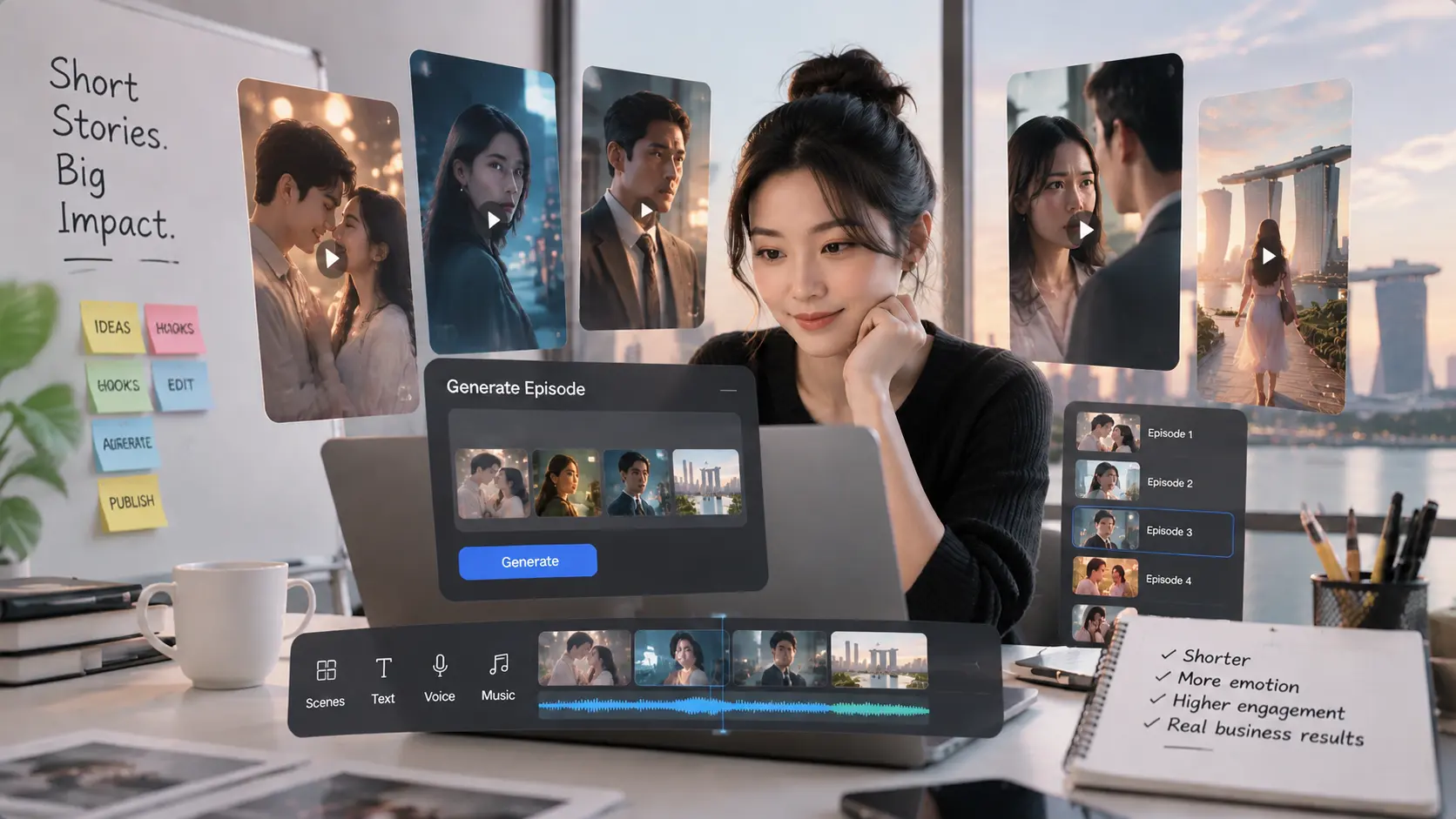
AI video generation is lowering the barrier to serialised brand storytelling. But producing more episodes is easier than making sure every story still earns attention, protects trust and feels right for the brand.

Grab Singapore’s first microdrama achieved something most branded content struggles to do: it got people talking. The problem was that not all of the conversation was about the entertainment.
I Fell In Love With My Grab Driver drew criticism over whether a romance between a driver and passenger sat comfortably with the safety expectations attached to a ride-hailing brand. Grab later acknowledged that it should have been more thoughtful about the title and premise. The company emphasised that “safety, clear boundaries, and respect in everyday interactions should never be compromised”.
Now add generative AI to that equation.
Instead of producing one short-form drama, marketers can increasingly use AI video generation to experiment with characters, settings, alternate openings, different languages and even entire scenes with far less traditional production work. That creates an obvious opportunity, but also a new problem:
AI makes branded storytelling easier to produce. It does not make brand judgement easier.
For marketers, that may be the real question behind the rise of the AI microdrama: when production becomes faster and cheaper, how do brands scale the story without scaling the risk with it?
Key Takeaways
- AI microdrama is emerging as a fast, low-cost way for brands to produce serialised, mobile-first video content, using generative AI for storyboards, scenes, voices and localisation.
- Faster production doesn’t reduce the need for brand judgment. As Grab’s driver-passenger romance backlash showed, every story premise still needs to be checked against what customers must trust about the brand.
- AI involvement spans three levels: AI-assisted, hybrid, and fully AI-generated — and risk to creative, legal, and reputational standing rises at each step up.
- Continuity (character look, voice, product appearance) and genuine cultural localisation remain jobs for human review, even as AI speeds up the production around them.
- Success should be measured beyond views alone, tracking hook rate, completion, brand sentiment, and “story-to-brand conversion” to confirm the drama builds brand value rather than just entertainment.
Why Microdramas Are Becoming a Marketing Format
Microdramas take familiar television mechanics such as romance, betrayal, comedy, secrets and cliffhangers and compress them into short vertical episodes designed for mobile viewing.
The format has already moved beyond a niche entertainment experiment. Reuters reported in August 2026 that microdramas were expanding as studios and entertainment companies chased mobile-first audiences, with TikTok, ReelShort and GoodShort helping drive discovery.
That fits the wider shift toward short-form social video marketing, where brands are already competing for attention in feeds designed around fast hooks and continual consumption.
Brands are also moving directly into the microdrama format. In Southeast Asia, VIRTUE Asia and COL Group partnered to develop brand-funded microdramas, vertical entertainment and creator-led mobile content across the region. Singapore-based Refinery Media has similarly expanded into vertical storytelling, with brands including Shopee and Nippon Paint participating in its projects.
The attraction is straightforward. Instead of asking viewers to sit through another conventional advertisement, a brand can give them a reason to return for Episode 2.
AI changes the economics again.
AI Video Generation Changes What Brands Can Produce
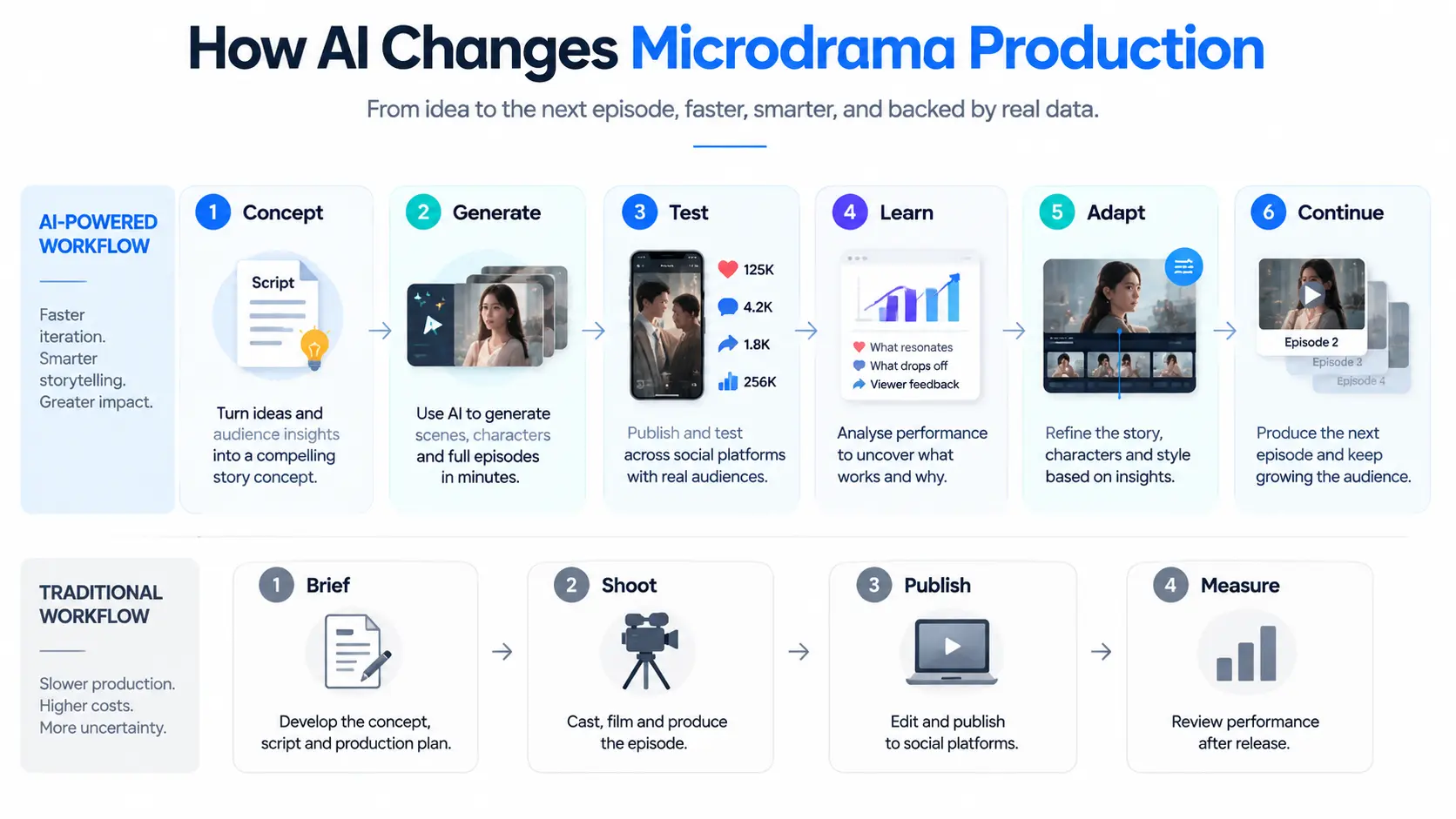
Traditional video production makes experimentation expensive. If a brand wants three opening hooks, four localised versions and two alternative endings, every variation can mean more scripting, filming, talent, editing and production time.
An AI video maker can reduce some of that friction. Depending on the workflow, AI can help with storyboards, visual concepts, generated environments, voice, translation, editing and alternate scenes.
This makes AI particularly relevant to companies already investing in video marketing and programmatic campaigns. Rather than using AI only to lower production costs, marketers can use the additional creative capacity to test more ideas and learn from audience behaviour.
That does not mean every microdrama should be fully AI generated. A better way to think about the opportunity is that AI creates more room to iterate.
Instead of:
Brief → Shoot → Publish → Measure
the workflow can become:
Concept → Generate → Test → Learn → Adapt → Continue
Because microdramas are episodic, marketers do not need to wait until the entire campaign ends to learn what worked. Audience response to Episode 1 can influence later episodes.
The format begins to borrow something from performance marketing: creative can evolve while the story is still running.
The Three Levels of AI Microdrama
Not every AI microdrama needs to feature synthetic actors reading a machine-generated script. Brands can use AI at very different levels depending on their creative goals and tolerance for risk.
1. AI-Assisted Microdrama
Most creative work remains human-led. Writers, directors and actors control the story while AI supports tasks such as:
- concept development
- storyboarding
- previsualisation
- subtitles
- localisation
- editing
- visual variations
This gives brands some of the production efficiencies of AI while leaving major creative decisions with people.
2. Hybrid AI Microdrama
AI contributes directly to parts of the finished production. That could include generated environments, visual effects, synthetic background characters, alternate shots, voice work or scenes that would otherwise be expensive to film.
The advantage is flexibility without making AI itself the centre of the campaign.
3. Fully AI-Generated Microdrama
Much of the pipeline, from characters and voices to scenes and editing, is generated with AI.
China is already showing how far this can go. CNA has documented AI-generated microdramas produced using generative tools instead of conventional actors, stunt crews and VFX production for every scene. The rapid growth of the format has also raised questions around copyright, likeness and the future role of creative professionals.
For brands, fully generated production offers the greatest potential efficiency. It also concentrates the greatest amount of creative, legal and reputational risk.
The Real Opportunity Is Not Just Cheaper Video
It is tempting to reduce the AI microdrama opportunity to one argument:
AI makes video cheaper, so brands can make more video.
But that misses the more interesting change.
AI can make storytelling testable at a scale that traditional branded entertainment rarely allows.
Imagine launching three versions of the same opening tension:
- romance
- mystery
- betrayal
A brand could compare retention across each hook and use the result when developing later episodes. It could also test episode length, character focus, cliffhangers, calls to continue watching, product integration and localised versions.
The marketer is no longer treating a microdrama purely as a miniature television series. It becomes serialised performance creative, combining storytelling with the experimentation already common in performance-focused social media marketing.
That creates a powerful feedback loop, but also a dangerous temptation.
The Most Engaging Story Can Still Be Wrong for the Brand
Performance marketers are trained to identify what earns attention. Drama thrives on tension, conflict and discomfort, and those qualities can improve retention precisely because something feels unresolved.
But the storyline with the highest completion rate is not automatically the storyline a brand should publish.
The Grab example demonstrates the problem. A driver-passenger romance creates tension because it touches on relationships between strangers, personal boundaries and safety. Those same ingredients can make the premise interesting while creating uncomfortable associations for a brand whose customers need to trust the safety of the underlying service.
AI could amplify this because it makes creative variations easier to produce. If marketers optimise purely for “Which story produces the strongest reaction?”, the process can gradually reward more provocative storylines.
The better question is:
Which story earns attention while reinforcing, or at least not undermining, what customers need to believe about the brand?
That is ultimately a brand strategy decision before it is an AI-production decision.
MediaOne’s Five-Part Brand Guardrail for AI Microdramas
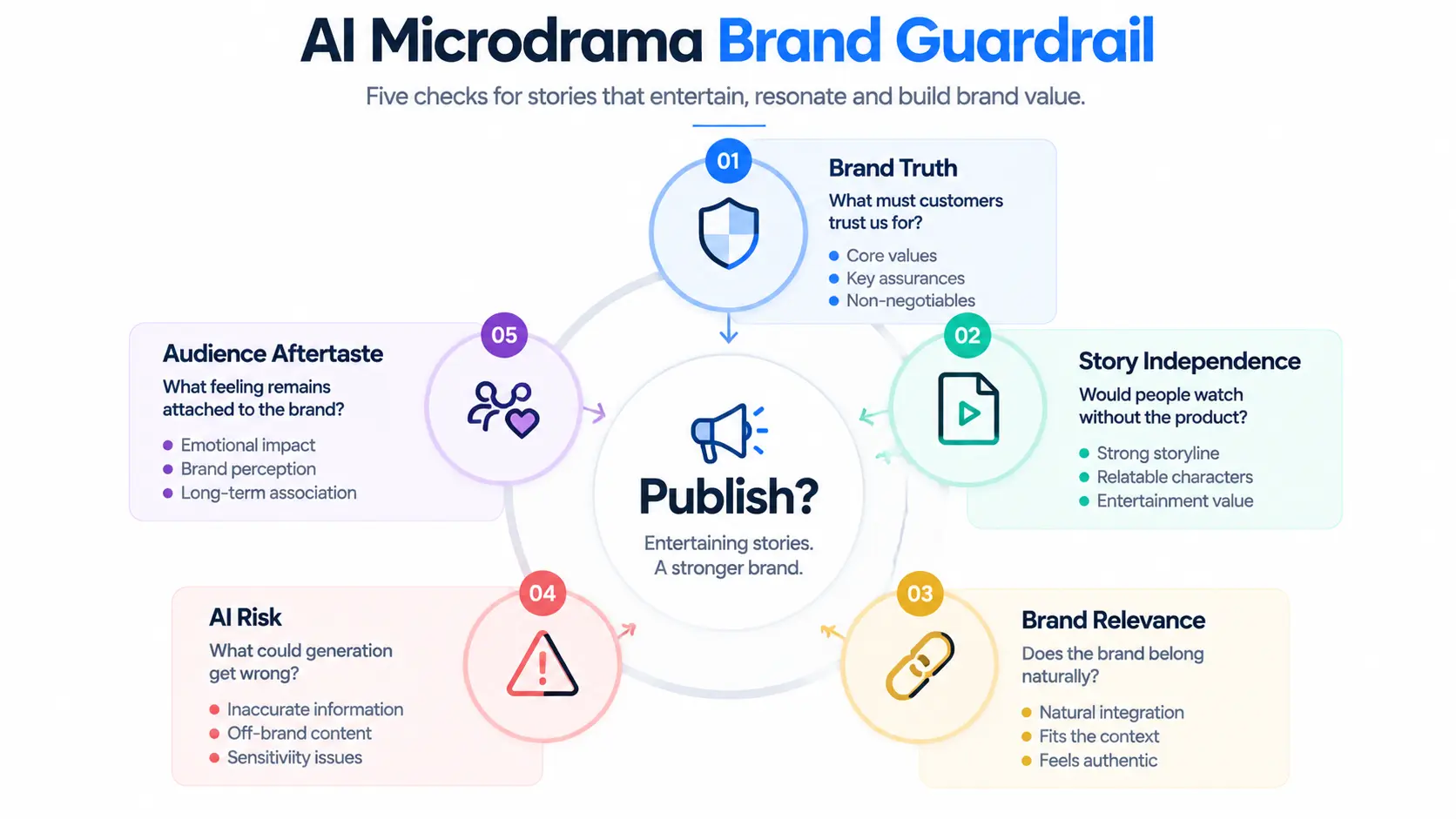
Before scaling an AI-generated story, marketers can put the idea through five checks.
1. Brand Truth: What Must Customers Continue to Believe?
Every company has something it cannot afford to undermine.
For a bank, that may be financial security. For a healthcare business, credibility. For cybersecurity, privacy. For transport, safety.
Ask:
Does the central tension of this story conflict with something customers need to trust us for?
If it does, engagement alone is not a strong enough reason to proceed.
2. Story Independence: Would Anyone Watch Without the Product?
Audiences watch entertainment because they care about the characters, conflict, humour or outcome, not because the company paid for production.
If every episode exists primarily to introduce another product feature, the series becomes a long advertisement divided into smaller pieces.
The story needs enough independent value to deserve the audience’s attention.
3. Brand Relevance: Could Any Other Brand Have Sponsored This?
There is an opposite problem too.
A story can be entertaining while having so little relationship with the advertiser that viewers remember the characters but forget the company behind them.
The useful territory sits somewhere between forced product placement and completely interchangeable sponsorship. The brand should belong inside the narrative without becoming the reason the narrative stops working.
4. AI Risk: What Can the Model Get Wrong?
Before publishing an AI-generated video, teams should identify the generation errors that could have meaningful consequences.
These might include:
- showing a product incorrectly
- creating a misleading demonstration
- fabricating a location
- generating culturally inappropriate imagery
- changing a character unexpectedly
- producing a false claim
- reproducing a person’s likeness without appropriate permission
- generating incorrect text or signage
In Singapore, this goes beyond creative quality. The Singapore Code of Advertising Practice establishes standards around truthful and responsible advertising, regardless of whether the creative was made traditionally or with AI. MediaOne’s broader guide to advertising in Singapore also covers the local advertising environment marketers need to consider.
AI disclosure alone does not make misleading advertising acceptable.
5. Audience Aftertaste: What Feeling Remains Attached to the Brand?
Marketers often ask whether viewers remember a campaign.
For dramatic content, the more useful question may be:
What do they remember the brand for once the cliffhanger is over?
Attention can be positive, negative or confusing. All three can produce impressive engagement numbers.
AI Can Scale Production Faster Than It Can Scale Taste
Singapore is already seeing rapid experimentation with generative AI advertising. CNA reported on rising demand for AI-generated advertising in Singapore, while industry practitioners warned that poor execution can make brands appear cheap or actively repel audiences.
Microdramas make that problem harder because a mistake does not necessarily exist in only one video. A 15-episode series asks viewers to believe in the same characters and the same fictional world repeatedly.
That makes continuity a much bigger production challenge.
Continuity Is the Hidden AI Microdrama Problem
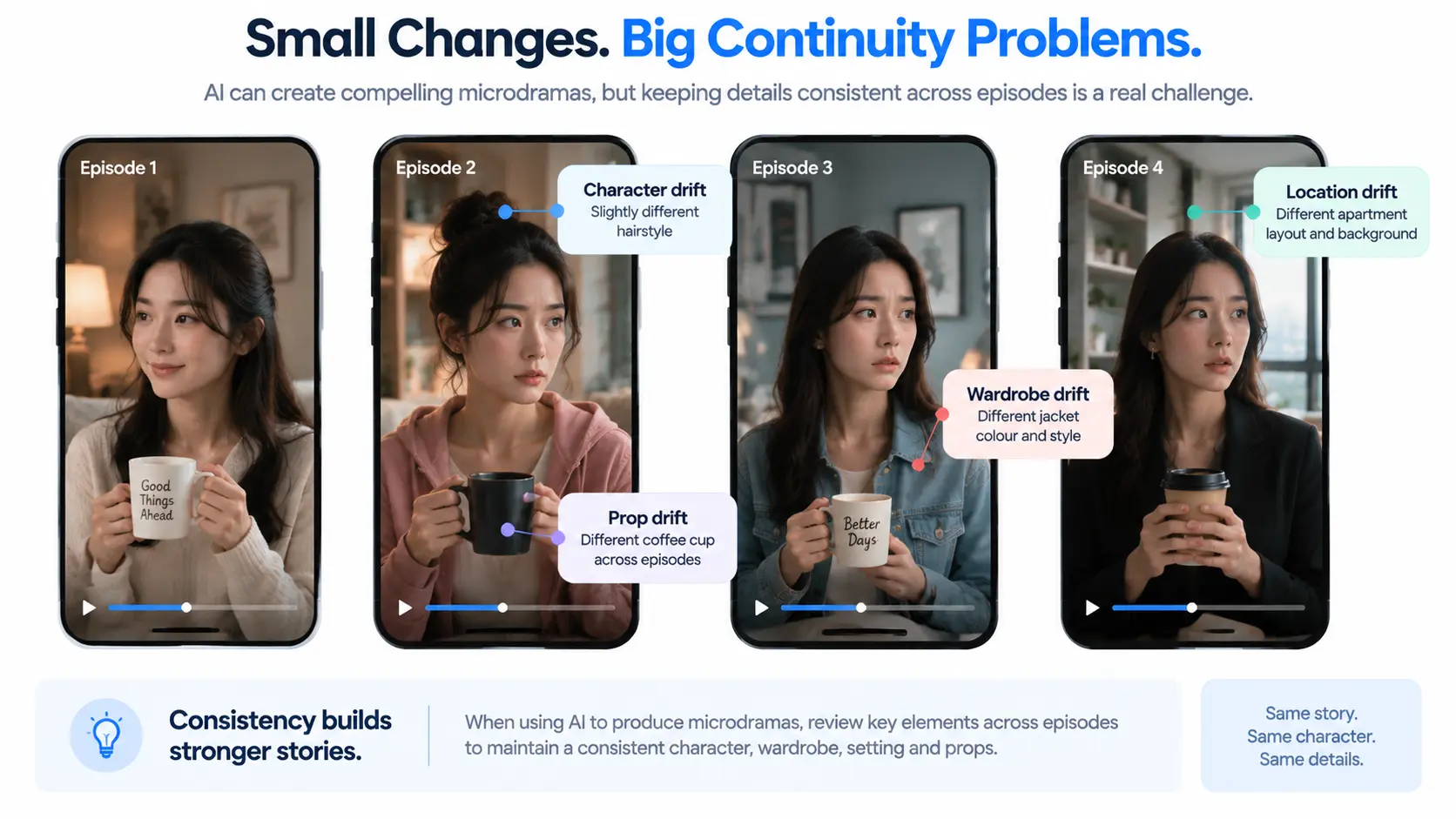
Storytelling depends on consistency.

If a lead character suddenly develops a different face, hairstyle, voice or apartment midway through a series, viewers stop following the story and start noticing the generation process.
An AI microdrama therefore needs more than good prompts. Brands may need a detailed continuity bible covering:
- character appearance
- clothing
- voice
- personality
- recurring locations
- product appearance
- props
- relationships
- timeline
- visual style
The longer the series runs, the more opportunities there are for small inconsistencies to compound.
Product continuity deserves the same attention. An AI-generated phone, food package, vehicle dashboard or storefront should not quietly change between scenes when that object represents the brand itself.
Production speed only matters if the audience continues to believe in the world being created.
AI Can Localise the Video. It Cannot Automatically Localise the Story
This is particularly important for Singapore brands operating across Southeast Asia.
AI can make it easier to experiment with translation, subtitles, dubbing and potentially visual localisation. One microdrama could theoretically be adapted for Singapore, Malaysia, Indonesia, Thailand, Vietnam or the Philippines without rebuilding every production element from scratch.
But localisation is not simply a language problem.
The same joke, family conflict, relationship dynamic, slang or social norm may be interpreted differently across markets. AI may help adapt dialogue, but it should not be assumed to understand every cultural boundary well enough to make the final creative decision.
The easier localisation becomes technically, the more important local human review becomes strategically.
Where AI Should Help, and Where Humans Should Stay in Control
The strongest AI microdrama workflow is unlikely to be entirely manual or entirely automated.
AI is most useful where it removes repetitive production friction. Humans should retain control where mistakes can create significant brand, cultural or legal consequences.
| AI can help with | Humans should own |
| Storyboard variations | Core story premise |
| Visual concepts | Brand boundaries |
| Alternate hooks | Cultural judgement |
| Subtitles | Humour and nuance |
| Translation drafts | Final localisation |
| Generated environments | Product claims |
| Editing assistance | Legal/IP review |
| Voice and scene variations | Final publishing decision |
This aligns with Singapore’s broader approach to AI governance. IMDA’s Model AI Governance Framework emphasises governance and human accountability even as AI systems become increasingly capable of performing work autonomously.
The objective should therefore be to automate where speed creates useful leverage while keeping human accountability where mistakes carry meaningful consequences.
How We Would Build an AI Microdrama Campaign
A sensible campaign starts with the audience rather than the AI video tool.
That is also the foundation of a stronger content marketing strategy: identify what the audience genuinely cares about first, then choose the format capable of carrying the idea.
Start With a Human Tension
Good drama needs a reason for someone to continue watching.
Instead of beginning with:
“How do we make our product dramatic?”
start with:
“What tension already exists in our audience’s life?”
For a tuition company, that might be a disagreement between a parent and teenager over the future. For a property platform, it could be a couple discovering that their dream neighbourhood creates two completely different commutes.
The product should enter where it naturally affects the tension rather than becoming the premise itself.
Define the Brand’s Role Before Writing the Episodes
Decide whether the brand is:
- the setting
- the solution
- a plot device
- an enabler
- simply part of the characters’ world
Defining this early prevents awkward product appearances from being inserted after the story has already been written.
Map the Full Story Arc
Micro does not mean random.
Even if episodes last less than a minute, the team should understand where the story begins, what changes, which cliffhangers matter, how characters develop, where the brand appears and how the series eventually resolves.
Otherwise, performance optimisation can turn the campaign into a collection of disconnected hooks.
Build the AI Production Rules
Before using an AI video maker at scale, document the character, visual and brand constraints.
Then generate a pilot rather than an entire season.
Test the Pilot
Measure whether viewers stop scrolling, whether they finish the episode, whether they want Episode 2 and whether the brand association remains positive.
A high completion rate accompanied by negative brand sentiment is not necessarily a win.
Scale What Works
This is where AI can create the most leverage.
Once the team knows that the premise, characters and brand integration are working, AI can make variations, localisation and supporting production much easier.
Use AI to scale a validated story, not to manufacture 20 episodes before knowing whether Episode 1 deserves a second.
What Should Brands Measure?
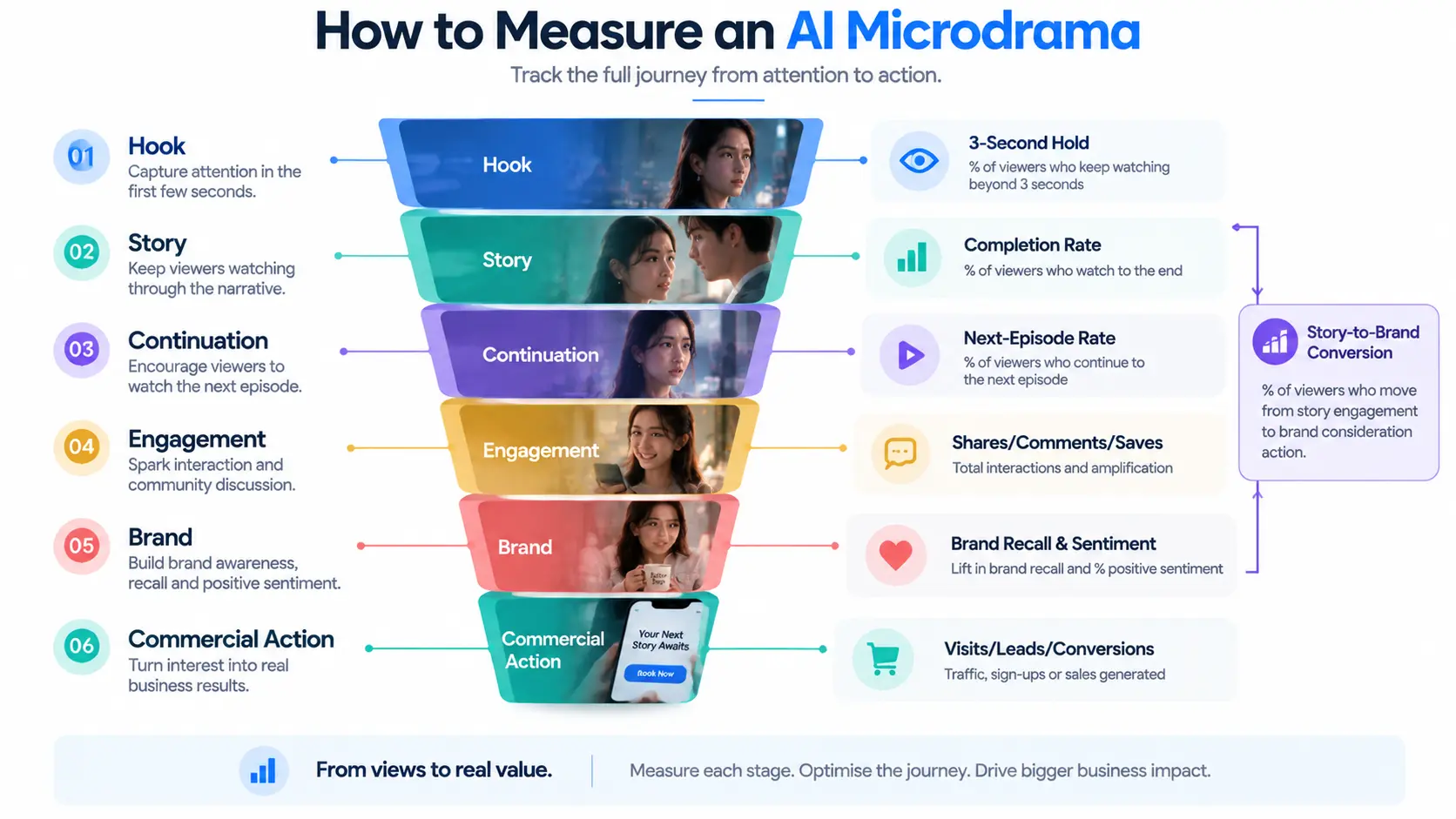
Views alone are too shallow for episodic branded content.
A more useful measurement model follows the audience from attention through to commercial action.
| Stage | What to measure |
| Hook | 3-second hold / scroll-stop rate |
| Story | Episode completion rate |
| Continuation | Next-episode viewing rate |
| Engagement | Shares, comments and saves |
| Brand | Sentiment, recall and branded-search movement |
| Commercial | Site visits, leads or conversions |
Story-to-Brand Conversion
One additional metric deserves attention because microdramas can become popular without strengthening the advertiser behind them.
Ask people who watched or engaged with the series:
Can they correctly identify the brand’s role in the story and what the company actually does?
If audiences love the characters but cannot remember who funded the series, the company may have created successful entertainment without creating equivalent marketing value.
Should Every Brand Test AI Microdramas?
No.
The format is most promising when a brand already has an audience consuming short-form content, a category with genuine human tension, enough creative resources to maintain continuity, a reason to produce multiple episodes and a measurement framework that goes beyond views.
It also requires a review process for AI-generated material.
AI microdramas are less attractive when the subject demands extreme factual precision, the brand has little tolerance for tonal errors or the entire creative concept exists only because AI makes it inexpensive to produce.
The technology should not be the idea.
A good campaign still needs something worth watching.
The Bigger Question Is Not Whether AI Can Make the Drama
Microdramas are already moving into branded entertainment, and AI video generation is lowering the effort required to produce, adapt and experiment with them.
That creates a genuine marketing opportunity. Episodic stories can become more iterative, more localised and potentially more measurable than traditional brand films.
But cheaper production does not make storytelling risk-free.
The same technology that allows a brand to generate five hooks instead of one also makes it easier to chase the most provocative version. The same localisation systems that help one campaign reach multiple markets can scale a cultural mistake just as efficiently. And the same AI-generated characters that reduce production requirements can lose an audience if continuity breaks halfway through the series.
As AI makes video creation easier, the competitive advantage may shift away from production itself.
The scarce skill becomes judgement: knowing which story deserves to be told, where the brand belongs inside it and when the most engaging concept is still the wrong idea to publish.
A useful test is:
If the story works without the brand, you have entertainment. If the brand ruins the story, you have an ad. The opportunity is the narrow space where each makes the other better.
AI can help brands produce that story faster.
It cannot decide where that line should be.
Frequently Asked Questions
What Is an AI Micro Drama?
An AI micro drama is a short episodic story produced partly or substantially using generative AI. AI may assist with scripting, storyboarding, visual generation, voices, editing or localisation, while the finished episodes are typically designed for vertical, mobile-first viewing.
How Can AI Video Generation Be Used for Microdramas?
AI video generation can help with visual development, scene creation, alternate hooks, environments, localisation, editing and other production work.
Brands can use AI as an assistant to conventional human production or as a larger part of the finished content, depending on the creative requirements and acceptable level of risk.
Are Fully AI-Generated Microdramas Already Being Made?
Yes. AI-generated microdramas are already appearing in markets such as China, where producers have used generative systems to create characters, environments and dramatic sequences without traditional production for every shot.
Can Brands Use AI-Generated Video in Advertising?
Yes, but the resulting advertisement still has to comply with relevant advertising, consumer-protection, copyright and other applicable rules.
In Singapore, AI-generated advertising remains subject to the same principle that advertising should be truthful and not misleading.
Should Brands Disclose That a Video Was Made With AI?
Disclosure may be appropriate depending on the execution, platform and context, but it should not be treated as a substitute for responsible advertising.
A disclosed AI-generated claim can still be misleading.
What Is the Best AI Video Maker for a Microdrama?
There is no single best AI video maker for every project.
The right choice depends on whether the production needs character consistency, text-to-video generation, image-to-video, voices, localisation, editing or integration with a wider production workflow.
More importantly, tool selection should come after the story, brand guardrails and review process are defined. Generating scenes is usually easier than deciding which scenes should exist.