A finance ad can look polished, yet still expose a brand to compliance risk. A paid search headline that promises attractive returns, a TikTok script that oversimplifies investment products, or a landing page with unclear disclosures can be problematic if it fails to meet finance ad guidelines. In Singapore’s highly regulated financial sector, compliance must be built into every stage of the campaign, from strategy to publishing and post-launch monitoring.
As digital marketing channels continue to evolve, financial institutions, agencies, and content creators face increasing pressure to balance engaging campaigns with responsible advertising practices. This guide breaks down the latest Monetary Authority of Singapore (MAS) expectations, Ministry of Law rules for money lenders, Google Ads verification, and common compliance risks into a practical, marketer-friendly framework.
Key Takeaways
- Finance ad guidelines in Singapore extend beyond ad copy. They also cover platform selection, clear disclosures, digital marketer oversight, campaign monitoring, and post-launch governance to help protect consumers.
- MAS’s digital advertising guidelines apply to financial institutions and appointed third parties, including agencies, affiliates, and online content creators involved in promoting financial products or services.
- Google Ads requires financial services verification for eligible advertisers targeting users seeking financial services in Singapore, making platform compliance just as important as regulatory compliance.
- Licensed moneylenders are different from MAS-regulated financial institutions. Their advertising channels are heavily restricted by the Ministry of Law / Registry of Moneylenders
- The most effective compliance strategy starts before launch. Using a structured review process, supported by ongoing monitoring and clear accountability, helps reduce risk while keeping finance campaigns accurate, transparent, and trustworthy.
What Are Finance Ad Guidelines?
Finance ad guidelines are the rules, platform policies, and internal controls that govern how financial products and services can be promoted. In Singapore, they usually cover claims, risk disclosures, product suitability, digital media selection, influencer activity, licensing risks, and whether ads may mislead consumers.
Why Finance Ads Are Treated Differently from Ordinary Ads
Unlike retail or lifestyle products, financial products can have a lasting impact on a person’s savings, debt, or retirement planning. Even small wording changes, such as implying guaranteed returns, can significantly influence consumer decisions.
This challenge becomes even greater on short-form digital channels like TikTok or Instagram Reels, where limited space makes it harder to communicate risks alongside promotional messages. As a result, regulators place greater emphasis on protecting consumers than on creative marketing alone.
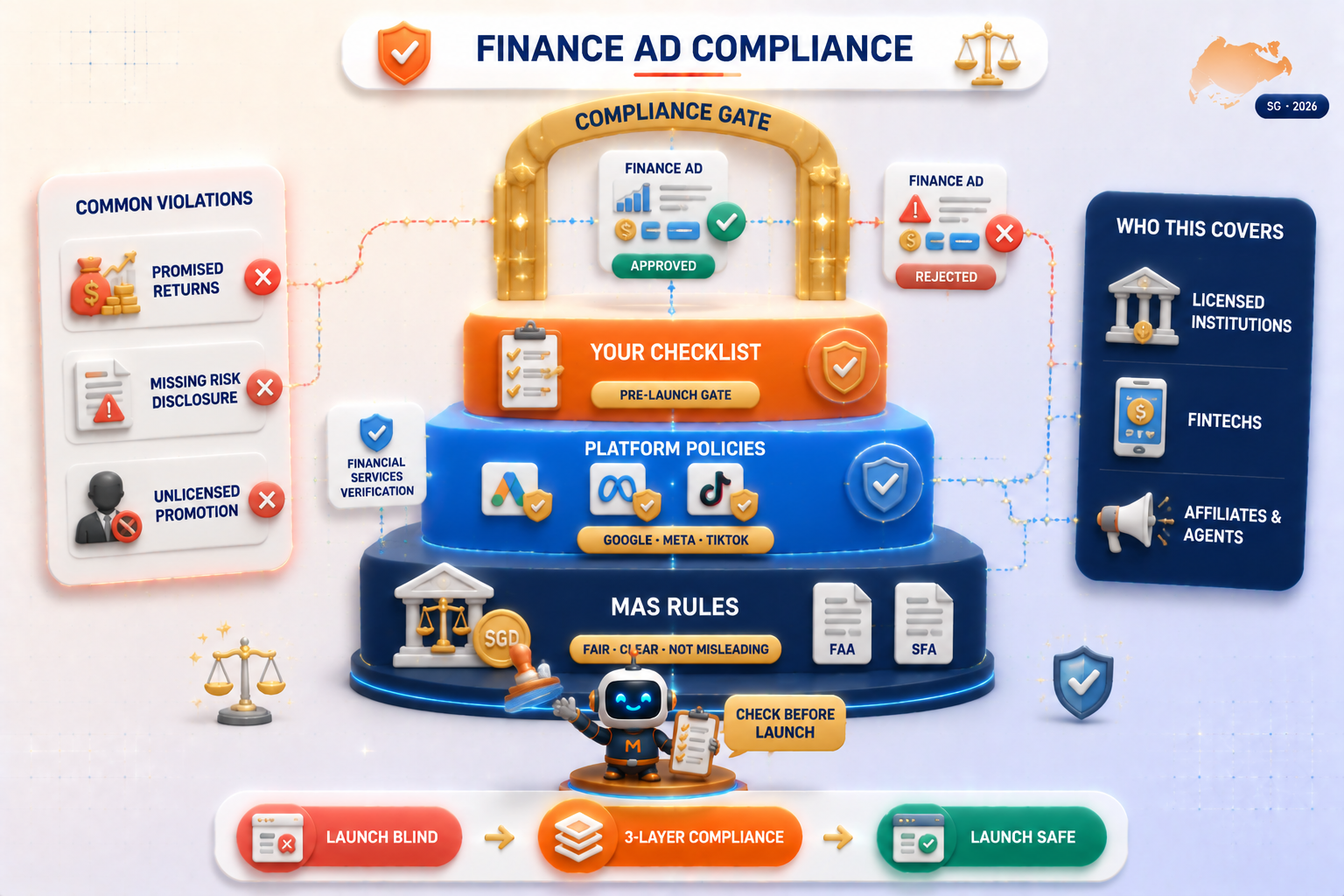
The Three Layers Marketers Must Manage

Creating compliant finance campaigns requires more than following regulations. Marketers should evaluate every campaign through three interconnected layers:
- Regulatory layer: Understand the Monetary Authority of Singapore (MAS) Guidelines (regulatory and supervisory expectations), applicable legislation such as the Financial Advisers Act and other sector-specific laws, and any additional requirements that apply to your product or service.
- Platform layer: Meet advertising policies enforced by platforms such as Google Ads, Meta, TikTok, and LinkedIn, including financial services verification where required.
- Execution layer: Ensure that ad copy, landing pages, influencer content, disclosures, approval workflows, and post-launch monitoring work together to support accurate and responsible financial advertising.
Who Needs to Follow Finance Ad Guidelines in Singapore?
Finance ad guidelines are often associated with banks and licensed financial institutions, but their reach extends much further. If you’re involved in creating, approving, publishing, or promoting financial advertisements, understanding your compliance responsibilities is essential.
The table below highlights the key stakeholders and why finance ad guidelines matter to each of them.
| Audience | Why It Matters |
| Banks and finance companies | Advertisements must be fair, clear, and not misleading, with accurate claims and appropriate disclosures. |
| Insurers and insurance intermediaries | Product benefits, exclusions, waiting periods, and policy conditions should be communicated transparently. |
| Fund managers and investment platforms | Performance claims, risk warnings, and product suitability require careful review and supporting evidence. |
| Fintech companies | Digital-first campaigns are still expected to meet applicable financial advertising standards. |
| Marketing agencies | Agencies representing financial institutions should follow approved messaging, compliance processes, and campaign controls. |
| Influencers/finfluencers | Sponsored financial content may create licensing, disclosure, and misleading-content risks if not managed properly. |
| Affiliate marketers | Referral links, commission-based promotions, and product claims must be transparent and appropriately controlled. |
| Paid media specialists | Platform requirements, like Google Ads financial services verification, must be met alongside regulatory obligations. |
Importantly, the Monetary Authority of Singapore (MAS) states that its digital advertising safeguards extend beyond financial institutions to appointed third parties, including online content creators and digital marketers.
Special Rules for Licensed Moneylenders in Singapore
Licensed moneylenders are not simply another type of financial advertiser. Their advertising is governed by three separate sources of authority:
- Moneylenders Act: The primary legislation governing licensed moneylending.
- Moneylenders Rules: Subsidiary legislation setting out operational requirements.
- Registrar’s Directions: Including the Advertising and Marketing Directions; binding requirements issued by the Registry of Moneylenders covering permitted advertising practices.
Under the Registry’s Advertising and Marketing Directions, licensed moneylenders may advertise their moneylending business only through:
- business or consumer directories in print or online media;
- internet websites belonging to the licensee; and
- advertising or marketing materials placed within the approved place of business, or on the exterior side of the approved premises.
Other channels are not a grey area. Paid-for internet links, including sponsored search links, are not permitted. Promotional social media or video-hosting content is also not permitted when used to promote a moneylending business or product. SMS, WhatsApp, WeChat, email marketing to the public, unsolicited calls, and solicitation outside the approved place of business also create serious risk.
Search engine optimisation for the licensee’s own website is permitted, but paid search is not treated as a directory listing. A licensed moneylender should not assume Google verification permits Google Ads.
| Advertiser | Primary Regulator | Google Ads | Social Media Ads | Key Issue |
| Bank / MAS-regulated FI | MAS | Potentially, subject to verification and regulation | Potentially | MAS digital advertising expectations |
| Insurer / investment firm | MAS | Potentially | Potentially | Product-specific disclosures and suitability |
| Fintech | Depends on regulated activity | Depends | Depends | Licence and activity assessment required |
| Licensed moneylender | Ministry of Law / Registry of Moneylenders | Not permitted under the Registry of Moneylenders’ Advertising and Marketing Directions | No | Advertising restricted to approved channels |
| Unlicensed moneylender | N/A | No | No | Unlawful moneylending risk |
For moneylenders, check the permitted channel first, then review the wording. Balanced copy does not rescue a campaign if the channel itself is prohibited.
What Marketers Must Never Assume
| Assumption | Reality |
| Google verification means I can advertise. | Google verification does not override Singapore law or Ministry of Law restrictions. |
| “Not financial advice” makes content compliant. | Disclaimers do not remove licensing or advertising obligations. |
| Balanced wording makes any campaign acceptable. | Some advertising channels remain prohibited regardless of the wording used. |
| SEO and paid search follow the same rules. | A licensed moneylender may optimise its own website for search but cannot treat paid search ads as permitted directory listings. |
The MAS Digital Advertising Safeguards Marketers Need to Understand
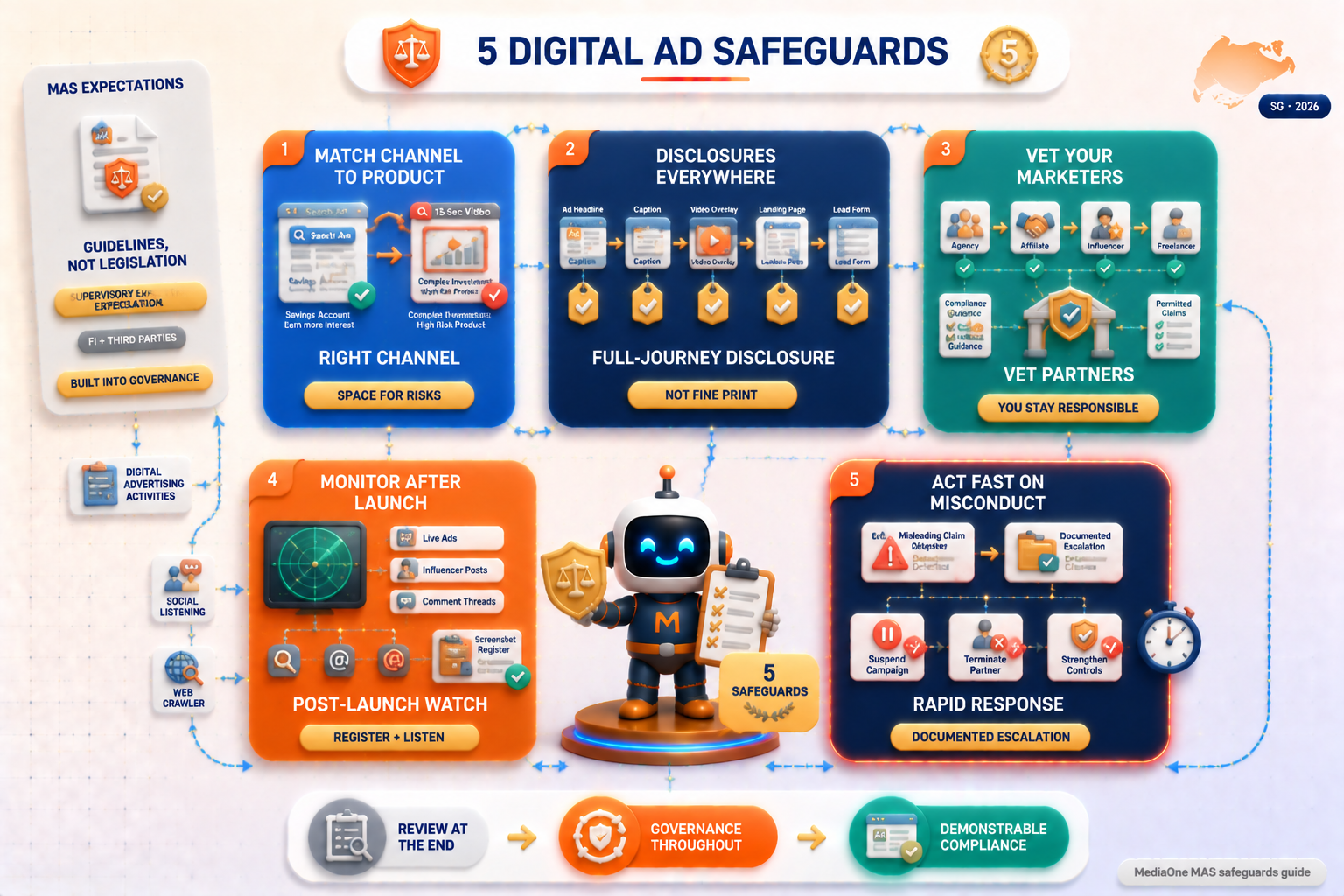
As financial marketing becomes increasingly digital, compliance can no longer rely on a final legal review before launch. The MAS Guidelines on Standards of Conduct for Digital Advertising Activities set out supervisory expectations for financial institutions and appointed third parties.
While they are not legislation, MAS expects regulated entities to incorporate these safeguards into their advertising governance.
1. Choose the Right Digital Media for the Product
Not every digital platform is suitable for every financial product. A simple promotion for a savings account may work well as a Google Search ad, while a complex investment product with significant risks may require a landing page optimisation or educational content rather than a 15-second TikTok video.
Marketers should evaluate whether a platform provides enough space and context to communicate both product benefits and material risks. Choosing the right channel helps reduce the likelihood of consumers making decisions based on incomplete information.
2. Make Disclosures Visible Throughout the User Journey
Risk disclosures should not be treated as fine print added at the end of the campaign. Consumers should encounter important qualifications wherever financial claims appear, whether in an ad headline, social media caption, video overlay, landing page, or lead generation form.
If an advertisement highlights promotional rates, guaranteed features, or investment opportunities, the corresponding terms, conditions, and risk information should be presented clearly and consistently. A compliant landing page cannot compensate for a misleading advertisement, and vice versa.
3. Vet Digital Marketers Before Giving Them the Campaign
Financial institutions remain responsible for the campaigns created on their behalf. Before engaging marketing agencies, affiliate partners, influencers, or freelance content creators, organisations should establish approval processes, provide compliance guidance, and define what claims are permitted.
Everyone involved in producing financial content should understand both the regulatory expectations and the brand’s internal standards before a campaign goes live.
4. Monitor Ads After They Go Live
Compliance does not end once a campaign is published. Teams should actively monitor live advertisements, capture screenshots of approved creatives, review influencer posts, and track comments or user-generated content that could create misleading impressions.
Maintaining a register of campaigns, social media accounts, and creator partnerships also makes it easier to investigate issues and demonstrate accountability. Larger organisations may supplement these efforts with social listening tools, web crawlers, or periodic audits to identify non-compliant content before it spreads.
5. Act Quickly When Misconduct Happens
Even well-planned campaigns can encounter compliance issues after launch. When misleading claims, missing disclosures, or unauthorised promotional content are identified, organisations should have a documented escalation process to correct or remove the content promptly.
Depending on the severity of the issue, this may involve suspending campaigns, terminating relationships with non-compliant partners, or strengthening internal controls to prevent repeat incidents.
Financial Education vs Financial Advertising vs Financial Advice
One of the easiest mistakes in finance content is assuming that anything labelled “educational” is automatically low-risk; that is not always true. A neutral explanation of budgeting, insurance, or compound interest is very different from content that promotes a specific product, encourages a transaction, or tells a reader what to buy, sell, or hold.
For marketers, the key question is not just “Does this content include a disclaimer?” It is “What action could this content reasonably influence?” The more specific, promotional, or personalised the message becomes, the more carefully it should be reviewed.

| Content Type | Lower-Risk Example | Higher-Risk Example |
| Financial education | “Here is how compound interest works.” | “This specific product is best for you.” |
| Product advertising | “Compare account features and eligibility.” | “Earn high returns with no downside.” |
| Financial advice | “Read the product documents and assess your risk profile.” | “You should buy, sell, or hold this investment.” |
| Sponsored content | “This post is sponsored by X. Here are the product terms.” | “I use this, so you should invest too.” |
“Not financial advice” is not a compliance shield. Regulators assess the overall content, not just the disclaimer.
Note: The examples above are illustrative only. Whether particular content constitutes regulated financial advice depends on the specific facts, the nature of the communication, and the applicable legislation. Marketing teams should not treat this table as a legal classification test.
Platform Policies Finance Advertisers Cannot Ignore
Platform approval and regulatory compliance are separate requirements. Completing Google Financial Services Verification may allow an advertiser to satisfy Google’s own requirements, but it does not override Singapore law. Advertisers must first determine whether they are legally permitted to advertise through a particular channel before considering platform-specific approval.
Google Ads Financial Services Verification in Singapore
This requirement is a Google Ads platform policy, not a legal approval under Singapore law. Depending on the nature of the business, advertisers may need to demonstrate that they are licensed by the Monetary Authority of Singapore (MAS), listed by the Ministry of Law, registered dealers, or otherwise exempt from licensing requirements.
Note: Google Financial Services Verification means Google may permit an advertiser to access its advertising platform. It does not mean Singapore law permits that advertiser to use that advertising channel.
Social Media Ads and Influencer Campaigns
Financial promotions on social media require more than engaging creatives. Captions, video overlays, and creator scripts should communicate key information clearly without exaggerating benefits or downplaying risks.
Sponsored posts should include appropriate partnership disclosures, while affiliate links and referral codes should be transparent about any commercial relationship. Since comments can sometimes introduce misleading claims, marketers should also monitor engagement and respond or moderate content where appropriate.
Note: Requirements imposed by Meta, TikTok, LinkedIn, and similar platforms are platform policies. Advertisers must satisfy these in addition to applicable Singapore legislation and MAS supervisory expectations.
Landing Pages Must Support the Ad Claim
Compliance does not stop once a user clicks an advertisement. Every landing page should reinforce the claims made in the ad. If a campaign promotes an interest rate, investment return, or insurance benefit, the landing page should clearly explain eligibility requirements, product risks, applicable fees, promotional periods, rate assumptions, and relevant terms and conditions.
Most importantly, any limitations or conditions affecting the advertised offer should be presented clearly so users can make informed decisions before taking the next step.
Common Operational Challenges in Finance Advertising
Regulatory requirements are only one part of the approval process. In practice, finance advertising campaigns often go through several rounds of revision before launch because multiple teams must review the same assets from different perspectives. Even when the advertising message is accurate, operational issues can delay approval or require last-minute changes.
Some of the most common challenges include:
- Google verification can affect launch timelines. While approval times vary, verification is often left until the final stages of campaign preparation. Treating verification as an early project milestone rather than a launch-day task helps avoid unnecessary delays if additional documentation is requested.
- Landing-page mismatches are a recurring source of revisions: We’ve encountered situations where the landing page was updated after the advertisement had been approved, creating inconsistencies that only surfaced during final QA. Experiences like this reinforce why version control and end-to-end QA are just as important as reviewing the ad copy itself.
- Compliance and marketing review different things: Marketing teams naturally focus on clarity, engagement, and conversion, while compliance reviewers evaluate whether claims are accurate, balanced, and properly disclosed. Establishing a shared approval workflow with documented feedback helps reduce repeated revisions and keeps everyone working from the same version of the campaign.
- Performance claims often require additional evidence: Claims involving interest rates, promotional returns, awards, or comparative statements typically generate the most internal review comments because they require supporting documentation and precise wording. Preparing that evidence alongside the draft significantly reduces revision cycles.
- Version control becomes more important as more teams become involved: When multiple editors, compliance reviewers, designers, and paid media specialists work on the same campaign, version control quickly becomes critical. Keeping dated approval records and archived creatives helps ensure that the final published advertisement matches the version that was approved.
- Automatically generated assets should still be reviewed: Advertising platforms sometimes generate or recombine headlines, descriptions, or other creative elements automatically. Before launch, marketers should preview these combinations to ensure important disclosures remain clear and the resulting advertisements continue to reflect the approved messaging.
From an SEO publishing perspective, many approval delays are caused by operational inconsistencies rather than incorrect advertising claims. During content production, advertisements, landing pages, downloadable PDFs, metadata, and promotional banners may all be updated separately.
Reviewing these assets together before publication helps identify conflicting rates, eligibility criteria, promotional dates, or disclosures before they become compliance issues.
Potentially Problematic vs More Balanced Finance Ad Examples
Knowing the rules is one thing; applying them to real campaigns is another. In practice, many compliance issues arise not because marketers intentionally mislead consumers, but because promotional messages oversimplify financial products or omit important context.
The examples below illustrate how a few wording changes can help shift an advertisement from a potentially risky claim toward a more balanced and transparent message.
| Scenario | Potentially Problematic Wording | More Balanced Illustrative Wording |
| Investment ad | “Earn 8% guaranteed returns.” | “Explore investment options. Returns are not guaranteed, and capital is at risk.” |
| Savings promotion | “Get 4.5% p.a. instantly.” | “Earn up to 4.5% p.a. when qualifying conditions are met. Terms and eligibility apply.” |
| Influencer post | “This fund made me money. Buy it now.” | “This is a sponsored post sharing general information about the product. It should not be considered personal financial advice.” |
| Crypto / digital token content | “Trade crypto safely and profit fast.” | “Digital token prices are highly volatile. You may lose some or all of your investment.” |
| Insurance advertisement | “Full protection for your family.” | “Coverage is subject to policy terms, exclusions, eligibility requirements, and underwriting.” |
Note: The examples above are provided for educational purposes only to illustrate good advertising practices. They are not legal advice or a substitute for reviewing applicable MAS regulations, platform policies, or internal compliance requirements before publishing financial advertisements.
For licensed moneylenders, wording is only one part of the review. Even balanced illustrative wording must appear only in permitted advertising channels.
The Finance Ad Pre-Launch Compliance Checklist
While every financial institution may have its own approval workflow, reviewing the fundamentals before launch can help marketing teams identify issues early, reduce revision cycles, and avoid preventable compliance risks.
Use the checklist below as a practical reference before publishing finance-related campaigns.
| Review Item | What to Verify | Evidence / Approval |
| Licensing | Is the advertiser licensed, authorised, exempt, or otherwise permitted to promote this product? | Licence number, regulatory status, or internal confirmation |
| Product Classification | Is the product subject to specific financial advertising requirements? | Compliance or legal review |
| Advertising Claims | Are all rates, returns, bonuses, cashback, yields, and performance claims supported? | Supporting documentation or source evidence |
| Risk Disclosures | Are material risks, limitations, and qualifying conditions clearly presented? | Approved disclosure wording |
| Landing Page Review | Does every landing page accurately support the advertisement? | Final QA review |
| Platform Requirements | Has Google verification (or other platform requirements) been completed where applicable? | Platform approval or verification status |
| Influencer / Affiliate Content | Have creator scripts, sponsorship disclosures, referral codes, and affiliate messaging been reviewed? | Approved briefing documents |
| Creative Approval | Has compliance or legal approved the final creative? | Final approved version |
| Version Control | Are screenshots, approvals, and published assets archived? | Campaign archive |
| Post-Launch Monitoring | Is there a process for monitoring, correcting, or removing problematic content? | Monitoring and escalation plan |
Note: Treat this table as part of your campaign approval workflow. Completing each review item before launch creates a documented record that helps marketing, compliance, and paid media teams work from the same approved version of every campaign asset.
A Practical Approval Workflow for Finance Ad Campaigns
A successful finance campaign is fueled by creativity, but it also depends on a repeatable approval process that identifies compliance risks before and after launch. The following five-step workflow can help marketing and compliance teams collaborate more efficiently.
- Classify the product and claim type: Start by identifying what you’re promoting. Is the campaign about deposits, loans, insurance, investment products, digital tokens, financial education, or general brand awareness? The product category often determines the level of review and the types of disclosures required.
- Map every claim to supporting evidence: Every statement about returns, interest rates, fees, awards, comparisons, or product performance should be backed by verifiable evidence. Unsupported marketing claims can quickly become compliance concerns.
- Review the ad and landing page together: Don’t review ad creatives in isolation. Headlines, visuals, calls to action, and landing page content should present a consistent message. A compliant advertisement can still mislead users if the landing page omits important conditions or contradicts the original claim.
- Confirm platform requirements: Before launch, verify that platform-specific requirements have been met. This includes advertising policies for Google, Meta, TikTok, LinkedIn, email marketing platforms, affiliate networks, and any other channels used in the campaign.
- Monitor after launch: Once the campaign is live, continue monitoring its performance and compliance. Archive approved creatives, review influencer posts, monitor user comments where appropriate, and establish a process for correcting or removing content if issues are identified.
Operational tip: When publishing, it’s common for metadata, page copy, downloadable PDFs, and lead forms to be updated at different stages of production. Before publishing finance content, perform one final QA review across every user-facing asset—not just the landing page. Even small inconsistencies in dates, rates, eligibility requirements, or product names can create unnecessary review cycles and reduce user trust.
Finance Ad Compliance Is a Campaign System, Not a Disclaimer
Finance ad guidelines are a framework for creating responsible, transparent, and trustworthy marketing campaigns. From choosing the right advertising platform and crafting balanced messaging to selecting influencer partners, reviewing landing pages, and monitoring campaigns after launch, every stage plays a role in reducing compliance risk.
For financial institutions, fintech companies, and marketing agencies looking to scale their digital campaigns, adopting a structured approval workflow helps maintain both performance and regulatory confidence. If your organisation needs expert support with SEO, paid advertising, content marketing, or performance-driven digital campaigns, MediaOne offers end-to-end digital marketing services tailored to highly regulated industries.
From SEO and content marketing to Google Ads and performance marketing, MediaOne works alongside clients’ legal and compliance teams to deliver campaigns that balance business growth with responsible advertising practices.
Contact us today and we’ll start with a comprehensive compliance and campaign audit to identify gaps in your current finance advertising strategy.
Frequently Asked Questions
What are finance ad guidelines?
Finance ad guidelines are the regulations, platform policies, and internal controls that govern how financial products and services are promoted. They help ensure advertisements are accurate, balanced, transparent, and do not mislead consumers.
Who regulates financial advertising in Singapore?
The Monetary Authority of Singapore (MAS) is the primary regulator overseeing financial services and related advertising expectations. Financial advertising in Singapore may be subject to:
- MAS supervisory guidelines for regulated financial institutions;
- Legislation, including the Financial Advisers Act and other sector-specific laws;
- The Moneylenders Act, Rules, and Registrar’s Directions for licensed moneylenders; and
- Platform policies such as Google Ads Financial Services Verification.
Do finance influencers need a MAS licence?
Not always. However, licensing considerations may arise if an influencer recommends buying, selling, or holding specific investment products, provides personalised financial advice, solicits transactions, or promotes regulated financial activities.
Is “not financial advice” enough?
No. A disclaimer alone does not make an advertisement compliant. If the overall content is misleading, exaggerated, or encourages inappropriate investment decisions, adding “not financial advice” will not remove the compliance risk.
Do Google Ads require financial services verification in Singapore?
Yes. Google requires eligible advertisers targeting users seeking financial services in Singapore to complete Financial Services Verification before certain financial services advertisements can run.
Are these guidelines only for banks?
Finance ad guidelines can apply to a wide range of regulated financial institutions and their appointed third parties, including insurers, investment firms, fintech companies, marketing agencies, affiliate partners, and online content creators involved in promoting financial products or services.