Social media is now a core part of every business strategy, especially during seasonal campaigns and peak periods.
Holiday sales, new product launches, and special events are prime opportunities to connect with your audience and drive real results.
A successful seasonal social media strategy is more than just posting. You need a plan that aligns with your business goals and actually resonates with your audience.
In this guide, I’ll break down the key elements of a strong seasonal social media strategy, from planning and content creation to tracking and optimisation.
If you want to elevate your seasonal campaigns and build lasting connections with your audience, you’ll find the practical insights you need here. Explore our social media marketing services or connect with an agency that knows how to drive results.
Key Takeaways
- Social media marketing services in Singapore usually include strategy development, audience research, content planning, and platform selection. These are the core building blocks that help brands create campaigns with clearer direction and stronger relevance.
- A full social media marketing service often covers content creation and publishing, including copywriting, design, short-form videos, and content calendar management. It may also include organic posting, paid social advertising, and influencer collaborations to expand reach and support campaign goals.
- Community management is another important part of the service. This includes responding to comments, handling direct messages, monitoring conversations, and engaging followers to build trust and maintain a strong brand presence.
- Performance tracking and optimisation are essential to improve results over time. Social media marketing services should include reporting, data analysis, audience and creative refinement, and ongoing adjustments to help deliver better engagement, leads, and ROI.
When you first look for social media marketing services, it is easy to assume you are mainly paying for content creation, posting, and maybe a monthly report. In practice, we usually find that strong social media results come from a much broader system than that.
Social media now affects how people discover brands, evaluate credibility, ask questions, and decide whether to buy.
In Singapore alone, there were 5.16 million social media user identities in January 2025, equivalent to 88.2% of the population, which shows just how central these platforms are to everyday brand visibility.
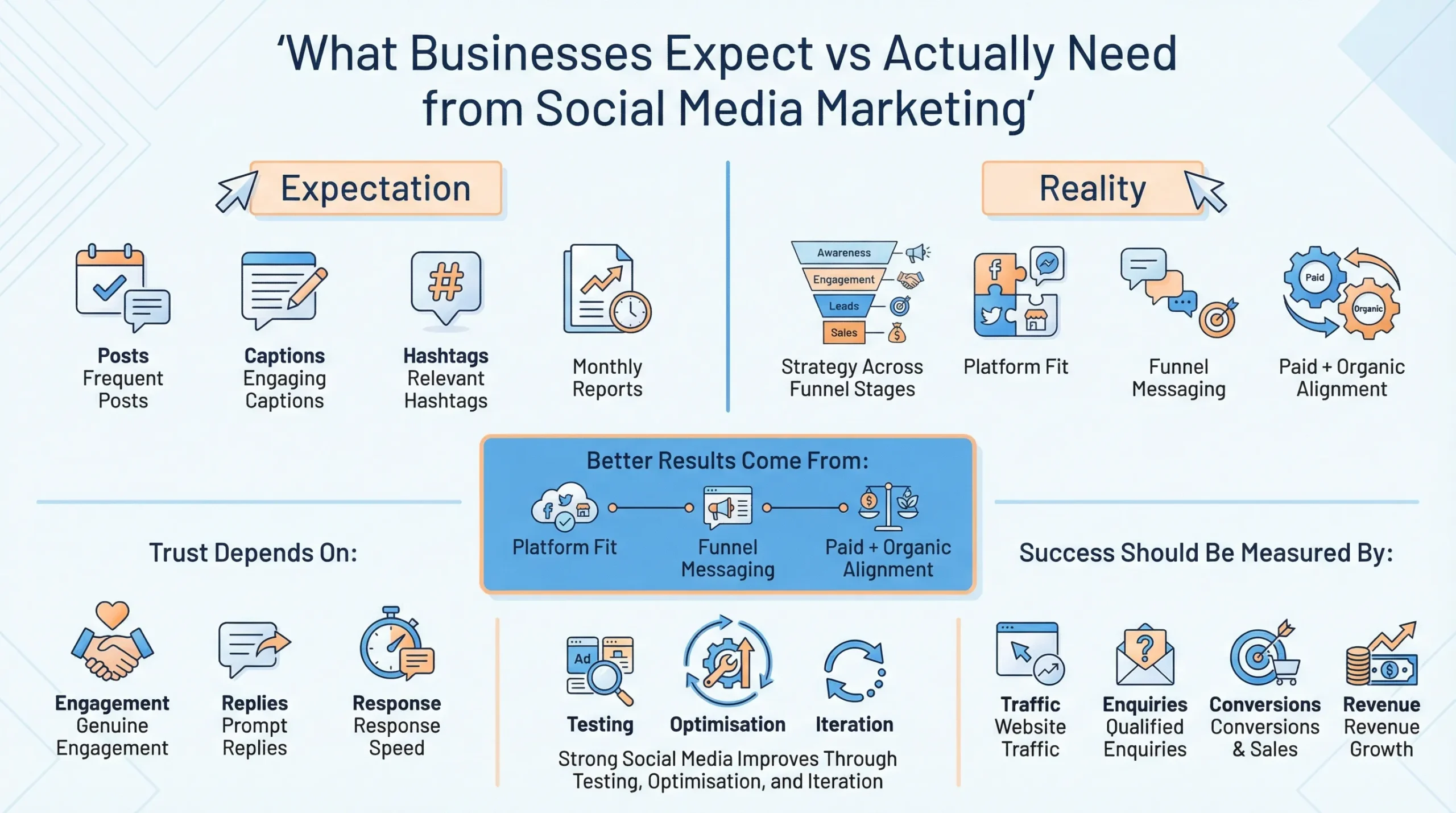
What you may expect from social media marketing services
At the start, many businesses expect social media marketing services to include:
- a monthly content calendar
- a set number of posts or videos
- captions and hashtags
- some light community management
- a report on likes, reach, and follower growth
Those are valid expectations, but they only cover the visible layer of the work.
What we actually need social media marketing services to do
For real impact, services must go beyond publishing to consider the target audience, platform priorities, funnel-stage messaging, integrated paid and organic efforts, the impact of engagement on trust, tracking outcomes, and clear next steps for improvement. We need to think about:
- who the content is meant to reach
- why certain platforms matter more than others
- what message fits each stage of the funnel
- how paid and organic efforts support each other
- how comments, direct messages, and replies affect trust
- how traffic, leads, and sales will be tracked
- what gets improved when performance is weak
That is why we do not view social media as a mere posting function. We treat it as a structured growth channel.
The difference in simple terms
| What you may expect | What effective social media marketing services should actually deliver |
| Regular posting | A strategy tied to awareness, engagement, leads, and sales |
| More followers | Better reach quality, stronger engagement, and clearer conversion pathways |
| Attractive visuals | Platform-specific creative built to hold attention and drive action |
| Monthly reports | Analysis tied to traffic, enquiries, conversions, or assisted revenue |
| Faster brand activity | A system that improves through testing, iteration, and optimisation |
Why does this gap cause poor results
When businesses buy social media marketing services based only on outputs, they often end up with visible activity but weak commercial results. We see this happen when:
- content is created without a clear audience or buying intent
- engagement is measured, but business impact is not
- paid support is treated separately from content strategy
- creative looks polished, but distribution is weak
- community management is overlooked, even though audiences expect responsiveness
That last point matters more than many brands realise. Nearly three-quarters of consumers expect brands to respond on social media within 24 hours, and 73% say they will switch to a competitor if a brand does not respond.
That means response handling is no longer a minor admin task. It is part of service quality and brand retention.
What you should really expect from social media marketing services
If we strip it back, the real job of social media marketing services is not to keep your page active. It is to help your brand stay visible, relevant, responsive, and commercially effective across the platforms your audience actually uses.
So while many expect content only, businesses usually need an integrated approach: strategy, creative, distribution, engagement, tracking, and optimisation all working together. This is the difference between simply being present and truly using social media effectively.
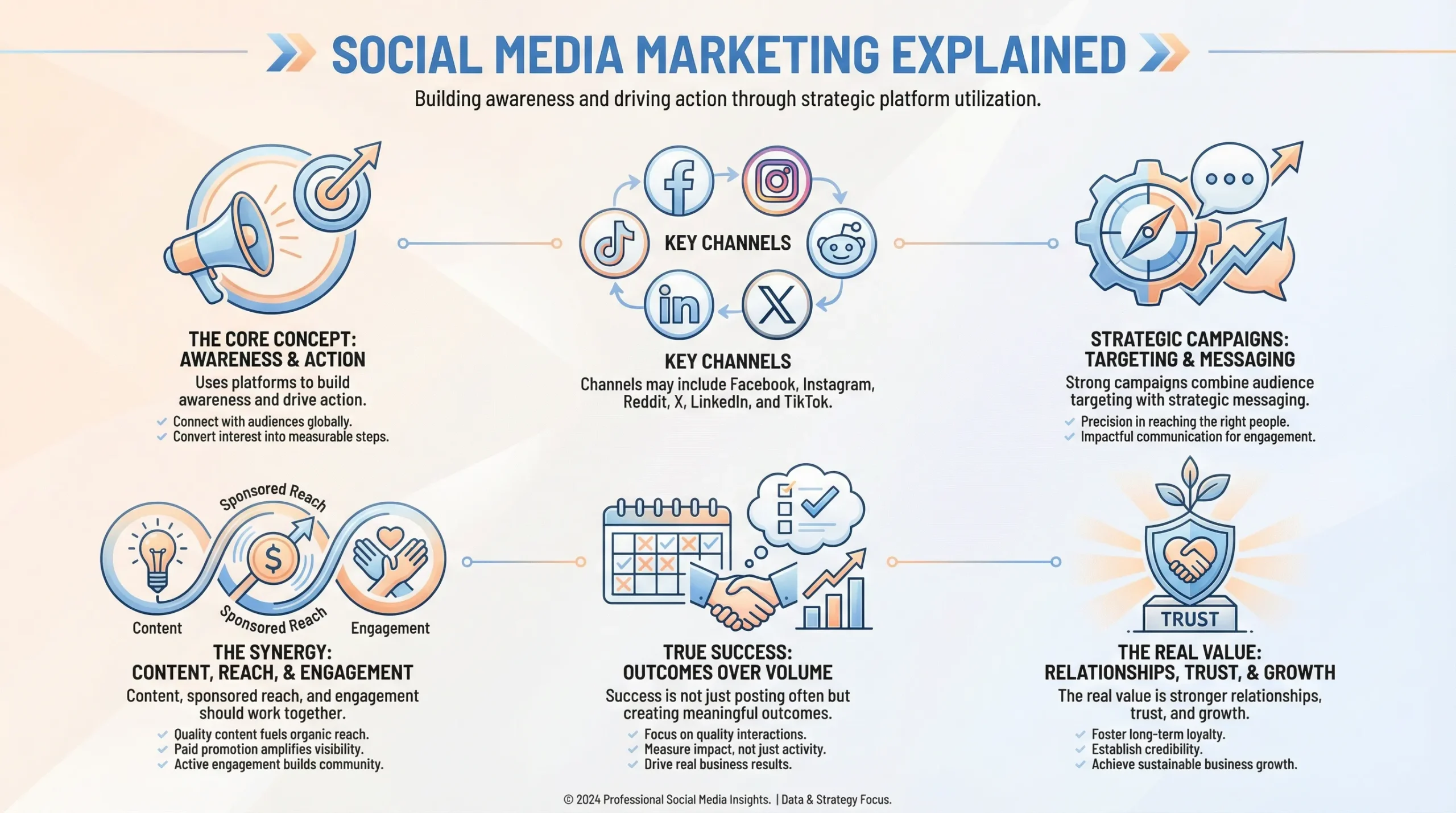
Social media marketing (SMM) is the use of social media platforms and websites to promote and advertise products, services, or brands. It involves creating and sharing content on social media channels such as Facebook, Instagram, Reddit, Twitter, LinkedIn, and TikTok to engage with current and potential customers, increase brand awareness, and drive traffic and sales.
The key to successful social media marketing is not just about posting content but creating strategic campaigns that align with business goals.
This includes audience targeting, content creation, paid promotions, and engagement tactics. Social media marketing can be organic (non-paid) or include paid advertising, such as sponsored posts, to further extend reach.
Overall, social media marketing is about building relationships with your audience, fostering trust, and driving meaningful results that support your brand’s objectives.
When you hire social media marketing services, you are not just paying for posts to appear on your feed.
You are investing in a system that should help your brand reach the right people, communicate clearly, and move them towards action. In my experience, the strongest results come when we treat social media as a set of connected layers rather than a list of disconnected tasks.
If one layer is weak, others underperform. Great content with poor distribution gets ignored, and reach without conversion tracking loses justification.
Good reporting without a strategy rarely tells you what to do next. That is why we need to look at social media marketing services as a full operating model.
The six core layers included in social media marketing services
| Core layer | What it covers | Why it matters |
| Strategy and planning | Audience, positioning, platform choice, content direction | Gives the work a clear purpose |
| Content production | Visuals, videos, captions, creative formats | Turns strategy into platform-ready assets |
| Distribution and amplification | Organic posting, boosting, paid media, and creator support | Helps strong content reach enough of the right people |
| Community management | Replies, moderation, engagement, and escalation handling | Builds trust and improves brand responsiveness |
| Conversion and journey tracking | CTAs, landing pages, lead flows, tracking setup | Connects social activity to business outcomes |
| Reporting and optimisation | Performance analysis, testing, iteration, next steps | Helps improve results over time |
1. Strategy and planning in social media marketing services
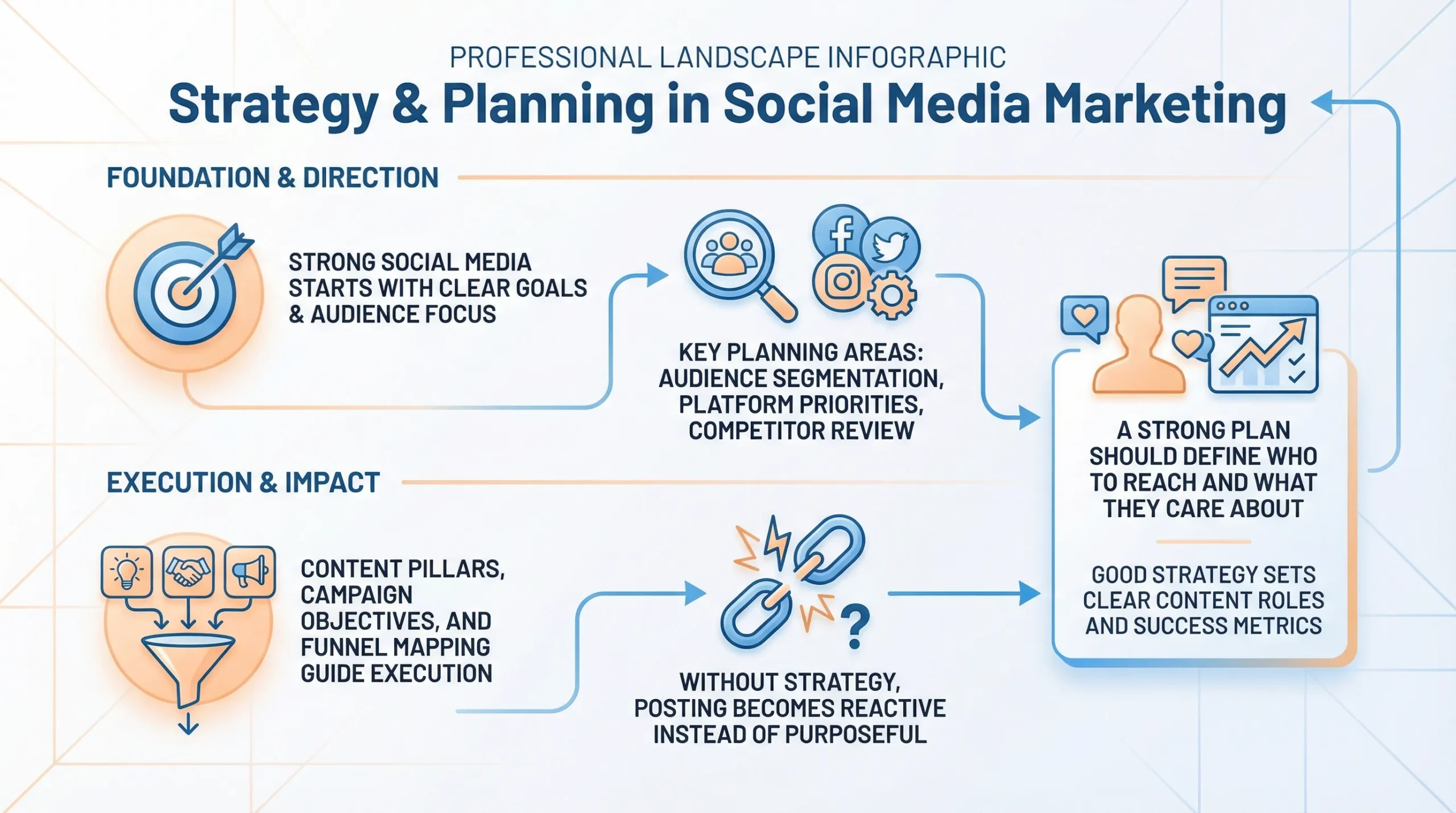
This is the layer many businesses do not see, but it is one of the most important. Before we create anything, we need to define what the brand is trying to achieve and who we need to reach.
That usually includes:
- audience segmentation
- platform prioritisation
- competitor review
- content pillars
- campaign objectives
- funnel mapping
Without this layer, social media marketing services can quickly become reactive. You end up posting because the calendar says you need a post, not because the content is tied to a clear goal.
What strong strategy work should answer
Before we move into execution, we should be able to answer questions like:
- Who are we trying to reach?
- What does that audience care about?
- Which platforms deserve the most attention?
- What is each type of content meant to achieve?
- How will we define success?
If your provider cannot answer these clearly, the rest of the work will likely feel shallow.
2. Content production in social media marketing services
Once the strategy is clear, we turn it into content people can actually consume and engage with. This is the most visible layer, but it is not just about making things look polished. It is about creating content that fits the platform, the audience, and the business goal.
Strong social content also depends on clear messaging, persuasive captions, and platform-ready brand language, which is why many businesses pair social media execution with copywriting services in Singapore.
Content production often includes:
- static posts
- carousels
- short form videos
- longer form videos
- captions
- motion graphics
- platform-specific creative adaptations
We also need to adapt by platform. A LinkedIn post should not feel like a recycled TikTok caption. An Instagram carousel should not read like a Facebook ad. Social media marketing services work better when content is shaped around how users behave on each platform.
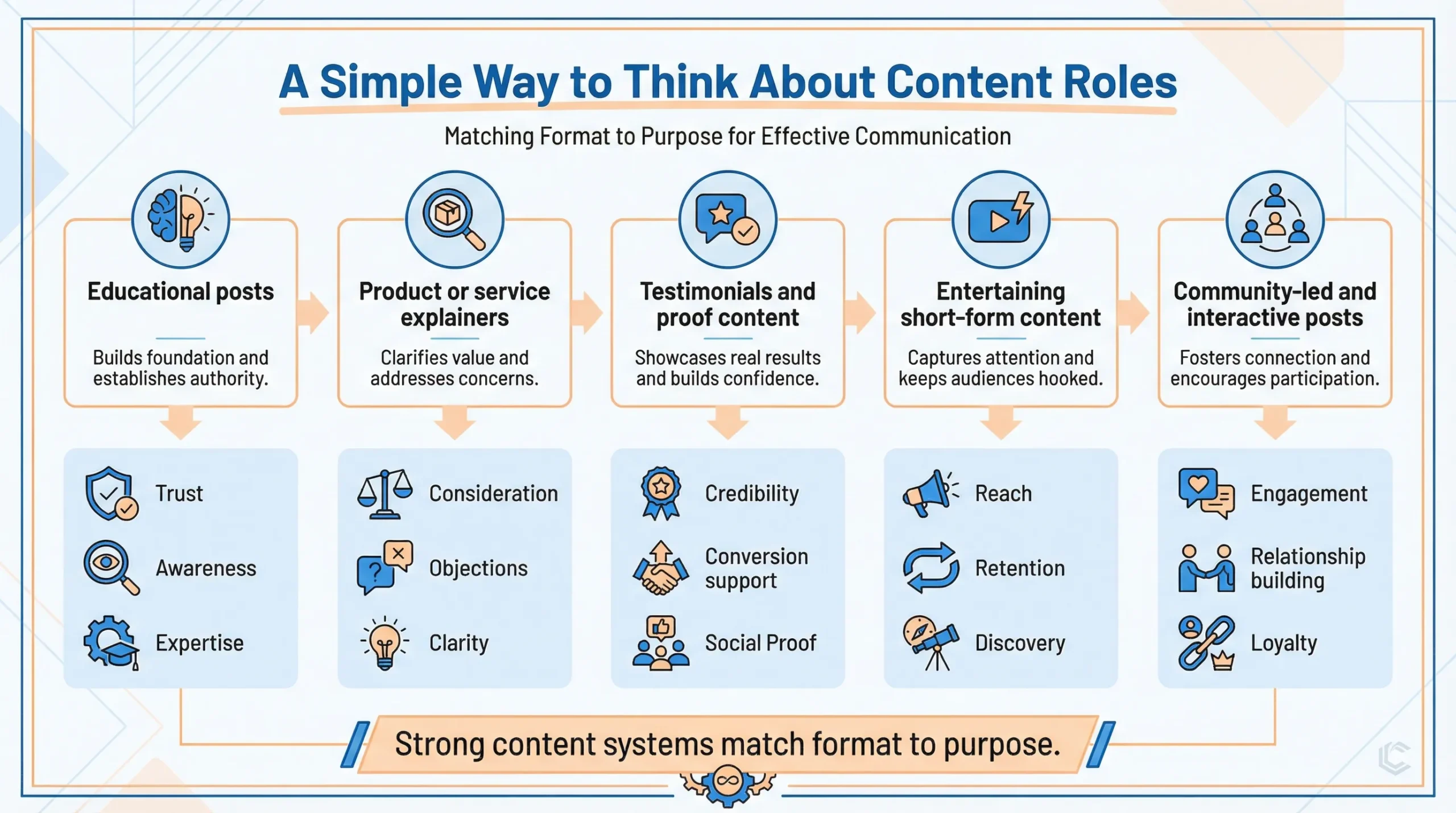
A simple way to think about content roles
| Content type | Best used for |
| Educational posts | Trust, awareness, expertise |
| Product or service explainers | Consideration, objections, clarity |
| Testimonials or proof content | Credibility, conversion support |
| Entertaining short-form content | Reach, retention, discovery |
| Community-led or interactive posts | Engagement, relationship building |
3. Distribution and amplification in social media marketing services
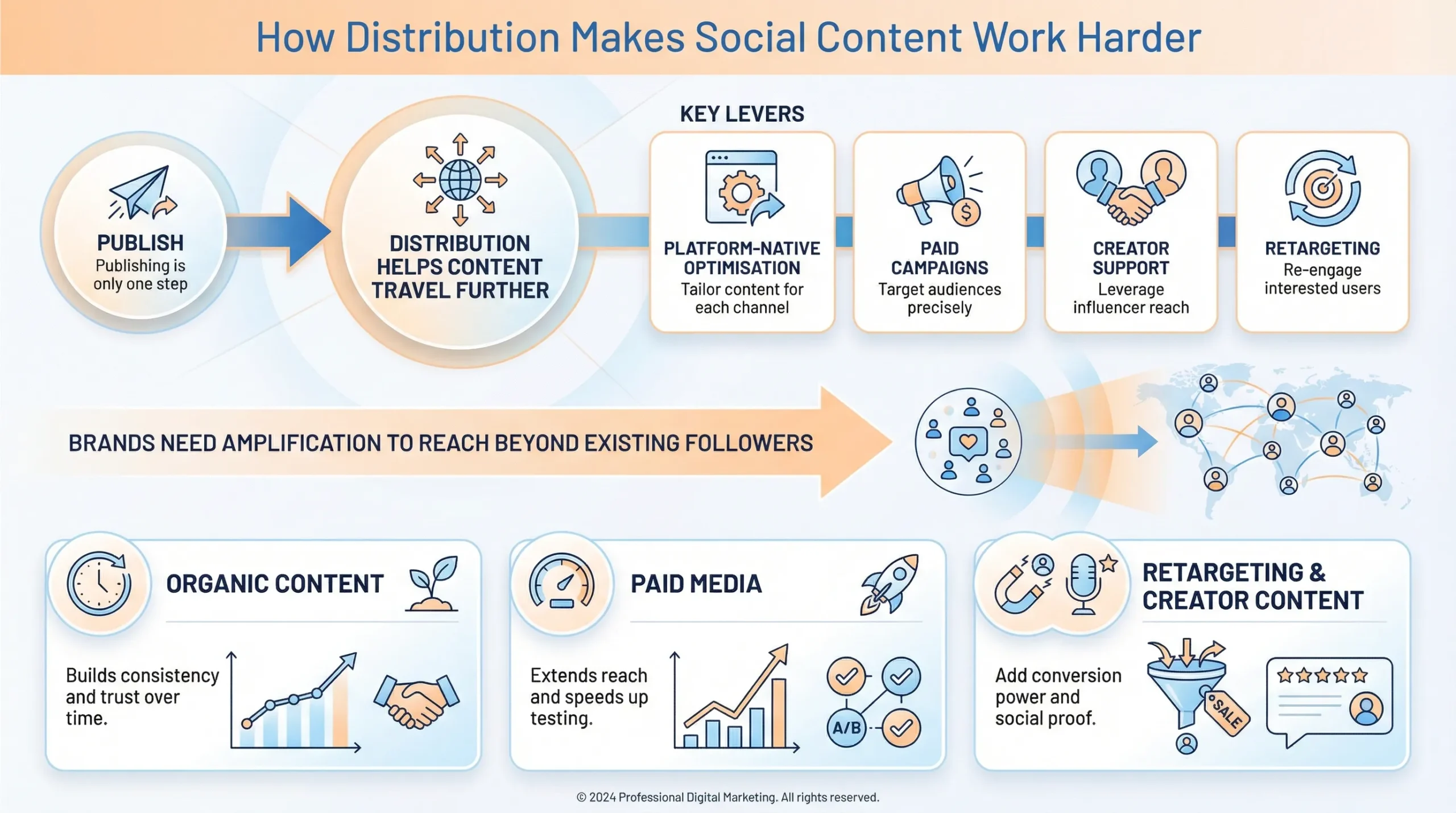
One of the biggest misconceptions is that good content will naturally perform on its own. Sometimes it does, but in most cases, we need a distribution plan to help it travel further.
This layer usually includes:
- content scheduling
- platform-native optimisation
- paid boosting
- paid social campaigns
- creator or influencer support where relevant
- retargeting for high-intent audiences
We need this because reach is no longer guaranteed, especially for brands that are trying to grow beyond their current followers. Social media marketing services should not stop at publishing. They should also help make sure the right people actually see the content.
Organic and paid should work together
A stronger model usually looks like this:
- organic content builds consistency and trust
- paid media extends reach and speeds up testing
- retargeting helps convert interested users
- creator content adds relevance and social proof
When we connect these properly, the whole system becomes more efficient.
4. Community management in social media marketing services
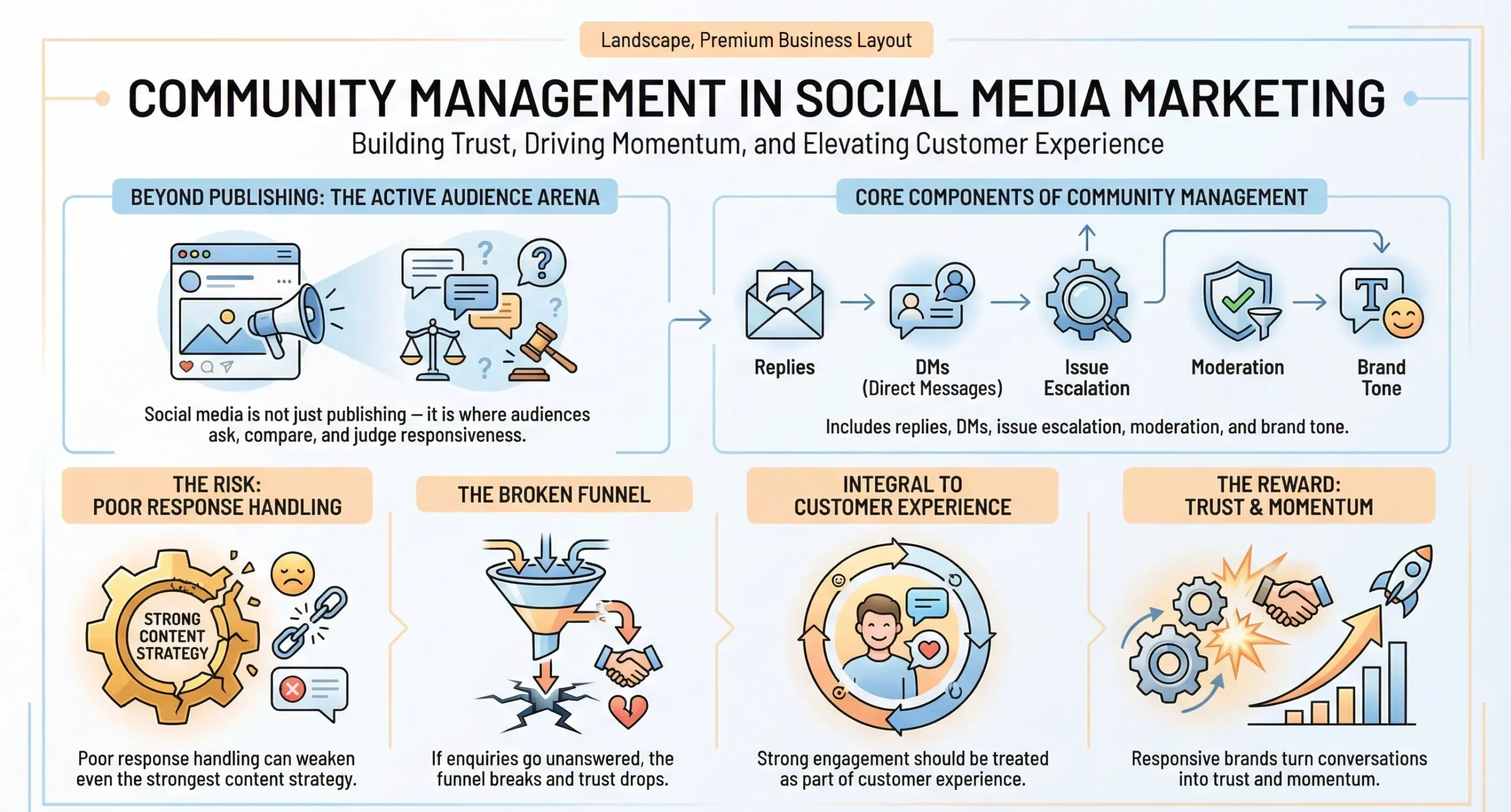
This is the layer many businesses underestimate. Social media is not just a publishing channel. It is also where people ask questions, leave feedback, compare options, and form opinions about how responsive your brand is.
Community management also shapes how brands perform across key social media metrics, engagement vs interaction, because responses, conversations, and visible activity all influence how audiences perceive credibility and attentiveness.
Community management often includes:
- replying to comments
- answering direct messages
- escalating customer issues
- moderating spam or harmful comments
- managing brand tone in public interactions
This matters because poor response handling can weaken the value of even the best content strategy. If your ads are driving interest but nobody replies to enquiries, the funnel breaks. If your posts generate comments but your page feels inactive, trust can drop.
Signs that this layer is being neglected
- comments go unanswered for days
- direct messages are not monitored properly
- repetitive questions are not turned into content opportunities
- sentiment issues are ignored until they escalate
Strong social media marketing services do not treat engagement as an afterthought. We treat it as part of the customer experience.
5. Conversion and journey tracking in social media marketing services
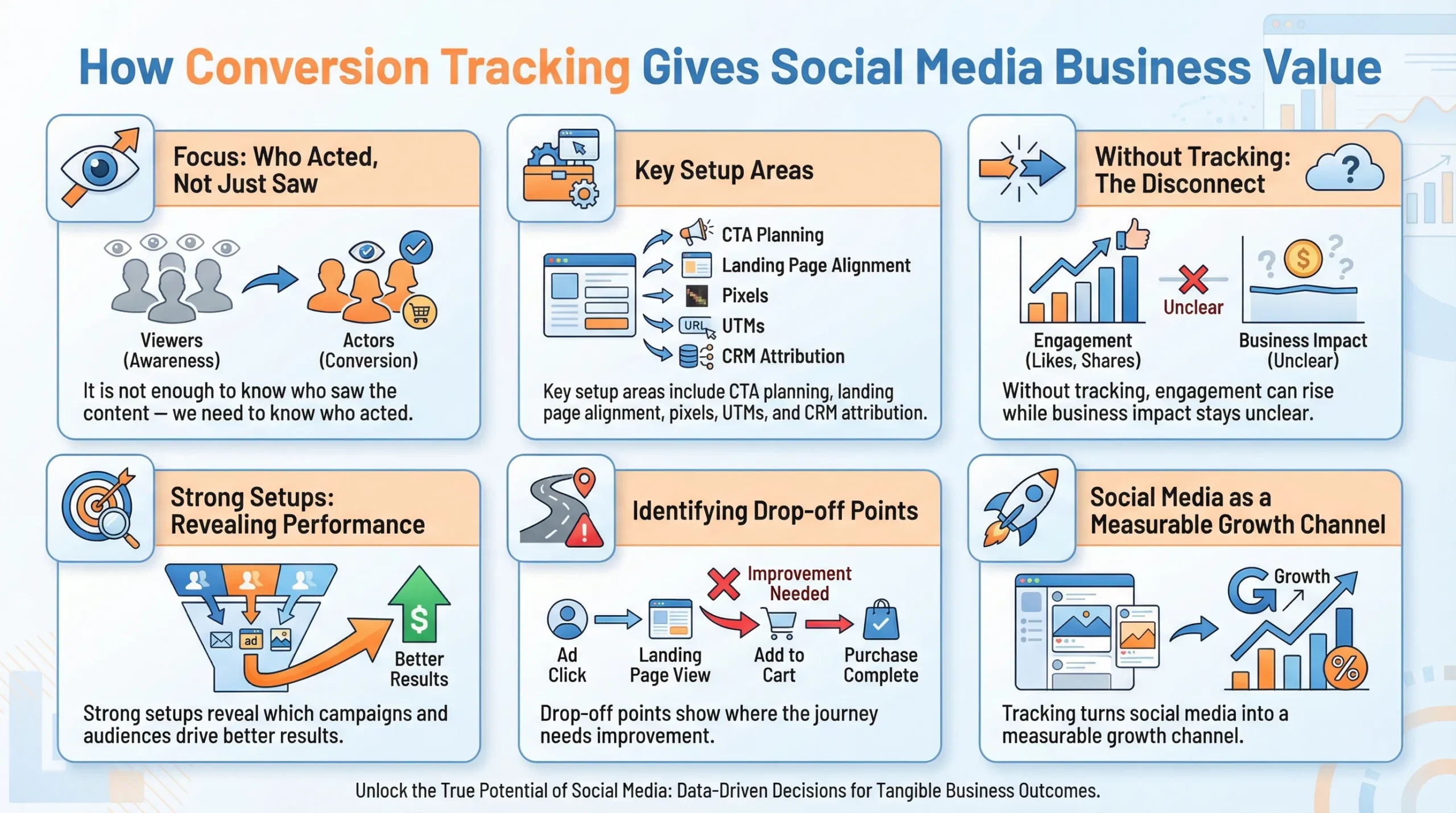
This is where social media starts proving its business value. We need to know not just whether people saw the content, but whether they clicked, signed up, enquired, or purchased.
This layer usually covers:
- call-to-action planning
- landing page alignment
- UTM tracking
- pixel setup
- lead form strategy
- conversion path review
- CRM attribution where relevant
Without this layer, you may know that engagement is improving, but you will struggle to show whether social media marketing services are influencing revenue or lead quality.
The questions we should be able to answer
A well-tracked setup should help us understand:
- Which content drove the most qualified traffic?
- Which campaign generated enquiries or leads?
- Which audience segments converted best?
- Where are people dropping off?
- What should we adjust next?
That is what turns social media from a visibility channel into a measurable growth channel.
6. Reporting and optimisation in social media marketing services
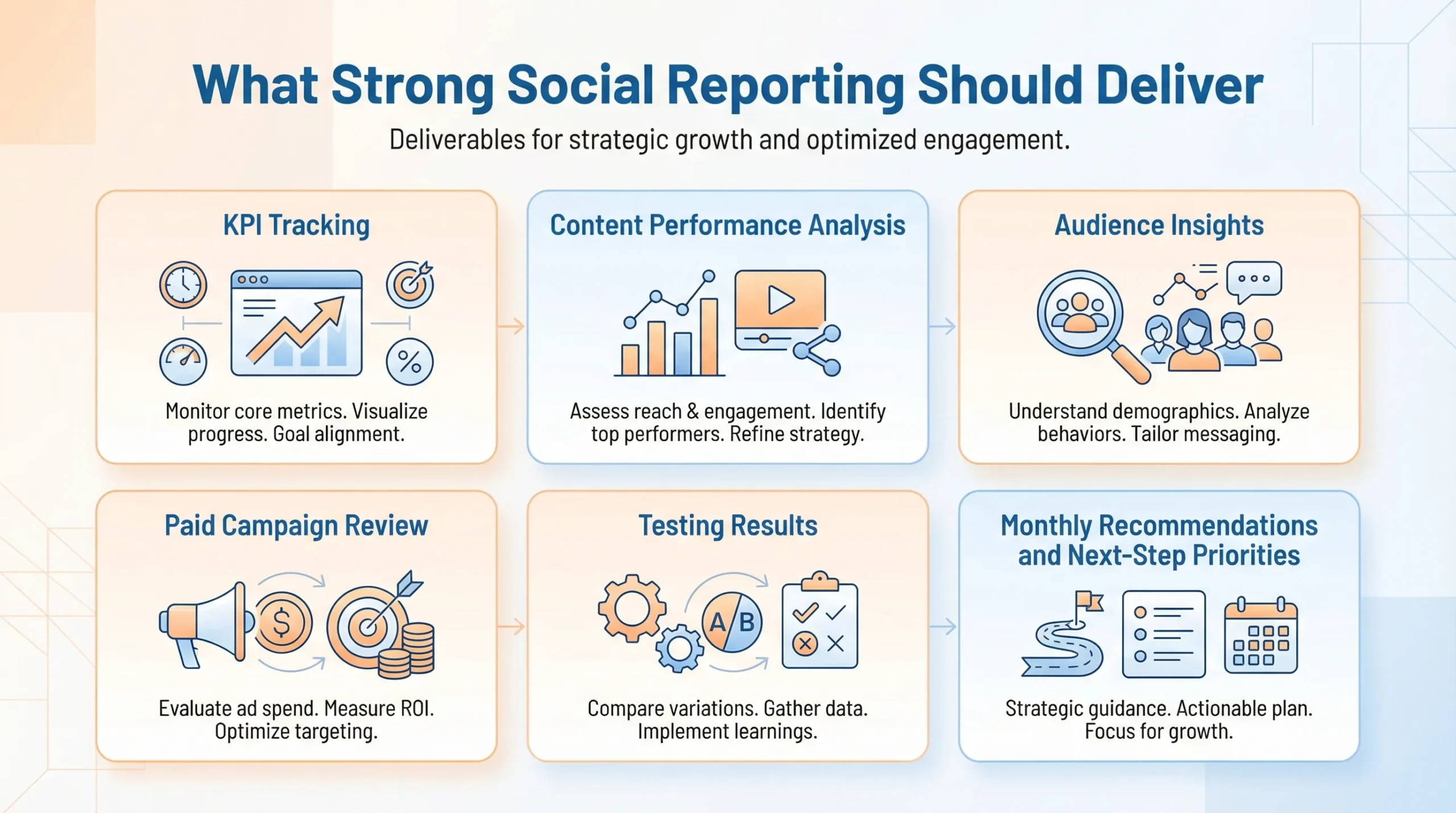
Reporting should do more than summarise what happened. It should help you understand why something worked, why something underperformed, and what we need to improve next.
This layer often includes:
- KPI tracking
- content performance analysis
- audience insights
- paid campaign review
- testing results
- monthly recommendations
- next-step prioritisation
We should not be satisfied with reports that simply list impressions, reach, and engagement. Those metrics have value, but they are only useful when they connect back to business goals.
When you are reviewing social media marketing services, it is easy to get distracted by the amount of content being promised. In practice, volume alone rarely drives results. What matters more is whether the service covers the right components and whether those components work together.
We usually recommend treating this as a checklist rather than a feature list. It helps you quickly identify whether a provider offers a complete solution or only partial support.
A complete checklist for social media marketing services
Use this as a baseline when evaluating any scope:
| Area | What should be included | Why it matters |
| Strategy | Audience targeting, platform selection, and content direction | Ensures all work is aligned with business goals |
| Content planning | Monthly calendar with clear themes and objectives | Prevents reactive and inconsistent posting |
| Content production | Platform-specific visuals, videos, captions | Improves engagement and relevance |
| Distribution | Organic scheduling and paid amplification | Ensures content reaches the right audience |
| Community management | Replies to comments and messages | Builds trust and improves brand perception |
| Conversion tracking | UTMs, pixels, tracking links | Connects social activity to leads and revenue |
| Paid media support | Campaign setup, optimisation, retargeting | Accelerates performance and testing |
| Reporting | Monthly performance reports with insights | Helps understand what is working |
| Optimisation | Testing, iteration, performance improvements | Ensures results improve over time |
A simple scoring framework you can use
Instead of just checking whether something is included, we suggest scoring it. This helps you quickly assess how complete the service actually is.
| Component | Included (Yes/No) | Impact if Missing |
| Strategy | Yes | Direction becomes unclear, inconsistent messaging emerges, and alignment with business goals is lacking. |
| Content planning | Yes | Content becomes inconsistent, disconnected from audience needs, and misaligned with the brand’s tone. |
| Paid support | Yes | Limited reach, slower growth, and inability to scale beyond organic reach, resulting in missed opportunities for new audience acquisition. |
| Community management | Yes | Weak engagement, poor response experience, lower customer satisfaction, and a negative impact on brand reputation. |
| Tracking setup | Yes | No visibility into ROI, unclear performance measurement, and missed opportunities to optimise campaigns for better results. |
| Reporting with insights | Yes | No clear next steps, inability to track progress, and difficulty in proving value to stakeholders or clients. |
| Optimisation process | Yes | Performance plateaus, wasted budget, and missed chances to improve ad creatives or targeting, leading to stagnant results. |
If more than two or three critical areas are missing, the service is likely not robust enough to deliver meaningful outcomes.
What many social media marketing services miss
From what we see, weaker social media marketing services tend to focus on output rather than effectiveness. You might notice:
- content is delivered, but there is no explanation of why it works
- reports show numbers, but not what to improve
- paid media is treated as an optional add-on rather than part of the strategy
- tracking is not properly set up, so results cannot be attributed
- engagement is reactive instead of managed as part of the customer experience
This is where businesses often feel that social media is “not working,” when in reality, the structure behind it is incomplete.
A quick diagnostic checklist before you commit
Before you sign on with any provider, it helps to ask:
- Do we know who the content is targeting and why?
- Do we understand what each platform is meant to achieve?
- Is there a plan for both organic and paid distribution?
- Are we tracking traffic, leads, or conversions from social media?
- Will we receive insights, not just reports?
- Is there a clear process for improving performance over time?
If you cannot get clear answers to these questions, it is worth pausing before moving forward.
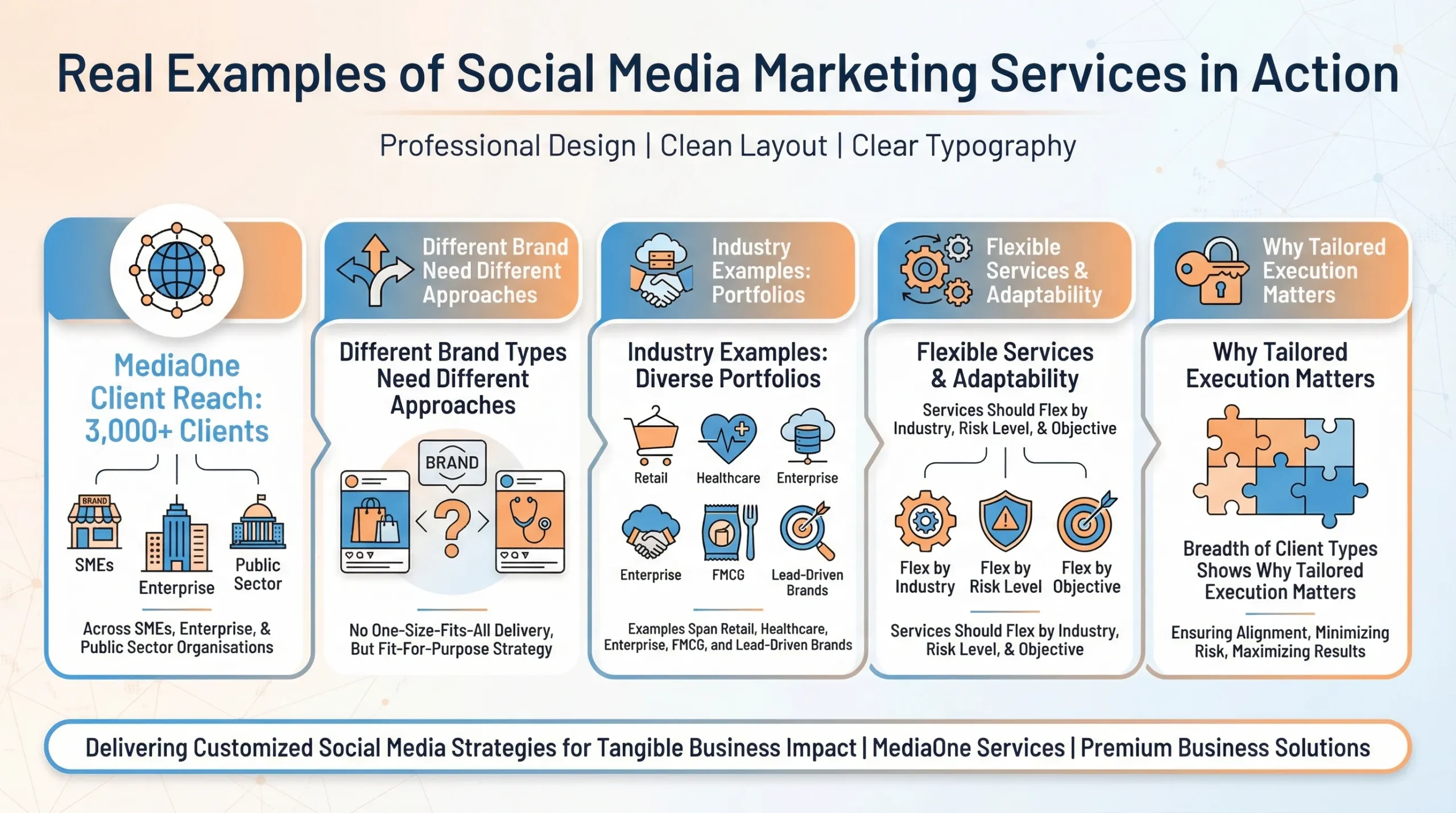
At MediaOne, we have worked with over 3,000 clients across SMEs, enterprise brands, and public sector organisations.
On our site, we also publicly reference brands such as Canon, SingHealth, P&G, Dior, Singtel, Changi Airport, Enterprise Singapore, CapitaLand, Old Chang Kee, StorHub, and Sincere Watch. That range matters because it shows that social media marketing services cannot be run with a one-size-fits-all model.
To be precise, we do not publicly publish a detailed, named, social-only case study for every one of these brands on the page reviewed.
What we can show clearly, though, is how social media marketing services need to flex across different client types, and how our service model is built for that breadth.
How our social media marketing services change by brand type
At MediaOne, we tailor social media marketing strategies to each brand’s type and industry needs. From consumer brands to trust-sensitive sectors, we focus on the right elements to help you achieve your specific goals.
| Brand type | Publicly referenced examples | What we typically need to focus on |
| Consumer and retail brands | Canon, Dior, Old Chang Kee, Sincere Watch | Product storytelling, creative content, paid amplification, audience targeting |
| Healthcare and trust-sensitive sectors | SingHealth, SATA CommHealth | Educational messaging, careful wording, trust building, and stronger review processes |
| Enterprise and public-facing organisations | Changi Airport, Enterprise Singapore, CapitaLand, Singtel | Cross-platform consistency, stakeholder alignment, reputation support, campaign coordination |
| FMCG and household brands | P&G | Reach, segmentation, campaign scale, creative refreshes |
| Lead-driven service brands | StorHub | Demand generation, remarketing, enquiry-focused content, conversion tracking |
Every brand needs a personalised approach to social media marketing. By understanding your unique requirements, we create campaigns that align with your objectives and deliver impactful results.
Consumer and retail brands need visibility plus persuasion
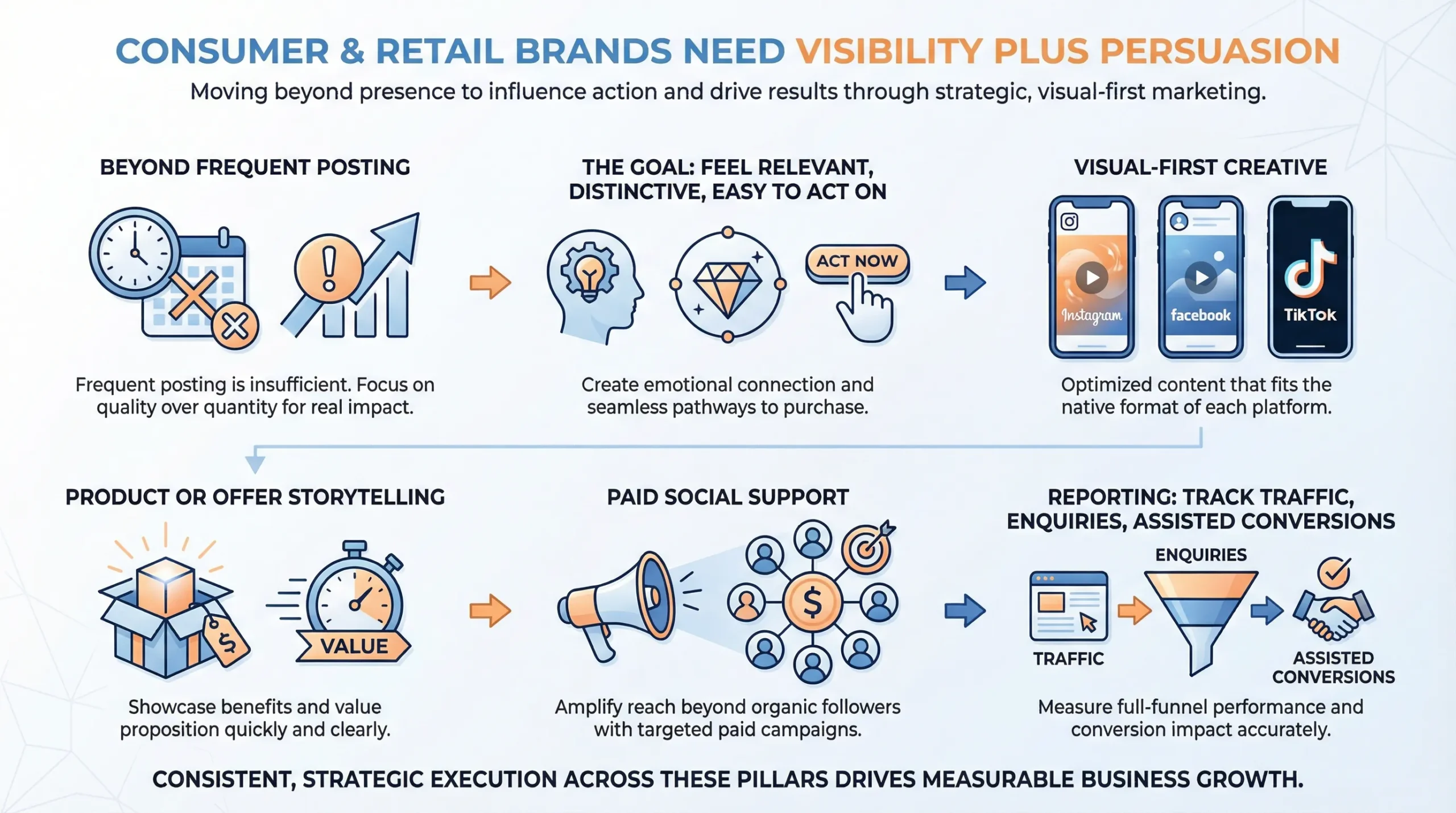
When we support consumer and retail brands, the challenge is rarely just posting often enough. We usually need to make the brand feel relevant, distinctive, and easy to act on.
For brands in this category, our social media marketing services typically involve:
- visual-first content tailored to Instagram, Facebook, and TikTok
- product or offer storytelling that highlights value quickly
- paid social support, so reach does not depend on organic distribution alone
- reporting that looks beyond engagement and tracks traffic, enquiries, or assisted conversions
That is why, for consumer-facing campaigns, we do not treat content as decoration. We treat it as a commercial asset.
Healthcare and trust-sensitive brands need tighter controls
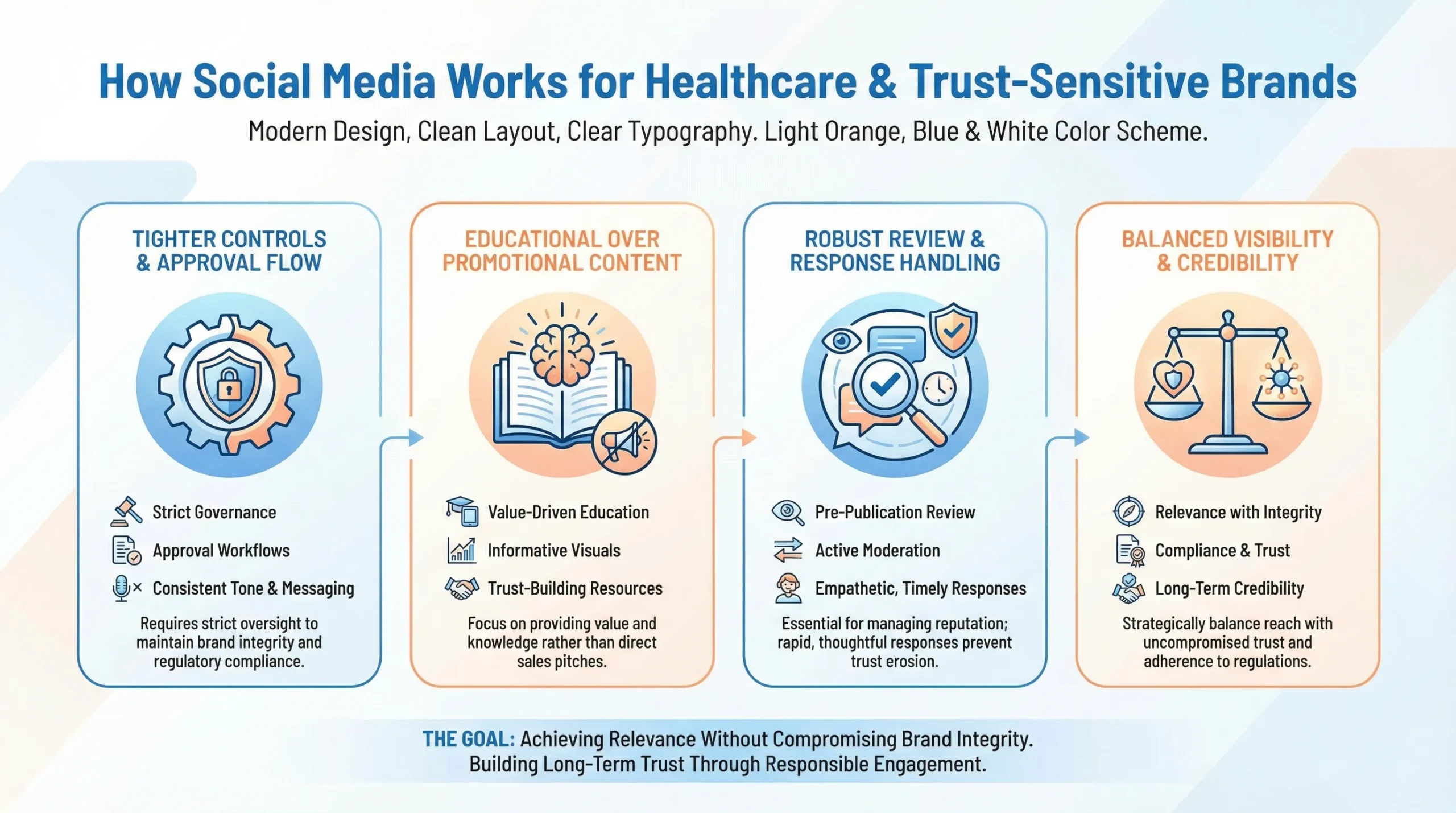
For healthcare-related brands, social media marketing services need a different structure. We cannot apply the same tone, pace, or promotional style we might use for a retail or lifestyle campaign.
In these cases, we usually place more emphasis on:
- educational content over overly promotional messaging
- careful review and approval workflows
- stronger moderation and response handling
- trust signals that support credibility, not just visibility
This is also where compliance matters more. If you operate in a regulated or trust-sensitive space, social media marketing services need to protect brand integrity while still helping you stay visible and relevant.
Enterprise and public-facing brands need scale and consistency
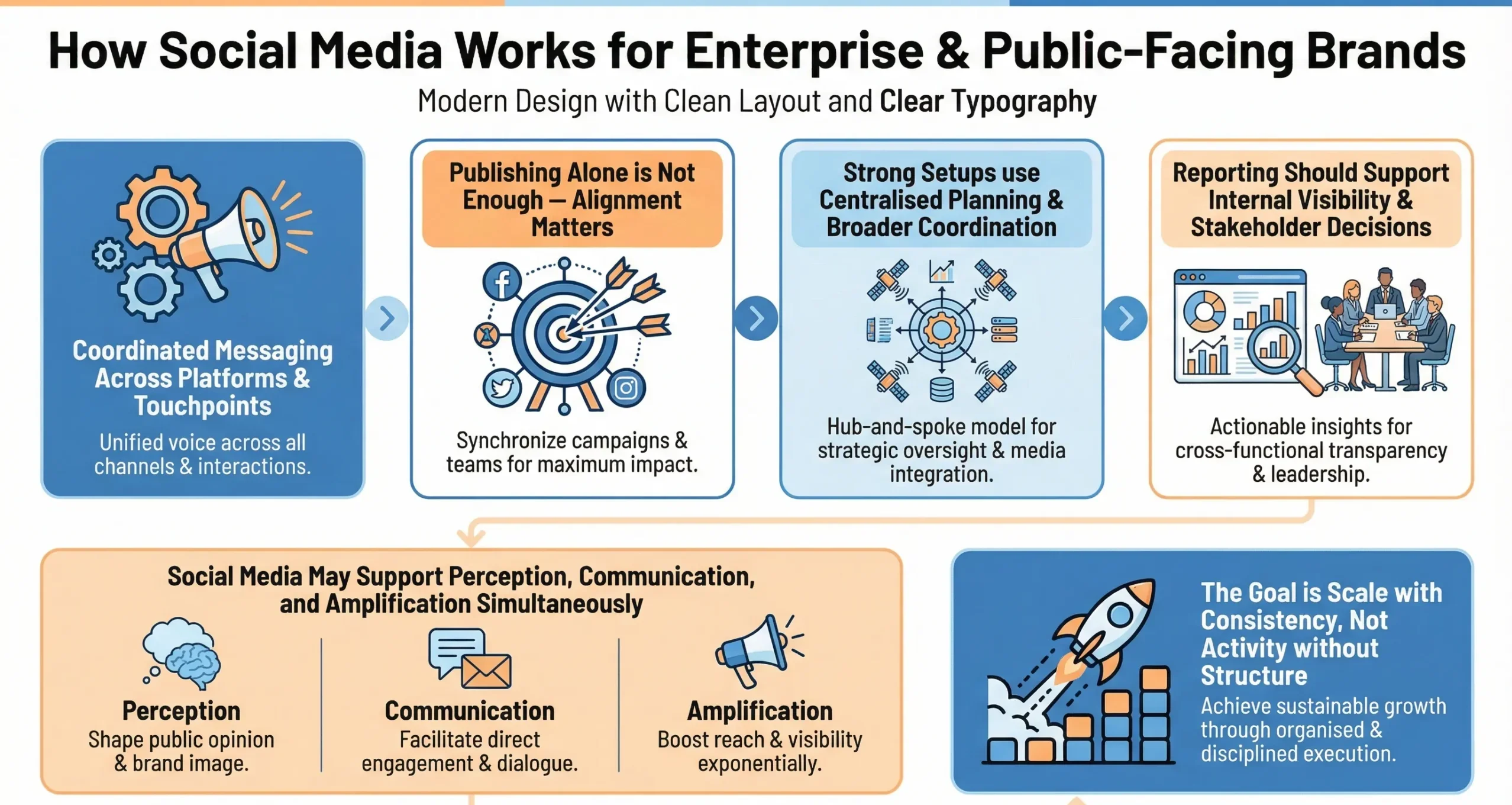
For larger organisations and public-facing entities, social media marketing services usually become more operationally complex. It is not just about publishing content. It is about keeping messaging aligned across campaigns, stakeholders, and touchpoints.
For this type of client, we typically need to manage:
- centralised campaign planning
- cross-platform message consistency
- stronger reporting visibility for internal stakeholders
- coordination with broader media, brand, or digital efforts
This is especially important when social media supports not just marketing, but also brand perception, stakeholder communication, and campaign amplification.
FMCG and high-volume brands need scale and speed
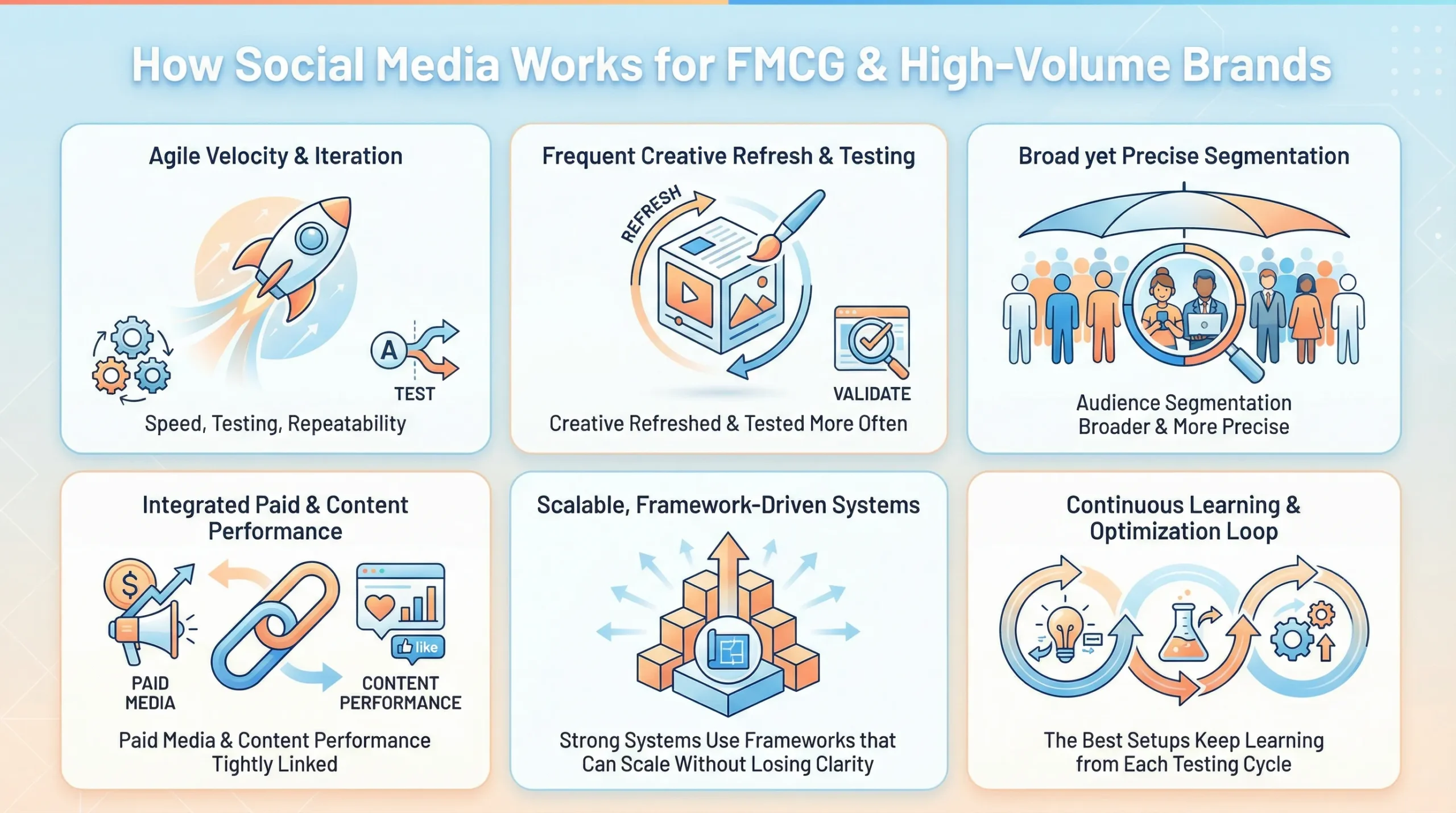
For large consumer brands, one of the biggest demands is scale. Social media marketing services in this environment usually require faster creative testing, broader audience segmentation, and more frequent performance optimisation.
That often means we need to build:
- repeatable campaign frameworks
- creative testing cycles
- audience-specific messaging
- a stronger link between paid media and content performance
In other words, we do not just need content. We need a system that can keep learning.
Lead-driven brands need social media tied to outcomes
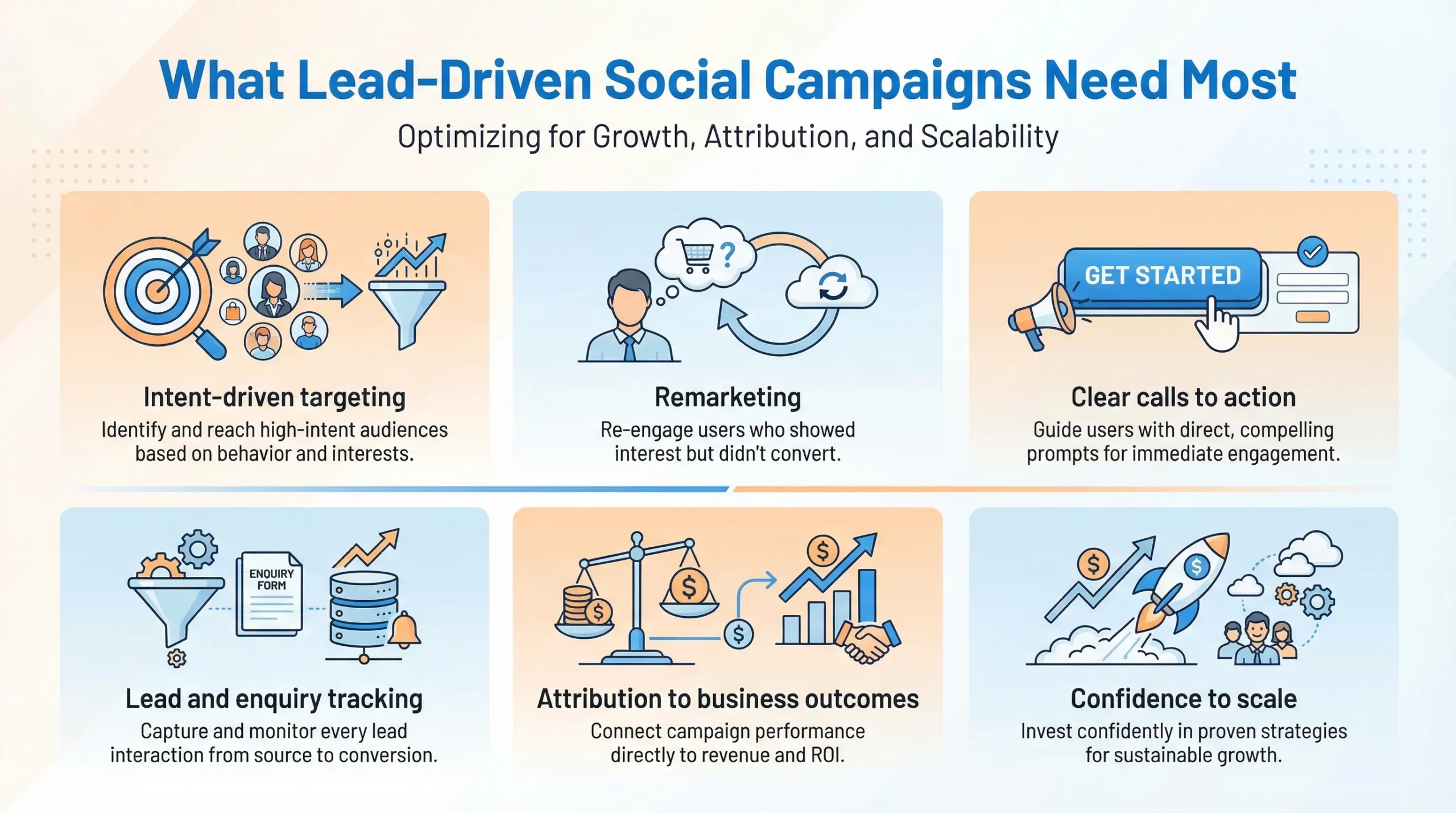
For demand generation brands, social media marketing services need to do more than create awareness. We need to see whether attention is turning into measurable business value.
That usually means including:
- intent-driven targeting
- remarketing
- clear calls to action
- tracking setups tied to leads or enquiries
This is one of the clearest differences between surface-level social support and performance-led social media marketing services. If you cannot track what social is contributing, it becomes much harder to scale with confidence.
What our testimonials reinforce
Our social media marketing page also includes testimonials that support this broader delivery model. One client shared that we had been helpful in their social media operations and that they saw steady performance in engagement and followers.
Another said our support for media buying across Google, Facebook, LinkedIn, and Twitter significantly increased their social media audience base and website traffic while improving brand awareness.
Our page also includes feedback that it was a pleasure working with us on SEO services, SEM, or Social Media Marketing.
When we deliver social media marketing services, compliance cannot be treated as a final check before posting. We need to build it into strategy, copy, approvals, lead capture, and reporting from the start. If a campaign performs well in terms of reach but raises disclosure issues, makes unsupported claims, or poses a risk to personal data, it is not a strong campaign.
In Singapore, the main frameworks we usually need to comply with are the ASAS social media advertising guidelines, the PDPA under the PDPC, and, for financial brands, the MAS Guidelines on Standards of Conduct for Digital Advertising Activities, published on 25 September 2025 and taking effect on 25 March 2026.
The main compliance areas we build into social media marketing services
| Compliance area | What we need to check | Why it matters |
| Advertising disclosure | Whether sponsored or incentivised content is clearly identifiable | Helps audiences recognise advertising and reduces trust risk |
| Claims and substantiation | Whether statements are accurate, supportable, and not misleading | Lowers complaint and reputational risk |
| Personal data handling | How lead data, remarketing data, and form submissions are collected and used | Supports lawful PDPA compliance |
| Direct marketing | Whether follow-up by SMS, email, or calls respects the right rules | Reduces nuisance marketing and consent issues |
| Sector-specific controls | Whether regulated industries face added requirements | Prevents category-specific compliance failures |
ASAS and social media marketing services

ASAS’ Guidelines for Interactive Marketing Communication and Social Media apply to advertising and marketing communication that uses social media to promote goods and services or influence consumer behaviour.
The guidelines apply to parties involved in social media marketing communication, including marketers, agencies, media, endorsers, and blog owners, and sit alongside the Singapore Code of Advertising Practice.
For us, the practical rule is simple: if there is a commercial relationship, the content should not appear neutral or ordinary. It should be clearly recognisable as advertising.
That usually means we need to review:
- paid partnerships
- creator or influencer posts
- gifted collaborations
- testimonial-style promotional content
- campaign assets that could blur the line between editorial and advertising
If we are running creator-led social media marketing services, disclosure is not optional. It is part of the campaign structure.
PDPA and personal data in social media marketing services
Many social media marketing services now include lead forms, event sign-ups, newsletter registrations, giveaways, remarketing audiences, and CRM syncing. Once personal data is collected, used, or disclosed, the PDPA becomes relevant.
PDPC states that the PDPA establishes rules governing the collection, use, disclosure, and care of personal data, and that organisations must comply with the data protection obligations when undertaking those activities.
So when we run lead generation campaigns, we need to think beyond ad performance. We also need to ask:
- What data are we collecting?
- Why are we collecting it?
- Is that purpose stated clearly?
- Where is the data being stored?
- Who can access it?
- How will follow-up marketing happen?
This is where weak social media marketing services often fall short. They may generate leads, but they do not always build the right data handling process behind the campaign.
Direct marketing, spam, and follow-up risk
This also affects post-click follow-up. PDPC states that the sending of unsolicited commercial electronic messages in bulk is covered under the Spam Control Act, while its consumer guidance also notes that the PDPA has been aligned with Spam Control Act requirements to improve protection across modern digital channels.
In practical terms, that means we should be careful about how we use contact details collected from social campaigns. A lead form is not just a list-building shortcut. It creates downstream compliance responsibilities.
MAS requirements for financial social media marketing services
If we are handling social media marketing services for a financial institution or financial product, the compliance bar is materially higher.
MAS says its Guidelines on Standards of Conduct for Digital Advertising Activities apply to financial institutions and their marketers advertising financial products and services via digital channels, and that the guidelines set out safeguards that financial institutions are expected to adopt to manage risks associated with digital advertising activities.
So for financial campaigns, we cannot rely on a generic social media workflow. We usually need tighter controls around:
- approval rights
- claims and promotional wording
- governance over paid and organic content
- use of third parties, including creators or marketers
- oversight of digital ad activity across channels
This is one of the clearest examples of why social media marketing services need to change by industry, not just by platform.
When you hire a full social media marketing services provider, you should be getting much more than content production. In our view, the real job is to manage the full system behind performance, from planning and execution to reporting and optimisation.
A lot of businesses assume social media support starts and ends with posts, captions, and basic engagement. In practice, that is only one layer. If you want social media to contribute to awareness, trust, leads, and revenue, we need to manage the moving parts around it as well.
At a glance: what a full social media marketing services provider actually manages
| Area | What we manage | Why it matters |
| Strategy | Audience, platform mix, content direction, campaign goals | Gives the work structure and commercial purpose |
| Content | Creative planning, copywriting, visuals, video, platform adaptation | Ensures content fits both the brand and the platform |
| Publishing | Scheduling, formatting, and platform best practices | Keeps execution consistent and timely |
| Paid support | Boosting, ad setup, audience targeting, retargeting | Extends reach and improves performance efficiency |
| Community management | Comments, direct messages, moderation, escalation | Protects brand experience and improves responsiveness |
| Tracking | UTMs, pixels, lead paths, conversion monitoring | Helps us connect activity to outcomes |
| Reporting | Performance analysis, insights, next steps | Shows what is working and what needs to improve |
| Optimisation | Testing, creative refinement, audience adjustments | Prevents performance from going stale |
We manage strategy, not just output
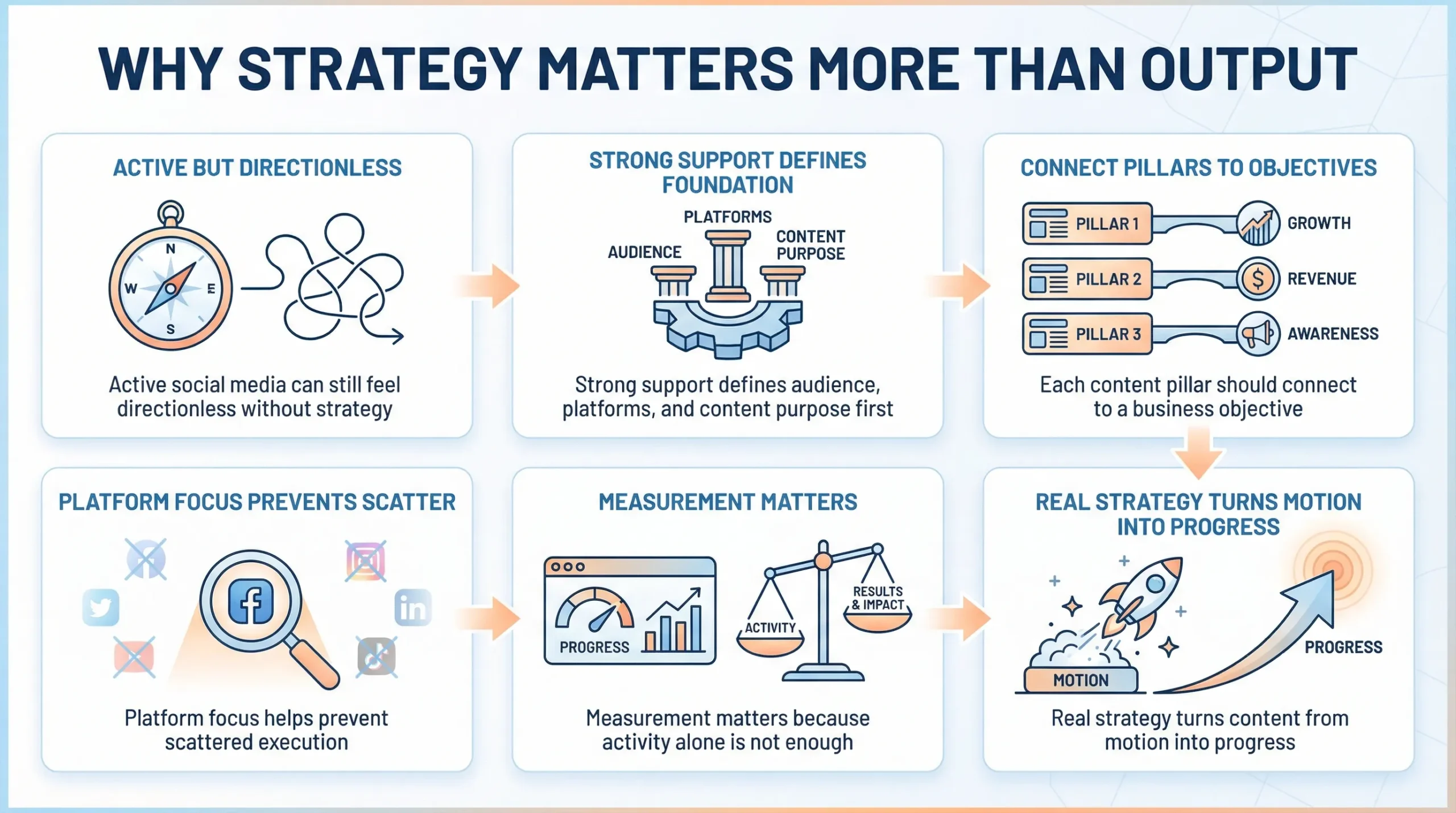
This is one of the biggest differences between full social media marketing services and lighter support models. We do not just ask what content you want posted. We also need to define:
- who we are trying to reach
- which platforms deserve focus
- what each content pillar is meant to achieve
- how social media supports wider business goals
- how we will measure success
Without that, the work can look active but still feel directionless.
We manage content as a system, not as isolated posts
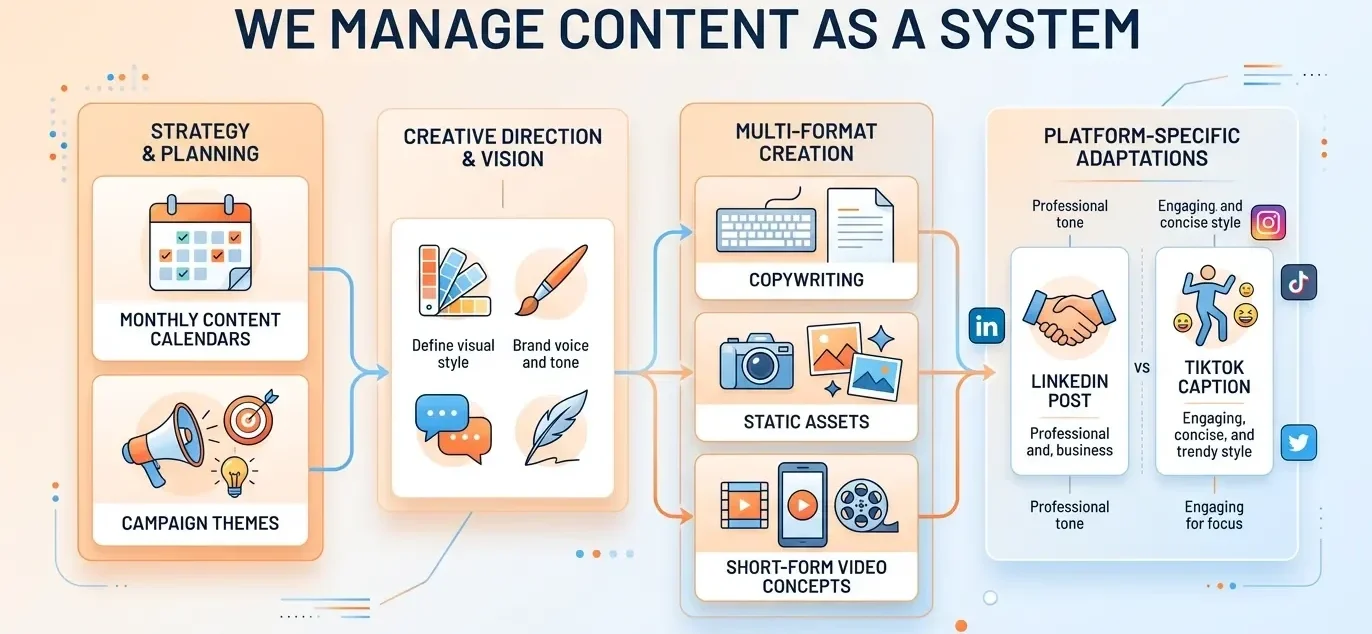
A full provider should not be producing content one piece at a time without context. We usually need to manage:
- monthly content calendars
- campaign themes
- creative direction
- copywriting
- static assets
- short form video concepts
- platform-specific adaptations
This matters because social media content does not perform equally across all platforms. A LinkedIn post should not sound like a TikTok caption. A strong provider manages those differences effectively rather than recycling the same idea everywhere.
We manage publishing and timing
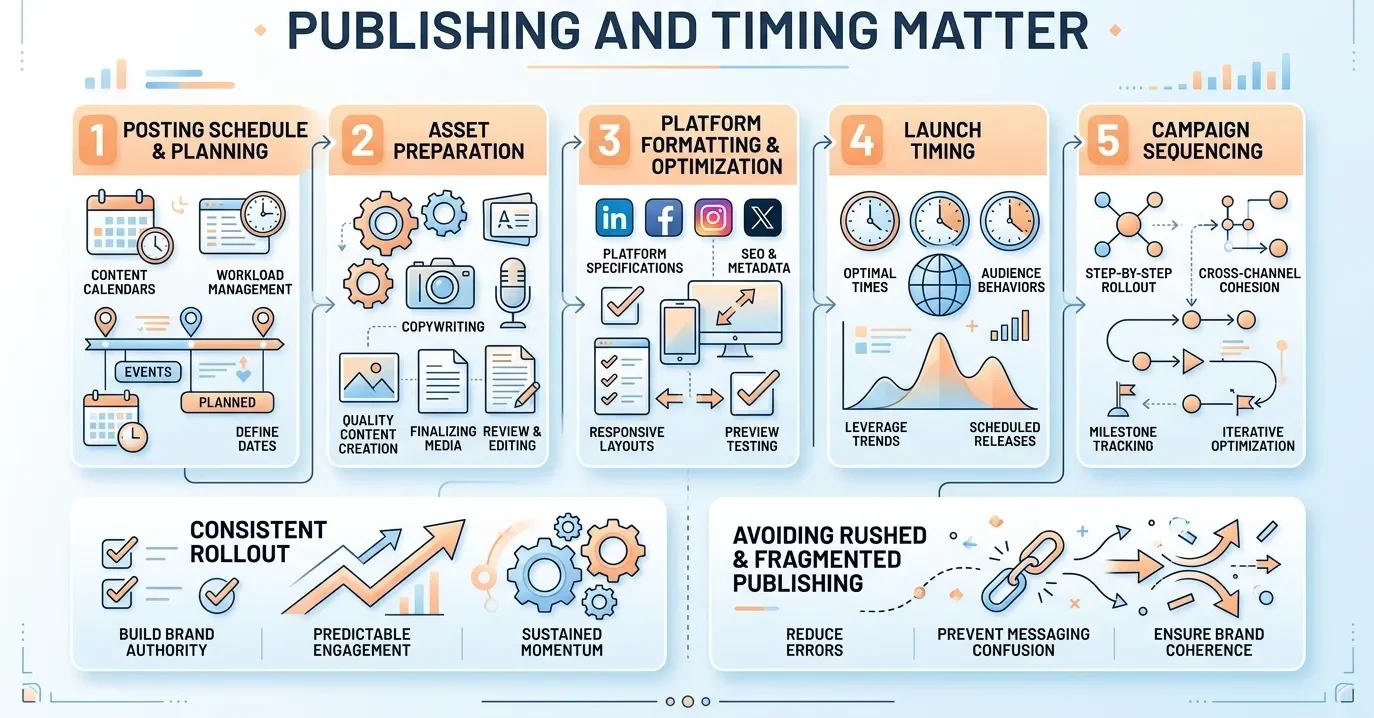
Publishing sounds simple until you realise how much weak execution can affect performance. A full social media marketing services provider should be managing:
- posting schedules
- platform formatting
- asset preparation
- launch timing
- campaign rollout sequencing
This helps make sure content goes live consistently and in the right format, rather than being rushed or fragmented.
We manage paid social and amplification
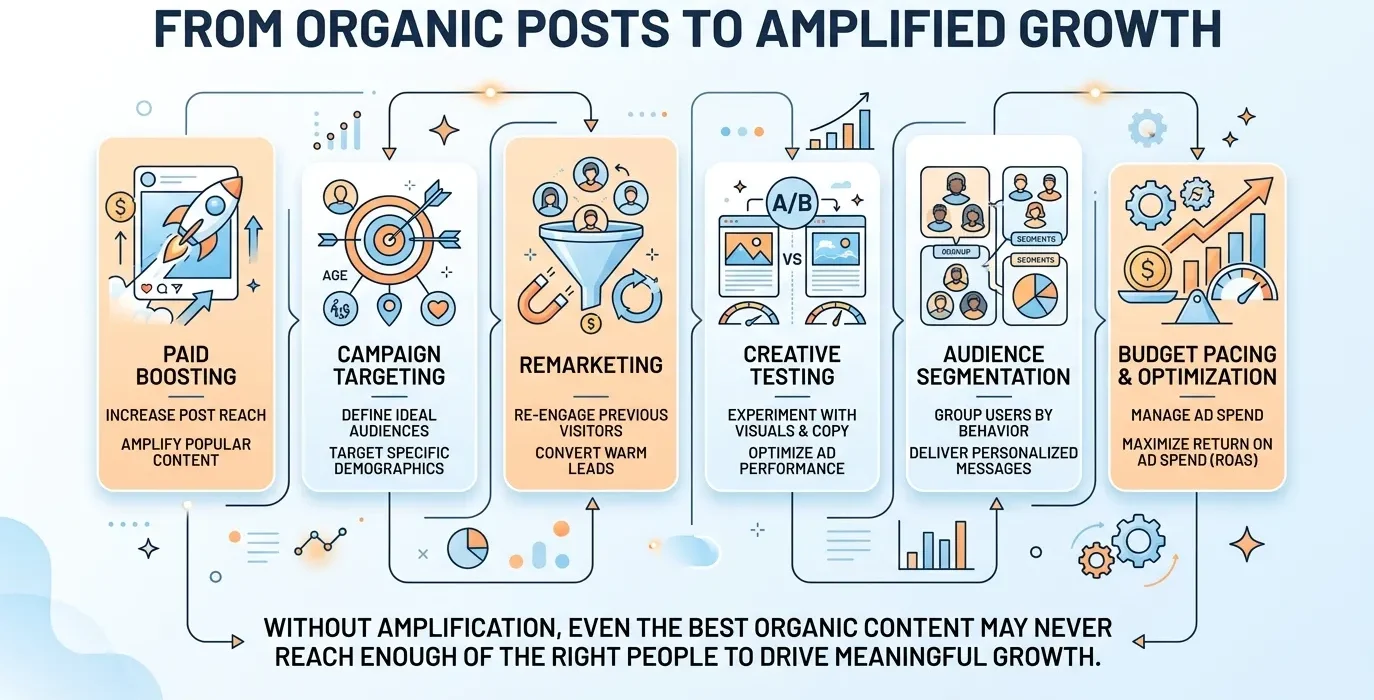
Organic content alone is often not enough, especially if your goal is growth rather than maintenance. That is why full social media marketing services often include:
- paid boosting
- campaign targeting
- remarketing
- creative testing
- audience segmentation
- budget pacing
This is where many businesses underestimate the scope. If a provider publishes content without considering amplification, your best assets may never reach enough of the right people.
We manage community response and brand interaction
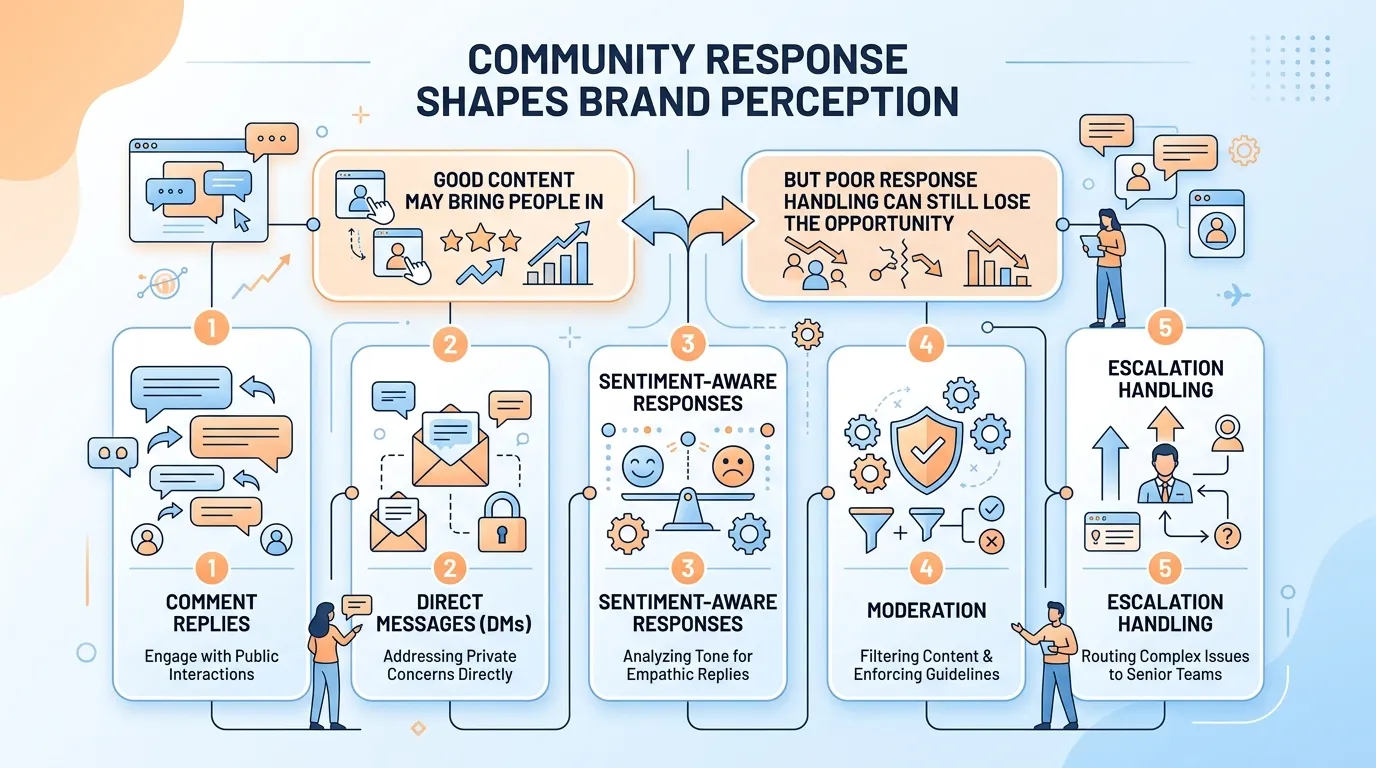
Social media is not only a broadcast channel. It is also where your audience asks questions, leaves comments, compares options, and forms opinions about your brand.
That means we also need to manage:
- comment replies
- direct messages
- sentiment-sensitive responses
- moderation
- escalation of service issues where needed
If this part is ignored, even strong campaigns can underperform. Good content may bring people in, but poor response handling can still lose the opportunity.
We manage tracking and attribution
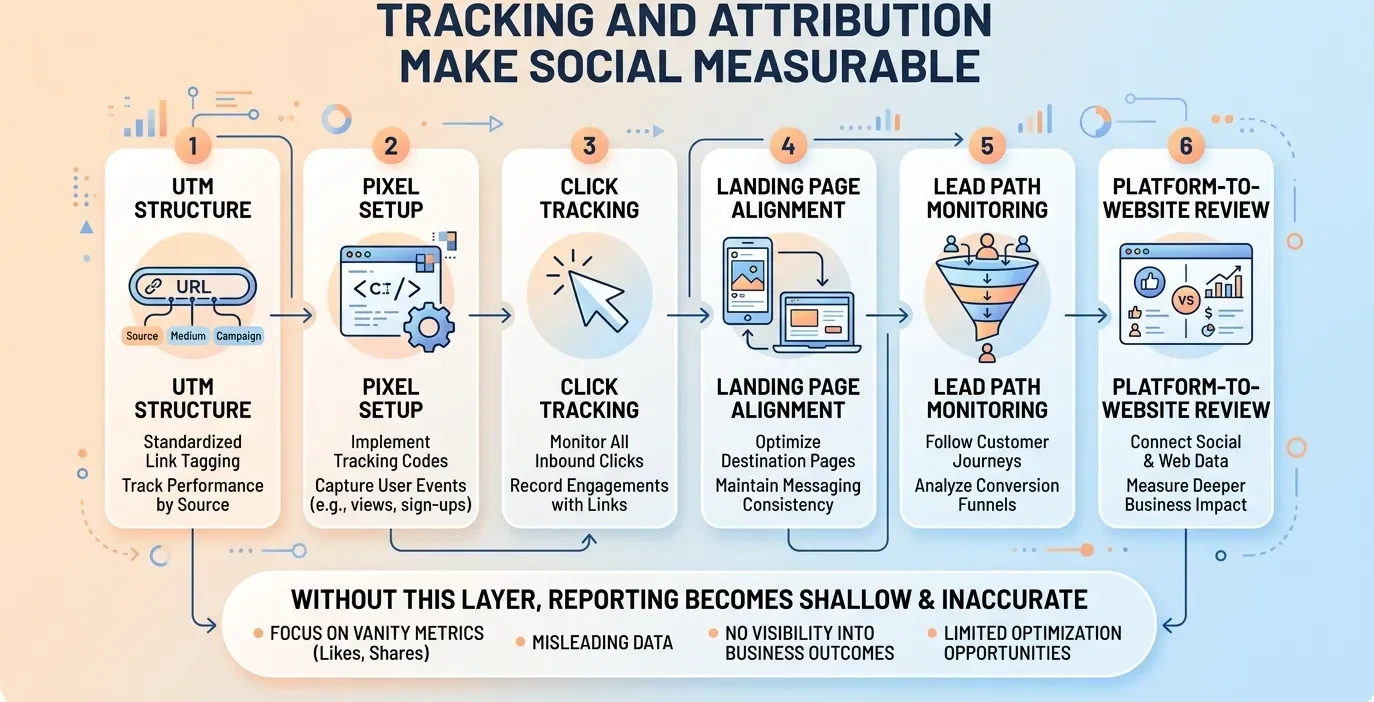
One of the most important things a full provider should manage is measurement. If we cannot see what social media is influencing, then it becomes much harder to justify spending or improve performance.
This usually includes:
- UTM structures
- pixel setup
- click tracking
- landing page alignment
- lead path monitoring
- platform-to-website performance review
This helps us answer questions like:
- Which content drove the most qualified traffic?
- Which audience converted best?
- Which campaign supported enquiries or leads?
- Where are users dropping off?
Without this layer, reporting becomes shallow.
We manage reporting with recommendations, not just numbers
A full social media marketing services provider should not stop at telling you what happened. We should also help you understand what to do next.
That means reporting should cover:
- what performed well
- what underperformed
- what changed month to month
- what audience or content trends we noticed
- what we recommend testing next
Here is the difference:
| Basic support | Full-service management |
| Shares a list of posts and engagement numbers | Interprets performance and explains what actions to take next |
| Reports vanity metrics only | Connects results to traffic, leads, or conversion intent |
| Stops at the monthly delivery | Builds a feedback loop for ongoing improvement |
We manage alignment across channels
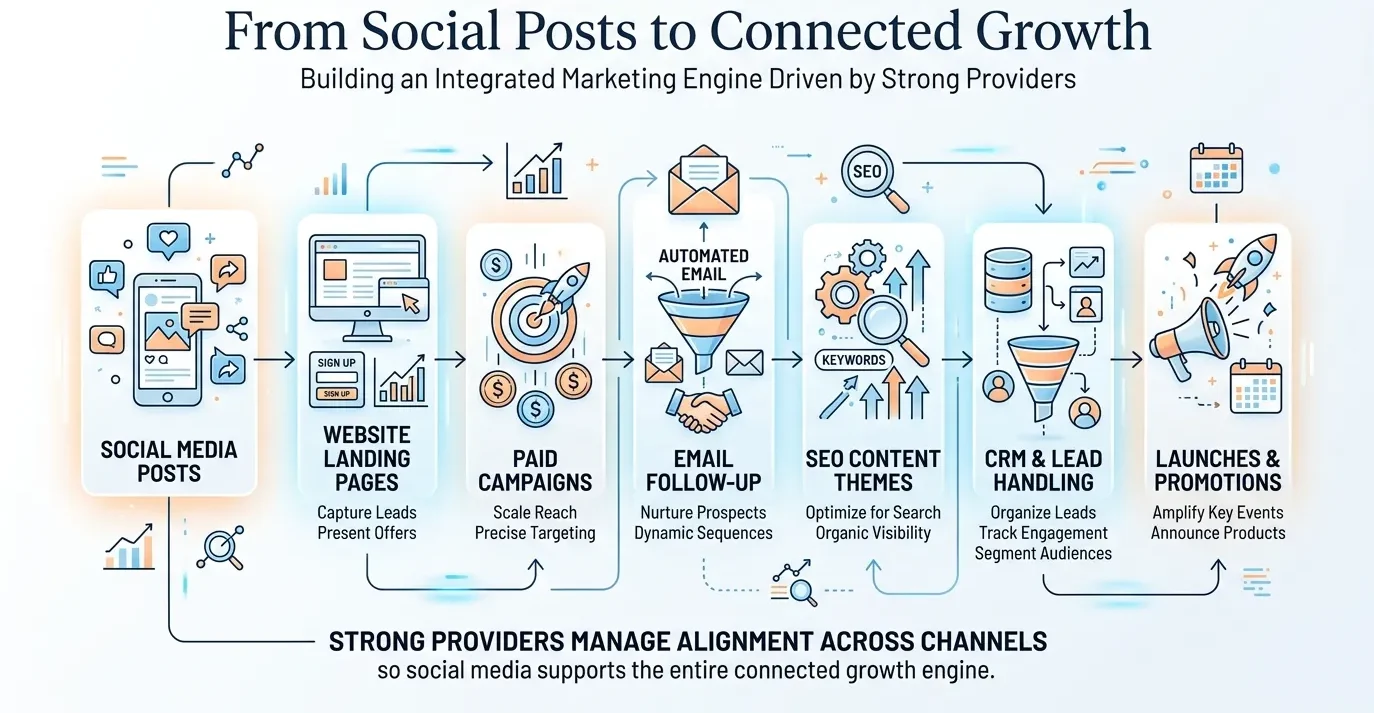
A full provider should also make sure social media does not operate in isolation. Depending on your business, we may need to align social with:
- your website landing pages
- paid media campaigns
- email follow-up
- SEO content themes
- CRM or lead handling
- campaign launches or promotions
This is where social media starts becoming part of a broader growth engine rather than a standalone content stream.
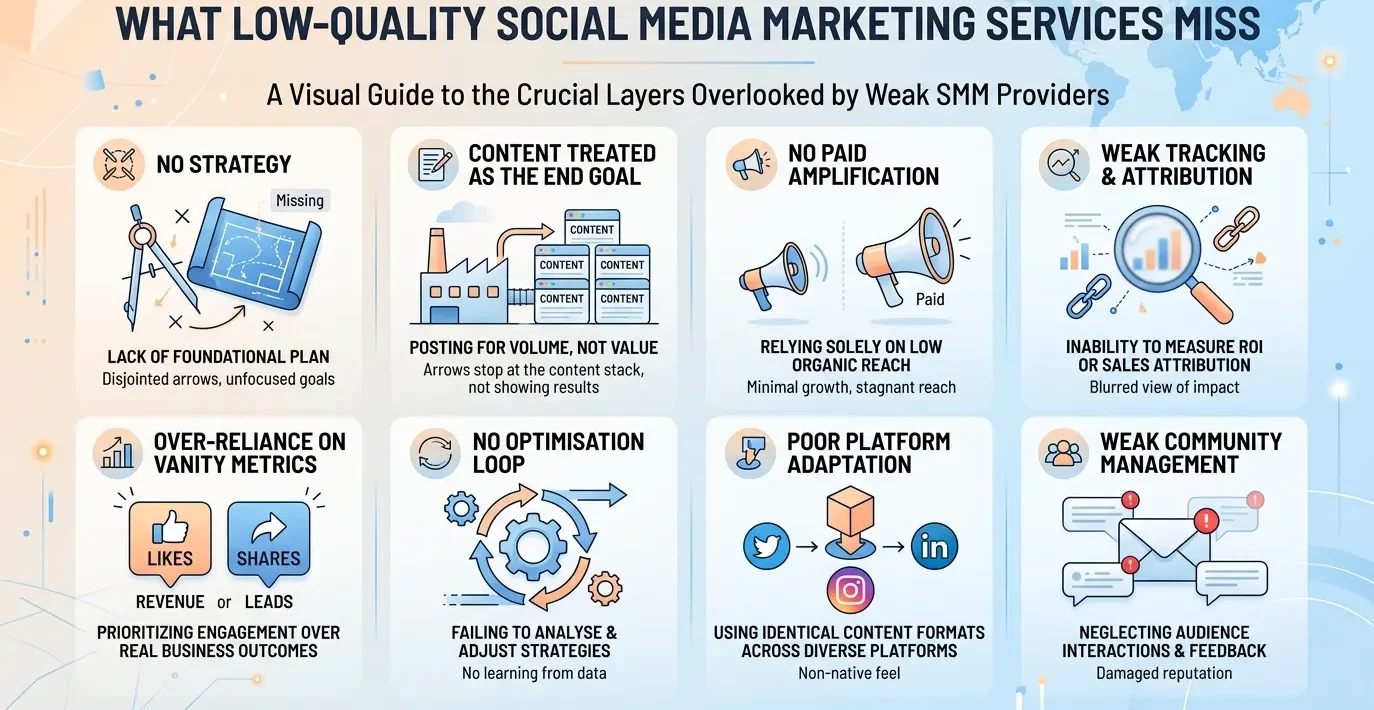
Not all social media marketing services are built the same. On the surface, many providers can look similar. You may see a content calendar, a set number of posts, and a monthly report. But once we look closer, the difference usually comes down to what is missing behind the scenes.
From our experience, low-quality social media marketing services rarely fail because of effort. They fail because key layers are either weak, disconnected, or absent altogether.
The most common gaps we see in low-quality social media marketing services
| Gap | What it looks like | Why does it become a problem |
| No clear strategy | Content is posted without a defined audience or goal | Leads to inconsistent messaging and weak results |
| Content-first thinking | Focus is only on visuals and captions | Ignores distribution, tracking, and conversion |
| No paid support | Everything relies on organic reach | Limits scalability and slows growth |
| Weak tracking setup | No UTMs, pixels, or proper attribution | Makes it difficult to measure ROI |
| Vanity metric reporting | Reports focus on likes and followers | Does not reflect business impact |
| No optimisation process | Same approach repeated every month | Performance plateaus over time |
| Poor platform adaptation | Same content reused across platforms | Reduces relevance and engagement |
| Limited community management | Comments and messages are ignored or delayed | Affects trust and conversion opportunities |
1. No clear strategy behind social media marketing services
This is one of the biggest red flags.
If social media marketing services do not start with a defined strategy, everything else becomes reactive. We often see:
- content created based on trends rather than audience needs
- inconsistent messaging across posts
- no clear link between content and business goals
Without a strategy, even high-quality content can feel disconnected and underperform.
2. Content is treated as the end goal, not the starting point
Many low-quality social media marketing services focus heavily on content output. The assumption is that if the content looks good, results will follow.
In reality, content is only one part of the system.
If there is no plan for:
- how the content will be distributed
- who it is meant to reach
- what action should it drive
then performance becomes unpredictable. We have seen strong creative fail simply because it was not supported by the right targeting or amplification.
3. No paid amplification or distribution strategy
Organic reach alone is often not enough, especially for brands that are trying to grow.
When social media marketing services exclude paid support, we usually see:
- slower audience growth
- limited reach beyond existing followers
- reduced ability to test and scale
Paid media does not replace organic content. It supports it. Without it, even strong campaigns can struggle to gain traction.
4. Weak or missing tracking and attribution
This is one of the most overlooked gaps.
If social media marketing services do not include proper tracking, we cannot answer basic questions like:
- Which posts drove traffic?
- Which campaigns generated leads?
- Which audiences converted best?
Instead, decisions are based on surface-level metrics.
What proper tracking should include
| Tracking element | Purpose |
| UTM parameters | Identify traffic sources and campaigns |
| Pixels (Meta, TikTok, Google) | Track conversions and audience behaviour |
| Landing page alignment | Ensure consistency between content and destination |
| CRM integration | Measure lead quality and downstream outcomes |
Without these, social media becomes difficult to justify as a performance channel.
5. Over-reliance on vanity metrics
A common issue with weaker social media marketing services is reporting that looks impressive but lacks depth.
You might see:
- high impressions
- growing follower counts
- increasing engagement
But what is often missing is the connection to actual business outcomes.
We prefer to look at:
- traffic quality
- enquiries or leads
- conversion signals
- assisted conversions
These metrics show whether social media is contributing to growth.
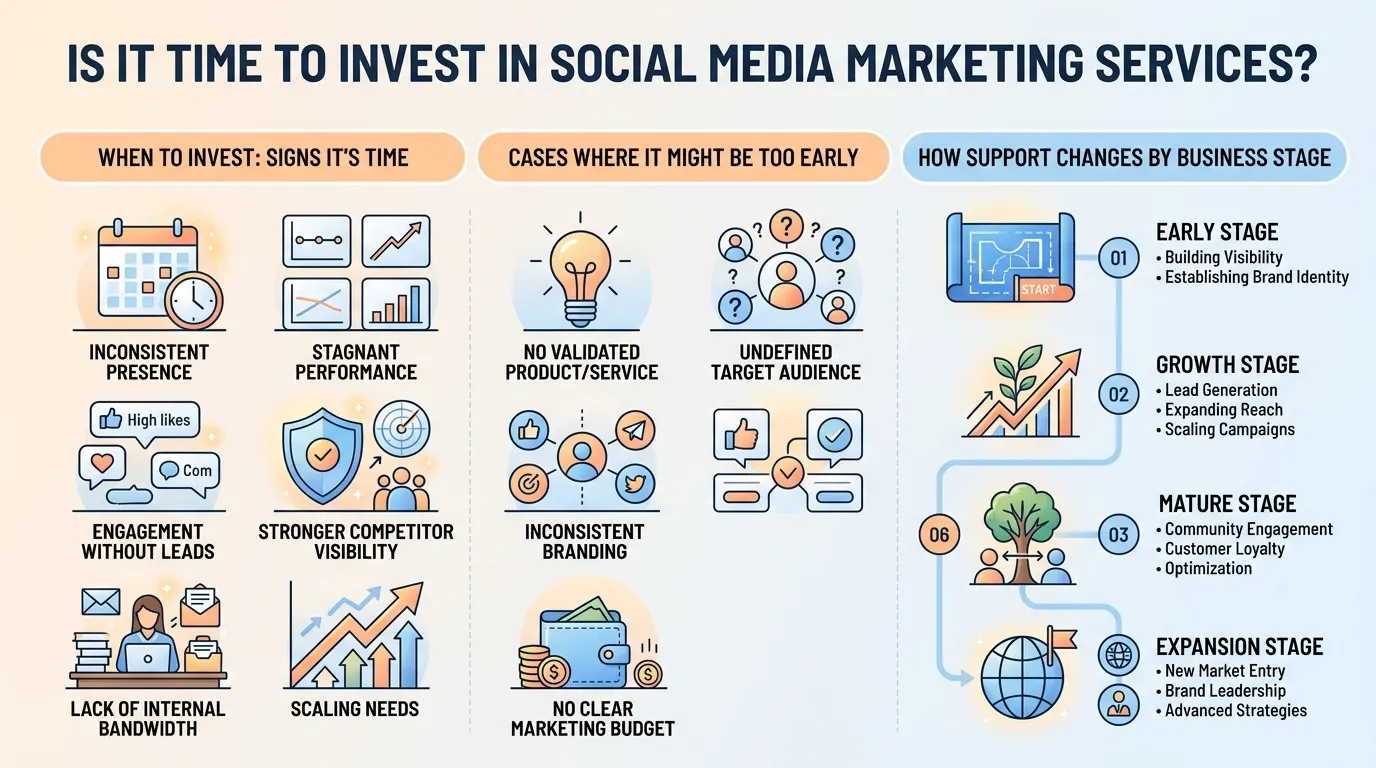
One of the most common questions we get is not what social media marketing services include, but when it actually makes sense to invest in them.
The honest answer is that timing matters. If you invest too early, you may not see meaningful returns. If you invest too late, you may already be losing visibility, leads, and market share to competitors.
From our experience, the right time usually depends on your business stage, internal resources, and growth goals.
The clearest signs that it is time to invest in social media marketing services
We usually recommend considering social media marketing services when you start seeing one or more of these:
- your social media presence is inconsistent or inactive
- content is being posted, but results are unclear or stagnant
- you are getting engagement, but not enquiries or sales
- competitors are more visible or active on key platforms
- your team does not have the time or expertise to manage social properly
- you want to scale but do not have a structured content or paid strategy
If any of these sound familiar, it usually means the issue is not effort. It is structured.
Different stages where social media marketing services become relevant
The right timing also depends on where your business currently sits.
| Business stage | What is happening | How social media marketing services help |
| Early stage | Building awareness, testing positioning | Define audience, platforms, and content direction |
| Growth stage | Increasing demand, scaling visibility | Add paid media, improve conversion tracking, and refine messaging |
| Mature stage | Stable business, looking to optimise | Improve efficiency, testing, and ROI |
| Expansion stage | Entering new markets or segments | Adapt strategy, localise content, scale campaigns |
We do not apply the same approach at every stage. Social media marketing services should evolve as your business grows.
When NOT to invest yet
It is also important to be realistic. There are situations where social media marketing services may not deliver strong results yet.
We usually advise holding off if:
- your product or service is not clearly defined
- your pricing or positioning is still unclear
- you do not have a working website or landing page
- there is no clear conversion path (enquiry, purchase, sign-up)
- your internal team is not ready to handle incoming leads
In these cases, even strong execution may struggle because the fundamentals are not in place.
In-house vs outsourcing social media marketing services
Another key decision is whether to manage this internally or work with a provider.
| Approach | When it works best |
| In-house team | You have experienced staff and enough resources to manage strategy, content, ads, and reporting |
| Outsourced provider | You need structure, speed, and cross-functional expertise without building a full team |
From what we see, many businesses start in-house, then move to external social media marketing services when:
- the workload increases
- performance plateaus
- they need more specialised skills
- they want faster execution
Seasonal social media campaigns do more than boost sales during peak periods. They help you build lasting relationships with your audience.
With the right planning, timely content, and active engagement, you can boost brand visibility and build loyalty that lasts beyond the season.
A successful seasonal campaign needs clear objectives, targeted content, and smart distribution. With strong planning and optimisation, you set your brand up for year-round growth and loyalty.
Ready to level up your seasonal campaigns? Work with a proven social media agency like MediaOne to build a strategy that delivers real results.
Contact us today to start planning your next high-impact seasonal campaign.
Frequently Asked Questions
How do I measure the success of my seasonal social media campaign?
Measuring success involves tracking specific key performance indicators (KPIs) such as engagement rates, website traffic, conversions, and return on ad spend (ROAS). It’s crucial to set up proper tracking using UTM parameters, pixel integration, and analytics tools. These insights allow you to determine which content resonated most with your audience and which channels performed best.
What is the best time to launch a seasonal social media campaign?
The best time to launch your campaign depends on the season you’re targeting and your audience’s online behaviour. For holidays like Christmas, Lunar New Year, or Black Friday, it’s important to start early, ideally 1–2 weeks before the event. For specific promotions, such as flash sales, timing should align with peak shopping times when your audience is most active on social media.
How can I make my seasonal campaign stand out from the competition?
To stand out, your campaign must resonate with your audience and align with the season’s spirit. Create authentic, platform-specific content, leverage user-generated content (UGC), and offer exclusive deals. Additionally, incorporating interactive elements like polls, quizzes, or contests can increase engagement and make your campaign more memorable.
What type of content works best during seasonal campaigns?
For seasonal campaigns, video content tends to perform best, especially on platforms like Instagram Reels, TikTok, and Facebook. Short, engaging videos that showcase your products in a seasonal context or tell a story about your brand’s values resonate well. Stories, live videos, UGC, and countdown posts also generate excitement and urgency during peak times.
How do I avoid overloading my audience with too much promotional content during seasonal campaigns?
To avoid overwhelming your audience, balance promotional content with engaging and value-driven posts. Focus on creating a mix of content that includes behind-the-scenes glimpses, customer stories, or helpful seasonal tips. Use storytelling to make the promotion feel part of a larger, engaging narrative rather than just a sales pitch.
Should I use paid advertising for my seasonal campaign?
Paid advertising is often a great way to amplify your seasonal campaign, especially if you want to reach a larger audience or retarget people who have interacted with your content. Platforms like Facebook, Instagram, and TikTok provide highly targeted ad options to reach specific demographics. Setting up paid campaigns with clear objectives (such as driving traffic, sales, or engagement) will maximise your ROI.
How can I keep my social media marketing campaigns relevant after the holiday season?
To keep the momentum going after a seasonal campaign, repurpose high-performing content and continue engaging your audience with post-season offers, exclusive deals, or loyalty programs. You can also focus on building relationships with your community by sharing customer reviews, hosting Q&A sessions, or promoting upcoming product releases.
How do I handle customer feedback or complaints during a seasonal campaign?
During a seasonal campaign, it’s essential to respond promptly and professionally to both positive and negative feedback. Acknowledge complaints, provide solutions, and reassure customers that their concerns are being addressed. Maintaining a transparent, helpful, and friendly tone can turn a negative experience into a positive one, strengthening customer loyalty in the long run.