Digital marketing is no longer a tactical add-on; it is where the majority of modern advertising dollars are spent. In 2025, global digital advertising spend was projected to reach roughly $740 billion, accounting for around 69% of total global ad spend, and was expected to grow further in 2026 as businesses continued shifting budgets online.
Yet despite this scale, many organisations still struggle to define what a digital marketing agency actually includes, how they differ from one another, and which combinations deliver measurable, sustainable business results.
Digital marketing services encompass a range of specialised practices from search, paid media, and social to artificial intelligence optimisations, that, when integrated strategically, drive predictable customer acquisition and long-term growth.
This guide breaks down the core components of digital marketing services, what they are, how they work, and why integration matters. By the end, you will understand not just what each service does, but how they operate together to build a full-funnel, data-driven growth engine.
Key Takeaways
- Digital marketing services are integrated growth systems, not isolated tactics. SEO, SEM, social media, and AI must work together to drive sustainable and measurable business outcomes.
- SEO builds long-term authority, while SEM delivers immediate acquisition. Combining both reduces long-term customer acquisition costs while maintaining short-term momentum.
- Social media strengthens trust and brand perception across the funnel. Strong brand presence improves conversion rates across both organic and paid channels.
- AI enhances efficiency, targeting precision, and optimisation speed. When layered onto a structured strategy, AI improves scalability and consistency in performance.
- Structured digital marketing services outperform fragmented execution. Businesses that integrate strategy, tracking, and cross-channel optimisation achieve more predictable growth.
What Are Digital Marketing Services?
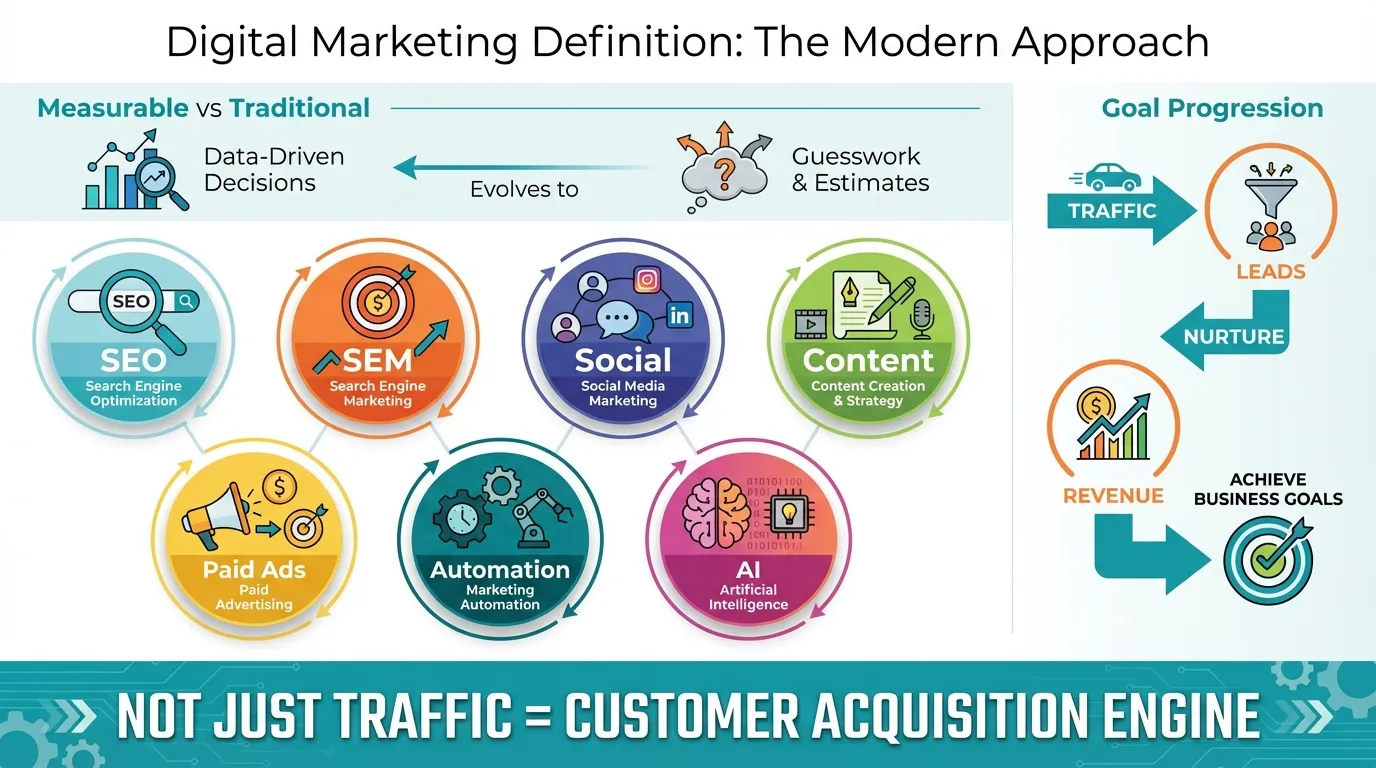
Digital marketing services refer to professional strategies and execution that promote a business through online channels. These services are designed to increase visibility, attract qualified traffic, generate leads, and ultimately drive revenue.
Unlike traditional marketing, digital marketing is measurable. Every click, impression, and conversion can be tracked. This allows campaigns to be optimised continuously based on data rather than assumptions.
Digital marketing services typically include a combination of:
- Search Engine Optimisation (SEO)
- Search Engine Marketing (SEM)
- Social Media Marketing
- Content Marketing
- Paid Advertising
- Marketing Automation
- AI-powered optimisation
The purpose is not merely to generate traffic. It is to build a predictable customer acquisition engine aligned with business objectives.
Search Engine Optimisation (SEO) Services Explained
Search Engine Optimisation is the process of improving a website’s organic visibility in search engine results pages. When users search for information, products, or services, SEO ensures that your website appears prominently without paying for each click.
SEO focuses on sustainable, long-term traffic growth. Unlike paid advertising, which stops when spending stops, SEO builds digital assets that compound over time.
To understand professional SEO services, we must examine the layers involved.
Technical SEO
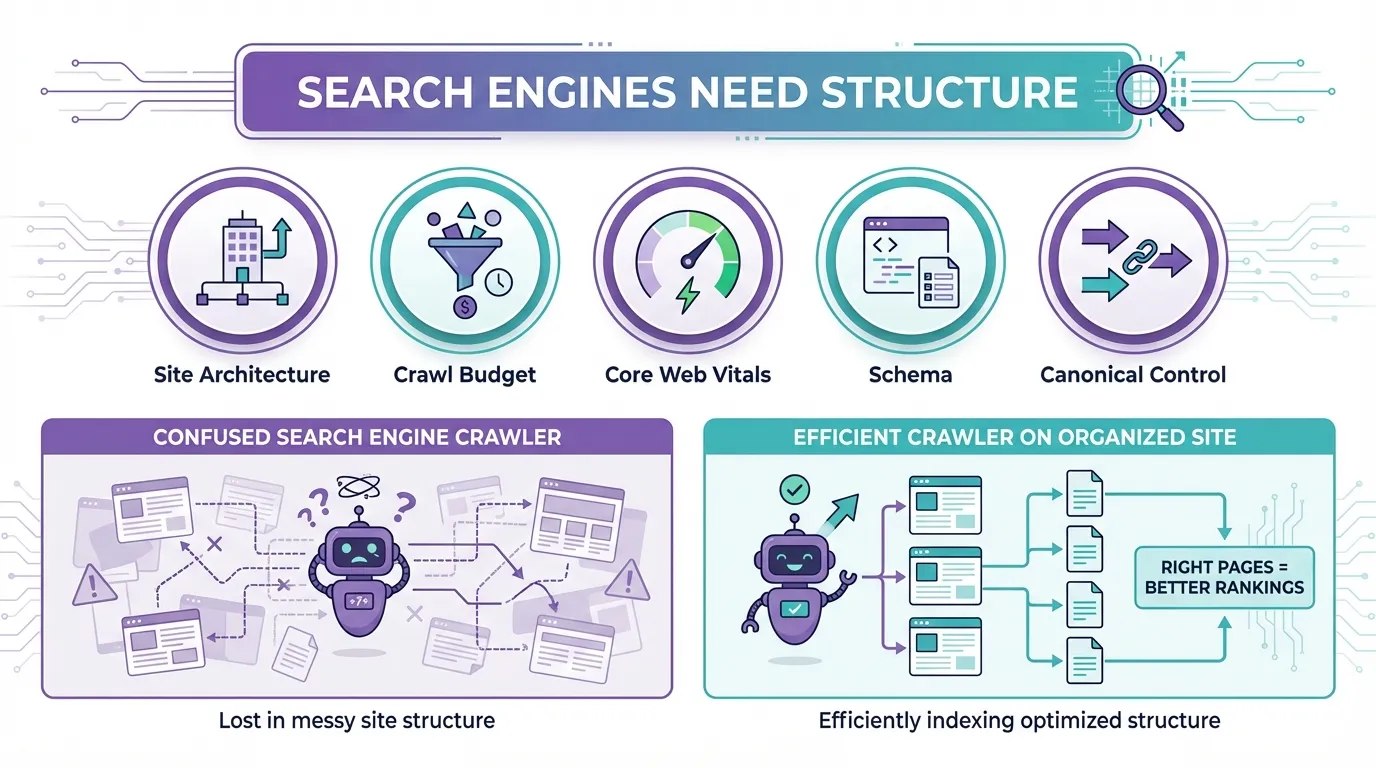
Technical SEO forms the structural backbone of organic visibility. It ensures that search engines can efficiently crawl and index your website without confusion or resource waste.
If technical foundations are weak, even strong content may struggle to rank because search engines cannot properly interpret or prioritise it.
Core technical SEO components include:
- Site architecture optimisation: Structuring categories and pages logically so search engines can navigate the site efficiently and understand content hierarchy.
- Crawl budget management: Controlling which pages search engines prioritise, particularly important for large e-commerce or enterprise sites with thousands of URLs.
- Core Web Vitals improvement: Enhancing loading speed, responsiveness, and visual stability to improve both user experience and ranking signals.
- Schema markup implementation: Adding structured data that helps search engines interpret content contextually, increasing eligibility for rich results.
- Canonical and index control: Preventing duplicate content issues and consolidating ranking signals to the most important URLs.
Technical SEO ensures that search engines spend their resources evaluating the right pages rather than being distracted by structural inefficiencies.
On-Page Optimisation
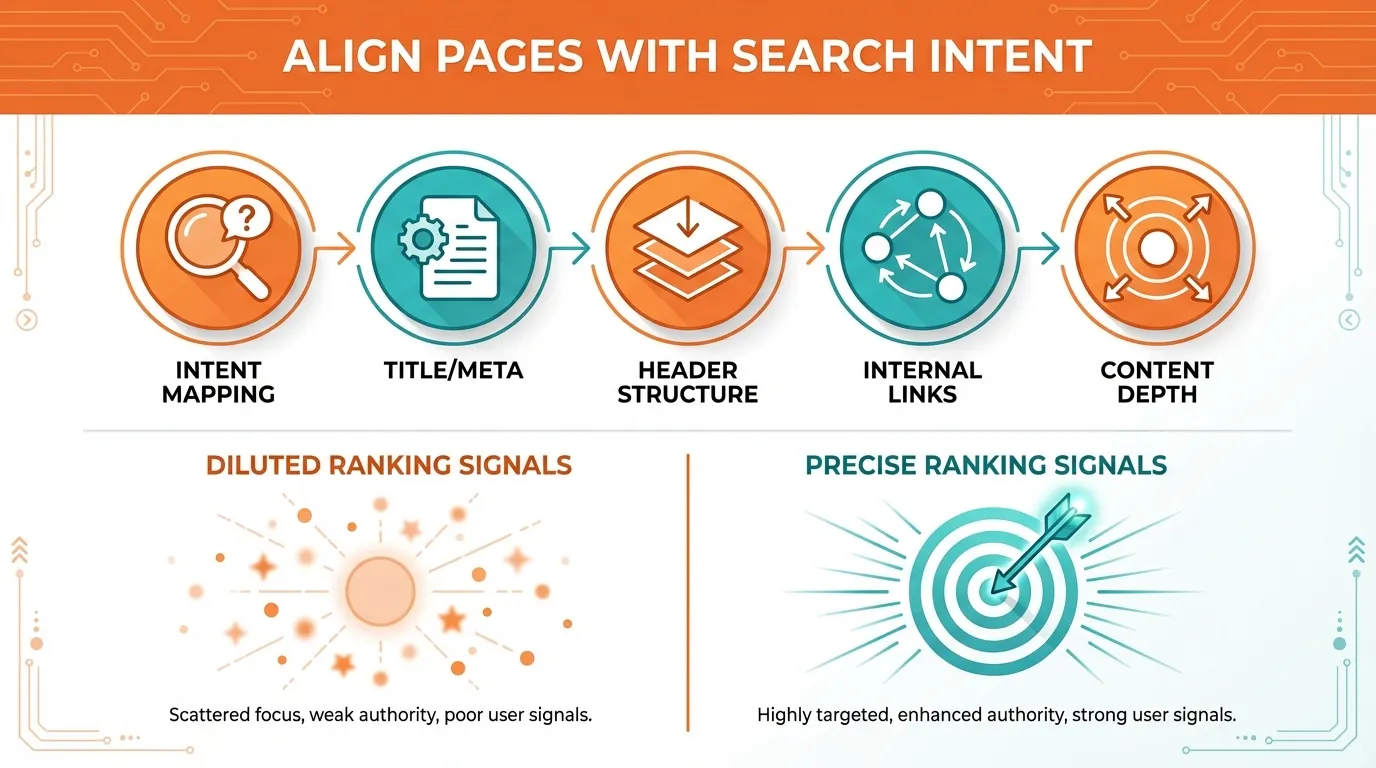
Once the technical foundation is secure, on-page optimisation ensures that individual pages align precisely with search intent.
On-page SEO focuses on clarity and relevance. It communicates to search engines what a page is about and why it deserves to rank for specific queries.
Key components include:
- Keyword intent mapping: Aligning page content with what users are actually searching for, whether informational, commercial, or transactional.
- Title and meta optimisation: Improving click-through rates and reinforcing keyword relevance signals.
- Header hierarchy structuring: Organising content logically so both users and search engines can understand the topical structure.
- Internal linking strategy: Connecting related pages to distribute authority and guide search engines toward priority content.
- Content depth enhancement: Expanding coverage to compete with top-ranking pages that provide comprehensive answers.
On-page optimisation ensures that ranking signals are precise rather than diluted.
Content Strategy
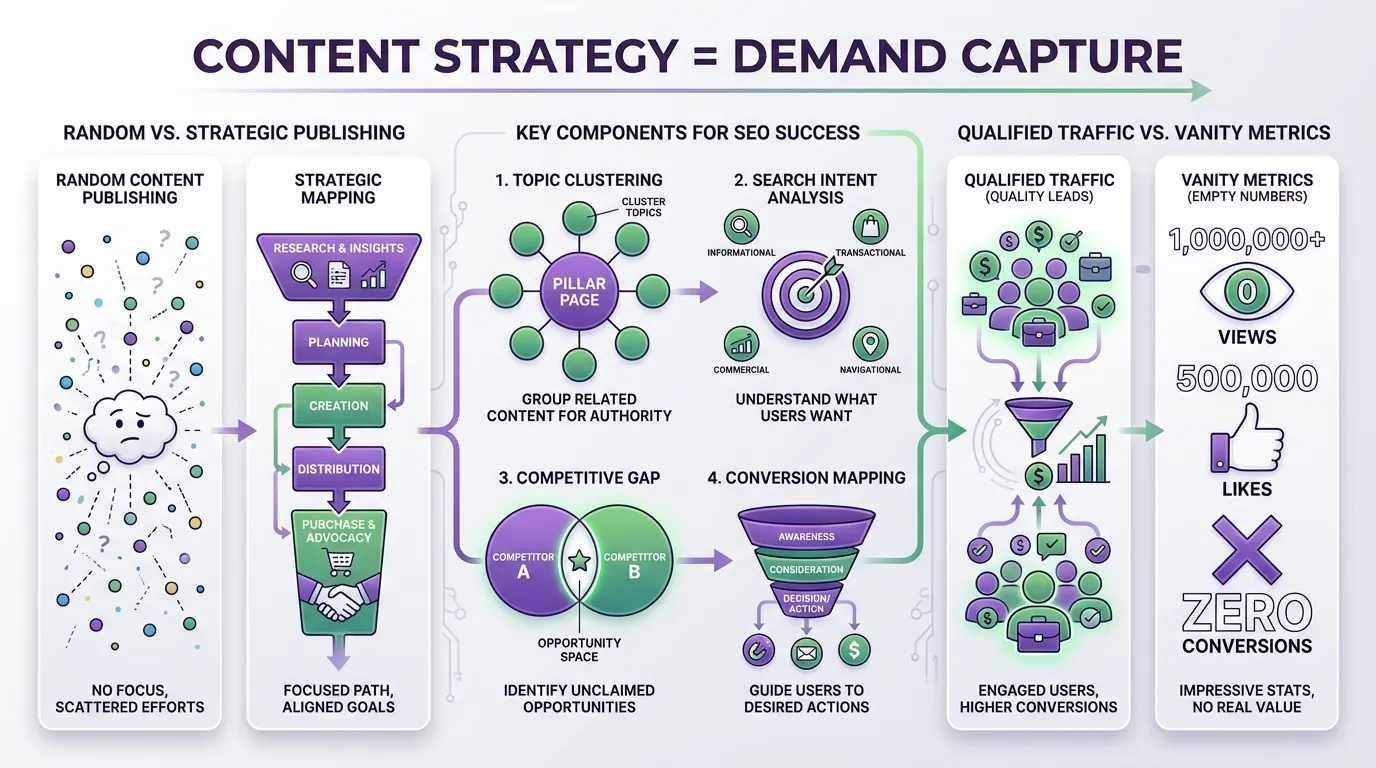
Content strategy transforms SEO from technical compliance into demand capture.
Rather than publishing content randomly, a strategic approach maps content across the customer journey, from early research queries to high-intent purchase terms.
An effective content strategy includes:
- Topic clustering: Grouping related articles and landing pages around core themes to build topical authority.
- Search intent analysis: Identifying the specific motivations behind queries, ensuring content matches user expectations.
- Competitive gap analysis: Discovering areas where competitors are underperforming or lacking depth.
- Conversion-focused mapping: Designing content that not only attracts traffic but also drives enquiries, sign-ups, or sales.
Content strategy ensures that SEO generates qualified traffic, not vanity metrics.
Authority Building

Search engines evaluate credibility through authority signals. Even technically sound and well-written content may struggle in competitive industries without external validation.
Authority building enhances a website’s trustworthiness and search ranking.
This includes:
- Digital PR outreach: Securing coverage and mentions from reputable publications and industry websites.
- Strategic link acquisition: Earning backlinks from relevant, high-authority domains that signal credibility.
- Brand amplification: Increasing overall brand visibility and online mentions, reinforcing trust signals.
Authority remains one of the most influential ranking factors in competitive markets.
Search Engine Marketing (SEM) Services Explained
Search Engine Marketing (SEM) refers to paid advertising campaigns on search platforms such as Google Ads and Microsoft Ads. Unlike SEO, which builds organic visibility over time, SEM allows businesses to appear immediately for targeted keywords by bidding for ad placement.
Every impression, click, and conversion is measurable. Budgets can be adjusted in real time. Campaigns can scale quickly.
However, profitability in SEM depends on strategic planning, disciplined execution, and continuous optimisation. Professional SEM services operate across three interconnected layers: campaign strategy, creative optimisation, and performance tracking.
Keyword & Campaign Strategy
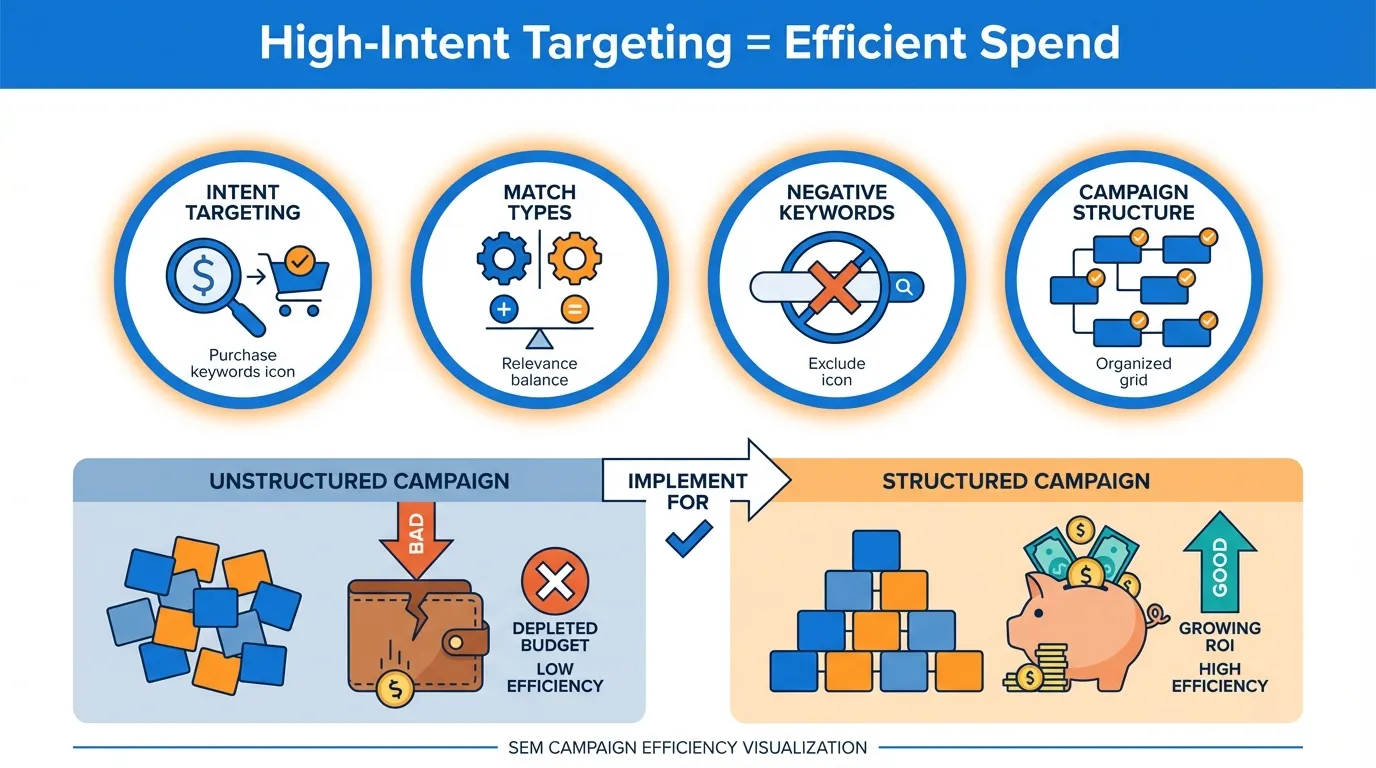
Effective SEM begins with identifying and structuring high-intent search demand. Not all keywords are equal. Some indicate research behaviour, while others signal purchase readiness.
Strategic campaign development includes:
- Search intent targeting: Identifying keywords that indicate commercial intent, such as “buy,” “hire,” or “pricing,” which are more likely to convert.
- Match type segmentation: Controlling how closely a user’s query must match your chosen keywords, balancing reach with relevance.
- Negative keyword filtering: Excluding irrelevant queries to prevent wasted ad spend and improve campaign efficiency.
- Campaign and ad group structuring: Organising keywords into tightly themed groups to improve ad relevance and Quality Score.
Without structured targeting, SEM budgets can be depleted quickly, yielding little meaningful return.
Ad Creative and Optimisation
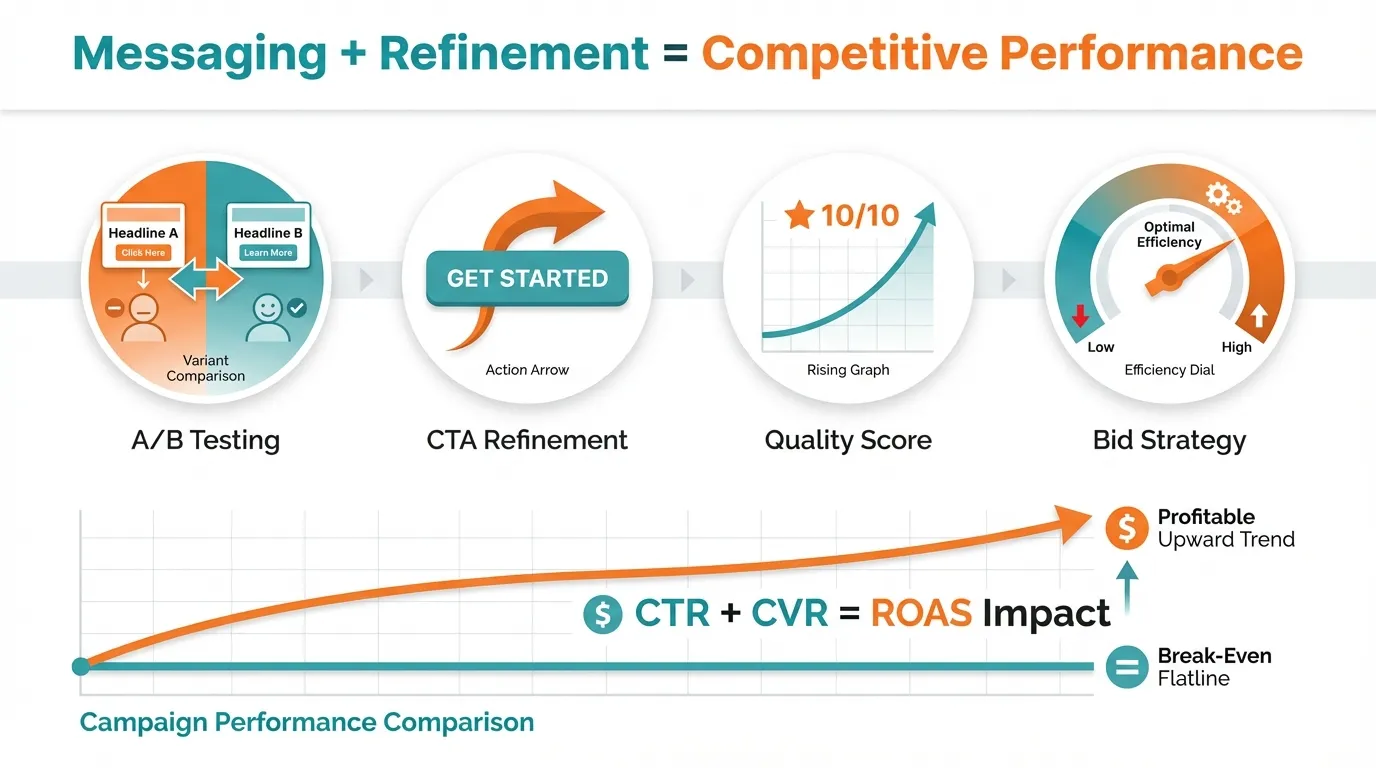
Once campaigns are structured correctly, performance depends on messaging and refinement. SEM is not static. Ads must be tested and improved continuously to remain competitive.
Core optimisation activities include:
- A/B testing headlines and descriptions: Experimenting with different messaging angles to increase click-through rates.
- Call-to-action refinement: Adjusting wording to encourage stronger user response and higher conversion intent.
- Quality Score optimisation: Improving ad relevance, landing page experience, and expected click-through rate to reduce cost per click.
- Bid strategy adjustments: Balancing automated and manual bidding to control cost efficiency while maintaining visibility.
Optimisation is what separates break-even campaigns from profitable ones. Small incremental improvements in click-through rate and conversion rate can significantly impact overall return on ad spend.
Conversion Tracking & Attribution
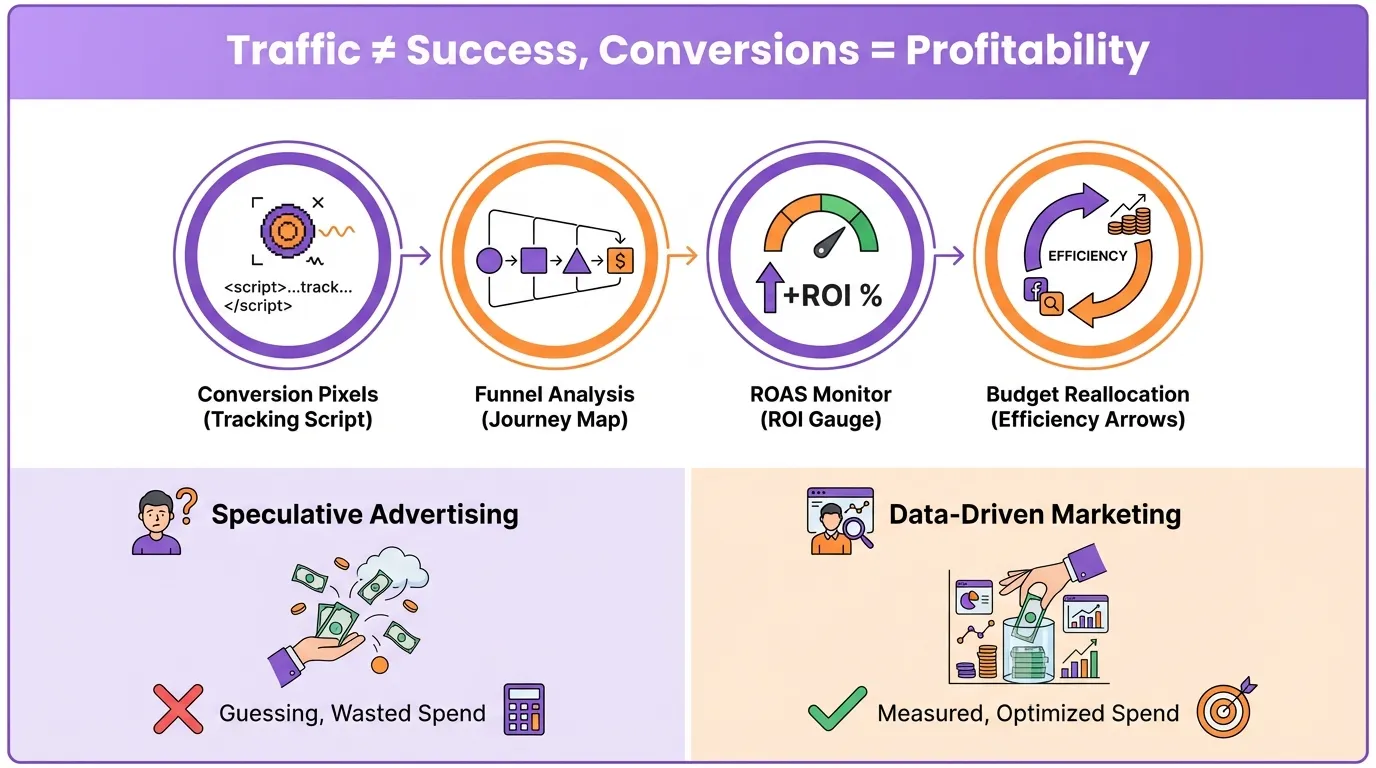
SEM performance cannot be judged solely by traffic. Profitability depends on accurate measurement and disciplined budget allocation.
Professional SEM services ensure that tracking infrastructure is properly implemented and analysed.
This includes:
- Conversion pixel implementation: Installing tracking scripts that accurately record leads, purchases, or other defined actions.
- Funnel analysis: Examining user behaviour across landing pages to identify drop-off points that reduce conversion rates.
- Return on ad spend (ROAS) monitoring: Measuring revenue generated relative to advertising cost.
- Budget reallocation: Redirecting spend toward high-performing campaigns and reducing investment in underperforming segments.
Data-driven decision-making transforms SEM from speculative advertising into measurable performance marketing.
Social Media Marketing Services Explained
Social Media Marketing refers to the strategic use of social platforms such as Facebook, Instagram, LinkedIn, TikTok, and others to build brand awareness, engage audiences, and drive measurable business outcomes.
Unlike search marketing, which captures existing demand, social media marketing often creates demand. It introduces brands to users who may not yet be actively searching but can be influenced through content, storytelling, and targeted advertising.
Professional social media marketing services operate across three interconnected layers: organic brand development, paid audience acquisition, and performance measurement.
Organic Social Media Strategy
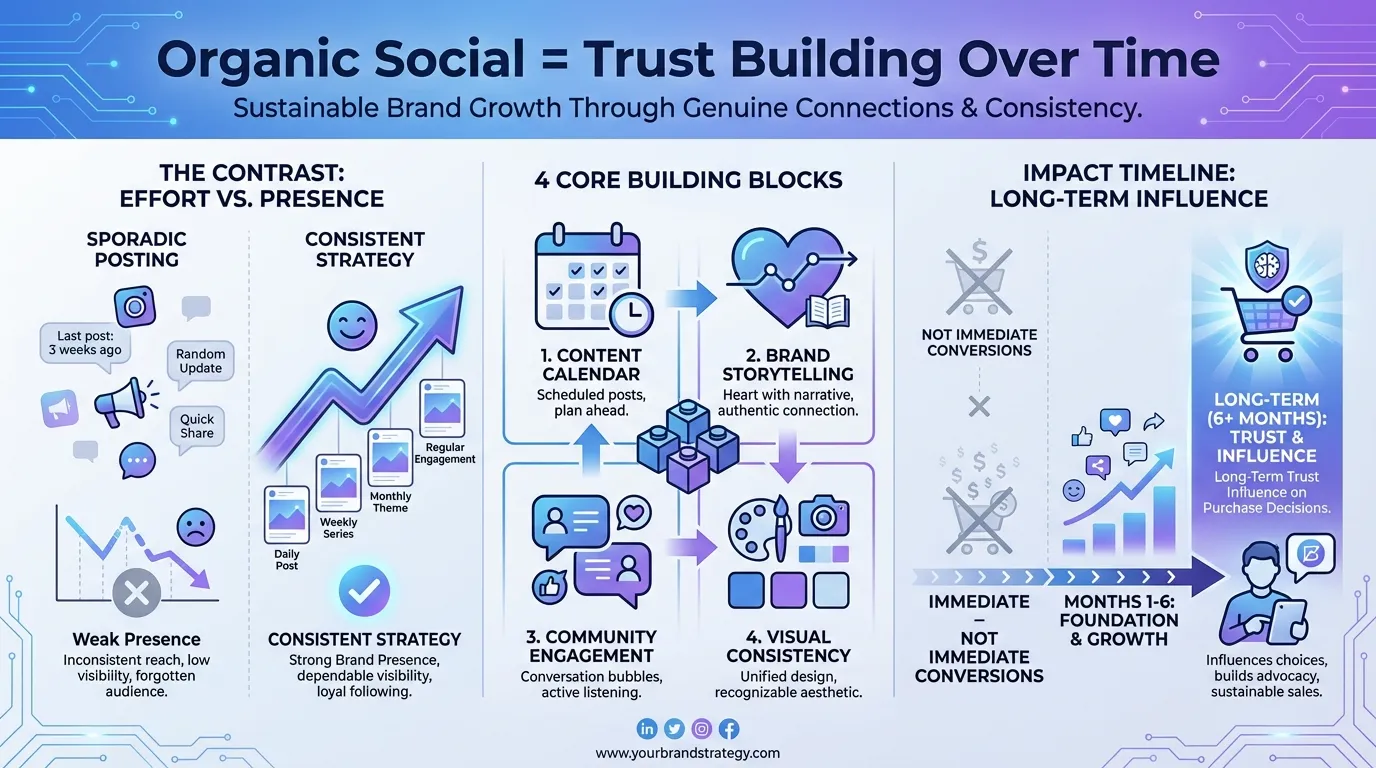
Organic social media focuses on building credibility, familiarity, and long-term audience trust. It establishes how a brand is perceived in the digital space.
This layer strengthens brand recognition and supports other marketing channels such as SEO and SEM.
Core components include:
- Content calendar planning: Structuring posts consistently to maintain brand presence rather than publishing sporadically.
- Brand storytelling: Communicating values, expertise, and differentiation in a way that resonates emotionally with audiences.
- Community engagement: Responding to comments, direct messages, and interactions to foster relationships and build loyalty.
- Visual brand consistency: Maintaining cohesive design, tone, and messaging to reinforce recognition across platforms.
Organic social media may not always drive immediate conversions, but it significantly influences trust and purchase decisions over time.
Paid Social Advertising

While organic content builds presence, paid social advertising accelerates reach and acquisition. It allows businesses to target highly specific audience segments based on behaviour, demographics, interests, and engagement patterns.
Paid social campaigns are particularly effective for top-of-funnel awareness and mid-funnel nurturing.
Key components include:
- Audience segmentation: Dividing target markets into precise groups to deliver tailored messaging.
- Retargeting funnels: Re-engaging users who previously visited the website but did not convert.
- Lead generation campaigns: Capturing user information directly within social platforms to reduce friction.
- Creative testing and iteration: Continuously testing visuals, messaging, and formats to improve engagement and reduce cost per acquisition.
Paid social success depends heavily on creative quality and precise audience targeting. Unlike search ads, which respond to intent, social ads must capture attention within seconds.
AI Marketing Services Explained
AI Marketing refers to the use of artificial intelligence and machine learning technologies to automate, optimise, and enhance digital marketing performance. It leverages data modelling, predictive analytics, and automation systems to improve targeting precision, operational efficiency, and scalability.
In modern digital marketing services, AI acts as an optimisation layer across SEO, SEM, social media, and content. It accelerates decision-making, reduces inefficiencies, and enables marketers to respond to behavioural data in real time.
Professional AI marketing services typically operate across three primary areas: search optimisation, paid media optimisation, and predictive analytics.
AI in SEO and Content
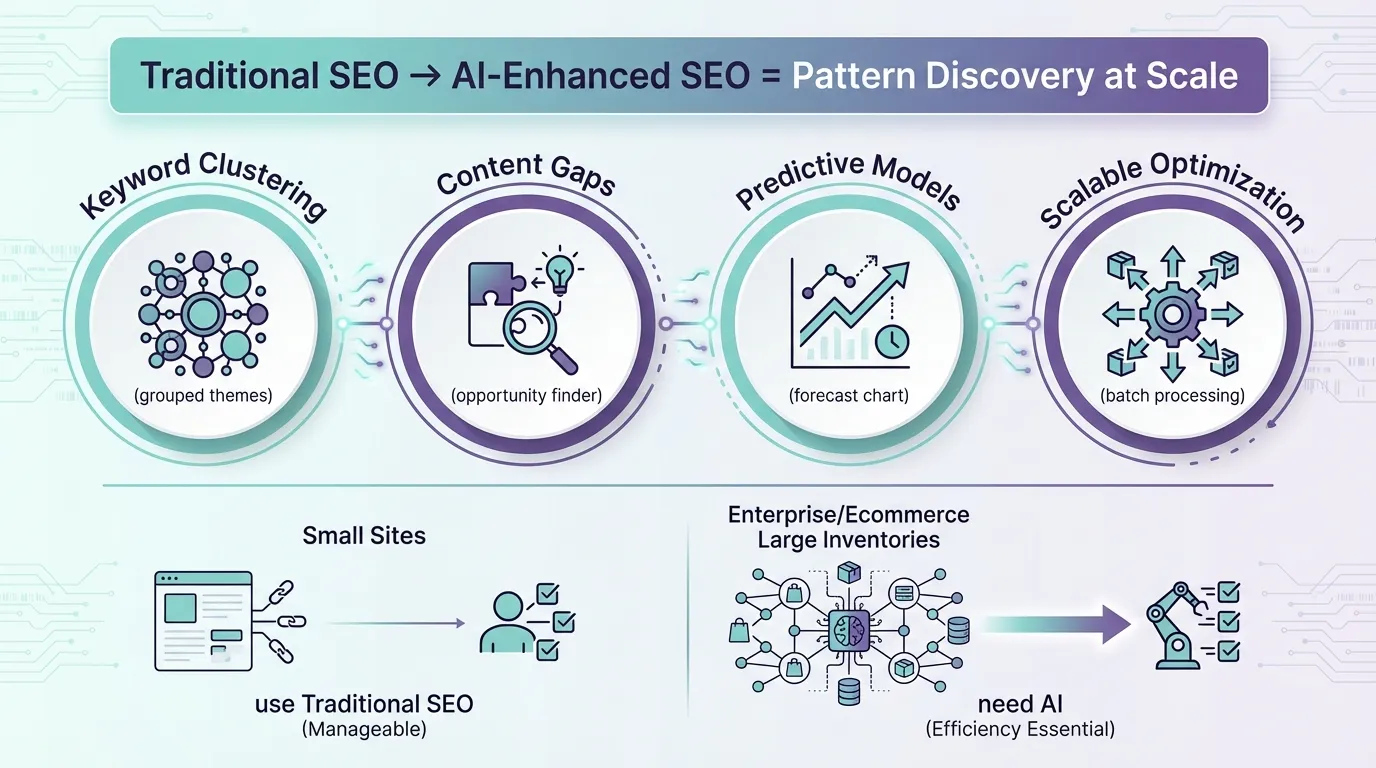
AI enhances SEO by improving how demand is analysed, structured, and prioritised. While traditional SEO relies heavily on manual research and interpretation, AI tools can process vast datasets to uncover patterns and opportunities faster.
Core AI-driven SEO capabilities include:
- Keyword clustering and intent modelling: Grouping thousands of related search queries into structured themes based on semantic similarity and behavioural intent.
- Content gap identification: Analysing competitor coverage to uncover missing topics and ranking opportunities.
- Predictive performance modelling: Estimating which keywords and pages are most likely to generate traffic or conversions.
- Scalable content optimisation: Assisting with on-page improvements and structural refinements across large websites.
AI increases speed and precision in research and optimisation, especially for enterprise or e-commerce sites with large content inventories.
AI in Paid Advertising
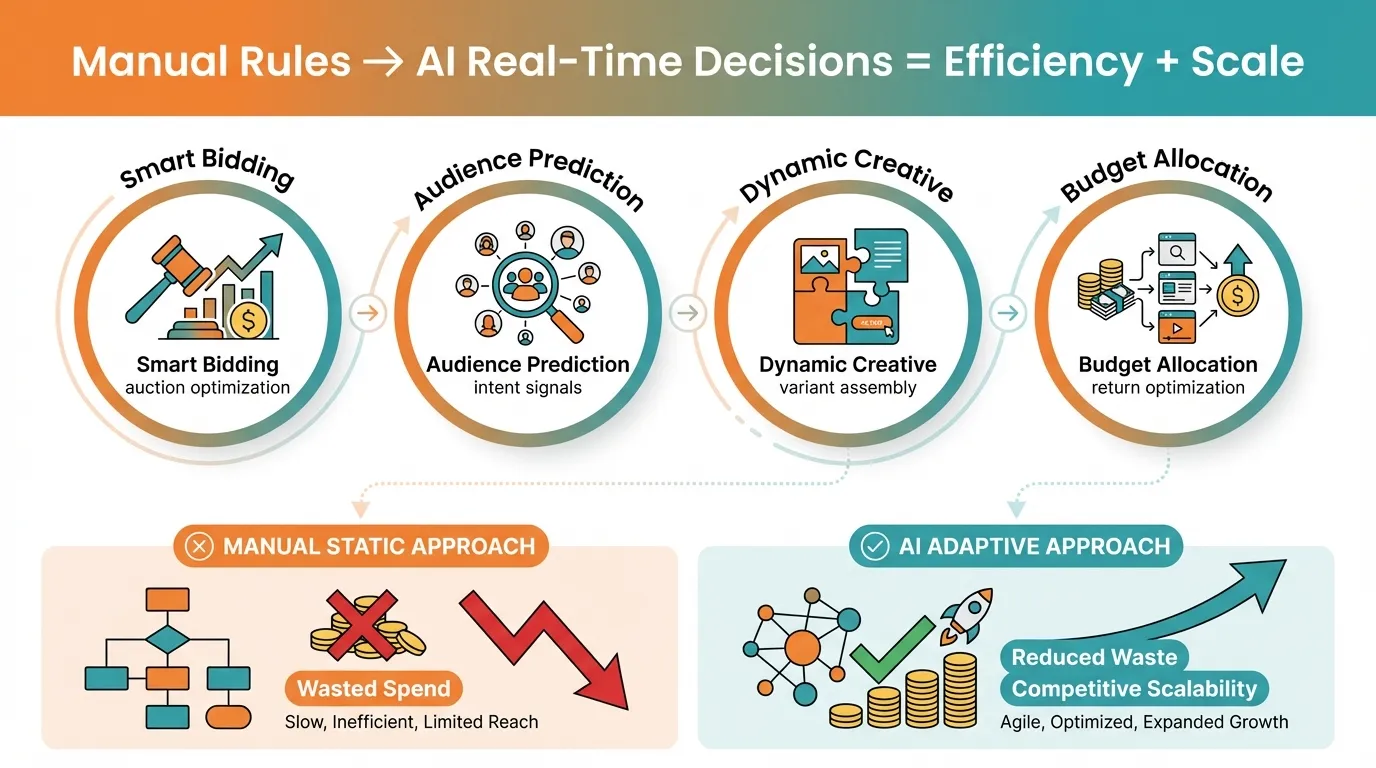
In paid media, AI enhances efficiency by automating decision-making that adjusts bids, budgets, and targeting based on real-time data signals.
Rather than relying solely on manual bidding and static rules, AI systems continuously evaluate user behaviour and conversion probability.
Key AI applications in advertising include:
- Smart bidding automation: Automatically adjusting bids based on the likelihood of conversion at auction time.
- Audience prediction modelling: Identifying users with higher purchase intent based on historical behaviour and engagement signals.
- Dynamic creative optimisation: Rotating and assembling ad variations dynamically to match audience segments.
- Budget allocation modelling: Redirecting spend toward campaigns and audiences delivering higher returns.
AI-powered advertising reduces wasted spend and improves scalability, particularly in competitive industries.
Predictive Analytics and Marketing Automation
Beyond search and paid campaigns, AI supports broader marketing intelligence.
Predictive analytics helps businesses anticipate trends, customer behaviour, and campaign outcomes before they occur.
AI-driven marketing automation includes:
- Lead scoring models: Ranking prospects based on likelihood to convert, allowing sales teams to prioritise efficiently.
- Customer lifetime value forecasting: Predicting long-term revenue potential from different acquisition channels.
- Behaviour-triggered automation: Sending personalised communications based on user actions.
- Churn prediction analysis: Identifying at-risk customers and deploying retention strategies proactively.
These capabilities move digital marketing services from reactive execution to predictive strategy.
How These Digital Marketing Services Work Together
Digital marketing services deliver the strongest results when they operate as a unified growth system rather than as isolated channels.
Each service addresses a different stage of the customer journey and serves a distinct strategic purpose. SEO builds sustainable visibility. SEM accelerates immediate acquisition. Social media strengthens trust and brand perception. AI enhances optimisation precision across all channels.
When properly aligned, these services reinforce one another rather than compete for budget and attention.
- SEO captures long-term search demand and builds authority over time.
- SEM delivers immediate exposure for high-intent queries.
- Social media nurtures awareness and credibility across touchpoints.
- AI improves targeting accuracy, automation, and decision speed.
Together, they create a full-funnel acquisition framework:
Awareness → Consideration → Conversion → Retention
Without integration, growth becomes fragmented. With integration, performance compounds.
Here’s how each digital marketing service differs from the others:
| Service | Primary Role | Time Horizon | Strategic Strength | Risk if Used Alone |
| SEO | Capture organic search demand | Long-term | Builds authority and lowers long-term acquisition cost | Slow initial traction |
| SEM | Capture high-intent paid traffic | Immediate | Fast lead generation and keyword testing | Traffic stops when the budget stops |
| Social Media | Build awareness and brand trust | Mid to long-term | Strengthens perception and retargeting performance | Weak direct intent capture |
| AI Marketing | Optimise and automate performance | Ongoing | Improves efficiency and scalability | Cannot compensate for a weak strategy |
When these services operate together:
- SEO insights inform SEM keyword targeting
- SEM conversion data guides SEO content prioritisation
- Social engagement improves search click-through rates
- AI reallocates budgets based on cross-channel performance
Instead of separate traffic streams, you create a coordinated growth engine. Isolated tactics may produce short bursts of performance. Integrated digital marketing services produce sustained, scalable business growth.
Signs You Need Professional Digital Marketing Services
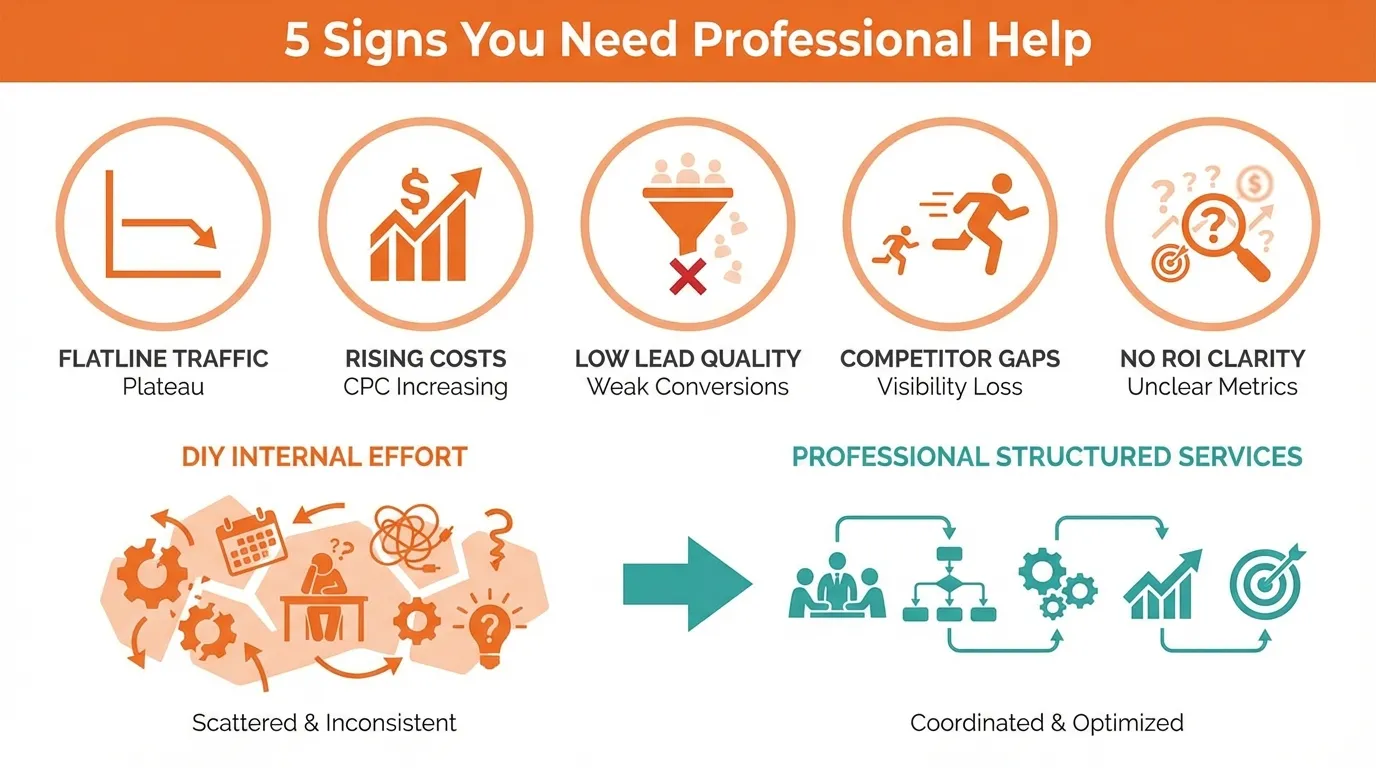
Many businesses attempt to manage digital marketing internally before engaging professional support. While this can work initially, complexity increases as competition intensifies and the number of channels grows.
When growth stalls, the issue is rarely effort. It is structured. Digital marketing requires coordinated planning, performance tracking, and cross-channel optimisation.
Without this, even consistent activity produces inconsistent results. Below are common indicators that structured digital marketing services may be necessary.
Traffic Growth Has Plateaued
If organic visibility has stopped improving despite publishing content or updating pages, deeper structural problems may be at play.
This often signals:
- Weak technical SEO foundations
- Poor keyword targeting strategy
- Insufficient authority signals
- Lack of topic depth compared to competitors
Plateaued traffic suggests activity without strategic leverage.
Advertising Costs Continue Rising
Increasing cost per click, combined with stagnant conversions, indicates declining efficiency.
Common causes include:
- Weak audience segmentation
- Poor Quality Score
- Limited creative testing
- Inefficient bidding strategies
Without advanced optimisation, paid campaigns become progressively less profitable.
Lead Quality Is Inconsistent
High traffic but low conversion quality often reflects targeting misalignment.
This can result from:
- Broad keyword coverage
- Generic messaging
- Weak landing page alignment
- Lack of funnel structuring
Digital marketing services focus not just on traffic volume, but on commercially qualified acquisition.
Competitors Dominate Online Visibility
If competitors consistently outrank your website or outperform you in paid placements, visibility gaps will widen over time.
This usually indicates:
- Stronger authority building
- More comprehensive content coverage
- Better campaign optimisation
- Higher brand recognition across channels
Reclaiming visibility requires a structured competitive strategy.
ROI Tracking Is Unclear
If performance cannot be measured confidently, optimisation becomes guesswork.
Inability to answer questions such as:
- What is your cost per acquisition?
- Which channel generates the highest lifetime value customers?
- Which campaigns are underperforming?
Indicates the need for structured tracking and attribution systems.
Quick Digital Marketing Diagnostic Checklist
If you answer “yes” to three or more of the questions below, structured digital marketing services may be required:
- Has your organic traffic remained flat for 6 months or longer?
- Are your paid advertising costs rising while conversions remain flat?
- Do you lack clarity on which channels generate the best ROI?
- Are competitors consistently outranking you for priority keywords?
- Is your content strategy reactive rather than mapped to search intent?
- Are campaigns managed independently without cross-channel data sharing?
- Is performance reporting focused on impressions rather than revenue?
Digital marketing becomes predictable when it is systemised.
Professional digital marketing services provide:
- Strategic planning across channels
- Measurable accountability
- Integrated optimisation
- Data-driven budget allocation
Growth does not stall because marketing stops. It stalls because marketing lacks structural integration.
Choosing the Right Digital Marketing Services for Sustainable Growth
Digital marketing services are often misunderstood because they are discussed as isolated channels rather than as parts of a cohesive system. The businesses that scale consistently are not the ones that “try marketing tactics.” They are the ones that implement integrated digital marketing systems structured around data, strategy, and measurable outcomes.
When marketing moves from isolated actions to a coordinated strategy:
- Data drives decisions instead of guesswork
- Budgets are allocated where they deliver the highest impact
- Performance becomes predictable rather than reactive
If your traffic has plateaued, acquisition costs are rising, or ROI is unclear, it may be time to shift from fragmented execution to a structured and measurable digital marketing strategy.
At MediaOne, we design and execute performance-driven digital marketing services tailored to your business goals; integrating SEO, SEM, social strategies, and AI optimisation into a unified growth framework that delivers measurable results.
Ready to transform your digital growth? We build a strategic digital marketing system that scales and does not just advertise. Contact us today!
Frequently Asked Questions
How do digital marketing services differ from traditional marketing services?
Digital marketing services focus on online channels such as search engines, social platforms, and paid advertising networks, where performance can be tracked in real time. Traditional marketing relies more on offline media such as print, radio, and television, where measurement and audience targeting are typically less precise.
How long should a business commit to digital marketing services before evaluating results?
Most digital marketing strategies require a minimum commitment of three to six months to generate measurable performance trends. SEO typically requires longer timeframes, while SEM and paid social campaigns can produce data within weeks but still require ongoing optimisation for stability.
Can digital marketing services work for niche or highly specialised industries?
Yes. In fact, niche industries often benefit more because search and paid targeting allow precise audience segmentation. Strategic keyword research and targeted advertising can capture high-intent prospects even in smaller markets.
What metrics should businesses prioritise when evaluating digital marketing services?
Rather than focusing solely on impressions or traffic, businesses should prioritise metrics such as cost per acquisition, conversion rate, customer lifetime value, and return on ad spend. These indicators directly reflect revenue impact rather than surface-level engagement.
Should digital marketing services focus more on branding or performance?
The most effective digital marketing services balance both. Performance campaigns drive measurable leads and sales, while branding efforts build trust, increase click-through rates, and improve long-term conversion efficiency. Over time, strong brand presence reduces overall acquisition costs.