A social media marketing funnel is the structure that guides people from first discovering your brand to considering your offer, converting, and, ideally, returning as repeat customers. Without that structure, many brands end up publishing content consistently but still struggle to connect social media activity to leads, sales, or long-term customer value.

That challenge is especially relevant in Singapore, where social media already plays a major role in how people discover and evaluate brands. Meltwater’s 2025 Singapore social media statistics report states that 66.1% of internet users in Singapore go online to find information, while 95.9% engage with social networks.
The same report also notes that Singapore users spend an average of 34 hours and 29 minutes per month on TikTok and 29 hours and 45 minutes per month on YouTube, which shows how deeply social and video-led platforms are embedded in everyday digital behaviour.
In a landscape shaped by this high level of engagement, simply posting more does not suffice. To truly capitalise on social attention, brands must adopt a system that guides audiences toward meaningful actions.
To address this need, this guide provides a step-by-step walkthrough of the entire funnel—from awareness to conversion and retention—detailing the content types, platform roles, metrics, compliance points, and optimisation steps necessary to make a social media marketing funnel effective in real-world scenarios.
If you are looking to connect social activity with measurable business growth, consider how the social media marketing consultancy of Mediaone can help build a clearer, full-funnel strategy.
Key Takeaways
- A social media marketing funnel helps brands move beyond random posting by giving each stage of social activity a clear purpose. Instead of treating every post the same, businesses can better align content, CTAs, and platforms with audience intent.
- Each stage, awareness, consideration, conversion, and retention, needs a different content strategy. Brands perform better when they avoid expecting one post to achieve every goal.
- Platform choice is crucial because each social channel plays a different role in the funnel. Instagram and TikTok are primarily effective at driving brand discovery because they focus on visual, short-form content.
- Measurement becomes much clearer when social media is structured around a funnel. Tracking stage-specific metrics helps brands understand where attention is building, where users are dropping off, and where optimisation is needed.
- A stronger funnel also improves long-term business value because it does not stop at the first conversion. When brands include retention, remarketing, and customer nurturing in their strategy, social media becomes a more useful and sustainable growth channel.
A social media marketing funnel is the path users follow from first seeing your brand on social platforms to engaging, evaluating, converting, and returning. It applies general funnel logic specifically to social channels, which matters because social media influences discovery, trust, research, remarketing, and post-purchase engagement differently from channels like search or email.
At a practical level, a social media funnel helps you align:
- audience intent
- content type
- platform choice
- campaign objective
- measurement
That alignment matters because different stages need different messages. LinkedIn’s marketing guidance breaks funnel stages into distinct stages because audience needs, content, and objectives change from awareness to conversion. The same post should not be expected to handle every objective.
Quick funnel overview
| Funnel Stage | Social Objective | User Mindset |
| Awareness | Get noticed | I’ve just discovered this brand |
| Consideration | Build trust and interest | I’m evaluating whether this is relevant |
| Conversion | Drive action | I’m ready to take the next step |
| Retention | Keep them engaged | I’ve already converted |
A social media marketing funnel works because not every user is in the same stage of decision-making. Some people are discovering your brand for the first time, while others are comparing options, preparing to act, or deciding whether to stay engaged after conversion.
Each funnel stage has a specific objective. This section defines what each stage should achieve, the typical content, and the most relevant metrics.
Awareness
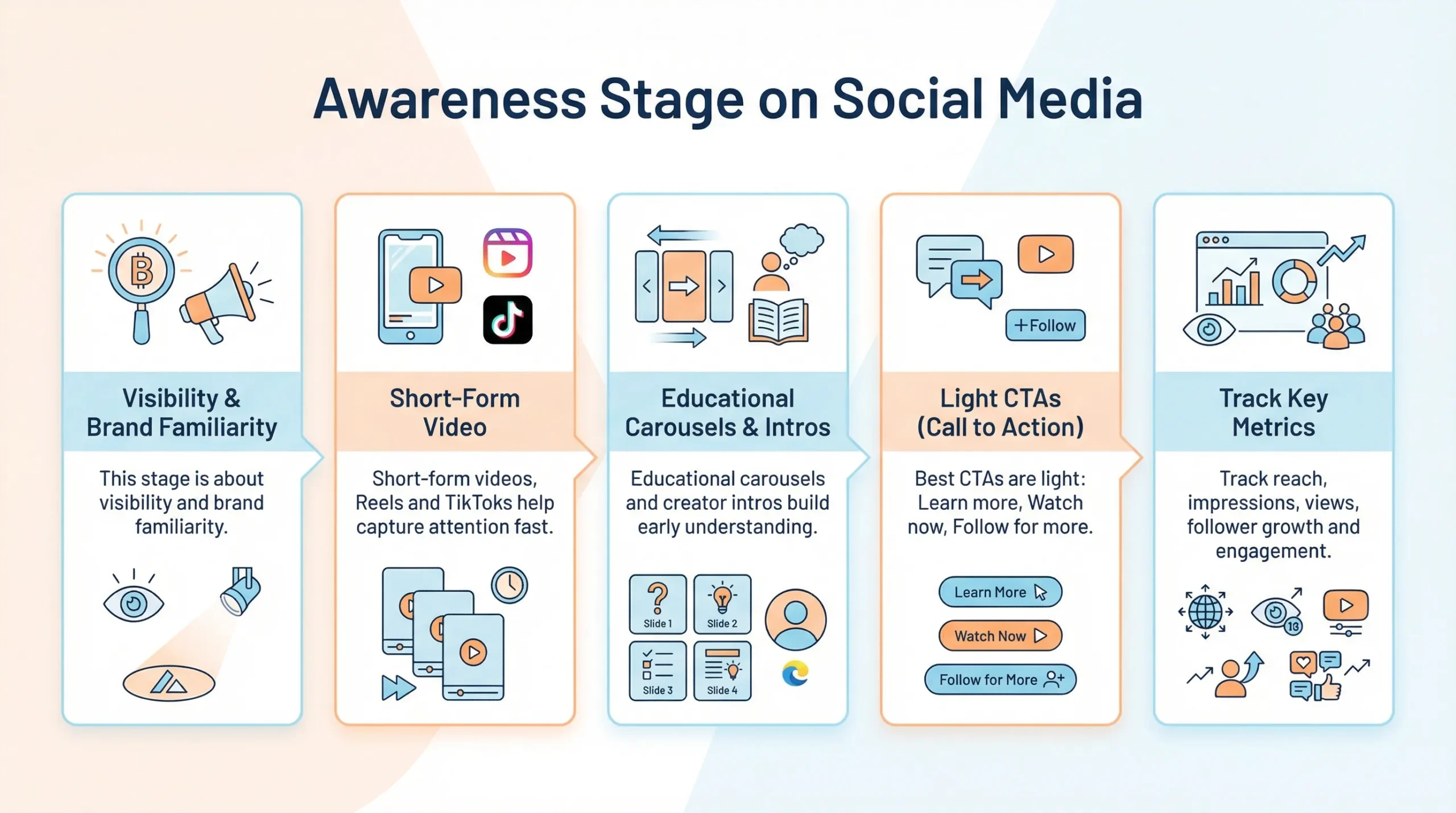
The awareness stage is when people first encounter your brand on social media. At this point, they are usually not ready to buy. They scroll through content, notice what feels relevant, and decide what is worth their attention.
The goal at this stage is visibility and familiarity. You want people to recognise your brand, understand your category, and form a basic impression of what you offer.
Content that often works well at this stage includes:
- short-form videos
- Reels and TikToks
- educational carousels
- creator-led brand introductions
- broad-interest thought leadership
- reach-focused paid ads
Typical CTAs:
- Learn more
- Watch now
- Follow for more
- Discover more
Metrics to watch:
- reach
- impressions
- video views
- follower growth
- engagement rate
Common mistake: Asking for a hard conversion too early. At this stage, the audience usually needs a reason to notice the brand before they are ready to take action.
Consideration
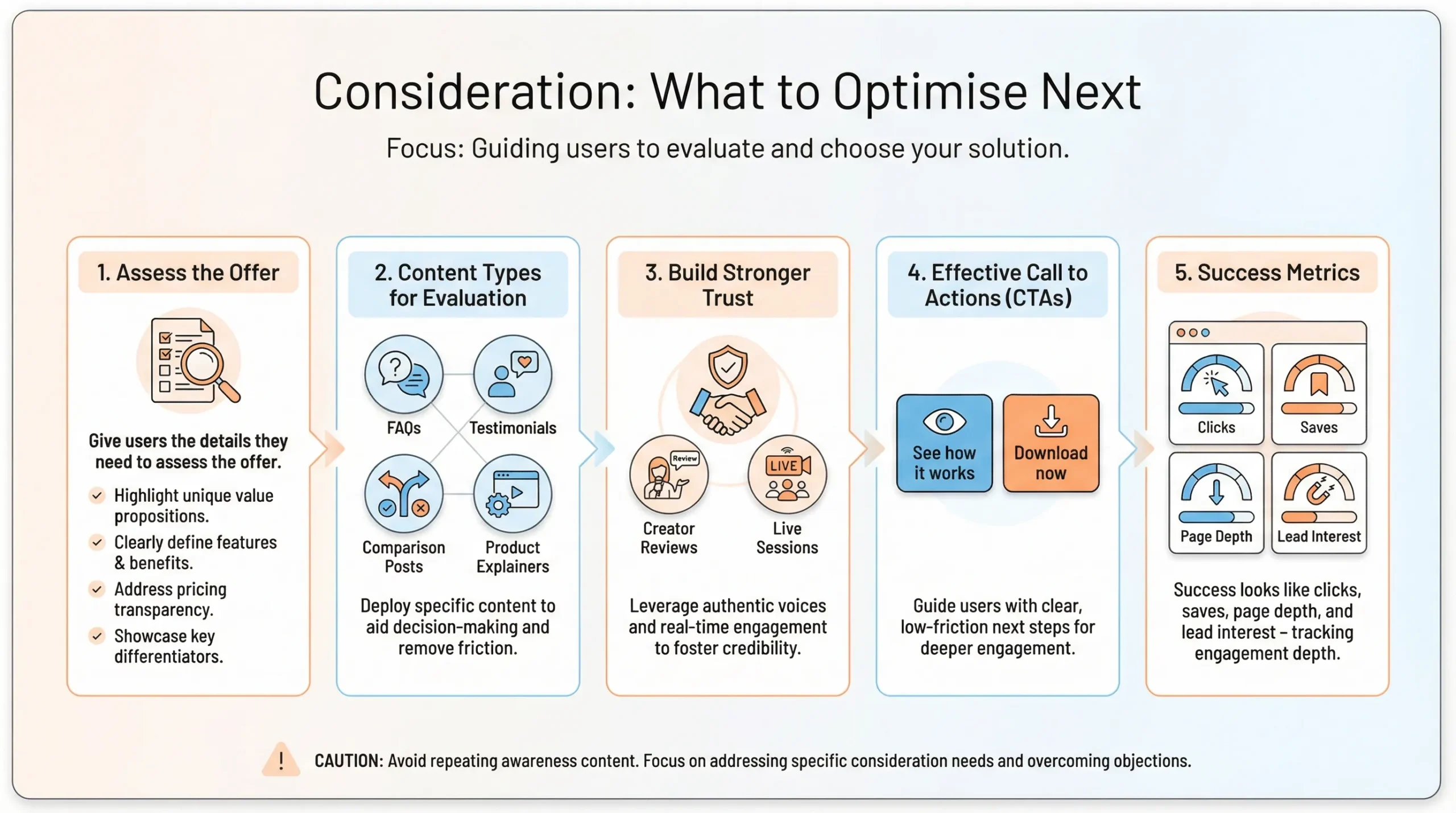
The consideration stage is where users begin evaluating your offer more seriously. They may visit your profile, save a post, compare features, read reviews, or spend more time with your content.
The goal here is to turn awareness into active interest. The audience already knows you exist. What they need now is more information, more proof, and more clarity about why your offer may be right for them.
Content that often works well at this stage includes:
- FAQs
- testimonials
- case studies
- comparison posts
- creator reviews
- webinars and live sessions
- product explainers
- lead magnets
Typical CTAs:
- See how it works
- Read the full guide
- Compare options
- Download now
Metrics to watch:
- link clicks
- profile visits
- saves
- landing page visits
- time on page
- lead form opens
Common mistake: Repeating awareness content without giving users the details they need to evaluate the offer properly.
Conversion
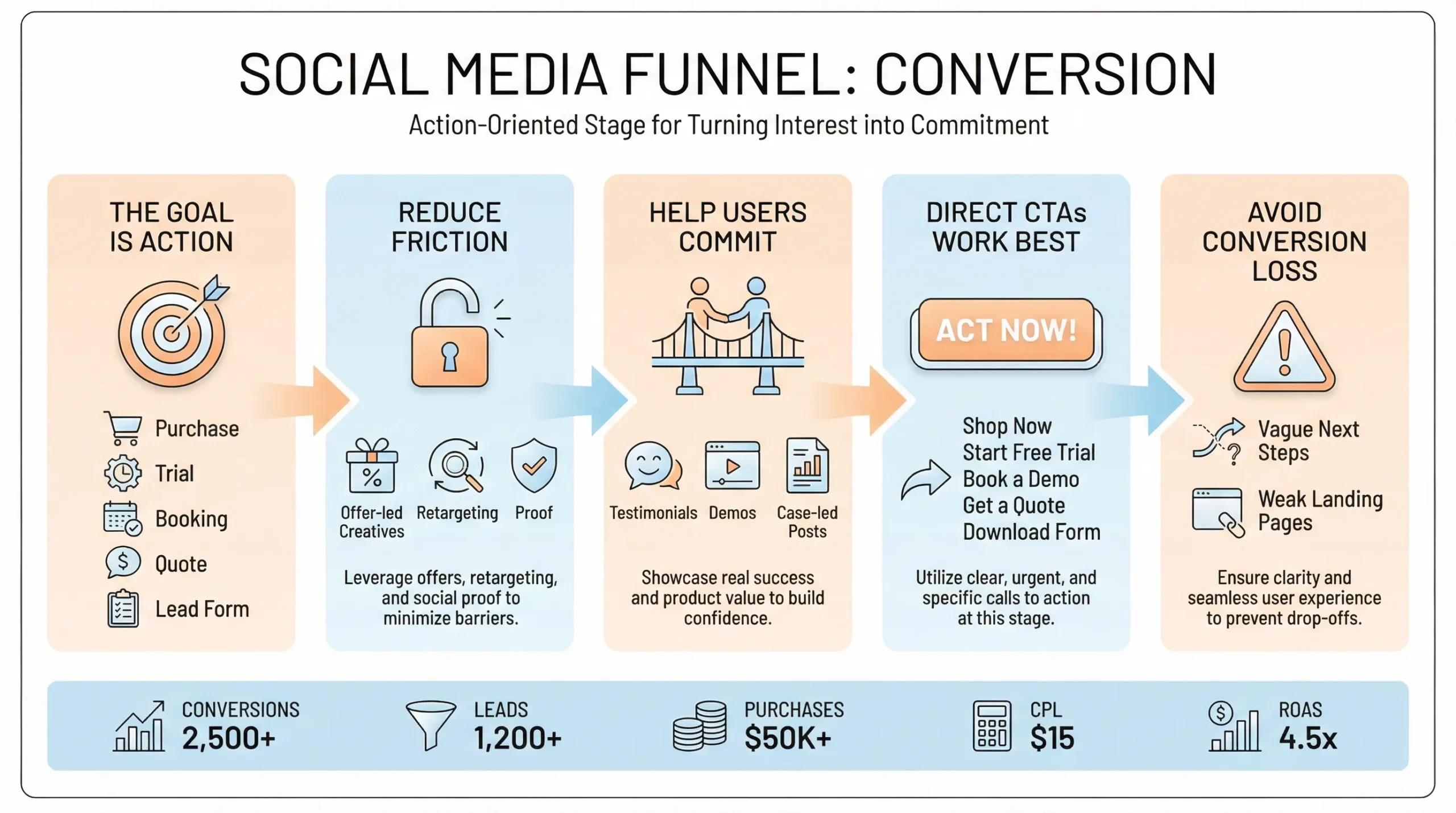
The conversion stage is where the brand asks the audience to take a clear next step. Depending on the business, that could mean making a purchase, booking a consultation, signing up for a trial, requesting a quote, or submitting a lead form.
The goal here is action. By this point, the user usually has enough familiarity and interest to respond to a more direct offer.
Content that often works well at this stage includes:
- retargeting ads
- offer-led creatives
- testimonials with clear proof
- product demos
- case-study-led landing page posts
- lead generation forms
- urgency-based promotions
Typical CTAs:
- Book now
- Buy now
- Get a quote
- Start your trial
Metrics to watch:
- conversions
- leads
- purchases
- cost per lead
- cost per acquisition
- conversion rate
- return on ad spend
Common mistake: Using weak landing pages or vague CTAs that make the next step less clear than it should be.
Retention and Loyalty
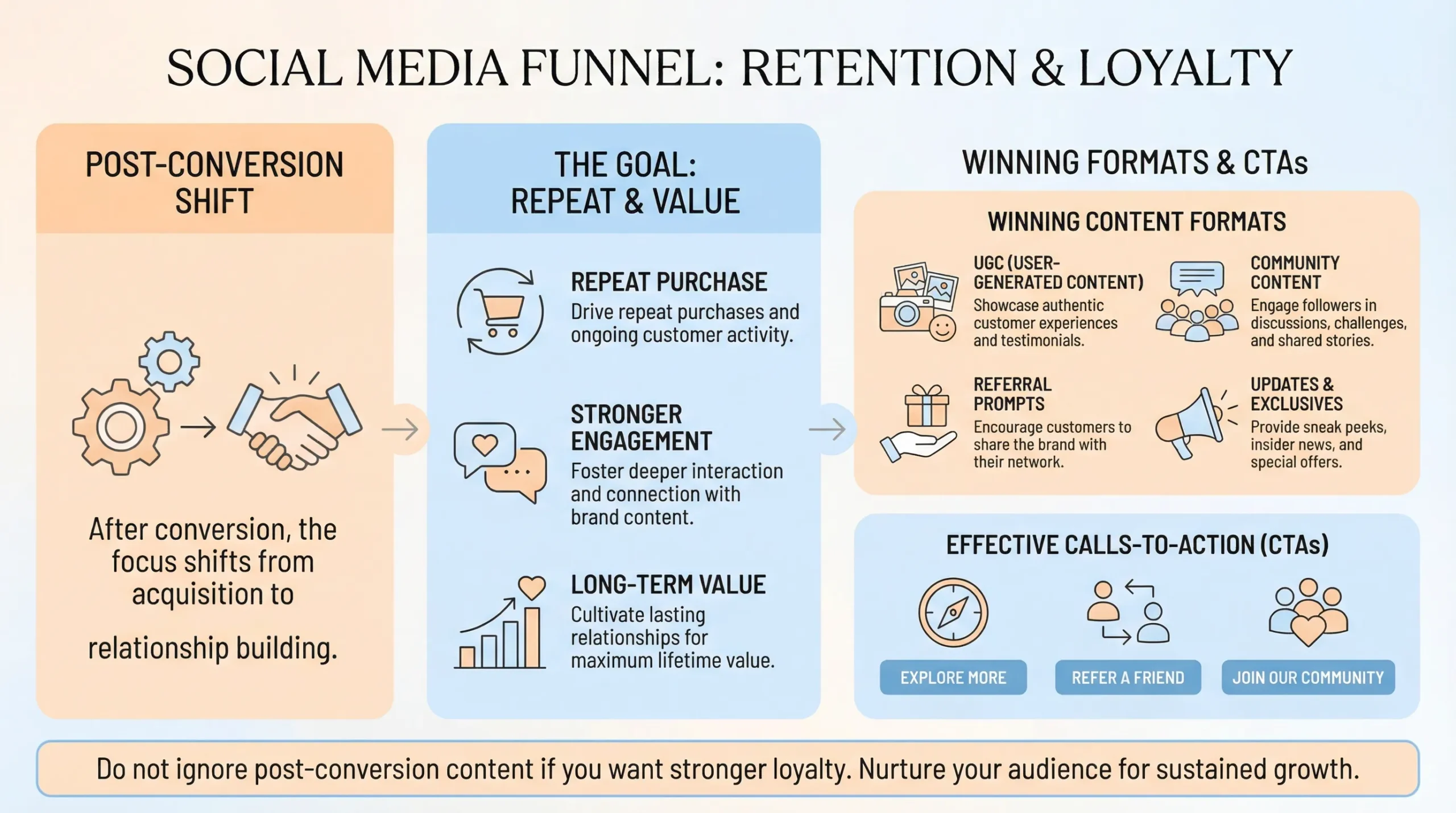
The retention and loyalty stage begins after the first conversion. This is where brands aim to keep customers engaged, encourage repeat purchases, and strengthen long-term value.

The goal here is to maintain the relationship and increase customer value over time. Social media can still play an important role after conversion by helping customers stay connected to the brand.
Content that often works well at this stage includes:
- onboarding content
- customer education
- loyalty offers
- community content
- remarketing creatives
- user-generated content
- referral prompts
- feature updates
Typical CTAs:
- Come back
- Refer a friend
- Explore more
- Join our community
Metrics to watch:
- repeat purchase rate
- retention rate
- customer lifetime value
- loyalty programme engagement
- repeat site visits
- social mentions
Common mistake: Treating social media only as an acquisition channel and overlooking what happens after the first conversion.
Stage summary
Each stage of the social media marketing funnel has a different job:
- Awareness helps people notice your brand
- Consideration helps them evaluate it
- Conversion helps them act
- Retention and loyalty help them stay engaged
This distinction matters because social performs better when content aligns with user intent—do not expect every post to achieve every outcome.
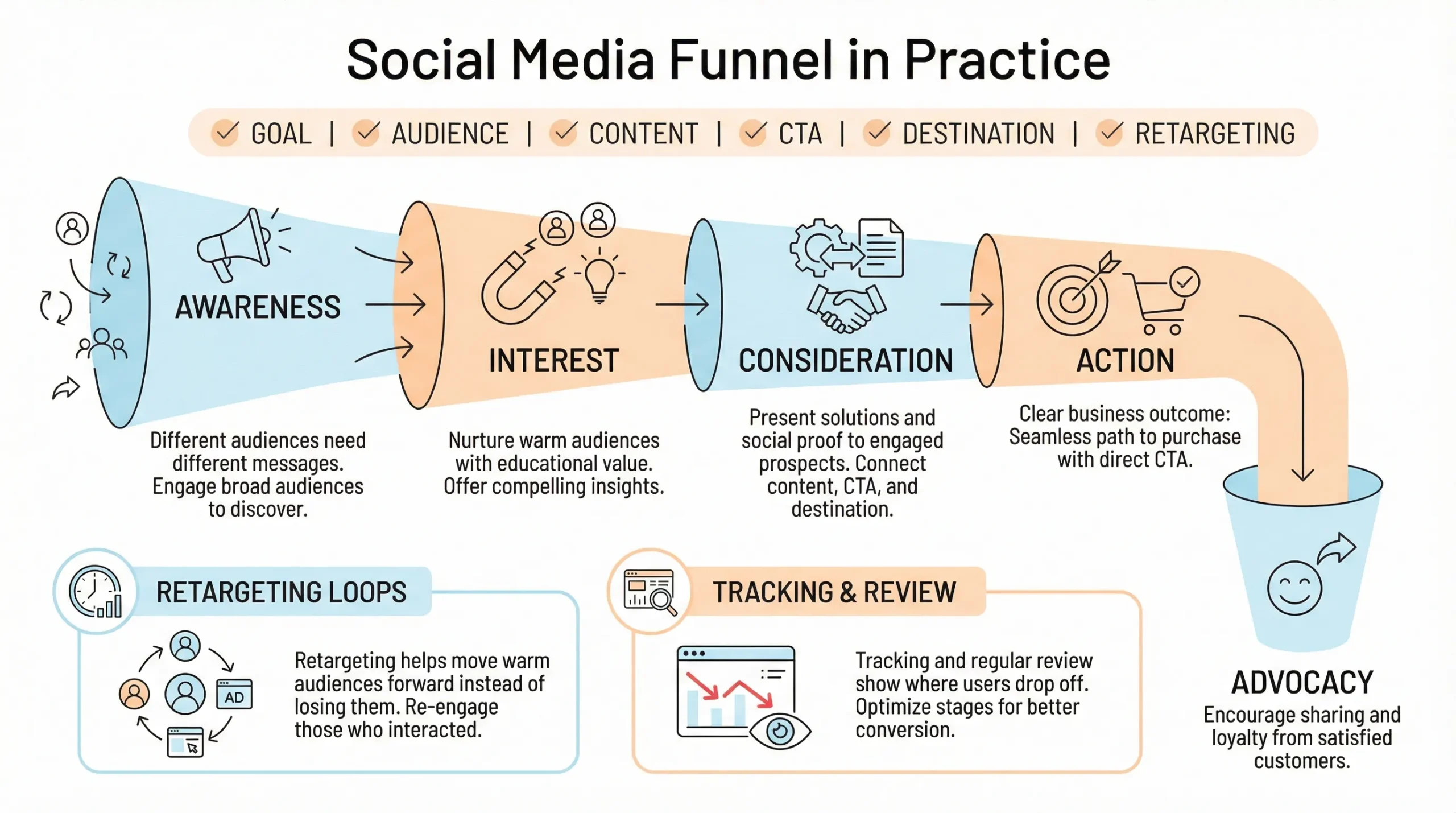
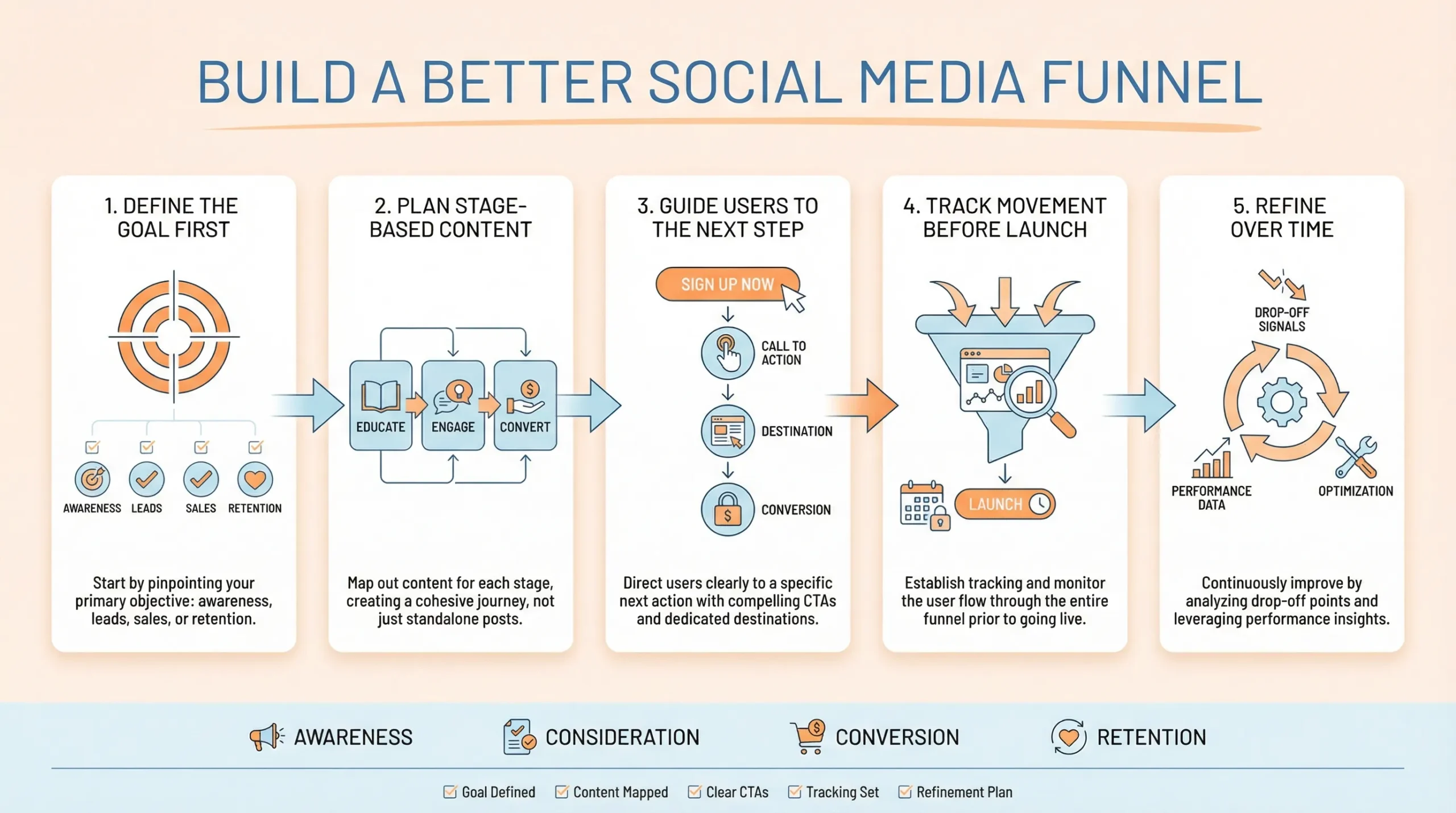
Building a social media marketing funnel means creating a clear path that moves users from discovery to action and, ideally, long-term engagement. The goal is not to post more content. It is to make sure each part of your social media activity supports a specific stage of the customer journey.
- Start with a clear business goal: Before building the funnel, define what success looks like. Your goal might be to increase brand awareness, generate leads, drive purchases, or improve retention. A funnel works best when each stage supports a clear business outcome rather than a vague idea of ‘doing better on social media’.
- Map your audience to each funnel stage: Different users need different things at different points in the journey. Cold audiences need a reason to notice your brand, while warmer audiences need more proof, clarity, or reassurance before taking action. Existing customers need a different kind of content again if the aim is retention or repeat engagement.
- Match content to the right stage: Each funnel stage needs content that fits its purpose. Awareness content should introduce the brand and attract attention. Consideration content should help users evaluate the offer. Conversion content should remove friction and encourage action. Retention content should keep customers engaged after the first conversion.
- Build a clear path to the next step: A funnel only works when users know what to do next. That means your content, CTA, and destination should feel connected. If a social post creates interest but the next step is unclear, too aggressive, or irrelevant, users are more likely to drop off.
- Put tracking in place early: Plan it before the campaign goes live, not after. If you want to understand how users move through the funnel, you need a way to measure what happens after they engage with your content. That usually means setting up clear KPIs, campaign links, and conversion tracking from the start.
- Use retargeting to move warm audiences forward: Not everyone will convert on the first interaction. A good social media marketing funnel includes a way to re-engage people who watched, clicked, visited, or engaged but did not take the next step. Retargeting helps keep warm audiences moving instead of losing them between stages.
- Review and refine the funnel over time: A funnel should not stay static. Audience behaviour changes, creative fatigue, and some stages will usually perform better than others. Reviewing the funnel regularly helps you spot where users are dropping off and where content or CTAs need improvement.
Short case snapshot: MediaOne x National Kidney Foundation
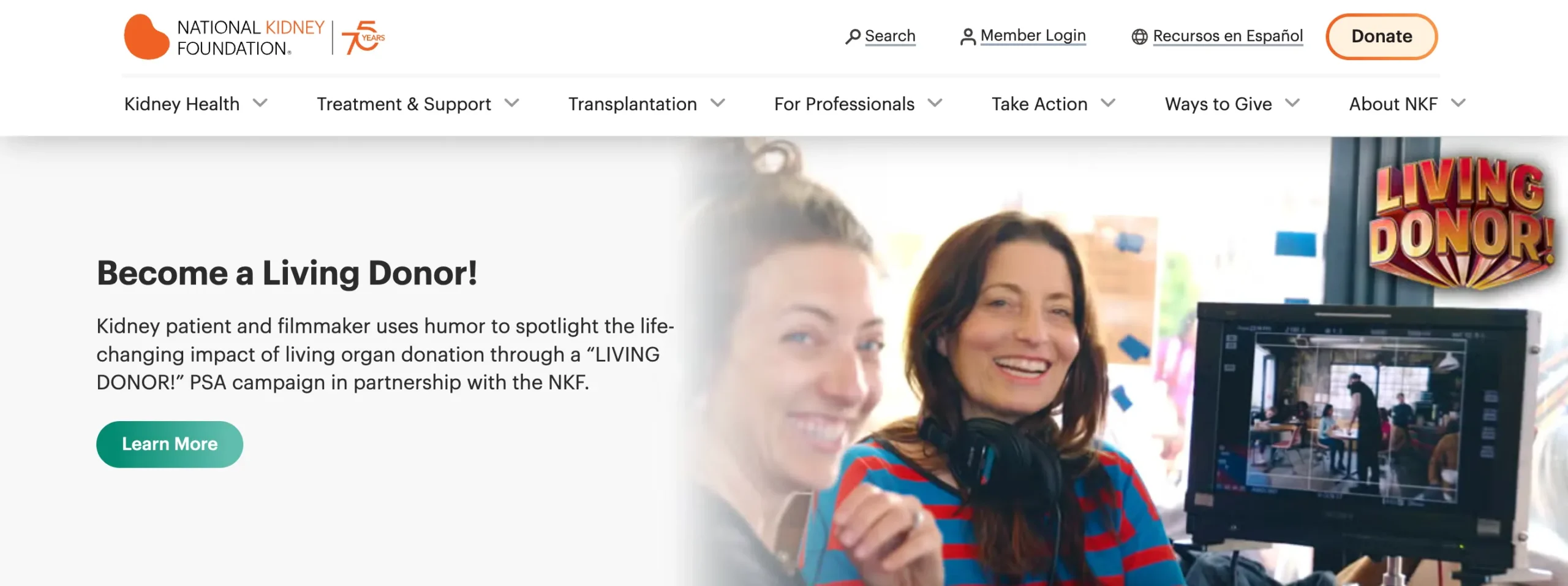
Image Credit: https://www.kidney.org/
A practical example of this in action can be seen in MediaOne’s work for the National Kidney Foundation (NKF). According to MediaOne’s published social media case study, the objective was to increase the organisation’s social media presence and public engagement.
The strategy combined informative, high-value content, improved posting cadence and format, and targeted amplification to strengthen awareness and engagement. MediaOne reports that this delivered 45,469 total engagements, 305,410 total reach, and a 20% increase in followers.
This is a useful reminder that a social media marketing funnel does not only apply to direct sales. It can also be used to improve reach, engagement, and audience growth when the funnel is aligned to the right objective.
Social media marketing funnel checklist
Use this as a quick check before launching:
- The business goal is clearly defined
- The target audience is mapped to each stage
- Content has been planned for every stage of the funnel
- Each post has a clear next step
- Tracking is in place before launch
- Retargeting is included where relevant
- Funnel performance will be reviewed regularly
This is what turns a social media presence into a social media marketing funnel. Instead of treating every post as a standalone effort, the brand creates a more deliberate journey from awareness to conversion and beyond.
Platform-by-Platform Funnel Strategy
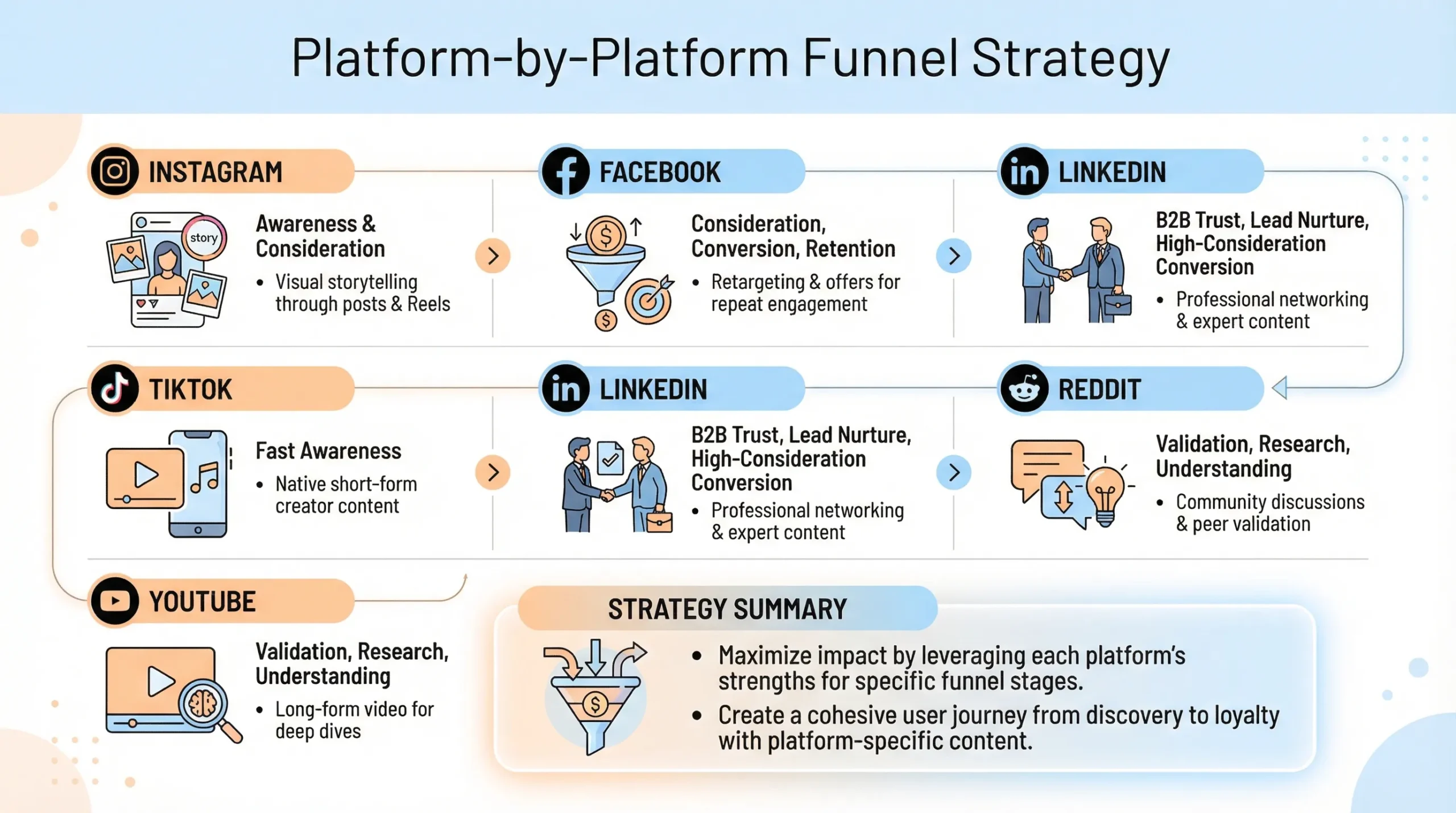
Not every platform plays the same role in a social media marketing funnel. Some are stronger for discovery and awareness, while others are better at nurturing interest, driving conversions, or supporting retention.
The key is to use each platform in line with how people typically behave on it, rather than expecting every channel to do everything equally well.
Instagram is often strongest at the awareness and consideration stages. It works well for visual storytelling, creator partnerships, product discovery, and content that helps users get familiar with a brand.
Best used for:
- Reels and short-form discovery content
- creator-led brand awareness
- visual product education
- social proof through Stories, highlights, and carousels
Best funnel role:
Introducing the brand, building familiarity, and encouraging users to explore further.
Facebook is often most useful at the consideration, conversion, and retention stages. It remains a strong channel for retargeting, offer-led content, lead generation, and community engagement, especially when paired with Meta Ads.
Best used for:
- retargeting warm audiences
- lead generation campaigns
- conversion-focused offers
- community updates and remarketing content
Best funnel role:
Helping users move from interest to action, and keeping existing audiences engaged after conversion.
TikTok
TikTok is strongest at the awareness stage, but it can also influence consideration and early conversion when the content feels native to the platform. It works well for fast attention, trend-led discovery, and creator content that feels natural rather than heavily polished.
Best used for:
- short-form video discovery
- creator-led storytelling
- product demonstrations with personality
- culturally relevant and trend-aware content
Best funnel role:
Generating awareness quickly and creating early interest through engaging, platform-native content.
LinkedIn is usually most effective at the awareness, consideration, and conversion stages for B2B brands. It is well-suited to thought leadership, professional credibility, lead nurturing, and lead generation.
Best used for:
- thought leadership posts
- industry insights
- webinars and lead magnets
- lead generation forms
- case-study content for decision-makers
Best funnel role:
Building trust with professional audiences and supporting lead generation for higher-consideration B2B offers.
YouTube
YouTube is often strongest at the awareness and consideration stages, especially for brands that need more time or depth to explain their offer. Longer-form video gives brands more room to educate, demonstrate, and build trust.
Best used for:
- product explainers
- customer stories
- tutorials
- long-form educational content
- deeper brand storytelling
Best funnel role:
Helping users understand the offer in more detail and building confidence before conversion.
Reddit is often most useful during the consideration and validation stages, especially when users are actively researching, comparing options, or seeking opinions before making a decision.
It works well for brands in categories where trust, peer discussion, and community-based discovery play a bigger role in the buying journey.
Best used for:
- community-based discussions
- promoted posts that match user intent
- educational content for research-heavy topics
- AMAs and discussion-led engagement
- trust-building content around products or services
Best funnel role:
Helping users validate their choices, explore real discussions, and build confidence before taking action.
Platform summary
| Platform | Strongest Funnel Stage | Best Use Case |
| Awareness, consideration | Visual storytelling, creator content, product discovery | |
| Consideration, conversion, retention | Retargeting, lead generation, offers, and remarketing | |
| TikTok | Awareness, early consideration | Discovery, trend-led content, creator storytelling |
| Awareness, consideration, conversion | B2B thought leadership, lead generation, case studies | |
| YouTube | Awareness, consideration | Education, demonstrations, long-form trust-building |
| Consideration, validation | Product research, peer discussion, trust-led decision-making |
A strong social media marketing funnel does not treat every platform the same way. It uses each channel according to the role it plays best, then connects those roles into a clearer path from awareness to conversion and beyond.
Best Content Types for Each Funnel Stage
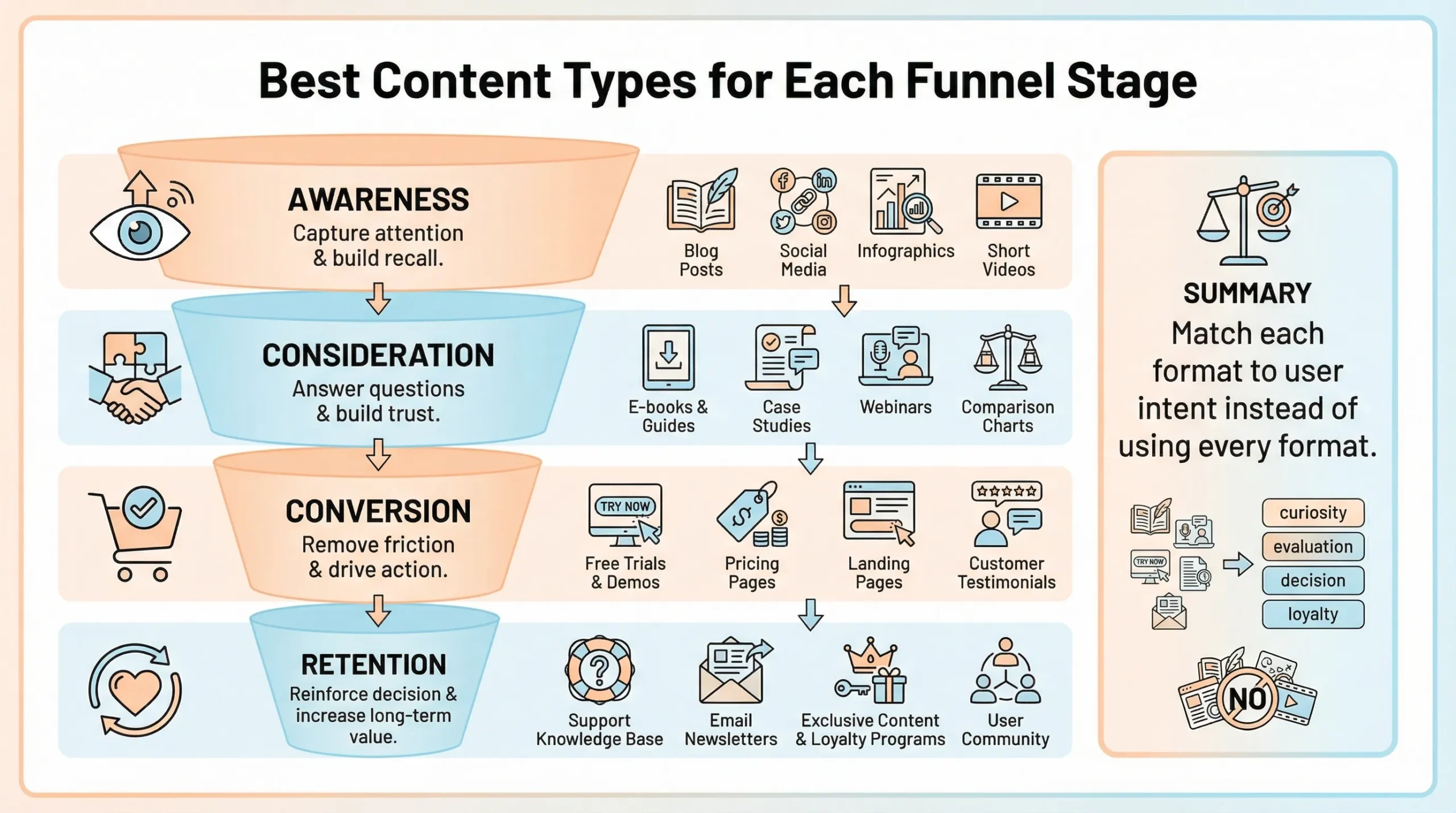
A social media marketing funnel works best when the content matches the user’s mindset at each stage. The goal is not to use every format available. It is to choose the type of content that makes the most sense for what the audience needs next.
Awareness content
At the awareness stage, content should quickly capture attention and introduce the brand in a way that feels easy to engage with. People at this stage are usually not looking for detailed explanations yet, so the content needs to be clear, relevant, and easy to consume.
Content types that often work well:
- short-form video
- Reels and TikToks
- educational carousels
- creator-led introductions
- broad-interest thought leadership
- top-of-funnel paid ads
What this content should do:
- create visibility
- spark curiosity
- make the brand easier to remember
Consideration content
At the consideration stage, content should help users evaluate whether the offer is worth exploring further. This is where detail, clarity, and proof become more important.
Content types that often work well:
- FAQs
- testimonials
- case studies
- comparison posts
- creator reviews
- product explainers
- live sessions or webinars
- lead magnets
What this content should do:
- answer questions
- reduce uncertainty
- build trust
Conversion content
At the conversion stage, content should clearly outline the next step. The focus here is not just on attention or interest, but on helping the user act with confidence.
Content types that often work well:
- retargeting ads
- offer-led creatives
- testimonials with clear proof
- product demos
- landing page-led posts
- lead generation forms
- urgency-based promotions
What this content should do:
- remove friction
- reinforce value
- make the next action feel clear and worthwhile
Retention content
At the retention stage, content should help maintain the relationship after the first conversion. This is where brands can encourage repeat engagement, repeat purchases, and stronger loyalty.
Content types that often work well:
- onboarding content
- customer education posts
- loyalty offers
- community content
- user-generated content
- referral prompts
- remarketing creatives
- feature updates
What this content should do:
- reinforce the customer decision
- keep the relationship active
- increase long-term value
Funnel content summary
| Funnel Stage | Goal | Best Content Types |
| Awareness | Get noticed | Short-form video, Reels, educational carousels, creator content |
| Consideration | Build interest and trust | FAQs, testimonials, case studies, comparisons, explainers |
| Conversion | Drive action | Retargeting ads, demos, offer-led creatives, lead forms |
| Retention | Encourage repeat engagement | Onboarding, loyalty content, UGC, referrals, updates |
The more closely your content aligns with the role of each stage, the easier it is for your social media marketing funnel to move users from first impression to meaningful action.
A social media marketing funnel is only useful if you can see how people move through it. Measuring performance helps you understand whether your content is attracting attention, building interest, driving action, and supporting long-term value.
The key is to measure each stage according to its purpose. If you use the same metric across the whole funnel, the data quickly becomes misleading.
A high-reach awareness campaign, for example, should not be judged the same way as a retargeting campaign built to generate leads or sales.
Measure awareness by visibility
At the top of the funnel, the goal is to get noticed. The most useful metrics are the ones that show how far your content is spreading and how often people are seeing it.
Typical awareness metrics include:
- reach
- impressions
- video views
- follower growth
- engagement rate
These metrics help you assess whether your content is creating visibility and attracting initial attention.
Measure consideration by engagement quality and intent
At the consideration stage, the audience shows greater interest. The most useful metrics here are those that indicate people are spending more time with your content or taking small steps toward evaluating your offer.
Typical consideration metrics include:
- link clicks
- profile visits
- saves
- landing page visits
- time on page
- lead form opens
These metrics indicate whether your content is creating enough interest for users to explore further.
Measure conversion by action
At the conversion stage, the focus shifts from attention to outcome. This is where the most commercially important metrics usually sit.
Typical conversion metrics include:
- leads
- purchases
- conversions
- conversion rate
- cost per lead
- cost per acquisition
- return on ad spend
These metrics help you see whether the funnel is actually turning social media activity into measurable business results.
Measure retention by repeat value
At the bottom of the funnel, performance should be measured by whether customers continue engaging after the first conversion.
Typical retention metrics include:
- repeat purchase rate
- retention rate
- customer lifetime value
- loyalty programme engagement
- repeat site visits
- social mentions
These metrics show whether the brand is keeping customers active rather than treating social media solely as an acquisition tool.
Use the right tracking setup
To measure a funnel properly, brands need more than platform-level metrics. A useful setup usually includes:
- UTM-tagged links
- platform pixels or tags
- conversion events
- landing page tracking
- stage-specific KPI reporting
Without these in place, it becomes much harder to understand where users are dropping off or which part of the funnel is doing the most work.
Keep the data in context
A common mistake is judging the entire funnel through a single lens. Awareness should not be judged only by direct conversions, and conversion content should not be assessed only by likes or impressions.
Each part of the funnel needs to be measured according to the job it is meant to do.
Funnel performance summary
| Funnel Stage | Key Metrics | What They Show |
| Awareness | Reach, impressions, video views, follower growth | Visibility and early attention |
| Consideration | Clicks, saves, profile visits, and landing page visits | Interest and evaluation |
| Conversion | Leads, purchases, conversion rate, CPA, ROAS | Action and business outcome |
| Retention | Repeat purchases, retention rate, loyalty engagement, LTV | Long-term value and repeat engagement |
A strong social media marketing funnel becomes much easier to optimise once you can clearly see how each stage is performing. Instead of guessing what is working, you can identify where attention is building, where interest is deepening, and where users are dropping off before they convert.
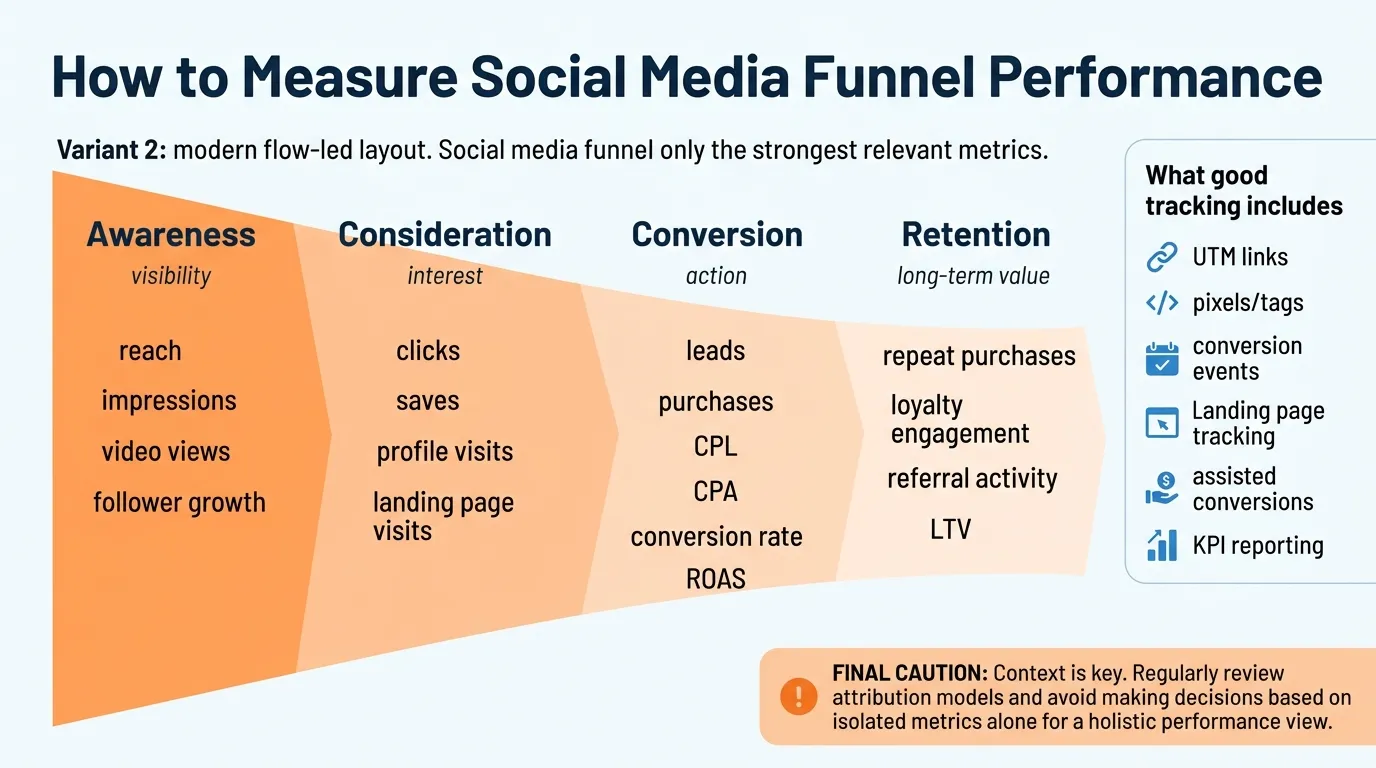
A funnel is only useful if you know where it is working and where it is leaking.
| Funnel Stage | Key Metrics | What They Indicate |
| Awareness | Reach, impressions, video views, follower growth | Visibility and exposure |
| Consideration | Clicks, saves, profile visits, and landing page visits | Interest and evaluation |
| Conversion | Leads, purchases, CPL, CPA, conversion rate, ROAS | Commercial action |
| Retention | Repeat purchases, loyalty engagement, referral activity, LTV | Long-term value |
What a good tracking setup should include
- UTM parameters on campaign links
- platform pixels or tags
- conversion events
- landing page tracking
- assisted conversion visibility
- stage-specific KPI reporting
Practical measurement rules
- Do not judge awareness creative by conversion rate alone
- Do not treat engagement as a final business outcome
- Do not ignore assisted conversions from social traffic
- Do not stop measurement after the first purchase
This is where many brands under-measure funnel performance. They track vanity metrics at the top and direct conversions at the bottom, but miss the movement in between.
Compliance and Regulatory Considerations
A social media marketing funnel is not only a performance framework. It also touches sponsored content, customer data, and regulated messaging.
In Singapore, the ASAS Guidelines on Interactive Marketing Communication and Social Media state that the guidance applies to advertising and marketing communication using social media to promote goods and services or influence consumer behaviour. If your funnel uses creator content, offer-led campaigns, lead forms, or persuasive social ads, that guidance is relevant.
If your funnel captures personal data through forms, sign-ups, giveaways, or lead ads, the Personal Data Protection Act matters too. PDPC states that the PDPA establishes a baseline standard of protection and governs the collection, use, disclosure, and care of personal data in Singapore.
When compliance matters most
- creator-led campaigns
- lead generation forms
- giveaways and contests
- remarketing audiences
- regulated sectors such as finance and healthcare
Quick compliance checklist
Before launching a funnel-based social campaign, check that:
- sponsored content is recognisable as marketing communication
- claims are accurate and supportable
- lead capture follows a clear data-handling process
- approvals are assigned clearly within the team
- regulated sectors have extra compliance review built in
For brands that want a more structured approach to full-funnel social planning, working with a social media marketing consultancy can help align strategy, execution, and compliance more clearly.
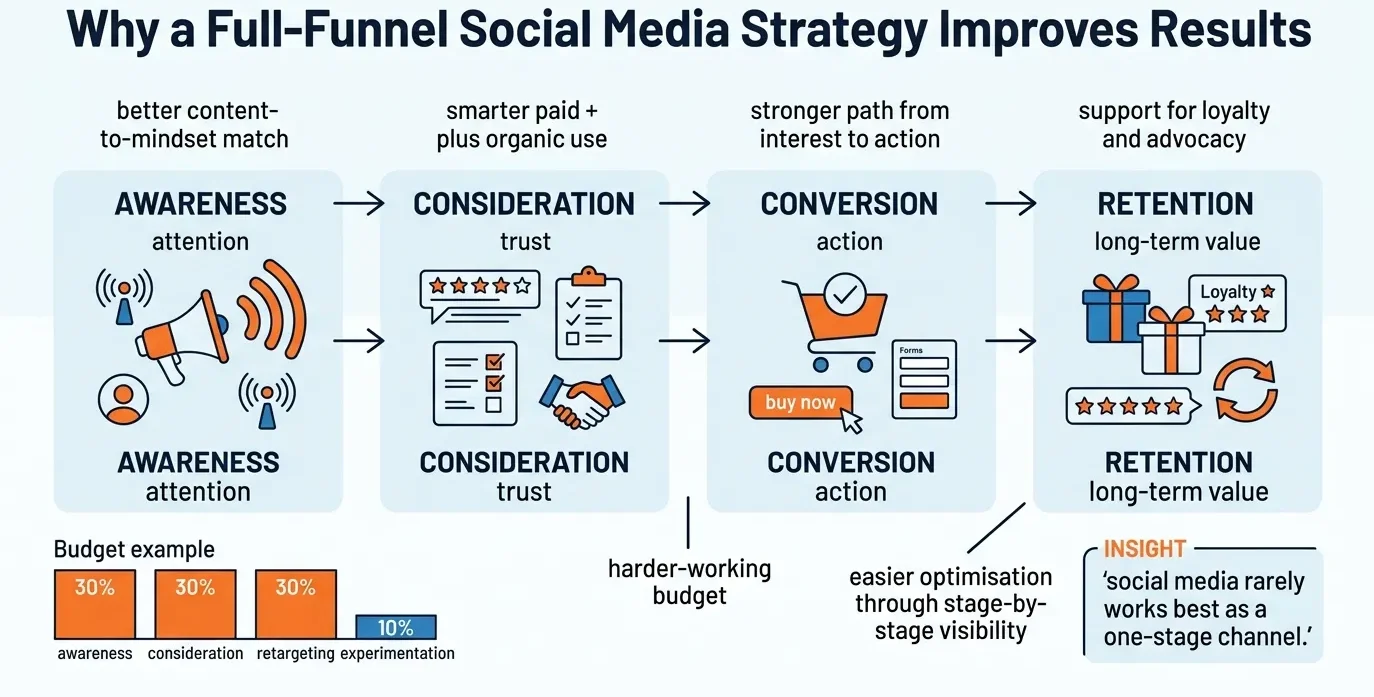
A full-funnel social media strategy usually improves results because it gives each part of your social activity a clearer job. Instead of treating every post as if it should drive the same outcome, it helps you align content, targeting, and budget to where the audience actually is in the journey.
In practice, that means a stronger funnel helps brands:
- Match the right content to the right user mindset: Awareness content can focus on visibility and discovery, while consideration and conversion content can focus more on proof, trust, and action.
- Use paid and organic more strategically: Organic content can support reach, trust, and community-building, while paid social can help scale visibility, retarget warm audiences, and drive more direct actions.
- Create stronger paths from interest to action: A full-funnel structure makes it easier to guide users from a first impression to deeper engagement, then towards a clearer CTA when they are ready.
- Improve spend efficiency: Budget tends to work harder when distributed across different funnel stages rather than concentrated on top-of-funnel reach or bottom-of-funnel conversion activity.
- Support retention, not just acquisition: A stronger strategy does not stop at the first lead or purchase. It also creates room for remarketing, loyalty, repeat engagement, and customer advocacy.
- Make performance easier to understand and optimise: When each stage has a distinct purpose, it becomes easier to identify where users are progressing, where they are dropping off, and where content or targeting needs adjustment.
This matters because social media rarely works best as a one-stage channel. Awareness may bring attention, but consideration builds trust, conversion drives action, and retention protects long-term value.
When those stages are planned together, brands usually get a clearer and more efficient path from reach to revenue.
LinkedIn’s latest small and scaling business guide even illustrates one full-funnel budgeting model: 30% awareness, 30% consideration, 30% retargeting, and 10% experimentation. The exact split will vary by business, but the principle is useful: funnel planning gives brands more control over how social media supports growth.
A social media marketing funnel gives brands a more practical way to connect social activity to real business outcomes. Instead of expecting every post to do the same job, it helps marketers match the right content, platform, and CTA to the right stage of audience intent.
That matters because awareness alone is not enough. The brands that tend to perform better on social media are usually those that build a progression from discovery to consideration, conversion, and retention.
When the funnel is clear, social media becomes easier to optimise, easier to measure, and far more useful as a growth channel.
If your business wants a more structured way to turn social activity into leads, sales, and long-term customer value, MediaOne can help. Contact our experts to build a stronger full-funnel strategy for your brand.
Frequently Asked Questions
How do I measure a social media marketing funnel?
Track different KPIs at different stages. Awareness usually uses reach and impressions; consideration uses clicks and engagement quality; conversion uses leads or sales; and retention uses repeat engagement or repeat purchases.
Which social media platforms work best for each funnel stage?
It depends on the business, but Instagram and TikTok often help with awareness, Meta can be strong for retargeting and conversion, LinkedIn is useful for B2B lead generation, and YouTube often supports deeper education and trust-building.
Do I need paid ads for a social media marketing funnel?
Not always, but paid social becomes very useful when you want to scale reach, retarget warm audiences, or drive more predictable conversion outcomes. Organic and paid usually work better together than in isolation.
How do I turn social media engagement into conversions?
Move users from engagement into stronger consideration content, then into direct CTAs such as demos, offers, lead forms, landing pages, or retargeting ads. Engagement only becomes commercially useful when the next step is built into the funnel.
What are the most common social media funnel mistakes?
Using the same content at every stage, focusing only on reach, weak retargeting, poor CTA alignment, incomplete tracking, and ignoring retention after conversion are some of the most common problems.
How often should I review and optimise my funnel?
At a minimum, review it monthly. For paid campaigns or faster-moving funnel activity, weekly checks are usually more useful. If you want, I can next give you a tighter meta title, a few better meta description options, and a final pass for keyword placement.