A few years ago, I was sitting across from the founder of a home renovation company in Singapore. They had just committed S$15,000 to a macro-influencer campaign and expected their phones to ring off the hook within a week.
Six weeks later, the campaign had generated some beautiful content, a reasonable spike in follower count, and almost no qualified leads.
“Should I just run paid ads instead?” he asked me.
It is a fair question, and one I hear constantly. It is also the wrong question if you want the right answer.
The real issue is not whether influencer marketing is “better” than paid social ads. It is whether your business needs trust, speed, targeting precision, creative assets, or some combination of all four. In Singapore, that decision matters even more because the market is small, competitive, digitally mature, and prone to faster audience saturation than larger countries.
Singapore’s total population stood at 6.11 million as of June 2025, which means inefficient targeting and tired creative ideas are quickly exposed in a compressed market.
Most articles treat influencer marketing vs paid ads as an either-or debate. They list advantages, disadvantages, maybe throw in a comparison table, and leave you to make the call yourself.
That is not how experienced teams make this decision.
What follows is a more commercially useful framework for Singapore businesses: what each channel is structurally good at, where each one tends to fail, how the economics really work, and why the strongest influencer marketing agency strategy in Singapore in 2026 is often not to choose one side at all, but to build an integrated stack.
Key Takeaways
- Influencer marketing is strongest when your business needs borrowed credibility, native content, and access to niche communities.
- Paid social ads are strongest when you need speed, targeting control, and scalable distribution.
- In Singapore, this decision is more complex because platform behaviour, audience saturation, and cost volatility differ from larger Western markets.
- The most effective strategy is often hybrid: use creator content to build trust and feed the paid system with better creative.
- The right channel mix depends on your business stage, budget, offer maturity, and the speed at which you need results.
What Is Influencer Marketing vs Paid Ads?
Influencer marketing is the practice of partnering with creators who have built an audience on platforms like Instagram, TikTok, YouTube, LinkedIn, and Xiaohongshu, then using their content and credibility to introduce your brand to that audience.
Paid social advertising is the practice of paying platforms such as Meta, TikTok, LinkedIn, or Google Display to distribute your message directly to a defined audience based on demographic, behavioural, professional, or retargeting signals.
At a surface level, they can look similar. Both show up in a feed. Both can include a call to action. Both can be part of a campaign launch.
But the mechanism is fundamentally different.
With influencer marketing, the audience encounters your brand through a person they already follow. That means the relationship starts with at least some degree of familiarity and trust.
With paid ads, you are renting attention directly from the platform. You control the targeting, message, budget, and timing, but the relationship begins cold.
That distinction matters because these channels solve different problems. Influencer marketing reduces scepticism. Paid social reduces invisibility.
Why This Decision Is Different in Singapore
Singapore is not just another market where global best practices can be copied and pasted.
It is a dense, high-competition digital environment where audiences overlap, creativity burns out faster, and media inefficiency becomes expensive quickly. The local platform mix also differs from many US- or UK-centric guides.
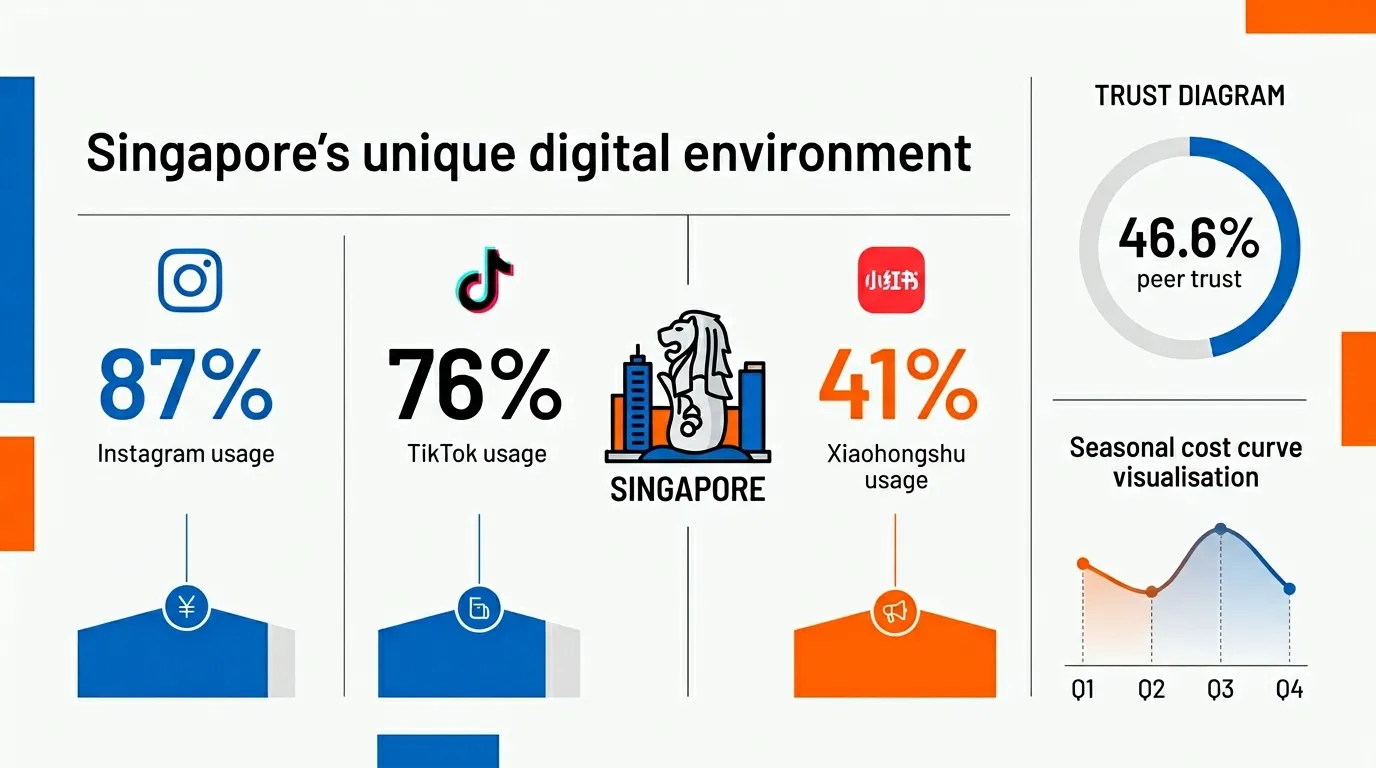
According to GoViral’s 2025 Singapore influencer marketing data, 87% of brands include Instagram in their influencer strategy, 76% include TikTok, and 41% include Xiaohongshu; an unusually important platform mix compared with many Western markets.
That matters because consumer discovery behaviour here is more fragmented than many brands assume. A Singapore audience might discover a product on TikTok, validate it through Xiaohongshu reviews, see a retargeting ad on Instagram, and convert after a branded search or landing-page revisit.
There is also a trust dynamic at play. On Xiaohongshu, 46.6% of users most often trust posts from regular users when researching products or services, compared with 30.3% for KOLs/influencers and 22.9% for official brand accounts. That is a strong signal that peer-style content and recommendation-led discovery matter in this market.
On the paid media side, Singapore’s costs can be volatile. One benchmark dataset tracking Facebook CPM in Singapore showed Q1 2025 averaging US$9.37, rising to US$33.76 in Q4, with particularly sharp peaks mid-year and in October.
Even if your exact results vary by industry, the directional lesson is clear: planning paid acquisition in Singapore requires more sensitivity to seasonality and creative fatigue than many businesses expect.
This is why the influencer vs paid ads question is not generic here. In Singapore, you are making decisions in a compact, sceptical, multilingual, and highly competitive market.
The Real Question Is Not Which Channel Wins, but How They Work Together
The strongest campaigns rarely treat influencer marketing and paid social as competing channels.
They treat them as different layers in the same system.
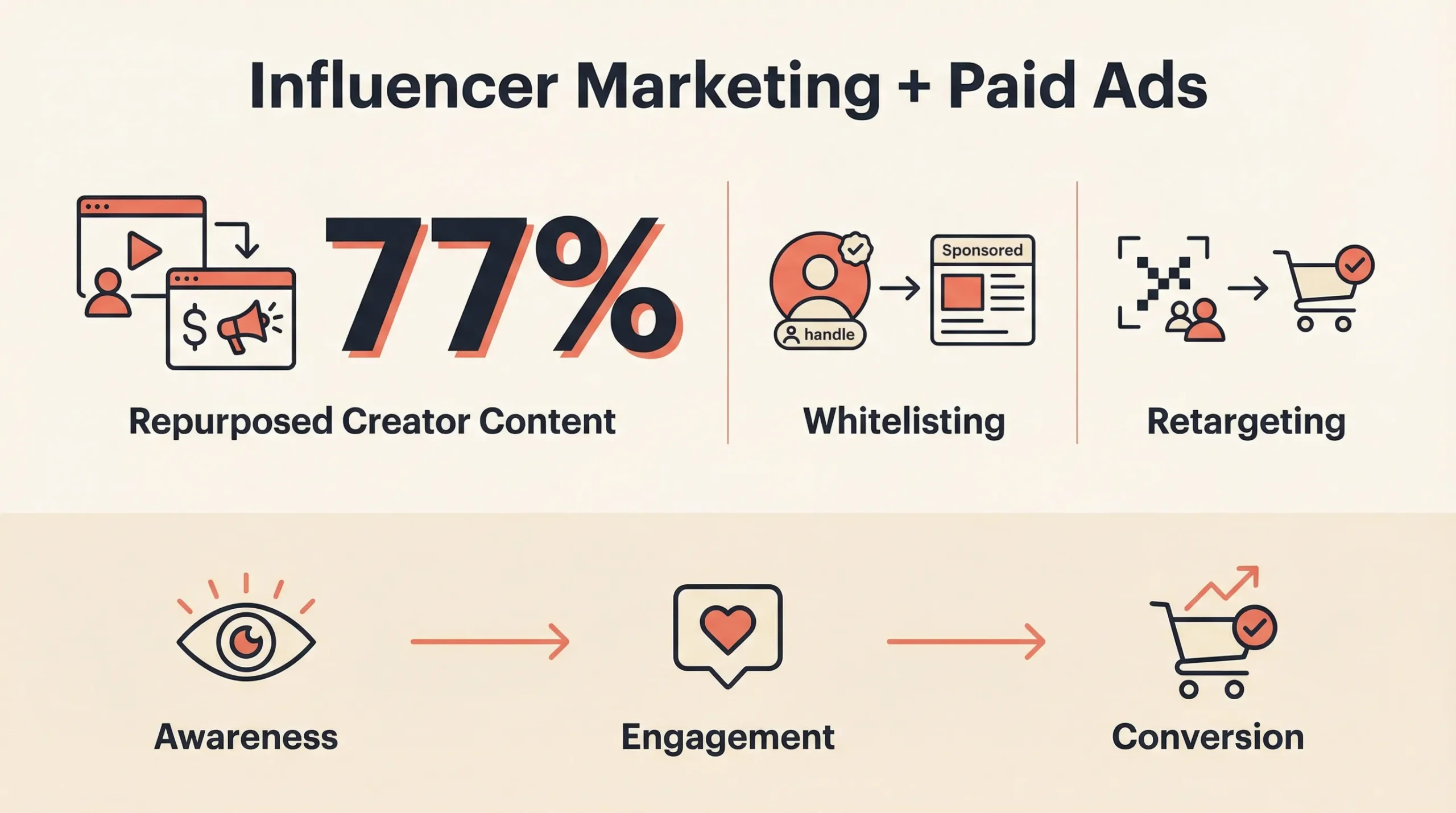
Influencer marketing is usually strongest at the top and middle of the funnel, where the goal is to build trust, capture attention, and create content that feels native to the platform. Paid social is usually strongest when the job is to scale, retarget, and convert with more control.
This convergence is no longer theoretical. Aspire reported in 2026 that 77% of brands actively repurpose creator content in paid ads, indicating exactly where the market is heading: creators are no longer just an awareness channel; they are increasingly part of the paid media creative engine. Source
That one number changes the framing of the whole debate.
If creator content is now routinely used as paid creative, then the real commercial question is not “Should I choose influencers or paid ads?” It is “How should I use creator-led trust and paid-media control together?”
That is the lens I would recommend using for the rest of this decision.
How Influencer Marketing Works in 2026
If you’re trying to decide between influencer marketing and paid ads, it helps to first understand how influencer marketing actually works today.
In 2026, it’s no longer just about paying creators to post a photo and hoping for the best. I’ve seen how it has evolved into a more structured, performance-driven channel, where content, audience trust, and platform algorithms all play a role.
In this section, I’ll walk you through how influencer marketing works in practice, what has changed, and what you need to know before investing in it.
Types of Influencers
The influencer ecosystem is now segmented by scale and relationship quality, not just follower count.
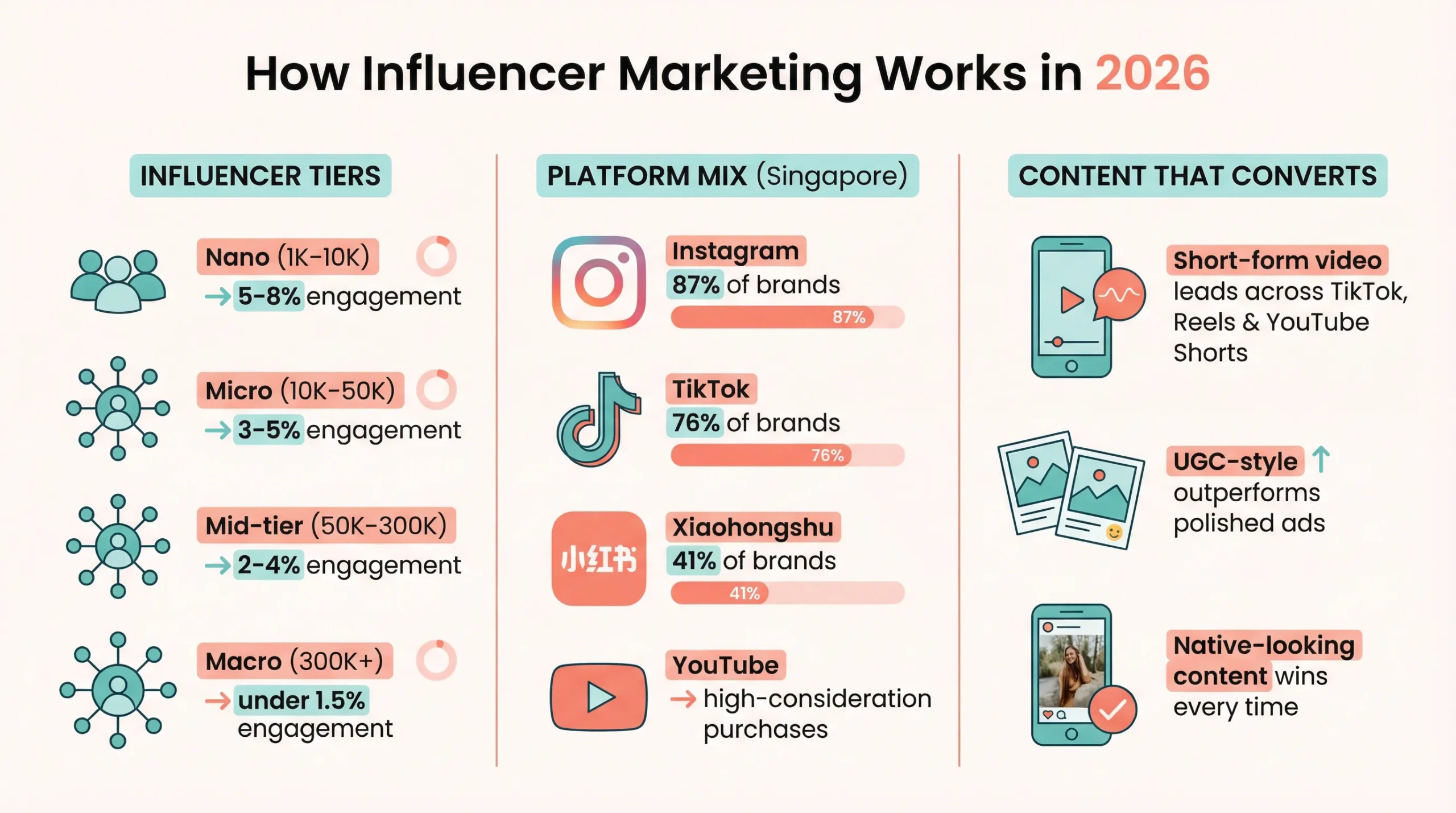
- Nano-influencers (1K to 10K followers) tend to have the tightest community bonds. Engagement rates for nano-influencers in Singapore average 5% to 8%. They are cost-effective and often highly trusted in niche communities, such as local food, parenting, home decor, or fitness.
- Micro-influencers (10K to 50K) offer a useful balance of reach and engagement, typically 3% to 5% on Instagram. For many Singapore SMEs, this tier delivers the best commercial outcome per dollar spent.
- Mid-tier influencers (50K to 300K) are increasingly professionalised. They produce stronger content but require more structured briefs and contracts. Engagement rates drop to around 2% to 4%.
- Macro and celebrity influencers (300K+ followers) are primarily an awareness play. Their reach is significant. Their engagement rates are lower, typically under 1.5% on Instagram. The brand association can be valuable, but do not expect it to drive direct conversions without a strong supporting infrastructure.
Platforms That Dominate Influencer Marketing in Singapore
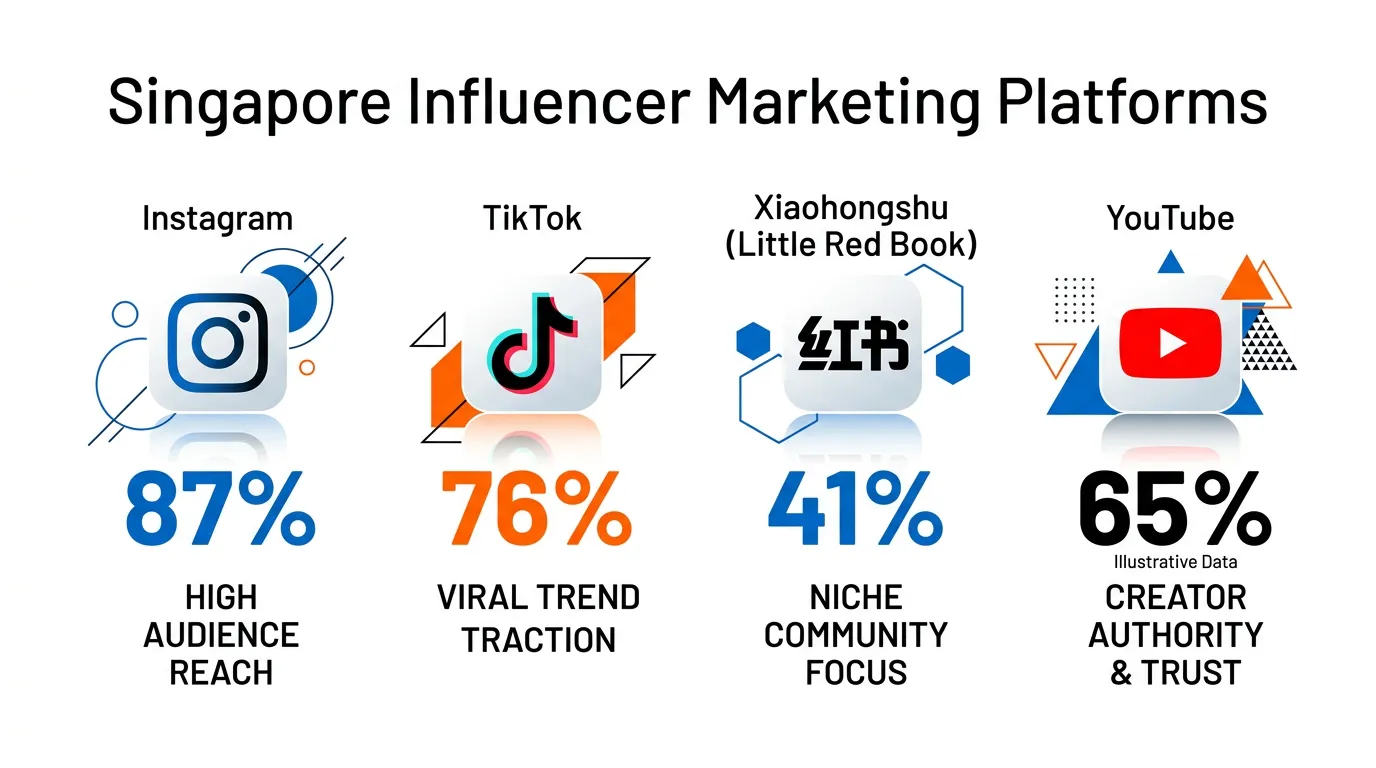
Singapore’s influencer ecosystem is more platform-diverse than most brands realise, and where you choose to activate matters as much as who you choose to work with.
Instagram remains the anchor platform. According to GoViral Global’s Singapore data, 87% of brands include it in their influencer strategy, with 52% treating it as their primary channel.
That dominance is not purely habit. Instagram gives brands strong visual storytelling through feed posts and Reels, reliable audience demographic data, and a creator community that has been refining its craft for years. For lifestyle, food and beverage, fashion, beauty, and home categories, it is still the first place I would look.
TikTok
TikTok has shifted from “worth testing” to structurally important. It is now used by 76% of Singapore brands for influencer campaigns, and 28% consider it their primary channel.
What makes TikTok different is the algorithm’s willingness to surface content beyond a creator’s existing follower base. A well-produced video from a 10,000-follower creator can outperform a macro-influencer’s post simply because it resonates.
For consumer brands looking to reach younger Singaporean audiences, TikTok is no longer optional.
Xiaohongshu
Xiaohongshu (Little Red Book) is the one I find English-first marketing teams most underestimate. Forty-one percent of Singapore brands now include it in their influencer mix, and for good reason.
The platform’s users actively search for product and lifestyle recommendations, which means content has a longer shelf life than on other platforms. If your brand speaks to Mandarin-speaking consumers, or if you are in categories like skincare, parenting, food, travel, or interior design, Xiaohongshu deserves serious attention.
YouTube
YouTube matters for high-consideration purchases. When someone is about to spend S$3,000 on a mattress, S$15,000 on a home renovation, or enrol in a professional course, they research.
A detailed YouTube review from a credible creator in that niche can genuinely influence that decision. The view counts are often modest compared to TikTok, but the viewer’s intent is much higher.
A practical note: The platform you choose should align with your buyer’s behaviour, not the one you personally find most familiar. Ask yourself where your customer actually spends time before the buying decision is made, then work backwards from there.
Content Formats That Perform Best
If I had to give one piece of format advice that applies across almost every Singapore campaign I have seen, it would be this: content that looks native to the platform consistently outperforms content that looks like an advertisement.
Short-form video is the dominant format across TikTok, Instagram Reels, and YouTube Shorts. Part of this is algorithmic, as all three platforms actively prioritise short-form video in their distribution. But the deeper reason is behavioural.
Singaporean audiences are accustomed to scrolling quickly, and short-form video attracts attention in a way static imagery rarely does.
The UGC-style approach, where influencers film themselves using the product in a natural, unscripted way, performs particularly well. It works because it mirrors the way real people share recommendations with friends. There is no studio lighting, no scripted tagline, and no obvious production budget, and that lack of polish is precisely the point.
Format considerations by category:
| Category | Recommended Format | Why It Works |
| Beauty and skincare | Short-form video, before/after Reels | Visual transformation is immediate and shareable |
| Food and F&B | Short Reels, TikTok taste tests | Sensory appeal translates well to video |
| Home and renovation | Xiaohongshu posts, YouTube walkthroughs | Longer consideration, detail, and trust matter |
| Tech and gadgets | YouTube reviews, unboxing Reels | Buyers want depth before committing |
| Professional services | LinkedIn thought leadership, YouTube explainers | Credibility and nuance are essential |
| Fitness and wellness | TikTok tutorials, Instagram Stories | Aspirational content drives strong engagement |
Long-form content still has a clear role, particularly in categories where buyers need to feel educated before they’re ready to act. A 12-minute YouTube review of an online course, a detailed renovation walkthrough, or a financial planning explainer from a trusted creator can carry significant conversion weight, even if the view count looks unimpressive on a dashboard.
One thing I watch for: The format’s length should match the complexity of the buying decision. If your product takes 30 seconds to understand, a 60-second Reel is appropriate. If your service requires context, trust, and explanation, a short video alone won’t do the job.
How Brands Collaborate with Influencers
The collaboration model you choose will affect not just cost but content quality, message control, and the type of relationship you build with the creator. I see businesses default to the simplest arrangement without thinking about what actually serves the campaign best.
There are three primary structures in use across Singapore.
Paid Partnerships
Paid partnerships are the most common. The brand pays the influencer a fixed fee in exchange for a defined deliverable: a TikTok video, an Instagram Reel, a set of Stories, or a combination. The advantage is clarity. Both sides know exactly what is being produced, when it goes live, and what it costs. The brief usually covers key messages, brand guidelines, disclosure requirements, and any exclusivity clauses.
What I would add is this: How prescriptive you are with the brief will determine how authentic the content feels. Overly scripted briefs tend to produce stiff, unconvincing content. The best creative direction gives the influencer a clear commercial objective while leaving them room to communicate it in their own voice.
Affiliate Arrangements
Affiliate arrangements tie the influencer’s earnings to performance, typically through a unique discount code or tracked referral link.
The influencer earns a commission on each sale or sign-up attributable to their content. For brands, the appeal is obvious: you only pay for results. For creators, the appeal depends entirely on how well the product converts with their audience.
This model works well for eCommerce and subscription products with short purchase cycles. It tends to underperform for high-ticket services or categories with longer purchase journeys, because the influencer sees little return even if they genuinely influenced the decision.
Gifting
Gifting involves sending the influencer a product or inviting them to an experience, with no financial payment and no guarantee of content in return.
It functions more as a PR seeding exercise than a formal campaign. Done well, it can generate organic content that feels more authentic than paid collaborations. Done poorly, it produces nothing.
I would only recommend gifting to brands that have a product compelling enough to earn organic coverage, and only as a supplementary tactic alongside paid partnerships, not as a standalone strategy.
Retainer Arrangement
A fourth model worth noting is the retainer arrangement, where a creator commits to producing content for a brand on an ongoing basis, typically monthly.
I have grouped this under pricing models below, but structurally, it represents a deeper relationship than one-off deliverables, and for brands with consistent content needs, it can be the most efficient long-term structure.
Typical Pricing Models in Singapore
Understanding how influencer campaigns are priced is not just useful for budgeting. It affects how you structure deals, what you should expect to receive, and how you protect your investment if the content underperforms.
Per-deliverable Pricing
Per-deliverable pricing is the standard for most Singapore campaigns. You agree to a fee for each specific piece of content: one Instagram Reel, one TikTok video, three Stories, or a combination package. This is the clearest and most flexible structure, particularly for brands that run campaign-by-campaign rather than maintain an ongoing creator relationship.
One thing to factor in from the outset is usage rights. If you plan to repurpose the influencer’s content as paid ad creative, which I strongly recommend for most brands, you need to negotiate that usage rights clause before signing the agreement.
Expecting to use content for paid ads without a usage licence is a common oversight, and securing it after the fact almost always costs more.
Retainer
Retainer arrangements are becoming more common as brands recognise the value of consistent creator output. A retainer typically commits the influencer to a set number of deliverables per month over an agreed period, typically 3 to 6 months.
In exchange, the brand usually receives a more favourable rate per piece, priority access to the creator’s calendar, and a creator who genuinely understands the brand over time.
Content quality tends to improve over the course of a retainer. The first post is often good. By the third month, the creator understands the brand’s voice, the audience’s reaction, and what actually works.
Performance-based Pricing
Performance-based pricing is less common in Singapore but worth understanding. Some influencers and agencies will negotiate a base fee plus a performance bonus tied to measurable outcomes such as tracked link clicks, promo code redemptions, or app installs.
This works best when both parties have enough data to agree on realistic benchmarks. Without that, the structure often creates disagreement rather than alignment.
What to watch for when agreeing on pricing:
- Confirm whether the rate includes content creation only, or also covers usage rights for paid amplification
- Clarify the revision policy. How many rounds of feedback are included before additional fees apply?
- Agree on the posting timeline and what happens if the influencer misses the agreed date
- For retainers, include an early exit clause in case the relationship is not working after 60 days
The most expensive influencer deal I have seen was not the one with the highest fee. It was the one where usage rights were not clarified upfront, the content needed three rounds of revisions, the post went live two weeks late, and the brand could not use any of it in paid ads without renegotiating.
Good contracting is not bureaucratic; it is commercial common sense.
How Paid Social Ads Work
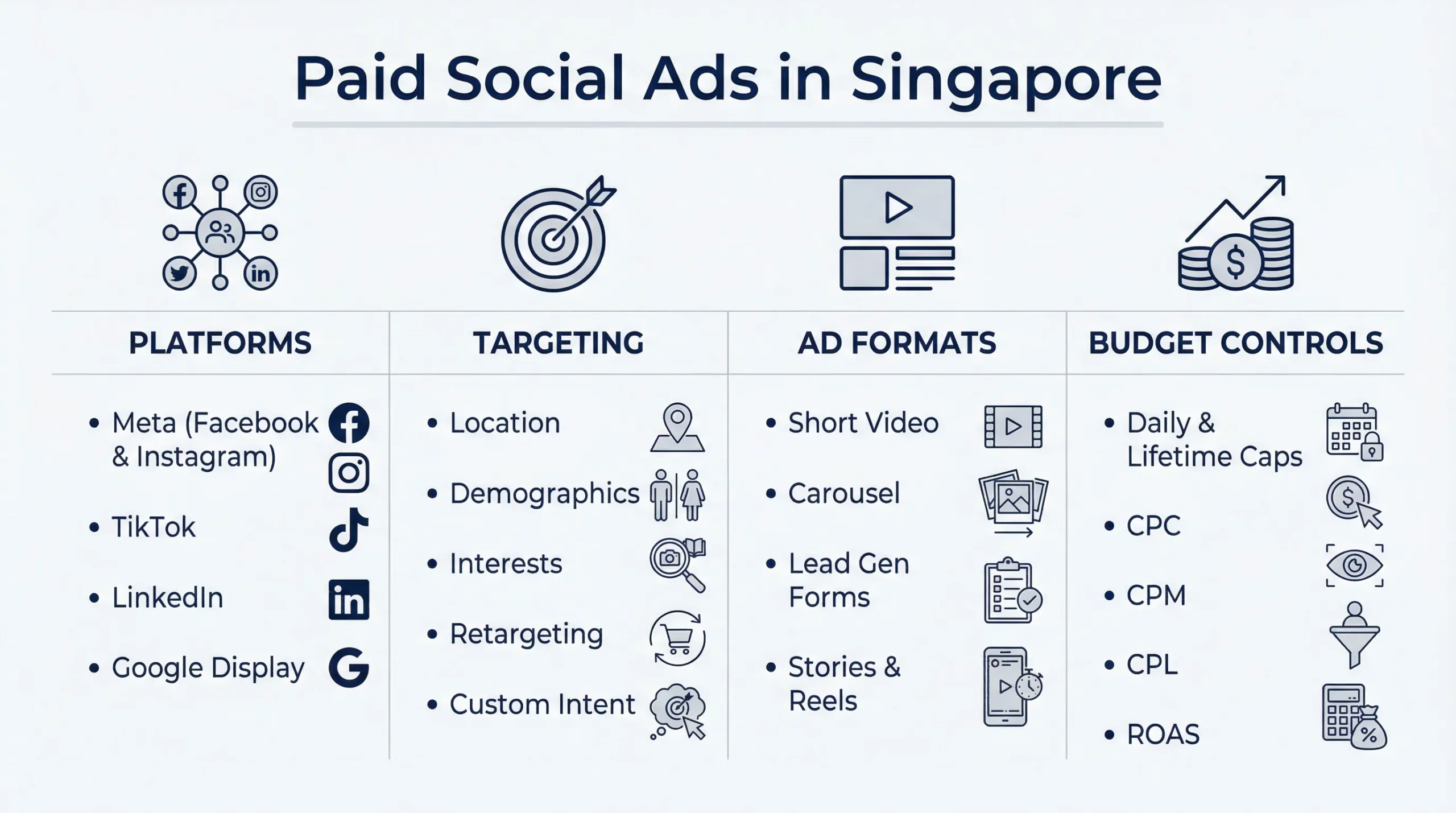
When I run paid social campaigns, I treat them as a controlled way to reach the right people at the right moment. Unlike influencer activity, where reach depends on a creator’s audience, paid ads give me direct control over who sees the message, how often, and what action I want them to take.
For Singaporean businesses operating in a highly digital and mobile-first market, that level of precision can make a noticeable difference in both speed and results. That said, success with paid social is not just about putting a budget behind a post. I need to understand how each platform distributes ads, how targeting works, and how creative and copy influence performance.
Once these elements come together, paid social becomes a reliable channel for testing offers, scaling campaigns, and driving consistent returns.
Ad Platforms in Singapore
Not every platform is worth your money, and that is a point most agencies are reluctant to make clearly. The right platform depends on who you are trying to reach, what you are selling, and what stage of the buying journey you are targeting.
Here is how I would frame the major paid social platforms for Singapore businesses specifically:
Meta Ads (Facebook and Instagram)
Meta remains the most commercially mature paid advertising ecosystem available to Singapore businesses. Its retargeting infrastructure is particularly strong. You can build Custom Audiences from website visitors, video viewers, and customer lists, then layer Lookalike Audiences on top to find new people who share the same behavioural profile as your existing customers.
For local lead generation in categories such as home renovation, education, financial services, and healthcare, Facebook lead gen forms remain among the most cost-efficient tools available. The friction is low because the user never has to leave the platform.
Instagram, operating within the same Meta Ads Manager, skews younger and is better suited to visual product categories. Reels placements, in particular, often generate stronger engagement at lower CPMs than feed placements.
TikTok Ads
TikTok has moved well beyond the “youth platform” perception. On TikTok, especially, the first two seconds of a video determine whether someone keeps watching or scrolls past.
Where TikTok is becoming genuinely important for Singapore businesses is TikTok Shop. The gap between discovery and purchase is narrowing significantly on this platform. For consumer brands selling physical products, this is worth paying close attention to in 2026.
LinkedIn Ads
LinkedIn is expensive. CPMs are consistently among the highest on any paid social platform, and Singapore is no exception. I do not recommend it for most B2C businesses or SMEs with tight budgets.
That said, for B2B companies in professional services, financial advisory, legal, technology, or corporate training, LinkedIn’s targeting by job function, seniority, company size, and industry is unmatched. A Singapore-based HR consultancy trying to reach HR Directors at companies with more than 200 employees has no better precision targeting option available.
Google Display Network
The Display Network is not a primary demand-generation channel. Think of it as a reinforcement layer. It keeps your brand visible to people who have already shown interest, as they browse news sites, read industry content, and move around the web.
Its value is in staying present with warm audiences at low cost, rather than acquiring cold traffic from scratch.
Targeting Capabilities
This is where paid advertising has a structural advantage that influencer marketing genuinely cannot match.
When I run paid campaigns for Singapore clients, the targeting parameters available go well beyond the basics most business owners imagine. You can define your audience by:
- Demographics: Age, gender, household income bracket, education level, and relationship status
- Location: Down to specific districts, postal codes, or a radius around a physical address in Singapore
- Interests and behaviours: People who have researched home loans, recently moved house, shown interest in interior design, or visited competitor websites
- Professional attributes (LinkedIn): Job title, company size, industry, seniority, and years of experience
- Custom intent: People who have searched for specific keywords on Google, watched your videos, or engaged with your posts
- Retargeting audiences: Website visitors, email subscribers, app users, or people who abandoned a shopping cart
In practice, this means a renovation company in Singapore can show a specific ad to homeowners aged 30 to 50 who live in HDB executive flats in the north-east region, have shown interest in home design content, and visited the company’s service page without making an enquiry. That level of specificity changes the economics of advertising meaningfully.
Influencer marketing works at the audience level, meaning your message reaches the influencer’s followers as a group. You have limited control over who within that audience actually sees the content on any given day. Paid ads, by contrast, let you apply precise filters before a single dollar is spent.
This does not make paid ads superior overall. It makes them better suited to specific objectives, particularly at the bottom of the funnel.
Ad Formats
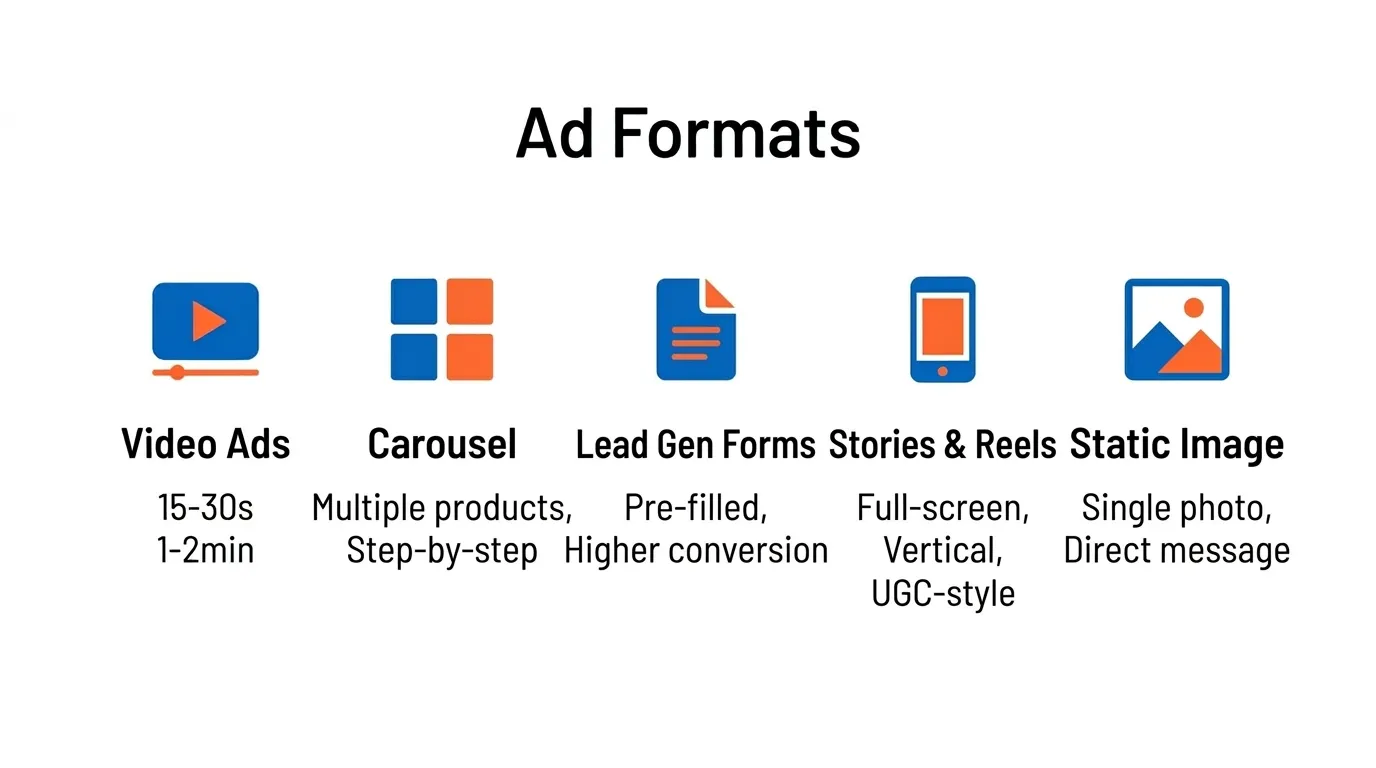
Format choice is underestimated. I have seen businesses waste excellent targeting by defaulting to a static image ad that no one stops to look at.
The most important principle is this: match the format to the environment and the viewer’s intent.
Video ads consistently outperform static creative on every major platform.
Short-form video, between 15 and 30 seconds, works best for awareness and consideration. Longer videos, between one and two minutes, can work for higher-consideration categories where the viewer needs more context before acting.
On TikTok, especially, the first two seconds of a video determine whether someone keeps watching or scrolls past.
Carousel ads are well-suited for showing multiple products, walking through a process step by step, or presenting several distinct benefits of a single offer.

I find them particularly effective for renovation and property-related campaigns, where showing before-and-after visuals or multiple project examples builds credibility that a single image cannot.
Lead gen forms deserve more attention than most Singapore businesses give them. On Facebook and LinkedIn, a lead gen form pre-populates the user’s details from their platform profile and allows them to submit an enquiry without leaving the app.
Conversion rates are typically higher than with traffic sent to an external landing page, particularly on mobile. For service businesses in education, healthcare, and finance, this format is worth testing before anything else.
Story and Reels ads are full-screen, vertical formats that benefit from an immersive feel. They work best when the creative doesn’t look like an ad, and they align well with the UGC-style content influencer campaigns produce.
This is one reason why repurposing influencer video content as story placements often delivers stronger performance than purpose-built studio creative.
The honest truth is that most businesses in Singapore are still running the same static image ad they designed three years ago. That creative fatigue is costing them more than they realise.
Budget Control and Bidding
One of the clearest practical advantages of paid social advertising is that you decide exactly how much to spend, and when to stop.
Every major platform gives you two fundamental budget controls:
- Daily budget caps, which set the maximum your campaign will spend on any given day
- Lifetime budget caps, which allocate a fixed total amount over a defined campaign period
Beyond budget, the bidding system determines how your ads compete in the auction. The main bidding approaches are:
- Cost per click (CPC): You pay when someone clicks on your ad. Best suited for campaigns where driving traffic to a landing page is the primary goal.
- Cost per mille (CPM): You pay per 1,000 impressions. More appropriate for awareness campaigns where reach matters more than individual clicks.
- Cost per result/cost per lead (CPL): You set a target cost per lead or conversion, and the platform optimises delivery towards that goal. This is typically the most useful bidding strategy for lead generation campaigns.
- ROAS targeting (Return on Ad Spend): The platform optimises for revenue outcomes. Most relevant for e-commerce businesses with purchase tracking in place.
For most Singapore SMEs running lead generation campaigns, I recommend starting with CPL or lowest-cost bidding while the algorithm gathers data, then shifting to a target cost once you have 30 to 50 conversion events per week.
Moving to manual cost controls too early, before the platform has enough signal, typically hurts performance rather than helping it.
The discipline to pause underperforming campaigns, reallocate budget to what is working, and resist the temptation to let failing ads run indefinitely is often what separates businesses that get good returns from paid ads from those that do not.
The Role of Creative in Performance
If I had to identify the single variable that most determines whether a paid ad campaign succeeds or fails, it would be the creative. Not the targeting. Not the bidding strategy. Not even the landing page, though that matters too.
The creative is what stops the scroll, or does not. I have managed campaigns where the targeting was deliberately broad, almost clumsy by textbook standards, but the creative was so well-executed that the ads performed consistently above benchmark.
I have also seen technically excellent audience builds produce dismal results because the ad looked exactly like an ad: polished, corporate, and immediately identifiable as something to skip.
In the Singapore market, this pattern is particularly pronounced. Audiences here are digitally sophisticated. They have developed a strong filter for promotional content, and anything that feels staged or brand-scripted tends to generate lower engagement, weaker click-through rates, and higher costs.
What actually works is content that feels native to the platform.
What high-performing creative tends to look like in 2026:
- Short-form video filmed in a natural setting, not a studio
- A real person speaking directly to the camera, not a polished voiceover
- Authentic product demonstration rather than a styled photoshoot
- Clear problem-and-solution framing within the first three seconds
- A single, obvious call to action rather than multiple competing messages
This is precisely why the hybrid strategy of using influencer-produced UGC as paid ad creative has become so effective. Creator content already has the visual language and production style that performs in a native social feed. Running it as a paid placement combines that authenticity with precise targeting, which is a combination that studio-produced ads rarely match.
When I review campaign creative for clients, I always ask: Does this look like something a real person would post, or like something a marketing department approved? The answer tells me almost everything I need to know about why the campaign is performing or not.
Influencer Marketing vs Paid Ads: Key Differences Explained
| Dimension | Influencer Marketing | Paid Ads |
| Trust and Credibility | High, borrowed from the creator’s existing relationship | Lower, brand-sourced messaging |
| Targeting Precision | Audience-level (defined by creator’s followers) | Granular, parameter-defined |
| Cost Structure | Per-deliverable or retainer | Pay-per-impression, click, or action |
| Speed of Results | Slower, awareness-first | Fast, predictable when dialled in |
| Scalability | Harder to scale quickly | Highly scalable with budget |
| Content Ownership | Depends on the contract | Brand-owned ad creatives |
The table above is a starting point, but the real strategic insight lies in reading these dimensions in the context of your business goals, not as a scorecard.
Pros and Cons of Influencer Marketing vs Paid Ads
When I weigh up influencer marketing vs paid ads, I do not see it as a simple case of one being better than the other. Each has its own strengths, trade-offs, and ideal use cases depending on the goal, budget, and audience I am trying to reach.
In Singapore’s highly digital and competitive landscape, where consumers are both savvy and selective, choosing the right approach can directly affect a campaign’s performance. Before deciding where to invest, I find it useful to look closely at the pros and cons of influencer marketing vs paid ads, so I can match the strategy to what the business actually needs rather than what is trending.
Influencer Marketing Pros
- Builds trust quickly through social proof. When a respected voice in your niche recommends your product, the trust transfer is immediate and powerful. According to recent data, between 61% and 67% of consumers trust influencer recommendations more than direct brand messages, a figure that has been rising year on year. In a market like Singapore, where word of mouth has always carried commercial weight, this matters.
- Native, less disruptive content. Influencer content lives in the feed the same way organic content does. There is no “Skip Ad” button. The audience has opted in to following that person. If the integration is well-executed, it does not feel like advertising at all.
- Strong for niche audiences. Singapore is a small market with highly specific community segments. A nail art influencer with 8,000 followers in Singapore has a more qualified audience for a beauty brand than a Facebook ad targeting women aged 20 to 40 across the island. That specificity has real commercial value.
Influencer Marketing Cons
- Harder to control messaging. Even with a detailed brief, you are ultimately trusting someone else to communicate your brand. Misalignments happen. In sensitive sectors such as healthcare, finance, or legal services, this introduces compliance and reputational risks.
- ROI tracking can be inconsistent. Unless you have a robust tracking infrastructure in place, including UTM parameters, unique codes, and pixel-based attribution, measuring the direct commercial return of an influencer campaign is genuinely difficult. Many businesses rely on soft metrics like reach and engagement, which do not always translate to revenue.
- Dependence on influencer quality. Your campaign performance is partly a function of the creator’s skill. A poorly produced video from the wrong influencer is not just ineffective; it can reflect badly on your brand.
Paid Ads Pros
- Highly measurable and trackable. From impression to click to conversion, paid social advertising gives you a clear data trail. Cost per lead, return on ad spend, and conversion rates are all visible. That transparency makes optimisation iterative and rational.
- Precise audience targeting. You can reach Singapore homeowners in their 40s who have shown interest in interior design and visited renovation-related content in the last 30 days. That level of precision is not available through any other digital channel.
- Scalable campaigns. Once a paid campaign is producing the results you want, you can scale spend with relative confidence that the economics will hold. That predictability is valuable for businesses with revenue targets and growth plans.
Paid Ads Cons
- Rising costs. Facebook CPM in Singapore averaged US$9.37 in Q1 but climbed to US$33.76 in Q4. The average cost-per-lead across industries is US$27.66. For SMEs working with modest budgets, Q4 campaigns can quickly become uneconomical.
- Ad fatigue and banner blindness. Audiences are bombarded with ads. Creative fatigue sets in faster than most advertisers expect. A campaign that performs well in month one often declines by month three unless the creative is regularly refreshed.
- Requires constant optimisation. Unlike SEO or influencer content that can continue generating value over time, paid ads stop the moment you stop paying. The platform also requires ongoing audience testing, bid management, and creative iteration to maintain efficiency.
Influencer Marketing vs Paid Ads: Cost Comparison
I often find that the real debate around influencer marketing vs paid ads comes down to cost. In Singapore’s competitive market, understanding where your budget goes can shape how effectively you grow.
This is the section most business owners actually want, so I will be direct.
Influencer Pricing Tiers in Singapore (SGD)
| Influencer Tier | Followers | Instagram Post | TikTok Video |
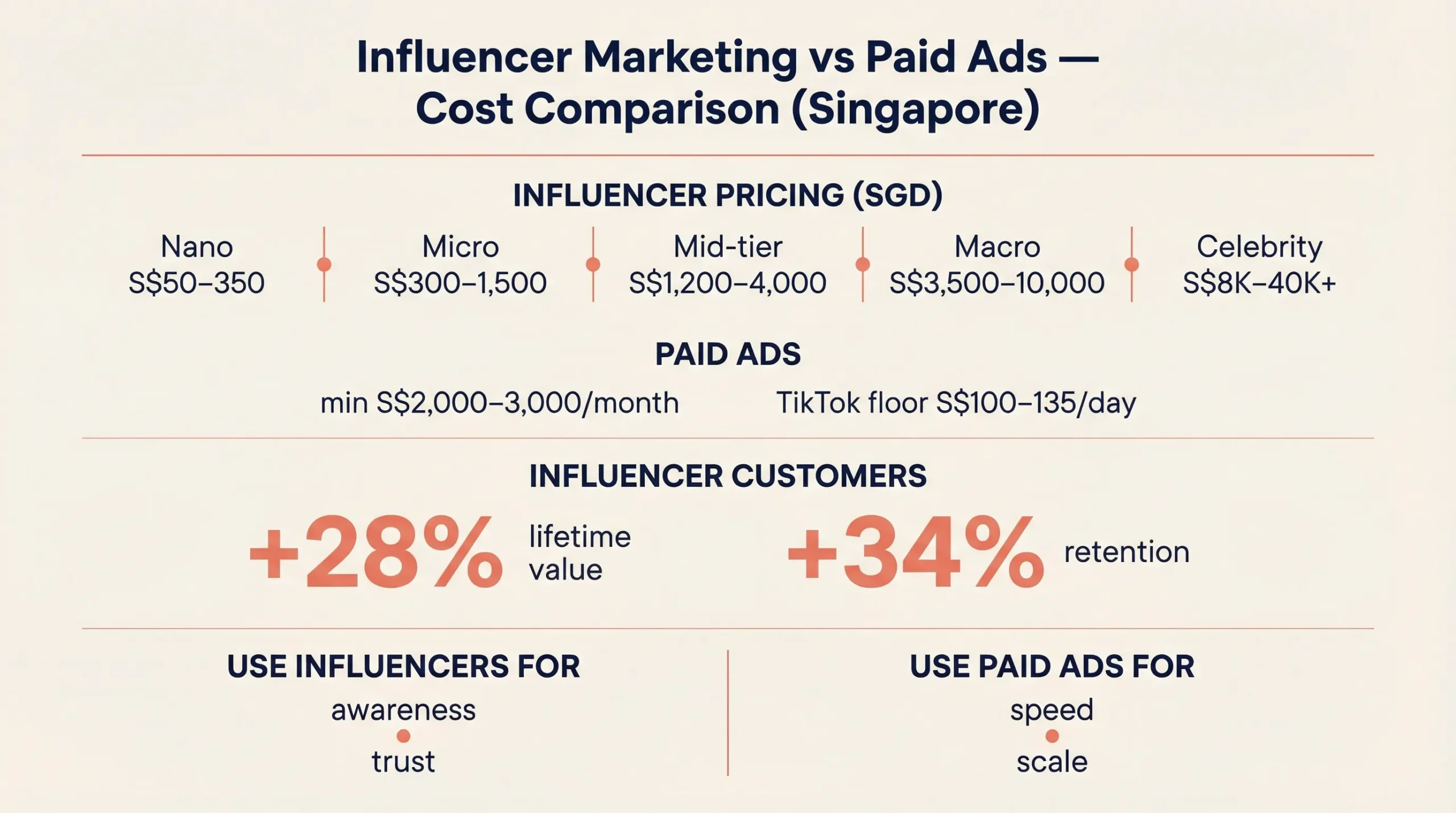
| Nano | 1K to 10K | S$50 to S$300 | S$80 to S$350 |
| Micro | 10K to 50K | S$300 to S$1,200 | S$350 to S$1,500 |
| Mid-tier | 50K to 300K | S$1,200 to S$3,500 | S$1,500 to S$4,000 |
| Macro | 300K to 1M | S$3,500 to S$8,000 | S$4,000 to S$10,000 |
| Celebrity | 1M+ | S$8,000 to S$30,000+ | S$10,000 to S$40,000+ |
Rates sourced from usual Singapore influencer pricing data and may vary by niche, exclusivity, and usage rights.
Typical Paid Ads Budget Benchmarks for Singapore Businesses
For context on the paid side, expect to invest a minimum of S$2,000 to S$3,000 per month across your paid social channels to gather meaningful data. Competitive categories like home renovation, finance, and education can require more before you start seeing consistent lead volume.
TikTok In-Feed Ads have an official minimum of USD $50/day (~S$67/day) at the campaign level, though S$100–S$135/day is a more realistic floor for generating actionable data.
Cost Per Acquisition Differences
Here is something that does not get discussed enough. Customers acquired through influencer marketing tend to exhibit 28% higher lifetime value and 34% higher retention rates than those acquired through paid social.
That materially changes the cost-per-acquisition calculation. If your average customer value is S$2,000 and influencer-acquired customers retain for longer, then spending S$800 on a micro-influencer campaign that brings in five customers is economically very different from spending S$800 on Facebook ads for the same five customers.
Hidden Costs
Both channels carry costs that rarely appear in the headline figures:
- Influencer campaigns: Agency management fees, content production support, usage rights, exclusivity clauses, and the time cost of outreach, negotiation, and briefing.
- Paid ads: Creative production, A/B testing budgets, platform management fees if using an agency, and the significant cost of poor creative that wastes media spend.
When to Use Influencer Marketing vs Paid Ads
When I choose between influencer marketing vs paid ads, I ask myself a simple question: What am I trying to achieve right now? That answer usually points me in the right direction, whether it is building awareness or driving conversions quickly.
So here I’m sharing my cheatsheet with you, to help you make the right decision:
Influencer Marketing: Where It Wins
Influencer marketing is powerful when trust is the missing ingredient.
It works especially well for launches, community-led brands, local credibility, and categories where people want to hear from someone human before they hear from a company.
It is also strong as a content engine. A well-run influencer campaign can produce not just reach, but a library of social-proof assets that continue to work long after the original post.
Influencer Marketing: Where It Breaks
Its weaknesses are control and measurement.
Even with a strong brief, the message still runs through someone else’s tone, style, and judgment. Attribution is also softer unless you have proper tracking infrastructure, including codes, links, landing pages, and post-view analysis.
And of course, creator quality varies. A mismatched or weak creator is not just ineffective. It can actively hurt perceived brand fit.
Paid Social Ads: Where They Win
Paid social is better when you need control, speed, and measurable outcomes.
It is excellent for testing offers, scaling proven messaging, retargeting site traffic, and generating direct-response leads with clearer attribution.
It also gives you immediate feedback. If the click-through rate is weak, you know quickly. If the CPL is too high, you can change the creative, audience, or offer without waiting weeks.
Paid Social Ads: Where They Break
Its biggest weakness is that it begins with no trust.
The audience knows they are seeing an ad. That means your creative has to do more work, your landing page has to do more work, and your economics can fall apart quickly if competition rises.
Singapore cost data illustrates the issue. One benchmark dataset showed Facebook CPM in Singapore averaging US$9.37 in Q1 2025 and US$33.76 in Q4, highlighting how dramatically costs can rise during peak periods.
That volatility does not make paid ads bad. It makes lazy paid ads expensive.
Why the Hybrid Strategy Is Usually Stronger
This is where the real leverage is.
The hybrid strategy works because it combines three things:
- The trust and platform-native feel of creator content
- The targeting and scalability of paid media
- The efficiency of reusing what has already proved it can engage humans
A good hybrid campaign typically looks like this:
- Top of funnel: Creator-led awareness and trust-building
- Mid funnel: Paid amplification of the best-performing creator content
- Bottom of funnel: Retargeting with offer-driven or proof-driven ads
This matters because the channels complement each other’s weaknesses. Influencer marketing often solves the “Why should I care?” problem.
Paid social often solves the “How do I reach more of the right people now?” problem.
When used together, they form a much more coherent system than either one can create alone.
The MediaOne Integration Playbook
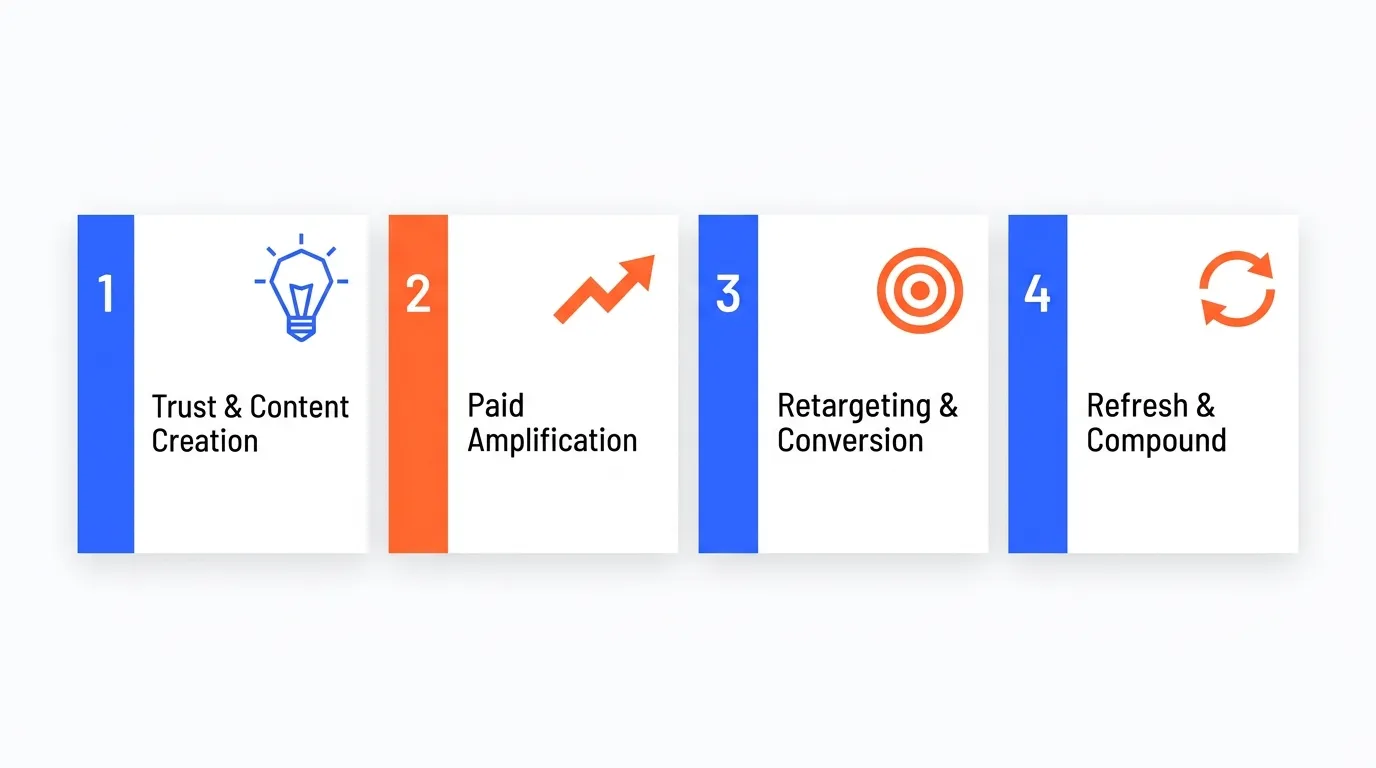
If I were structuring this as a repeatable commercial model, I would break it into four phases.
Phase 1: Trust and Content Creation
Start with creators who fit the audience and category well enough to produce believable, native content.
The goal here is not just to reach. It is also a creative discovery. Which hooks work? Which objections get resolved naturally? Which formats feel convincing?
Phase 2: Paid Amplification
Take the creator assets that performed best organically and run them through paid distribution.
Because the content has already proved it can hold attention in-feed, you are not guessing from zero. You are amplifying something with social proof and platform fit already built in.
Phase 3: Retargeting and Conversion
Now the audience has seen the brand in a way that’s more human than a cold ad.
That is when retargeting gets more effective. Your follow-up ads can be more direct because scepticism has already been lowered.
Phase 4: Refresh and Compound
Continue generating creator content over time so the paid system always has fresh native creative to work with.
This is the compounding advantage. Your influencer programme stops being just an awareness line item and becomes a content supply system for performance marketing.
The True Cost Comparison: Pricing, CAC, LTV, and Content Value
Most businesses compare channels too superficially. They ask, “What does one influencer cost?” or “What is my Meta CPL?”
Those are useful questions, but incomplete. The more useful economic comparison is:
- What does it cost to generate demand?
- What does it cost to acquire a customer?
- What quality of customer does each channel tend to bring?
- What content assets do I keep after the spend is over?
- How easy is it to scale the channel without efficiency collapsing?
Surface Pricing: What You Usually Pay
Creator rates in Singapore are rising rapidly by tier. StarNgage Pro’s pricing ranges show just how wide the gap can be, from nano creators paying tens to low hundreds of dollars per post to celebrities charging tens of thousands.
Paid social has different economics. You are not buying a person’s audience and content bundle; you are buying platform inventory. On TikTok, for example, the platform’s own documentation requires campaign budgets above US$50 and ad-group budgets above US$20, which means under-budgeted testing often fails before it produces meaningful learning.
The Hidden Cost Most Businesses Miss
The real hidden cost in paid ads is creative fatigue.
If your ads keep running but the creative gets stale, performance declines, and you end up paying more just to maintain the same result.
The hidden cost in influencer marketing is usually under-negotiated usage rights. If you do not secure paid usage, raw assets, or extension rights up front, the best-performing content may become much harder or more expensive to reuse later.
That is why the cost comparison should never be based solely on media prices.

An Illustrative Economics Example for a Singapore SME
The following is not a benchmark. It is a simplified example to show how different channel structures can produce different outcomes.
Scenario: Singapore Home Services Business
Paid Ads Path
- Spend: S$2,500
- Leads: 50
- Cost per lead: S$50
- Lead-to-customer conversion: 8%
- Customers acquired: 4
- Estimated CAC: S$625
Influencer Path
- Spend: S$1,200 on 2 micro-influencers
- Leads: 12
- Effective CPL: S$100
- Lead-to-customer conversion: 12%
- Customers acquired: 1.44
- Estimated CAC: ~S$833
- Bonus value: creator content assets retained for reuse
Hybrid Path
- Spend: S$1,200 on creator content + S$1,500 on paid amplification
- Leads: 35
- Effective blended CPL: ~S$77
- Lead-to-customer conversion: 10%
- Customers acquired: 3.5
- Estimated CAC: ~S$771
- Bonus value: native content library + scalable distribution
The point of the example is not that the hybrid always wins mathematically.
It is that each path buys a different type of value. Paid ads usually maximise speed and control. Influencer campaigns often buy trust and creative assets. Hybrid campaigns try to capture both.
The Content Asset Accumulation Effect
This is one of the least discussed differences between the channels. Paid social is mostly rental spend. When you stop paying, reach stops.
Influencer campaigns can create something that outlasts the initial distribution: a growing library of native content, social proof, reviews, testimonial-style clips, and creator assets that can be reused across paid, organic, landing pages, and sales materials.
That makes the creator spend differently from pure media spend.
If your creator contracts include proper usage rights, each campaign is not just a traffic exercise. It is also an asset-building exercise. That compounding effect is one of the strongest arguments for the hybrid model.
The Hidden Cost of Creative Fatigue
Creative fatigue is one of the main reasons paid ads feel less efficient over time.
In a market like Singapore, where audience pools can saturate quickly, the same creative gets old faster than many brands expect. Frequency rises, engagement drops, click-through rates weaken, and acquisition costs climb.
Creator-led UGC helps offset that because it looks less like a traditional ad and can often be cut into multiple paid variations from a single shoot.
This does not eliminate the need for a refresh. It changes the economics of refresh.
Instead of commissioning every new ad asset from scratch, you can use ongoing creator partnerships as a steady source of fresh material for your paid system.
That is one reason the influencer-vs-paid question is often framed too narrowly. Creator campaigns are not just a media decision. They are also a creative production decision.
When to Use Influencer Marketing
Influencer marketing deserves priority when:
- You Are Launching Something New: If your brand or product is relatively unknown, creator endorsement can reduce the cold-start problem. The audience is introduced through someone they already pay attention to.
- Trust Is a Precondition to Conversion: This applies to categories such as home renovation, education, beauty, wellness, healthcare, finance-adjacent services, and B2B expert-led offers. If people need reassurance before they click, influencer marketing can warm the path better than a cold ad.
- You Need Authentic Content, Not Just Reach: If your internal team lacks strong native creative, creators can solve two problems at once: access and assets.
- Your Budget Is Limited: For businesses operating under roughly S$3,000 per month, a focused micro-influencer programme may produce more practical learning than trying to force paid media platforms to optimise on thin data.
When to Use Paid Social Ads
Paid social deserves priority when:
- You Need Results Fast: If there is a promotion ending this month, a launch window next week, or a pipeline target that cannot wait, paid media is usually the faster lever.
- You Already Have a Proven Offer: Paid social becomes far more effective when the message and economics are already validated elsewhere.
- You Need Retargeting: Once someone has visited your site, watched a video, engaged with a creator post, or entered your CRM, paid retargeting becomes one of the most efficient ways to convert demand already in motion.
- You Need Scale With Precision: If you want to reach a very specific audience repeatedly, paid media gives you control that influencer marketing cannot fully match.
The MediaOne Channel Selection Framework
If you want a practical decision process, use this.
Step 1: Identify the Main Constraint
If the business needs results in under two weeks, lean paid.
If the business has a trust problem, lean influencer.
If the business has a small budget and limited room for platform learning, lean micro-influencer.
Step 2: Assess Offer Maturity
If the offer is proven, paid social is often the stronger scale lever.
If the offer is still being validated, influencer campaigns can sometimes test positioning in a lower-friction way.
If the brand is established but the product is new, a hybrid usually makes more sense.
Step 3: Evaluate Creative Capacity
If you do not have strong in-house creative, influencer marketing can double as your content engine.
If you already have a strong creative team producing native video, paid social becomes easier to optimise.
If creative is your bottleneck, hybrid often solves it best.
Step 4: Match the Channel to Category Dynamics
If your category is high-trust or high-consideration, lean influencer-led or hybrid.
If your category is impulse-driven or offer-led, lean paid-led.
If your category sits in the middle, use hybrid sequencing.
How to Test Both Channels Before Committing Budget
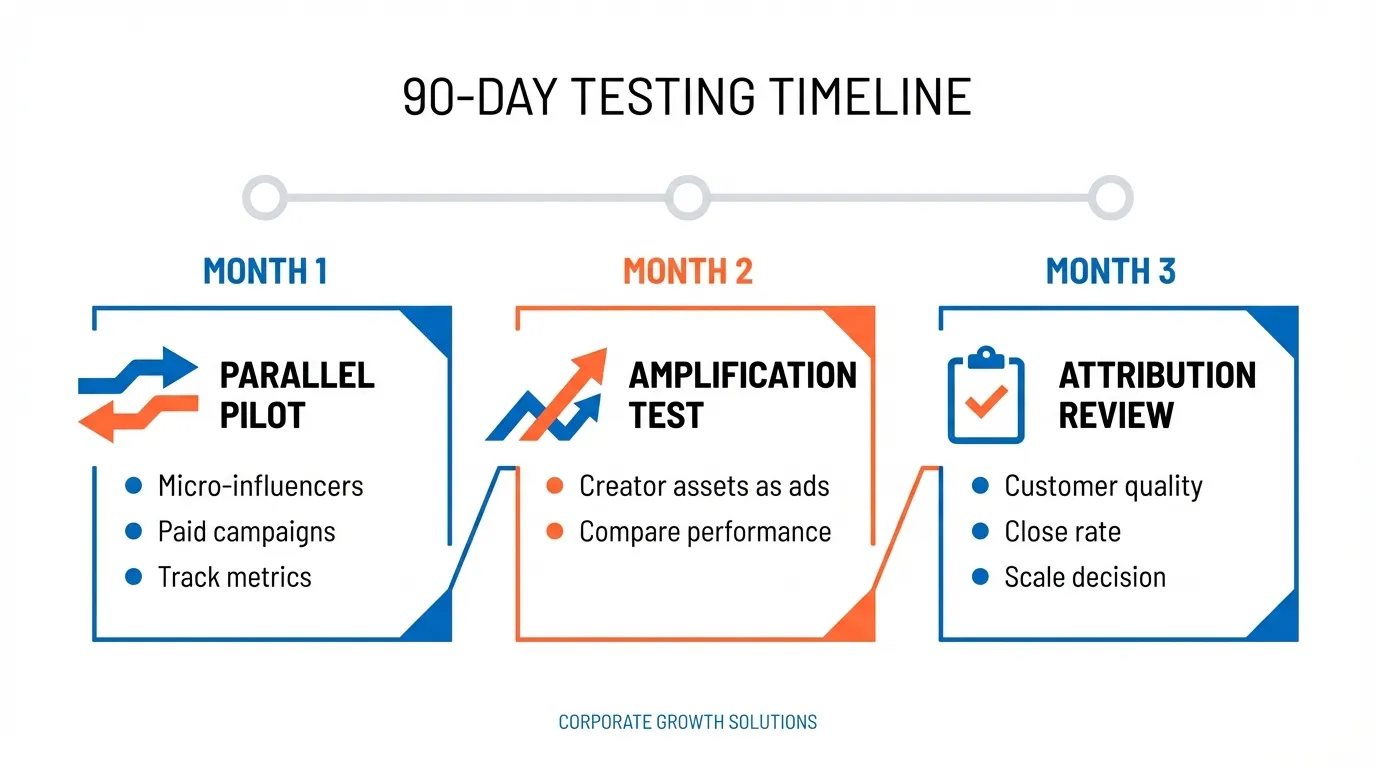
One of the smartest ways to reduce risk is to stop treating this as a philosophical choice and run a structured test.
A 90-Day Testing Model for Singapore SMEs
Month 1: Parallel Pilot
- Run 2 micro-influencers with clear tracking links or codes
- Run paid campaigns on Meta and/or TikTok with a simple structure
- Track reach, CTR, CPL, engagement quality, branded search lift, and lead quality
Month 2: Amplification Test
- Take the best creator assets and run them as paid ads
- Compare creator-sourced creative vs brand-made paid creative
- Track fatigue rate, CTR, CPL, and conversion rate
Month 3: Attribution Review
- Compare customer quality, not just lead volume
- Review close rate, sales feedback, content reusability, and channel efficiency
- Decide whether to scale influencer, scale paid, or move to a stronger hybrid split
This testing approach matters because sometimes neither channel is the problem. Sometimes the real issue is the offer, landing page, sales handling, or positioning.
My Final Thoughts on Influencer Marketing vs Paid Ads
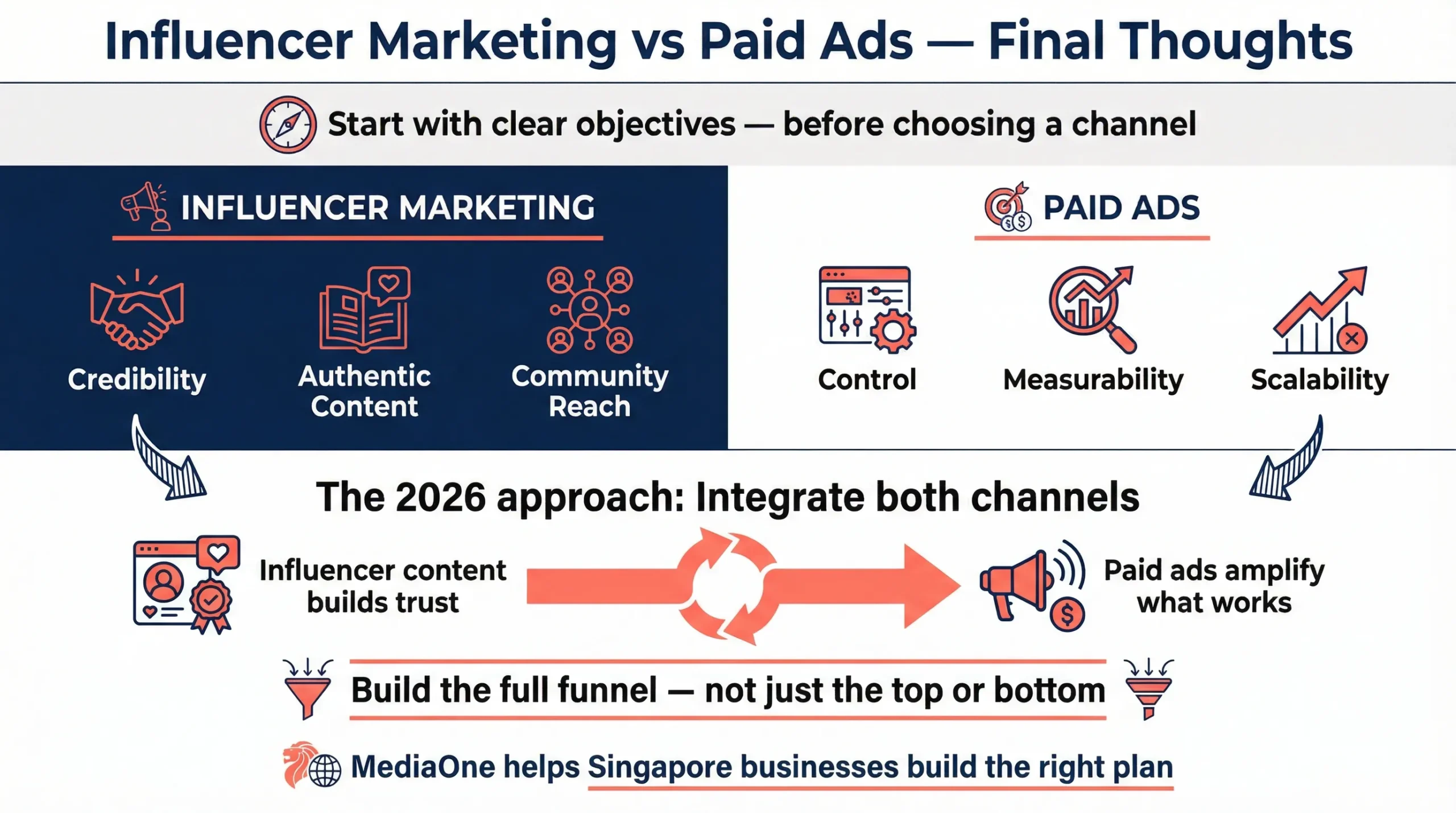
The businesses that navigate this decision well share one thing in common: they are clear on what they are trying to achieve before they pick a channel.
Influencer marketing builds credibility, creates authentic content, and reaches community-specific audiences in ways that paid advertising simply cannot replicate. For a new brand in Singapore, or for a business trying to shift perception in a competitive category, it is often the right starting point.
Paid ads give you control, measurability, and scalability. When your offer is proven and your economics are understood, paid social is the most reliable way to increase volume.
The most intelligent approach in 2026 is integration. Use influencer content to build trust and generate native creative assets. Use paid ads to amplify what works and retarget engaged audiences. Build the full funnel, not just the top or the bottom.
The question of influencer marketing vs paid ads is ultimately not about which channel wins. It is about understanding the role each one plays at different stages of your buyer’s journey, and ensuring your budget reflects that logic rather than the anxiety of choosing one over the other.
If you want a clearer view of how to structure this strategy for your business specifically, it may be worth speaking with MediaOne before making the final call.
We work with Singapore businesses on channel strategy, paid media, and content-led growth, and can help you build a plan that aligns with your actual commercial objectives rather than general best practices. Contact us today!
Frequently Asked Questions
How long does it take to see results from influencer marketing vs paid ads?
Paid ads can generate results within days because campaigns go live immediately, and targeting is precise. Influencer marketing typically takes longer as it builds awareness and trust before driving action. In Singapore, influencer campaigns often show stronger results over several weeks rather than instantly. The timeline depends on your objective and the extent to which your offer is already validated.
Is influencer marketing or paid ads better for B2B businesses?
Paid ads are generally more reliable for B2B because they allow precise targeting by job title, industry, and company size. Influencer marketing can still work in B2B, especially through LinkedIn thought leaders or niche experts, but it requires careful selection. In Singapore, B2B buyers tend to rely on credibility and detailed information before making decisions. A combined approach often works best.
How do you measure success in influencer marketing vs paid ads?
Paid ads are measured through clear metrics such as cost per lead, click-through rate, and return on ad spend. Influencer marketing success is broader and may include engagement, reach, brand lift, and assisted conversions. In Singapore campaigns, tracking often improves when using unique links or promo codes. A fair comparison requires aligning metrics with the campaign goal.
Can small businesses in Singapore afford influencer marketing vs paid ads?
Small businesses can use both, but budget allocation matters. Influencer marketing with nano or micro-creators is often more cost-efficient for smaller budgets. Paid ads require a minimum spend to generate reliable data, which can be limiting. For many Singapore SMEs, starting with micro-influencers and scaling into paid ads is a practical approach.
Which is better for brand building: influencer marketing vs paid ads?
Influencer marketing is generally stronger for brand building because it leverages existing trust and community relationships. Paid ads can support brand awareness but often lack the same level of credibility. In Singapore’s competitive market, consumers respond better to authentic recommendations than direct advertising. The strongest brand strategies combine both for reach and reinforcement.