

Running an art class in Singapore in 2026 is a different commercial exercise than it was five years ago. The competition has multiplied, the parent-buyer has become more sophisticated, digital ad costs have climbed, and the audience for arts education has fragmented into distinct sub-segments that respond to completely different marketing signals. Most art school owners we speak with describe the same problem: the marketing tactics that filled classes reliably in 2020 now produce inconsistent enquiries, and the reasons why are not obvious from inside the business.

According to the National Arts Council’s ongoing arts consumer research, Singapore’s arts audience is no longer a single demographic. It splits across 12 distinct arts consumer types with different motivations, price sensitivity, and channel preferences. Marketing an art class as if the audience were homogenous produces the exact inconsistency most schools are quietly experiencing.
Key Takeaways
- Singapore’s arts audience splits across 12 documented consumer types, each responding to different marketing signals
- The parent-buyer in Singapore weighs skill development, portfolio outcomes, and holistic child growth differently across primary, secondary, and JC stages
- A distinctive Value Anchor matters more than a generic USP in the current competitive climate
- Digital channels now favour vertical video and visible teacher personality over polished institutional content
- Retention economics beat acquisition economics for art schools running above 40 students
- The MediaOne Arts Enrolment Framework maps decisions across five stages from awareness to renewal
The Real Competitive Reality For Singapore Art Schools In 2026
The number of art schools, private studios, and independent art tutors in Singapore has expanded significantly since 2020. What was once a category with a small number of established players now includes hundreds of registered art education providers, individual instructors on classroom-hire arrangements, online-only offerings, and traditional schools all competing for the same enrolment pool.
The commercial implication most owners do not want to face: differentiation that felt distinctive in 2019 now reads as generic. Nearly every art school website in Singapore uses similar language around “nurturing creativity”, “individual attention”, and “certified instructors”. Parents comparing options quickly discover that they cannot tell the schools apart from the marketing materials, and they default to the choice most convenient logistically. This is the single most common commercial failure we surface when auditing arts education businesses.
The window for building genuine differentiation is still open, particularly for schools willing to commit to a specific positioning rather than trying to serve every audience segment. Schools that specialise clearly outperform schools that generalise, and the gap is widening year on year. Business owners searching for how to make an art school stand out in Singapore should start from the assumption that generalist positioning has already lost the market, and specific positioning is the only viable path forward.
Understand The Real Segments Behind Your Audience
The existing conversation about “target audience” for art classes tends to stop at broad demographics: children, teens, adults, seniors. This framing is no longer sufficient because within each demographic, the actual buying motivation now splits sharply.
The National Arts Council’s arts consumer segmentation identifies 12 distinct types, but for art class marketing specifically, the segments that matter reduce to five commercially relevant groups.
| Segment | Primary Motivation | Willingness To Pay | Preferred Channels |
| Parents of Primary-School Children | Skill foundation, motor development, structured learning | Moderate to high | Facebook, WhatsApp referrals, school parent networks |
| Parents of Secondary-School Children | Portfolio building, DSA application preparation, exam-linked artistic outcomes | High | School alumni networks, targeted Google Ads, testimonials |
| Adult Hobbyists (25-45) | Personal expression, stress relief, community | Moderate | Instagram, Facebook groups, workplace referrals |
| Retirees And Seniors | Lifelong learning, community connection, meaningful activity | Moderate to high | Facebook, community centre networks, word-of-mouth |
| Working Professionals (Career-Adjacent) | Skill for design work, creative portfolio development | High | LinkedIn, Instagram, curated online listings |
We often see schools trying to serve all five segments with the same website copy, the same social media content, and the same class structures. The parents of a Primary 3 child seeking foundational skill development do not want the same messaging as an adult hobbyist seeking Sunday morning stress relief. Trying to speak to both simultaneously produces messaging that speaks to neither.
Parents of secondary-school students are the most commercially valuable segment for schools positioning themselves seriously in this space. Between DSA preparation and portfolio requirements for creative course applications, this segment has documented, urgent needs and correspondingly higher willingness to pay.

Marketing built around how art classes help with DSA portfolios in Singapore or art tuition for secondary school students preparing for O-Level Art speaks directly to these parents in language that matches their actual search behaviour. The mechanics of matching search phrases to parent buying intent are covered in more depth in our work on social media marketing strategy for small business where the same segmentation principles apply across enrichment, coaching, and specialist services categories.
Beyond USP: Building A Value Anchor Instead
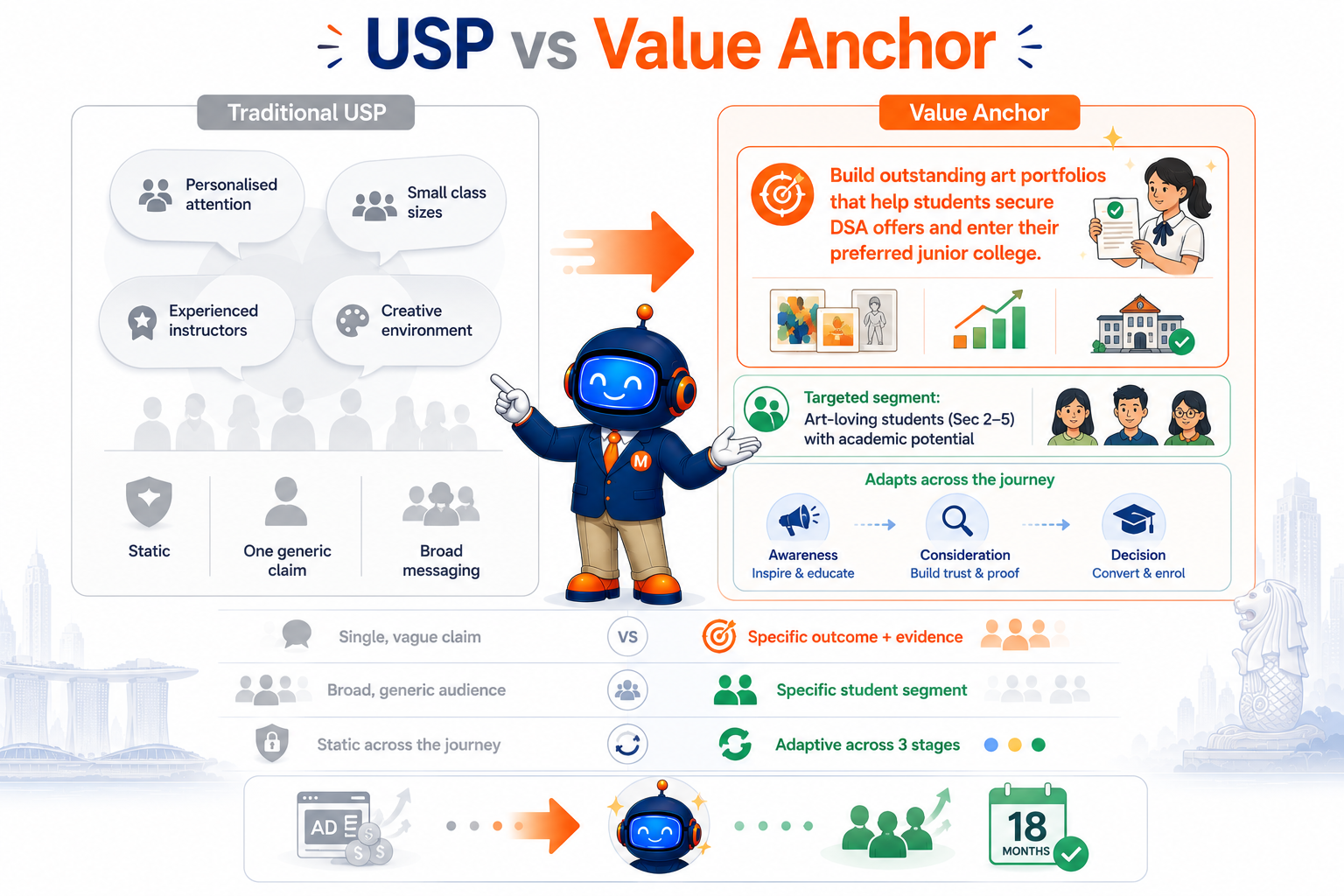
The traditional advice to develop a Unique Selling Proposition is not wrong, but it is incomplete for the current Singapore market. Nearly every art school in Singapore has attempted to articulate a USP. The result is a category of USPs that all sound similar: “personalised attention”, “small class sizes”, “experienced instructors”, “creative environment”.
We use a different framework with clients that produces materially different commercial outcomes. We call it the Value Anchor, and it differs from a USP in three important ways.
| Traditional USP | MediaOne Value Anchor |
| A single differentiator claim | A specific, verifiable outcome tied to a specific student segment |
| Written for marketing consistency | Written for buyer-specific commercial resonance |
| Focused on what makes you unique | Focused on what makes you the correct choice for a particular parent |
| Static across the customer journey | Adapted across awareness, consideration, and decision stages |
A Value Anchor answers a specific parent question with a specific evidence-based claim. Rather than saying “we develop creativity”, a Value Anchor says something like “our secondary-school students have secured DSA offers at seven junior colleges over the last three intakes, and here are the portfolios that got them there”.
The evidence bar for a Value Anchor is higher than for a USP, which is exactly why so few schools bother to build one. The schools that do build one usually stop paying for expensive digital advertising within 18 months, because the messaging itself does most of the enrolment work.
The Digital Presence That Now Actually Works
The generic advice about building a professional website, maintaining social media, and running a blog remains directionally correct. Though, the execution has changed enough in 2026 that following the generic advice produces significantly worse results than following the updated version.
Website Priorities That Matter For Art Schools In 2026
Parents evaluating art schools in Singapore now expect to find specific information on a website within 30 seconds of landing. If the information is not immediately findable, the tab closes and the parent moves on. Working with a specialist content marketing agency in Singapore that understands the parent-buyer decision path prevents the common mistake of designing art school websites for aesthetic appeal without commercial function.
The specific information parents look for:
| Website Element | Importance |
| Class schedules with real times | Parents need to check logistics against family calendars immediately |
| Full pricing published transparently | Hidden pricing signals distrust and drives parents to competitors |
| Instructor credentials with photos | Establishes teacher personality and credibility upfront |
| Student portfolio samples by age | Provides evidence of skill development at each level |
| Trial class booking form on the same page | Removes friction from the highest-intent action |
| Contact via WhatsApp | Matches how Singapore parents actually prefer to communicate |
Schools that hide pricing behind “contact us” forms lose 40 to 60% of interested parents within the first visit. This is one of the most measurable optimisation gains available for art school websites in 2026, and it costs nothing to fix.
Social Media In 2026: Vertical Video Over Everything Else
The image-based Instagram feed still matters, but it is no longer the primary discovery channel for art classes. TikTok and Instagram Reels have taken over as the dominant discovery format for parents in the 30-45 demographic, which happens to be the exact demographic making enrolment decisions for children’s art classes.
The content that consistently performs across our client accounts:
- Time-lapse videos of students producing artwork from blank canvas to finished piece
- Teacher personality content showing the instructor’s own creative process
- Behind-the-scenes footage of classes in progress (with proper parental consent)
- Before-and-after progress videos of specific students over 3 to 6 months
- Answers to specific parent questions in short-form video, such as what age should my child start art classes in Singapore or how do I know if my child has real artistic potential
Polished institutional video content underperforms compared to authentic, teacher-personality-driven content by a factor of 3 to 5 in our data. This is uncomfortable for schools that have invested in professional video production, but the data is consistent enough that it cannot be dismissed.
Blog Content That Actually Drives Enrolment
The generic advice to “start a blog” is correct in principle and often executed badly in practice. Most art school blogs contain generic content about the benefits of art, painting technique tips, and colour theory basics. This content ranks nowhere and drives no enrolment because it does not match what parents actually search for.

The blog topics that produce measurable enrolment inquiries for art schools in Singapore:
- Age-specific guides on when to start art classes
- Comparison articles on different art class formats (group, private, semi-private)
- Practical guides on how to prepare for O-Level Art or DSA portfolios
- Local-specific content on which Singapore neighbourhoods have quality art class options
- Parent-focused content on how to identify genuine artistic development versus generic craft activity
Producing content in these categories requires more work than generic art tips, and the payoff appears more slowly. The schools willing to publish this depth of content dominate organic search results for high-intent commercial queries within 12 to 18 months. Producing content in these categories requires more work than generic art tips, and the payoff appears more slowly. The schools willing to publish this depth of content dominate organic search results for high-intent commercial queries within 12 to 18 months. Sustained enrolment growth from organic content usually requires pairing technical SEO discipline with parent-buyer psychology, which is why an experienced digital marketing agency working across both dimensions produces materially stronger outcomes than teams optimising only for search engines or only for creative appeal.
The MediaOne Arts Enrolment Framework
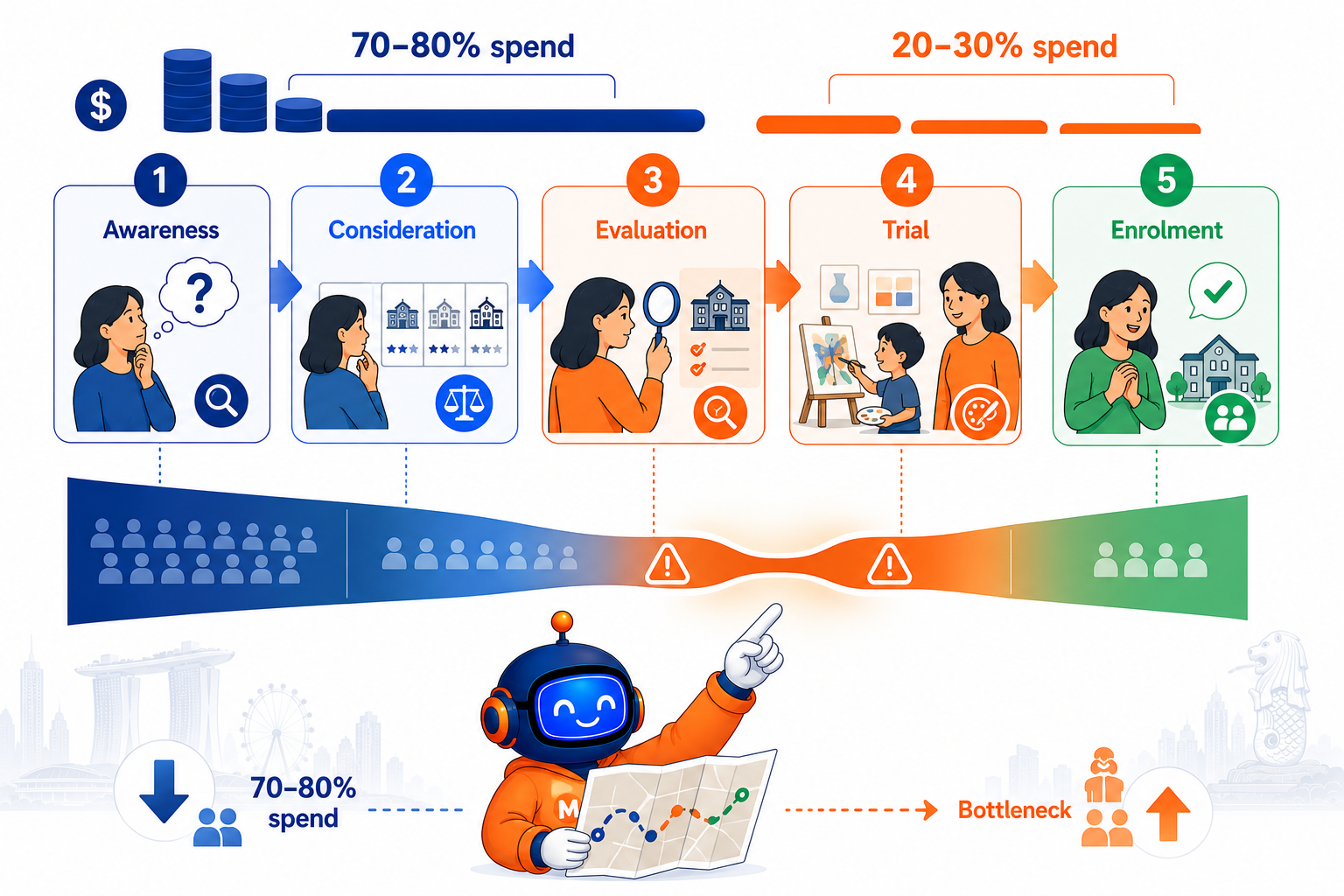

Across the arts education providers we work with, we developed a proprietary five-stage framework for art class marketing that maps the complete parent-buyer journey. We call it the Arts Enrolment Framework, and it identifies the specific action needed at each stage.
| Stage | Parent Question | What Marketing Needs To Do |
| Awareness | Should my child do art classes at all? | Educate on developmental benefits, share evidence of skill outcomes |
| Consideration | Which art school might be right for us? | Demonstrate positioning fit, publish comparison-friendly content |
| Evaluation | Is this school worth the trial commitment? | Provide social proof, remove friction from trial booking |
| Trial | Should we sign up after the trial? | Show clear next-step progression, demonstrate teacher-student fit |
| Enrolment | How do we make ongoing enrolment easy? | Reduce administrative friction, communicate progress transparently |
Most art schools focus 70 to 80% of their marketing spend on Awareness and Consideration stages, and severely under-invest in Evaluation, Trial, and Enrolment. This produces the common failure where marketing generates enquiries that fail to convert to trials, or trials that fail to convert to paid enrolments. The bottleneck is rarely at the top of the funnel. It is almost always in the middle stages that schools ignore.
The Trial Class Model
The existing advice to offer free trials is correct but incomplete. The way trials are structured determines whether they convert or waste marketing spend on parents who were never going to enrol.
The trial models we see in the market fall into three categories.
1. The Free Full Lesson
The most common model. Prospective students attend a normal class at no cost. Conversion rates typically sit at 15-25%.
The problem: parents who accept free lessons often do so without commitment, treating the trial as a free enrichment activity rather than an evaluation. The lower-cost signal reduces perceived value.
2. The Nominal-Fee Trial (S$25 to S$50)
A modest payment for the trial lesson. Conversion rates typically sit at 40-60%.
The advantage: the small financial commitment filters out low-intent parents and signals that the school values its own offering. Parents who pay for a trial are meaningfully more likely to convert to full enrolment.
3. The Structured Trial Programme (Two to Four Sessions)
A short paid programme designed to produce a specific artistic outcome by the end. Conversion rates typically sit at 55-75%.
The advantage: parents experience genuine skill development within the trial itself, and children develop attachment to the teacher and process. This is the model we recommend for most established art schools targeting parents of primary and secondary students.
Free trials produce higher volume but lower conversion. Paid trials produce lower volume but significantly higher conversion. For schools with strong reputational signals in the local community, paid structured trials produce better commercial outcomes. For newer schools without established reputation, free trials may be necessary initially to build proof points.
Paid Advertising In 2026: What Actually Produces Enrolments
Paid advertising for art classes in Singapore has become significantly more expensive and less predictable since 2022. Meta ad costs for parent-targeted audiences have roughly doubled over the last three years, and Google Ads for art class keywords in Singapore have followed a similar trajectory.
This shifts the strategic priority. The old approach of running broad awareness campaigns to a large parent audience no longer produces defensible cost-per-enrolment. The current approach requires much sharper targeting and much better creative.
Where Paid Advertising Still Works Well
- Retargeting parents who visited specific class pages: conversion rates 5 to 8 times higher than cold traffic
- Local geo-targeted campaigns within 5km of the studio: significantly better cost per lead than broader radius campaigns
- Lookalike audiences built from existing paying parents: often the best cold-audience source
- Search campaigns on high-intent keywords like “art classes near me” or “children’s art classes [specific neighbourhood]”: high-intent traffic that converts
Where Paid Advertising Now Underperforms
- Broad awareness campaigns to general parent audiences: cost per enrolment now often exceeds student lifetime value
- Video ads without teacher personality: institutional-feeling video content underperforms authentic content
- Campaigns without proper conversion tracking: 60 to 70% of art school ad accounts we audit have broken or incomplete conversion tracking
The businesses running paid advertising as a compounding channel treat it as one input in a broader system that includes strong organic content, retention economics, and referral flows. Businesses treating paid advertising as their primary acquisition channel spend increasing amounts for shrinking returns.
Local Partnerships That Actually Move Enrolment
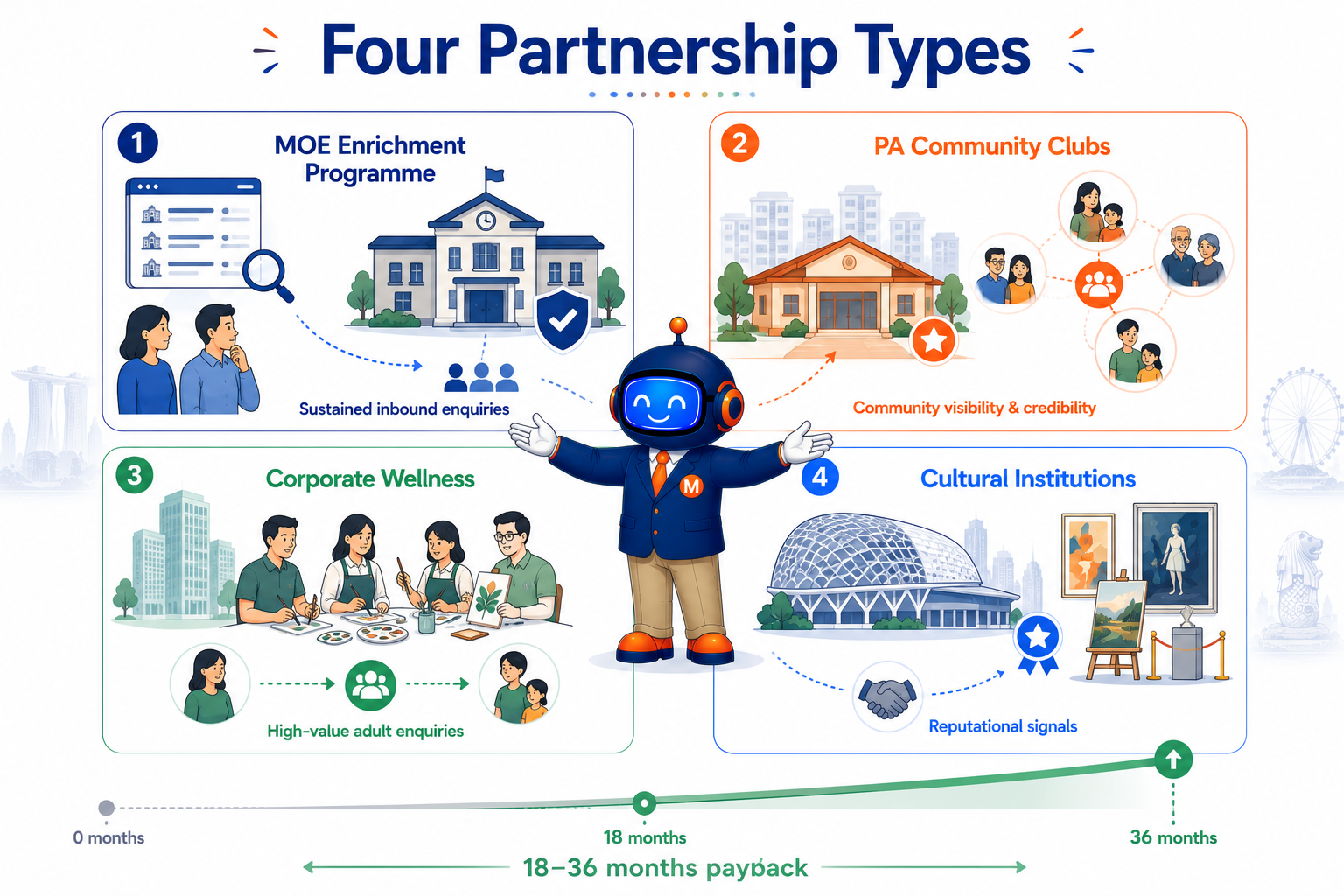
The concept behind partnering with schools and community groups is correct but frequently produces zero commercial return because most schools execute it poorly. We have noticed many times where art school owners write to primary school principals offering free workshops, receive polite non-responses, and give up after two attempts.
The version that actually works looks different.
1. Enrichment Programme Placement
Register your art school as a formal enrichment provider through the MOE-endorsed channels. This requires meeting specific quality standards and going through a proper application process. The barrier to entry is real, and the corresponding advantage is significant. Schools listed as approved enrichment providers appear on lists that parents actively consult, which produces sustained inbound enquiries rather than one-off event attendance. The visibility gains from formal directory placements compound over time, particularly when combined with a properly executed local SEO agency strategy that reinforces geographical relevance signals across Google Business Profile, map pack listings, and neighbourhood-specific content.
2. PA Community Club Programming
Community clubs run under the People’s Association host arts programming at highly subsidised rates. This is not primarily a revenue channel, but it produces:
- Visibility across community networks that traditional marketing cannot reach
- A steady stream of parents encountering your teaching in low-risk formats
- Reputational credibility that transfers to your paid classes
3. Corporate Wellness Programming
Larger Singapore companies increasingly commission art workshops as part of employee wellness or team-building activities. This produces high-value adult hobbyist enquiries as workshop participants often subsequently enrol themselves or their children.
4. Cultural Institution Collaborations
Working with venues like the Esplanade, Gillman Barracks galleries, or independent arts spaces on collaborative programming produces reputational signals that direct marketing cannot buy. These partnerships take time to develop and require genuine mutual value.
Partnership work is a long-cycle activity that pays back over 18 to 36 months. Schools looking for immediate enrolment growth should not prioritise this channel. Schools building for the next five to ten years cannot afford to ignore it.
The Retention Economics Most Art Schools Ignore
The commercial reality of running an art school in Singapore: the second-highest-leverage activity available to most owners is not acquiring new students. It is retaining existing students longer.
The maths is straightforward. A student enrolled for 18 months produces roughly 2.5 times the revenue of a student enrolled for 6 months, at essentially zero incremental marketing cost. A school that improves average retention from 6 months to 12 months effectively doubles revenue without touching acquisition.
Yet retention is the least-discussed topic in most art school marketing conversations, because it does not feel like marketing. It feels like operations, teacher training, or curriculum development. The businesses that recognise retention as a marketing outcome, and invest accordingly, outperform the businesses that treat marketing and retention as separate disciplines.
The retention drivers that consistently produce results:
- Structured progress reporting to parents every 3 months: shows tangible skill development
- Portfolio milestones that celebrate specific achievements: creates emotional attachment to progress
- Teacher continuity across terms: relationship-based retention outperforms instructor rotation
- Transparent long-term progression paths: parents commit longer when they see where the journey leads
- Community-building activities like end-of-term showcases: reinforces family investment in the school
Art school owners assume retention is high because they have not measured it. When we run retention analysis during audits, the actual retention numbers are almost always lower than the owner estimated. Measuring retention properly is often the highest-value diagnostic exercise available to an art school owner.
Metrics That Actually Matter For Art Class Marketing
Tracking KPIs is usually the best way to ascertain whether the efforts are paying off, but the specific KPIs that matter for art schools are frequently misunderstood.
| Metric | Importance | What Good Looks Like |
| Trial-to-Enrolment Conversion Rate | Diagnoses whether trials are the right format | 40% or above for structured trials |
| 6-Month Retention Rate | Diagnoses whether the class experience is delivering | 70% or above for children’s classes |
| 12-Month Retention Rate | Diagnoses long-term commercial health | 45% or above for children’s classes |
| Referral Rate (New Enrolments From Referrals) | Diagnoses whether current students value the school | 30% or above indicates strong reputational signal |
| Cost Per Enrolled Student (Not Cost Per Lead) | Diagnoses whether marketing is actually profitable | Under one month of student fees |
| Average Student Lifetime Value | Diagnoses commercial sustainability | Ratio of at least 5:1 vs acquisition cost |
Most businesses are doing it wrong by tracking website visits, social media followers, and ad impressions, but never tracking retention or lifetime value. These metrics look impressive in reports but do not correlate reliably with commercial outcomes.
Investing in structured SEO services makes sense when the underlying enrolment mechanics are already producing sustainable retention and referral rates. Before scaling marketing spend, most art schools benefit from a proper diagnostic exercise, which is what a rigorous SEO audit in Singapore delivers by identifying whether the website is technically ready to support the additional traffic that expanded marketing will generate. When retention is weak, adding more marketing spend accelerates the loss rather than the gain, because more students enter the top of the funnel only to leave through the same broken back door.
When retention is weak, adding more marketing spend accelerates the loss rather than the gain, because more students enter the top of the funnel only to leave through the same broken back door.
The Bigger Questions Most Owners Do Not Ask
The strategic questions that determine long-term success for a Singapore art school are rarely covered in marketing content because they are uncomfortable to answer honestly.
-
Who exactly is your school for?
Trying to serve every age group and every skill level produces messaging confusion and operational complexity. Schools that specialise in one clear segment outperform schools that try to be everything.
-
What are you actually selling?
Are you selling artistic skill development, portfolio outcomes for exam purposes, weekly enrichment for balanced childhood, or community and belonging? The answer determines everything else about how the school should be marketed.
-
What happens after a student stops attending?
Most art schools have no alumni relationship strategy. Alumni are the strongest referral source, potential future teachers, and long-term reputational advocates. Building a proper alumni programme is a five-year investment that most owners never begin.
-
Would parents actively recommend your school without being asked?
If not, the marketing problem is downstream of a product or experience problem, and no amount of digital advertising will fix it.
These questions deserve honest answers before committing budget to any of the tactical marketing described earlier in this guide. Schools working through these questions carefully rarely need to spend heavily on paid advertising, because their positioning and product do most of the marketing work.
The Enrolment Question Behind Every Marketing Decision
Every marketing decision an art school makes should trace back to one question.
Does this activity make it easier for the right parent to say yes to the right class at the right time?
Activities that pass this test compound. Activities that do not pass it consume budget and attention without moving the number that actually matters. The Singapore art education market rewards specificity, honesty, and long-term relationship building more than it rewards clever advertising, which is why the schools that grow steadily over decades tend to look boring from a marketing perspective and thriving from a commercial one.
A working SEO consultant who understands the parent-buyer psychology and the technical mechanics of Singapore search behaviour becomes valuable when the school is ready to scale sustainable enrolment rather than chase short-term enquiry spikes. As AI answer engines continue to shape how parents research enrichment options, art schools should also consider how a geo agency can build citation share inside AI-generated recommendations, since a growing proportion of parents now ask ChatGPT or Perplexity to shortlist providers before ever visiting individual school websites.
Contact us for a free quote to run an Arts Enrolment Framework audit across your current marketing programme and identify which activities are compounding, which are neutral, and which are quietly working against your enrolment growth.
Frequently Asked Questions
How do I market my art class in Singapore effectively in 2026?
Effective art class marketing in Singapore in 2026 starts with sharp positioning for a specific audience segment rather than generic messaging aimed at everyone. Combine clear, transparent website information with authentic short-form video content on Instagram and TikTok, and structure trial classes to convert rather than simply attract volume. Retention economics matter more than acquisition economics once the school reaches roughly 40 active students.
What are the best marketing channels for art schools in Singapore?
The most effective channels vary by segment. For parents of primary and secondary school children, Facebook, WhatsApp referrals, and Google Search perform strongest. For adult hobbyists, Instagram and workplace-driven referrals dominate. For retirees, Facebook and community club networks are most productive. TikTok and Instagram Reels have become the strongest discovery channels for parents in the 30-45 demographic making enrolment decisions.
How much should I spend on marketing an art class in Singapore?

For an established art school with 40 or more active students, a working benchmark is 10 to 15% of gross revenue on combined marketing spend, weighted toward organic content and retention infrastructure rather than paid advertising. Newer schools building initial student bases may need to spend higher percentages in the first 12 to 18 months, with the ratio dropping once retention economics become reliable.
Should I offer free trial classes or charge for them?
Structured paid trial programmes (S$25 to S$100 for two to four sessions) convert at 55 to 75%, significantly outperforming free single trials which convert at 15 to 25%. Paid trials filter for genuine intent and give both parties enough time to determine fit. For newer schools without established reputation, free trials may be necessary initially to build proof, transitioning to paid structured trials as the school matures.
How do I stand out from other art schools in Singapore?
Genuine differentiation now requires committing to a specific audience segment and a specific value claim rather than trying to serve all age groups and all skill levels. Schools that specialise clearly (children’s foundational skills, DSA portfolio preparation, adult contemporary practice, senior lifelong learning) outperform generalist competitors. The differentiation should be verifiable with evidence, not just claimed in marketing copy.
Focus on trial class booking as the specific conversion action rather than treating engagement as the goal. Content that leads to a bookable trial converts at meaningfully higher rates than content that ends with “message us to learn more”. Retargeting campaigns to social media followers who have visited class pages produce the highest cost-effectiveness among paid channels.
How long does it take to see results from art class marketing?
Paid advertising can produce enquiries within days and enrolments within weeks. Organic content strategies (SEO, YouTube, blog content) typically take 6 to 12 months to produce sustained enrolment flow but produce lower long-term acquisition costs. Retention improvements begin producing measurable revenue impact within 3 to 6 months. A working art school marketing programme balances all three timelines simultaneously.