Retargeting Marketing in Singapore: The Full-Funnel Structure That Actually Recovers Revenue
Every quarter, we run paid media audits for Singapore businesses spending between SGD 5,000 and SGD 80,000 a month on ads. There is a pattern we see so often it has stopped surprising us.
The top-of-funnel spend looks disciplined. The landing pages are decent. The reporting dashboards are colourful. Then we open the retargeting layer and find it running on autopilot with one audience, one ad, and no exclusion list.

Retargeting marketing is not the finishing touch on a campaign. In our client work across e-commerce, B2B SaaS, and professional services, it is the single lever most likely to change return on ad spend within 60 days without adding a cent to traffic budget. If ads feel like they are working “okay” but not scaling, this is almost always the reason.
Key Takeaways
- Most retargeting problems are audience problems, not creative problems. Fix segmentation before touching the ad.
- Warm audiences on Meta convert at roughly 15.8% against 4-5% for cold traffic, but only when the retargeting layer is separated from prospecting properly.
- The 30-day retargeting window that most agencies default to is wrong for roughly two-thirds of the businesses we audit. Match the window to the actual sales cycle.
- Retargeting without a proper exclusion list is not aggressive marketing. It is a budget leak.
- In a first-party-data world, your CRM is now the most valuable retargeting asset you own. Most Singapore SMEs are not using theirs.
What Retargeting Marketing Actually Is
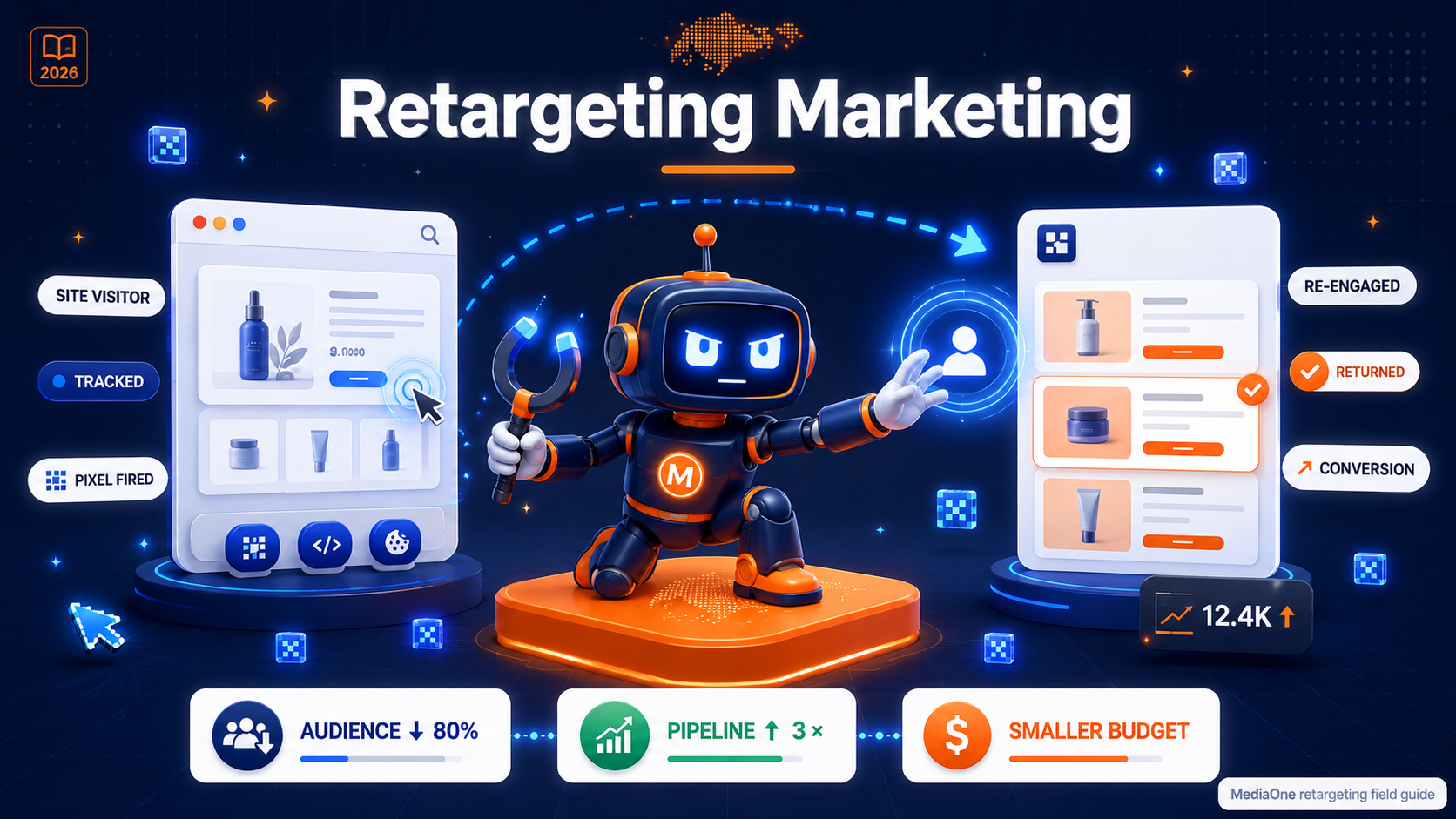
Retargeting marketing is the practice of serving ads specifically to people who have already interacted with your brand but did not convert.
A tracking pixel, an event tag, or a first-party data upload places a past visitor into an audience pool. When that same person appears on Facebook, Instagram, YouTube, LinkedIn, or the Google Display Network, your ad shows up in their feed instead of a stranger’s.
The Strategic Reality Behind the Search
Searches like how does retargeting marketing work or what is retargeting in digital marketing rarely get answered with the strategic reality.
Retargeting is the only paid media layer where the person has already demonstrated intent. You paid for that intent once through SEO, social, or search. Failing to retarget them properly means paying for the same person to arrive through a cold channel later, or watching them convert with a competitor who did retarget them.
Retargeting vs Remarketing: A Distinction That No Longer Matters
A related search we see constantly is what is the difference between retargeting and remarketing, and the confusion is worth clearing up because it drives real budget decisions.
Historically, remarketing meant email follow-ups and retargeting meant paid ad placements. In 2026, that distinction is functionally dead. Google Ads, Meta, and LinkedIn all let you upload email lists, sync CRM audiences, and trigger behavioural ads from the same interface.
For a fuller breakdown with local examples, our piece on remarketing vs retargeting for Singapore SMEs covers the five most expensive misunderstandings we see in audits.
Why 2026 Rewrote the Rules
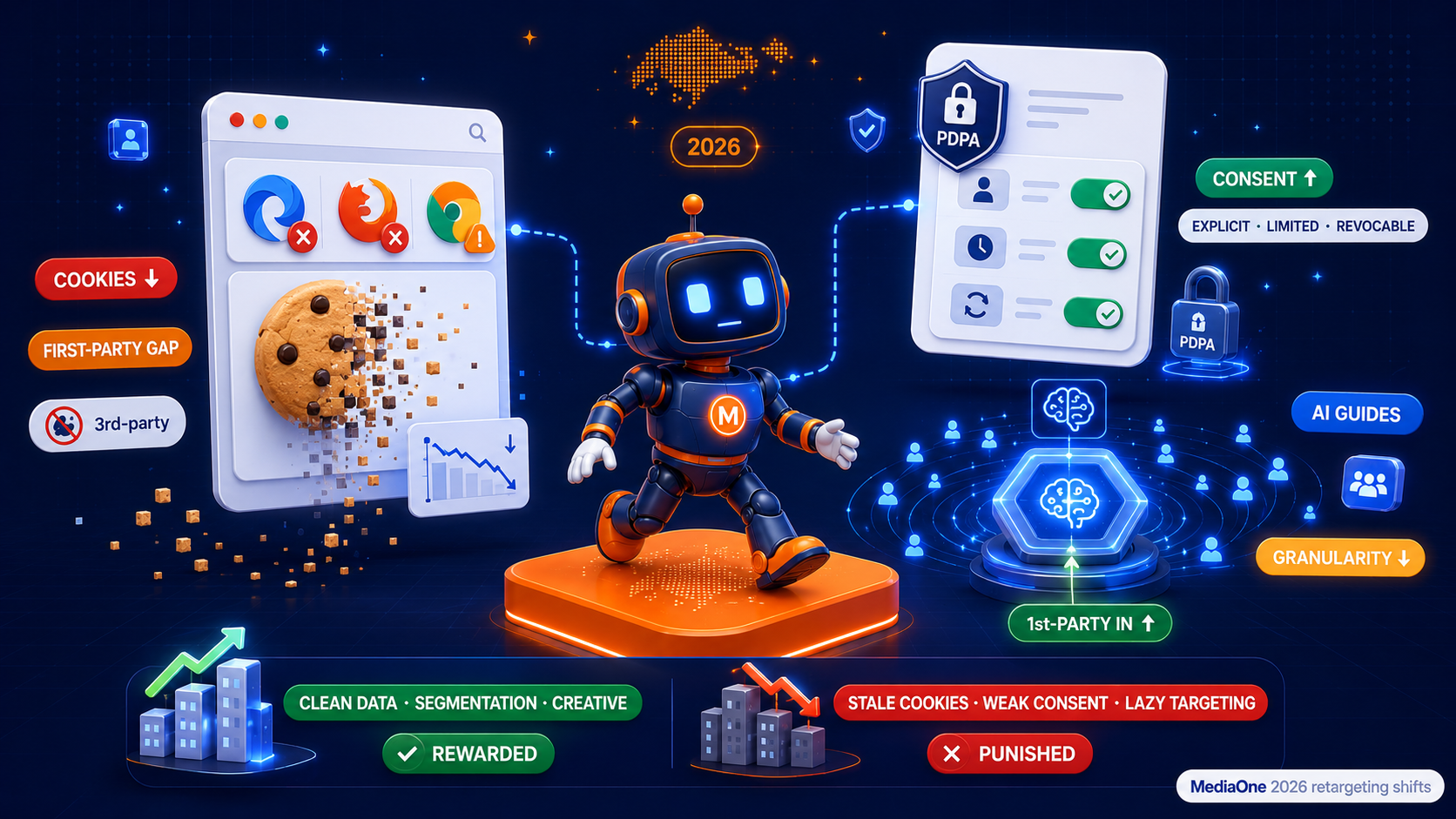
Three things shifted at once, and most Singapore marketers have only partially adjusted to any of them.
1. Third-Party Cookies Are Functionally Dead
Safari and Firefox already block them. Chrome’s Privacy Sandbox has quietly reshaped Display Network retargeting.
If your setup still relies on cookie-based tracking without a first-party layer, audience sizes are shrinking every month and it may not be showing up in your reports yet.
2. PDPA Enforcement Is More Visible
Singapore’s PDPA now requires consent that is explicit, purpose-limited, and revocable.
Retargeting audiences built without proper consent capture are not just a compliance risk. They are also less accurate, because opted-in users behave measurably differently from users who slipped through a weak cookie banner.
3. AI Audience Expansion Has Changed Targeting Control
Meta’s Advantage+ Audience and Google’s Performance Max no longer let you control targeting the way you used to. Audience signals now guide the AI rather than lock it down.

This makes the quality of your first-party data more important than the granularity of your targeting settings, a trend we go deeper on in our review of the top PPC trends shaping 2026.
Retargeting in 2026 rewards operators who invest in clean data, real segmentation, and creative variation. It quietly punishes everyone else.
The Leaky Funnel Problem in Real Numbers
Say you spend SGD 15,000 per month across Google Ads and Meta, and your landing pages convert at 2.5%. For every 1,000 clicks, 25 people convert and 975 leave.
Without retargeting, that 975 is a sunk cost. With a structured retargeting layer, the picture changes:
| Audience Segment | Typical Size | Realistic Re-engagement Rate | Additional Conversions |
| Pricing page visitors, no enquiry | 8% of traffic | 6-9% | 5-7 |
| Deep content readers (>60s) | 15% of traffic | 2-4% | 3-6 |
| Cart or form abandoners | 4% of traffic | 12-18% | 5-7 |
|
Total incremental conversions |
13-20 extra per 1,000 clicks | ||
This is the pattern we consistently see in Singapore accounts once retargeting is restructured. On a SGD 15,000 monthly spend, most rebuilds produce between 40% and 90% more conversions from the same traffic budget within two months.
A Prerequisite Worth Checking First
If your baseline conversion rate is sitting under 2%, retargeting alone will not save the account. The offer or page needs to be fixed first, and our field notes on landing page optimisation in Singapore walk through the exact fixes we run before layering retargeting spend on top.
The businesses that plateau are almost never plateauing because their acquisition is broken. They plateau because their re-engagement layer is untuned.
The Intent Weight Model: How We Structure Retargeting Internally
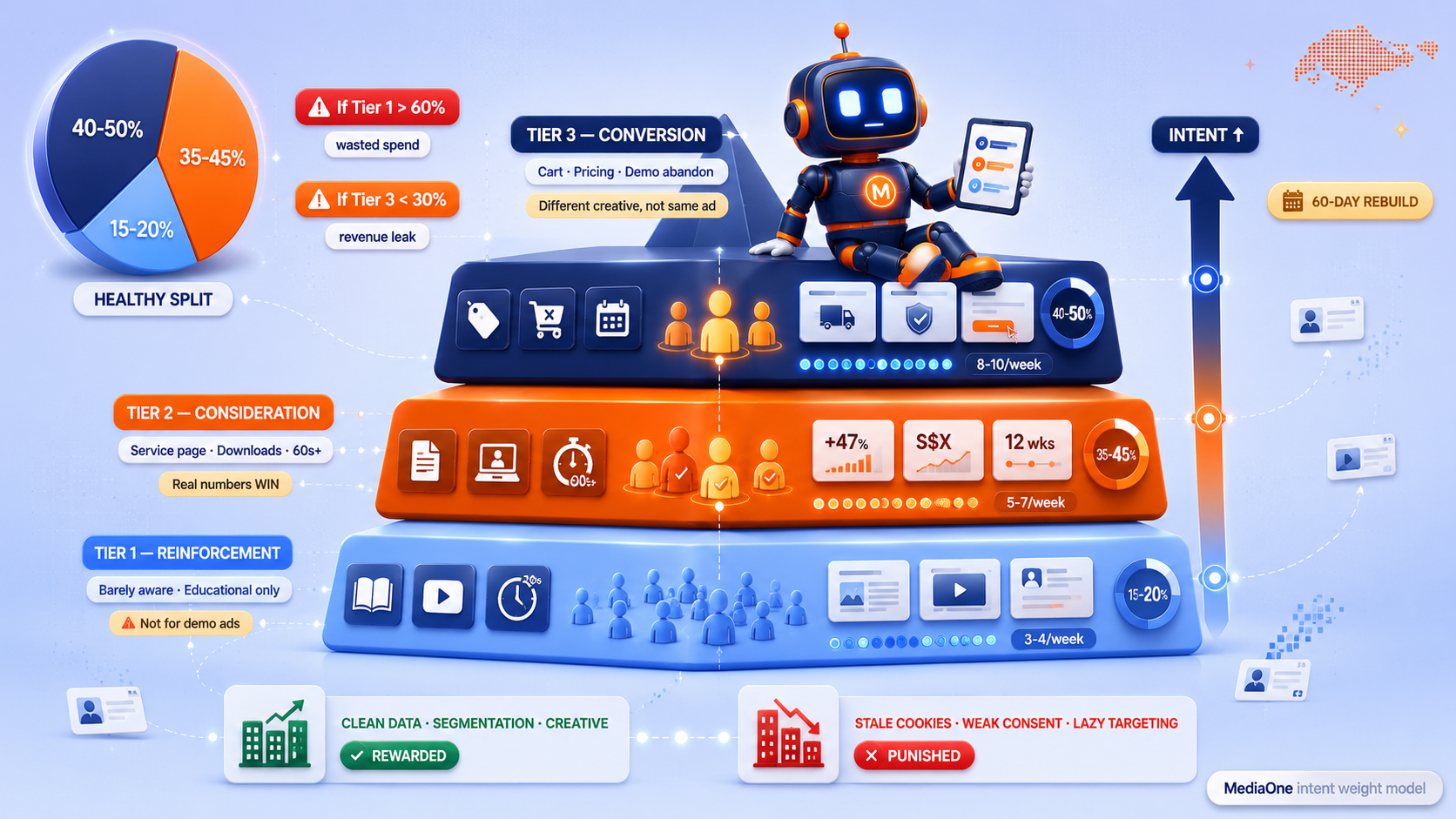
Most agencies talk about retargeting as one thing. We split it into three tiers based on intent, which we call the Intent Weight Model.
Every past visitor is scored based on behaviour, and each tier gets a different creative approach, budget share, and frequency cap. This is the structure that produces the largest efficiency gains in the first 60 days of any account rebuild.
Tier 1: The Reinforcement Layer
| Who sits here: | People who read a blog, watched a short video, or spent under 30 seconds on a landing page. They know your name now, but barely. |
| What to serve them: | Educational follow-ups, founder-led content, or a single proof point. Never a hard sell. |
| Frequency cap: | Three to four impressions per week, maximum. Push harder than that and you burn goodwill before it exists. |
| Common mistake: | Showing this tier the same “book a demo” ad as your bottom-funnel audience. It converts almost nothing and inflates cost per acquisition across the whole account. |
Tier 2: The Consideration Layer
| Who sits here: | Service-page visitors, guide downloaders, webinar registrants, and readers who spent over 60 seconds on site. These are the visitors most worth chasing, and the query how to retarget website visitors who did not convert is essentially a question about this tier. |
| What to serve them: | Comparison content, case studies with real numbers, and testimonials from customers in similar industries. |
| Frequency cap: | Five to seven impressions per week. |
Case studies with a real outcome (percentage lift, currency figure, or timeframe) consistently outperform generic testimonial ads in this tier. If your case studies read like brand kudos rather than a story with numbers, they will not carry Tier 2.
Tier 3: The Conversion Layer
| Who sits here: | Pricing page visitors, cart abandoners, demo-request abandoners, and repeat visitors who have hit multiple key pages. This tier answers the search behind best retargeting ads for high intent buyers, because these are the people closest to a decision. |
| What to serve them: | Objection handling, risk reversal, time-limited offers, or a direct human handover such as “book a 15-minute call with a specialist”. |
| Frequency cap: | Eight to ten impressions per week. This is the only tier where higher frequency is defensible. |
Cart abandoners almost always get retargeted with the same product ad they saw before leaving. That does not work. What works is a different creative angle addressing the specific hesitation:
- For local B2C: shipping cost, return policy, or price comparison
- For B2B: implementation friction or contract commitment
The Budget Ratio That Actually Matters
Across the accounts we audit, the healthiest split of retargeting spend across these tiers looks like this:
| Tier | Budget Share | Purpose |
| Tier 1: Reinforcement | 15-20% | Brand recall |
| Tier 2: Consideration | 35-45% | Objection handling |
| Tier 3: Conversion | 40-50% | Direct revenue |
If more than 60% of retargeting budget is going to Tier 1, you are paying to remind people you exist without moving them forward. If less than 30% is going to Tier 3, you are leaving revenue in a warm audience that decays by the day.
The Four Types of Retargeting, Ranked by ROI Impact in 2026
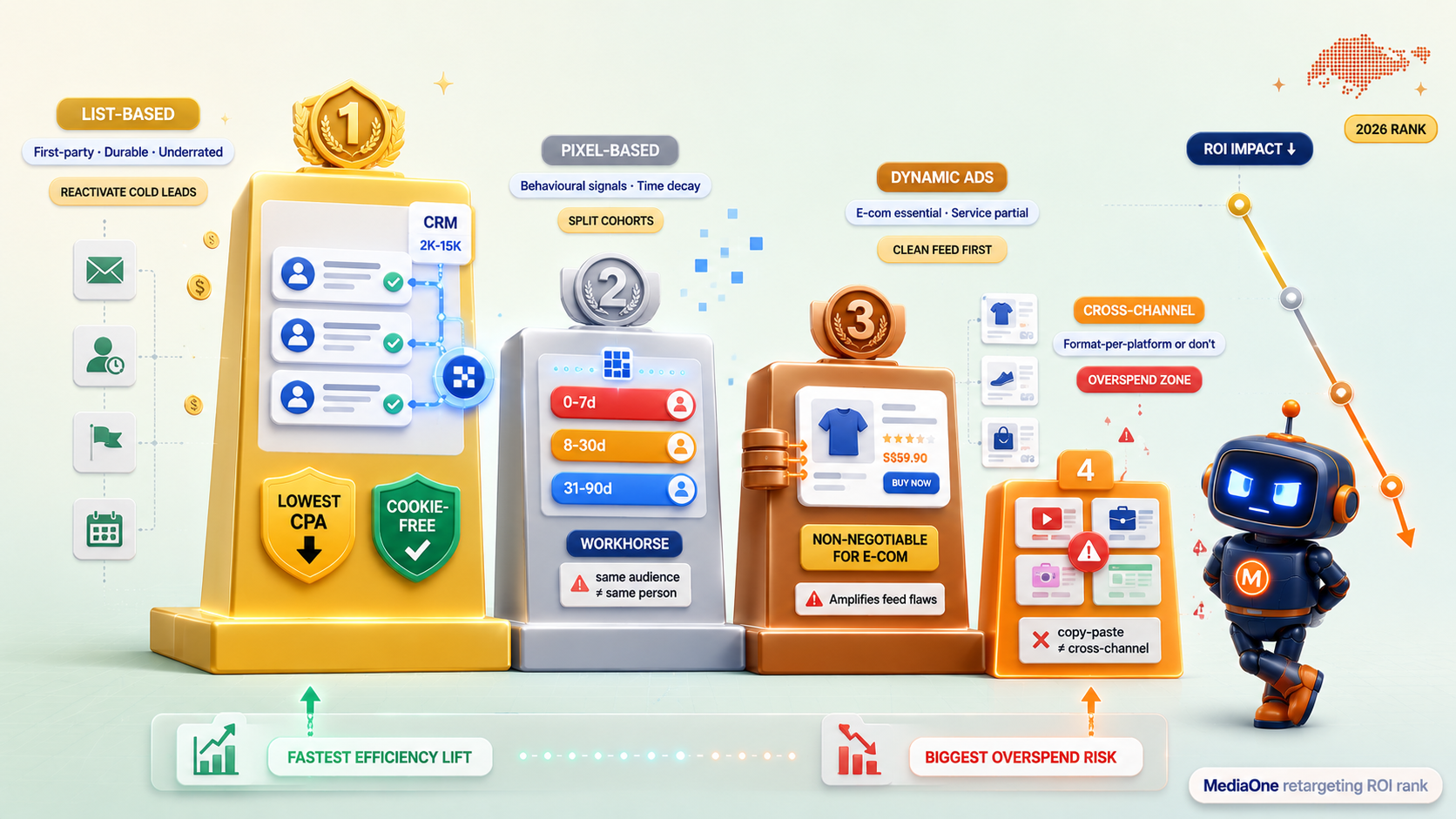
Not every retargeting method deserves equal weight. Based on the accounts we run, here is the honest ranking.
1. List-Based Retargeting: Underrated and Highest ROI
Upload email subscribers, past customers, CRM leads, and event registrants directly into Meta or Google Ads. In a privacy-first environment, this is the most durable retargeting asset you own because it does not rely on cookies at all.
Most Singapore SMEs sit on a CRM of 2,000 to 15,000 contacts and never activate them as a paid audience. That is a mistake. Segmented list-based retargeting to dormant leads consistently produces some of the lowest cost-per-acquisition numbers in the entire account.
Use it to:
- Reactivate leads who went cold after a proposal
- Upsell existing customers to a higher tier of service
- Promote new offerings to buyers who already trust you
- Reinforce B2B prospects in a long sales cycle who have gone silent
2. Pixel-Based Behavioural Retargeting: The Workhorse
Still the backbone of most campaigns. The pixel or event tag captures behaviour, and audiences are built from actions rather than assumptions.
On Meta specifically, the pixel setup is where most SMEs quietly break their own funnel, which is why we broke down the Facebook targeting techniques that actually hold up under Advantage+ in a separate piece.
Layer behavioural signals with time decay. A pricing page visitor from three days ago behaves very differently from a pricing page visitor from 60 days ago. Treating them as one audience flattens performance.
Splitting them into 0-7 day, 8-30 day, and 31-90 day cohorts, with different creative for each, is one of the fastest ways to improve results without adding budget.
3. Dynamic Retargeting: Non-Negotiable for E-commerce
Dynamic ads pull the exact product a user viewed and show it back with pricing, image, and stock status. For any e-commerce business, this is not optional.
For service businesses, dynamic retargeting can still work if you tag service categories or pricing tiers, though the gain is smaller.
Dynamic ads amplify whatever is wrong with your product feed. If your feed has poor images, missing descriptions, or inconsistent pricing, dynamic retargeting will make those flaws visible at scale before it drives any revenue.
4. Cross-Channel Retargeting: Where Most Setups Overspend
The theory is that your audience lives on Google, Meta, LinkedIn, and YouTube throughout the day, so your message should follow them. The execution is where budgets get burned.
Running the same static banner across all four platforms is not cross-channel retargeting. It is a copy-paste.
Real cross-channel retargeting means matching format to platform:
- YouTube: Long-form educational video
- LinkedIn (B2B): Founder-led content and social proof
- Instagram: Product visuals and testimonials
- Google Display: Reminder banners with strict frequency caps
Cross-channel works when the format changes to fit the platform. When it does not, you are paying four networks to annoy the same person.
Setting Retargeting Windows: The Mistake Even Experienced Marketers Make
The default window on most platforms is 30 days. Almost every client we onboard has been using it, and for the majority, it is wrong.
The correct answer to how long should a retargeting window be is not a number. It is a function of your average sales cycle.
Here is the pattern we recommend:
| Business Type | Sales Cycle | Recommended Window |
| E-commerce, impulse-buy price point | 1-3 days | 7-14 days |
| E-commerce, considered purchase | 1-3 weeks | 30-45 days |
| B2C services (aesthetics, tuition, F&B) | 1-4 weeks | 30-60 days |
| B2B SaaS, low ticket | 2-6 weeks | 60-90 days |
| B2B services, high-value contracts | 2-6 months | 90-180 days |
| Property, education, insurance | 3-12 months | 180 days plus CRM list |
Retargeting within the first seven days generally produces conversion rates two to three times higher than audiences older than 30 days for shorter cycles.
That does not mean older audiences are useless. It means they need different messaging, usually softer and value-led rather than direct-response.
The Singapore-Specific Reality Most Global Articles Miss
Almost every retargeting article available online is written from a US or European perspective. Singapore behaves differently, and three local realities change how retargeting should be built here.
-
Audience Pools Are Small
Even a well-trafficked local site will have retargeting pools between 20,000 and 200,000.
That means creative fatigue sets in within two to three weeks, not the four to six weeks quoted in most benchmarks. Rotation cadence needs to be tighter.
-
Cross-Language Behaviour Matters
English is dominant, but Mandarin, Malay, and Tamil audiences behave differently on ad creative, particularly in F&B, education, and healthcare verticals.
Retargeting the same ad in English to a bilingual audience that first engaged with your Mandarin content usually underperforms. Match the language of the retargeting ad to the language of the initial touchpoint.
-
Consideration Cycles Are Longer Than Global Benchmarks Suggest
Singapore buyers, especially in B2B, comparison-shop more than most Western markets. A 30-day window that works in the US often needs to stretch to 60-90 days locally.
Cutting the window too short is the single most common configuration error we see when auditing accounts run by overseas agencies. This is one of the reasons picking a local digital marketing agency in Singapore that understands local buyer behaviour tends to produce better retargeting economics than the same budget deployed by a regional or global team.
The Measurement Question Most Agencies Avoid
Here is an uncomfortable observation from our audit work.
Most retargeting campaigns look far more successful than they actually are, because last-click attribution gives retargeting credit for conversions that would have happened anyway.
The scenario plays out like this:
The person who was going to convert this week visits your site, leaves briefly to check something, sees your retargeting ad, clicks it, and buys. The retargeting ad gets 100% of the credit. The reality is closer to 10-30%.
The Fix: Incrementality Testing
We push every serious client to run incrementality testing at least quarterly.
In simple terms:
- Hold back a small portion of your retargeting audience as a control group who sees no ads
- Compare their conversion rate against the exposed group over 30 days
- The difference is the true incremental value of your retargeting layer
Remerge has a good breakdown of ghost bid methodology for anyone wanting the technical detail.
Some accounts we have tested came back with retargeting delivering 60-70% incremental lift. Others came back with 10-15%. Both results are useful. The account with 15% lift is not wasting money, but the operator now knows to scale prospecting rather than pouring more into retargeting.
If you have never run this test, you do not actually know whether your retargeting is driving revenue or just claiming it.
Common Retargeting Mistakes That Quietly Drain Budget
Every one of these is something we have fixed in a live account this year.
Mistake 1: Blending Prospecting and Retargeting Under One Campaign |
|
| When retargeting sits inside the same campaign as cold prospecting, the platform’s algorithm blurs the two audiences, attribution becomes unreliable, and budget flows toward whichever ad set has the lowest cost per result on the surface, usually the wrong one. | |
| Fix: | Separate them completely. Different campaigns, different budgets, different creative pools, different reporting. |
Mistake 2: One-Size-Fits-All Audience |
|
| Serving the same ad to a blog reader and a checkout abandoner is not retargeting. It is remarketing spray-and-pray. | |
| Fix: | Segment by behaviour, page depth, and recency, or do not bother. |
Mistake 3: Never Rotating Creative |
|
| Singapore audience pools are small, and creative fatigue sets in fast. | |
| Fix: | Rotate creative every two to four weeks. Vary format across static, carousel, and short video. Adjust the message based on recency. |
Mistake 4: Not Excluding Converted Users |
|
| Every week we find accounts still serving conversion ads to people who bought weeks ago. This is expensive, damaging to brand perception, and easily fixed. | |
| Fix: | Build exclusion lists from thank-you pages, CRM sync, and purchase events. Move converted users into a separate upsell or loyalty audience. |
Mistake 5: Ad-Landing Page Mismatch |
|
| Your ad promises a specific outcome, but the landing page delivers a generic homepage. Every time this happens, you lose trust and the click is wasted.
Retargeting amplifies expectations because the user has interacted with you before. Inconsistency between ad and page will hurt you more here than in prospecting. |
|
| Fix: | Match the ad headline, offer, and tone directly to the landing page it points to. |
Where Retargeting Fits Alongside SEO, Email, and Search
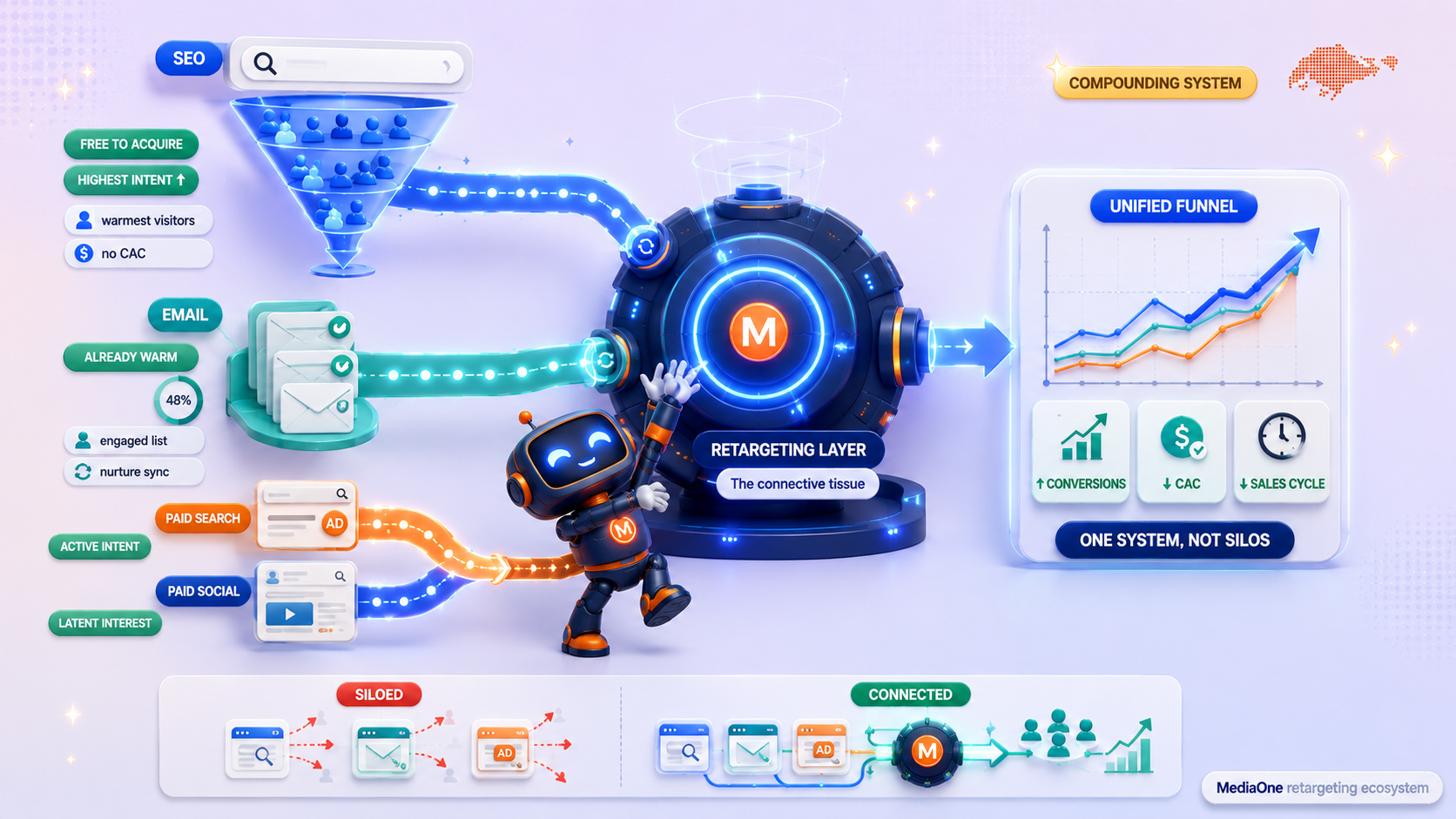
Retargeting does not live in isolation. In our client work, the highest-performing accounts always have retargeting connected to three other layers.
Layer 1: Organic Search Traffic
Organic visitors are among the warmest, highest-intent audiences you can retarget, and they cost nothing to acquire in the first place.
Feeding SEO traffic into a structured retargeting layer is one of the cleanest efficiency plays available, which is why our SEO services and paid media teams share the same brief on every account.
Layer 2: Email Nurture
People opening your emails are already warm. Syncing an engaged email list into Meta or Google Ads gives you a paid layer that reinforces every email touchpoint, especially in longer sales cycles.
Our breakdown of the full social media marketing funnel shows how these email cohorts get layered against paid social for compounding effect.
Layer 3: Paid Search and Paid Social
Search captures active intent and paid social captures latent interest. Retargeting captures both back into a single funnel.
Without it, the two channels look like siloed campaigns. With it, they behave as one system.
Businesses that want retargeting to plug into the full acquisition stack rather than run as an afterthought usually see the fastest gains when their Google Ads agency treats prospecting, retargeting, and CRM as one connected system.
The Retargeting Situations Where We Tell Clients to Wait
Not every business should invest heavily in retargeting right now. These are the situations where we recommend fixing other things first, even at the cost of a smaller retainer.
| Situation | Why Retargeting Will Not Help Yet |
| Traffic below 1,500 monthly visitors | Audience pool too small to move meaningful numbers. Focus on acquisition and content first. |
| Landing pages converting below 1% | The problem is the offer or the page, not the follow-up. Retargeting will not fix a broken offer. |
| No CRM or tagging infrastructure | Retargeting will be ineffective or actively damaging to brand perception. Fix the plumbing first. |
| Very long, one-time buying cycles (property, luxury vehicles) | Retargeting still helps, but the ROI window is long and needs to be measured differently. Do not benchmark against e-commerce timelines. |
Retargeting is powerful when the fundamentals are in place. When they are not, it is expensive theatre.
Funding the Rebuild: Grants Most Singapore SMEs Overlook
One point worth flagging for local businesses.
If you are running a Singapore-registered SME and planning to rebuild your paid media and retargeting infrastructure, part of the cost is often reimbursable. The PSG digital marketing grant covers up to 50% of qualifying digital marketing costs when the work is done through a pre-approved vendor, and it applies to structured retargeting builds, paid media management, and SEO packages.
The application is straightforward, and we have written a separate breakdown of the PSG grant timeline from application to reimbursement for founders who want to plan around it before committing spend.
An Honest Diagnostic Checklist
Before your next campaign review, run through this. It is the same checklist we use on the first day of any client audit.
| No. | Item |
| 1 | Are prospecting and retargeting in separate campaigns with separate budgets? |
| 2 | Do you have at least three behavioural tiers, not one blanket audience? |
| 3 | Is your retargeting window matched to your actual sales cycle? |
| 4 | Are converted customers excluded from acquisition retargeting and moved to an upsell audience? |
| 5 | Is your CRM synced into your ad platforms and refreshed at least weekly? |
| 6 | Do your ads rotate every two to four weeks? |
| 7 | Have you run an incrementality test in the last 90 days? |
| 8 | Do the landing pages match the specific ad promise, not just the general brand? |
Ticking fewer than six of these means your retargeting is almost certainly underperforming what it could deliver on the same budget.
Turning Wasted Traffic Into Revenue
The businesses that scale efficiently in 2026 are not the ones with the biggest ad budgets. They are the ones who take the traffic they have already paid for and refuse to let it walk out of the door.
Retargeting marketing is the mechanism that makes that possible. When it is structured around real intent tiers, clean first-party data, and honest measurement, it becomes the single most efficient layer in the entire funnel.
If you would like a paid media specialist to look at how your current retargeting is structured and where the leaks are, MediaOne runs diagnostic sessions for Singapore businesses each month. A 30-minute review usually surfaces two or three fixes worth more than the entire monthly ad spend.
Speak to our team at MediaOne, a digital marketing agency built around full-funnel performance work, and we will walk through your setup.
Frequently Asked Questions
Does retargeting marketing work for services, not just products?
Yes, and often better than for products, because service buyers tend to research longer before committing. The question how to retarget website visitors for a service business comes down to two things: segmenting by page depth (blog reader against service page visitor against pricing page visitor) and serving different proof for each tier. Case studies work harder than generic brand ads at the middle and bottom of the funnel.
What is a good retargeting frequency cap?
For most Singapore B2C accounts, three to seven impressions per week per person works well. For B2B in longer cycles, you can push to eight to ten at the bottom of the funnel where the audience is small and the intent is high. The wrong answer is having no cap at all, which is where most creative fatigue starts.
Yes, but the balance has shifted. Retargeting built on first-party data, meaning your CRM lists, engaged email subscribers, and on-platform behaviour, is now more valuable than retargeting built on pixel-only cookie tracking. Businesses that invested early in first-party data collection have a measurable advantage over those still catching up.
Why do retargeting ads sometimes feel intrusive to users?
Almost always because of one of three issues: no frequency cap, no exclusion of converted users, or one creative running for weeks without rotation. Well-structured retargeting does not feel like being followed. It feels like a relevant reminder at the right time.
How do I know if my retargeting is actually driving incremental revenue?
Run a holdout test. Segment your retargeting audience into an exposed group and a control group, then compare conversion rates over 30 days. The difference is your true incremental lift. Without this test, last-click attribution overstates retargeting’s contribution, sometimes by three to five times.
Can retargeting improve brand awareness, or is it only for conversion?
Both. The Tier 1 reinforcement layer described earlier is a brand play, keeping you top of mind so that when the buyer is ready, they think of you first. The measurable outcome is not immediate conversions but a lift in branded search volume and direct traffic over 60 to 90 days.