Guerrilla marketing is an innovative, cost-effective way for businesses to cut through advertising noise and make a lasting impact.
In fact, 86% of consumers say guerrilla marketing campaigns are more memorable than traditional advertising, underscoring the power of unconventional, creative tactics to stay top of mind.
By leveraging imagination, surprise, and unexpected experiences, guerrilla marketing connects brands with audiences more deeply. It generates buzz and word-of-mouth exposure that can far exceed the investment.
If you’re looking for fresh, engaging ways to market your business, whether you’re working with a Google Ads agency or running campaigns in-house, this article explores guerrilla marketing and showcases 13 creative examples to inspire your next breakthrough campaign.
Key Takeaways
- Guerrilla marketing is an unconventional marketing strategy focused on creativity and surprise, often with minimal cost.
- It works through memorable and interactive campaigns that engage customers emotionally and leave a lasting impact.
- Some of the most effective guerrilla marketing campaigns have gone viral and generated significant attention without large budgets.
- Guerrilla marketing is an effective option for businesses of any size to increase visibility and build strong connections with their audience.
What Is Guerrilla Marketing?
Guerrilla marketing is a strategy that uses unconventional, low-cost tactics to maximise exposure. Unlike traditional advertising, which relies on large-scale media buys (TV, print, etc.), guerrilla marketing relies on creativity, surprise, and interactivity to make a lasting impression on the audience.
This approach taps into human emotions through shock value, humour, or social relevance to create buzz. The goal is to be memorable, making the audience notice your brand in unexpected places.
From street art to flash mobs to viral social media challenges, guerrilla marketing finds new ways to engage your audience. It aims to do this with minimal financial investment.
How Guerrilla Marketing Works
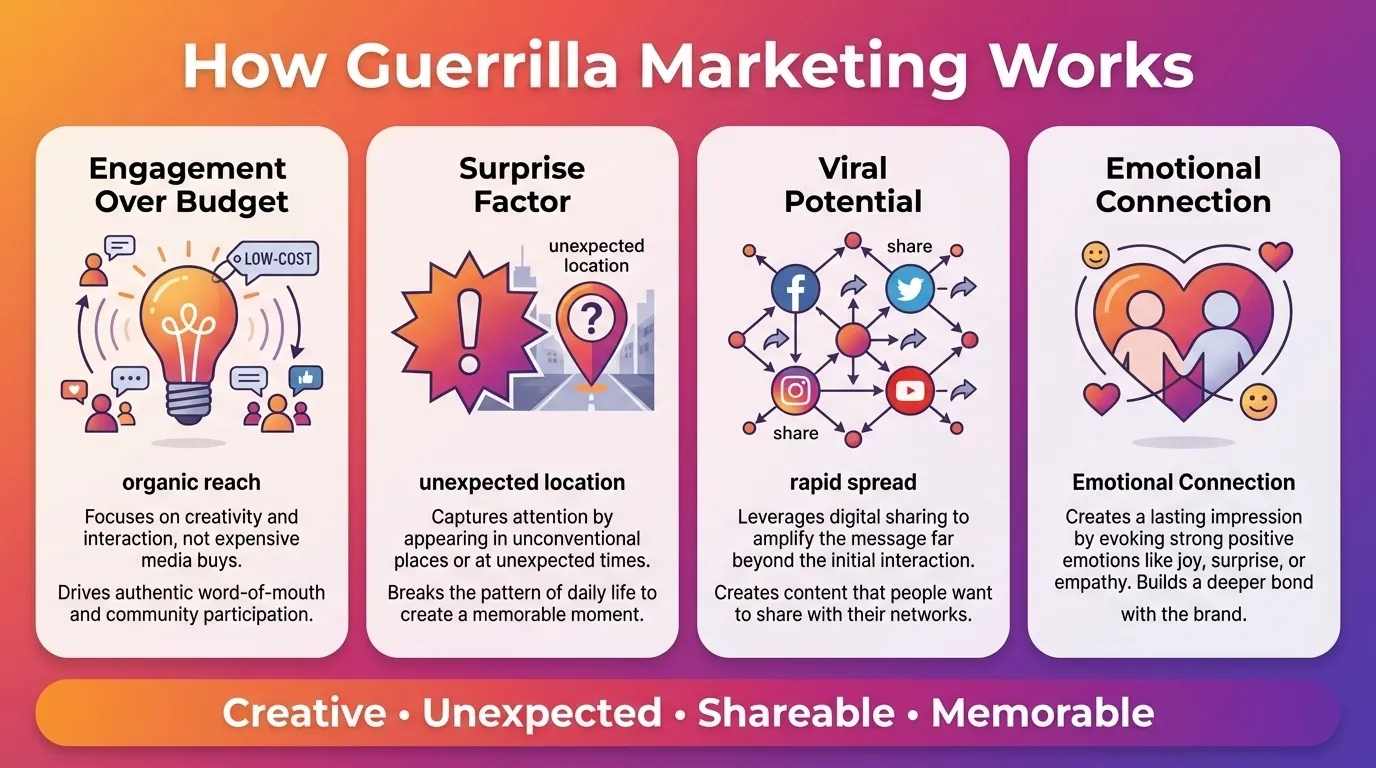
Guerrilla marketing surprises audiences with engaging, unexpected experiences. It creates interactions that feel personal, emotional, and fun. Here’s how:
Engagement Over Budget
Guerrilla marketing proves that you don’t need a massive advertising budget to create buzz. Instead of spending heavily on media placements, it relies on creative ideas that naturally capture attention and encourage participation.
Well-executed guerrilla campaigns spark organic engagement, with people willingly sharing, discussing, and promoting the campaign. This word-of-mouth effect often delivers far greater reach than paid advertising, especially when the concept feels clever or unexpected.
The Element of Surprise
One of the most powerful drivers of guerrilla marketing is surprise. By appearing in unexpected locations or using unconventional formats, these campaigns break people out of autopilot and instantly grab attention.
This could mean transforming everyday public spaces, reimagining familiar objects, or presenting a message in a way audiences don’t anticipate. When people are pleasantly surprised, they are far more likely to pause, engage, and remember the brand behind the experience.
Guerrilla marketing campaigns are often designed with virality in mind, especially in today’s social-first world. When people encounter something surprising or entertaining, their instinct is to share it online, whether through photos, videos, or stories.
By encouraging audiences to document and share their experiences, guerrilla campaigns can spread rapidly across social platforms. This organic amplification allows brands to reach a much larger audience than the original physical or digital activation alone, significantly boosting visibility.
Emotional Connection That Lasts
The most successful guerrilla marketing campaigns tap into human emotions. Whether it’s humour, inspiration, curiosity, or empathy, emotional responses make experiences more memorable and meaningful.
When people experience a positive emotion, they are more likely to associate it with the brand. This emotional connection not only increases recall but also helps build stronger brand loyalty, as customers feel a deeper connection beyond a simple transaction.
Guerrilla marketing is about capturing your audience’s attention in an authentic, unforgettable way. When you combine engagement, surprise, virality, and emotional connection, you can spark a buzz. This turns customers into passionate brand ambassadors eager to share your message.
Key Features of Guerrilla Marketing
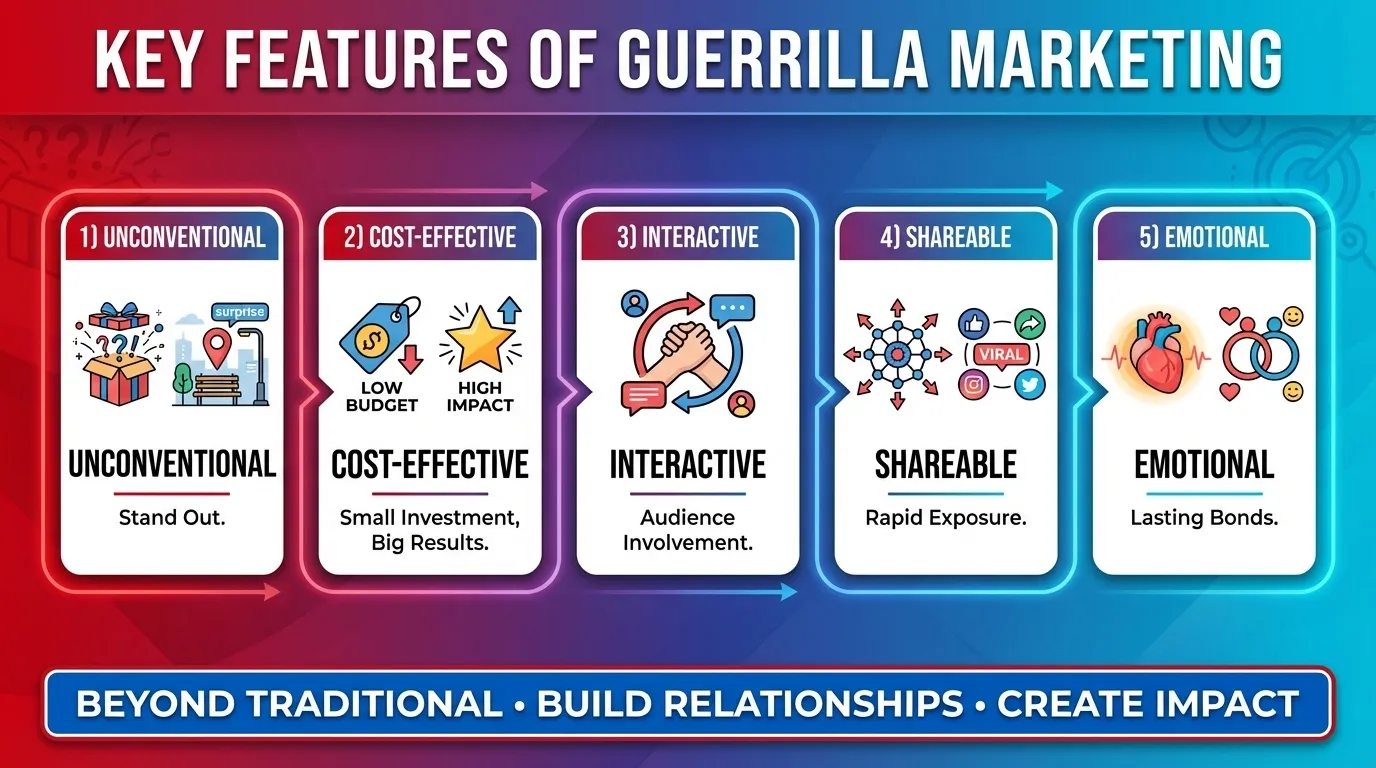
To truly understand guerrilla marketing, you need to grasp its key characteristics. These features are what set it apart from traditional marketing strategies.
Unconventional and Surprising
Guerrilla marketing thrives on unexpected locations and formats that catch people off guard. Instead of relying on predictable advertising spaces, campaigns often appear in everyday environments such as streets, public transport areas, parks, or digital spaces where audiences don’t expect to be marketed to.
By disrupting routine and presenting something unusual, guerrilla marketing forces people to pause and take notice. This element of surprise is critical, as it helps the campaign stand out in a world where consumers are constantly exposed to ads and have become skilled at ignoring them.
Cost-Effective by Design
One of the biggest advantages of guerrilla marketing is its cost efficiency. Rather than spending heavily on media buys, guerrilla campaigns focus on creative execution and clever use of resources.
A simple idea, executed well, can generate significant attention without a large budget. This makes guerrilla marketing especially appealing for startups and smaller businesses, but it’s equally effective for larger brands looking to maximise impact without excessive spend.
Interactive and Participatory
Guerrilla marketing doesn’t just talk at the audience; it invites them to take part. Interaction might come in the form of:
- Live experiences or installations
- Social media challenges
- Physical or digital activations that encourage participation
When audiences actively engage with a campaign, they are more likely to remember it and feel a personal connection to the brand. This participation also increases the likelihood of sharing the experience with others.
Shareability is one of guerrilla marketing’s strongest assets. Campaigns that are fun, unexpected, or thought-provoking naturally encourage people to take photos, record videos, and share their experiences online. This organic sharing helps campaigns spread rapidly across social media platforms, often reaching far beyond the original audience. As a result, brands can achieve massive exposure without relying on paid amplification.
Strong Emotional Appeal
At the heart of guerrilla marketing is emotion. Whether it’s humour, inspiration, curiosity, or empathy, emotional responses make campaigns more memorable.
When people feel something, they are far more likely to talk about the experience and associate that feeling with the brand itself. This emotional connection increases recall, strengthens brand perception, and contributes significantly to a campaign’s viral success.
With its unconventional methods, cost-effectiveness, and ability to create emotional connections, guerrilla marketing offers a unique approach that goes beyond traditional advertising. When done right, it not only grabs attention but also builds long-lasting relationships with your audience.
13 Creative Examples of Guerrilla Marketing Campaigns
Now that we’ve covered the basics, let’s take a look at 13 creative guerrilla marketing examples from some of the most successful campaigns in recent years. These examples show how businesses used creativity and surprise to engage audiences and make a memorable impact. They often did this without breaking the bank.
1. IKEA Sleepover
IKEA invited a select group of customers to sleep overnight in its store, turning an ordinary shopping experience into an unforgettable adventure. Participants enjoyed a real-life sleepover in the store, complete with snacks, sleepwear, and guided activities.
This campaign generated huge social buzz as attendees shared their experiences. By making IKEA fun and approachable, the event forged an emotional bond and showcased products through hands-on engagement.
The sleepover was not just a promotional stunt. It brought the brand to life and turned customers into brand advocates. Experiential marketing works because it creates memorable, engaging experiences that reflect the brand’s identity.
This worked because it turned a store visit into a story worth sharing, while letting customers “test” products in the most convincing way possible, by actually living in the showroom.
Coca-Cola’s Share a Coke campaign replaced the brand’s iconic logo on bottles with popular first names, encouraging consumers to find a bottle with their name or the name of someone special.
This campaign tapped into the emotional appeal of personalisation, fostering a connection between the brand and its consumers. Coca-Cola encouraged people to share pictures of their bottles on social media, making the campaign highly interactive and shareable.
This approach boosted brand visibility, drove engagement, and built community among Coca-Cola’s customers. Personalisation turns a product into a shared experience, increasing engagement.
Putting names on packaging transformed a mass-produced item into a personal object, naturally prompting collecting, gifting, and social sharing without additional persuasion.
3. Red Bull Stratos Jump
In 2012, Red Bull sponsored Felix Baumgartner’s record-breaking jump from the edge of space, which was streamed live for millions of viewers. The campaign is perfectly aligned with Red Bull’s brand, which is centred on adventure, extreme sports, and pushing limits.
The stunt was not just a marketing campaign; it was a spectacular event that captured the world’s attention. The campaign garnered global media coverage, and the livestream broke records for online viewership.
This campaign cemented Red Bull’s position as a leader in extreme sports and innovative marketing, demonstrating that high-impact stunts can drive significant brand exposure. Bold, innovative campaigns that align with your brand values can generate global exposure.
Sponsoring Felix Baumgartner’s real, high-stakes feat gave the brand “owned media” at a global scale, with credibility that no ordinary ad can buy.
4. The Blair Witch Project
The filmmakers of The Blair Witch Project used guerrilla marketing to create mystery around the film’s plot. They posted fake documentary-style footage, news reports, and an official website, all designed to make the audience believe the film’s events were real.
This tactic blurred the line between fiction and reality, creating an air of suspense and intrigue. The viral campaign encouraged fans to research the story, building excitement well before the movie’s release.
By crafting a mysterious narrative and leveraging the internet for viral marketing, the filmmakers built anticipation, generating a cult following for the film. Mystery and suspense are effective guerrilla marketing tactics that spark curiosity and encourage audience engagement.
The campaign succeeded by making the audience do the work, because curiosity, combined with “is this real?” speculation, created viral distribution long before social platforms operated as they do today.
5. Volkswagen Fun Theory
Volkswagen’s Fun Theory encouraged people to take the stairs instead of the escalator by transforming them into a giant piano keyboard. Each step played a musical note, turning an everyday activity into an entertaining experience.
The campaign not only increased participation but also reinforced Volkswagen’s commitment to creativity and innovation. By making the mundane fun, Volkswagen captured passersby’s attention, prompting them to reconsider their choices.
The Fun Theory campaign was a huge success because it engaged people in unexpected, interactive ways, making them more likely to share their experiences on social media. Interactive campaigns that make everyday activities more fun can increase participation and foster positive brand association.
It used behavioural design instead of messaging, rewarding the desired action instantly, so people participated first and only then connected it back to the brand.
6. ALS Ice Bucket Challenge
The ALS Ice Bucket Challenge became a viral sensation, with people around the world dumping ice-cold water over themselves to raise awareness for ALS (Amyotrophic Lateral Sclerosis).
What began as a simple social media challenge quickly turned into a global movement. The campaign raised millions for ALS research, thanks to celebrity endorsements and the involvement of everyday people, who were challenged to participate and then nominate others.
By using social media and encouraging participation, the campaign achieved massive reach and raised significant funds for a good cause. Social media challenges are a great way to engage a broad audience and raise awareness for social causes.
The format was frictionless and repeatable, and the nomination mechanic created a built-in distribution loop, which is why it spread faster than typical charity awareness campaigns.
7. Nike’s “Find Your Greatness”
Nike’s “Find Your Greatness” campaign featured everyday athletes rather than professional athletes, emphasising that greatness is not limited to the elite. The campaign used real people, not just athletes, encouraging anyone to pursue their own version of greatness.
By focusing on inclusivity and personal achievement, Nike connected with a wide audience beyond just sports fans. The campaign resonated emotionally, inspiring and empowering many.
By focusing on personal empowerment, Nike not only promoted their products but also aligned their brand with the idea of self-improvement. Emotion-driven marketing that promotes personal empowerment can create deep brand loyalty and broaden your audience.
Featuring everyday athletes widened identification, making the message feel attainable, which is a strong route to brand affinity when you want scale beyond hardcore sports fans.
8. Burger King’s “Whopper Detour”
Burger King’s “Whopper Detour” campaign offered a Whopper for 1 cent to people who were near a McDonald’s, encouraging them to drive to the nearest Burger King instead.
This cheeky, competitive marketing tactic used an app-based promotion to target McDonald’s customers. The campaign generated significant attention and sparked a friendly rivalry, with people eager to claim their discounted Whopper.
The location-based strategy and playful competition made the campaign fun and disruptive, ultimately very successful in attracting attention to the brand. Competitive guerrilla marketing that targets a competitor’s audience can create memorable brand experiences and increase foot traffic.
The genius was using location targeting near McDonald’s to hijack intent at the exact decision moment, while also driving app installs as a secondary win.
9. TOMS “One Day Without Shoes”
TOMS’ “One Day Without Shoes” campaign encouraged people to go barefoot for a day to raise awareness of the challenges faced by children in impoverished communities without access to shoes.
This campaign cleverly leveraged social media to inspire participation, with participants sharing photos of themselves going barefoot using the hashtag #WithoutShoes. By encouraging people to experience firsthand a problem faced by many, TOMS highlighted the importance of shoes in preventing disease and improving quality of life.
The campaign was impactful because it was simple, engaging, and easy to participate in, while effectively raising awareness for a social cause. It is also perfectly aligned with TOMS’ brand mission, which focuses on making a difference in people’s lives with each purchase.
Cause-related guerrilla marketing can be highly impactful when it invites people to engage personally with a social cause, fostering emotional connections and driving action.
It created empathy through participation, so the cause felt personal rather than abstract, and that emotional involvement made sharing feel like advocacy rather than promotion.
10. Carlsberg’s “Probably the Best Poster in the World”
Carlsberg created a beer-powered billboard in Copenhagen, where people could press a button and receive a cold beer.
This playful, interactive campaign reinforced Carlsberg’s brand message of being “probably the best” while offering the public an unexpected experience. The campaign was a huge success in tapping into local culture and creating a fun, memorable interaction with the brand.
By connecting the brand with a fun, social experience, Carlsberg enhanced its appeal and boosted customer engagement. Interactive and memorable experiences tied to your product can enhance brand perception and increase engagement.
Turning a billboard into product sampling in Copenhagen made the ad tangible, and that “you will not believe this” moment is exactly what fuels organic filming and sharing.
11. Kit Kat’s “Bench” Campaign
Kit Kat turned an ordinary park bench into a giant chocolate bar, encouraging people to take a break. The campaign’s simple, clever concept reinforced Kit Kat’s brand message, “Have a break, have a Kit Kat.”
The product’s use in a fun, unexpected way made the campaign incredibly engaging, turning a public bench into a conversation starter.
This fun, playful twist on an everyday object made Kit Kat’s campaign both memorable and effective. Sometimes, simple and creative ideas can leave a lasting impression on your audience and strengthen your brand identity.
It’s a great example of environmental branding, using a common public object to reinforce the product’s core message in context, making recall feel effortless.
12. Taco Bell’s “Taco Liberty Bell”
In 1996, Taco Bell announced that it had purchased the Liberty Bell, creating a national uproar. The campaign was a prank that generated widespread media coverage and prompted people to question the announcement’s legitimacy.
The prank successfully caught the public’s attention and helped Taco Bell gain national press coverage. This humorous, bold tactic disrupted expectations and generated excitement, positioning Taco Bell as a fun and irreverent brand.
Humour and surprise can help create viral buzz and capture attention in unexpected ways. A prank tied to a national symbol like the Liberty Bell guarantees earned media, but it only works when the reveal is timed well enough to avoid genuine public backlash.
13. Peta’s “I’d Rather Go Naked”
PETA’s “I’d Rather Go Naked” campaign featured celebrities posing nude to raise awareness about animal rights. While controversial, the campaign generated massive attention and was widely covered in the media.
The campaign’s boldness prompted people to discuss PETA’s cause and generated buzz around the brand’s message.
By using shocking visuals and controversy, PETA created a campaign that sparked conversation and attention. Controversial guerrilla marketing can generate significant media coverage, but it’s essential to align it with your brand’s values.
This is “designed controversy,” where polarisation is part of the distribution strategy, and it only makes sense if your brand is comfortable trading broad likeability for sustained attention to a cause.
How to Create Your Own Guerrilla Marketing Campaign
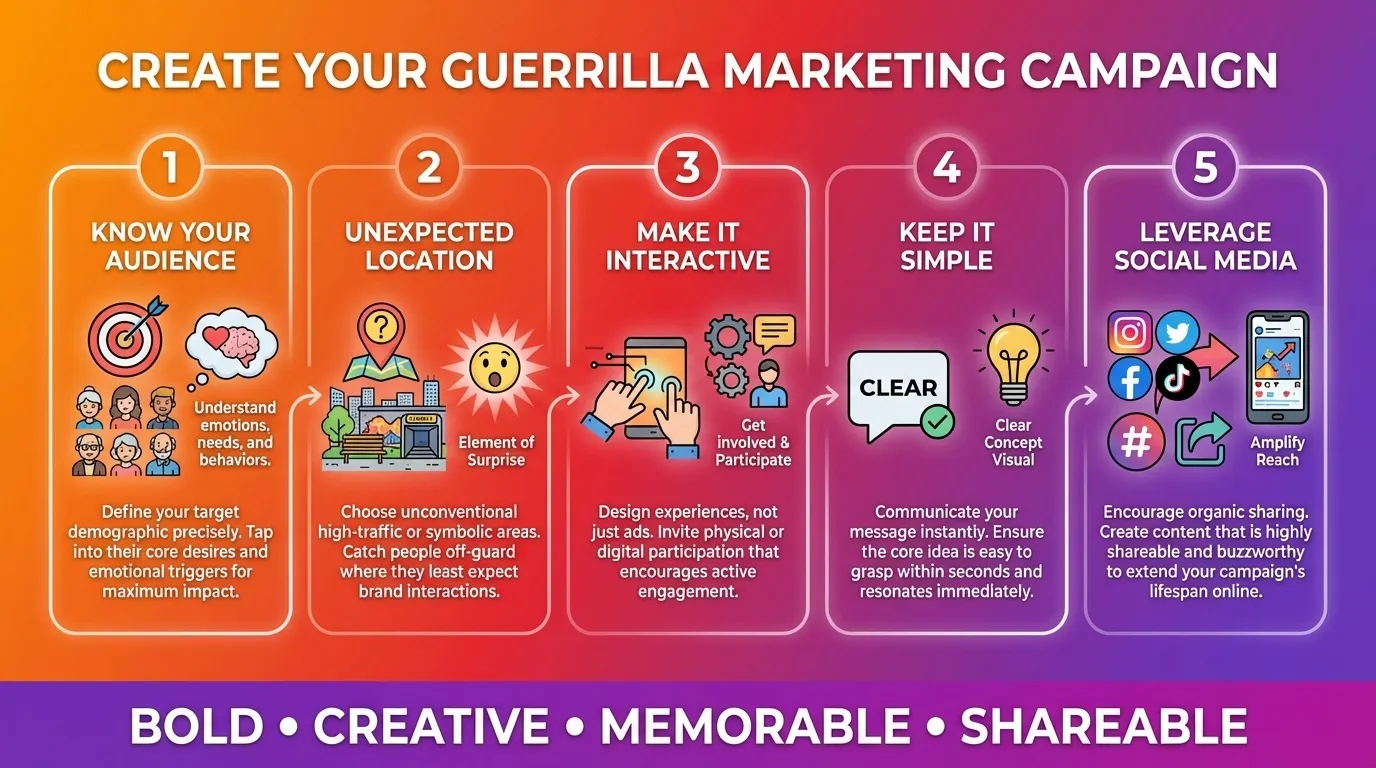
Ready to create your own guerrilla marketing campaign? Guerrilla marketing is all about being bold, creative, and memorable. Follow these steps to craft a campaign that stands out, grabs attention, and leaves a lasting impression on your audience.
1. Know Your Audience
Guerrilla marketing only works when it feels like it was made for that audience in that moment. If you don’t understand what your audience finds funny, share-worthy, or meaningful, even the most “creative” stunt will land flat.
Focus areas to lock in first:
- Who they are in context (not just demographics)
- Daily routines: commute, office hours, weekend habits
- Where they spend attention: TikTok, MRT, malls, niche communities
- What they’re trying to solve: convenience, savings, confidence, belonging
- What actually triggers action
- Humour: quick shares and tags
- Nostalgia: “this is so me” reactions
- Surprise: attention and filming
- Belonging: participation and community-building
- Achievement: people posting it as a personal win
Once you’ve mapped those, design the campaign around how they naturally behave. Ask yourself: would they stop for 10 seconds, 30 seconds, or 2 minutes? Then build the experience to match that attention window.
Simple segment examples:
- Millennials / Gen Z: Interactive challenges, Easter eggs, social-first mechanics (QR, filters, “tag to unlock”)
- Families: Wholesome, safe, photo-friendly activations that are easy to participate in
2. Pick an Unexpected Location
Guerrilla marketing thrives on placement because the location is often the hook. When a brand shows up in places people don’t expect, the environment itself becomes part of the story, which is why it earns attention without needing a big ad spend.
Where “unexpected” tends to work best:
- Waiting zones: MRT platforms, escalators, queues, lift lobbies
- Pause zones: parks, benches, plazas, event areas
- Decision zones: outside stores, near competitors, entrances where choices happen
The key is to match the location to the behaviour you want. If you want visibility, choose high-foot-traffic areas. If you want participation, pick places where people can stop safely without blocking the flow. If you want conversion, place it near moments of intent.
Make the location part of the concept:
- Turn everyday structures into interactions (stairs, pavements, benches, mirrors)
- Create a clear “photo moment” people can capture in 3 seconds
- Keep the interaction intuitive with minimal instructions
Practical checks before you commit:
- Permissions and safety (especially for public spaces)
- Weather and setup constraints (one-day stunt vs multi-week installation)
- Whether the idea can be replicated in multiple locations if it performs well
3. Make It Interactive
Interactivity is where guerrilla marketing stops being “an ad” and becomes an experience. The moment people do something rather than just see it, you create stronger recall, stronger emotion, and better sharing behaviour.
How to build interaction that people actually want to join:
- Keep the action obvious
- If people need to read a long instruction panel, you’ve already lost them
- Make the “what to do” intuitive within 3 seconds
- Design for low effort, high payoff
- Tap, scan, press, step, pose, vote
- Reward can be fun (photo moment), social (status), or tangible (sample, discount)
- Make participation social by default
- Built-in “tag a friend” mechanic
- Group-friendly interactions (two-person photo spots, challenges, mini-games)
Formats that consistently work:
- Public installations: interactive walls, AR triggers, motion-activated elements
- Social challenges: short, repeatable actions (easy to copy, easy to nominate)
- Live moments: flash mobs, pop-ups, surprise performances
- Gamified mechanics: stamp cards, scavenger hunts, leaderboard-style tasks
Reality check: if someone joins in, can they instantly explain it to a friend in one sentence? If yes, you’ve got a campaign that spreads.
4. Keep It Simple
Guerrilla marketing competes in fast, noisy environments. Your audience will not “study” your concept. They’ll either get it immediately or walk past it. Simplicity is what turns a clever idea into something memorable.
What “simple” looks like in practice:
- One idea, one message: Avoid multiple claims, multiple CTAs, or too many visuals fighting for attention
- Instant comprehension: People should understand the point at a glance, especially in public spaces
- Strong visual anchor: A bold object, a clear contrast, or a single unexpected twist
Keep your message frictionless:
- Use short phrases (think: headline length)
- Make the brand presence clear but not overpowering
- Remove anything that needs explanation to be “smart”
Quick test:
- If someone snaps a photo and posts it with no caption, will others still understand what’s happening?
If yes, it’s simple enough.
5. Leverage Social Media
Guerrilla marketing creates the moment. Social media scales it. A good activation should feel designed to be filmed and shared, not just experienced in person.
Build your campaign with shareability baked in:
- Create a clear “capture moment”
- A photo spot, a reveal, an interaction that looks satisfying on video
- Make sharing effortless
- QR codes that lead to filters or landing pages
- Simple hashtags and tagging prompts
- Give people a reason to post
- Identity: “this represents me”
- Status: “look what I found”
- Humour: “you have to see this”
- Utility: “this is actually useful”
Tactics that amplify reach without extra spend:
- Seed it with micro-creators to kickstart UGC
- Use location tags to dominate local discovery
- Repost UGC fast (momentum matters more than perfection)
Best practice: don’t just hope people will share. Design the campaign so sharing feels like the natural next step.
Common Mistakes to Avoid in Guerrilla Marketing
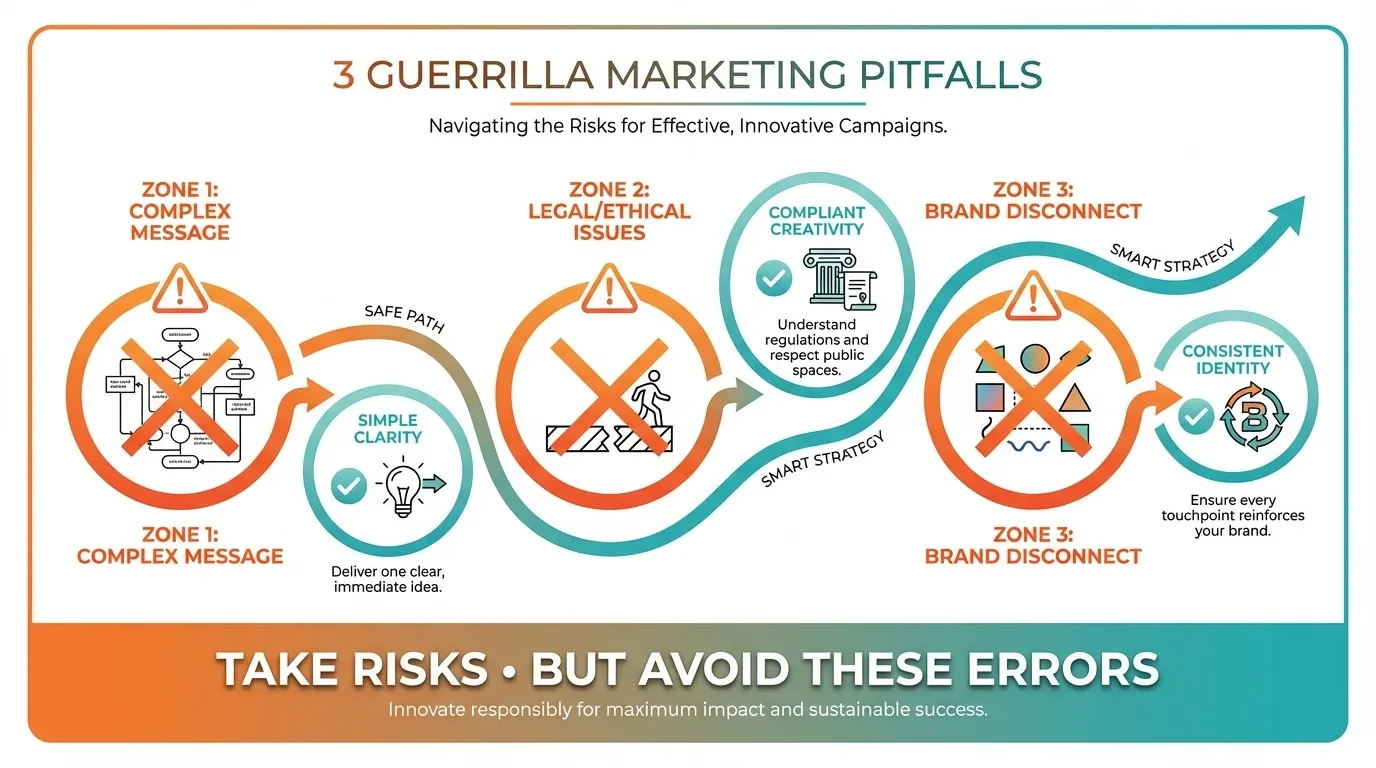
Guerrilla marketing can be a powerful tool for brands looking to make a big impact with a small budget. However, it’s also a risky strategy, and a single misstep can tarnish your brand’s reputation. To ensure your guerrilla campaign is successful, here are some common mistakes to avoid:
1. Overcomplicating the Message
One of the biggest mistakes in guerrilla marketing is overcomplicating the message. While innovation is important, a complex campaign can confuse your audience and diminish its effectiveness.
The key to successful guerrilla marketing is to deliver a clear, easy-to-understand message that grabs attention quickly.
Keep your concept simple, focusing on one core idea that can be communicated with minimal effort. Overly complex ideas often get lost in the execution, and the audience may miss the point entirely, resulting in wasted effort and resources.
2. Ignoring Legal or Ethical Boundaries
Guerrilla marketing often involves bold and unconventional tactics, but it’s crucial to stay within legal and ethical boundaries. What might seem like a harmless prank or stunt to you could be viewed as offensive, inappropriate, or even illegal by others.
Always ensure your campaign does not violate local laws, such as public space regulations, advertising standards, or intellectual property rights. Additionally, consider the social and cultural impact. What works in one region might deeply offend another.
Ethical considerations are just as important as creative execution; a campaign that crosses these boundaries can backfire, leading to negative publicity or even legal consequences.
3. Forgetting Brand Consistency
Guerrilla marketing should always align with your brand identity. A successful guerrilla campaign not only captures attention but also reinforces your brand’s core message and values. When guerrilla tactics are too disconnected from the brand, it can confuse the audience and undermine your brand’s integrity.
For example, a fun and playful campaign from a traditionally serious brand may confuse consumers or fail to resonate with your core audience. Guerrilla marketing should enhance your brand’s image without straying too far from its established identity.
Always ensure that your campaign stays true to your voice, offering an experience that feels authentic and consistent with your business’s overall messaging.
In guerrilla marketing, the execution is just as important as the concept. Avoiding these common mistakes can make the difference between a campaign that falls flat and one that goes viral.
The beauty of guerrilla marketing lies in its boldness and creativity, so take risks, but make sure you avoid these avoidable errors along the way.
Take Your Guerrilla Marketing to the Next Level
Guerrilla marketing is an incredibly effective way to capture attention and reach your target audience without a large advertising budget. By leveraging creativity, boldness, and a bit of risk, guerrilla marketing allows you to make a big impact in a small, cost-effective way.
Guerrilla campaigns excel at creating memorable experiences that surprise, engage, and entertain. This makes your brand stand out in unexpected places.
The 13 campaigns we’ve explored in this article highlight how unconventional marketing strategies can not only raise brand awareness but also ignite conversations and create viral moments that spread far beyond the initial campaign. So, why not leap and create your own guerrilla marketing campaign? It’s the perfect opportunity to connect with your customers in an authentic, exciting way.
If you need expert help to bring your creative ideas to life, MediaOne is here to guide you.
Contact us today! Let us help you design a high-impact, cost-effective marketing strategy that elevates your brand and drives real results.
Frequently Asked Questions
How do I measure the success of a guerrilla marketing campaign?
Measuring the success of a guerrilla marketing campaign can be challenging, as it often focuses more on brand awareness and engagement than on direct sales. Key metrics to track include social media mentions, shares, media coverage, engagement rates, and foot traffic to your physical or online store. It’s also important to set clear objectives for your campaign beforehand, so you can assess whether it met your goals.
Is guerrilla marketing suitable for all types of businesses?
While guerrilla marketing can be effective for a wide range of businesses, it’s especially impactful for small businesses and startups with limited advertising budgets. However, larger companies can also benefit, provided the campaign aligns with their brand identity and resonates with their audience. The key is to be creative, bold, and willing to take risks.
What is the best way to budget for a guerrilla marketing campaign?
Guerrilla marketing is known for being cost-effective, but it’s still important to allocate resources wisely. Budget for creative execution, any physical materials or props, and any permits or permissions needed for public space use. The beauty of guerrilla marketing is that you don’t have to spend much on traditional advertising; just make sure the campaign is well planned and executed to maximise impact.
How can I ensure my guerrilla marketing campaign doesn’t offend people?
When planning a guerrilla marketing campaign, it’s important to keep cultural sensitivity in mind. Avoid controversial or offensive tactics that might backfire. Test your idea with a small group to gauge reactions before launching the campaign. Ensuring that your campaign is fun, positive, and aligned with your brand values will help you avoid negative consequences.
Can guerrilla marketing be effective for online businesses?
Yes, guerrilla marketing can be highly effective for online businesses, especially when combined with social media and digital platforms. Online guerrilla campaigns often focus on creating shareable content, viral videos, or interactive challenges that generate buzz. Digital guerrilla marketing is particularly impactful because it can quickly reach a wide audience with minimal spend.