I still remember a founder telling me, “We spent six months posting every day and got nothing but likes.” No leads. No sales. Just a growing sense that something was off.
They had hired one of the many social media marketing agencies in Singapore that looked impressive at first glance. Clean portfolio. Confident pitch. Reasonable pricing.
But once the work started, it became clear there was no real strategy behind the execution. Content was consistently going out, but nothing was tied to actual business outcomes. No clear funnel. No platform rationale. No serious view on how Singapore customers discover, compare, and buy.
That situation is more common than most business owners realise.
Today, social platforms play a central role in how brands attract attention, build trust, and drive conversion and revenue. In Singapore, that matters even more because digital adoption is very high, social commerce is growing, and consumers frequently move across social content, messaging platforms, and purchase journeys.
With many agencies making similar promises around growth, engagement, and conversions, brands need clearer evidence of execution quality and business impact to distinguish genuine expertise from superficial delivery.
The wrong choice does not just waste budget. It can dilute your positioning, create inconsistent messaging, mishandle lead data, and slow down momentum at a stage where speed and clarity matter most. In a market like Singapore, where audiences are relatively concentrated and poor targeting becomes expensive fast, a weak strategy shows up quickly.
Many businesses only realise this after months of underwhelming results, when switching costs are higher and internal confidence has already dipped.
This guide is built from what I have seen across audits, transitions, and campaigns that needed fixing after the fact. It is designed to give you a clear, structured way to evaluate a social media marketing agency in Singapore, so you can avoid common pitfalls and make decisions with confidence.
If you are currently assessing social media marketing agencies in Singapore, the principles in this guide will help you judge whether an agency is the right fit before you commit.
Key Takeaways
- Define your goals clearly before speaking to any social media marketing agency.
- Prioritise agencies with relevant industry experience and proven, credible case studies.
- Assess strategy, communication, reporting, and team structure — not just content execution.
- Understand pricing, tools, AI capabilities, and legal or data compliance before signing.
- Compare agencies carefully and consider a pilot campaign to reduce risk and improve fit.
Checklist for Selecting the Best Social Media Marketing Agencies
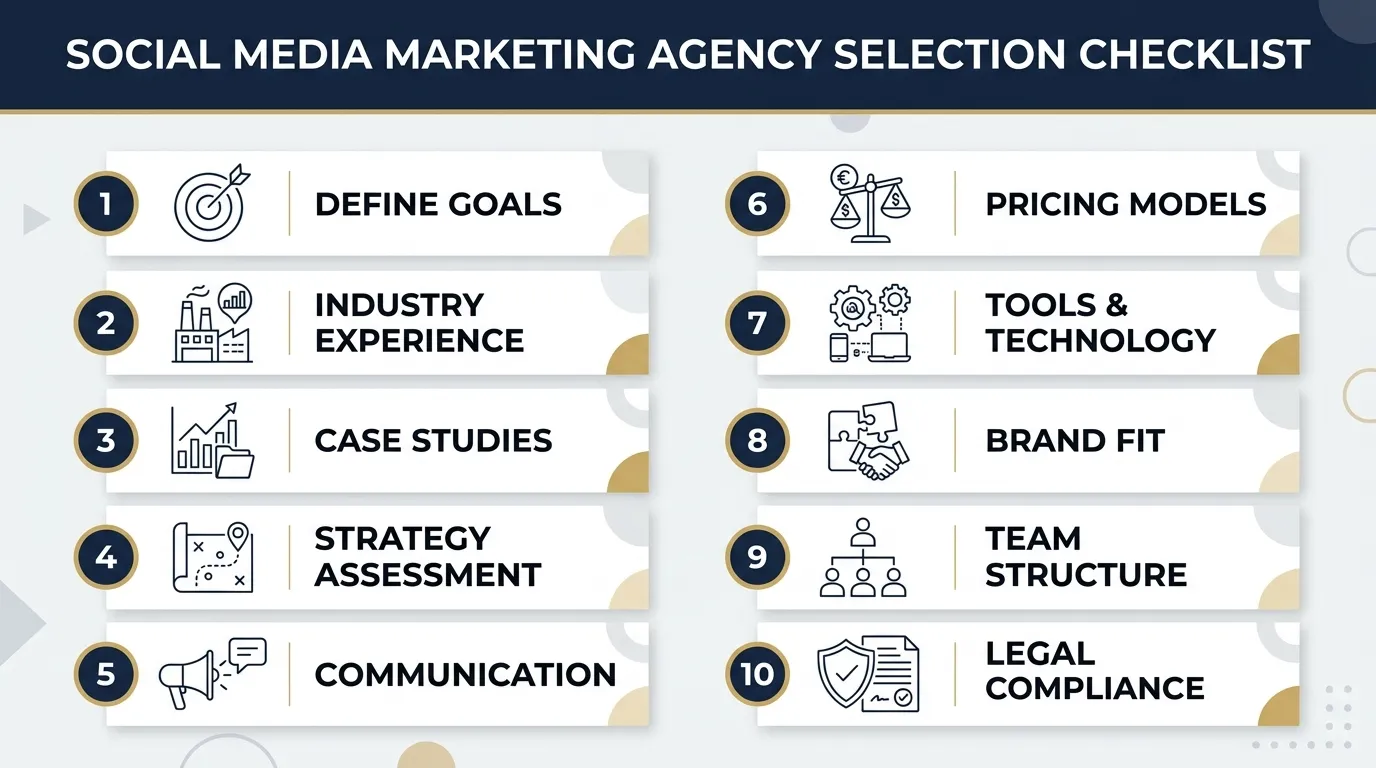
Most guides give you tips. What you actually need is a way to make decisions when information is incomplete, and every agency sounds convincing.
Over the years at MediaOne, I have reviewed accounts where businesses spent months, sometimes years, with the wrong agency. The issue was rarely a lack of effort. Campaigns were active. Content was being published. Reports were being sent.
The problem was misalignment.
What follows is the framework I now walk clients through when they are choosing between agencies providing social media marketing services, especially in Singapore.
Tip #1: Define Your Goals Before Contacting Social Media Marketing Agencies
I always start here because this is where many engagements quietly unravel.
Before you speak to any agency, you need clarity on three things: the outcome that matters most, the platforms that actually influence your audience, and the budget and timeline that fit your stage of growth.
This sounds obvious, but it is often skipped.
A business says it wants “growth.” The agency interprets that as engagement. Six months later, the reports show more impressions and followers, but revenue has not moved.
When goals are vague, agencies default to what is easiest to demonstrate. That usually means reach, impressions, or engagement. If you cannot define success in concrete terms, the agency will fill in the gaps with assumptions.
What Do Social Media Marketing Agencies Actually Do
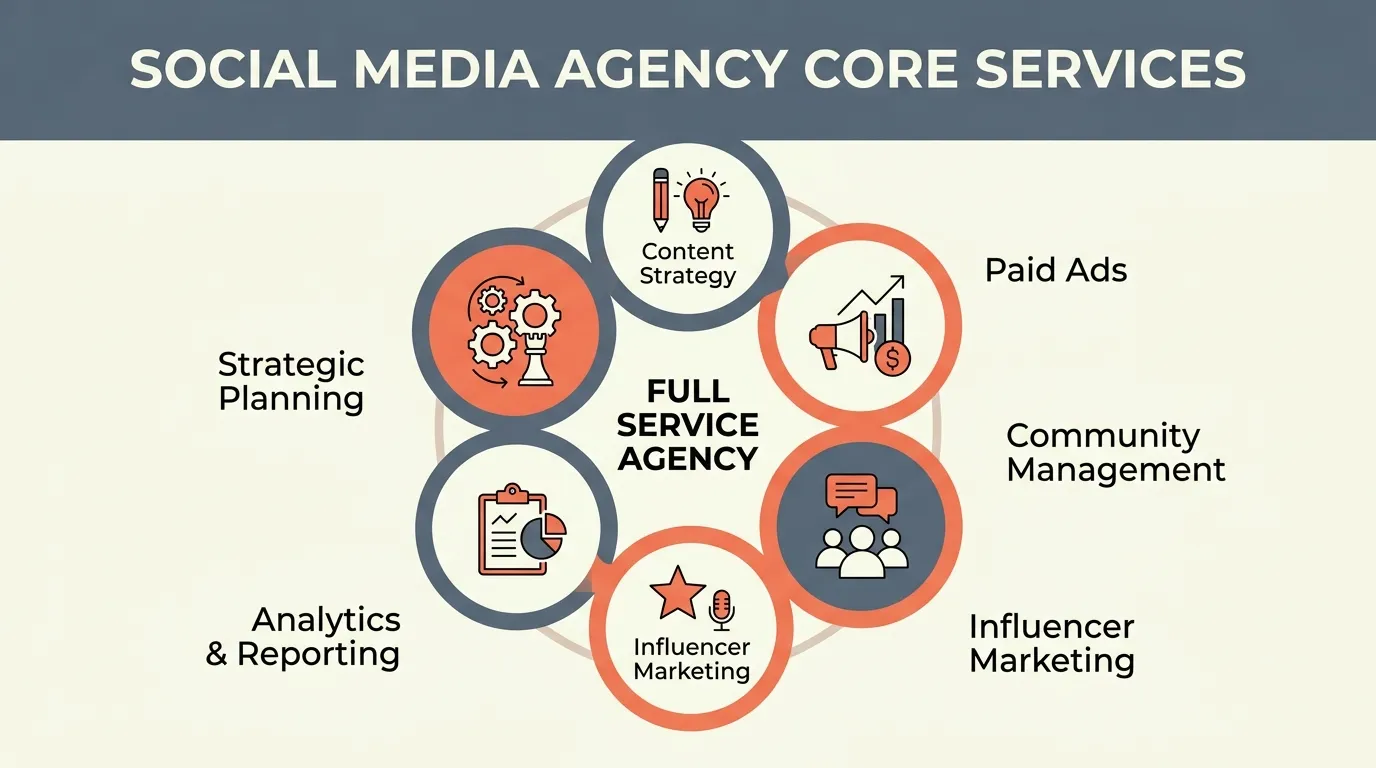
One of the first things I clarify with clients is this: when you say you want help with social media, what exactly do you mean?
Most businesses come in with a vague expectation. They assume a social media agency will “handle everything.” That sounds convenient, but it is not specific enough to drive results.
Social media is not a single function. It is a system built on strategy, execution, data, and continuous iteration.
In Singapore, the agencies that deliver consistent outcomes usually understand that platform selection is not cosmetic.
A B2B brand targeting decision-makers in finance or enterprise tech should not be using the same playbook as an F&B group trying to drive weekend foot traffic, or a beauty brand trying to reach Chinese-speaking consumers through XiaoHongShu.
When I look at campaigns that actually perform, the agency is usually working across a few core areas.
Content Strategy That Connects to Business Goals
Content is where most businesses begin, but it is also where many go wrong. A good agency does not just create social media posts. It builds a content strategy that aligns with your business’s goals, whether those are lead generation, brand positioning, direct sales, retail visits, or customer retention.
In Singapore, that often means building around real audience behaviour rather than platform trends.
- A law firm or B2B consultancy may need thoughtful LinkedIn content that builds trust over time.
- A tuition centre might need parent-facing educational content paired with testimonial-led ads.
- A restaurant group may need short-form video and local discovery content that performs on Instagram and TikTok.
- A premium skincare or wellness brand trying to reach Chinese-speaking audiences may need visibility on XiaoHongShu, as product research and recommendation behaviour often occur there before purchase.
A strong content strategy usually involves defining content pillars, mapping content to different funnel stages, planning formats for each platform, and building a publishing cadence that balances consistency with quality.
I have seen Singapore brands post every day and still see no traction. The issue was not effort. It was that the content was not built around how their actual customers discover and decide.
Paid Social Advertising That Drives Measurable Outcomes
Organic reach alone is rarely enough, especially in a competitive market like Singapore. This is where paid social becomes important.
Platforms like Instagram, TikTok, LinkedIn, and Meta’s broader ad ecosystem offer powerful targeting capabilities, but they also require discipline. Smaller audiences mean waste becomes visible quickly. Poor messaging, weak landing pages, or bad follow-up processes can make campaigns look like platform failures when the real issue is strategy.
Strong agencies build campaign structures around specific outcomes. They test audiences, creatives, offers, and messaging. They optimise around cost per lead, cost per acquisition, lead quality, booked calls, or return on ad spend. They do not simply launch campaigns and wait.
In Singapore, paid social also needs to be viewed through a practical compliance lens. If an agency is collecting enquiries, managing remarketing audiences, using WhatsApp follow-ups, or running SMS and phone-based lead flows, it should understand how PDPA and Do Not Call considerations affect campaign execution.
If they cannot explain that clearly, that is a warning sign.
Community Management and Engagement
This is often treated as an afterthought, but it plays a bigger role than many businesses expect.
Social media is not just a broadcasting channel. It is a conversation layer. How your brand responds to comments, direct messages, and enquiries shapes how it is perceived.
That matters in Singapore because social proof has a real commercial impact. Consumers increasingly rely on recommendations, trend signals, and peer behaviour when deciding what to try, buy, or enquire about. In practical terms, that means community management is not just customer service. It is part of the conversion process.
A capable agency will monitor and respond to comments and messages, manage conversations in a way that reflects your brand voice, and build response workflows that turn interest into actual business opportunities.
I have seen conversion rates improve simply because response times got tighter and the handoff from social enquiry to sales follow-up became clearer.
Influencer and Creator Partnerships
Influencer marketing has evolved. It is no longer just about borrowing reach. The better agencies treat it as a trust and a distribution channel.
In Singapore, this matters because buying behaviour is increasingly shaped by creators, peer recommendations, and social commerce patterns. But that does not mean the answer is always to hire the biggest influencer available.
The better agencies look for creator-audience fit. They assess whether the audience aligns with your target market, whether the creator’s tone suits your brand, and whether the campaign can be measured beyond vanity metrics.
For some brands, a niche local creator with strong trust in a specific category will outperform a larger personality with broader but weaker intent. A neighbourhood F&B brand, enrichment centre, or aesthetic clinic often benefits more from relevant credibility than mass reach.
A poorly matched influencer can dilute your brand faster than a weak ad campaign. The nuance matters.
Analytics, Reporting, and Continuous Optimisation
If you cannot measure it, you cannot improve it.
This is where I see one of the clearest gaps between average and high-performing agencies. Reporting should not just present numbers. It should help the business make better decisions.
In Singapore, good reporting usually tracks metrics tied to commercial outcomes, not just likes and impressions. That may include lead quality, WhatsApp enquiries, booked appointments, consultation requests, ecommerce conversions, or customer acquisition cost.
Effective agencies explain what is working, what is not, and what will be changed next. Weak agencies hide behind polished dashboards and broad summaries.
If reporting is vague, overly decorative, or disconnected from business outcomes, it usually signals that real optimisation is not happening behind the scenes.
The Real Difference: Depth, Not Just Services
On paper, many agencies offer the same services. The difference lies in how deeply they execute.
Some are full-service and manage everything end-to-end. Others specialise in one area, such as paid media, creative production, or influencer marketing. Neither is automatically better.
The right choice depends on your current bottleneck.
- If you lack strategy, a full-service or strategy-led agency may be more valuable.
- If your paid campaigns are underperforming, a performance specialist may be the better fit.
- If your brand feels invisible or interchangeable, a content-first agency may help sharpen relevance.
- If you are targeting specific local or regional segments, the right platform expertise becomes critical.
I often tell clients this: do not choose based on what an agency offers. Choose based on what your business actually needs in Singapore right now.
Signs You’re Ready for an Agency
Not every business needs an agency from day one. But there comes a point when outside expertise can help you grow faster, sharpen your execution, and build on the momentum you already have.
You may be ready for an agency if:
- You already have some traction
- You understand your core offer and audience
- You are ready to scale what is working, not just experiment
At this stage, an agency can do more than simply execute tasks. The right partner helps you move faster, bring more consistency to your marketing, and turn early wins into repeatable growth.
Types of Social Media Marketing Agencies You Can Choose From
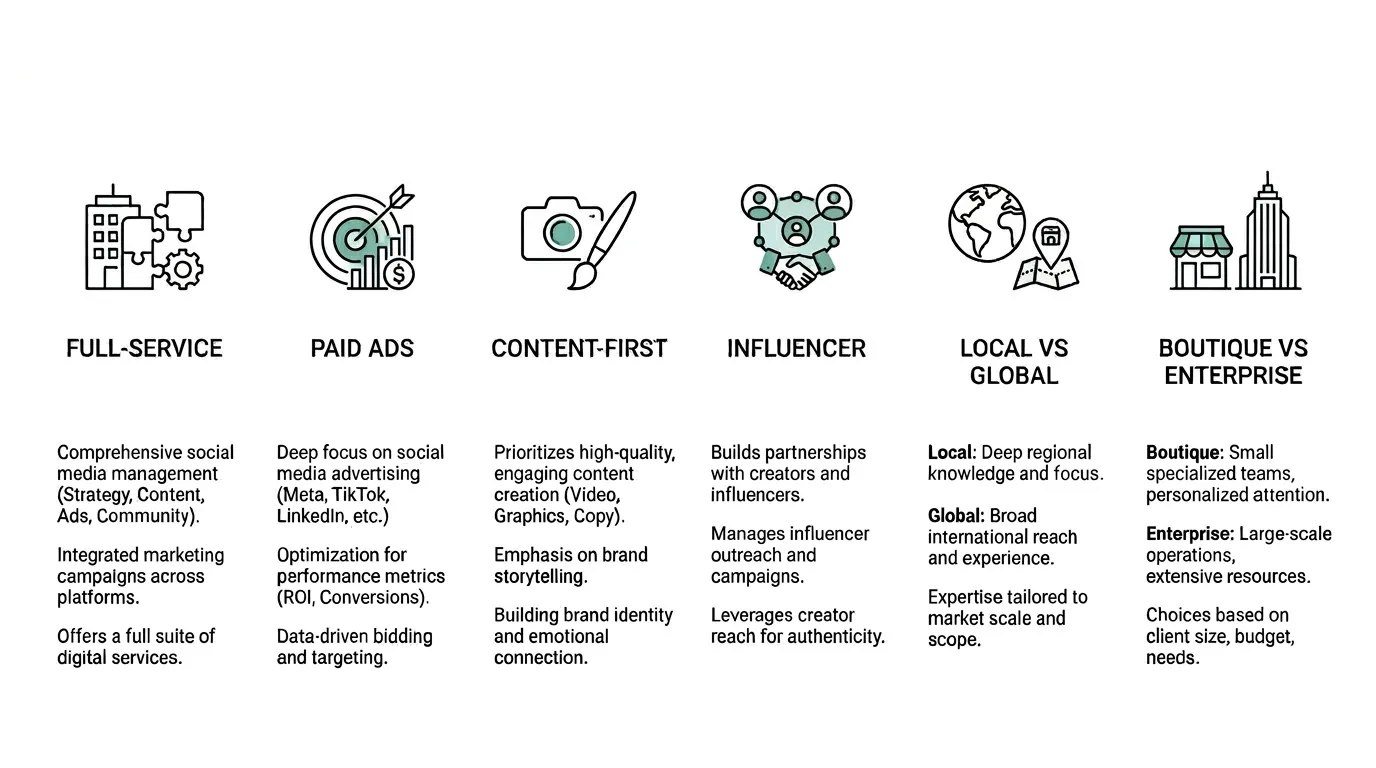
One of the most common mistakes I see, even among experienced founders, is assuming that all agencies operate in roughly the same way. They do not.
On the surface, many look interchangeable. The decks are polished. The pricing can seem comparable. The service lists overlap. That creates the illusion that the decision can be made based on branding, chemistry, or cost.
In reality, agencies are built very differently behind the scenes. Their strengths, internal processes, and definitions of success can vary much more than most business owners expect.
In Singapore, that difference matters because businesses are often trying to solve very different problems with the same shortlist of agencies. As of January 2025, Singapore had 5.16 million active social media user identities, equivalent to 88.2% of the population, and about 92% of internet users were active on at least one social platform.
Users in Singapore now spread their attention across an average of 7.2 social platforms each month. That creates a more fragmented environment, where agency specialisation, whether in paid media, creative, influencer marketing, or regional execution, becomes more important than a generic “full-service” label.
Full-Service Social Media Marketing Agencies
Best for: Businesses that want a single partner to manage the entire social media function, from strategy through to reporting.
This is where many businesses begin. A full-service agency usually handles strategy, content creation, publishing, paid campaigns, community management, and reporting.
For Singapore SMEs, this can be attractive because internal teams are often lean. Having one partner manage the entire process can simplify execution and reduce coordination overhead.
That model can make particular sense in Singapore, where social media advertising spend reached US $510 million in 2024, up 15.9% year on year. In a market with that level of channel investment, consolidating strategy, content, paid media, and reporting under one roof may help reduce fragmentation and speed up execution.
In terms of business outcomes, a well-run full-service agency can help you consistently build brand awareness, grow your organic following, generate leads through paid campaigns, and maintain a professional social presence without needing multiple vendors.
For a business that is early in its social media journey or stretched for internal resources, that breadth has real commercial value. But full-service does not always mean depth across every function.
Some agencies are strategically strong but inconsistent in creative execution. Others produce visually polished content but lack performance rigour in paid acquisition, tracking, and lead quality.
When I evaluate a full-service agency, I focus less on what they claim to cover and more on where they consistently deliver results.
Paid Ads Specialist Agencies
Best for: Businesses with a clear acquisition goal, an established offer, and an urgent need to improve conversion efficiency.
A paid ads agency is built around performance. Their structure is designed to run and optimise paid campaigns, allocate budgets efficiently, and generate measurable outcomes such as leads, sales, or reduced acquisition costs.
If your current issue is that your campaigns are not converting, your cost per lead is too high, or you need more disciplined testing, a paid specialist can be very effective.
There is also a strong platform-level case for specialists in Singapore. DataReportal reports that figures from TikTok’s advertising resources indicated 3.63 million users aged 18 and above in Singapore in early 2025, up 7.4% from the start of 2024, while figures from LinkedIn’s advertising resources indicated 4.80 million members in Singapore, up 14.3% over the same period.
When a platform plays an outsized role in your funnel, specialist depth may matter more than broad service coverage. This matters in Singapore because market size forces clarity. If targeting is weak, if the creative misses, or if the offer is not compelling, results deteriorate quickly.
The limitation is that paid specialists are not usually designed to build brand voice or long-term organic storytelling. Their mindset is rooted in funnels, testing frameworks, and conversion metrics. If your bigger issue is positioning or relevance, they may not be the right first move.
Content-First or Creative Agencies
Best for: Businesses that have the distribution but lack the creative quality, brand voice, or content strategy to make it work.
Some brands do not have a media-buying problem. They have a relevance problem.
Their content does not resonate. Their voice feels generic. Their social presence blends into the background.
That is especially relevant in Singapore’s video-heavy social environment. We Are Social reports that TikTok users in Singapore spend an average of 34 hours and 29 minutes per month on the platform, while YouTube users spend 29 hours and 45 minutes.
These usage patterns help explain why content-first agencies increasingly lean toward short-form video, creator-native storytelling, and platform-specific editing rather than static content calendars.
This is where content-first agencies can be valuable. They usually focus on content planning, visual identity, brand voice, short-form video, and platform-native storytelling.
In Singapore, this can matter a great deal for lifestyle, F&B, beauty, fashion, hospitality, wellness, education, and retail brands. Discovery in these categories is often visual, social, and recommendation-driven.
This becomes even more relevant if your target audience includes Chinese-speaking consumers, students, or tourists who use XiaoHongShu to search for brands, places, and products before making decisions.
Some agencies still ignore this platform because it sits outside their usual playbook. For the right business, that is a serious blind spot.
Creative strength can transform how a brand is perceived. But creative without distribution and measurement usually underperforms. The strongest agencies combine storytelling with performance thinking.
Influencer Marketing Agencies
Best for: Brands that rely on social proof, peer recommendation, or creator-led content to drive discovery and purchase decisions.
Influencer marketing agencies sit in a different part of the ecosystem. Their job is to help brands use creators to build visibility, trust, and social proof.
The category is no longer niche in Singapore. We Are Social reports that influencer advertising spend in Singapore reached US$106 million in 2024, up 13.6% year on year.
This model works well when your category is shaped by peer recommendations, personal credibility, or content-led discovery. In Singapore, that often applies to beauty, F&B, wellness, retail, lifestyle services, and new product launches.
But influencer campaigns are not a substitute for strategy. Without clear positioning, messaging, and measurement, the campaign may generate reach without driving real commercial value.
The best influencer agencies understand that creator partnerships should support the broader strategy, not replace it.
Local vs Regional Agencies
Best for: Depends entirely on where your growth is being driven and how deeply local context shapes your buying audience.
This is less about size and more about context.
A Singapore-based agency usually brings a stronger local understanding. That includes how local buyers behave, which platforms matter by segment, how quickly brands need to move, and what practical issues affect execution, from bilingual content to consent management.
A regional agency may be a better fit if you are scaling across Southeast Asia and need broader infrastructure, repeatable systems, or multi-market coordination.
If most of your revenue is being driven in Singapore, local relevance often matters more than regional scale. If your growth is cross-border, the answer may be the opposite.
Boutique vs Enterprise-Level Agencies
Best for: Different stages of business maturity, different operational needs, and different expectations around how closely you work with the people managing your account.
Boutique agencies are usually smaller, more hands-on, and closer to both strategy and execution. Clients often appreciate the direct access to senior talent and the ability to move quickly.
That can work especially well for Singapore SMEs that value agility and close collaboration.
Enterprise agencies are more structured, process-driven, and built to manage larger campaigns with multiple stakeholders. They can bring consistency and scalability, but they can also be slower and more layered.
Neither model is inherently better. What matters is whether the agency’s operations align with how your business needs to move.
Tip #2: Evaluate Industry Experience of Social Media Marketing Agencies
Experience is often presented as a headline number. Years in business. Number of clients. Campaign volume.
I tend to ignore those at first and focus on relevance. What matters more is whether the agency understands your commercial environment.
- Do they know how your audience evaluates options?
- Have they worked with similar decision cycles?
- Do they understand whether trust, urgency, price sensitivity, or social proof is what moves the buyer?
A strategy that works for retail does not necessarily work for B2B. A healthcare campaign cannot be approached the same way as a restaurant launch. A tuition or enrichment business needs a very different messaging structure from an ecommerce store.
The more similar the context, the less time the agency spends guessing.
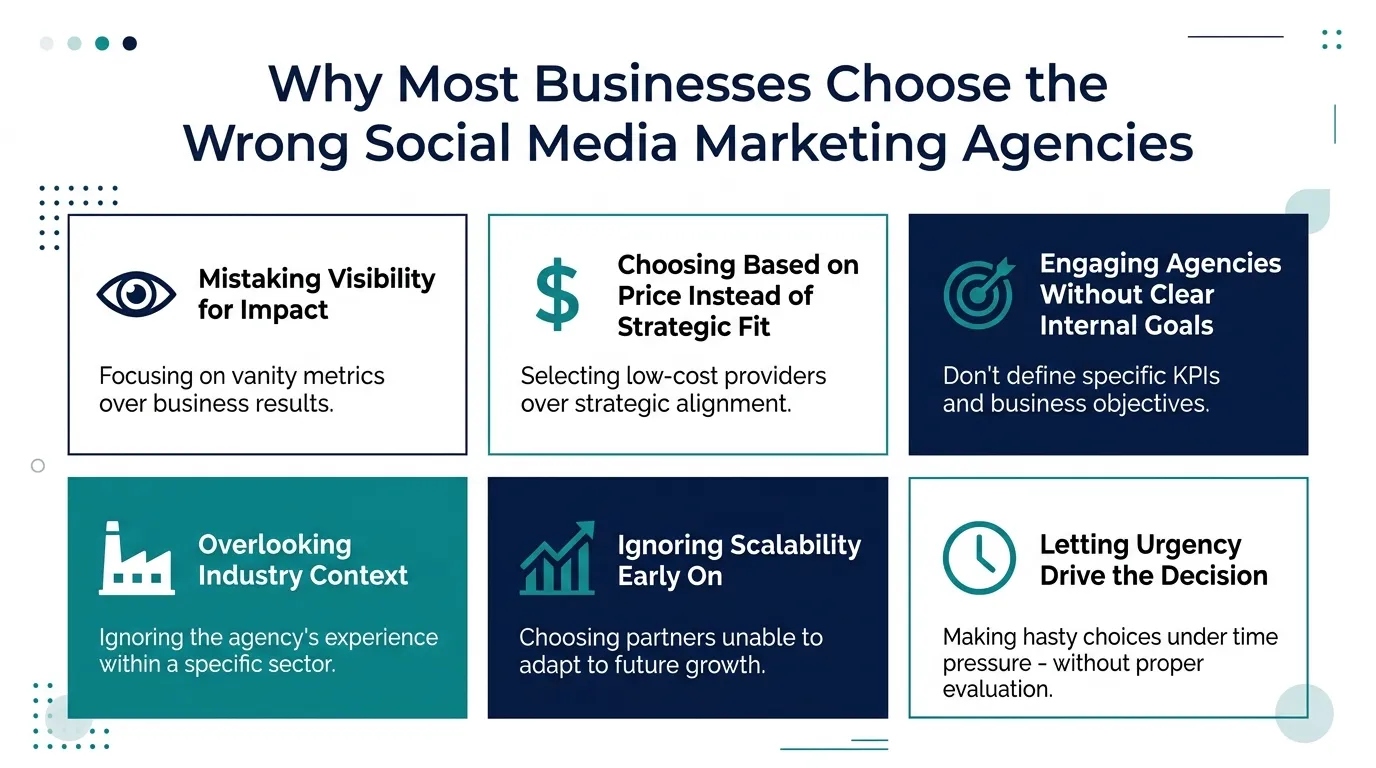
Why Most Businesses Choose the Wrong Social Media Marketing Agencies
I have reviewed enough campaigns, audits, and agency transitions to recognise a pattern. The issue is almost never effort. It is rarely in the budget. More often than not, the problem begins much earlier, with the decision-making process.
When businesses evaluate agencies, they tend to rely on signals that feel important at first glance but have little connection to business outcomes. The agency has a strong portfolio. The proposal looks polished. The pricing seems reasonable. The deliverables are clearly listed.
Then six months later, the results do not match expectations.
Here is where things usually go off track.
Mistake 1: Mistaking Visibility for Impact
This is easily the most common trap.
Numbers are visible, so they feel meaningful. Follower growth. Likes. Shares. Views. Comments.
I often hear statements like, “Our engagement doubled,” or “We gained 10,000 followers in three months.” On the surface, that sounds like progress.
But I always ask a different question: what changed in the business?
- Did enquiries increase?
- Did qualified leads improve?
- Did revenue move?
- Did customer acquisition become more efficient?
If the answer is unclear, the strategy is incomplete.
I have seen Singapore businesses with relatively small audiences generate consistent high-quality leads through social, while larger accounts with impressive reach struggle to produce meaningful conversions.
Visibility creates opportunity. It does not guarantee outcomes.
Mistake 2: Choosing Based on Price Instead of Strategic Fit
Budget matters. That is unavoidable. The problem begins when pricing becomes the main filter.
From the outside, many agencies seem to offer similar packages. A certain number of posts per month. Basic reporting. Some engagement management. Maybe ad support.
That creates the illusion that you are comparing like-for-like.
In reality, the difference is not usually in the deliverables. It is in the thinking behind them:
- Is there a clear content strategy connected to a funnel?
- Is there a structured testing framework?
- Is paid media integrated into the broader plan, or treated as a separate add-on?
Two agencies can offer similar scopes and produce very different outcomes. One executes tasks. The other builds a system.
Mistake 3: Engaging Agencies Without Clear Internal Goals
This is one of the most overlooked issues.
Businesses approach agencies expecting them to “figure it out” without first defining what success should look like.
When that happens, the agency fills in the blanks.
Sometimes they default to engagement metrics because those are easy to show. Sometimes they focus on content volume because it creates visible activity. Neither is automatically wrong, but neither may align with what the business actually needs.
Before any engagement begins, there should be clarity on a few points:
- Are you prioritising lead generation, sales, or awareness?
- Which platforms actually influence your audience?
- What does a good lead look like?
- What timeline is realistic?
Without that foundation, even a capable agency is operating on assumptions.
Mistake 4: Overlooking Industry Context
Success in one category does not automatically transfer to another.
An ecommerce brand running TikTok-led promotions operates in a very different environment from a B2B company trying to build authority on LinkedIn. A tuition centre, clinic, law firm, or property agency each has different conversion cycles, audience expectations, and content constraints.
I have seen businesses hire agencies based on strong portfolios, only to realise later that those results came from industries with completely different dynamics.
Experience is not just about time in the market. It is about how well that experience translates to your specific situation.
Mistake 5: Ignoring Scalability Early On
This issue tends to surface later.
At first, many agencies perform well enough. Content is consistent. Engagement improves. The client feels momentum.
Then growth slows.
At that point, the structural gaps become more obvious. There is no serious testing framework. Reporting stays superficial. Campaigns are not built to scale. Insights are not being converted into stronger creative, better targeting, or smarter offers.
A strategy that works at a small scale may not hold up as you increase spending or expand the number of campaigns running simultaneously.
Mistake 6: Letting Urgency Drive the Decision
If I had to identify a root cause, this would be it.
There is constant pressure to stay active on social media. Competitors are posting. Trends move fast. It feels like something needs to happen immediately.
That urgency shortens the decision-making process.
Instead of asking deeper questions about strategy, fit, and long-term capability, businesses focus on speed. Who can start next week? Who has immediate availability? Who can produce content quickly?
There may be activity at the start, but over time, the lack of strategic alignment becomes harder to ignore.
Quick decisions often lead to slower progress later.
What This Means in Practice
The issue is not that the market lacks capable agencies. Singapore has plenty of good providers.
The problem is that many businesses evaluate them using incomplete criteria. The real question is not, “Which agency looks the most impressive?”
It is, “Which agency is built to solve the problem we actually have right now, and can they continue to support us as that problem evolves?”
That shift in perspective filters out most of the wrong fits before the conversation even begins.
Tip #3: Review Case Studies Critically
Case studies are designed to build confidence, but they should be read carefully. I look beyond the headline metrics.
- Which numbers improved?
- Why do those numbers matter?
- Were results tied to pipeline, revenue, lead quality, or only visibility?
- Was the client’s situation similar to yours?
If a case study highlights engagement growth, I want to know what happened after that. Did it translate into enquiries or sales? Or did the impact stop at reach?
I also pay attention to whether the agency can talk honestly about campaigns that required adjustment. If everything looks flawless, you are probably seeing a curated version of reality.
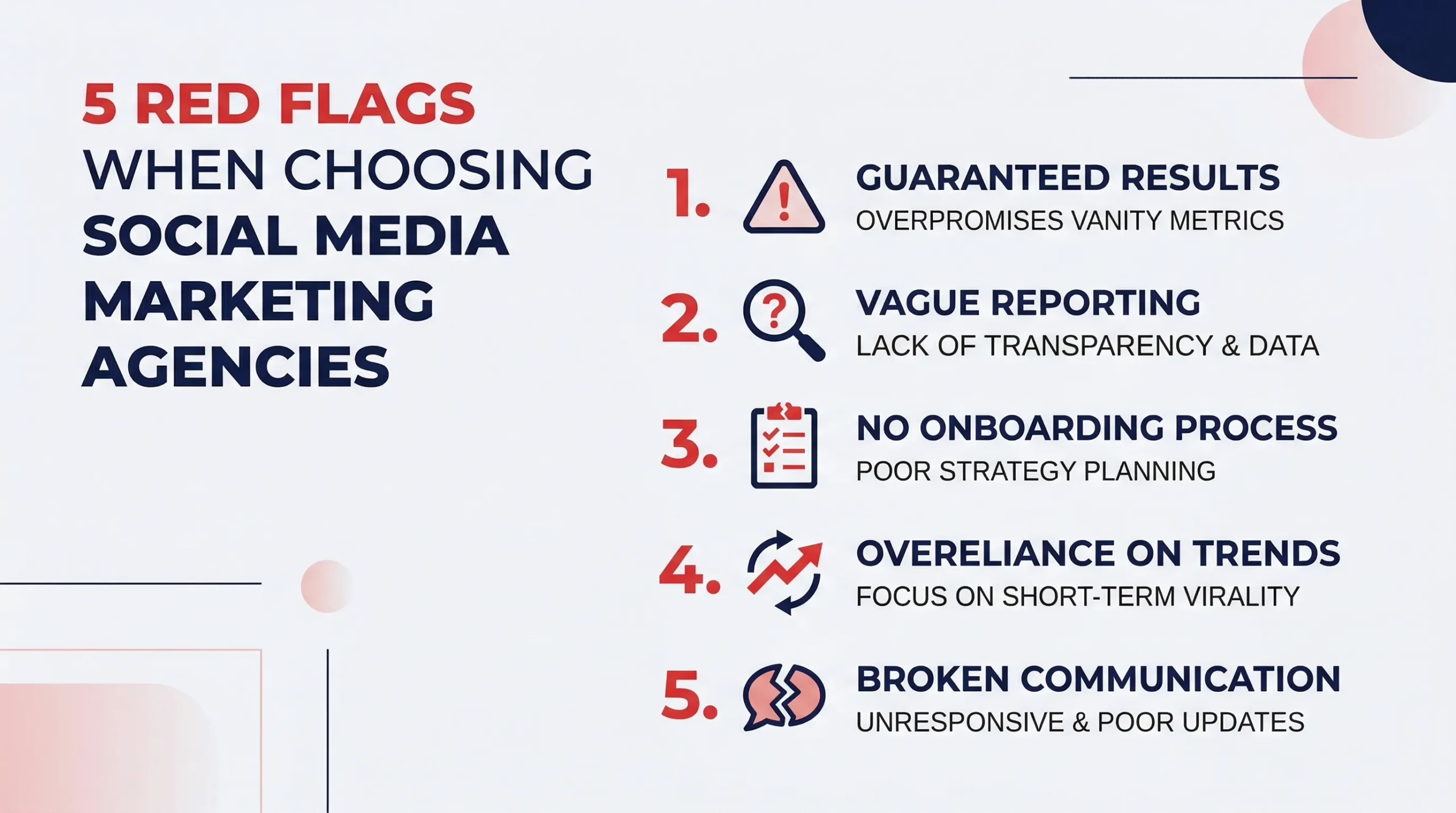
Red Flags to Watch Out for
The biggest problems rarely appear three or six months into a campaign. They are usually visible from the beginning, if you know where to look.
They show up in how an agency explains its thinking, how it frames expectations, and how it responds when you ask difficult questions.
1. Guaranteed Results or Overconfident Promises
Whenever I hear the word ‘guarantee,’ I slow the conversation down.
No agency can fully control platform algorithms, audience behaviour, seasonality, or shifting market conditions. Even strong campaigns go through testing phases before they stabilise.
So when an agency says it will double your revenue in a fixed time frame or guarantee viral content, I treat that as a warning sign.
What I look for instead is a grounded explanation of success metrics, timelines, risks, and trade-offs. Confidence is useful. False certainty is not.
2. Vague Reporting With No Clear Metrics
Reporting is where credibility either strengthens or breaks down.
I have reviewed reports that looked polished at first glance but became unclear the moment I asked how the numbers connected to actual business outcomes.
If the report is heavy on impressions, reach, and engagement but weak on leads, cost efficiency, sales signals, or next-step decisions, something is missing.
A good report should help you understand the business impact of the work, not just the activity level.
3. No Structured Onboarding Process
The onboarding phase tells you how the agency actually operates.
If they move straight into posting content or launching ads without a serious discovery process, they are probably working from assumptions.
A strong onboarding process should include a deep understanding of your business model, audience, competitors, data access, messaging, and near-term roadmap.
If onboarding feels rushed, the strategy usually will be too.
4. Overreliance on Trends Without Strategy
Trends can be useful, but they are not a strategy.
I have seen agencies build content plans almost entirely around viral formats and short-term hooks. That can create bursts of attention, but it rarely builds sustained growth unless it is connected to a broader system.
The real question is simple: how does this tactic support long-term business outcomes?
If every idea revolves around what is trending right now, the agency may be chasing attention rather than building momentum.
5. Slow or Unclear Communication From the Start
Early communication usually reflects what working together will feel like later.
If responses are slow during the sales process, if answers are vague, or if details are repeatedly left unclear, I pay attention.
Communication does not usually improve after the contract is signed. Good communication is not just fast. It is clear, accountable, and specific.
A Final Thought on Red Flags
Most red flags do not appear in dramatic ways. They show up as slightly vague explanations, claims that feel too neat, or details that are quietly avoided.
When one or two appear, ask more questions. When several appear together, step back.
Choosing the right agency is not about finding a perfect partner. It is about recognising patterns early and understanding what those patterns are likely to lead to.
Tip #4: Assess Strategy, Not Just Execution
Execution is visible. Strategy is not.
You can scroll through posts and evaluate creative output. What matters more is whether the agency can explain why the content exists, who it is meant to influence, and how it supports the broader conversion journey.
- Do they build strategies from first principles or rely on repeatable templates?
- Do they know why TikTok, LinkedIn, Instagram, Facebook, or XiaoHongShu should or should not be part of your mix?
- Can they explain how paid and organic support one another?
If the approach sounds interchangeable across industries and clients, it usually is.
How to Compare Multiple Social Media Marketing Agencies Effectively
Most business owners believe they are making a rational decision when choosing between social media marketing agencies. In reality, many decisions are shaped by presentation quality, confidence in the pitch, or how well the agency tells its story.
I have seen this from both sides.
As the owner of MediaOne, I have sat in pitches where we lost to agencies with slicker decks. I have also audited accounts where those same businesses returned six months later, frustrated by weak results and an unclear strategy.
A polished proposal can win attention. It does not guarantee performance.
What you need is a way to compare agencies that removes bias and forces clarity. In my experience, this framework has been useful across startups, SMEs, and enterprise clients in Singapore.
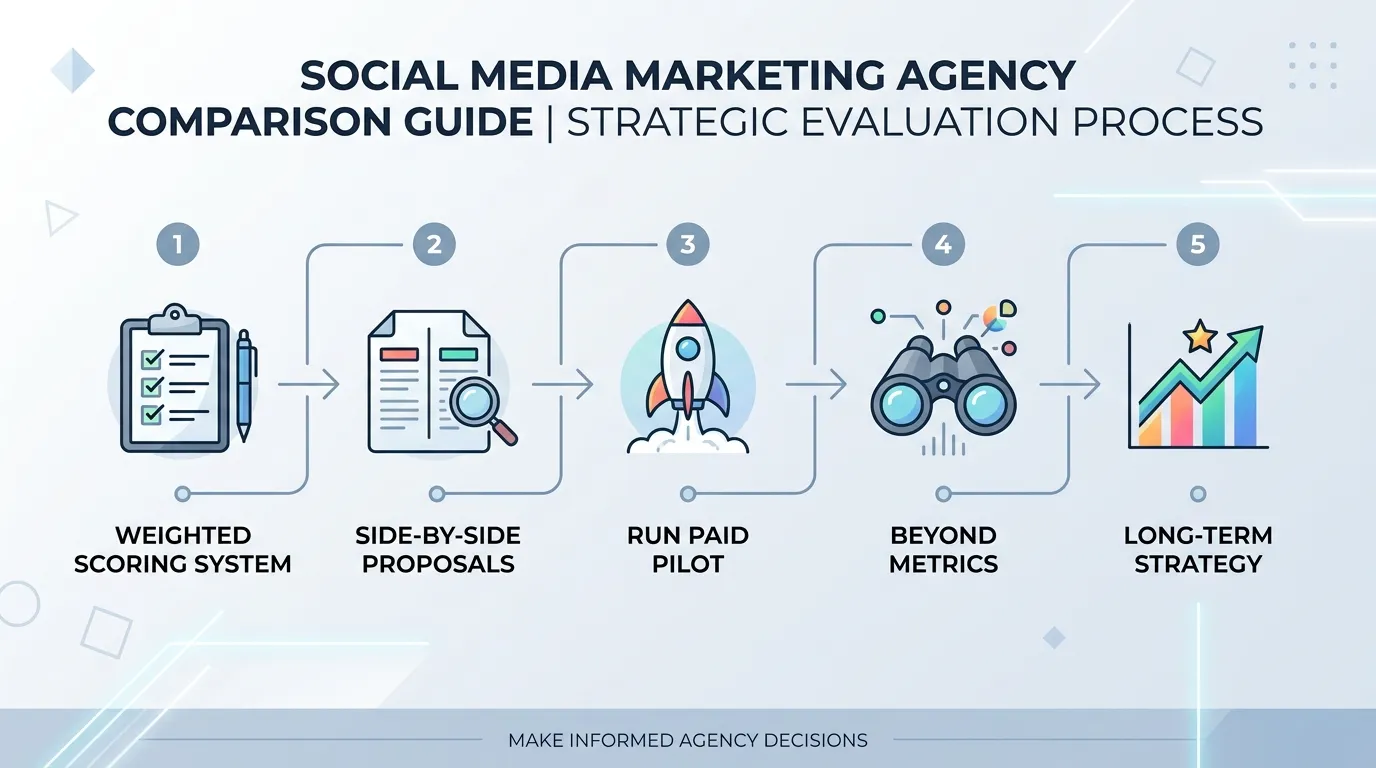
Start With a Weighted Scoring System
Before reviewing any proposal, define what actually matters to your business.
Different companies prioritise different outcomes. A startup chasing rapid growth will value speed, experimentation, and aggressive testing. A more established brand may prioritise consistency, brand control, and long-term ROI.
Put structure around that.
Create a scoring system that reflects your priorities. It does not need to be complex, but it should be intentional.
Typical evaluation categories:
- Strategy quality and clarity
- Relevant industry experience
- Proven track record with measurable outcomes
- Communication and reporting transparency
- Pricing structure and flexibility
- Tools, technology, and AI capabilities
Assign weight to each category. Strategy might carry 30 percent of the total score, while pricing might carry 15 percent. Adjust this depending on your stage of growth.
Then score every agency against the same criteria.
This process helps reduce emotional bias and makes it easier to evaluate substance over presentation.
At MediaOne, we often encourage prospects to build this scoring model even when we are being evaluated. It leads to better conversations because both sides are clear on what success looks like.
Compare Proposals Side by Side, Not in Isolation
One of the most common mistakes I see is reviewing proposals individually.
Each proposal feels compelling on its own. Each agency sounds confident. Each approach seems reasonable in isolation.
The real insight appears when you compare them side by side.
Focus on substance, not design.
What to look for:
- How clearly the strategy is explained
- Whether the approach is tailored or templated
- Depth of audience and platform understanding
- Balance between paid and organic execution
- The metrics used to define success
When you do this properly, patterns start to emerge.
Some agencies rely heavily on buzzwords but offer little detail. Others present a thoughtful strategy but lack execution clarity. A few demonstrate both, which is where you should pay attention.
In Singapore, this contrast becomes clearer when comparing well-known players.
Comparison of Leading Social Media Marketing Agencies in Singapore
The comparison below is intended as a high-level editorial summary of selected digital marketing agencies based on information they publicly describe on their websites and other public materials.
It focuses on stated services, credentials, and positioning rather than subjective assessments of execution quality, transparency, or strategic depth. It should be read as a summary of publicly available information, not as an independent audit or verified ranking.
| Agency | Publicly listed services and areas of focus | Publicly stated differentiators/credentials | Public positioning/client focus |
| MediaOne | MediaOne is an integrated digital marketing offering spanning SEO, paid advertising/PPC, content marketing, CRO, analytics/reporting, and social media marketing.
We have managed paid campaigns across Google Ads, Facebook, LinkedIn, TikTok, and other major advertising platforms, and built social media strategies across Facebook, Instagram, LinkedIn, and TikTok. |
We proudly showcase our proprietary AI marketing engine, Digimetrics.ai, for SEO intelligence, technical SEO audits, schema generation, AI-generated ad content, landing page audits, media plan recommendations, persona generation, and competitor identification.
Our Digimetrics has received awards and recognitions, including Most Effective Use of AI in Marketing, Best AI Marketing Automation Platform, MarTech Innovation Gold, Best Use of Data in Strategy, and Finalist for APAC AI Innovation. We have also received PSG accreditation, including support for social media marketing and social media advertising. |
|
| First Page Digital | First Page publicly lists services including SEO, SEM/Google Ads, social media marketing, content marketing, and website-related digital marketing support, and it also publicly promotes YouTube advertising and Google Display advertising services. | First Page prominently highlights its Google Premier Partner status in its Google Ads/SEM materials and publicly states partnerships with major platforms, including Google, Facebook, and HubSpot, on its Facebook advertising page. | First Page publicly positions itself as a full-service digital marketing agency in Singapore serving businesses with search, social, and website-related needs. |
| Brew Interactive | Brew Interactive publicly describes B2B marketing services, including LinkedIn and Google performance marketing, SEO/GEO, content syndication, outbound campaigns, lead nurturing, CRM and marketing automation, ABM, sales enablement, PR/media relations, and thought leadership/content production. | Brew Interactive publicly presents a B2B demand generation model and displays HubSpot Platinum Partner and Google Premier Partner badges on its B2B marketing page. | Brew Interactive publicly positions itself as a B2B solutions provider for companies in Singapore and APAC, particularly those with longer, more complex sales cycles. |
| Impossible Marketing | Impossible Marketing publicly lists SEO, GEO (AI SEO), Google Ads/SEM, social media marketing, lead generation, and content marketing as core digital marketing solutions. | Impossible Marketing publicly states that it is a certified partner of Google, Meta, and TikTok, presents itself as AI-powered, and highlights PSG grant support for eligible SMEs. | Impossible Marketing publicly positions itself as a Singapore-owned digital marketing agency serving SMEs and enterprises across multiple industries. |
| OOm | OOm publicly lists SEO, SEM, social media management, content creation, web design and development, and also references media planning and buying and lead generation support. | OOm publicly states that it is a Premier Google Partner, a Meta Business Partner, and a pre-approved PSG vendor, and also references the GeBIZ S8 Financial Grade certification. | OOm publicly positions itself as a one-stop digital marketing agency for businesses seeking bundled digital marketing and website-related services. |
Editorial Disclaimer:
This comparison is based on publicly available information and is provided for general informational purposes only. It is not an independent audit, endorsement, or verified ranking of any agency’s services, performance, execution quality, or transparency.
For businesses evaluating digital marketing partners, the most useful comparison points are usually service scope, platform coverage, credentials, and the type of clients each agency publicly says it serves.
Final selection should depend on business goals, budget, industry requirements, and the specific capabilities a company needs, ideally verified through direct consultation, case studies, and proposal review.
Run a Paid Pilot Before Long-Term Commitment
If there is one step I wish more businesses would take, it is this: Do not commit to a long-term contract immediately. Start with a pilot.
This could be:
- A one-month campaign
- A controlled paid ads test
- A focused content sprint
The goal is not immediate ROI. It is to understand how the agency actually operates.
During the pilot, observe closely:
- How they communicate and respond
- How quickly they adapt to feedback
- The quality and consistency of execution
- Their ability to interpret data and refine strategy
A proposal shows intent. A pilot reveals behaviour.
We have onboarded clients at MediaOne who previously worked with other social media marketing agencies. In many cases, the issue was not capability on paper. It was inconsistency in execution, slow response times, or a lack of strategic thinking once campaigns were live.
Look for Signals Beyond the Metrics
Metrics matter, but early-stage performance can be misleading. Instead of focusing only on results, examine how those results are produced.
Ask yourself:
- Are decisions backed by clear reasoning
- Is there a structured testing framework
- Are insights being generated or just reported
Agencies that use structured testing and feedback loops may be better positioned to improve performance over time.
At MediaOne, we place strong emphasis on this. Campaigns are not static. Data feeds into strategy, strategy informs execution, and the cycle continues. That is how performance compounds over time.
Balance Short-Term Wins With Long-Term Strategy
Quick wins are appealing. A spike in engagement or a drop in cost per click creates momentum. But short-term performance does not always translate to sustainable growth. When comparing agencies, look beyond the first campaign.
Consider:
- Do they have a roadmap beyond initial execution
- Are they building reusable assets such as content frameworks or audience insights
- Can their strategy scale with your business
Some social media marketing agencies are excellent at delivering immediate results but struggle to maintain consistency. Others take longer to ramp up but build stronger long-term systems.
Neither approach is inherently better. What matters is alignment with your goals.
Choosing between social media marketing agencies is not about picking the most impressive option. It is about reducing uncertainty and understanding how each agency thinks.
When you apply a structured comparison process, you start to see beyond the pitch. You recognise patterns in strategy, execution, and decision-making.That clarity changes how you choose.
At MediaOne, the strongest client relationships we have built did not start with urgency. They started with careful evaluation, honest conversations, and a shared understanding of what success should look like.
That tends to make all the difference.
Tip #5: Analyse Communication and Reporting Practices
This is where partnerships either stabilise or start to break down. What matters is not just frequency. It is clarity.
You should know how often reports will be issued, which metrics will be included, how those metrics relate to business outcomes, and what decisions will be made based on the data.
Some agencies overwhelm clients with dashboards but offer no interpretation. Others simplify too much and hide important context.
The best agencies help you understand what changed, why it mattered, and what will happen next.
Transparency is not about volume. It is about making decision-making visible.
Tip #6: Understand Pricing Models of Social Media Marketing Agencies
Pricing is not just a number. It reflects how the agency structures its work and where it places its priorities.
In Singapore, you will usually encounter monthly retainers, project-based pricing, or performance-linked structures. Each can work depending on your goals.
What matters is knowing exactly what is included and what is not.
- Ad spend is usually separate.
- Creative production may be separate.
- Influencer fees are often separate.
- Landing page work, shoot coordination, platform tools, and reporting depth may vary.
For Singapore SMEs, there is one more question worth asking early: is the agency or package potentially relevant to PSG-supported solutions, and if so, what are the eligibility conditions?
Even if grant support is not available for your exact scope, the question itself reveals whether the agency understands the local business environment.
Cost Breakdown of Hiring Social Media Marketing Agencies
One of the first questions I get from business owners is simple: How much should this cost in Singapore?
The honest answer is that pricing varies widely, and it should. A startup testing one platform with light content support is not buying the same thing as a regional brand running paid campaigns, short-form video, community management, and monthly optimisation across multiple channels.
In Singapore, that gap is especially noticeable because the market includes freelancers, boutique agencies, full-service firms, and performance-led teams, all pricing very differently.
Local pricing guides put basic social media management at roughly S$500 to S$1,500 per month, standard SME retainers at around S$1,500 to S$3,500, and more advanced retainers at S$3,000 to S$6,000+.
On the higher end, strategy-heavy or multi-platform agency retainers can stretch to S$5,000 to S$20,000 per month, depending on content frequency, reporting depth, and campaign complexity.
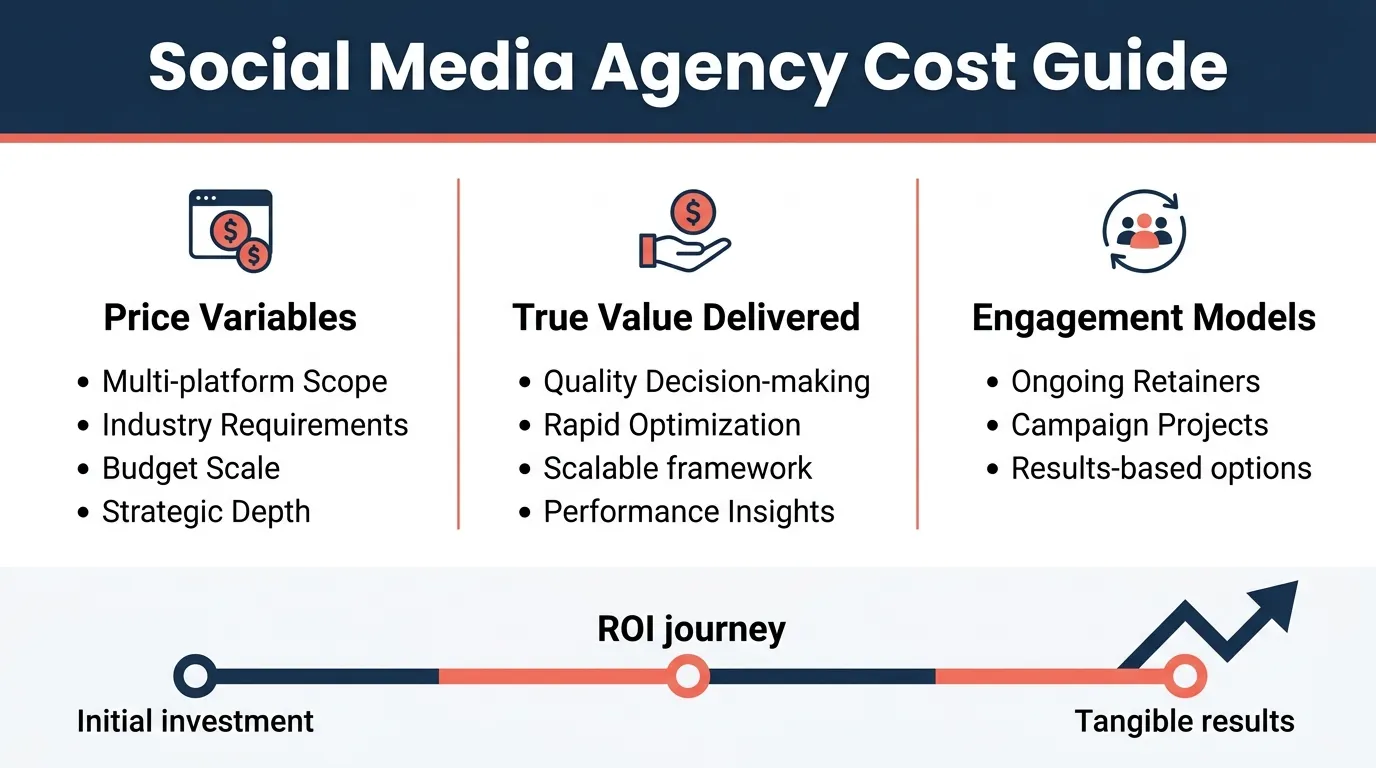
What Actually Drives the Cost of Social Media Marketing Agencies
When you receive proposals, these are the variables that will shape pricing more than anything else.
1. Scope of Work and Platform Coverage
The wider the scope, the higher the cost, but also the greater the complexity.
- Managing one platform with basic posting is very different from running multi-platform campaigns
- Adding paid ads, content production, and community management increases both effort and coordination
- Integrating funnels, landing pages, and retargeting moves the work closer to full-funnel marketing
DataReportal reports 5.16 million social media user identities in Singapore, representing 88.2% of the population, while 91.8% of adults use social media. That means agency costs are often shaped not just by volume of work, but by how much strategy and testing are needed to stand out in an already saturated market.
At MediaOne, we often see businesses underestimate the coordination required when organic and paid efforts are combined. That gap usually shows up later as inefficiency or inconsistent results.
2. Industry Complexity
Not all industries behave the same on social media.
- A B2B company in Singapore may need a stronger LinkedIn strategy and more thought-leadership content, given LinkedIn’s significant local membership base.
- A lifestyle, beauty, F&B, or retail brand may need a more visual and creator-driven mix across Instagram and TikTok.
- B2B brands typically face longer, multi-stakeholder buying cycles, while healthcare brands usually require stricter compliance oversight and content review.
- Regulated industries need tighter controls and review processes.
This affects not just execution, but also strategy depth and iteration cycles.
3. Ad Budget Size
Your ad spend directly impacts how an agency structures its work.
- Smaller budgets often mean tighter testing and slower scaling
- Larger budgets require more rigorous optimisation, audience segmentation, and creative variation
- Performance tracking becomes more granular as spend increases
Agencies with larger budgets tend to build more robust systems because the margin for error is smaller.
4. Level of Strategy vs Execution
This is where pricing differences become more obvious. Some social media marketing agencies focus primarily on execution. They post content, run ads, and report metrics.
Others invest heavily in strategy.
- Audience research and segmentation
- Funnel design across platforms
- Messaging frameworks and positioning
- Continuous optimisation based on data
At MediaOne, this is where we tend to stand apart. We do not position ourselves as the cheapest option, and that is intentional. Our focus has always been on building strategies that connect social media activity to measurable growth, rather than just maintaining presence.
5. Content Format
In Singapore, businesses often underestimate how quickly costs rise once they move from static posts into Reels, TikTok-style edits, creator collaborations, or multi-language content.
A brand targeting English-speaking professionals will not need the same production setup as one targeting younger bilingual consumers across visual-first channels.
This is where costs often jump from “basic management” to a much more strategic, production-heavy engagement.
What You Are Really Paying For
It helps to reframe the conversation.
You are not just paying for posts, ads, or reports. You are paying for:
- Decision-making quality
- Speed of iteration and optimisation
- Ability to identify what is not working early
- Systems that scale beyond initial campaigns
Two agencies can charge similar fees and deliver completely different outcomes depending on how they approach these elements.
Typical Pricing Models You Will Encounter
While exact numbers vary by market and agency positioning, most social media marketing agencies structure pricing in one of these ways:
- Monthly retainers for ongoing strategy and execution
- Project-based fees for specific campaigns or launches
- Performance-based models tied to leads, sales, or conversions
Each has its place.
Retainers tend to work best when you are building long-term momentum. Project-based work suits defined campaigns. Performance models can align incentives, but only when tracking and attribution are clear.
A Realistic View on ROI
This is where expectations often need recalibration. Social media ROI is not an instant-return channel in most cases. Even strong campaigns go through phases:
- Initial setup and data gathering
- Testing of creatives, audiences, and messaging
- Optimisation based on early signals
- Scaling what works
Results compound over time, especially when insights from one campaign inform the next.
At MediaOne, we typically frame the first phase as an investment in clarity. Once the data stabilises, performance becomes more predictable and scalable.
How to Think About Cost Moving Forward
Instead of asking, “What is the cheapest option?”, a better question is:
“What level of thinking, execution, and scalability does this investment unlock for my business?”
That shift alone tends to change how decisions are made.
Some businesses come to us after cycling through multiple social media marketing agencies, each time hoping for a different outcome. What usually changes the trajectory is not just switching providers, but understanding what good work actually looks like.
That is where the real return begins.
Tip #7: Check Tools, Technology, and AI Capabilities
This used to be a secondary consideration. It is becoming central.
I ask direct questions about the platforms an agency uses for scheduling, analytics, approvals, content tracking, and social listening. I also ask specifically how AI is used across their workflow, whether that is in planning, content ideation, performance testing, or reporting. Vague answers here are worth noting.
In Singapore, platform discussions should go beyond Facebook and Instagram by default. Depending on the business, TikTok may be crucial for consumer reach, LinkedIn may matter most for B2B, and XiaoHongShu may be directly relevant for Chinese-speaking audiences who use the platform to research brands, places, and products before making a purchase decision.
What to look for when assessing an agency’s tech stack:
- Do they use professional social listening tools, or are they manually checking platforms?
- Is their reporting built around business outcomes, or just engagement metrics?
- How do they use AI in practice, and can they show you examples of the output?
- Are their systems integrated, or are different teams using disconnected tools that create reporting gaps?
Agencies that invest seriously in systems tend to operate with greater consistency. They can test faster, identify patterns earlier, and scale what is working with less guesswork.
A Note on Proprietary AI Tooling
One thing that has shifted my thinking on this over the past few years is the difference between agencies that use off-the-shelf tools and those that have invested in building their own solutions.
MediaOne, for instance, developed Digimetrics, a proprietary AI engine built specifically to support precision planning across SEO, content, paid media, and social strategy. It is not a publicly available product. It is used internally for every client engagement.
What makes this relevant when evaluating an agency is not the technology for its own sake. It is what the technology reveals about the agency’s thinking.
Digimetrics processes real-time data to surface trending topics, identify competitor content gaining traction across platforms, and align social content strategy with actual search intent and audience demand. For social media specifically, that means campaigns are not built on assumptions. They are built on current market signals.
The practical implication is that clients working with MediaOne benefit from a layer of strategic intelligence that most standard agency toolkits simply cannot replicate.
Whether it is identifying the right content angles before a campaign launches or catching shifts in audience sentiment during one, having a purpose-built AI system running in the background changes the quality of the decisions being made.
I am not suggesting every agency needs to build proprietary technology. But I do think the question of how AI is genuinely integrated into strategy and execution, not just mentioned in a pitch deck, is now one of the most important things to probe during an agency evaluation.
The answer will tell you a great deal about how seriously the team thinks about competitive performance.
Tip #8: Evaluate Cultural and Brand Fit
This is less tangible, but it affects execution quality more than many businesses expect.
Even if the strategy is sound, misalignment in tone, working style, or brand understanding creates friction.
- Does the agency understand how your brand should sound in the market?
- Can they adapt to your audience without flattening your identity?
- Do they communicate in a way that makes collaboration easier rather than harder?
You will be working closely with this team. If every interaction requires correction or reinterpretation, the relationship becomes expensive in ways that do not show up in the invoice.
Tip #9: Ask About Team Structure and Expertise
One of the biggest misconceptions is that you are hiring the agency as a whole. In reality, you are working with a specific team inside that agency.
- Who will manage the account day to day?
- How involved are senior strategists once the contract begins?
- What happens if a key team member leaves?
I have seen situations where experienced people lead the pitch, but execution is handed to junior staff with limited context.
That shift can affect results more than most expect.
Questions to Ask Before Signing
Over the years, I have reviewed countless agency proposals. Most of them look convincing on paper. Clean decks. Strong claims. Impressive numbers. Yet when campaigns fail, it is rarely because of what was written. It is because of what was never asked.
The questions you raise before signing will tell you far more than any pitch. Not just in the answers themselves, but in how those answers are explained, qualified, and defended.
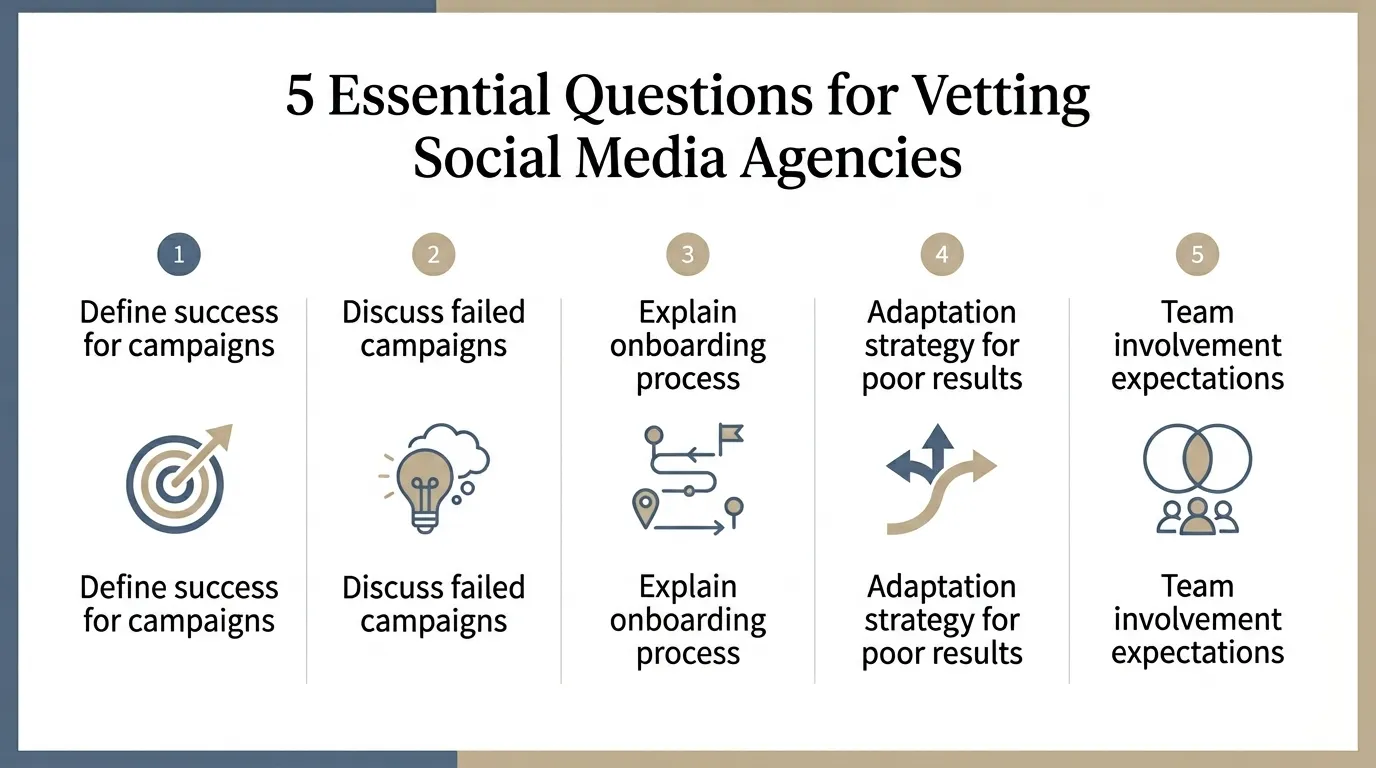
Here are the conversations I always encourage business owners to have before committing to any social media marketing agency:
How do you define success for campaigns?
This sounds basic, but it is where alignment either begins or breaks.
I have seen agencies report success based on reach and engagement, while the client was expecting leads and revenue. Both sides thought they were doing well. Neither was measuring the same thing.
A strong agency will not jump straight to metrics. They will ask about your business model, sales cycle, and margins before defining success.
What I look for in their answer:
- A clear distinction between vanity metrics and business outcomes
- An understanding of how social media connects to your revenue pipeline
- Willingness to define success differently across campaign stages
If they default to impressions, likes, or follower growth without context, that is usually a sign of shallow strategy.
Most agencies will happily show you their best work. That is expected. What matters more is how they handle failure. I often ask this question early because it reveals how honest and self-aware the team is.
A thoughtful answer should include:
- What the original strategy was
- Where the assumptions went wrong
- What data signalled underperformance
- How they adjusted the approach
If the response feels rehearsed or avoids accountability, take note. Campaigns do fail. What matters is whether the agency has a process for learning and improving.
What does your onboarding process look like?
Onboarding is where strategy becomes execution. Yet it is often rushed or overlooked. In my experience, weak onboarding leads to months of misalignment.
A structured onboarding process should cover:
- Deep discovery of your brand, audience, and competitors
- Access to existing data, accounts, and historical performance
- Clear timelines for strategy development and campaign launch
- Defined roles on both sides
I pay close attention to how detailed this process is. If onboarding is vague, the strategy will likely be too.
How do you adapt when results underperform?
No campaign performs perfectly from day one. The difference between average and high-performing agencies lies in how they respond. This is where you want to understand their optimisation mindset.
Look for answers that show:
- Regular performance reviews and iteration cycles
- Use of data to guide decisions, not assumptions
- Willingness to test new approaches rather than repeat failing ones
- Clear escalation paths when results do not improve
If the answer suggests waiting longer without a clear adjustment plan, that is a concern. Time alone does not fix a weak strategy.
What level of involvement do you expect from our team?
This question is often overlooked, yet it directly affects outcomes.
Some agencies operate independently. Others require close collaboration. Neither is wrong, but expectations must be clear. From my experience, the best results usually come from a balanced approach.
Clarify:
- How often does your team need to provide input or approvals?
- Whether you are expected to supply content, insights, or data?
- Who will be the main point of contact on both sides?
- How will feedback be incorporated into campaigns?
Misalignment here can slow down execution or create frustration on both ends.
What You Should Really Be Listening For
It is easy to focus on the content of the answers. I would argue the delivery matters just as much.
When I speak with potential partners or clients, I pay attention to:
- Clarity. Are they explaining concepts in a way that makes sense for your business
- Specificity. Are they giving real examples or staying at a high level
- Transparency. Are they open about limitations and risks?
- Curiosity. Are they asking you questions in return?
Agencies that ask thoughtful follow-up questions tend to build stronger strategies because they are trying to understand, not just impress.
Why Singapore Context Changes the Pricing Conversation
This is where local relevance starts to matter.
For example, if you are targeting Chinese-speaking or cross-border audiences, platforms like XiaoHongShu (XHS) may become part of the conversation. That does not apply to every business, but for beauty, travel, wellness, retail, and premium lifestyle brands, it can be highly relevant.
A 2025 report covered by Marketing Interactive found that among Singapore XHS users, 46.6% trust posts from regular users when researching products or services, compared with 30.3% for KOLs and 22.9% for official brand accounts.
That has direct pricing implications: if your agency recommends XHS, the cost structure may need to include creator seeding, UGC-style content, and community-led credibility building rather than just polished brand content.
At the same time, XHS is still not universal in Singapore. The same report notes that only 21.7% of respondents currently use the platform, although 78.2% say they would consider using it in future. So the platform decision should be strategic, not trend-driven.
If an agency adds XiaoHongShu to a proposal, they should be able to explain clearly why it fits their audience and whether the extra cost is justified.
PSG Grant: Useful, But Do Not Assume Everything Qualifies
Another Singapore-specific factor is the Productivity Solutions Grant (PSG). Under IMDA’s SMEs Go Digital initiative, eligible SMEs can access pre-approved digital solutions with up to 50% grant support. That is worth checking if your social media engagement includes software, commerce tools, automation, or other supported digital solutions.
But this is where many businesses make the wrong assumption. PSG support does not automatically mean your full agency retainer is claimable. In most cases, you need to verify whether the specific solution is pre-approved and whether your business qualifies.
So if cost sensitivity is high, it is worth asking agencies a practical question early: Which parts of this engagement, if any, may align with PSG-supported solutions, and which parts are standard service fees? That one question can save a lot of confusion later.
Tip #10: Review Legal, Compliance, and Data Policies
This is often left too late.
For businesses in Singapore, legal and compliance review should explicitly include PDPA and Do Not Call implications, especially if the agency will manage lead forms, CRM uploads, phone numbers, remarketing audiences, WhatsApp follow-ups, event registrations, or customer testimonials used in marketing.
You also need clarity on who owns the ad account, the creative assets, the audience data, and the historical campaign information.
These issues usually become urgent only when you want to change agencies. It is far easier to clarify them at the beginning.
PDPA Compliance Is Part of Cost, Not a Separate Issue
In Singapore, pricing should also be evaluated through a compliance lens.
The Personal Data Protection Act (PDPA) governs the collection, use, disclosure, and protection of personal data in Singapore and sits alongside the Do Not Call Registry for telemarketing controls. That matters directly for social campaigns using lead forms, CRM uploads, remarketing audiences, WhatsApp follow-up workflows, or customer databases.
Why does this affect the cost? Because agencies with stronger processes usually price in the discipline required to handle approvals, data access, consent considerations, audience permissions, and account ownership properly. Cheaper proposals sometimes leave these details vague, which can create risk later.
In Singapore, I would always clarify who owns the ad account, who controls audience data, how leads are stored, and whether the agency’s workflow is PDPA-aware before comparing fees too simplistically.
A Final Perspective
At MediaOne, we have learned that the best engagements rarely start with a proposal. They start with a conversation that challenges assumptions on both sides.
The goal of these questions is not to catch an agency out. It is to see how they think when there is no script to follow.
If you come away from that discussion with clearer expectations, a shared definition of success, and a sense of how the team approaches uncertainty, you are already in a much stronger position than most businesses when they begin working with social media marketing agencies.
Making the Right Investment in Social Media Marketing Agencies
If there is one thing I have learned after years of working with businesses across different stages, it is this. The right agency is rarely the one that promises the most. It is the one that understands your business deeply enough to make the right trade-offs.
Social media is no longer just a visibility channel. It is tied to how you generate demand, nurture audiences, and convert attention into revenue. That means the decision you make today will influence not just your campaigns, but your overall growth trajectory.
Take the time to define what success looks like for your business. Be clear about your goals, your constraints, and the level of involvement you expect. Then evaluate agencies based on how they think, not just how they present.
At MediaOne, we work closely with businesses that want to move beyond surface-level activity and build structured, scalable social media strategies. If you are assessing social media marketing agencies and want a clearer view of what will actually drive results, a short conversation can often reveal more than any proposal.
Call MediaOne to explore whether there is a fit. Even a brief discussion can help you approach social media marketing agencies with sharper clarity and better questions.
Frequently Asked Questions
Most businesses begin to see early indicators within the first one to three months, particularly in engagement and audience insights. However, meaningful business results such as leads or sales often take three to six months, depending on the industry and budget.
The timeline depends on how quickly campaigns can be tested and optimised. Consistency and data-driven adjustments matter more than speed alone.
Many agencies offer retainers that run for three to twelve months because social media performance improves over time. Some also provide shorter pilot projects or flexible agreements to reduce risk. It is important to carefully review contract terms, including exit clauses and performance expectations. A reasonable commitment period allows enough time for strategy, testing, and optimisation to take effect.
Yes, but the approach needs to match the business stage and budget. Smaller businesses often benefit from focused strategies on one or two platforms rather than spreading resources too thinly. Agencies can provide structure, consistency, and expertise that may be difficult to build internally. The key is selecting an agency that understands lean growth and prioritises return on investment.
Most agencies concentrate on major platforms such as Facebook, Instagram, LinkedIn, and TikTok, as these offer strong reach and advertising tools. Some agencies also specialise in niche or emerging platforms depending on audience behaviour. The right platform mix depends on your target market, not trends. A good agency will justify platform choices based on data and strategy.
Businesses should remain actively involved, especially in providing direction, feedback, and brand context. Agencies handle execution and optimisation, but alignment requires ongoing communication. Regular check-ins help refine messaging and ensure campaigns stay relevant. The most effective partnerships balance agency expertise with internal insights.