Choosing between organic and paid social media is a key decision in digital marketing. Both drive growth, but work differently and require distinct expectations.
Organic social media builds trust, consistency, and long-term brand visibility, while paid social media delivers fast reach, targeted campaigns, and measurable results.
That is why the real question is not whether organic or paid social media is better in absolute terms. Which one makes more sense for your business goal, budget, timeline, and internal capacity?
For brands that want a clearer, more structured approach to balancing both, working with a social media marketing agency can help turn social media activity into a strategy that supports both visibility and results.
This guide breaks down the differences between organic and paid social media, when each works best, how they can support each other, and what businesses should consider before deciding where to allocate time and budget.
Key Takeaways
- Organic and paid social media serve different purposes. Organic is typically for trust and visibility; paid is for speed, reach, and campaign results.
- The right mix depends on the business goal, budget, timeline, and internal capacity. A strategy works best when these factors are considered together rather than choosing a channel based solely on preference.
- Organic social media often performs best when the brand consistently publishes strong content over time. Paid social media becomes more valuable when the business needs faster traction, tighter targeting, or clearer performance signals.
- Strong results come from combining organic and paid efforts: organic reveals resonant messages, and paid scales those insights.
- Businesses make better decisions when they judge each channel by the job it is meant to do. Organic should not be dismissed just because it does not produce immediate conversions, and paid should not be judged solely by likes or impressions without considering actual business outcomes.
Organic social earns attention. Paid social buys distribution. Organic is slower and builds trust; paid is faster but depends on budget and creative.
| Area | Organic social media | Paid social media |
| Main role | Build trust, engagement, and community | Drive reach, targeting, traffic, and conversions |
| Speed | Slower | Faster |
| Cost model | Lower direct media cost, higher time cost | Ongoing media spend plus creative and management cost |
| Reach | Less predictable | More controllable |
| Targeting | Limited by platform distribution and existing audience | Precise audience targeting and retargeting |
| Best use case | Brand building, community, social proof | Launches, lead generation, promotions, scaling |
| Best KPIs | Saves, shares, comments, profile actions | CTR, CPC, CPA, conversion rate, ROAS |
If we need long-term brand strength, organic deserves more weight. If we need immediate visibility or measurable acquisition, paid usually deserves a larger role.
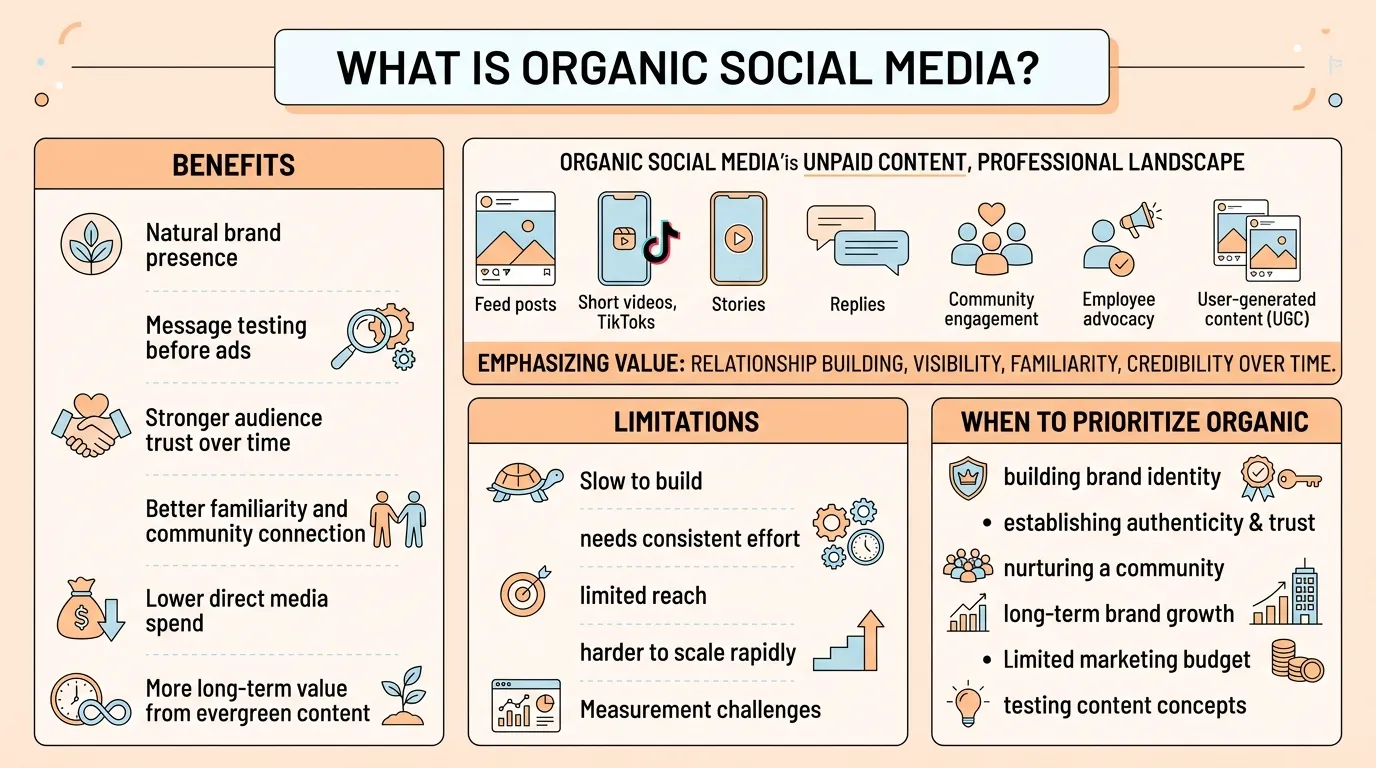
Organic social media is content posted without paying platforms, such as feed posts, short videos, Stories, responses, community engagement, employee advocacy, and user content. Its value is relationship building, showing how the brand thinks and responds over time.
For most businesses, organic social is best when the goal is to stay visible, build familiarity, and create content that feels credible rather than interruptive. It is especially useful when the audience needs repeated exposure before they are ready to trust the brand.
Benefits of Organic Social Media
Organic builds a natural brand presence. Consistent posting and good responses make brands memorable without a hard sell, strengthening recall and trust beyond paid media.
It’s great for message testing. Before investing in ads, see which themes or formats get shares, saves, comments, or actions. This shows what to promote later.
In practical terms, the biggest advantages are:
- stronger audience trust over time
- better brand familiarity and community connection
- lower direct media spend
- more long-term value from evergreen or repeatable content
Limitations of Organic Social Media
Organic is valuable but slow. It requires planning, content, consistent publishing, and moderation. Platform distribution is unpredictable, so reach can be limited.
Organic alone isn’t the best for immediate leads or fast growth. It’s ideal for discovery and trust, but not for rapid traffic or conversions.
When Businesses Should Prioritise Organic Social Media
This was a missing piece in the earlier draft, and it matters. If we are comparing organic and paid fairly, we need to be explicit about when organic should lead.
We should usually prioritise organic social when:
- the business is still building brand recognition
- trust matters more than speed
- the budget is limited but the team can create content consistently
- the category depends on credibility, education, or community
- we want to test messaging before scaling paid campaigns
For SMEs, this is crucial. Organic is a low-risk way to build visibility before increasing spend. If not ready to pay for reach, earn attention first.
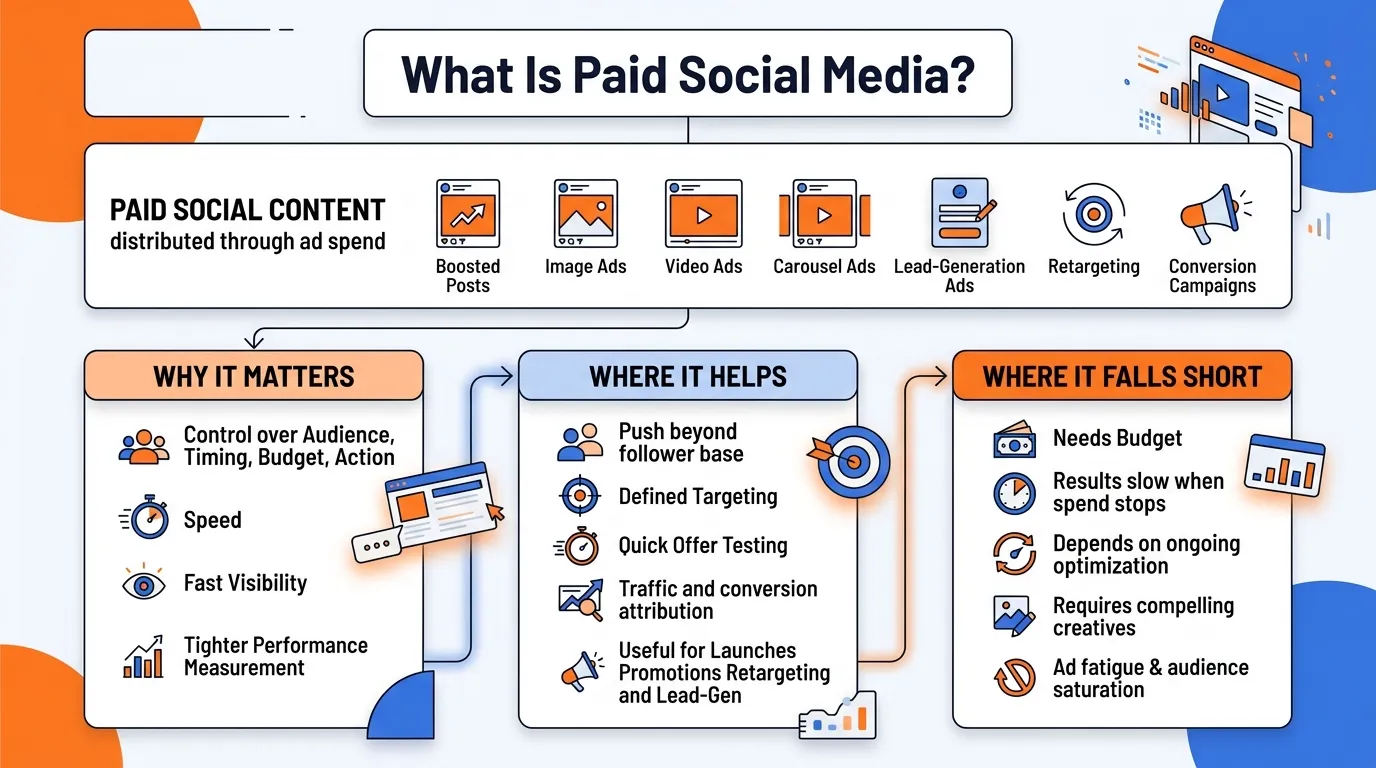
Paid social media refers to content distributed through advertising spend. That includes boosted posts, image ads, video ads, carousel ads, lead-generation ads, retargeting, and conversion campaigns. Its main advantage is control.
We can choose the audience, timing, budget, and desired action much more directly than with organic alone.
From a business perspective, paid social becomes valuable when visibility needs to happen quickly, when targeting matters, or when we need to measure campaign performance more tightly.
Benefits of Paid Social Media
The biggest strength of paid social is speed. It lets us push beyond the follower base, target defined audiences, and test offers quickly. For launches, promotions, lead-generation campaigns, or retargeting, this level of control is difficult to replicate organically.
Paid social also performs better in terms of attribution. We can structure campaigns around traffic, sign-ups, purchases, or other conversion actions and evaluate performance through metrics that matter commercially, not just socially.
Limitations of Paid Social Media
Paid social requires a budget, and results usually slow down once the budget runs out. It also depends heavily on strong creative and a clear landing-page journey. If the messaging is weak, the offer is unclear, or the page experience is poor, ads will simply push a weak experience further.
There is also the issue of fatigue. Audiences stop responding when the same ad keeps appearing without creative refreshes, which means paid social needs ongoing optimisation to remain efficient.
When Businesses Should Prioritise Paid Social Media
We should usually lean more heavily into paid social when speed matters. That includes:
- product launches
- promotions or seasonal campaigns
- lead-generation pushes
- retargeting warm audiences
- campaigns where measurable traffic or conversions are the priority
Paid social also becomes more important when the market is crowded, and organic reach alone is too slow to support the business goal.
This is the most practical way to decide.
| Business goal | Organic social media | Paid social media | Best approach |
| Brand awareness | Good over time | Fast reach | Both |
| Community building | Strong | Limited on its own | Organic led |
| Lead generation | Weak on its own | Strong | Paid led |
| Product launch | Supportive | Strong | Both |
| Retargeting | Limited | Strong | Paid led |
| Long-term credibility | Strong | Supportive | Organic led |
If we want trust and staying power, organic should lead the way. If we want speed and measurable response, paid should lead. If we want growth with staying power, the best answer is usually both.
How to Choose the Right Mix for Your Business
An effective analysis goes beyond definitions to help decision-makers select the most strategic approach for their context, rather than assuming parity between organic and paid social media.
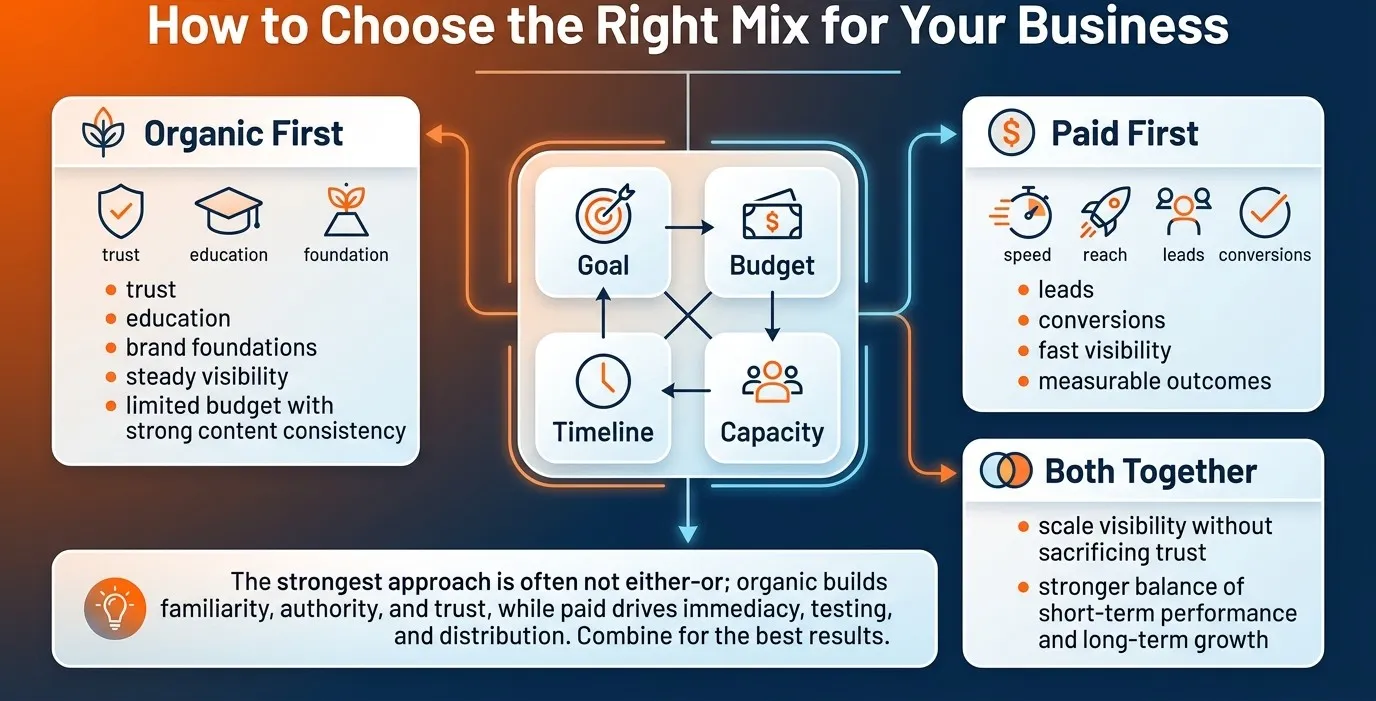
In most cases, the right mix comes down to four practical factors: goal, budget, timeline, and internal capacity. These four variables usually determine whether a business should lean more heavily on organic social media, paid social media, or a combination of both.
- Start with the goal: Choose based on what the business needs most. If the priority is trust, education, and long-term brand building, organic should carry more weight. If the priority is leads, conversions, or fast visibility, paid should take the lead.
- Consider the budget: It affects how quickly and how far your content can reach. If spending is limited but the team can consistently create strong content, organic may be the better starting point. If the budget is available and results need to move faster, paid can accelerate reach and action.
- Factor in the timeline: If the business needs results quickly, paid social is usually the more practical option. If the business can afford to build steadily over time, organic social can play a bigger role.
- Be honest about capacity: The best mix depends on what the team can sustain. Organic requires consistency and content, while paid requires setup, testing, and optimisation. If the team cannot properly support one, the strategy should be adjusted.
A simpler way to think about it
A practical way to approach the decision is:
- Choose organic first when trust, consistency, and brand foundations matter most.
- Choose paid first when speed, reach, and measurable outcomes matter most.
- Choose both together when the business wants to scale visibility without sacrificing trust.
The strongest approach is often not either-or
For many businesses, the most effective strategy is not choosing one channel over the other. It is using each one for the role it performs best.
Organic content can build familiarity, authority, and audience trust, while paid social can amplify visibility, support campaigns, and drive more direct action when needed.
That usually creates a more balanced system. Instead of relying solely on organic and waiting too long for traction, or solely on paid and missing long-term brand value, the business builds a mix that supports both immediate performance and longer-term growth.
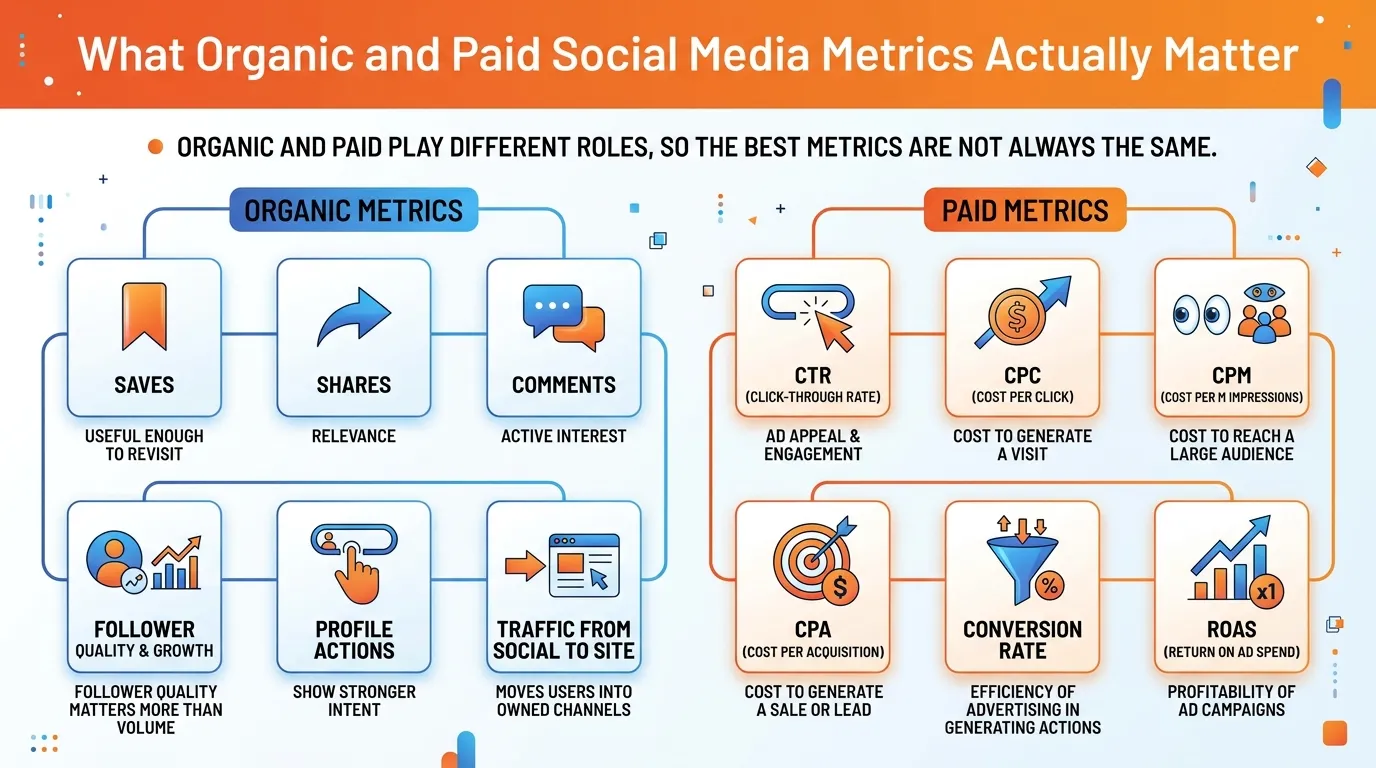
One of the biggest mistakes in this comparison is measuring organic and paid social media in the same way. They often play different roles, so the metrics that matter most are not always the same.
For organic social, I would usually focus on:
- Saves: A strong sign that the content feels useful enough to revisit.
- Shares: A signal that the content is relevant enough for someone to pass on to others.
- Comments: A better indicator of active interest than passive likes, especially when users ask questions or start discussions.
- Follower quality and growth: Growth matters, but relevant and engaged followers matter more than volume alone.
- Profile actions: Actions such as profile visits, link taps, or contact clicks suggest stronger interest than surface-level engagement.
- Traffic from social to the site: This shows whether organic content is pushing users beyond the platform and into your owned channels.
For paid social, I would usually focus on:
- CTR: Helps show whether the ad is compelling enough to earn clicks.
- CPC: Useful for understanding how efficiently paid social is generating traffic.
- CPM: Shows how expensive it is to reach the audience.
- CPA: One of the clearest indicators of whether the campaign is producing results efficiently.
- Conversion rate: Helps show whether paid traffic is turning into the action you want.
- ROAS: Useful when the goal is to assess paid social in direct commercial terms.
The reason this matters is simple: if both channels are measured with the wrong metrics, budget decisions become distorted. Organic should not be judged only by last-click conversions, and paid should not be judged only by likes or impressions.
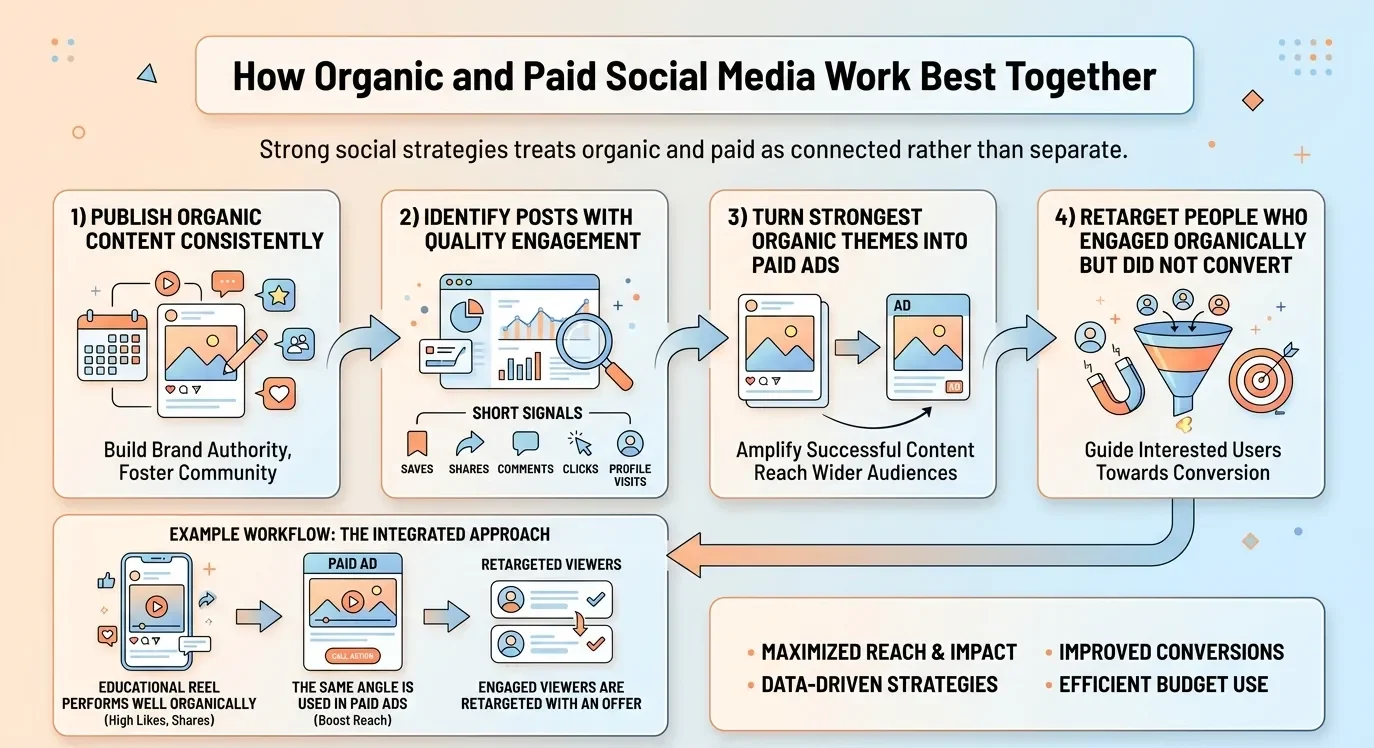
The strongest social strategies usually treat organic and paid as connected rather than separate. Organic helps brands see what content, message, or angle people respond to naturally. Paid then helps scale those insights to a larger or more targeted audience.
A practical way to combine them is:
- Publish organic content consistently: This provides the brand with a steady stream of audience signals, rather than relying on guesswork.
- Identify which posts attract quality engagement: Look for content that earns saves, shares, comments, clicks, or other signs of real interest, not just passive reach.
- Turn the strongest organic themes into paid ads: If a topic or creative angle already performs well organically, it often has a better chance of working in paid campaigns too.
- Retarget people who engaged organically but didn’t convert: This helps move warm audiences forward rather than treating every paid campaign as a cold start.
For example, a brand might post an educational Reel organically and notice that it drives strong saves, profile visits, and comments.
Instead of creating a paid ad from scratch, the brand can use that same angle in a paid campaign and then retarget viewers who engaged but did not take the next step.
That is often where the best efficiency comes from. Organic improves the creative, while paid improves the distribution.
Compliance and Advertising Rules Businesses Should Not Ignore
In Singapore, social media campaigns are not outside advertising rules just because they appear on digital platforms. ASAS’ Guidelines on Interactive Marketing Communication and Social Media make clear that the guidance applies to advertising and marketing communication that uses social media to promote goods and services or influence consumer behaviour.
If the campaign collects personal data through lead forms, giveaway entries, sign-ups, or remarketing flows, PDPA obligations also apply.
PDPC’s PDPA overview states that the Act establishes a baseline standard of protection for personal data in Singapore and includes requirements governing its collection, use, disclosure, and care.
From a practical standpoint, we should check:
- whether sponsored content is clearly identifiable
- whether claims are accurate and supportable
- whether personal data collection is disclosed properly
- whether internal approvals are clear before launch
That keeps the section useful and scoped without drifting into legal overreach.
Real Examples of When Organic, Paid, or Both Work Best
The best examples for this topic are the ones that clearly show which model was doing the heavy lifting.
When organic-led momentum is the priority
OCBC’s #HuntTheMouse campaign is a strong example of how community participation, social sharing, and earned attention can outperform a heavy media approach.
With media spend of just S$1,500, the launch post reportedly reached 746,191 unique individuals, generated 175,724 engagements, and helped drive more than 2.87 million engagements and 30,000 comments across social media.
The campaign also attracted an estimated 210,565 participants and contributed to a 14% increase in monthly downloads of the OCBC Pay Anyone app.
This is a useful reminder that when the campaign mechanic itself is highly shareable, organic and earned momentum can do much of the work.
When a paid-led push makes more sense
Poh Heng’s brand campaign is a better fit when the goal is broad, controlled visibility supported by paid distribution.
Public reporting shows that the campaign used targeted video-led digital media, including Facebook collection ads and Facebook video link ads, and generated 18.6 million impressions, 37.4K clicks, and 3.1 million video views.
Within one week, Facebook engagement reportedly rose by 165%, and the brand’s following grew by 20%. This is a good example of when paid social is useful because the business needs scale, control, and measurable delivery rather than slow-burn organic growth alone.
When both organic and paid work best together
Singlife is one of the clearest examples of a mixed model. Its launch campaign ran across Facebook, Instagram, YouTube, display, and app stores, while the team tracked both organic and paid performance through a dashboard broken down by campaign, platform, and time period.
According to public case-study coverage, the campaign used about 120 creative assets for different audience segments and measured success beyond impressions by mapping activity against brand searches, installs, and lower-funnel goals.
Singlife reported that its brand searches increased and that its marketing activity contributed an estimated 40% to organic installs.
That makes this a strong example of why organic and paid should not always be treated as separate choices. Paid media built scale, while organic response helped signal broader interest and lift.
This mix is often the most realistic answer for businesses. Organic helps build credibility and engagement signals, while paid helps increase reach and accelerate outcomes. The better question is usually not which one is better in absolute terms, but which one should lead for the specific goal.
A common problem in organic vs paid social media is not the channel itself, but how the business applies it. Poor assumptions at the planning stage often lead to weak performance and even weaker conclusions about what is or is not working.
Some of the most common mistakes include:
- Expecting organic social media to deliver immediate commercial results: Organic content can build visibility, trust, and audience familiarity, but it usually works more gradually. When businesses expect it to function like a performance channel from day one, they often judge it too harshly.
- Using paid social media before the message is strong enough: Paid distribution can increase reach, but it cannot fix an unclear offer or message. If the core angle is weak, paid media may only accelerate underperformance.
- Putting a budget behind content that shows no early signs of relevance: Not every post deserves amplification. Paid social tends to work better when it supports a message, theme, or creative direction that already appears to connect with the intended audience.
- Treating channel choice as a one-time decision: Some businesses act as if they must commit fully to either organic or paid. In practice, the stronger approach often involves adjusting the balance over time as goals, budget, and audience behaviour change.
- Confusing activity with progress: A busy content calendar or an active ad account does not automatically mean the strategy is working. Without a clear role for each channel, businesses can end up doing more without moving closer to the real objective.
These mistakes matter because they distort decision-making. A business may conclude that paid social media is ineffective when the real problem is weak positioning, or assume organic social media is working well simply because it looks active.
A clearer view of organic vs paid social media starts with avoiding those early strategic errors.
Before deciding where to allocate time and budget, use this checklist to ensure the strategy aligns with the business needs.
- Define the main goal clearly, whether that is awareness, engagement, leads, sales, or retention.
- Decide how quickly results are needed.
- Confirm whether a budget is available for paid distribution.
- Assess whether the team has the capacity to consistently create organic content.
- Make sure tracking is set up properly before the campaign begins.
- Clarify who is responsible for approvals and review timelines.
- Check whether the campaign will collect personal data through forms, entries, sign-ups, or remarketing.
- Match the channel mix to the real objective instead of treating organic and paid as interchangeable.
- Give organic more weight when trust, authority, and long-term visibility matter most.
- Give paid more weight when speed, reach, and measurable response matter most.
- Use both together when the goal is sustained growth with clearer roles for each channel.
If the strategy passes these checks, it is far more likely to be aligned with the business outcome rather than driven by habit or guesswork.
The real value in comparing organic vs paid social media is not in deciding which is always better. It is in understanding what each approach is designed to do, where each one performs best, and how both can support different business goals at different stages of growth.
Organic social media is often stronger when the priority is trust, consistency, audience connection, and long-term brand visibility.
Paid social media is often stronger when the priority is speed, reach, campaign control, and measurable response. For many businesses, the strongest approach is not choosing one at the expense of the other, but combining both in a way that gives each channel a clear role.
That is usually where better results come from. Organic helps build credibility, engagement, and brand familiarity over time, while paid helps accelerate visibility, support campaigns, and drive more direct action when needed. When the mix aligns with the real objective, social media becomes more than a publishing channel. It becomes a more effective growth channel.
If your business wants a clearer strategy for balancing organic and paid social media, MediaOne can help.
Explore our social media marketing consultancy services to build a social strategy that supports stronger visibility, better engagement, and more measurable business outcomes. Reach out to us today!
Frequently Asked Questions
Is organic social media better than paid social media?
Not in absolute terms. Organic is usually better for long-term brand building and credibility. Paid is usually better for launches, lead generation, retargeting, and faster scale. The better option depends on the objective.
Should small businesses start with organic or paid social media?
That depends on urgency and budget. If the business needs trust and can invest time, organic is a sensible starting point. If the business needs leads or traffic quickly and has a budget, a small paid test can make sense earlier.
Can paid social media support organic growth?
Yes. Paid social can expose the brand to new audiences who may later follow, search, or engage organically. It can also help us test which messages deserve more long-term organic attention.
What should businesses check before launching a social campaign in Singapore?
At a minimum, we should check disclosure, claim accuracy, tracking setup, landing-page readiness, and whether the campaign collects personal data in a way that triggers PDPA considerations. ASAS and PDPC guidance are both relevant here.
Does paid social media improve organic social media performance?
Paid social does not directly improve organic reach in a guaranteed way, but it can help more people discover the brand, which may lead to stronger brand recall, more profile visits, and higher engagement on organic content over time. It is most useful when the paid campaign is amplifying a message or offer that already fits the audience well.
Should I test content organically before putting budget behind it?
In many cases, yes. Organic content can give early signals on which themes, hooks, or creative angles attract stronger engagement before ad spend is committed. This can help reduce waste by giving paid campaigns a better starting point.
Is organic social media more credible than paid social media?
Organic social often feels more natural because people encounter it as part of the brand’s ongoing presence rather than as an advertisement. Paid social can still be effective, but it usually works best when the creative feels relevant and trustworthy rather than overly promotional.
Do different industries need different organic vs paid social media mixes?
Yes. A business in a trust-led or higher-consideration industry may need stronger organic content to build confidence before paid campaigns can convert effectively. By contrast, a business with a fast-moving offer or promotion may rely more heavily on paid social to generate immediate visibility and drive immediate responses.
Can paid social media work if organic social media is weak?
It can still generate reach, traffic, or short-term results, but the overall strategy may feel less convincing if the brand’s organic presence is weak. When users click through from a paid ad and encounter an inactive or underdeveloped profile, trust can drop, potentially reducing the campaign’s overall effectiveness.