Artificial intelligence (AI) is transforming marketing from a supporting tool into a powerful engine for growth and innovation. According to a recent survey, 80% of marketers have used or currently use AI tools to help create marketing content.

This widespread adoption shows how AI helps brands work faster, create personalised experiences and connect better with their customers. AI is creating content at scale and predicting customer behaviour, opening possibilities that were once unimaginable.
In this blog, we explore seven emerging AI marketing trends that are reshaping marketing right now, providing actionable insights and practical strategies for brands aiming to stay ahead.
Key Takeaways
- AI enables marketers to produce text, images, video and audio at scale, freeing up creative teams to focus on strategy and storytelling.
- Leveraging AI and real-time data allows brands to deliver tailored experiences, offers and messages that resonate with individual customers.
- Combining historical data with live insights lets marketers forecast trends, optimise campaigns instantly and act proactively.
Trend 1: Generative AI for Content Creation
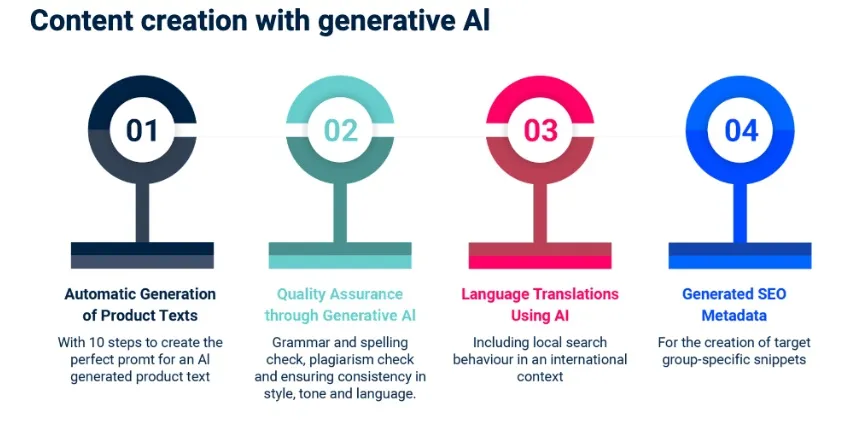
Image Credit: Artefact
Generative AI uses advanced algorithms to create original content in the form of text, images, video and audio. These content are based on patterns learned from existing data. In marketing, it enables brands to produce blog posts, social media content, product descriptions and ad campaigns faster and at scale.
Beyond speed, generative AI helps maintain consistency in brand voice and style across multiple channels, reducing the risk of human error or content fatigue.
For example, e-commerce companies can automatically generate thousands of product descriptions tailored to different audiences, while social media teams can quickly create multiple variations of posts for A/B testing.
Video marketers can use AI to draft short promotional clips and designers can produce concept visuals for campaigns, significantly reducing production time and costs.
Trend 2: Hyper‑Personalisation at Scale
Hyper-personalisation uses AI and real-time data to deliver marketing messages, offers and experiences tailored to individual customers rather than broad, generic segments. Brands dynamically adapt content to meet each user’s unique needs by analysing customer behaviour, preferences, purchase history and contextual factors such as location or device type.
This goes beyond basic personalisation like addressing a customer by name; it involves creating highly relevant experiences at every touchpoint in the customer journey.
For instance, an e-commerce retailer can recommend products based on browsing patterns, past purchases, or even trending items in the user’s area, while a streaming service can curate video or music suggestions tailored to the user’s mood, time of day, or previously watched content.
Hyper-personalisation also extends to real-time triggers, such as sending a discount offer immediately after a customer abandons a shopping cart or adjusting website banners and pop-ups to match the visitor’s interests.
Benefits include higher engagement, reduced churn and improved customer loyalty. Success depends on robust data infrastructure, privacy compliance and real-time decisioning.
Trend 3: Predictive Analytics & Real‑Time Decision‑Making

Image Credit: Data Expertise
Predictive analytics uses AI, machine learning and historical data to anticipate customer behaviour. Marketers recognise patterns in past interactions, purchase histories and engagement metrics to make informed predictions about what customers are likely to do next.
Real-time decision-making uses live data (like browsing behaviour, location, device type and recent interactions) to adjust marketing strategies immediately. This lets marketers act proactively, sending timely and relevant messages that connect with customers.
For example, a retailer can detect when a shopper is about to abandon a cart and immediately trigger a personalised discount offer, or a streaming service can suggest content in real time based on a user’s viewing pattern.
Brands combine predictive insights with live optimisations to improve engagement, increase conversion rates, allocate budgets more efficiently to ensure every interaction feels personalised and impactful.
Trend 4: AI‑Powered Automation in Campaigns & Ads
Rather than handling repetitive tasks manually, marketing teams can deploy AI to automate content distribution, manage ad spend, run A/B tests and even personalise messaging at scale.
Brands can automatically adjust their social media ad budgets based on real-time performance, or trigger personalised emails when a customer abandons their cart, ensuring timely engagement without human intervention.
AI also enables rapid testing of creative variations, helping teams identify the most effective visuals, copy and offer faster than traditional methods. Marketers integrate AI into campaign workflows to focus on strategy, creative storytelling and audience insights, while automation handles routine execution.
This not only improves efficiency and reduces operational costs but also enhances campaign relevance and responsiveness, allowing brands to react swiftly to market trends and customer behaviour.
Trend 5: Multimodal & Visual Search, Voice & Conversational Interfaces

Image Credit: Master.Of.Code
Instead of relying solely on typed queries, users can now speak to virtual assistants, upload images to find visually similar products, or combine text with images to refine search results.
This evolution reflects a more natural, intuitive way of engaging with technology, where users expect instant, relevant responses across multiple formats. For marketers, it means optimising content not just for traditional search engines but also for voice assistants, visual search platforms and conversational interfaces.
Brands that adapt can capture audiences earlier in the discovery process, provide seamless and engaging experiences and meet consumer expectations for convenience and immediacy.
Multimodal search allows shoppers to photograph a product and find it online or ask questions naturally through smart speakers, changing the rules of engagement. Marketers who stay ahead can turn these interactions into meaningful conversions.
Why does this matter to marketing? Because when users can talk, snap, or point to something and instantly get results, the rules of discovery and engagement change.
Search queries become more conversational (“Where can I buy a blue running shoe like this?”), image‑based (uploading a photo to find matching products) or voice‑based (“Show me the nearest café that’s pet‑friendly”). Brands that optimise only for typed keywords risk being left behind.
Trend 6: Ethical AI, Trust & Transparency in Marketing
The integration of artificial intelligence into marketing campaigns has unlocked remarkable efficiencies and opened up new creative possibilities. However, this power also brings ethical considerations and transparency into sharp focus.
For brands deploying AI-powered systems, these factors play a big role in customer engagement that keeps people coming back. Consumers increasingly expect brands to be clear about how AI influences marketing interactions, including the use of personal data, automated decision-making and AI-generated content.
Failing to meet these expectations can erode trust, damage brand credibility and even result in regulatory scrutiny. On the other hand, brands that disclose AI involvement and provide consumers with control over their data, can differentiate themselves in a competitive market.
When brands handle AI rushily, ignoring ethics, transparency or consumer expectations, they can suffer reputational damage, engagement declines or even regulatory fines. In contrast, brands that embed ethical AI practices and build transparent policies gain competitive advantage.

For example, one analysis reported that companies with responsible AI practices see 15‑25% higher customer‑trust scores within six months of implementation.
Trend 7: Integration of AI Into the Marketing Tech Stack & Skill‑Sets
Modern marketers are no longer just creators or campaign managers. They are expected to understand how AI tools can inform decisions, automate processes and optimise customer experiences.
Integrating AI effectively requires more than simply adding new software; it demands connecting platforms such as CRM systems, analytics dashboards, content automation tools and personalisation engines so they work together seamlessly.
At the same time, teams must develop hybrid skill sets that combine creativity, data literacy, analytical thinking and familiarity with AI-powered systems.
Successful organisations often start with targeted pilot projects such as integrating a personalisation engine into an existing website or automating ad testing before scaling across channels.
Brands gradually build both the technology and the team’s capabilities to master AI, streamline workflows and deliver smarter, more personalised campaigns. Those that align their tech stack and skill sets effectively gain a deeper understanding of their audiences.
AI Metrics and KPIs That Matter in 2026
To measure the impact of AI effectively, marketers should focus on metrics that capture performance, efficiency and customer impact. The table below summarises the most important AI KPIs and how to track them:
| Metric / KPI | What to Measure | Example |
| Personalisation Effectiveness | Engagement with AI-driven personalised content | Click-through rates on recommendations, conversion uplift from tailored offers |
| Predictive Accuracy | How accurately AI forecasts customer behaviour and campaign outcomes | Compare predicted purchases or churn with actual results |
| Automation Efficiency | Time and resources saved through AI automation | Number of tasks automated, reduction in campaign turnaround time, cost savings |
| Customer Experience & Engagement | Improvement in user satisfaction and retention | Session duration, repeat visits, Customer Satisfaction Score, Net Promoter Score |
| ROI & Revenue Impact | Financial performance and value generated by AI campaigns | Revenue growth, average order value, customer lifetime value (LTV) |
| Ethical AI & Trust | Transparency, fairness and bias in AI systems | Bias audits, explainable AI decisions, customer trust survey scores |
Focusing on metrics that combine performance, efficiency and customer impact ensures that AI supports both business goals and customer satisfaction.
Practical Tip: Start with 3–5 core KPIs that align with your marketing objectives. Track them regularly using AI dashboards or analytics platforms, review results and iterate to optimise performance.
Looking Ahead: Mastering AI for Marketing Success
AI is transforming marketing at every level and brands that embrace AI strategically gain efficiency, deeper insights and the ability to deliver highly relevant interactions that resonate with their audience.
At the same time, maintaining ethical practices, transparency and human oversight ensures that AI strengthens trust rather than undermines it.
To stay ahead in this rapidly evolving landscape, businesses must integrate AI thoughtfully into their technology stack, develop the right skills within their teams and continuously measure performance with the right metrics.
If you’re ready to leverage AI to drive smarter, more impactful marketing, MediaOne can help you implement AI-powered strategies that boost engagement, conversions and long-term growth. Contact us today to start your journey.
Frequently Asked Questions
Will AI replace human marketers?
AI is designed to augment human capabilities, not replace them. While AI can handle repetitive tasks, analyse data and generate content drafts, human creativity, strategic thinking and emotional intelligence remain critical for successful marketing campaigns.
How do I ensure AI-driven campaigns remain relevant over time?
Relevance comes from continuous monitoring and optimisation. Regularly reviewing AI insights, updating customer data, A/B testing content and combining AI recommendations with human oversight ensures campaigns remain timely, personalised and effective.
Can AI help with multi-channel marketing strategies?
Yes. AI can integrate across social media, email, websites, mobile apps and paid advertising to deliver consistent messaging, optimise timing and personalise experiences. This ensures a cohesive, data-driven approach that reaches customers wherever they engage.
What are the biggest risks of using AI in marketing and how can they be mitigated?
Common risks include biased recommendations, data privacy issues, over-reliance on automation and lack of transparency. These can be mitigated by implementing ethical AI practices, maintaining human oversight, ensuring robust data security and regularly auditing AI outputs for fairness and accuracy.
Is my customer data safe when using AI?
Data safety depends on the platforms and practices you use. Ensure compliance with privacy regulations like GDPR or CCPA, anonymise personal information where possible and choose AI tools with strong security measures to protect customer data.