Many businesses still track SEO the wrong way. Traffic goes up, impressions rise, rankings improve, and the report looks impressive, but nobody can clearly explain whether SEO is helping the business grow.

That gap is the real problem.
In 2026, measuring SEO properly is no longer about collecting more numbers. It is about choosing the right indicators, understanding what they actually mean, and tying them to commercial outcomes. Search behaviour is less linear than it used to be, AI-influenced search is reshaping discovery, and visibility alone is not enough to prove impact.
I often see businesses invest time into dashboards and reporting without first deciding which numbers actually deserve KPI status. That usually leads to bloated reports, weak decision-making, and SEO discussions that sound busy but do not move the business forward.
Whether you are managing SEO in-house or evaluating options with an SEO agency in Singapore, the goal should be the same: measure the numbers that help you make better decisions and prove real impact.
In this guide, I break down the most important SEO KPIs to track in 2026, how to measure them properly, which tools to use, and how to build a reporting framework that connects SEO to real business outcomes.
Key Takeaways
- The most useful SEO KPIs in 2026 are the ones tied to business outcomes, not just visibility. Organic conversions, revenue, qualified leads, and assisted conversions usually matter more than traffic alone.
- SEO metrics and SEO KPIs are not the same thing. Metrics help explain performance, while KPIs help you judge whether SEO is actually contributing to the business.
- The right KPI mix depends on your business model. A lead generation business should prioritise qualified leads and conversion rate, while an e-commerce brand should focus more on organic revenue, product page performance, and add-to-cart activity.
- Modern SEO measurement needs to account for influence, not just last-click results. That means tracking non-brand clicks, topic visibility, assisted conversions, and technical health alongside direct conversions.
- Strong SEO reporting should combine first-party tools like Google Search Console and GA4 with a clear dashboard structure. The goal is not to collect more numbers, but to track the numbers that help you make better decisions.
The Most Important SEO KPIs to Track in 2026
If you want the short answer first, these are the SEO KPIs I would prioritise in 2026:
- Organic conversions
- Organic revenue or pipeline contribution
- Non-brand organic clicks
- Organic CTR
- Search visibility or share of voice
- Rankings for commercial-intent keywords
- Indexed pages and indexation health
- Core Web Vitals
- Assisted conversions
- Local SEO KPIs where location visibility matters

Not every KPI will matter equally for every business. An e-commerce brand should care more about organic revenue than a publisher, while a service business may care more about qualified leads than total sessions.
But across most business models, these are the KPIs most likely to reflect real SEO performance because they better connect visibility, technical health, and commercial impact than traffic alone.
SEO KPIs vs SEO Metrics: What Is the Difference?
This is where many SEO reports go wrong.
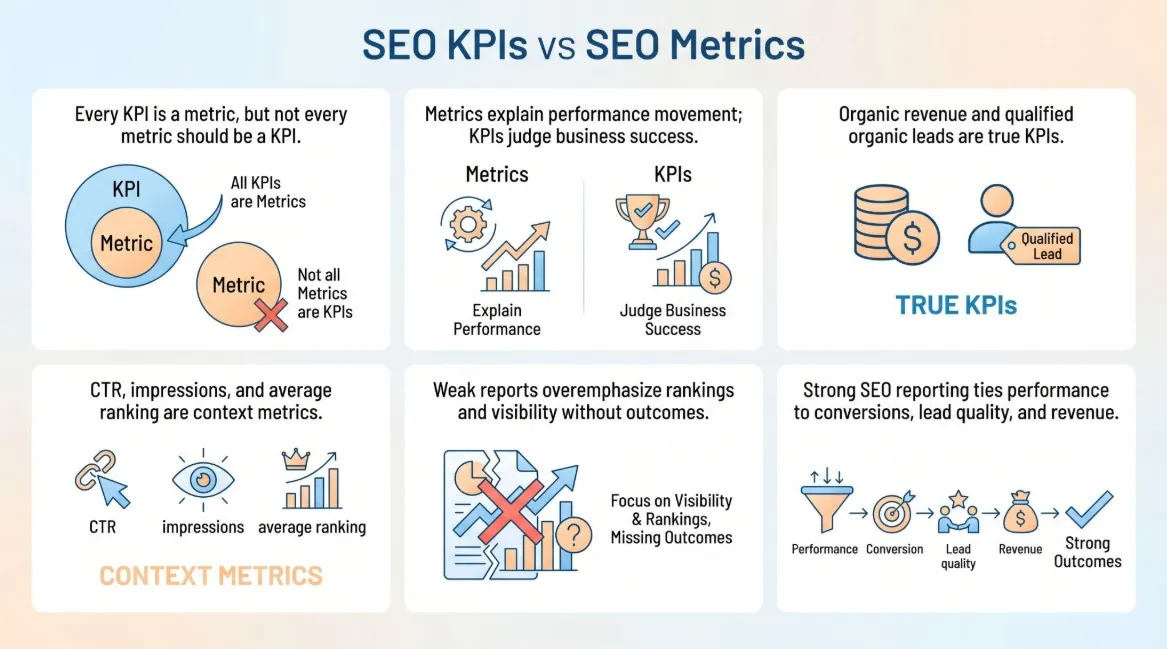
An SEO metric is any measurable data point that helps explain performance. An SEO KPI is a metric important enough to judge whether SEO is succeeding against a business goal.
That means every KPI is a metric, but not every metric should be treated like a KPI.
For example:
- Organic CTR is a useful metric because it helps explain how efficiently you turn impressions into clicks.
- Organic revenue is a KPI because it reflects direct business value.
- The average ranking is a metric because it provides context.
- Qualified organic leads are a KPI because they connect SEO to commercial outcomes.
SEO KPIs vs SEO Metrics at a Glance
| KPI | Organic revenue | Direct business outcome |
| KPI | Organic conversions | Measures commercial value |
| KPI | Lead quality from organic | Connects SEO to business quality, not just quantity |
| Metric | CTR | Helps explain visibility efficiency |
| Metric | Impressions | Shows exposure, not outcome, on its own |
| Metric | Average ranking | Useful for context, but too weak to stand alone |
SEO metrics help explain movement. SEO KPIs help judge whether SEO is actually helping the business.
That distinction matters because many weak SEO reports still overload stakeholders with impressions, sessions, and average rankings without tying those numbers to qualified traffic, conversions, or revenue.
How SEO Measurement Has Changed Since 2023
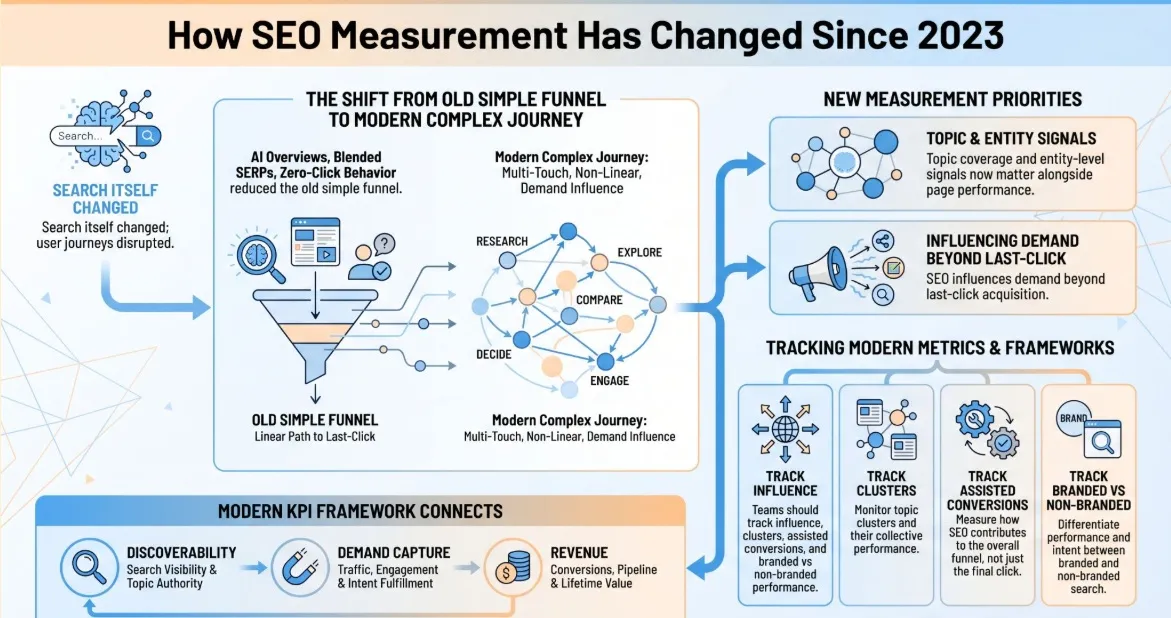
SEO measurement has changed because search has changed.
A few years ago, it was much easier to treat SEO as a simple flow: rank a page, get the click, count the session, measure the conversion. That model still exists, but it no longer captures the full picture.
Today, search performance is shaped by:
- AI Overviews and more blended SERPs
- More zero-click behaviour
- Topical and entity-level evaluation
- Longer and less direct paths to conversion
- Brand influence and assisted discovery
This means SEO cannot be measured purely as a last-click acquisition channel anymore. Visibility can influence demand before the final visit. Informational content can support conversion later in the journey. Topic coverage can matter as much as page-level performance.
What These Changes in Practice
In practical terms, that means we should:
- track influence, not just clicks
- measure topics and clusters, not just single URLs
- separate branded from non-branded performance
- report assisted conversions alongside last-click outcomes
- combine commercial KPIs with technical and visibility signals
The KPI framework needs to show not only what happened, but whether SEO is helping the business capture demand, improve discoverability, and contribute to revenue more effectively.
Core SEO KPI Categories for 2026
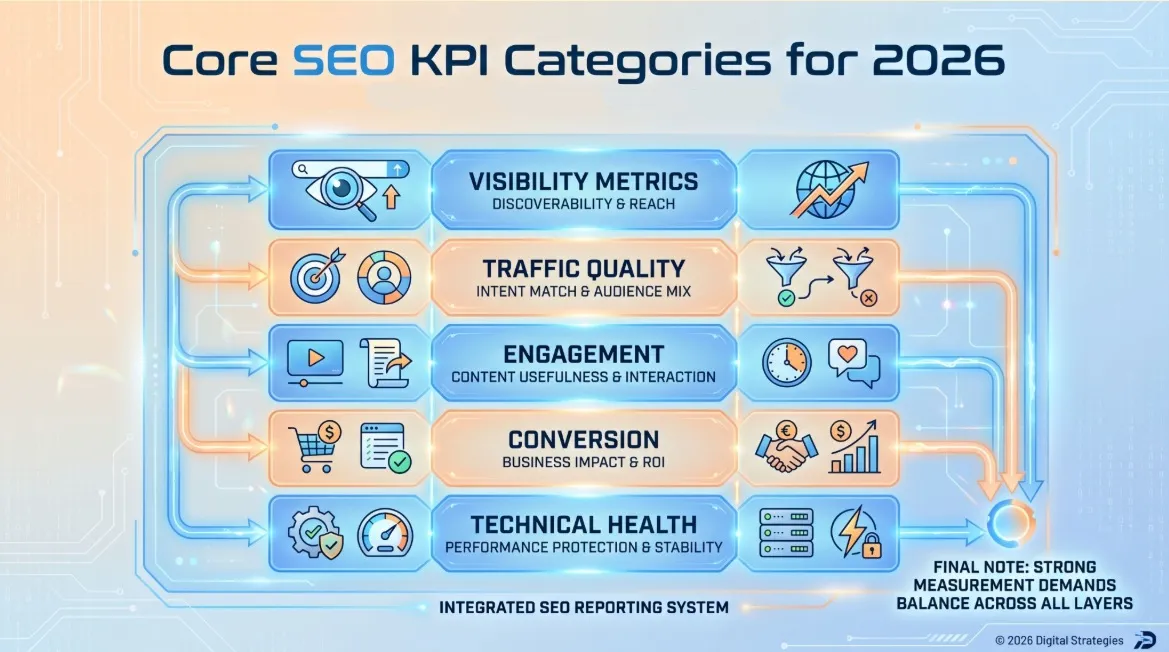
A useful SEO KPI framework usually fits into five categories:
- Visibility
- Traffic quality
- Engagement
- Conversion
- Technical health
Core SEO KPI Categories at a Glance
| Visibility | Impressions, non-brand clicks, search appearance, rankings | Google Search Console, Ahrefs, Semrush |
| Traffic quality | Landing page intent, geo split, device split | GA4, Google Search Console |
| Engagement | Engaged sessions, content interaction, path depth | GA4 |
| Conversion | Leads, purchases, assisted conversions, revenue | GA4, CRM, and an e-commerce platform |
| Technical health | Indexed pages, Core Web Vitals, crawl and coverage issues | Google Search Console, PageSpeed Insights, crawler |
This structure matters because it prevents reports from becoming too narrow. If you only report traffic, you miss commercial value.
If you only report conversions, you may miss visibility and technical deterioration. A balanced KPI model makes it easier to see where SEO is performing well and where it is breaking down.
The SEO KPIs That Matter Most by Category
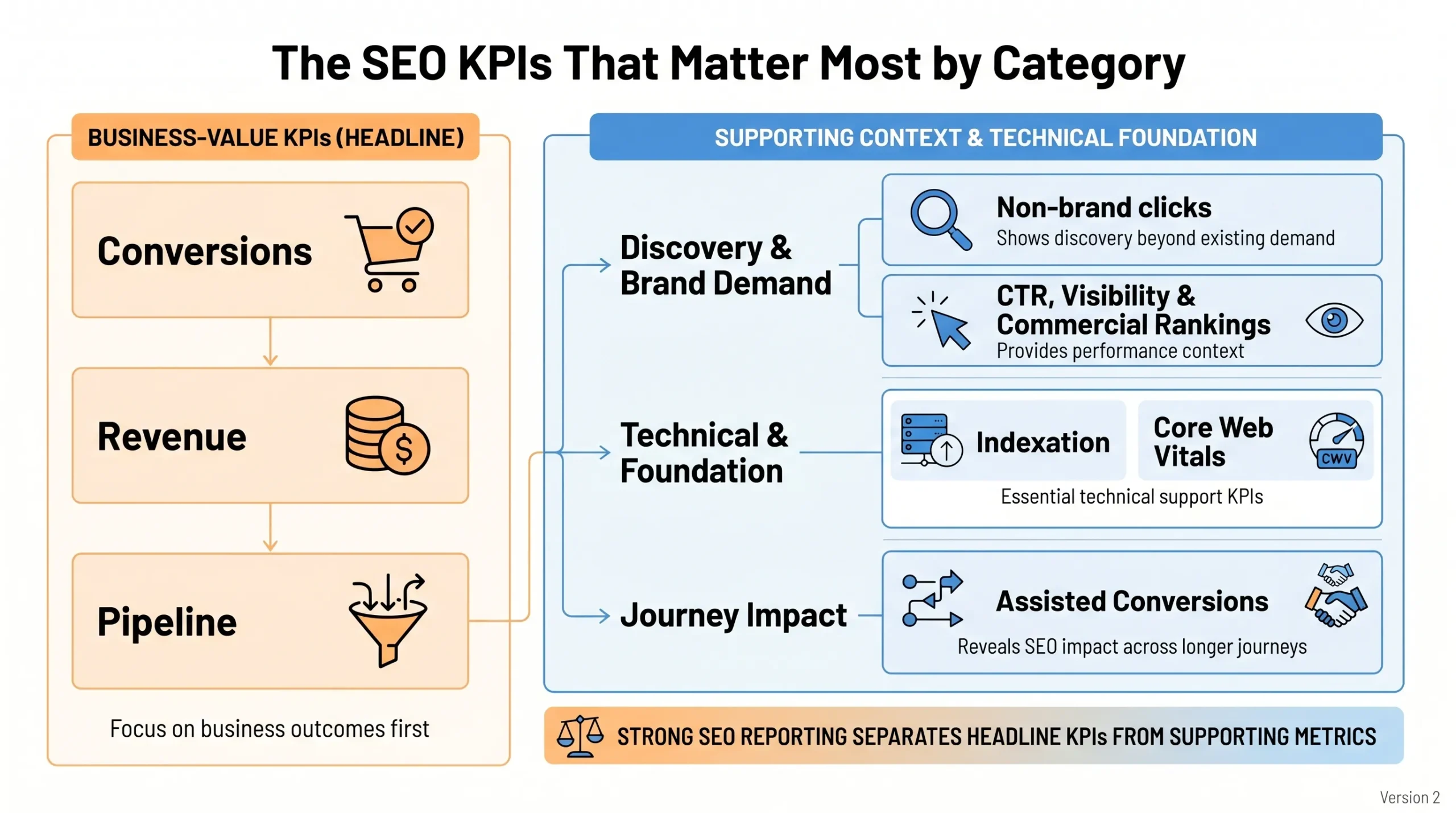
Organic Conversions
Organic conversions are still one of the clearest SEO KPIs because they tell you whether organic traffic is turning into meaningful actions.
That might mean: purchases, form submissions, consultation requests, demo bookings, and phone calls
- Why it matters: Traffic is only useful if it helps move the business forward.
- How to track it: Track conversions in GA4, then segment by organic channel and landing page.
- Common mistake: Celebrating traffic growth while ignoring whether that traffic converts.
Organic Revenue or Pipeline Contribution
For e-commerce, this is often the headline KPI. For lead generation, the equivalent may be pipeline contribution, sales-qualified lead value, or attributed opportunity value.
- Why it matters: This is how SEO becomes a commercial growth channel rather than a reporting category.
- How to track it: Use GA4 for ecommerce revenue or connect organic lead attribution to CRM and pipeline reporting.
- Common mistake: Tracking conversions without checking whether those conversions actually create meaningful business value.
Non-Brand Organic Clicks
Non-branded performance is one of the cleanest indicators that SEO is capturing demand from users who were not already looking for your brand.
- Why it matters: It shows whether SEO is generating net-new discovery.
- How to track it: Use Google Search Console query filters to exclude brand terms and monitor clicks and impressions over time.
- Common mistake: Treating total organic growth as proof of SEO progress when most gains are branded.
Organic CTR
CTR is not a standalone business KPI, but it is one of the most useful supporting KPIs because it shows how efficiently you are converting impressions into visits.
- Why it matters: A stronger CTR can indicate better title alignment, better SERP positioning, or stronger intent match.
- How to track it: Use Search Console by page, query, and page group.
- Common mistake: Reading CTR in isolation without checking SERP features or query mix.
Search Visibility or Share of Voice
Search visibility is especially useful in competitive categories where ranking for a handful of terms does not tell the full story.

- Why it matters: It helps reveal whether you are gaining or losing ground in the wider search landscape before traffic trends become obvious.
- How to track it: Use Ahrefs, Semrush, or other ranking visibility tools.
- Common mistake: Using rankings for a small keyword set and assuming that represents total market presence.
Rankings for Commercial-Intent Keywords
Not all rankings matter equally. Ranking first for a low-intent informational term may not matter nearly as much as moving into the top three for a commercial query tied to revenue.
- Why it matters: Commercial rankings tend to carry more weight in business.
- How to track it: Track a focused set of commercial keywords by service, category, or bottom-funnel intent.
- Common mistake: Treating all rankings as equally important.
Indexed Pages and Indexation Health
If the right pages aren’t indexed, the rest of the SEO strategy is capped.
- Why it matters: Indexation is the baseline condition for visibility.
- How to track it: Use Search Console’s Page Indexing reports and validate with a crawler.
- Common mistake: Tracking the number of indexed pages without checking whether the most important ones are included.
Core Web Vitals
Core Web Vitals still matter as technical quality indicators, especially when poor page experience affects engagement or conversion efficiency.
- Why it matters: Technical friction can reduce the value of otherwise strong SEO traffic.
- How to track it: Use PageSpeed Insights, CrUX, and Search Console CWV reporting.
- Common mistake: Treating Core Web Vitals as a direct ROI KPI rather than a supporting technical KPI.
Assisted Conversions
SEO often influences the journey leading up to the final click.
- Why it matters: A lot of upper- and mid-funnel SEO content will never look strong in last-click reporting, even when it plays a real role in demand generation.
- How to track it: Use GA4 attribution paths and assisted conversion analysis.
- Common mistake: Undervaluing SEO because the final conversion happened through branded search, direct, or paid.
How to Track SEO KPIs by Tool
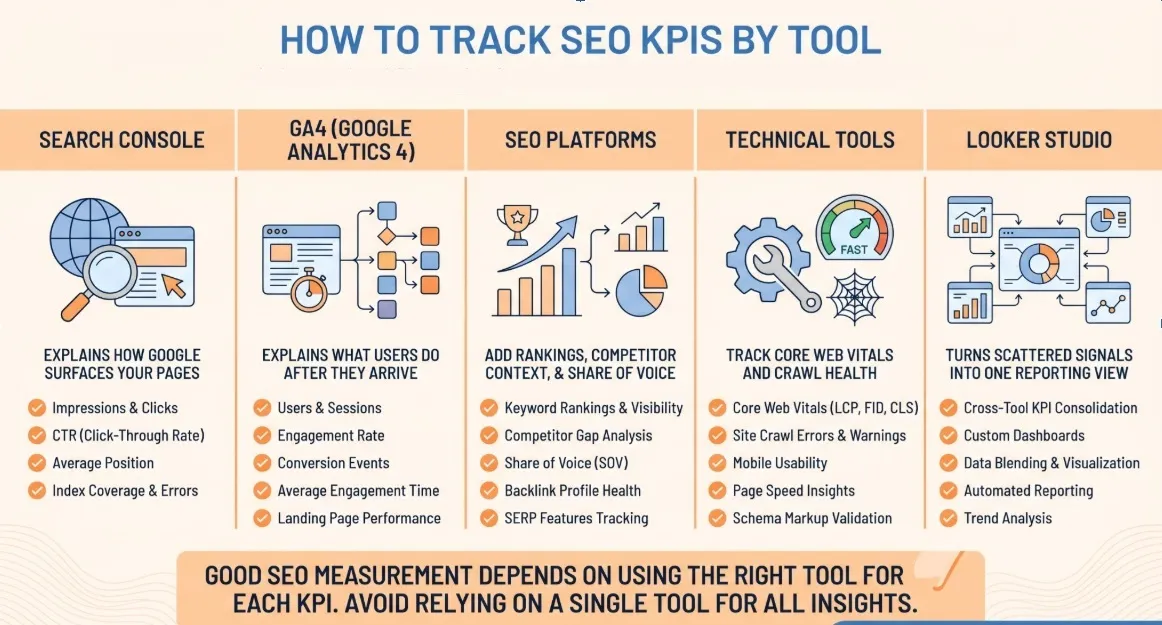
The right KPI framework only works if you know where to measure each signal.

Google Search Console
Search Console is still the strongest first-party visibility source for SEO.
Use it for:
- impressions
- clicks
- CTR
- average position
- search appearance types
- non-brand query visibility
- indexation trends
If you want to understand how Google is surfacing your pages and whether visibility is trending in the right direction, this is usually the starting point.
GA4
GA4 is where SEO becomes commercially measurable.
Use it for:
- organic conversions
- engaged sessions
- landing page performance
- revenue from organic traffic
- assisted conversion paths
- conversion rate by page group
Search Console tells you how users arrive. GA4 tells you what they do after they arrive.
SEO Platforms Like Ahrefs, Semrush, or AWR-Style Tools
These platforms are best used for:
- rankings
- visibility trends
- competitor movement
- share of voice
- commercial keyword tracking
They add the market context that Google’s first-party tools do not provide on their own.
PageSpeed Insights, CrUX, and Crawler Tools
Use these for:
- Core Web Vitals
- crawl errors
- orphan pages
- crawl depth
- status code distribution
- technical issue trends
These are especially important when technical health is likely to affect discoverability or conversion efficiency.
Looker Studio
Looker Studio is useful because it combines KPI layers into a single reporting view.
Use it for:
- stakeholder dashboards
- monthly KPI reporting
- executive summaries
- recurring reporting workflows
This makes it much easier to keep reporting focused on the KPIs that matter rather than screenshots from multiple tools.
SEO KPIs for Different Business Models
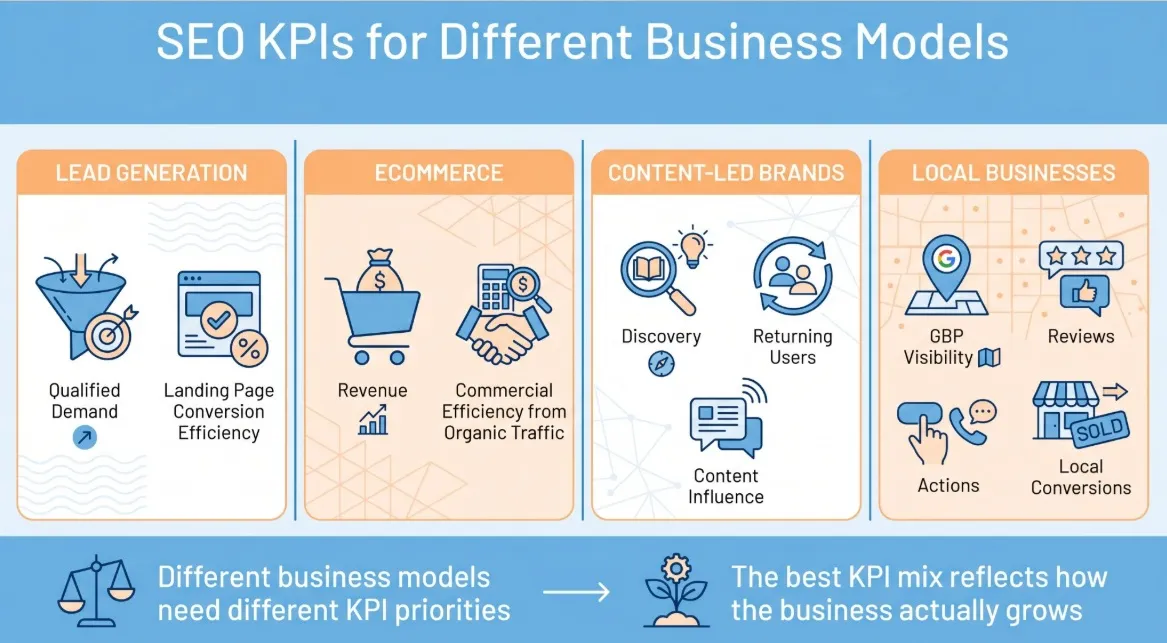
The right KPI mix depends on how the business grows.
SEO KPIs for Lead Generation Businesses
For lead generation, I would prioritise:
- organic leads
- lead quality
- conversion rate from organic landing pages
- assisted conversions
- non-brand clicks to commercial pages
Traffic matters here, but only if it leads to qualified demand.
SEO KPIs for E-commerce
For e-commerce, I would prioritise:
- organic revenue
- product and category page conversion rate
- add-to-cart actions from organic sessions
- non-brand category visibility
- revenue per organic session
The goal is not just to grow organic visits, but to improve the commercial efficiency of those visits.
SEO KPIs for Content-Led Brands
For publishers, education sites, and content-led demand generation, I would prioritise:
- non-brand clicks
- topic cluster visibility
- returning organic users
- assisted conversions from content
- content-to-conversion contribution
Here, the KPI model should account for influence and discovery, not just immediate purchase intent.
SEO KPIs for Multi-Location or Local Businesses
For local businesses, I would prioritise:
- GBP profile views
- calls, website clicks, and direction requests
- local pack rankings
- review growth and average rating
- local landing page conversions
This is where local SEO KPI coverage becomes important enough to deserve its own section.
Local SEO KPIs to Track if Location Visibility Matters
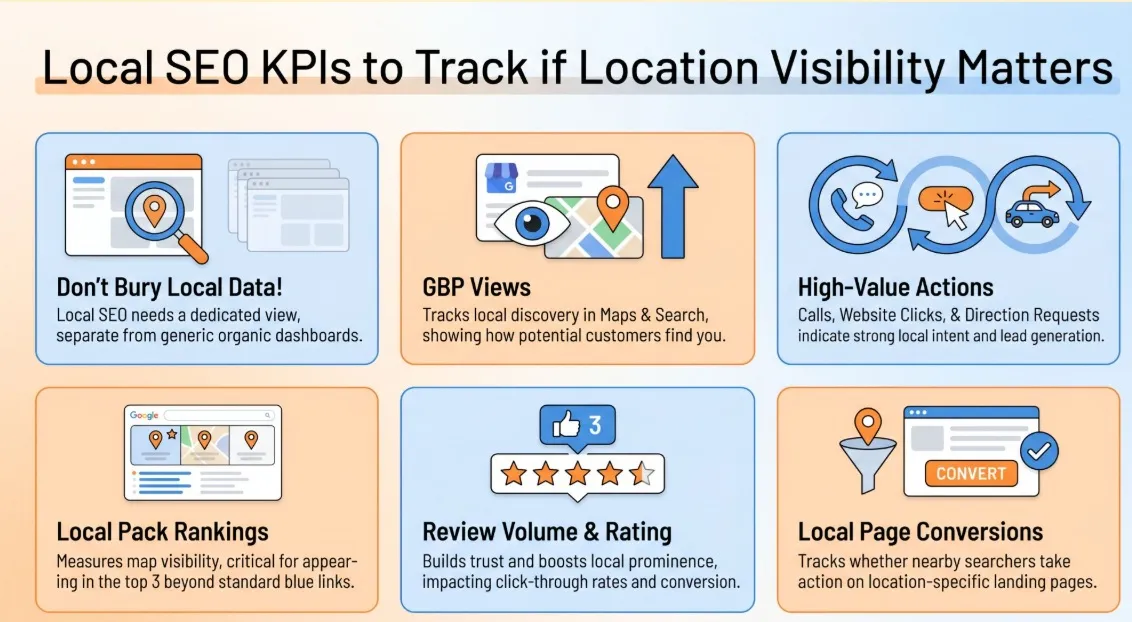
If local search directly drives enquiries or visits, local SEO should not be hidden within a generic organic dashboard.
The most useful local SEO KPIs include:
- Google Business Profile Views: A useful signal of local discovery.
- Calls, Website Clicks, and Direction Requests: These are often some of the clearest action KPIs in local search.
- Local Pack Rankings: Useful for measuring visibility beyond standard blue-link rankings.
- Review Volume and Average Rating: These support trust and local prominence over time.
- Local Landing Page Conversions: Critical if you rely on branch, city, or location pages.
For local businesses, organic SEO success is not just about website traffic. It is also about whether nearby searchers are taking action.
Technical SEO KPIs to Watch More Closely in 2026
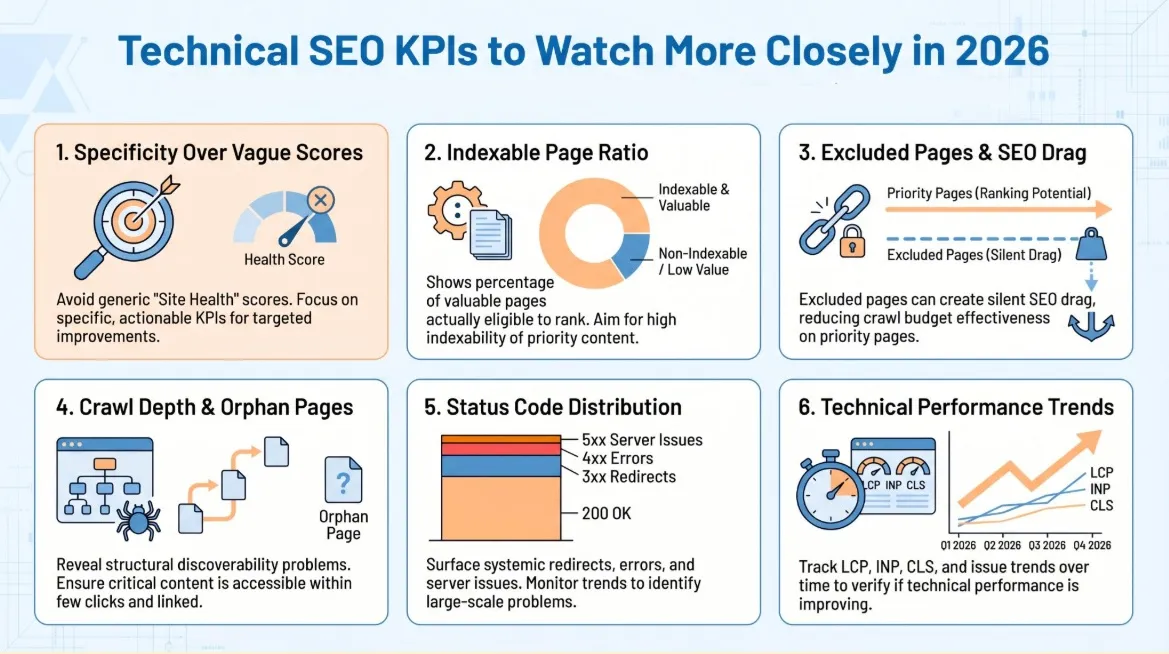
Technical SEO KPIs often get reduced to “site health,” which is too vague to be useful.
The technical KPI layer should include:
- Indexable Page Ratio: The percentage of valuable pages that are actually eligible to rank.
- Pages Excluded From Index: Important because excluded priority pages often create silent SEO drag.
- Crawl Depth: Useful for understanding whether important pages are buried too deeply in the architecture.
- Orphan Pages: Pages with no internal links are harder to discover and support less efficiently.
- Status Code Distribution: Useful for identifying systemic redirects, errors, or server issues.
- LCP, INP, and CLS: Still useful as technical quality indicators tied to usability and friction.
- Technical Issue Trend Over Time: What matters most is whether technical performance is improving, not just the current issue count.
AI and LLM-Influenced SEO KPIs to Watch
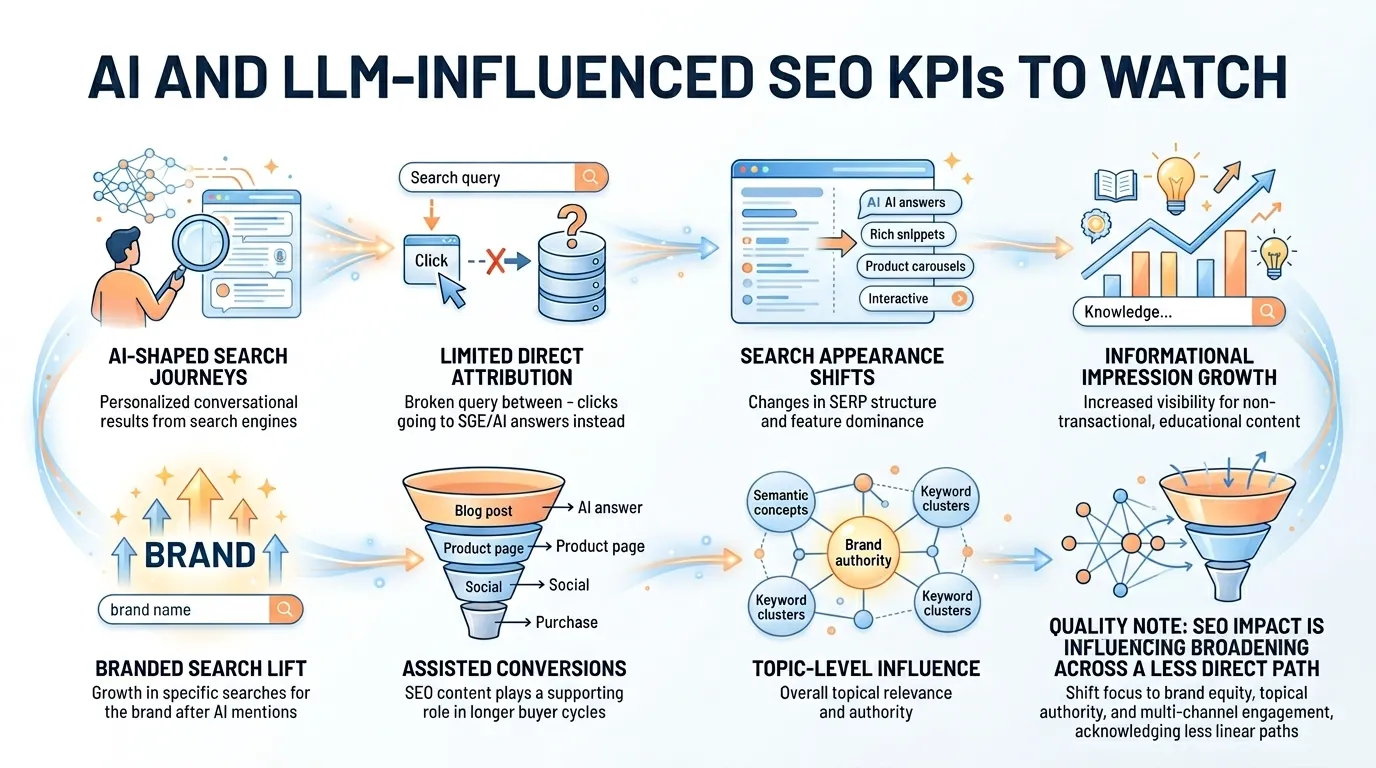
AI-shaped search poses a real measurement challenge because direct attribution remains limited.
What we can realistically measure today includes:
- search appearance changes in Search Console
- informational impression growth
- branded search lift after informational visibility growth
- assisted conversions from upper-funnel content
- topic-level influence, not just page-level clicks
The important point is not to overclaim direct AI attribution. It is to recognise that SEO influence is broadening, and that the KPI framework has to account for visibility and demand creation across a less direct search journey.
What Healthy SEO KPI Trends Look Like
Healthy SEO trends usually look more like steady directional improvement than sudden spikes.
Examples include:
- rising non-brand clicks over 3 to 6 months
- improving CTR on high-intent pages
- increasing percentage of pages earning meaningful impressions
- lower technical error counts over time
- stronger assisted conversion contribution from organic
- broader visibility across target topics or commercial page groups
The point is not to promise fixed benchmarks. Different industries, site ages, and competition levels behave differently. What matters more is whether the trend is moving in the right direction relative to the business model, historical baseline, and competitive context.
How to Build an SEO KPI Dashboard
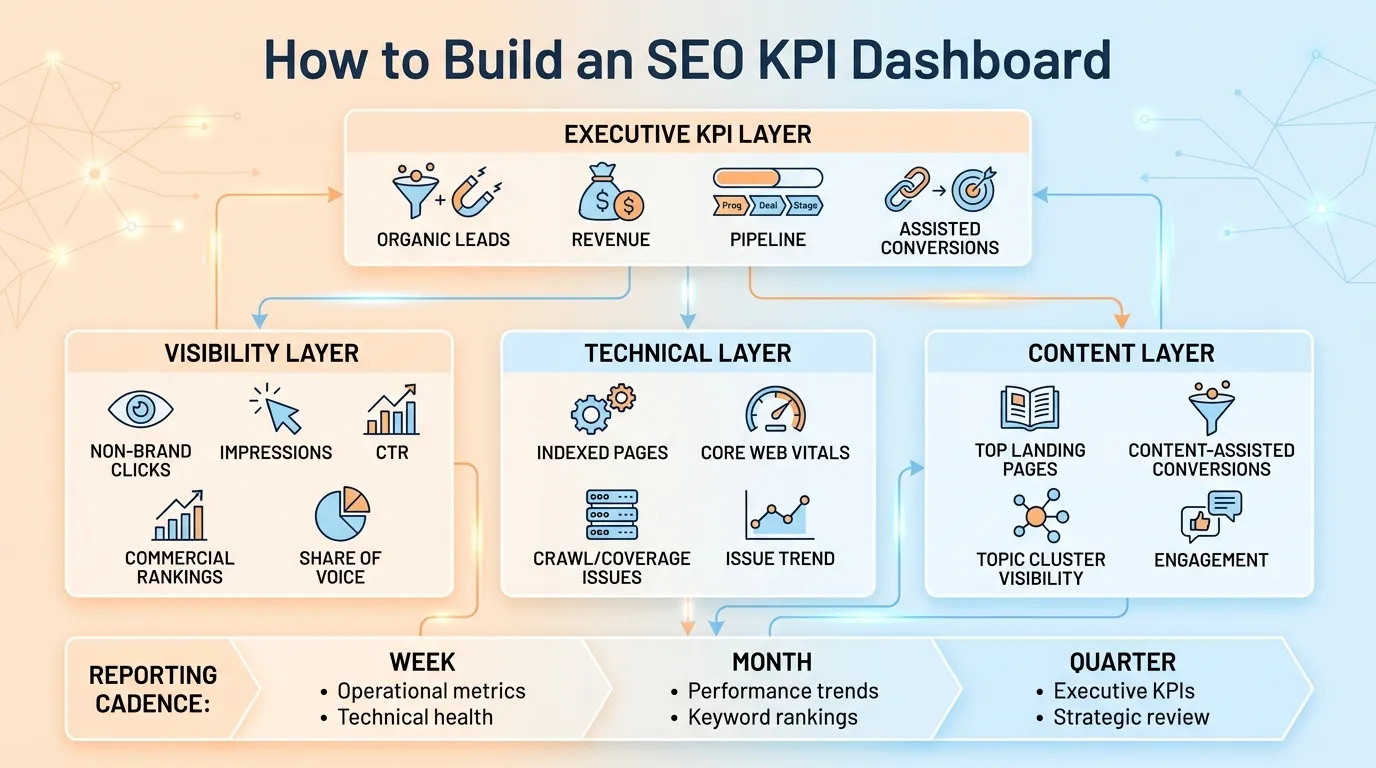
A useful SEO dashboard should not feel like a random export from five tools. It should tell a clear story.
A practical structure usually looks like this:
Executive KPI Layer
- Organic leads
- Organic revenue
- Pipeline contribution
- Assisted conversions
Visibility Layer
- Non-brand clicks
- Impressions
- CTR
- Rankings for commercial terms
- Search visibility or share of voice
Technical Layer
- Indexed pages
- Core Web Vitals
- Crawl or coverage issues
- Technical issue trend
Content Layer
- Top landing pages
- Assisted conversions from content
- Topic cluster visibility
- Engagement on priority content
Reporting Cadence
- Weekly technical and visibility checks
- Monthly KPI reporting
- Quarterly benchmark review and KPI reset if needed
This kind of structure keeps reporting focused on what decision-makers actually need to understand, rather than overwhelming them with raw exports.
SEO Metrics to Treat Carefully in 2026
Some SEO metrics still matter, but they should be used carefully.
The ones I would treat more cautiously include:
- total organic traffic without intent segmentation
- average ranking as a headline KPI
- impression growth without commercial context
- backlink count without relevance or quality context
- session growth without conversion or lead-quality framing
These are not useless metrics. They are just weak if used without context.
Common KPI Mistakes Businesses Make
The most common KPI mistakes I see are:
- treating metrics as KPIs
- reporting traffic without business outcomes
- relying too heavily on the average ranking
- ignoring assisted conversions
- failing to separate brand from non-brand performance
- setting unrealistic benchmarks
- measuring everything without prioritisation
The problem is not a lack of data. It is a weak interpretation.
Measuring SEO KPIs That Actually Matter
SEO success in 2026 is not about collecting more numbers. It is about choosing measurements that reflect how your business actually grows, then using them to make better decisions.
A useful SEO report should show more than whether traffic increased or rankings moved. It should make it clear whether SEO is improving visibility in the right places, attracting the right audience, and contributing to outcomes that matter to the business.
That is why the difference between SEO metrics and SEO KPIs matters so much. Metrics help explain movement, but KPIs help you judge whether SEO is working. When the reporting framework is built around the wrong numbers, it becomes easy to spend time analysing activity that looks positive on paper but does not move the business forward.
The strongest KPI framework is always the one that matches the business model, the type of search intent being targeted, and the role SEO plays in the wider customer journey.
If you want an SEO strategy built around the KPIs that actually matter, MediaOne can help you move beyond vanity metrics and focus on the numbers that drive growth.
From technical SEO and content strategy to reporting frameworks tied to leads, revenue, and commercial performance, we help businesses build SEO systems that are measurable, accountable, and built for long-term results.
If you want a clearer path to sustainable organic growth, get in touch with MediaOne.
Frequently Asked Questions
What are the most important SEO KPIs?
The most important SEO KPIs usually include organic conversions, organic revenue or pipeline value, non-brand clicks, organic CTR, search visibility, indexed pages, Core Web Vitals, and assisted conversions. The right mix depends on the business model.
What is the difference between SEO KPIs and SEO metrics?
SEO KPIs are the indicators used to judge success against business goals. SEO metrics are the supporting measurements that explain what is happening and why.
How do I measure SEO success?
Measure SEO success by tracking business-aligned KPIs first, then using supporting metrics to explain visibility, technical health, and conversion quality. The strongest reporting setups combine Search Console, GA4, technical tools, and one consolidated dashboard.
Which SEO KPIs matter most for lead generation?
Lead generation businesses should focus most on qualified organic leads, conversion rate from organic landing pages, assisted conversions, non-brand clicks to commercial pages, and pipeline value, where possible.
Which SEO KPIs matter most for e-commerce?
E-commerce brands should prioritise organic revenue, product or category page conversion rate, add-to-cart actions from organic sessions, non-brand category visibility, and revenue per organic session.
What tools should I use to track SEO KPIs?
Google Search Console is best for visibility and indexing; GA4 is best for conversions and behaviour; SEO platforms like Ahrefs or Semrush are useful for rankings and competitive context; and Looker Studio helps unify reporting.
How often should SEO KPIs be reviewed?
Weekly monitoring is best for technical health and visibility anomalies, monthly reporting for most KPI reviews, and quarterly reviews for benchmark resets and strategic planning.