Online reviews remain one of the most powerful signals for local businesses. They influence customer decisions, affect local search rankings and shape trust in your brand. If you want to get more Google reviews in 2026 without risking penalties or losing customer trust, this article gives a practical, legal and ethical roadmap. It includes up-to-date facts, actionable tactics and a couple of simple charts to illustrate why Google reviews matter.
Key Takeaways
- Genuine customer feedback strengthens your credibility and boosts local SEO performance.
- Google and the CCCS classify fake or incentivised reviews as deceptive marketing, which can lead to penalties or profile suspension.
- Regular, authentic reviews signal reliability to both Google and customers, improving visibility and conversions over time.
- Engaging with both positive and negative reviews shows accountability and can turn customer experiences into brand loyalty.
- Encourage reviews naturally throughout the customer journey to sustain growth and strengthen your local SEO foundation.
Why Google Reviews Matter More Than Ever

Image Credit: Ninjatables
Google is the default search destination for most people looking for local businesses. A large share of consumers use Google to check reviews before they decide where to buy or which service to choose. This makes Google reviews extremely important for visibility and reputation.
Beyond visibility, reviews are a factor in Google’s local ranking system. Local results rely on relevance, distance and popularity. Reviews feed the popularity signal and provide fresh, user-generated content that Google uses to understand a business’s credibility.
At the same time regulators and platforms are tightening rules against fake reviews. In the United States the FTC finalised a ban on the buying and selling of fake online reviews, with heavy penalties for organised trafficking of fraudulent reviews.
In the UK, Google has agreed to intensify efforts to detect and remove inauthentic reviews following competition authority scrutiny. These developments reinforce the need to grow reviews legitimately.
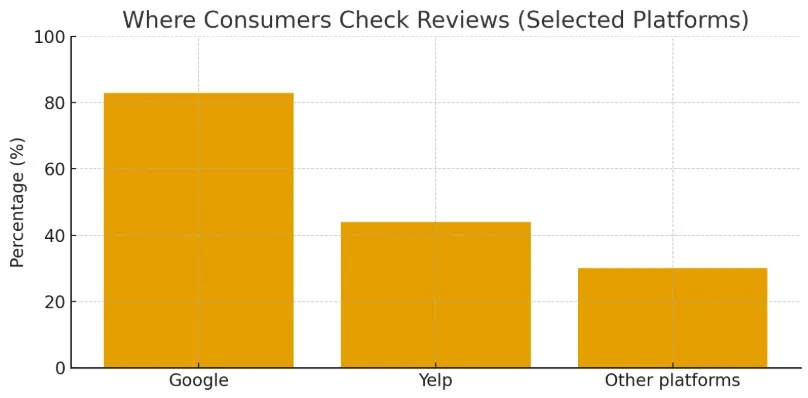
Image Credit: ChatGPT Generated


Note: Charts shown above illustrate where consumers check reviews and how willing people are to leave them when asked. They underline two simple truths: most shoppers check Google, and many will leave feedback if prompted.
Consumer Willingness to Write Reviews
Customers are far more open to leaving reviews than most businesses realise.
| Review Behaviour | Percentage of Consumers |
| Would leave a review if asked | 77% |
| Would consider writing one | 86% |
| Would not leave a review | 17% |
(Source: Fera.ai, 2025)
This means most customers are willing. They just need to be asked politely and shown how.
The Five rules you must follow before you start
Before you try to get more Google reviews, make sure your approach aligns with Google’s review policies and Singapore’s laws under the Competition and Consumer Commission (CCCS) and Personal Data Protection Act (PDPA). These rules promote fairness, accuracy, and transparency—and help you build genuine trust with customers.
Here are the five essentials to remember:
- Ask only real customers. Reviews must come from genuine buyers or clients. Fake or friend-written reviews mislead consumers and may breach CCCS guidelines.
- Never offer incentives. Avoid offering vouchers, discounts, or freebies for positive reviews. This violates both Google’s rules and Singapore’s fair trading principles.
- Stay away from fake or bulk reviews. Don’t buy reviews or use agencies that promise fast boosts. Google can detect manipulation, and getting caught can lead to suspension or delisting.
- Keep it optional and PDPA-compliant. Make review requests voluntary. If you follow up by email or SMS, ensure you have consent and include an easy opt-out option.
- Respond to every review. Acknowledge all feedback, positive or negative. Professional responses show accountability, improve credibility, and enhance your local search ranking.
Following these simple principles keeps your business compliant, authentic, and trusted both by Google and your customers.
Google-safe Ways to Get More Google Reviews
Once you understand the rules, it’s time to focus on ethical, effective ways to grow your reviews. In Singapore’s competitive local market, where customers often check Google before visiting a shop or booking a service, an authentic review strategy can give your business a clear edge.
Here are proven, Google-safe methods to earn more genuine feedback in 2026:
1. Ask at the Right Time
Timing is everything. The best moment to request a review is right after a positive interaction when the customer has just completed a purchase, received great service, or expressed satisfaction.
For example:
- A café can politely ask for a review right after a customer compliments their meal.
- A salon can include a review link in the thank-you message after an appointment.
When the experience is still fresh, customers are more likely to take a minute to share their thoughts.
2. Use Google’s Official Review Link
Google provides an official short link to your Google Business Profile. You can share this link in:
- WhatsApp or Telegram follow-up messages
- Email signatures and post-purchase emails
- Digital receipts or QR codes at your store counter
This makes the process seamless and prevents errors or fake review redirects. To find your link, log into your Google Business Profile dashboard and click “Ask for Reviews”. You’ll get a shareable URL you can copy and use safely.
3. Make It Part of Your Customer Journey
The most effective way to earn authentic feedback is to make it a seamless part of your customer experience from start to finish. Integrate review requests naturally into your business process.
For example:
- Retail shops: Place a small QR code at the counter or on packaging.
- Service providers: Include a review reminder in follow-up messages after the service.
- Clinics or wellness centres: Add a short line like “We’d love your feedback on Google” in post-visit texts.
The key is to make it effortless. When the review process is part of a positive experience, customers are more inclined to participate.
4. Train Your Team to Ask Politely
Your frontline staff often have the most influence on customer sentiment. A polite verbal request at the end of a service can make all the difference.
Here’s an example script: “Thank you for visiting us today! If you enjoyed our service, we’d really appreciate it if you could share your feedback on Google. It helps others discover us.”
When done sincerely and without pressure, these small interactions can double your review volume over time.
5. Leverage Follow-up Emails and SMS (PDPA-Compliant)
Follow-up messages are one of the most effective review drivers, but they must comply with Singapore’s Personal Data Protection Act (PDPA). Always ensure customers have opted in to receive communications.
A good follow-up message might look like this: “Thank you for your visit! We hope you enjoyed your experience with us. If you have a moment, we’d appreciate your feedback on Google. Here’s our link: [Your short link].”
Simple, personal, and non-intrusive messages often yield the best results.
6. Use Signage and In-store Prompts
For brick-and-mortar businesses, a simple visual cue can encourage customers to leave a review right after their visit. Visual reminders work well for brick-and-mortar businesses. Display small, tasteful signs that read: “Loved your experience? Tell us on Google!”
Include a QR code leading directly to your review page. It’s subtle but effective, especially in cafés, clinics, salons, or retail outlets where customers have a short waiting time.
7. Automate Review Requests with CRM or POS Systems
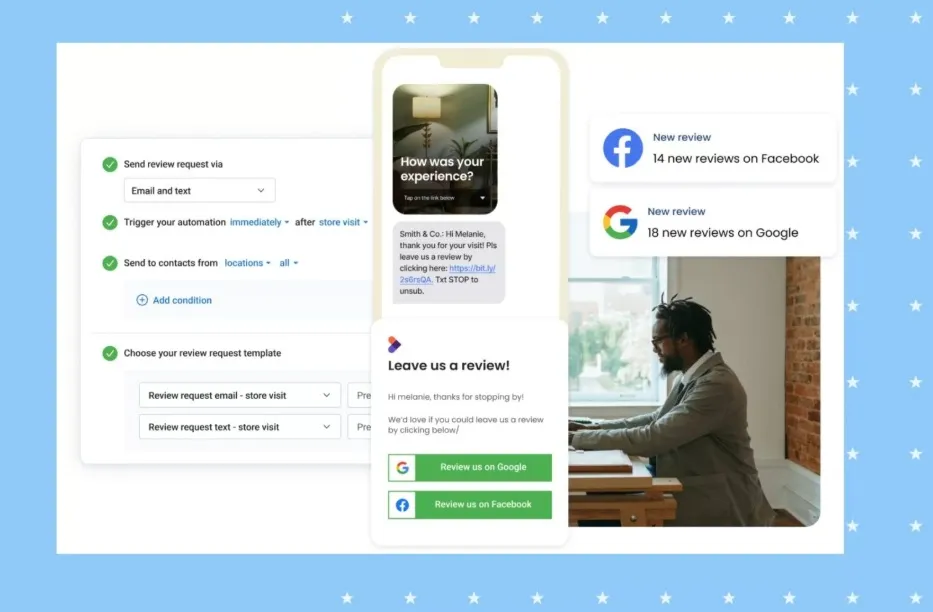
Image Credit: Birdeye
For growing businesses, automation can save time. Many customer relationship management (CRM) tools and point-of-sale (POS) systems now allow automatic review requests after a completed transaction.
Tools such as HubSpot, Zoho CRM, or Shopify’s email apps can be set up to send review invitations automatically—but remember to personalise messages and ensure they follow Google’s policies.
8. Showcase Your Reviews to Build Momentum
Highlighting existing positive reviews on your website, social media, or printed materials can motivate other customers to contribute.
Example: Add a carousel of 5-star Google reviews on your homepage with the title “What Our Customers Say on Google”.
When people see others sharing their experiences, they’re more likely to do the same. It is a form of social proof that encourages participation.
9. Respond Quickly and Professionally
Replying to reviews, especially negative ones, demonstrates integrity. A respectful, empathetic response can turn criticism into an opportunity.
For example: “We’re sorry to hear about your experience. Thank you for your feedback—it helps us improve. Please reach out to us directly so we can make this right.”
Publicly acknowledging mistakes shows transparency and strengthens your brand’s image.
10. Track and Analyse Your Review Performance
Gathering Google reviews is only half the job. To truly benefit, you need to understand what customers are saying and how their feedback impacts your visibility and reputation. Don’t just collect reviews. Use them strategically. Monitor key trends such as:
- Review frequency (how often new reviews are coming in)
- Average star rating over time
Most-mentioned positive and negative keywords
You can use free tools like Google Business Profile Insights or AI-based sentiment analysis tools to understand what customers love (and what needs improvement).
Quick Chart: Why Consistent Reviews Matter in Singapore
Regular reviews signal to Google that your business is active and trusted, which can boost your local rankings and attract more walk-in customers. The chart below highlights how maintaining a steady flow of recent, authentic reviews can directly influence both your local visibility and customer engagement in Singapore.
| Metric | Statistic | Source |
| Singapore consumers who read Google reviews before visiting a business | 93% | BrightLocal, 2025 |
| Consumers who trust online reviews as much as personal recommendations | 84% | Statista, 2024 |
| Consumers who are more likely to visit a business with recent reviews (within 3 months) | 73% | Local Consumer Review Survey, 2025 |
Consistent, authentic reviews send a powerful signal to Google that your business is active and trustworthy, which can improve your local ranking and click-through rates in Maps and Search.
What Not to Do When Collecting Google Reviews
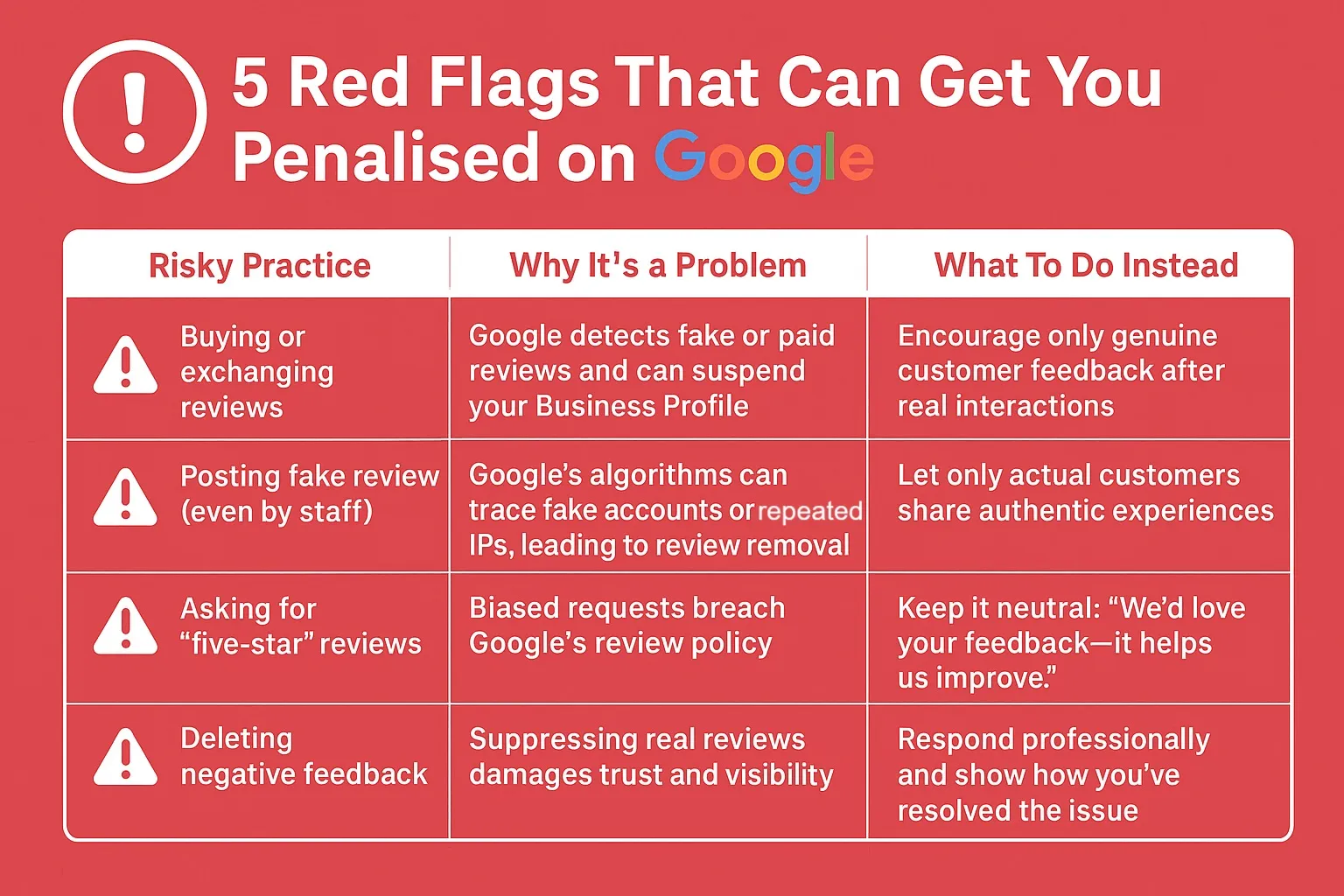
When trying to get more Google reviews, it’s just as important to know what not to do. Shortcuts might promise quick wins, but they can damage your credibility, breach Google’s rules, and attract scrutiny from Singapore regulators.
Here’s what every local business should avoid:
- Buying or Exchanging Reviews: Never pay for reviews or join “review swap” schemes. Google flags fake activity and can suspend your Business Profile or remove your listing entirely. The Competition and Consumer Commission of Singapore (CCCS) also considers this deceptive marketing. In 2025, Google removed over 170 million fake reviews globally, showing how closely the platform monitors authenticity.
- Posting or Encouraging Fake Reviews: Don’t write fake reviews for your own business or ask employees to do so. Google detects manipulation through account and IP tracking, and penalties can include review removal or ranking drops. Once customers lose trust, recovery is difficult.
- Asking for Star Ratings: Avoid phrases like “Leave us a five-star review.” Google prohibits biased requests. Instead, use neutral wording such as: “We’d love your feedback on Google—it helps us improve.” Authentic, unprompted feedback builds stronger loyalty.
- Deleting Negative Reviews: Never try to remove or hide legitimate criticism. Responding professionally shows integrity and may even turn unhappy customers into advocates. In Singapore, transparency often earns respect.
- Misusing Customer Data: When requesting reviews via email or SMS, comply with the Personal Data Protection Act (PDPA). Obtain consent, explain how you’ll use their contact details, and offer a clear opt-out option. Privacy lapses can trigger complaints or penalties from the PDPC.
Avoiding these pitfalls keeps your reputation authentic and your business compliant. In 2026, transparency isn’t just ethical, it’s a competitive advantage.
Building Trust Through Authentic Reviews
For Singapore’s local businesses, genuine customer feedback remains one of the most powerful growth tools. A steady stream of authentic reviews not only improves visibility on Google but also helps potential customers feel confident about choosing your business over competitors.
The key takeaway is simple: earn reviews, don’t manipulate them. Ask only genuine customers, follow PDPA rules when communicating, and keep your requests polite and voluntary. Use your Google Business Profile effectively, respond thoughtfully to every review, and analyse feedback to improve your service.
If you’re ready to take your local marketing strategy to the next level, explore how MediaOne can help you attract authentic reviews, optimise your local search presence, and stay fully compliant with Google’s latest guidelines. Contact us today!
Frequently Asked Questions
How often should I ask customers for Google reviews?
It’s best to request reviews consistently but moderately. For instance, after every few successful transactions or positive customer interactions. A steady flow of new reviews signals to Google that your business is active and reliable. However, avoid sending mass requests in a short period, as sudden spikes may appear suspicious.
Can negative Google reviews be removed?
You can only request removal if a review violates Google’s content policies. For example, if it contains hate speech, spam, or false information unrelated to your business. Legitimate negative feedback cannot be deleted, but you can respond professionally to show accountability and attempt to resolve the issue offline.
Do Google reviews really affect local SEO rankings in Singapore?
Yes. Google reviews play a key role in local search rankings. The number of reviews, star rating, and how recently reviews were posted all influence your visibility in Google Maps and Search results. Businesses with regular, authentic reviews typically enjoy higher trust signals and better click-through rates.
Should I use review management software to help get more Google reviews?
Yes, as long as it’s Google-compliant and transparent. Review management tools can automate review requests, reminders, and response tracking. Avoid any software that filters or hides negative reviews, as this breaches Google’s terms. Always review messages before sending to ensure they align with PDPA requirements in Singapore.
What’s the best way to handle fake or misleading reviews from competitors?
If you believe a review is fake or malicious, flag it directly in your Google Business Profile and provide supporting evidence (such as transaction records or communication logs). Google’s moderation team will investigate and remove it if it breaches review policies. You can also post a calm public response clarifying the facts while maintaining professionalism.