Over 70% of businesses in Singapore have adopted AI in 2025, according to the Singapore Economic Development Board (EDB). The message is clear — artificial intelligence is no longer a futuristic concept. It’s here, and it’s rewriting how small and medium enterprises (SMEs) compete, communicate, and convert.
But among the many branches of AI, generative AI marketing has emerged as the most disruptive. Unlike traditional AI that analyses or predicts, generative AI creates — text, images, videos, even campaign ideas. It’s not about automating the mundane. It’s about scaling creativity itself.
For SMEs in Singapore, where manpower is tight and competition fierce, this levels the playing field. Generative AI allows lean teams to produce content, design visuals, and personalise customer experiences at a fraction of the time and cost. It gives you the creative output of a full marketing department — without the overheads.
In this guide, you’ll learn:
- Real-world use cases showing how SMEs are already winning with AI
- The pitfalls to avoid when deploying it
- And the best practices to make AI work for your brand, not against it
Because while the tools are powerful, success depends on how strategically you wield them — often with expert help from a GEO agency that’s been guiding Singapore businesses through digital transformation long before AI became the buzzword it is today.
Key Takeaways
- Generative AI enables Singapore SMEs to streamline marketing workflows, create high-quality content at scale, and deliver more personalised customer experiences that boost engagement and conversions.
- While the technology offers immense potential, businesses must stay alert to pitfalls such as over-reliance on automation, data privacy risks, and the need for human oversight to maintain brand authenticity.
- The most successful AI-driven marketing strategies combine the efficiency of automation with strategic human guidance, supported by trusted GEO agency partners that can help SMEs integrate generative AI responsibly and effectively.
What Does Generative AI Mean for Marketing Teams?

Image Credit: Gartner
For years, SMEs have leaned on marketing automation to handle repetitive tasks — scheduling posts, sending email marketing campaigns, tracking analytics. But generative AI takes this further. It’s not just executing your ideas. It’s creating them.
Imagine having a digital assistant that drafts your campaign slogan, writes your next blog, designs a Facebook ad, and analyses performance — all before lunch. That’s the reality of tools like ChatGPT, Midjourney, and Adobe Firefly.
You can leverage generative AI tools to boost, say, your coffee shop operations by analysing customer data and generating personalised marketing content, resulting in faster customer engagement and more targeted campaigns for your brand. This kind of agility was once reserved for multinational brands.

Generative AI is democratising creativity — enabling you to do more with less. Whether you’re a three-person marketing team or a one-man founder juggling sales and social media, AI gives you enterprise-grade capability without enterprise-level costs.
Key Use Cases of Generative AI in Marketing

Generative AI’s greatest strength is its versatility. From content ideation to predictive planning, it plugs into almost every stage of the marketing funnel. Below are the most impactful applications for Singapore SMEs right now.
Content Creation and Copywriting
Tools like ChatGPT, Jasper, and Writesonic can generate blog drafts, ad copy, and newsletters in minutes. This means more time for strategy and less on writing from scratch.
- Benefit: A 34% boost on content creation productivity, based on recent research data.
- Example: Travel brand Klook uses AI-powered content generation to personalise itineraries and destination content, helping to increase customer engagement and conversion.
Pro tip: Always review any AI-generated copywriting output to ensure local context — Singaporeans respond differently to “value-for-money” than “cheap”. Tone matters.
Social Media Campaign Ideation and Design
With Canva Magic Studio and Midjourney, you can instantly generate creative concepts or product visuals without hiring a designer.
- Example: Agoda Singapore has used generative AI tech for its Instagram posts.
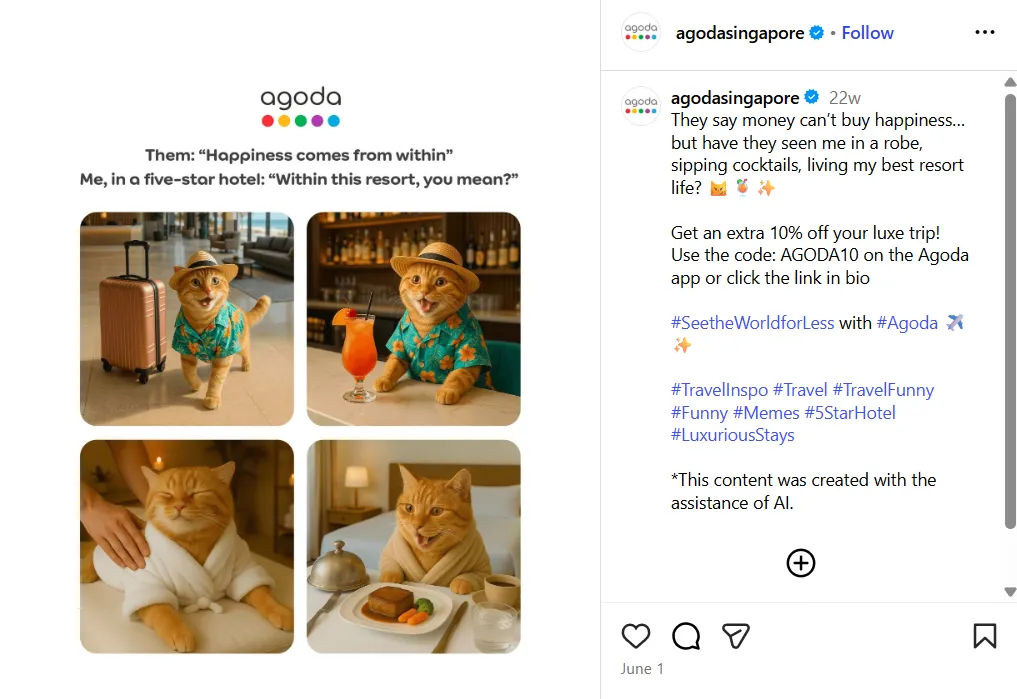

Image Credit: Agoda Singapore
- Advantage: Speed and visual diversity. Instead of one or two mock-ups, you can produce 20 unique visuals to A/B test.
Pro tip: Pair AI visuals with human emotional insight — data may tell you what to post, but humans know why it resonates.
SEO and Content Optimisation
Tools such as Surfer SEO and MarketMuse use AI to identify keyword gaps, competitor structures, and on-page opportunities.
- Benefit: Generate data-backed outlines that increase ranking odds.
- Example: A Singapore-based interior design firm used Surfer SEO to identify under-served search terms like “HDB kitchen renovation ideas”, leading to a 25% boost in organic leads within three months.
Key learning: Generative AI doesn’t replace your search engine optimisation (SEO) strategy — it amplifies it when aligned with strong keyword research and localisation.
Customer Engagement and Chatbots
Generative AI chatbots powered by ChatGPT API or Intercom Fin can handle enquiries 24/7 with natural, context-aware responses — making them powerful tools for improving customer engagement and lead generation.
- Example: Singapore schools like NTU and NUS are using AI assistants that answer course queries, improving lead response time significantly, per The Straits Times.
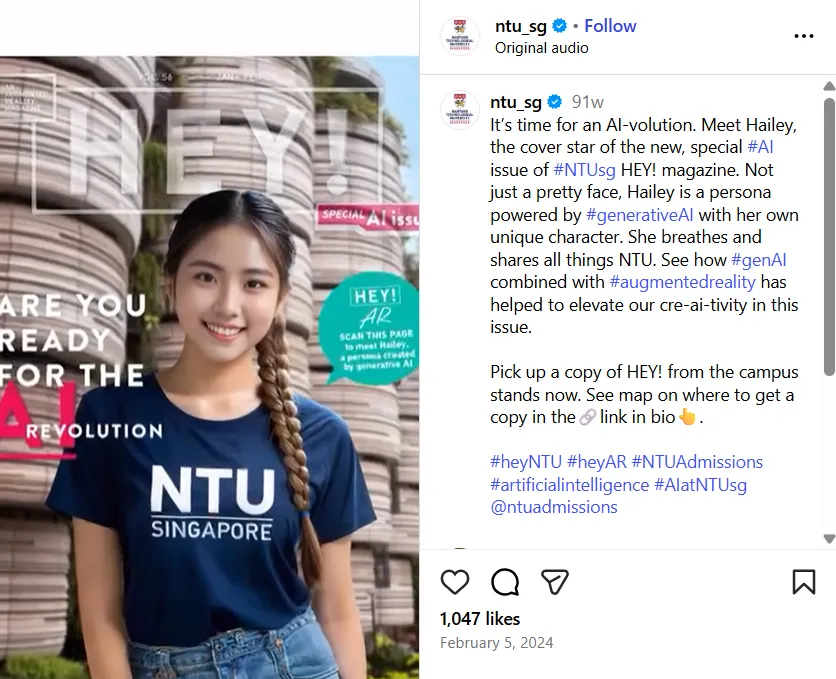
Image Credit: NTU
- Advantage: Immediate engagement and consistent service quality.
- Caution: Human supervision remains crucial for complex or sensitive conversations — empathy still outperforms automation.
Email Personalisation and A/B Testing
AI platforms like HubSpot AI and Copy.ai can generate multiple email versions, automatically test them, and optimise based on open rates.
- Example: Zalora leverages AI to deliver hyper-personalised product recommendations, boosting click-through rates and conversions across Southeast Asia.
- Benefit: Personalisation at scale — from subject line testing to custom content blocks.

Predictive Campaign Planning
Combining generative AI with predictive analytics helps you forecast campaign performance before spending a cent.
- Example: Unilever’s ice cream production uses AI models to predict demand in key markets, improving cost efficiencies and reducing waste in their factories.

Image Credit: Unilever
- Why It Matters: SMEs can now simulate campaign scenarios — testing creative, copy, and timing — before launching. It’s like running multiple campaigns in a parallel universe, then betting only on the winner.
Common Pitfalls and Challenges When Using Generative AI for Marketing

Generative AI can be a growth multiplier — but without the right checks, it can also become a liability. Here are the biggest mistakes to avoid when integrating it into your marketing stack.
Over-Reliance on AI Content
AI-generated text can feel robotic or off-brand if used without editing.
- Risk: Diminished authenticity and audience trust.
- Fix: Use AI as a first draft tool, not your final voice. Always run a human review for nuance, emotion, and brand consistency.
Data Privacy and Regulatory Risks
Singapore’s Personal Data Protection Act (PDPA) governs how customer data is used. Feeding personally identifiable data into public AI systems may breach compliance.
- Solution: Choose enterprise-grade AI tools offering data isolation or private cloud models.
- Tip: Avoid inputting any customer or financial information into public chatbots.
Accuracy and Hallucinations
AI models can sometimes “hallucinate” — making confident but incorrect claims.
- Example: CNET’s 2023 incident where AI-written articles contained factual errors, per The Verge.
- Fix: Implement a mandatory fact-checking workflow. Always cross-verify claims with credible sources such as Gov.sg, Infocomm Media Development Authority (IMDA), or Statista.
Copyright and Intellectual Property Issues
Generative AI can inadvertently recreate copyrighted material.
- Example: Getty Images filed a lawsuit against Stability AI for training on protected visuals, as reported by Tech In Asia.
- Recommendation: Use AI tools with commercial indemnity, such as Adobe Firefly, which guarantees content is safe for business use.
Lack of Localisation
AI models trained on global data often fail to reflect Singapore’s cultural nuances.
- Example: A chatbot using Western idioms might confuse local audiences.
- Fix: Fine-tune AI prompts with Singapore context. Include local slang, examples, and holidays like Hari Raya or Chinese New Year for cultural relevance.
Best Practices for Implementing Generative AI in Marketing

Here’s how you can deploy generative AI effectively — balancing automation with authenticity.
Start Small and Scale Gradually
Begin with low-risk areas such as social media marketing posts or internal content drafts.
- Measure time saved, engagement improvements, and content performance.
- Once confident, scale to customer-facing campaigns.
Maintain a Human-AI Collaboration Model
Think of AI as an assistant that accelerates — not replaces — creativity.
- Example: Use ChatGPT to outline your content calendar, but let your marketing team refine tone and emotion.
- This blend ensures productivity without losing your unique voice.
Invest in Prompt Engineering Skills
The quality of your output depends on the quality of your input.
- Tip: Train your team in prompt engineering — knowing how to ask AI the right questions is a competitive advantage.
- Instead of “Write a caption”, try “Write a witty Instagram caption for a Singapore café promoting matcha lattes to Gen Z audiences.”
Set Clear Governance and Ethical Policies
Create internal guidelines that define acceptable AI use.
- Outline when AI is allowed, what data can be used, and who must review outputs.
- Transparency builds trust — both internally and with customers.
Prioritise Local Context and Cultural Sensitivity
Singapore’s audience is diverse and discerning.
- Ensure your AI-generated campaigns consider cultural context.
- Example: Use local humour or references that resonate authentically — from Kopitiam culture to heartland living.
Continuously Measure ROI and Performance
Track KPIs such as:
- Time saved per content piece
- Engagement uplift from AI-generated creatives
- Lead conversions from personalised campaigns
Example: A local digital agency measured a 35% faster turnaround and 20% increase in engagement after integrating AI-assisted content planning. The result? More output, higher ROI, and better use of human talent.
Real-World Examples: Generative AI Marketing Success Stories
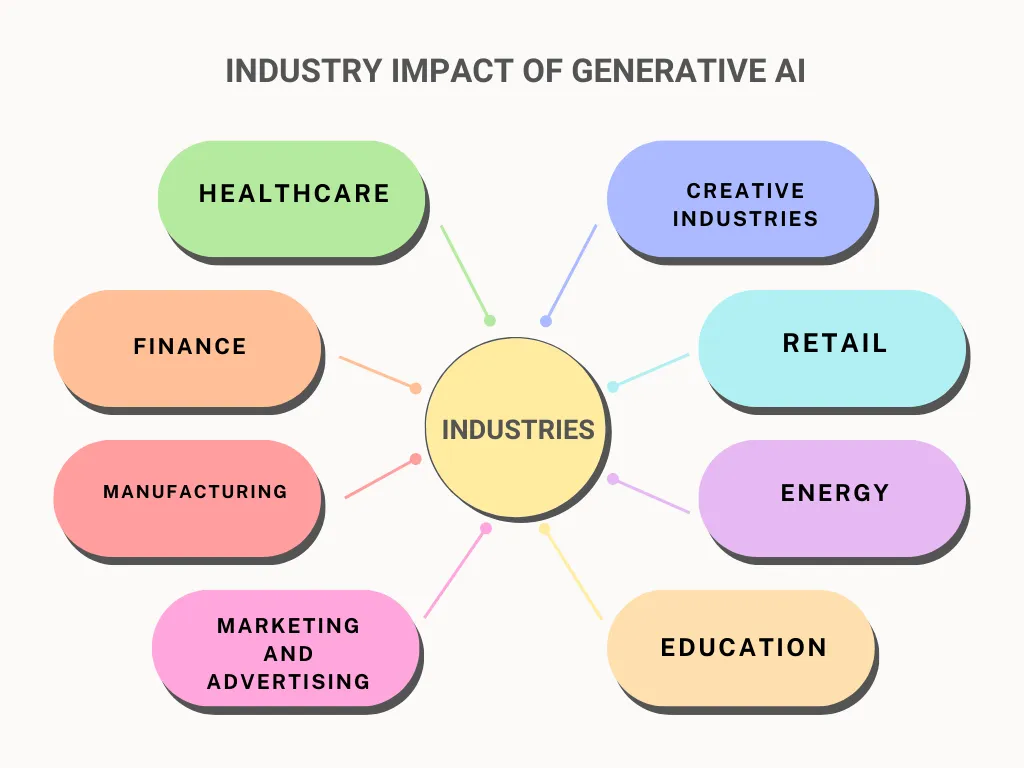
Image Credit: Medium
Generative AI isn’t theoretical — it’s already being applied by forward-thinking Singapore SMEs to streamline operations, enhance creativity, and scale their marketing efforts. These aren’t “big tech only” solutions.
When used strategically, AI tools can fit seamlessly into everyday business workflows, producing measurable improvements in productivity, engagement, and revenue. Below are real examples of how small and medium businesses in Singapore are leveraging generative AI to gain a competitive edge.
Retail: Faster Creative Production and Higher Sales
A local fashion brand that previously struggled with the time and cost of seasonal campaign production began using generative AI tools to create lookbook concepts, product styling layouts, and promotional visuals.
What once took weeks of brainstorming and back-and-forth with designers now takes a fraction of the time. The team reported a 60% reduction in design preparation time, which allowed them to launch collections faster and with greater frequency.
More importantly, the enhanced consistency and visual appeal contributed to a 15% increase in seasonal sales, demonstrating how AI can directly support revenue velocity in retail.
F&B: Higher Engagement Through Visual Storytelling
A Singapore café chain used Midjourney to generate high-quality campaign visuals and ChatGPT to craft menu descriptions, festive promotions, and social media captions. Instead of outsourcing to agencies for every campaign, the marketing team now ideates and prototypes in-house at speed.
This approach led to a 40% increase in social media engagement during festive promotional periods. Customers responded well to the brand’s stronger visual identity and more frequent content updates — showing how AI can boost brand recall in highly competitive F&B environments.
Education: Personalisation at Scale
A tuition centre integrated AI-powered messaging to send personalised study reminders, motivational notes, and lesson follow-ups. By tailoring messages to each student’s behaviour and progress, the centre saw a 25% improvement in student retention — a critical metric for tuition businesses.
This demonstrates AI’s ability to support meaningful relationship-building, not just marketing automation.
Bottom line: These examples show that when combined with clear strategy and human oversight, generative AI becomes a powerful growth catalyst for SMEs in Singapore.
The Next Phase of Generate AI Marketing

The next evolution of AI marketing isn’t just about generating copy or automating tasks — it’s about multimodal AI, where tools can understand and produce text, visuals, audio, and even video at the same time. For Singapore SMEs, this shift will fundamentally change how content is planned, produced, and delivered to customers.
What Multimodal AI Means for Marketing
Multimodal AI allows a single platform to produce an entire marketing asset suite:
- A video script based on your brand voice
- The narration voiceover that matches your tone
- The video storyboard and visual mockups
- Accompanying captions for social media platforms, email copy, and landing page content
This means SMEs will soon be able to conceptualise and produce full campaigns in hours instead of weeks. Marketers can move from execution to strategy and differentiation, focusing more on positioning, audience understanding, and message clarity.
This doesn’t replace creativity — it amplifies it. The SMEs that thrive will be those that use AI to enhance their brand’s uniqueness, not copy the crowd.
Government Support Will Influence the Pace of Adoption
Singapore continues to play a leading role in shaping responsible AI adoption. Initiatives like AI Verify help businesses test the transparency and reliability of AI outputs, ensuring trust and accountability. Meanwhile, programmes under SMEs Go Digital and various Enterprise Singapore grants help reduce the financial burden of adopting new tools.
These frameworks matter because they give SMEs a clear pathway to experiment without excessive risk. You’re not expected to become an AI expert overnight — the support systems exist to guide businesses step by step.
Expect More Regulation — and More Opportunity
As AI becomes more integrated into marketing and customer experience, regulations around privacy, data use, and content authenticity will tighten. But let me be clear: This is not a barrier — it’s a competitive filter. Businesses that adopt AI ethically and transparently will gain consumer trust faster, especially in Singapore’s reputation-conscious market.
The Advantage Belongs to the Fast Learners
The winners won’t simply be the biggest companies — they’ll be the SMEs that test early, learn quickly, and refine continuously. Partnering with experts who understand both marketing strategy and machine learning can accelerate this journey. The next phase of generative AI marketing is here — and SMEs who embrace it thoughtfully will lead the future.
Use Generative AI Marketing As A Strategic Edge

Image Credit: Criya
Here’s the truth — generative AI marketing isn’t a shortcut. It’s a strategic edge. The businesses that combine AI’s efficiency with human insight will dominate Singapore’s digital space in the next five years. Start small. Experiment safely. Build your team’s AI literacy. But most importantly, don’t do it alone. Partner with experts who understand how to turn AI potential into ROI.
At MediaOne, we’ve helped hundreds of SMEs streamline content, boost conversions, and stay ahead of algorithm shifts.
We are an innovative digital marketing agency that integrates generative AI tools with proven SEO, PPC, and content marketing strategies — giving you results that are fast, ethical, and future-ready. Contact us today — because the sooner you learn to collaborate with AI, the faster your business can scale smarter.
Frequently Asked Questions
How is generative AI different from traditional marketing automation?
Generative AI goes beyond rule-based automation by using machine learning models to create new, original content such as ad copy, visuals, or emails. Unlike traditional automation, which follows predefined workflows, generative AI can understand context and adapt outputs dynamically based on audience behaviour and data insights.
Can generative AI help with SEO and content marketing?
Yes, generative AI can assist with keyword research, content briefs, and optimised drafts tailored for search intent. When combined with human editing and SEO strategy, it helps marketers produce relevant, high-ranking content faster without sacrificing quality or originality.
What are some common ethical concerns with generative AI in marketing?
Key ethical issues include data privacy, intellectual property rights, and the risk of producing misleading or biased content. Marketers must ensure transparency, accuracy, and accountability when using AI-generated materials to maintain trust and compliance.
How can SMEs measure ROI from generative AI marketing tools?
ROI can be assessed by tracking key performance metrics such as content production efficiency, campaign engagement rates, conversion uplift, and cost savings. SMEs should compare results before and after AI integration to quantify both tangible and strategic gains.
What skills do marketers need to use generative AI effectively?
Marketers should develop data literacy, prompt engineering, and critical evaluation skills to guide and refine AI outputs. Understanding how to balance automation with human creativity ensures that AI tools enhance, rather than replace, strategic marketing judgment.